Problems
Filters
14 problems found
1997 Paper 2 Q1
Find the sum of those numbers between 1000 and 6000 every one of whose digits is one of the numbers \(0,\,2,\,5\) or \(7\), giving your answer as a product of primes.
Solution: The first digit is \(2\) or \(5\), all the other digits can be any value from \(0,2,5,7\). Therefore we have \begin{align*} S &= 2000 \cdot 4^3+5000 \cdot 4^3 + (200+500+700) \cdot 2 \cdot 4^2 + (20+50+70) \cdot 2 \cdot 4^2 + (2+5+7) \cdot 2 \cdot 4^2 \\ &= 7 \cdot 4^3 \cdot 2^3 \cdot 5^3 + 14 \cdot 2 \cdot 4^2 \cdot 111 \\ &= 2^{9} \cdot5^3 \cdot 7 + 2^{6} \cdot 3 \cdot 7 \cdot 37 \\ &= 2^6 \cdot 7 \cdot (1000+111) \\ &= 2^6 \cdot 7 \cdot 11 \cdot 101 \end{align*} Alternatively, consider adding the first and last terms, and second and second and last terms, etc we obtain \(7777\). There are \(2 \cdot 4^3\) terms so \(7777 \cdot 4^3 = 2^6 \cdot 7 \cdot 11 \cdot 101\)
1997 Paper 2 Q2
Suppose that $$3=\frac{2}{ x_1}=x_1+\frac{2}{ x_2} =x_2+\frac{2}{ x_3}=x_3+\frac{2}{ x_4}=\cdots.$$ Guess an expression, in terms of \(n\), for \(x_n\). Then, by induction or otherwise, prove the correctness of your guess.
Solution: \begin{align*} x_1 &= \frac{2}{3} \\ x_n &= \frac{2}{3-x_{n-1}} \\ x_2 &= \frac{2}{3 - \frac23} \\ &= \frac{6}7 \\ x_3 &= \frac{2}{3-\frac67} \\ &= \frac{14}{15} \\ x_4 &= \frac{2}{3 - \frac{14}{15}} \\ &= \frac{30}{31} \end{align*} Guess: \(x_n = \frac{2^{n+1}-2}{2^{n+1}-1}\). Proof: (By induction) (Base case): We have checked several initial cases. (Inductive step): Suppose our formula is true for \(n = k\), then consider: \begin{align*} x_{k+1} &= \frac{2}{3 - x_{k}} \\ &= \frac{2}{3 - \frac{2^{k+1}-2}{2^{k+1}-1}}\tag{assumption} \\ &= \frac{2\cdot(2^{k+1}-1)}{3 \cdot(2^{k+1}-1) - (2^{k+1}-2) } \\ &= \frac{2^{k+2}-2}{2\cdot 2^{k+1} - 3 + 2 } \\ &= \frac{2^{k+2}-2}{ 2^{k+2} - 1 } \\ \end{align*} Therefore, if our formula is true for \(n = k\) it is true for \(n = k+1\). Therefore by the principle of mathematical induction it is true for \(n \geq 1, n \in \mathbb{Z}\)
1997 Paper 2 Q3
Find constants \(a,\,b,\,c\) and \(d\) such that $$\frac{ax+b}{ x^2+2x+2}+\frac{cx+d}{ x^2-2x+2}= \frac{1}{ x^4+4}.$$ Show that $$\int_0^1\frac {\d x}{ x^4+4}\;= \frac{1}{16} \ln 5 +\frac{1}{8} \tan^{-1}2 .$$
Solution: First notice that \((x^2+2+2x)(x^2+2-2x) = (x^2+2)^2-4x^2 = x^2+4\) and so \begin{align*} && \frac{1}{x^4+4} &= \frac{ax+b}{ x^2+2x+2}+\frac{cx+d}{ x^2-2x+2} \\ \Rightarrow && 1 &= (ax+b)(x^2-2x+2) + (cx+d)(x^2+2x+2) \\ &&&= (a+c)x^3+(b-2a+d+2c)x^2+(2a-2b+2c+2d)x+2b+2d \\ \Rightarrow && 0 &= a+c \\ && 2a &= b+d+2c \\ && b &= a+c+d \\ && \frac12 &= b+d \\ \Rightarrow && c &= -a \\ && 2a &= \frac12+2(-a) \\ \Rightarrow && a &= \frac18, c = -\frac18 \\ && b &= d \\ \Rightarrow && b &= \frac14, d = \frac14 \end{align*} Therefore \begin{align*} \int_0^1\frac {\d x}{ x^4+4} &= \int_0^1 \frac18\left ( \frac{x+2}{x^2+2x+2} -\frac{x-2}{x^2-2x+2}\right) \d x \\ &= \frac1{16}\int_0^1 \left ( \frac{2x+2+2}{x^2+2x+2} -\frac{2x-2-2}{x^2-2x+2}\right) \d x \\ &= \frac1{16} \left [ \ln(x^2+2x+2) -\ln(x^2-2x+2)\right]_0^1 + \frac1{16} \int_0^1 \left ( \frac{2}{(x+1)^2+1} + \frac{2}{(x-1)^2+1} \right) \d x \\ &= \frac1{16} \left (\ln 5 - \ln 1 -(\ln 2-\ln 2) \right) + \frac18 \left [ \tan^{-1} (x+1)+\tan^{-1}(x-1) \right]_0^1 \\ &= \frac1{16} \ln 5 + \frac18 \left (\tan^{-1} 2+\tan^{-1} 0 - \tan^{-1}1-\tan^{-1} (-1) \right) \\ &= \frac1{16} \ln 5+ \frac18 \tan^{-1} 2 \end{align*}
1997 Paper 2 Q4
Show that, when the polynomial \({\rm p} (x)\) is divided by \((x-a)\), where \(a\) is a real number, the remainder is \({\rm p}(a)\).
- When the polynomial \({\rm p}(x)\) is divided by \(x-1,\,x-2,\,x-3\) the remainders are 3,1,5 respectively. Given that $${\rm p}(x)=(x-1)(x-2)(x-3){\rm q}(x)+{\rm r} (x),$$ where \({\rm q}(x)\) and \({\rm r}(x)\) are polynomials with \({\rm r}(x)\) having degree less than three, find \({\rm r}(x)\).
- Find a polynomial \({\rm P}(x)\) of degree \(n+1\), where \(n\) is a given positive integer, such that for each integer \(a\) satisfying \(0\le a\le n\), the remainder when \({\rm P}_n(x)\) is divided by \(x-a\) is \(a\).
Solution: Notice by polynomial division, we can write \(p(x) = (x-a)q(x) + r(x)\) where degree \(r(x) < 1\), ie \(r(x)\) is a constant. Evaluating at \(x = a\), we have \(p(a) = (a-a)q(a) + r(a) = r(a)\). Therefore \(r(a) = p(a)\) and since \(r(x)\) is a constant, it is always \(p(a)\).
- \(\,\) \begin{align*} && p(x) &= (x-1)(x-2)(x-3)q(x) + r(x) \\ && p(1) &= r(1) = 3 \\ && p(2) &= r(2) = 1 \\ && p(3) &= r(3) = 5 \end{align*} Therefore \(r(x)\) is a polynomial of degree \(2\) or less through \((1,3),(2,1), (3, 5)\) we can write this as \begin{align*} && r(x) &= 5\frac{(x-1)(x-2)}{(3-1)(3-2)} + 1\frac{(x-1)(x-3)}{(2-1)(2-3)} + 3\frac{(x-2)(x-3)}{(1-2)(1-3)} \\ &&&= \frac52(x^2-3x+2)-(x^2-4x+3) + \frac32(x^2-5x+6) \\ &&&= 3x^2-11x+11 \end{align*}
- Let \(P_n(x) = x(x-1)\cdots(x-n) + x\), then \(P_n(a) = a\)
1997 Paper 2 Q5
The complex numbers \(w=u+\mathrm{i}v\) and \(z=x+\mathrm{i}y\) are related by the equation $$z= (\cos v+\mathrm{i}\sin v)\mathrm{e}^u.$$ Find all \(w\) which correspond to \(z=\mathrm{i\,e}\). Find the loci in the \(x\)--\(y\) plane corresponding to the lines \(u=\) constant in the \(u\)--\(v\) plane. Find also the loci corresponding to the lines \(v=\) constant. Illustrate your answers with clearly labelled sketches. Identify two subsets \(W_1\) and \(W_2\) of the \(u\)--\(v\) plane each of which is in one-to-one correspondence with the first quadrant \(\{(x,\,y):\,x>0,\,y>0\}\) of the \(x\)--\(y\) plane. Identify also two subsets \(W_3\) and \(W_4\) each of which is in one-to-one correspondence with the set \(\{z\,:0<\,\vert z\vert\,<1\}\). \noindent[{\bf NB} `one-to-one' means here that to each value of \(w\) there is only one corresponding value of \(z\), and vice-versa.]
1997 Paper 2 Q6
Show that, if \(\,\tan^2\phi=2\tan\phi+1\), then \(\tan2\phi=-1\). Find all solutions of the equation $$\tan\theta=2+\tan3\theta$$ which satisfy \(0<\theta< 2\pi\), expressing your answers as rational multiples of \(\pi\). Find all solutions of the equation the equation $$\cot\theta=2+\cot3\theta$$ which satisfy $$-\frac{3\pi}{2}<\theta<\frac{\pi}{2}.$$
1997 Paper 2 Q7
Let $$y^2=x^2(a^2-x^2),$$ where \(a\) is a real constant. Find, in terms of \(a\), the maximum and minimum values of \(y\). Sketch carefully on the same axes the graphs of \(y\) in the cases \(a=1\) and \(a=2\).
Solution: \begin{align*} && y^2 &= x^2a^2-x^2 \\ &&&= \frac{a^4}{4} -\left ( x^2 -\frac{a^2}{2} \right)^2 \end{align*} Therefore the maximum and minimum values of \(y\) are \(\pm \frac{a^2}2\)

1997 Paper 2 Q8
If \({\rm f}(t)\ge {\rm g}(t)\) for \(a\le t\le b\), explain very briefly why \(\displaystyle \int_a^b {\rm f}(t) \d t \ge \int_a^b {\rm g}(t) \d t\). Prove that if \(p>q>0\) and \(x\ge1\) then $$\frac{x^p-1}{ p}\ge\frac{x^q-1}{ q}.$$ Show that this inequality also holds when \(p>q>0\) and \(0\le x\le1\). Prove that, if \(p>q>0\) and \(x\ge0\), then $$\frac{1}{ p}\left(\frac{x^p}{ p+1}-1\right)\ge \frac{1}{q}\left(\frac{x^q}{ q+1}-1\right).$$
Solution: This is just the result that all of the area beneath \(g(t)\) is also below \(f(t)\) If \(p > q > 0, x \geq 1 \Rightarrow x^p \geq x^q\), therefore applying the result we have \begin{align*} && \int_1^x x^p\, \d t & \geq \int_1^x x^q\, \d t \\ \Rightarrow && \frac{x^p-1}{p} & \geq \frac{x^q-1}{q} \end{align*} When \(p > q > 0, 0 \leq x \leq 1\) we have \(x^p \leq x^q\), ie \begin{align*} && \int_x^1 x^q\, \d t & \geq \int_{x}^1 x^p\, \d t \\ \Rightarrow && \frac{1-x^q}{q} & \geq \frac{1-x^p}{p} \\ \Rightarrow && \frac{x^p-1}{p} &\geq \frac{x^q-1}{q} \end{align*} Now looking at the functions \(f(x) = \frac{x^p-1}{p}, g(x) = \frac{x^q-1}{q}\) and \(x \geq 1\) we have \begin{align*} && \int_0^x \frac{t^p-1}{p} \d t & \geq \int_0^x \frac{t^q-1}{q} \d t\\ \Rightarrow &&\frac1p \left[\frac{t^{p+1}}{p+1} - t \right]_0^x &\geq\frac1q \left[\frac{t^{q+1}}{q+1} - t \right]_0^x \\ \Rightarrow &&\frac1p \left(\frac{x^{p+1}}{p+1} -x\right) &\geq\frac1q \left(\frac{x^{q+1}}{q+1} - x \right)\\ \Rightarrow &&\frac1p \left(\frac{x^{p}}{p+1} -1\right) &\geq\frac1q \left(\frac{x^{q}}{q+1} - 1 \right)\\ \end{align*}
1997 Paper 2 Q9
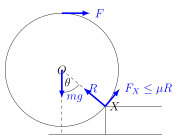
A uniform solid sphere of diameter \(d\) and mass \(m\) is drawn very slowly and without slipping from horizontal ground onto a step of height \(d/4\) by a horizontal force which is always applied to the highest point of the sphere and is always perpendicular to the vertical plane which forms the face of the step. Find the maximum horizontal force throughout the movement, and prove that the coefficient of friction between the sphere and the edge of the step must exceed \(1/\sqrt{3}\).
Solution:
1997 Paper 2 Q10
\noindent{\it In this question the effect of gravity is to be neglected.} A small body of mass \(M\) is moving with velocity \(v\) along the axis of a long, smooth, fixed, circular cylinder of radius \(L\). An internal explosion splits the body into two spherical fragments, with masses \(qM\) and \((1-q)M\), where \(q\le\frac{1}{2}\). After bouncing perfectly elastically off the cylinder (one bounce each) the fragments collide and coalesce at a point \(\frac{1}{2}L\) from the axis. Show that \(q=\frac{3}{ 8}\). The collision occurs at a time \(5L/v\) after the explosion. Find the energy imparted to the fragments by the explosion, and find the velocity after coalescence.
1997 Paper 2 Q11
A tennis player serves from height \(H\) above horizontal ground, hitting the ball downwards with speed \(v\) at an angle \(\alpha\) below the horizontal. The ball just clears the net of height \(h\) at horizontal distance \(a\) from the server and hits the ground a further horizontal distance \(b\) beyond the net. Show that $$v^2 = \frac{ g(a+b)^2(1+\tan^2\alpha)}{ 2[H-(a+b)\tan\alpha]}$$ and $$\tan\alpha = \frac{2a+b }{ a(a+b)}H - \frac{a+b }{ ab}h \,.$$ By considering the signs of \(v^2\) and \(\tan\alpha\), find upper and lower bounds on \(H\) for such a serve to be possible.
Solution: We have \begin{align*} \rightarrow: && a &= v\cos \alpha t_{net} \\ \Rightarrow && t_{net} &= \frac{a}{v \cos \alpha} \\ \downarrow: && H-h &= v\sin \alpha t_{net} + \frac12 g t_{net}^2 \\ &&&= a \tan \alpha + \frac12 g \frac{a^2}{v^2} \sec^2 \alpha \\ &&&= a \tan \alpha + \frac{a^2g}{2v^2}(1 + \tan^2 \alpha) \tag{*}\\ \\ \rightarrow: && a+b &= v \cos \alpha t_{ground} \\ && t_{ground} &= \frac{a+b}{v \cos \alpha}\\ \downarrow: && H &= v\sin \alpha t_{ground} + \frac12 g t_{ground}^2 \\ &&&= (a+b)\tan \alpha + \frac{(a+b)^2g}{2v^2}(1+\tan^2\alpha) \tag{**} \\ \\ (**): && v^2 &= \frac{g(a+b)^2(1+\tan^2\alpha)}{2[H-(a+b)\tan \alpha]} \\ (a+b)^2(*) - a^2(**): && (a+b)^2(H-h) -a^2H &= [(a+b)^2a - a^2(a+b)]\tan \alpha \\ \Rightarrow && (2ab+b^2)H - (a+b)^2h &= ab(a+b) \tan \alpha \\ \Rightarrow && \tan \alpha &= \frac{2a+b}{a(a+b)}H - \frac{a+b}{ab} h \end{align*} Noting that \(v^2 \geq 0\) and the numerator is positive, we must have \begin{align*} && H &> (a+b)\tan \alpha \\ &&&= \frac{2a+b}{a}H - \frac{(a+b)^2}{ab} h \\ \Rightarrow && \frac{a+b}{a}H &< \frac{(a+b)^2}{ab} h \\ \Rightarrow && H &< \frac{a+b}{b} h \end{align*} Noting that \(\tan \alpha > 0\) we must have \begin{align*} && \frac{2a+b}{a(a+b)} H & > \frac{a+b}{ab} h \\ \Rightarrow && H &> \frac{(a+b)^2}{b(2a+b)}h \end{align*}
1997 Paper 2 Q12
The game of Cambridge Whispers starts with the first participant Albert flipping an un-biased coin and whispering to his neighbour Bertha whether it fell `heads' or `tails'. Bertha then whispers this information to her neighbour, and so on. The game ends when the final player Zebedee whispers to Albert and the game is won, by all players, if what Albert hears is correct. The acoustics are such that the listeners have, independently at each stage, only a probability of 2/3 of hearing correctly what is said. Find the probability that the game is won when there are just three players. By considering the binomial expansion of \((a+b)^n+(a-b)^n\), or otherwise, find a concise expression for the probability \(P\) that the game is won when is it played by \(n\) players each having a probability \(p\) of hearing correctly. % Show in particular that, if \(n\) is even, %\(P(n,1/10) = P(n,9/10)\).% How do you explain this apparent anomaly? To avoid the trauma of a lost game, the rules are now modified to require Albert to whisper to Bertha what he hears from Zebedee, and so keep the game going, if what he hears from Zebedee is not correct. Find the expected total number of times that Albert whispers to Bertha before the modified game ends. \noindent [You may use without proof the fact that \(\sum_1^\infty kx^{k-1}=(1-x)^{-2}\) for \(\vert x\vert<1\).]
1997 Paper 2 Q13
A needle of length two cm is dropped at random onto a large piece of paper ruled with parallel lines two cm apart.
- By considering the angle which the needle makes with the lines, find the probability that the needle crosses the nearest line given that its centre is \(x\) cm from it, where \(0 < x < 1\).
- Given that the centre of the needle is \(x\) cm from the nearest line and that the needle crosses that line, find the cumulative distribution function for the length of the shorter segment of the needle cut off by the line.
- Find the probability that the needle misses all the lines.
Solution:
- Suppose the needle's center is \(x\) cm from the nearest line and makes an angle of \(\theta\). Then if \(\sin \theta > x\) it will cross the line, otherwise it will not. Given that \(\theta \sim U(0, \frac{\pi}{2})\), we can see that \begin{align*} && \mathbb{P}(\text{needle crosses}) &= \mathbb{P}(\sin \theta > x) \\ &&&= \mathbb{P}(\theta > \sin^{-1} x) \\ &&&= 1-\frac{2\sin^{-1} x}{\pi} \end{align*}
- The length of the short segment is \(L = 1 - \frac{x}{\sin \theta}\) and \(\theta \sim U(\sin^{-1} x, \frac{\pi}{2})\). So \begin{align*} && F_L(l) &= \mathbb{P}(L < l) \\ &&&= \mathbb{P}\left (1 - \frac{x} {\sin \theta} < l\right) \\ &&&= \mathbb{P}\left ( \sin \theta < \frac{x}{1-l}\right) \\ &&&= \mathbb{P}\left (\theta < \sin^{-1} \frac{x}{1-l}\right) \\ &&&= \frac{ \sin^{-1} \frac{x}{1-l} - \sin^{-1} x }{\frac{\pi}{2} - \sin^{-1}x} \end{align*}
- The needle (with probability \(1\)) cannot hit \(2\) lines, so let's only consider the line it's nearest too. The distance to this line is uniform on \([0,1]\), and the so we want to calculate. \begin{align*} && \mathbb{P}(\text{needle crosses}) &= \int_0^1 \left (1 - \frac{2\sin^{-1}x}{\pi} \right) \d x \\ &&&= 1 - \frac{2}{\pi} \int_0^1 \sin^{-1} x \d x\\ &&&= 1 - \frac{2}{\pi} \left ( \frac{\pi}{2} - 1 \right) \\ &&&= \frac{2}{\pi} \end{align*} Therefore the probability it misses is \(1 - \frac{\pi}{2}\)
1997 Paper 2 Q14
Traffic enters a tunnel which is 9600 metres long, and in which overtaking is impossible. The number of vehicles which enter in any given time is governed by the Poisson distribution with mean 6 cars per minute. All vehicles travel at a constant speed until forced to slow down on catching up with a slower vehicle ahead. I enter the tunnel travelling at 30 m\(\,\)s\(^{-1}\) and all the other traffic is travelling at 32 m\(\,\)s\(^{-1}\). What is the expected number of vehicles in the queue behind me when I leave the tunnel? Assuming again that I travel at 30 m\(\,\)s\(^{-1}\), but that all the other vehicles are independently equally likely to be travelling at 30 m\(\,\)s\(^{-1}\) or 32 m\(\,\)s\(^{-1}\), find the probability that exactly two vehicles enter the tunnel within 20 seconds of my doing so and catch me up before I leave it. Find also the probability that there are exactly two vehicles queuing behind me when I leave the tunnel. \noindent [Ignore the lengths of the vehicles.]