Problems
Filters
13 problems found
2014 Paper 1 Q1
All numbers referred to in this question are non-negative integers.
- Express each of the numbers 3, 5, 8, 12 and 16 as the difference of two non-zero squares.
- Prove that any odd number can be written as the difference of two squares.
- Prove that all numbers of the form \(4k\), where \(k\) is a non-negative integer, can be written as the difference of two squares.
- Prove that no number of the form \(4k+2\), where \(k\) is a non-negative integer, can be written as the difference of two squares.
- Prove that any number of the form \(pq\), where \(p\) and \(q\) are prime numbers greater than 2, can be written as the difference of two squares in exactly two distinct ways. Does this result hold if \(p\) is a prime greater than 2 and \(q=2\)?
- Determine the number of distinct ways in which 675 can be written as the difference of two squares.
Solution:
- \(\,\) \begin{align*} && 3 &= 2^2 - 1^2 \\ && 5 &= 3^2 - 2^2 \\ && 8 &= 3^2 - 1^2 \\ && 16 &= 5^2 - 3^2 \end{align*}
- Suppose \(n = 2k+1\), then \(n = (k+1)^2 - k^2\)
- Suppose \(n = 4k\) then \(n = (2k+1)^2 - (2k-1)^2\)
- All squares leave a remainder of \(0\) or \(1\) on division by \(4\). Therefore the difference can leave a remainder of \(0\), \(1\), \(-1 \equiv 3\), none of which are \(2\).
- Suppose \(n = pq = a^2 - b^2\) with \(a > b\) ie \((a-b)(a+b) = pq\). Since \(p\) is prime, \(p \mid (a-b)\) or \(p \mid (a+b)\). Similarly for \(q\). Suppose also (wlog) that \(p > q\) Since the factors of \(pq\) are \(1, p, q, pq\) then \(a-b = 1, p\) (which are two possibilities) and \(a+b = pq, q\), ie \(a = \frac{1+pq}{2}, \frac{p+q}{2}\) and \(b = \frac{pq-1}{2}, \frac{p-q}{2}\) \begin{align*} && pq &= \left ( \frac{1+pq}{2} \right)^2- \left ( \frac{1-pq}{2} \right)^2 \\ &&&= \left ( \frac{p+q}{2} \right)^2- \left ( \frac{p-q}{2} \right)^2 \\ \end{align*} Where everything is an integer since \(p\) and \(q\) are odd. If we have \(p > 2\) and \(q = 2\) then \(p\) is odd and the number has the form \(4k+2\) which cannot be expressed as the difference of two squares.
- \(675 = 3^3 \cdot 5^2\), each factor pair of \(675\) will lead to a different solution of \(675 = a^2-b^2\), since we will have an equation \(a-b = X, a+b = Y\) where \(X, Y\) are both odd. Therefore there are as many solution as (half) the number of factors, ie \(4 \times 3 = 12\)
2014 Paper 1 Q2
- Show that \(\int \ln (2-x) \d x = -(2-x)\ln (2-x) + (2-x) + c \,,\ \) where \(x<2\).
- Sketch the curve \(A\) given by \(y= \ln \vert x^2-4\vert\).
- Show that the area of the finite region enclosed by the positive \(x\)-axis, the \(y\)-axis and the curve \(A\) is \(4\ln(2+\sqrt3)-2\sqrt3\,\).
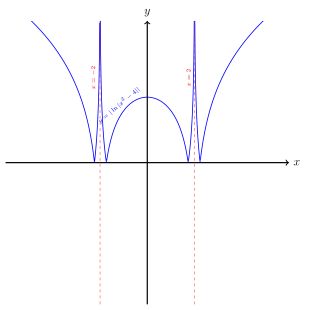
- The curve \(B\) is given by \(y= \vert \ln \vert x^2-4\vert \vert\,\). Find the area between the curve \(B\) and the \(x\)-axis with \(| x| <2\). Note: you may assume that \(t \ln t \to 0\) as \(t\to 0\).
Solution:
- \(\,\) \begin{align*} && \int \ln (2- x) \d x &= \left [ (x-2) \ln (2- x) \right] - \int -\frac{x-2}{2-x} \d x \\ && \int \ln (2- x) \d x &= \left [ (x-2) \ln (2- x) \right] + \int 1 \d x \\ &&&= -(2-x) \ln (2-x) +(2-x) + C \end{align*}
- \(\,\)
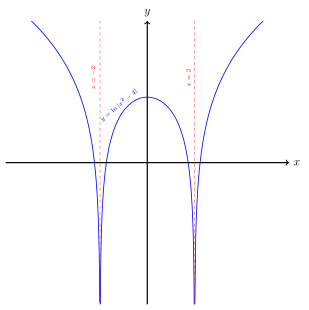
- \begin{align*} && \text{Area} &= \int_0^{\sqrt{3}} \ln | x^2 - 4 | \d x \\ &&&= \int_0^\sqrt{3} \ln(4-x^2) \d x \\ &&&= \int_0^\sqrt{3} \left ( \ln(2-x) + \ln (2+x) \right) \d x \\ &&&= \left [ -(2-x) \ln (2-x) +(2-x) +(2+x)\ln(2+x)-(2+x)\right]_0^{\sqrt{3}} \\ &&&= \left ( -(2-\sqrt{3}) \ln (2-\sqrt{3}) +(2-\sqrt{3}) +(2+\sqrt{3})\ln(2+\sqrt{3})-(2+\sqrt{3}) \right) - \\ &&&\quad \quad \left (- 2\ln (2)+2 +2\ln(2)-2 \right) \\ &&&=\left ( -(2-\sqrt{3}) \ln \left ( \frac{1}{2+\sqrt{3}} \right) -2\sqrt{3} +(2+\sqrt{3})\ln(2+\sqrt{3}) \right) \\ &&&= 4\ln(2 + \sqrt{3}) - 2 \sqrt{3} \end{align*}
- \begin{align*} && \text{Area} &= 2 \left ( \int_0^\sqrt{3} \ln (4-x^2) \d x - \lim_{t \to 2}\int_{\sqrt{3}}^t \ln(4-x^2) \d x \right) \\ &&&= 8\ln(2 + \sqrt{3})-4\sqrt{3} - 2 \lim_{t \to 2}\int_{\sqrt{3}}^t \left ( \ln (2-x) + \ln (2+x) \right) \d x \\ &&&= 8\ln(2 + \sqrt{3})-4\sqrt{3} - 2 \lim_{t \to 2} \left [ -(2-x) \ln (2-x) +(2-x) +(2+x)\ln(2+x)-(2+x)\right]_{\sqrt{3}}^{t} \\ &&&= 16 \ln(2+\sqrt{3})-8\sqrt{3} - 2 \lim_{t \to 2} \left(-(2-t) \ln (2-t) +(2-t) +(2+t)\ln(2+t)-(2+x) \right) \\ &&&= 16 \ln(2+\sqrt{3})-8\sqrt{3} -2(4 \ln4-4) \\ &&&= 16 \ln(2 + \sqrt{3}) - 16 \ln 2 +8(1-\sqrt{3}) \end{align*}
2014 Paper 1 Q3
The numbers \(a\) and \(b\), where \(b > a\ge0\), are such that \[ \int_a^b x^2 \d x = \left ( \int_a^b x \d x\right)^{\!\!2}\,. \]
- In the case \(a=0\) and \(b>0\), find the value of \(b\).
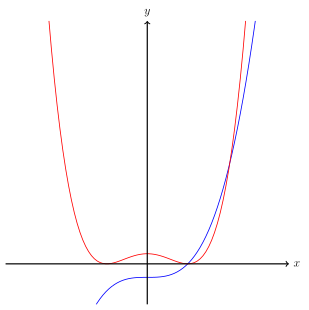
- In the case \(a=1\), show that \(b\) satisfies \[ 3b^3 -b^2-7b -7 =0\,. \] Show further, with the help of a sketch, that there is only one (real) value of \(b\) that satisfies this equation and that it lies between \(2\) and \(3\).
- Show that \(3p^2 + q^2 = 3p^2q\), where \(p=b+a\) and \(q=b-a\), and express \(p^2\) in terms of \(q\). Deduce that \(1< b-a\le\frac43\).
Solution:
- \(\,\) \begin{align*} && \int_0^b x^2 \d x &= \left ( \int_0^b x \d x \right)^2 \\ \Rightarrow && \frac{b^3}{3} &= \left ( \frac{b^2}{2} \right)^2 \\ \Rightarrow && b &= \frac{4}{3} \end{align*}
- \(\,\)
\begin{align*}
&& \int_1^b x^2 \d x &= \left ( \int_1^b x \d x \right)^2 \\
\Rightarrow && \frac{b^3}{3} - \frac{1}{3} &= \left ( \frac{b^2}{2} - \frac{1}{2} \right)^2 \\
\Rightarrow && 4(b^3 - 1) &= 3(b^2-1)^2 \\
\Rightarrow && 4(b^3-1) &= 3(b^4-2b^2+1) \\
\Rightarrow && 0 &= 3b^4-4b^3-6b^2+7 \\
&&&= (b-1)(3b^3-b^2-7b-7) \\
\Rightarrow && 0 &= 3b^3-b^2-7b-7
\end{align*}
Let \(f(x) = 3x^3-x^2-7x-7\) then \(f(2) = 3 \cdot 8 - 4 - 14 - 7 = -1 < 0\), \(f(3) = 3 \cdot 27 - 9 - 21 - 7 = 44 > 0\) therefore the root must lie between \(2\) and \(3\).
- \(,\) \begin{align*} && \int_a^b x^2 \d x &= \left ( \int_a^b x \d x \right)^2 \\ \Rightarrow && \frac{b^3}{3} - \frac{a^3}{3} &= \left ( \frac{b^2}{2} - \frac{a^2}{2} \right)^2 \\ \Rightarrow && 4(b^3 - a^3) &= 3(b^2-a^2)^2 \\ \Rightarrow && 4(b^2+ab+a^2) &= 3(b-a)(b+a)^2 \\ \Rightarrow && 4 \left ( \left ( \frac{p+q}{2}\right)^2+\left ( \frac{p+q}{2}\right)\left ( \frac{p-q}{2}\right)+\left ( \frac{p-q}{2}\right)^2\right) &= 3qp^2 \\ \Rightarrow && 3p^2 + q^2 &= 3qp^2 \\ \Rightarrow && 3p^2(q-1) &= q^2 \\ \Rightarrow && p^2 &= \frac{q^2}{3(q-1)} \\ \Rightarrow && 1 &\leq \frac{1}{3(q-1)} \\ \Rightarrow && 3(q-1) &\leq 1 \\ \Rightarrow && q & \leq \frac{4}{3} \\ \end{align*}
2014 Paper 1 Q4
An accurate clock has an hour hand of length \(a\) and a minute hand of length \(b\) (where \(b>a\)), both measured from the pivot at the centre of the clock face. Let \(x\) be the distance between the ends of the hands when the angle between the hands is \(\theta\), where \(0\le\theta < \pi\). Show that the rate of increase of \(x\) is greatest when \(x=(b^2-a^2)^\frac12\). In the case when \(b=2a\) and the clock starts at mid-day (with both hands pointing vertically upwards), show that this occurs for the first time a little less than 11 minutes later.
Solution: The position of the hands are \(\begin{pmatrix} a\sin(-t) \\ a \cos(-t) \end{pmatrix}\) and \(\begin{pmatrix} b\sin(-60t) \\ b \cos(-60t) \end{pmatrix}\), the distance between the hands is \begin{align*} x &= \sqrt{\left ( a \sin t - b \sin 60t\right)^2+\left ( a \cos t - b \cos 60t\right)^2} \\ &= \sqrt{a^2+b^2-2ab\left (\sin t \sin 60t+\cos t \cos 60t \right)} \\ &= \sqrt{a^2+b^2-2ab \cos(59t)} = \sqrt{a^2+b^2-2ab \cos \theta} \\ \\ \frac{\d x}{\d \theta} &= \frac{ab \sin \theta}{ \sqrt{a^2+b^2-2ab \cos \theta}} \\ \frac{\d^2 x}{\d \theta^2} &= \frac{ab \cos \theta\sqrt{a^2+b^2-2ab \cos \theta} - \frac{a^2b^2 \sin^2 \theta}{\sqrt{a^2+b^2-2ab \cos \theta}} }{a^2+b^2-2ab \cos \theta} \\ &= \frac{ab \cos \theta(a^2+b^2-2ab \cos \theta) - a^2b^2 \sin^2 \theta }{(a^2+b^2-2ab \cos \theta)^{3/2}} \\ &= \frac{ab \cos \theta(a^2+b^2-2ab \cos \theta) - a^2b^2(1-\cos^2 \theta)}{(a^2+b^2-2ab \cos \theta)^{3/2}} \\ &= \frac{ab(a^2+b^2) \cos \theta-a^2b^2 \cos \theta- a^2b^2}{(a^2+b^2-2ab \cos \theta)^{3/2}} \\ &= \frac{-ab(a\cos \theta -b)(b \cos \theta - a)}{(a^2+b^2-2ab \cos \theta)^{3/2}} \\ \end{align*} So the rate of increase is largest when \(\cos \theta = \frac{a}{b}\) (since \(\frac{b}{a}\) is impossible. Therefore when \(x = \sqrt{a^2+b^2-2ab \frac{a}{b}} = \sqrt{a^2+b^2-2a^2} = \sqrt{b^2-a^2}\) If \(b = 2a\) then \(\cos \theta = \frac{a}{2a} = \frac12 = \frac{\pi}{3} = 60^\circ\) The relative speed of the hands is \(5.5^\circ\) per minute, so \(\frac{60}{5.5} = \frac{120}{11} \approx 11\) but clearly also less than since \(121 = 11^2\).
2014 Paper 1 Q5
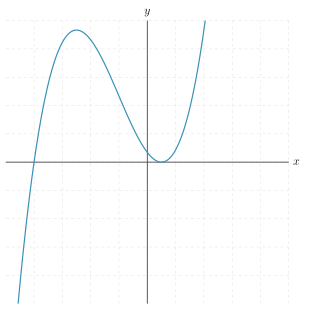
- Let \(f(x) = (x+2a)^3 -27 a^2 x\), where \(a\ge 0\). By sketching \(f(x)\), show that \(f(x)\ge 0\) for \(x \ge0\).
- Use part (i) to find the greatest value of \(xy^2\) in the region of the \(x\)-\(y\) plane given by \(x\ge0\), \(y\ge0\) and \(x+2y\le 3\,\). For what values of \(x\) and \(y\) is this greatest value achieved?
- Use part (i) to show that \((p+q+r)^3 \ge 27pqr\) for any non-negative numbers \(p\), \(q\) and \(r\). If \((p+q+r)^3 = 27pqr\), what relationship must \(p\), \(q\) and \(r\) satisfy?
Solution:
- Note that \(f(x) = (x+2a)^3 - 27a^2x\) so \(f'(x) = 3(x+2a)^2-27a^2 = 3x^2+12ax-15a^2 = (x-a)(3x+15a)\) so the turning points are at \(x = a, x = -5a\). But \(f(a) = 0\), so the curve just touches the \(x\)-axis. Note also that \(f(0) = 8a^3 \geq 0\) so:
- \(\,\) \begin{align*} && 0 &\leq (x+2y)^3 - 27y^2 x \\ &&& \leq 3^3 - 27 y^2 x \\ &&&= 27(1-y^2x) \\ \Rightarrow && xy^2 &\leq1 \end{align*} with equality when \(x = y = 1\)
- Notice that \begin{align*} && 0 &\leq (p+q+r)^3 - 27\left (\frac{q+r}{2}\right)^2 p \\ \Rightarrow && (p+q+r)^3 &\geq 27\left (\frac{q+r}{2}\right)^2 p \\ &&&\underbrace{\geq}_{AM-GM} 27\left (\sqrt{qr}\right)^2 p \\ &&&= 27pqr \end{align*} Equality can only hold if \(p = \frac{q+r}{2}\), but by symmetry we must also have \(q = \frac{r+p}{2}, r = \frac{p+q}{2}\) ie \(p = q = r\). And indeed equality does hold in this case.
2014 Paper 1 Q6
- The sequence of numbers \(u_0, u_1, \ldots \) is given by \(u_0=u\) and, for \(n\ge 0\), \begin{equation} u_{n+1} =4u_n(1- u_n)\,. \tag{\(*\)} \end{equation} In the case \(u= \sin^2\theta\) for some given angle \(\theta\), write down and simplify expressions for \(u_1\) and \(u_2\) in terms of \(\theta\). Conjecture an expression for \(u_n\) and prove your conjecture.
- The sequence of numbers \(v_0, v_1, \ldots\) is given by $v_0= v \text{ and, for }n\ge 0$, \[ v_{n+1} = -pv_n^2 +qv_n +r\,, \] where \(p\), \(q\) and \(r\) are given numbers, with \(p\ne0\). Show that a substitution of the form \(v_n =\alpha u_n +\beta\), where \(\alpha\) and \(\beta\) are suitably chosen, results in the sequence \((*)\) provided that \[ 4pr = 8 +2q -q^2 \,. \] Hence obtain the sequence satisfying \(v_0=1\) and, for \(n\ge0\), \(v_{n+1} = -v_n^2 +2 v_n +2 \,\).
Solution:
- Suppose \(u_0 = u = \sin^2 \theta\) then \begin{align*} && u_1 &= 4 u_0 (1-u_0) \\ &&&= 4 \sin^2 \theta ( 1- \sin^2 \theta) \\ &&&= 4 \sin^2 \theta \cos^2 \theta \\ &&&= (2 \sin \theta \cos \theta)^2 \\ &&&= (\sin 2 \theta)^2 = \sin^2 2 \theta \\ \\ && u_2 & = 4u_1 (1-u_1) \\ &&&= 4 \sin^2 2\theta \cos^2 2 \theta \\ &&&= \sin^2 4 \theta \end{align*} Claim: \(u_n = \sin^2 2^n \theta\). Proof: (By Induction) Base case is clear, suppose it's true for \(n=k\), then \begin{align*} && u_{k+1} &= 4u_k(1-u_k) \\ &&&= 4 \sin^2 2^k \theta(1-\sin^2 2^k \theta) \\ &&&= (2 \sin 2^k \theta \cos 2^k \theta)^2 \\ &&&= (\sin 2^{k+1} \theta)^2 \\ &&&= \sin^2 2^{k+1} \theta \end{align*} Therefore since it is true for \(n = 1\) and if it's true for \(n = k\) it is true for \(n=k+1\) it must be true for all \(k\).
- Suppose \(v_n = \alpha u_n + \beta\) then \begin{align*} && (\alpha u_{n+1}+\beta) &= -p(\alpha u_n + \beta)^2 + q(\alpha u_n + \beta) + r \\ &&&= -p\alpha^2u_n^2+\alpha(q-2p\beta) u_n -p \beta^2 +q \beta+r \\ \Rightarrow && u_{n+1} &= u_n(q-2p\beta -p \alpha u_n) -(p\beta^2-(q-1)\beta-r) \end{align*} So if \(\alpha = \frac{4}{p}\) and \(q-2p\beta = 4\) ie \(\beta = \frac{q-4}{2p}\) then we also need the constant term to vanish, ie \begin{align*} 0 &&&= p\beta^2-(q-1)\beta+r \\ &&&= p \left (\frac{q-4}{2p} \right)^2 - (q-1) \frac{q-4}{2p} - r \\ \Rightarrow && 0 &= p(q-4)^2 -(q-1)(q-4)2p - 4p^2r \\ \Rightarrow && 0 &= (q-4)^2-2(q-1)(q-4)-4pr \\ &&&= q^2-8q+16-2q^2+10q-8-4pr \\ \Rightarrow && 4pr &= -q^2+2q+8 \end{align*} Suppose \(v_{n+1} = -v_n^2 + 2v_n +2\) then since \(4\cdot 1 \cdot 2 = 8\) and \(8 + 4 -4 = 8\) we can apply our method. \(v_n = 4u_n + \frac{-2}{2} = 4u_n -1 = 4\sin^2 (2^{n-1} \pi)-1\)
2014 Paper 1 Q7
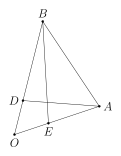
In the triangle \(OAB\), the point \(D\) divides the side \(BO\) in the ratio \(r:1\) (so that \(BD = rDO\)), and the point \(E\) divides the side \(OA\) in the ratio \(s:1\) (so that \(OE =s EA\)), where \(r\) and \(s\) are both positive.
- The lines \(AD\) and \(BE\) intersect at \(G\). Show that \[ \mathbf{g}= \frac{rs}{1+r+rs} \, \mathbf{a} + \frac 1 {1+r+rs} \, \mathbf{b} \,, \] where \(\mathbf{a}, \mathbf{b}\) and \(\mathbf{g}\) are the position vectors with respect to \(O\) of \(A\), \(B\) and \(G\), respectively.
- The line through \(G\) and \(O\) meets \(AB\) at \(F\). Given that \(F\) divides \(AB\) in the ratio \(t:1\), find an expression for \(t\) in terms of \(r\) and \(s\).
Solution:
2014 Paper 1 Q8
Let \(L_a\) denote the line joining the points \((a,0)\) and \((0, 1-a)\), where \(0< a < 1\). The line \(L_b\) is defined similarly.
- Determine the point of intersection of \(L_a\) and \(L_b\), where \(a\ne b\).
- Show that this point of intersection, in the limit as \(b\to a\), lies on the curve \(C\) given by \[ y=(1-\sqrt x)^2\, \ \ \ \ (0< x < 1)\,. \]
- Show that every tangent to \(C\) is of the form \(L_a\) for some \(a\).
Solution:
- \(L_a : \frac{y}{x-a} = \frac{1-a-0}{0-a} = \frac{a-1}{a} \Rightarrow ay+(1-a)x = a(1-a)\) \begin{align*} && ay + (1-a)x &= a(1-a) \\ && by + (1-b)x &= b(1-b) \\ \Rightarrow && aby + b(1-a)x &= ba(1-a) \\ && aby + a(1-b)x &= ab(1-b) \\ \Rightarrow && (b-a)x &= ab(b-a) \\ \Rightarrow && x &= ab \\ && y &= \frac{a-1}{a} \cdot a(b-1) \\ &&&= (1-a)(1-b) \end{align*}
- As \(a \to b\), \(x \to a^2, y \to 1-2a+a^2 =(1-a)^2 = (1-\sqrt{x})^2\)
- \(\frac{\d y}{\d x} = 2(1-\sqrt{x})\cdot \left (-\tfrac12 \frac{1}{\sqrt{x}} \right) = 1 - \frac{1}{\sqrt{x}}\). Therefore the tangent when \(x = c^2, y = (1-c)^2\) is \begin{align*} && \frac{y-(1-c)^2}{x-c^2} &= 1 - \frac{1}{c} \\ \Rightarrow && cy + (1-c)x &= c(c-1)+c(1-c)^2 \\ &&&= c(1-c) \end{align*} Which is an equation of the form \(L_c\)
2014 Paper 1 Q9
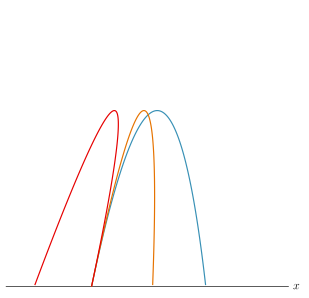
A particle of mass \(m\) is projected due east at speed \(U\) from a point on horizontal ground at an angle \(\theta\) above the horizontal, where \(0 < \theta < 90^\circ\). In addition to the gravitational force \(mg\), it experiences a horizontal force of magnitude \(mkg\), where \(k\) is a positive constant, acting due west in the plane of motion of the particle. Determine expressions in terms of \(U\), \(\theta\) and \(g\) for the time, \(T_H\), at which the particle reaches its greatest height and the time, \(T_L \), at which it lands. Let \(T = U\cos\theta /(kg)\). By considering the relative magnitudes of \(T_H\), \(T_L \) and \(T\), or otherwise, sketch the trajectory of the particle in the cases \(k\tan\theta<\frac12\), \(\frac12 < k\tan\theta<1\), and \(k\tan\theta>1\). What happens when \(k\tan\theta =1\)?
Solution: \begin{align*} && v_{\uparrow} &= U\sin \theta - g t \\ \Rightarrow && T_H &= \frac{U \sin \theta}{g} \\ \\ && s_{\uparrow} &= U \sin \theta t - \frac12 g t^2 \\ \Rightarrow && 0 &= U\sin \theta T_L - \frac12 g T_L^2 \\ && T_L &= \frac{2 U \sin \theta}{g} \end{align*} \(T = U\cos \theta / (kg)\) is the point when the particle's horizontal motion is reversed.
2014 Paper 1 Q10
- A uniform spherical ball of mass \(M\) and radius \(R\) is released from rest with its centre a distance \(H+R\) above horizontal ground. The coefficient of restitution between the ball and the ground is \(e\). Show that, after bouncing, the centre of the ball reaches a height \(R+He^2\) above the ground.
- A second uniform spherical ball, of mass \(m\) and radius \(r\), is now released from rest together with the first ball (whose centre is again a distance \(H+R\) above the ground when it is released). The two balls are initially one on top of the other, with the second ball (of mass \(m\)) above the first. The two balls separate slightly during their fall, with their centres remaining in the same vertical line, so that they collide immediately after the first ball has bounced on the ground. The coefficient of restitution between the balls is also \(e\). The centre of the second ball attains a height \(h\) above the ground. Given that \(R=0.2\), \(r=0.05\), \(H=1.8\), \(h=4.5\) and \(e=\frac23\), determine the value of \(M/m\).
Solution:
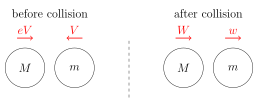
- The story for first ball (before it collides with the second ball) will be exactly the same, ie it rebounds with speed \(eV\).
For the second ball, it will also have fallen a distance \(H\) and will be travelling with the same speed \(V\). Their speed of approach therefore will be \((1+e)V\), and the speed of separating therefore must be \(e(1+e)V\)
Given the centre of the second ball reaches a height of \(h\) (from a position of height) \(2R+r\), we must have:
\begin{align*}
&& v^2 &= u^2 + 2as \\
&& 0 &= w^2 - 2g(h - 2R-r) \\
\Rightarrow && w^2 &= 2g(h-2R-r)
\end{align*}
Taking upwards to be positive, then we have:
\begin{align*} \text{COM}: && MeV + m(-V) &= M(w-e(1+e)V) + mw \\ \Rightarrow && V(Me-m)+e(1+e)MV &= w(M+m) \\ \Rightarrow && w &= \frac{2Me+e^2M-m}{M+m} V \\ \Rightarrow && w^2 &= \left ( \frac{M/m(2e+e^2)-1}{M/m+1}\right)^2 V^2 \\ \Rightarrow && 2g(h-2R-r) &= \left ( \frac{M/m(2e+e^2)-1}{M/m+1}\right)^2 2gH \\ \Rightarrow && \left ( \frac{M/m(2e+e^2)-1}{M/m+1}\right)^2 &= \frac{h-2R-r}{H} \\ &&&= \frac{4.5-0.4-0.05}{1.8} \\ &&&= \frac{9}{4} \\ \Rightarrow && \frac{M/m(\frac43+\frac49)-1}{M/m+1} &= \frac32 \\ \Rightarrow && \frac{16}9M/m-1 &= \frac32 M/m+\frac32 \\ \Rightarrow && \frac{5}{18}M/m &= \frac{5}{2} \\ \Rightarrow && M/m &= 9 \end{align*}
2014 Paper 1 Q11
The diagrams below show two separate systems of particles, strings and pulleys.In both systems, the pulleys are smooth and light, the strings are light and inextensible, the particles move vertically and the pulleys labelled with \(P\) are fixed. The masses of the particles are as indicated on the diagrams.
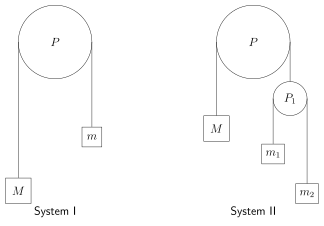
- For system I show that the acceleration, \(a_1\), of the particle of mass \(M\), measured in the downwards direction, is given by \[ a_1= \frac{M-m}{M+m} \, g \,, \] where \(g\) is the acceleration due to gravity. Give an expression for the force on the pulley due to the tension in the string.
- For system II show that the acceleration, \(a_2\), of the particle of mass \(M\), measured in the downwards direction, is given by \[ a_2= \frac{ M - 4\mu}{M+4\mu}\,g \,, \] where \(\mu = \dfrac{m_1m_2}{m_1+m_2}\). In the case \(m= m_1+m_2\), show that \(a_1= a_2\) if and only if \(m_1=m_2\).
Solution:
- \(\,\)
\begin{align*} \text{N2}(\uparrow, m): && T - mg &= ma_1 \\ \text{N2}(\uparrow, M): && T-Mg &= -Ma_1 \\ \Rightarrow && (M-m)g &= a_1(m+M) \\ \Rightarrow && a_1 &= \frac{M-m}{M+m}g \\ && T &= mg + ma_1 \\ &&&= \frac{2mM}{M+m}g \end{align*}
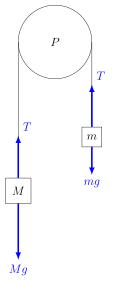
- System II is the same as system I, but with \(m\) replaced with \(2\frac{T}{g} = \frac{4mM}{M+m}\). In particular, this means that: \begin{align*} && a_2 &= \frac{M - \frac{4m_1m_2}{m_1+m_2}}{M + \frac{4m_1m_2}{m_1+m_2}} g \\ &&&= \frac{M-4\mu}{M+4\mu}g \end{align*} If \(m = m_1 + m_2\) then \begin{align*} && a_1 &= a_2 \\ \Leftrightarrow && \frac{M-m_1-m_2}{M+m_1+m_2} &= \frac{M - \frac{4m_1m_2}{m_1+m_2}}{M + \frac{4m_1m_2}{m_1+m_2}} \\ \Leftrightarrow && \frac{M-m_1-m_2}{M+m_1+m_2} &= \frac{M(m_1+m_2) -4m_1m_2}{M(m_1+m_2) + 4m_1m_2} \\ \Leftrightarrow && M^2(m_1+m_2)+4m_1m_2M &- M(m_1+m_2)^2 - 4m_1m_2(m_1+m_2) \\ &&\quad \quad = M^2(m_1+m_2) - 4m_1m_2M &+M(m_1+m_2)^2-4m_1m_2(m_1+m_2) \\ \Leftrightarrow && 8m_1m_2M&= 2M(m_1+m_2)^2 \\ \Leftrightarrow && 0 &= (m_1-m_2)^2 \\ \Leftrightarrow && m_1 &= m_2 \end{align*}
2014 Paper 1 Q12
A game in a casino is played with a fair coin and an unbiased cubical die whose faces are labelled \(1, 1, 1, 2, 2\) and \(3.\) In each round of the game, the die is rolled once and the coin is tossed once. The outcome of the round is a random variable \(X\). The value, \(x\), of \(X\) is determined as follows. If the result of the toss is heads then \(x= \vert ks -1\vert\), and if the result of the toss is tails then \(x=\vert k-s\vert\), where \(s\) is the number on the die and \(k\) is a given number. Show that \(\mathbb{E}(X^2) = k +13(k-1)^2 /6\). Given that both \(\mathbb{E}(X^2)\) and \(\mathbb{E}(X)\) are positive integers, and that \(k\) is a single-digit positive integer, determine the value of \(k\), and write down the probability distribution of \(X\). A gambler pays \(\pounds 1\) to play the game, which consists of two rounds. The gambler is paid:
- \(\pounds w\), where \(w\) is an integer, if the sum of the outcomes of the two rounds exceeds \(25\);
- \(\pounds 1\) if the sum of the outcomes equals \(25\);
- nothing if the sum of the outcomes is less that \(25\).
Solution: \begin{align*} && \mathbb{E}(X^2) &= \frac12 \left (\frac16 \left ( 3(k -1)^2+2(2k-1)^2+(3k-1)^2 \right) +\frac16 \left ( 3(k -1)^2+2(k-2)^2+(k-3)^2 \right) \right) \\ &&&= \frac12 \left (\frac16 \left (20k^2-20k+6 \right) + \frac16 \left ( 6k^2-20k+20\right) \right) \\ &&&= \frac1{12} \left (26k^2-40k+ 26\right) \\ &&&= \frac{13}{6} (k^2+1) - \frac{10}{3}k \\ &&&= \frac{13}{6}(k-1)^2+k \end{align*} Since \(k\) a single digit positive number and \(\mathbb{E}(X^2)\) is an integer, \(6 \mid k-1 \Rightarrow k = 1, 7\). \begin{align*} \mathbb{E}(X | k=1) &= \frac12 \left (\frac16 \left ( 2+2 \right) +\frac16 \left ( 2+2 \right) \right) = \frac23 \not \in \mathbb{Z}\\ \mathbb{E}(X | k=7) &= \frac12 \left (\frac16 \left ( 3\cdot6+2\cdot13+20 \right) +\frac16 \left ( 3\cdot6+2\cdot5+4 \right) \right) = 8 \end{align*} Therefore \(k = 7\) The probability distribution is \begin{align*} && \mathbb{P}(X=4) = \frac1{12} \\ && \mathbb{P}(X=5) = \frac1{6} \\ && \mathbb{P}(X=6) = \frac12 \\ && \mathbb{P}(X=13) = \frac1{6} \\ && \mathbb{P}(X=20)= \frac1{12} \\ \end{align*} The only ways to score more than \(25\) are: \(20+6, 20+13, 20+20, 13+13\) The only ways to score exactly \(25\) are \(20+5\) \begin{align*} \mathbb{P}(>25) &= \frac1{12} \cdot\left(2\cdot \frac12+2\cdot\frac16+\frac1{12}\right) + \frac{1}{6^2} \\ &= \frac{7}{48} \\ \mathbb{P}(=25) &= \frac{2}{12 \cdot 6} = \frac{1}{36} \\ \\ \mathbb{E}(\text{payout}) &= \frac{7}{48}w + \frac{1}{36} = \frac{21w+4}{144} \end{align*} The casino needs \(\frac{21w+4}{144} < 1 \Rightarrow 21w< 140 \Rightarrow w < \frac{20}{3}\)
2014 Paper 1 Q13
A continuous random variable \(X\) has a triangular distribution, which means that it has a probability density function of the form \[ \f(x) = \begin{cases} \g(x) & \text{for \(a< x \le c\)} \\ \h(x) & \text{for \(c\le x < b\)} \\ 0 & \text{otherwise,} \end{cases} \] where \(\g(x)\) is an increasing linear function with \(\g(a)=0\), \(\h(x)\) is a decreasing linear function with \(\h(b) =0\), and \(\g(c)=\h(c)\). Show that \(\g(x) = \dfrac{2(x-a)}{(b-a)(c-a)}\) and find a similar expression for \(\h(x)\).
- Show that the mean of the distribution is \(\frac13(a+b+c)\).
- Find the median of the distribution in the different cases that arise.
Solution: Since \(\int f(x) \, dx = 1\), and \(f(x)\) is a triangle with base \(b-a\), it must have height \(\frac{2}{b-a}\) in order to have the desired area. Since \(g(a) = 0, g(c) = \frac{2}{b-a}\), \(g(x) = A(x-a)\) and \(\frac{2}{b-a} = A (c-a) \Rightarrow g(x) = \frac{2(x-a)}{(b-a)(c-a)}\) as required. Similarly, \(h(x) = B(x-b)\) and \(\frac{2}{b-a} = B(c-b) \Rightarrow h(x) = \frac{2(b-x)}{(b-a)(b-c)}\) The mean of the distribution will be: \begin{align*} \int_a^b xf(x) \, dx &= \int_a^c xg(x) \, dx + \int_c^b xh(x) \, dx \\ &= \frac{2}{(b-a)(c-a)} \int_a^c x(x-a) dx + \frac{2}{(b-a)(b-c)} \int_c^b x(b-x) \, dx \\ &= \frac{2}{(b-a)} \l \frac{1}{c-a} \left [ \frac{x^3}{3} - a\frac{x^2}{2} \right ]_a^c + \frac{1}{b-c} \left [ b\frac{x^2}{2} - \frac{x^3}{3} \right ]_c^b\r \\ &= \frac{2}{(b-a)} \l \frac{1}{c-a} \l \frac{c^3}{3} - a\frac{c^2}{2} - \frac{a^3}{3} + \frac{a^3}{2} \r + \frac{1}{b-c} \l \frac{b^3}{2} - \frac{b^3}{3} - \frac{bc^2}{2} + \frac{c^3}{3} \r \r \\ &= \frac{2}{(b-a)} \l \l \frac{c^2+ac+a^2}{3} - \frac{a(a+c)}{2} \r +\l \frac{b(b+c)}{2} - \frac{b^2+bc+c^2}{3} \r\r \\ &= \frac{2}{(b-a)} \l \frac{2c^2+2ac+2a^2}{6} - \frac{3a^2+3ac}{6} + \frac{3b^2+3bc}{6} - \frac{2b^2+2bc+2c^2}{6} \r \\ &= \frac{2}{(b-a)} \l \frac{-a^2+b^2-ac+bc}{6} \r \\ &= \frac{a+b+c}{3} \\ \end{align*} The median \(M\) satisfies: \begin{align*} && \int_a^M f(x) \, dx &= \frac12 \\ \end{align*} The left hand triangle will have area: \(\frac{c-a}{b-a}\) which will be \(\geq \frac12\) if \(c \geq \frac{a+b}{2}\). In this case we need \begin{align*} && \frac{(M-a)^2}{(b-a)(c-a)} &= \frac12 \\ \Rightarrow && M &= a + \sqrt{\frac12 (b-a)(c-a)} \end{align*} Otherwise, we need: \begin{align*} && \frac{(b-M)^2}{(b-a)(b-c)} &= \frac12 \\ \Rightarrow && M &= b - \sqrt{\frac12 (b-a)(b-c)} \end{align*} These are consistent, if \(c = \frac{b+a}{2}\)