Problems
Filters
233 problems found
2004 Paper 3 Q1
Show that \[ \int_0^a \frac{\sinh x}{2\cosh^2 x -1} \, \mathrm{d} x = \frac{1}{2 \sqrt{2}} \ln \l \frac{\sqrt{2}\cosh a -1}{\sqrt{2}\cosh a +1}\r + \frac{1}{2 \sqrt{2}} \ln \l \frac{\sqrt{2}+1}{\sqrt{2}-1}\r \] and find \[ \int_0^a \frac{\cosh x}{1+2\sinh^2 x} \, \mathrm{d} x \, . \] Hence show that \[ \int_0^\infty \frac{\cosh x - \sinh x}{1+2\sinh^2 x} \, \mathrm{d} x = \frac{\pi}{2\sqrt{2}} - \frac{1}{2 \sqrt{2}} \ln \l \frac{\sqrt{2}+1}{\sqrt{2}-1}\r \, . \] By substituting \(u = \e^x\) in this result, or otherwise, find \[ \int_1^\infty \frac{1}{1+u^4} \, \mathrm{d} u \, . \]
2004 Paper 3 Q3
Given that \(\f''(x) > 0\) when \(a \le x \le b\,\), explain with the aid of a sketch why \[ (b-a) \, \f \Big( {a+b \over 2} \Big) < \int^b_a \f(x) \, \mathrm{d}x < (b-a) \, \displaystyle \frac{\f(a) + \f(b)}{2} \;. \] By choosing suitable \(a\), \(b\) and \(\f(x)\,\), show that \[ {4 \over (2n-1)^2} < {1 \over n-1} - {1 \over n} < {1 \over 2} \l {1 \over n^2} + {1 \over (n-1)^2}\r \,, \] where \(n\) is an integer greater than 1. Deduce that \[ 4 \l {1 \over 3^2} +{1 \over 5^2} + {1 \over 7^2} + \cdots \r < 1 < {1 \over 2} + \left( {1 \over 2^2} +{1 \over 3^2} + {1 \over 4^2} + \cdots \right)\,. \] Show that \[ {1 \over 2} \l {1 \over 3^2} + {1 \over 4^2} + {1 \over 5^2} + \frac 1 {6^2} + \cdots \r < {1 \over 3^2} +{1 \over 5^2} + {1 \over 7^2} + \cdots \] and hence show that \[ {3 \over 2} \displaystyle < \sum_{n=1}^\infty {1 \over n^2} <{7 \over 4}\;. \]
2004 Paper 3 Q7
For \(n=1\), \(2\), \(3\), \(\ldots\,\), let \[ I_n = \int_0^1 {t^{n-1} \over \l t+1 \r^n} \, \mathrm{d} t \, . \] By considering the greatest value taken by \(\displaystyle {t \over t+1}\) for \(0 \le t \le 1\) show that \(I_{n+1} < {1 \over 2} I_{n}\,\). Show also that \(\; \displaystyle I_{n+1}= - \frac 1{\; n\, 2^n} + I_{n}\,\). Deduce that \(\; \displaystyle I_n < \frac1 {\; n \, 2^{n-1}}\,\). Prove that \[ \ln 2 = \sum_{r=1}^n {1 \over \; r\, 2^r} + I_{n+1} \] and hence show that \({2 \over 3} < \ln 2 < {17 \over 24}\,\).
Solution: \begin{align*} && \frac{t}{t+1} &= 1 - \frac{1}{t+1} \geq \frac12 \\ \Rightarrow && I_{n+1} &= \int_0^1 \frac{t^{n}}{(t+1)^{n+1}} \d t \\ &&&= \int_0^1\frac{t}{t+1} \frac{t^{n-1}}{(t+1)^{n}} \d t \\ &&&< \int_0^1\frac12\frac{t^{n-1}}{(t+1)^{n}} \d t \\ &&&= \frac12 I_n \\ \\ && I_{n+1} &= \int_0^1 \frac{t^{n}}{(t+1)^{n+1}} \d t \\ &&&= \left [ t^n \frac{(1+t)^{-n}}{-n} \right]_0^1 +\frac1n \int_0^1 n t^{n-1}(1+t)^{-n} \d t \\ &&&= -\frac{1}{n2^n} + I_n \\ \Rightarrow && \frac12 I_n &> -\frac1{n2^n} + I_n \\ \Rightarrow && \frac{1}{n2^{n-1}} &> I_n \end{align*} \begin{align*} && \ln 2 &= \int_0^1 \frac{1}{1+t} \d t \\ &&&= I_1 \\ &&&= \frac1{2} + I_2 \\ &&&= \frac1{2} + \frac{1}{2 \cdot 2^2} + I_3 \\ &&&= \sum_{r=1}^n \frac{1}{r2^r} + I_{n+1} \\ \\ && \ln 2 &= \frac12 + \frac18 + \frac1{24} + I_4 \\ \Rightarrow && \ln 2 &> \frac12 + \frac18 + \frac1{24} = \frac{12+3+1}{24} = \frac{16}{24} = \frac23 \\ \Rightarrow && \ln 2 &= \frac12 + \frac18 + I_3 \\ &&&< \frac12 + \frac18 +\frac{1}{3 \cdot 4} \\ &&&< \frac{12}{24} + \frac{3}{24} + \frac{2}{24} = \frac{17}{24} \end{align*}
2004 Paper 3 Q11
Particles \(P\), of mass \(2\), and \(Q\), of mass \(1\), move along a line. Their distances from a fixed point are \(x_1\) and \(x_2\), respectively where \(x_2>x_1\,\). Each particle is subject to a repulsive force from the other of magnitude \(\displaystyle {2 \over z^3}\), where \(z = x_2-x_1 \,\). Initially, \(x_1=0\), \(x_2 = 1\), \(Q\) is at rest and \(P\) moves towards \(Q\) with speed 1. Show that \(z\) obeys the equation \(\displaystyle {\mathrm{d}^2 z \over \mathrm{d}t^2} = {3 \over z^3}\). By first writing \(\displaystyle {\mathrm{d}^2 z \over \mathrm{d}t^2} = v {\mathrm{d}v \over \mathrm{d}z} \,\), where \(\displaystyle v={\mathrm{d}z \over \mathrm{d}t}\,\), show that \(z=\sqrt{4t^2-2t+1}\,\). By considering the equation satisfied by \(2x_1+x_2\,\), find \(x_1\) and \(x_2\) in terms of \(t \,\).
Solution: \begin{align*} \text{N2}: && 2\ddot{x}_1 &= -\frac{2}{(x_2-x_1)^3}\\ \text{N2}: && \ddot{x}_2 &= \frac{2}{(x_2-x_1)^3}\\ \Rightarrow && \ddot{x}_2 - \ddot{x}_1 &= \frac{3}{(x_1-x_2)^3} \\ \Rightarrow && \frac{\d^2 z}{\d t^2} &= \frac{3}{z^3} \\ \Rightarrow && v \frac{\d v}{\d z} &= \frac{3}{z^3} \\ \Rightarrow && \int v \d v &= \int \frac{3}{z^3} \d z \\ \Rightarrow && \frac{v^2}{2} &= -\frac{3}{2}z^{-2} + C \\ \Rightarrow && v^2 &= -3 z^{-2} + C' \\ t=0,z=1,v=-1: && 1 &= -3+C \Rightarrow C = 4 \\ \Rightarrow && \frac{\d z}{\d t} &= -\sqrt{4-3z^{-2}} \\ \Rightarrow && \int \d t &= -\int \frac{1}{\sqrt{4-3z^{-2}}} \d z \\ \Rightarrow && t &= \int \frac{z}{\sqrt{4z^2-3}} \d z \\ \Rightarrow && t &= -\frac14\sqrt{4z^2-3} + C \\ t=0, z = 1: && 0 &= -\frac14+C \\ \Rightarrow && C &= \frac14\\ \Rightarrow && 4t -1 &= -\sqrt{4z^2-3} \\ \Rightarrow && 16t^2+1-8t &= 4z^2-3 \\ \Rightarrow && z &= \sqrt{4t^2-2t+1} \end{align*} \begin{align*} && 2\ddot{x}_1 + \ddot{x}_2 &= 0 \\ \Rightarrow && 2x_1+x_2 &= At + B \\ t = 0, v = -1: && 2x_1+x_2 &= -t+1 \\ \\ \Rightarrow && x_2-x_1 &= \sqrt{4t^2-2t+1}\\ && 2x_1+x_2 &= 1-t \\ \Rightarrow && x_1 &= \frac13 \left (1-t-\sqrt{4t^2-2t+1} \right) \\ && x_2 &= \frac13(1-t + \sqrt{4t^2-2t+1}) \end{align*} This method of considering the relative position and considering the motion of the centre of mass is extremely common for solving systems of particles problems.
2003 Paper 1 Q6
Evaluate the following integrals, in the different cases that arise according to the value of the positive constant \(a\,\):
- \[ \displaystyle \int_0^1 \frac 1 {x^2 + (a+2)x +2a} \; \d x \]
- \[\displaystyle \int _{1}^2\frac 1 {u^2 +au +a-1} \; \d u\]
Solution:
- \(\,\) \begin{align*} && I &= \int_0^1 \frac 1 {x^2 + (a+2)x +2a} \; \d x \\ &&&= \int_0^1 \frac{1}{(x+a)(x+2)} \d x\\ \end{align*} Case 1: \(a = 2\) \begin{align*} && I &= \int_0^1 \frac{1}{(x+2)^2} \d x \\ &&&= \left [ -(x+2)^{-1}\right]_0^1 = \frac12 - \frac13 = \frac16 \end{align*} Case 2: \(a \neq 2, a \not \in [0,1]\) \begin{align*} && I &=\frac{1}{a-2} \int_0^1 \left ( \frac{1}{x+2} - \frac{1}{x+a} \right) \d x \\ &&&= \frac{1}{a-2} \left [ \ln |x+2| - \ln |x + a|\right]_0^1 \\ &&&= \frac{1}{a-2} \left ( \ln \frac{3}{|1+a|} - \ln \frac{2}{|a|} \right) \\ &&&= \frac{1}{a-2} \ln \frac{3|a|}{2|a+1|} \end{align*} Case 3: \(a \in [0, 1]\), \(I\) does not converge
- \(\,\) \begin{align*} && J &= \int _{1}^2\frac 1 {u^2 +au +a-1} \; \d u \\ &&&= \int_1^2 \frac{1}{(u+a-1)(u+1)} \d u \\ x = u-1:&&&= \int_0^1 \frac{1}{(x+a)(x+2)} \d x \end{align*} So it's the same as the previous integral
2003 Paper 2 Q4
The line \(y=d\,\), where \(d>0\,\), intersects the circle \(x^2+y^2=R^2\) at \(G\) and \(H\). Show that the area of the minor segment \(GH\) is equal to \begin{equation} R^2\arccos \left({d \over R}\right) -d\sqrt{R^2 - d^2}\;. \tag {\(*\)} \end{equation} In the following cases, the given line intersects the given circle. Determine how, in each case, the expression \((*)\) should be modified to give the area of the minor segment.
- Line: \(y=c\,\); \ \ \ circle: \((x-a)^2+(y-b)^2=R^2\,\).
- Line: \(y=mx+c\, \); \ \ \ circle: \(x^2+y^2=R^2\,\).
- Line: \(y=mx+c\,\); \ \ \ circle: \((x-a)^2+(y-b)^2=R^2\,\).
2003 Paper 2 Q6
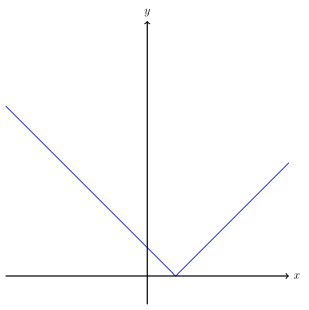
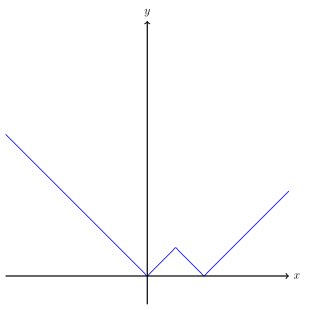
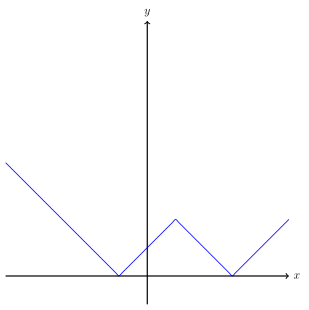
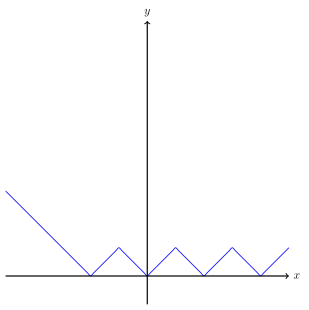
The function \(\f\) is defined by $$ \f(x)= \vert x-1 \vert\;, $$ where the domain is \({\bf R}\,\), the set of all real numbers. The function \(\g_n =\f^n\), with domain \({\bf R}\,\), so for example \(\g_3(x) = \f(\f(\f(x)))\,\). In separate diagrams, sketch graphs of \(\g_1\,\), \(\g_2\,\), \(\g_3\,\) and \(\g_4\,\). The function \(\h\) is defined by \[ \h(x) = |\sin {{{\pi}x} \over 2}|, \] where the domain is \({\bf R}\,\). Show that if \(n\) is even, \[ \int_0^n\,\big( \h(x)-\g_n(x)\big)\,\d x = \frac{2n}{\pi} -\frac{n}2\;. \]
Solution:
2003 Paper 2 Q7
Show that, if \(n>0\,\), then $$ \int_{e^{1/n}}^\infty\,{{\ln x} \over {x^{n+1}}}\,\d x = {2 \over {n^2\e}}\;. $$ You may assume that \(\ds \frac{\ln x} x \to 0\;\) as \(x\to\infty\,\). Explain why, if \(1 < a < b\,\), then $$ \int_b^\infty\,{{\ln x} \over {x^{n+1}}}\,\d x < \int_a^\infty\,{{\ln x} \over {x^{n+1}}}\,\d x\;. $$ Deduce that $$ \sum_{n=1}^{N}{1 \over n^2} < {\e \over 2}\int_{\e^{1/N}}^{\infty} \left({1-x^{-N}} \over {x^2-x}\right) \ln x\,\d x\;, $$ where \(N\,\) is any integer greater than \(1\).
2003 Paper 3 Q1
Given that \(x+a>0\) and \(x+b>0\,\), and that \(b>a\,\), show that \[ \frac{\mathrm{d} \ }{\mathrm{d} x} \arcsin \left ( \frac{x + a }{ \ x + b} \right) = \frac{ \sqrt{\;b - a\;}} {( x + b ) \sqrt{ a + b + 2x} \ \ } \] and find $\displaystyle \frac{\mathrm{d} \ }{ \mathrm{d} x} \; \mathrm{arcosh} \left ( \frac{x + b }{ \ x + a} \right)$. Hence, or otherwise, integrate, for \(x > -1\,\),
- \[ \int \frac{1}{ ( x + 1) \sqrt{x + 3} } \mathrm{d} x \]
- \[ \int \frac{1} {( x + 3 ) \sqrt{x + 1} } \mathrm{d} x \] .
Solution: \begin{align*} \frac{\mathrm{d} \ }{\mathrm{d} x} \arcsin \left ( \frac{x + a }{ \ x + b} \right ) &= \frac{1}{\sqrt{1-\left ( \frac{x + a }{ \ x + b} \right )^2}} \left ( \frac{b-a}{(x+b)^2} \right) \\ &= \frac{b-a}{(x+b)\sqrt{(x+b)^2-(x+a)^2}} \\ &= \frac{b-a}{(x+b)\sqrt{(b-a)(2x+b+a)}} \\ &= \frac{\sqrt{b-a}}{(x+b)\sqrt{a+b+2x}} \\ \\ \frac{\mathrm{d} \ }{ \mathrm{d} x} \; \mathrm{arcosh} \left ( \frac{x + b }{ \ x + a} \right) &= \frac{1}{\sqrt{\left ( \frac{x + b }{ \ x + a} \right)^2-1}} \left ( -\frac{b-a}{(x+a)^2} \right) \\ &= -\frac{b-a}{(x+a)\sqrt{(x+b)^2-(x+a)^2}} \\ &= -\frac{b-a}{(x+a)\sqrt{(b-a)(a+b+2x)}} \\ &= -\frac{\sqrt{b-a}}{(x+a)\sqrt{a+b+2x}} \end{align*}
- \begin{align*} \int \frac{1}{ ( x + 1) \sqrt{x + 3} } \mathrm{d} x &= \int \frac{1}{(x+1)\sqrt{\frac12 (2x+6)}} \d x\\ &= \int \frac{\sqrt{2}}{(x+1)\sqrt{2x+1+5}} \d x \\ &= \frac{\sqrt{2}}{2}\int \frac{\sqrt{5-1}}{(x+1)\sqrt{2x+1+5}} \d x \\ &= - \frac{\sqrt{2}}{2}\textrm{arcosh} \left ( \frac{x+5}{x+1} \right) + C \end{align*}
- \begin{align*} \int \frac{1}{(x+3)\sqrt{x+1}} \d x &= \int \frac{1}{(x+3)\sqrt{\tfrac12(2x+2)}} \d x + C \\ &= \int \frac{\sqrt{3-1}}{(x+3)\sqrt{2x+3-1}} \d x \\ &= \textrm{arcsin} \left ( \frac{x-1}{x+3} \right) \end{align*}
2002 Paper 1 Q4
Give a sketch of the curve \( \;\displaystyle y= \frac1 {1+x^2}\;\), for \(x\ge0\). Find the equation of the line that intersects the curve at \(x=0\) and is tangent to the curve at some point with \(x>0\,\). Prove that there are no further intersections between the line and the curve. Draw the line on your sketch. By considering the area under the curve for \(0\le x\le1\), show that \(\pi>3\,\). Show also, by considering the volume formed by rotating the curve about the \(y\) axis, that \(\ln 2 >2/3\,\). [Note: \(\displaystyle \int_0^ 1 \frac1 {1+x^2}\, \d x = \frac\pi 4\,.\;\)]
Solution:

2002 Paper 1 Q7
Let \[ I= \int_0^a \frac {\cos x}{\sin x + \cos x} \; \d x \, \quad \mbox{ and } \quad J= \int_0^a \frac {\sin x}{\sin x + \cos x} \; \d x \;, \] where \(0\le a < \frac{3}{4}\pi\,\). By considering \(I+J\) and \(I-J\), show that $ 2I= a + \ln (\sin a +\cos a)\;. $ Find also:
- \(\displaystyle \int_0^{\frac{1}{2}\pi} \frac {\cos x}{p\sin x + q\cos x} \; \d x \,\), where \(p\) and \(q\) are positive numbers; %
- [(ii)] %\(\displaystyle \int_0^{\frac{1}{2}\pi/2} \frac {\cos x}{\sin (x+k)} \; \d x \,\), where \(0 < k < \pi/2\,\);
- \(\displaystyle \int_0^{\frac{1}{2}\pi} \frac {\cos x+4}{3\sin x + 4\cos x+ 25} \; \d x \,\).
Solution: \begin{align*} && I + J &= \int_0^a \frac{\sin x + \cos x}{\sin x + \cos x } \d x = a \\ && I - J &= \int_0^a \frac{\cos x - \sin x}{\sin x + \cos x} \d x \\ &&&= \left [\ln ( \sin x + \cos x) \right]_0^a = \ln (\sin a + \cos a) - \ln 1 = \ln(\sin a + \cos a) \\ \\ \Rightarrow && 2I &= a + \ln(\sin a + \cos a) \end{align*}
- Let \(\displaystyle I = \int_0^{\frac12 \pi} \frac{\cos x}{p \sin x + q \cos x} \d x, J = \int_0^{\frac12 \pi} \frac{\sin x}{p \sin x + q \cos x} \d x\) so \begin{align*} && qI + pJ &= \frac{\pi}{2} \\ && pI - qJ &= \int_0^{\frac12 \pi} \frac{p \cos x - q \sin x}{p \sin x + q \cos x } \d x \\ &&&= \left [\ln (p \sin x + q \cos x) \right]_0^{\pi/2} \\ &&&= \ln(p) - \ln(q) = \ln \frac{p}{q} \end{align*}
- \(\,\) \begin{align*} && \int_0^{\frac{\pi}{2}} \frac{\cos x}{\sin(x + k)} \d x &= \int_0^{\frac{\pi}{2}} \frac{\cos x}{\sin(x) \cos(k) + \cos(x) \sin (k)} \d x \\ &&&= \ln \tan k \end{align*}
- Let \(\displaystyle I = \int_0^{\pi/2} \frac{\cos x + 4}{3 \sin x + 4 \cos x + 25} \d x, J = \int_0^{\pi/2} \frac{\sin x + 3}{3 \sin x + 4 \cos x + 25} \d x\), so \begin{align*} && 4I + 3J &= \int_0^{\pi/2} \frac{3 \sin x + 4 \cos x + 25}{3 \sin x + 4 \cos x + 25} \d x \\ &&&= \frac{\pi}{2} \\ && 3I - 4J &= \int_0^{\pi/2} \frac{3\cos x - 4 \sin x}{3 \sin x + 4 \cos x + 25} \d x \\ &&&= \left [\ln(3 \sin x + 4 \cos x + 25) \right]_0^{\pi/2} \\ &&&= \ln (28) - \ln (29) = \ln \frac{28}{29} \\ \Rightarrow && 25I &= 2\pi + 3 \ln \frac{28}{29} \\ \Rightarrow && I &= \frac{2}{25} \pi + \frac{3}{25} \ln \frac{28}{29} \end{align*}
2002 Paper 2 Q1
Show that \[ \int_{\frac{1}{6}\pi}^{\frac{1}{4}\pi} \frac 1{1-\cos2\theta} \;\d\theta = \frac{\sqrt3}2 - \frac12\;. \] By using the substitution \(x=\sin2\theta\), or otherwise, show that \[ \int_{\sqrt3/2}^1 \frac 1 {1-\sqrt{1-x^2}} \, \d x = \sqrt 3 -1 -\frac\pi 6 \;. \] Hence evaluate the integral \[ \int_1^{2/\sqrt3} \frac 1{y ( y - \sqrt{y^2-1^2})} \, \d y \;. \]
Solution: \begin{align*} && I &= \int_{\frac{1}{6}\pi}^{\frac{1}{4}\pi} \frac 1{1-\cos2\theta} \;\d\theta \\ &&&= \int_{\frac{1}{6}\pi}^{\frac{1}{4}\pi} \frac 1{2\sin^2 \theta} \;\d\theta \\ &&&= \frac12\int_{\frac{1}{6}\pi}^{\frac{1}{4}\pi} \cosec^2 \theta \;\d\theta \\ &&&= \frac12\left [-\cot \theta \right]_{\frac{1}{6}\pi}^{\frac{1}{4}\pi} \\ &&&= \frac12 \left (\cot \frac{\pi}{6} - \cot \frac{\pi}{4} \right)\\ &&&= \frac{\sqrt{3} - 1}{2} \end{align*} \begin{align*} && J &= \int_{\sqrt3/2}^1 \frac 1 {1-\sqrt{1-x^2}} \, \d x \\ x = \sin 2 \theta, \d x = 2\cos 2\theta \d \theta &&&=\int_{\pi/6}^{\pi/4} \frac{2 \cos 2 \theta }{1-\cos 2 \theta} \d \theta \\ &&&=\int_{\pi/6}^{\pi/4} \frac{2 \cos 2 \theta -2+2}{1-\cos 2 \theta} \d \theta \\ &&&= -2\left (\frac{\pi}{4} - \frac{\pi}6 \right) + 2I \\ &&&= \sqrt{3}-1-\frac{\pi}{6} \end{align*} \begin{align*} && K &= \int_1^{2/\sqrt{3}} \frac{1}{y(y-\sqrt{y^2-1})} \d y \\ y = 1/x, \d x = -1/y^2 \d y &&&= \int_{x=1}^{x=\sqrt{3}/2} \frac{1}{1-\sqrt{1-x^2}} \d x\\ &&&= \sqrt{3}-1 -\frac{\pi}6 \end{align*}
2002 Paper 2 Q4
Give a sketch to show that, if \(\f(x) > 0\) for \(p < x < q\,\), then \(\displaystyle \int_p^{q} \f(x) \d x > 0\,\).
- By considering \(\f(x) = ax^2-bx+c\,\) show that, if \(a > 0\) and \(b^2 < 4ac\), then \(3b < 2a+6c\,\).
- By considering \(\f(x)= a\sin^2x - b\sin x + c\,\) show that, if \(a > 0\) and \(b^2< 4ac\), then \(4b < (a+2c)\pi\)
- Show that, if \(a > 0\), \(b^2 < 4ac\) and \(q > p > 0\,\), then $$ b\ln(q/p) < a\left(\frac1p -\frac1q\right) +c(q-p)\;. $$
Solution:
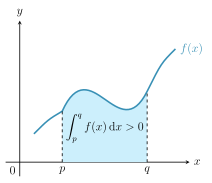
- If \(a > 0\) and \(b^2 < 4ac \Rightarrow \Delta < 0\) then \(f(x) = ax^2-bx+c > 0\) for all \(x\). Therefore \begin{align*} && 0 & < \int_0^1 (ax^2-bx+c) \d x\\ &&&= \frac13 a-\frac12b+c \\ \Rightarrow && 3b &< 2a+6c \end{align*}
- Similar logic tells us this must also be always positive, therefore \begin{align*} && 0 &< \int_0^{\pi} (a \sin^2 x - b \sin x +c ) \d x\\ &&&= \frac{\pi}{2}a - 2b+\pi c \\ \Rightarrow && 4b &< (a+2c)\pi \end{align*}
- Similar logic shows that \(f(x) = \frac{a}{x^2}-\frac{b}{x} +c>0\), therefore \begin{align*} && 0 &< \int_p^q \left (\frac{a}{x^2} - \frac{b}{x} + c\right) \d x \\ &&&=a\left (\frac{1}{p} - \frac{1}{q} \right) - b(\ln q - \ln p)+c(q-p) \\ \Rightarrow && b \ln (q/p) &,< a\left (\frac{1}{p} - \frac{1}{q} \right) +c(q-p) \end{align*}
2002 Paper 2 Q11
A rigid straight beam \(AB\) has length \(l\) and weight \(W\). Its weight per unit length at a distance \(x\) from \(B\) is \(\alpha Wl^{-1} (x/l)^{\alpha-1}\,\), where \(\alpha\) is a positive constant. Show that the centre of mass of the beam is at a distance \(\alpha l/(\alpha+1)\) from \(B\). The beam is placed with the end \(A\) on a rough horizontal floor and the end \(B\) resting against a rough vertical wall. The beam is in a vertical plane at right angles to the plane of the wall and makes an angle of \(\theta\) with the floor. The coefficient of friction between the floor and the beam is \(\mu\) and the coefficient of friction between the wall and the beam is also \(\mu\,\). Show that, if the equilibrium is limiting at both \(A\) and \(B\), then \[ \tan\theta = \frac{1-\alpha \mu^2}{(1+\alpha)\mu}\;. \] Given that \(\alpha =3/2\,\) and given also that the beam slides for any \(\theta<\pi/4\,\) find the greatest possible value of \(\mu\,\).
2002 Paper 3 Q1
Find the area of the region between the curve \(\displaystyle y = {\ln x \over x}\,\) and the \(x\)-axis, for \(1 \le x \le a\). What happens to this area as \(a\) tends to infinity? Find the volume of the solid obtained when the region between the curve \(\displaystyle y = {\ln x \over x}\,\) and the \(x\)-axis, for \(1 \le x\le a\), is rotated through \(2 \pi\) radians about the \(x\)-axis. What happens to this volume as \(a\) tends to infinity?
Solution: \begin{align*} && \int_1^a \frac{\ln x}{x} \d x &= \left [ \ln x \cdot \ln x\right ]_1^a - \int_1^a \frac{\ln x}{x} \d x \\ \Rightarrow && \int_1^a \frac{\ln x}{x} \d x &= \frac12 \left ( \ln a \right) ^2 \\ && \int_1^\infty \frac{\ln x}{x} \d x &= \lim_{a \to \infty} \frac12 (\ln a)^2 \\ &&&= \infty \end{align*} \begin{align*} && \pi \int_1^a \left ( \frac{\ln x}{x} \right)^2 \d x &= \pi \int_{u=0}^{u=\ln a} \left ( \frac{u}{e^u} \right)^2 e^u \d u \\ &&&= \pi \int_0^{\ln a} u^2 e^{-u} \d u \\ &&&= \pi \left [-u^2e^{-u} \right]_0^{\ln a} +\pi \int_0^{\ln a} 2u e^{-u} \d u \\ &&&= -\frac{\pi}{a} (\ln a)^2 + \pi \left [-2u e^{-u} \right]_0^{\ln a} + \pi \int_0^{\ln a} e^{-u} \d u \\ &&&= -\frac{\pi}{a} (\ln a)^2- \frac{2 \pi}{a}\ln a+\pi \left (1 - \frac{1}{a} \right) \\ \\ && \pi \int_1^{\infty} \left ( \frac{\ln x}{x} \right)^2 \d x &= \lim_{a \to \infty} \left ( -\frac{\pi}{a} (\ln a)^2- \frac{2 \pi}{a}\ln a+\pi \left (1 - \frac{1}{a} \right) \right) \\ &&&= \pi \end{align*}