Problems
Filters
298 problems found
2013 Paper 3 Q13
- The continuous random variable \(X\) satisfies
\(0\le X\le 1\), and has probability density function
\(\f(x)\) and cumulative distribution
function \(\F(x)\). The
greatest value of \(\f(x)\) is \(M\), so that \(0\le \f(x) \le M\).
- Show that \(0\le \F(x) \le Mx\) for \(0\le x\le1\).
- For any function \(\g(x)\), show that \[ \int_0^1 2 \g(x) \F(x) \f(x) \d x = \g(1) - \int_0^1 \g'(x) \big( \F(x)\big)^2 \d x \,. \]
- The
continuous random variable \(Y\)
satisfies
\(0\le Y\le 1\), and has probability density function
\(k \F(y) \f(y)\), where \(\f\) and \(\F\) are as above.
- Determine the value of the constant \(k\).
- Show that \[ 1+ \frac{nM}{n+1}\mu_{n+1} - \frac{nM}{n+1} \le \E(Y^n) \le 2M\mu_{n+1}\,, \] where \(\mu_{n+1} = \E(X^{n+1})\) and \(n\ge0\).
- Hence show that, for \(n\ge 1\), \[ \mu _n \ge \frac{n}{(n+1)M} -\frac{n-1}{n+1} \,.\]
Solution:
- \(\,\) \begin{align*} && 0 &\leq f(t) &\leq M \\ \Rightarrow && \int_0^x 0 \d t &\leq \int_0^x f(t) \d t & \leq \int_0^x M \d x \\ \Rightarrow && 0 &\leq F(x) &\leq Mx \end{align*}
- \(\,\) \begin{align*} && \int_0^1 2g(x)F(x)f(x) \d x &= \left [ g(x) F(x)^2 \right] - \int_0^1 g'(x) \left ( F(x)\right)^2 \d x \\ &&&= g(1) - \int_0^1 g'(x) \left ( F(x)\right)^2 \d x \end{align*}
- \(\,\) \begin{align*} && 1 &= \int_0^1 kF(y)f(y) \d y \\ &&&= k\left [ \frac12 F(y)^2\right]_0^1 \\ &&&= \frac{k}{2} \\ \Rightarrow && k &= 2 \end{align*}
- \(\,\) \begin{align*} \E[Y^n] &= \int_0^1 y^n 2F(y)f(y) \d y \\ &\geq \int_0^1 y^n 2My f(y) \d y \\ &= 2M\int_0^1 y^{n+1} f(y) \d y \\ &= 2M \E[X^{n+1}] = 2M\mu_{n+1} \\ \\ \E[Y^n] &= \int_0^1 y^n 2F(y)f(y) \d y \\ &= 1 - \int_0^1 ny^{n-1} F(y)^2 \d y \\ &\geq 1 - \int_0^1 ny^{n-1}My F(y) \d y \\ &= 1 - M\int_0^1 ny^n F(y) \d y \\ &= 1 - M[\frac{n}{n+1}y^{n+1} F(y)]_0^1 + M\int_0^1\frac{n}{n+1} y^{n+1} f(y) \d y \\ &= 1 - \frac{nM}{n+1} + \frac{nM}{n+1} \mu_{n+1} \end{align*}
- Since \(\E[Y^{n-1}] \geq 0\) we must have \begin{align*} && 2M\mu_n \geq 1 + \frac{(n-1)M}{n}\mu_n - \frac{(n-1)M}{n} \\ \Rightarrow && \mu_n \left (2M + \frac{(n-1)M}{n} \right) \geq 1 - \frac{(n-1)M}{n} \\ \Rightarrow && \mu_n \frac{3Mn-M}{n} & \geq \frac{n-(n-1)M}{n} \\ \Rightarrow && \mu_n & \geq \frac{n-(n-1)M}{3Mn-M} \end{align*}
2012 Paper 1 Q3
- Sketch the curve \(y=\sin x\) for \(0\le x \le \tfrac12 \pi\) and add to your diagram the tangent to the curve at the origin and the chord joining the origin to the point \((b, \sin b)\), where \(0 < b < \frac12\pi\). By considering areas, show that \[ 1-\tfrac12 b^2 <\cos b < 1-\tfrac 12 b \sin b\,. \]
- By considering the curve \(y=a^x\), where \(a>1\), show that \[ \frac{2(a-1)}{a+1} < \ln a < -1 + \sqrt{2a-1\,}\,. \] [Hint: You may wish to write \(a^x\) as \(\e^{x\ln a}\).]
Solution:
- \(\,\)
The area under the blue curve is \(1-\cos b\). The area under the green line is \(\frac12 b \sin b\) The area under the red line is \(\frac12 b^2\) Therefore \(\frac12 b \sin b < 1- \cos b < \frac12 b^2 \Rightarrow 1- \frac12 b^2 < \cos b < 1 - \frac12 b \sin b\)

- \(\,\)
\begin{align*} &&\text{Area under blue curve}: &= \int_0^1 a^x \d x\\ &&&= \left [ \frac{1}{\ln a}e^{x \ln a} \right]_0^1 \\ &&&= \frac{a-1}{\ln a} \\ \\ &&\text{Area under green line}: &=\frac12 \cdot 1 \cdot (a + 1)\\ &&&= \frac{a+1}{2} \\ \\ &&\text{Area under tangent}: &=\frac12 \cdot 1 \cdot (1+\ln a + 1)\\ &&&= \frac{\ln a+2}{2} \\ \\ \Rightarrow && \frac{a+1}{2} & > \frac{a-1}{\ln a} \\ \Rightarrow && \ln a& > \frac{2(a-1)}{a+1} \\ \\ \Rightarrow && \frac{a-1}{\ln a} &> \frac{\ln a +2}{2} \\ \Rightarrow && 2(a-1) -2\ln a - (\ln a)^2 &> 0 \\ \Rightarrow && \ln a & < -1 + \sqrt{2a-1} \end{align*}

2012 Paper 1 Q6
A thin circular path with diameter \(AB\) is laid on horizontal ground. A vertical flagpole is erected with its base at a point \(D\) on the diameter \(AB\). The angles of elevation of the top of the flagpole from \(A\) and \(B\) are \(\alpha\) and \(\beta\) respectively (both are acute). The point \(C\) lies on the circular path with \(DC\) perpendicular to \(AB\) and the angle of elevation of the top of the flagpole from \(C\) is \(\phi\). Show that \(\cot\alpha\cot \beta = \cot^2\phi\). Show that, for any \(p\) and \(q\), \[ \cos p \cos q \sin^2\tfrac12(p+q) - \sin p\sin q \cos^2 \tfrac12 (p+q) = \tfrac12 \cos(p+q) -\tfrac12 \cos(p+q)\cos(p-q) .\] Deduce that, if \(p\) and \(q\) are positive and \( p+q \le \tfrac12 \pi\), then \[ \cot p\cot q\, \ge \cot^2 \tfrac12(p+q) \, \] and hence show that \(\phi \le \tfrac12(\alpha+\beta)\) when \( \alpha +\beta \le \tfrac12 \pi\,\).
Solution:

2012 Paper 2 Q4
In this question, you may assume that the infinite series \[ \ln(1+x) = x-\frac{x^2}2 + \frac{x^3}{3} -\frac {x^4}4 +\cdots + (-1)^{n+1} \frac {x^n}{n} + \cdots \] is valid for \(\vert x \vert <1\).
- Let \(n\) be an integer greater than 1. Show that, for any positive integer \(k\), \[ \frac1{(k+1)n^{k+1}} < \frac1{kn^{k}}\,. \] Hence show that \(\displaystyle \ln\! \left(1+\frac1n\right) <\frac1n\,\). Deduce that \[ \left(1+\frac1n\right)^{\!n}<\e\,. \]
- Show, using an expansion in powers of \(\dfrac1y\,\), that $ \displaystyle \ln \! \left(\frac{2y+1}{2y-1}\right) > \frac 1y %= \sum _{r=0}^\infty \frac 1{(2r+1)(2y)^{2r}}\,. \( for \)y>\frac12$. Deduce that, for any positive integer \(n\), \[ \e < \left(1+\frac1n\right)^{\! n+\frac12}\,. \]
- Use parts (i) and (ii) to show that as \(n\to\infty\) \[ \left(1+\frac1n\right)^{\!n} \to \e\,. \]
Solution:
- Since \(k \geq 1\) we have \(n^{k+1} > n^k\) and \((k+1) > k\), therefore \((k+1)n^{k+1} >kn^k \Rightarrow \frac{1}{(k+1)n^{k+1}} < \frac{1}{kn^k}\) \begin{align*} && \ln \left ( 1 + \frac1n \right) &= \frac1n -\frac{1}{2n^2} + \frac{1}{3n^3} - \frac{1}{4n^4} + \cdots \\ &&&= \frac1n - \underbrace{\left (\frac{1}{2n^2}-\frac{1}{3n^3} \right)}_{>0}- \underbrace{\left (\frac{1}{4n^4}-\frac{1}{5n^5} \right)}_{>0} - \cdot \\ &&&< \frac1n \\ \\ \Rightarrow && n \ln \left ( 1 + \frac1n \right) &< 1 \\ \Rightarrow && \ln \left ( \left ( 1 + \frac1n \right)^n \right) &< 1 \\ \Rightarrow && \left ( 1 + \frac1n \right)^n &< e \end{align*}
- \(\,\) \begin{align*} &&\ln \left(\frac{2y+1}{2y-1}\right) &= \ln \left (1 + \frac{1}{2y} \right)-\ln \left (1 - \frac{1}{2y} \right) \\ &&&= \frac{1}{2y} - \frac{1}{2(2y)^2} + \frac{1}{3(2y)^3} - \cdots - \left (-\frac{1}{2y} - \frac{1}{2(2y)^2} - \frac{1}{3(2y)^3} - \cdots \right) \\ &&&= \frac{1}{y} + \frac{2}{3(2y)^3} + \frac{2}{5(2y)^5} \\ &&&= \sum_{r=1}^{\infty} \frac{2}{(2r-1)(2y)^{2r-1}} \\ &&&> \frac1y \\ \\ \Rightarrow && \ln \left (1 + \frac{1}{y-\frac12} \right) &> \frac{1}{y} \\\Rightarrow && \ln \left (1 + \frac{1}{n} \right) &> \frac{1}{n+\frac12} \\ \Rightarrow &&(n+\tfrac12) \ln \left (1 + \frac{1}{n} \right) &> 1\\ \Rightarrow && \ln \left ( \left (1 + \frac{1}{n} \right)^{n+\tfrac12} \right) &> 1\\ \Rightarrow && \left (1 + \frac{1}{n} \right)^{n+\tfrac12} & > e \end{align*}
2012 Paper 2 Q8
The positive numbers \(\alpha\), \(\beta\) and \(q\) satisfy \(\beta-\alpha >q\). Show that \[ \frac{\alpha^2+\beta^2 -q^2}{\alpha\beta}-2> 0\,. \] The sequence \(u_0\), \(u_1\), \(\ldots\) is defined by \(u_0=\alpha\), \(u_1=\beta\) and \[ \ \ \ \ \ \ \ \ \ \ \ \ \ \ \ u_{n+1} = \frac {u_{n}^2 -q^2}{u_{n-1}} \ \ \ \ \ \ \ \ \ \ \ (n\ge1), \] where \(\alpha\), \(\beta\) and \(q\) are given positive numbers (and \(\alpha\) and \(\beta\) are such that no term in the sequence is zero). Prove that \(u_n(u_n+u_{n+2}) = u_{n+1}(u_{n-1}+u_{n+1})\,\). Prove also that \[ u_{n+1} -pu_n + u_{n-1}=0 \] for some number \(p\) which you should express in terms of \(\alpha\), \(\beta\) and \(q\). Hence, or otherwise, show that if \(\beta> \alpha+q\), the sequence is strictly increasing (that is, \(u_{n+1}-u_n > 0\) for all \(n\)). Comment on the case \(\beta =\alpha +q\).
Solution: \begin{align*} && \beta - \alpha &> q \\ \Rightarrow &&(\beta - \alpha)^2 &> q^2 \\ \Rightarrow && \beta^2 +\alpha^2 - 2\beta \alpha &> q^2 \\ \Rightarrow && \alpha^2+\beta^2-q^2 -2 \beta \alpha &> 0 \\ \Rightarrow && \frac{\alpha^2+\beta^2-q^2}{\alpha\beta} - 2 &> 0 \end{align*} \begin{align*} && u_n(u_n+u_{n+2}) &= u_n \cdot \left (u_n + \frac {u_{n+1}^2 -q^2}{u_{n}}\right) \\ &&&= u_n^2 + u_{n+1}^2-q^2 \\ &&&= u_n^2 + u_{n+1}^2 - (u_n^2-u_{n-1}u_{n+1}) \\ &&&= u_{n+1}^2 + u_{n+1}u_{n-1} \\ &&&= u_{n+1}(u_{n-1}+u_{n+1}) \\ \\ && u_{n+1}-pu_n+u_{n-1} &= -pu_n+\frac{u_{n}(u_{n-2}+u_n)}{u_{n-1}} \\ &&&= \frac{u_n(u_{n}-pu_{n-1}+u_{n-2})}{u_{n-1}} \end{align*} Therefore if \(u_2 -pu_1 + u_0 = 0\) it is always zero, ie if \begin{align*} && u_2 &= p\beta - \alpha \\ && u_2 &= \frac{\beta^2-q^2}{\alpha} \\ \Rightarrow && \frac{\beta^2-q^2}{\alpha} &= p\beta - \alpha \\ \Rightarrow && p &= \frac{\alpha^2+\beta^2-q^2}{\alpha\beta} \end{align*} If \(\beta > \alpha + q\) we must have that \(p > 2\), and so \(u_{n+1}-u_n = (p-1)u_n - u_{n-1} > u_n-u_{n-1} > 0\), therefore the sequence is strictly increasing. If \(\beta = \alpha + q\) the sequence follows \(u_{n+1} - 2u_n + u_{n-1} =0\) and so \(u_{n+1}-u_n = u_n - u_{n-1}\) for all \(n\) (which is still increasing - it's an arithmetic progression with common difference \(\beta - \alpha\)).
2012 Paper 2 Q9
A tennis ball is projected from a height of \(2h\) above horizontal ground with speed \(u\) and at an angle of \(\alpha\) below the horizontal. It travels in a plane perpendicular to a vertical net of height \(h\) which is a horizontal distance of \(a\) from the point of projection. Given that the ball passes over the net, show that \[ \frac 1{u^2}< \frac {2(h-a\tan\alpha)}{ga^2\sec^2\alpha}\,. \] The ball lands before it has travelled a horizontal distance of \(b\) from the point of projection. Show that \[ \sqrt{u^2\sin^2\alpha +4gh \ } < \frac{bg}{u\cos\alpha} + u \sin\alpha\,. \] Hence show that \[ \tan\alpha < \frac{h(b^2-2a^2)}{ab(b-a)}\,. \]
Solution: \begin{align*} && s &= ut \\ \Rightarrow && a &= u \cos \alpha t\\ \Rightarrow && t &= \frac{a}{u \cos \alpha}\\ && s &= ut+ \frac12at^2 \\ \Rightarrow && -h &< -u\sin \alpha \frac{a}{u \cos \alpha}-\frac12 g \left (\frac{a}{u \cos \alpha} \right)^2 \\ &&&= -a \tan \alpha-\frac12 g a^2 \frac{1}{u^2} \sec^2 \alpha \\ \Rightarrow && \frac12 g a^2 \frac{1}{u^2} \sec^2 \alpha &< h -a\tan \alpha \\ \Rightarrow &&\frac{1}{u^2} &< \frac{2(h-a\tan \alpha)}{ga^2 \sec^2 \alpha} \end{align*} \begin{align*} && s &= ut + \frac12a t^2 \\ \Rightarrow && 2h &= u\sin \alpha t + \frac12 gt^2 \\ \Rightarrow && t &= \frac{-u\sin \alpha \pm \sqrt{u^2 \sin^2 \alpha+4hg}}{g}\\ && t &= \frac{-u\sin \alpha +\sqrt{u^2 \sin^2 \alpha+4hg}}{g}\\ && s &= ut \\ \Rightarrow && b &> u \cos \alpha t \\ \Rightarrow && \frac{b}{u \cos \alpha} &> \frac{-u\sin \alpha +\sqrt{u^2 \sin^2 \alpha+4hg}}{g} \\ \Rightarrow && \sqrt{u^2 \sin^2 \alpha+4hg} &< \frac{bg}{u \cos \alpha} + u \sin \alpha \\ \end{align*} \begin{align*} \Rightarrow && u^2 \sin^2 \alpha+4hg &< \frac{b^2g^2}{u^2 \cos^2 \alpha} +u^2 \sin^2 \alpha + 2bg \tan \alpha \\ \Rightarrow && 4hg - 2bg \tan \alpha &< \frac{b^2g^2}{u^2 \cos^2 \alpha} \\ &&&< \frac{b^2g^2}{\cos^2 \alpha} \frac{2(h-a\tan \alpha)}{ga^2 \sec^2 \alpha} \\ &&&= \frac{2b^2g(h-a\tan \alpha)}{a^2} \\ \Rightarrow && \tan \alpha \left (\frac{2b^2g}{a} - 2bg \right) &< \frac{2b^2gh}{a^2} - 4hg \\ \Leftrightarrow && \tan \alpha \left (\frac{2b^2g- 2abg}{a} \right) &< \frac{2b^2gh- 4hga^2}{a^2} \\ \Leftrightarrow && \tan \alpha \left (\frac{2bg(b- a)}{a} \right) &< \frac{2hg(b^2- 2a^2)}{a^2} \\ \Rightarrow && \tan \alpha &< \frac{h(b^2-2a^2)}{ab(b-a)} \end{align*}
2012 Paper 2 Q10
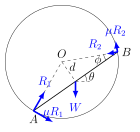
A hollow circular cylinder of internal radius \(r\) is held fixed with its axis horizontal. A uniform rod of length \(2a\) (where \(a < r\)) rests in equilibrium inside the cylinder inclined at an angle of \(\theta\) to the horizontal, where \(\theta\ne0\). The vertical plane containing the rod is perpendicular to the axis of the cylinder. The coefficient of friction between the cylinder and each end of the rod is \(\mu\), where \(\mu > 0\). Show that, if the rod is on the point of slipping, then the normal reactions \(R_1\) and \(R_2\) of the lower and higher ends of the rod, respectively, on the cylinder are related by \[ \mu(R_1+R_2) = (R_1-R_2)\tan\phi \] where \(\phi\) is the angle between the rod and the radius to an end of the rod. Show further that \[ \tan\theta = \frac {\mu r^2}{r^2 -a^2(1+\mu^2)}\,. \] Deduce that \(\lambda <\phi \), where \(\tan\lambda =\mu\).
Solution:
2012 Paper 2 Q12
A modern villa has complicated lighting controls. In order for the light in the swimming pool to be on, a particular switch in the hallway must be on and a particular switch in the kitchen must be on. There are four identical switches in the hallway and four identical switches in the kitchen. Guests cannot tell whether the switches are on or off, or what they control. Each Monday morning a guest arrives, and the switches in the hallway are either all on or all off. The probability that they are all on is \(p\) and the probability that they are all off is \(1-p\). The switches in the kitchen are each on or off, independently, with probability \(\frac12\).
- On the first Monday, a guest presses one switch in the hallway at random and one switch in the kitchen at random. Find the probability that the swimming pool light is on at the end of this process. Show that the probability that the guest has pressed the swimming pool light switch in the hallway, given that the light is on at the end of the process, is \(\displaystyle \frac{1-p}{1+2p}\).
- On each of seven Mondays, guests go through the above process independently of each other, and each time the swimming pool light is found to be on at the end of the process. Given that the most likely number of days on which the swimming pool light switch in the hallway was pressed is 3, show that \(\frac14 < p < \frac{5}{14}\).
Solution:
- \(\,\) \begin{align*} && \mathbb{P}(\text{hall switch on}) &= \underbrace{p \cdot \frac34 }_{\text{already on and not flipped}}+ \underbrace{(1-p) \cdot \frac14}_{\text{not on and flipped}} \\ &&&= \frac14 +\frac12 p\\ && \mathbb{P}(\text{kitchen on}) &= \frac12 \\ \Rightarrow && \mathbb{P}(\text{pool is on}) &= \frac18 + \frac14p \end{align*} \begin{align*} && \mathbb{P}(\text{flipped hall switch} | \text{pool on}) &= \frac{\mathbb{P}(\text{flipped hall and pool on})}{\mathbb{P}(\text{pool on})} \\ &&&= \frac{(1-p)\frac14 \cdot \frac 12}{\frac18 + \frac14 p} \\ &&&= \frac{1-p}{1+2p} \end{align*}
- The number of days the swimming pool light was pressed is \(X = B\left (7, \frac{1-p}{1+2p} \right)\), and we have that \(\mathbb{P}(X = 2) < \mathbb{P}(X = 3) > \mathbb{P}(X=4)\) (since the binomial is unimodal). Let \(q = \frac{1-p}{1+2p} \) \begin{align*} && \mathbb{P}(X = 2) &< \mathbb{P}(X = 3) \\ \Rightarrow && \binom{7}{2} q^2(1-q)^5 &< \binom{7}{3}q^3(1-q)^4 \\ \Rightarrow && 21(1-q) &< 35q \\ \Rightarrow && 21 &< 56q \\ \Rightarrow && \frac{3}{8} &< \frac{1-p}{1+2p} \\ \Rightarrow && 3+6p &< 8-8p \\ \Rightarrow && 14p &< 5\\ \Rightarrow && p &< \frac5{14} \\ \\ && \mathbb{P}(X = 3) &> \mathbb{P}(X = 4) \\ \Rightarrow && \binom{7}{3} q^3(1-q)^4 &> \binom{7}{4}q^4(1-q)^3 \\ \Rightarrow &&(1-q)&> q \\ \Rightarrow && \frac12 &> q \\ \Rightarrow && \frac12 &> \frac{1-p}{1+2p} \\ \Rightarrow && 1+2p &> 2-2p \\ \Rightarrow && 4p &> 1\\ \Rightarrow && p &> \frac1{4} \end{align*} Therefore \(\frac14 < p < \frac{5}{14}\) as required.
2012 Paper 3 Q9
A pulley consists of a disc of radius \(r\) with centre \(O\) and a light thin axle through \(O\) perpendicular to the plane of the disc. The disc is non-uniform, its mass is \(M\) and its centre of mass is at \(O\). The axle is fixed and horizontal. Two particles, of masses \(m_1\) and \(m_2\) where \(m_1>m_2\), are connected by a light inextensible string which passes over the pulley. The contact between the string and the pulley is rough enough to prevent the string sliding. The pulley turns and the vertical force on the axle is found, by measurement, to be~\(P+Mg\).
- The moment of inertia of the pulley about its axle is calculated assuming that the pulley rotates without friction about its axle. Show that the calculated value is \[ \frac{((m_1 + m_2)P - 4m_1m_2g)r^2} {(m_1 + m_2)g - P}\,. \tag{\(*\)}\]
- Instead, the moment of inertia of the pulley about its axle is calculated assuming that a couple of magnitude \(C\) due to friction acts on the axle of the pulley. Determine whether this calculated value is greater or smaller than \((*)\). Show that \(C<(m_1-m_2)rg\).
2011 Paper 1 Q8
- The numbers \(m\) and \(n\) satisfy
\[
m^3=n^3+n^2+1\,.
\tag{\(*\)}
\]
- Show that \(m > n\). Show also that \(m < n+1\) if and only if \(2n^2+3n > 0\,\). Deduce that \(n < m < n+1\) unless \(-\frac32 \le n \le 0\,\).
- Hence show that the only solutions of \((*)\) for which both \(m\) and \(n\) are integers are \((m,n) = (1,0)\) and \((m,n)= (1,-1)\).
- Find all integer solutions of the equation \[ p^3=q^3+2q^2-1\,. \]
2011 Paper 2 Q2
Write down the cubes of the integers \(1, 2, \ldots , 10\). The positive integers \(x\), \(y\) and \(z\), where \(x < y\), satisfy \[ x^3+y^3 = kz^3\,, \tag{\(*\)} \] where \(k\) is a given positive integer.
- In the case \(x+y =k\), show that \[ z^3 = k^2 -3kx+3x^2\,. \] Deduce that \((4z^3 - k^2)/3\) is a perfect square and that \(\frac14 {k^2} \le z^3 < k^2\,\). Use these results to find a solution of \((*)\) when \(k=20\).
- By considering the case \(x+y = z^2\), find two solutions of \((*)\) when \(k=19\).
Solution: \begin{array}{c|c} n & n^3 \\ \hline 1 & 1 \\ 2 & 8 \\ 3 & 27 \\ 4 & 64 \\ 5 & 125 \\ 6 & 216 \\ 7 & 343 \\ 8 & 512 \\ 9 & 729 \\ 10 & 1000 \\ \end{array}
- \(\,\) \begin{align*} && x^3 + y^3 &= kz^3 \\ \Rightarrow &&k(x^2-xy+y^2)&=kz^3 \\ \Rightarrow && z^3 &= (x+y)^2-3xy \\ &&&= k^2-3x(k-x) \\ &&&= k^2-3xk+3x^2 \\ \\ \Rightarrow && \frac{4z^3-k^2}{3} &= \frac{4(k^2-3xk+3x^2)-k^2}{3} \\ &&&= \frac{3k^2-12xk+12x^2}{3} \\ &&&= k^2-4xk+4x^2 \\ &&&= (k-2x)^2 \end{align*} Therefore \(\frac{4z^3-k^2}{3}\) is a perfect square and so \(4z^3 \geq k^2 \Rightarrow z^3 \geq \frac14k^2\). Clearly \(kz^3 < x^3+3x^2y+3xy^2+y^3 = k^3 \Rightarrow z^3 < k^2\), therefore \(\frac14 k^2 \leq z^3 < k^2\) Therefore if \(k = 20\), \(100 \leq z^3 < 400 \Rightarrow z \in \{ 5, 6,7\}\). Mod \(3\) it is clear that \(4z^3-k^2\) is not divisible by \(3\) for \(z = 5,6\) therefore \(z = 7\) \begin{align*} && 343 &= 3x^2-60x+400 \\ \Rightarrow && 0 &= 3x^2-60x+57 \\ \Rightarrow && 0 &= x^2-20x+19 \\ \Rightarrow && x &= 1,19 \end{align*} Therefore a solution is \(1^3 + 19^3 = 20 \cdot 7^3\)
- When \(x+y = z^2\) we must have \begin{align*} && x^3 + y^3 &= kz^3 \\ \Rightarrow &&(x^2-xy+y^2)&=kz \\ \Rightarrow && kz &= (x+y)^2-3xy \\ &&&= z^4-3x(z^2-x)\\ &&&= z^4-3xz^2+3x^2 \\ \Rightarrow && 0 &= 3x^2-3z^2x+z^4-kz \\ \\ \Rightarrow && 0 &\leq \Delta = 9z^4-12(z^4-kz) \\ &&&=12kz-3z^4 \\ \Rightarrow && z^3 &\leq 4k \end{align*} If \(k = 19\) this means \(z \leq 4\) \begin{array}{c|c|c|c} z & 19z^3 & x & y \\ \hline 1 & 19 & - & - \\ 2 & 152 & 3 & 5 \\ 3 & 513 & 1 & 8 \end{array} So two solutions are \(1^3+8^3 = 19 \cdot 3^3\) and \(3^3+5^3=19 \cdot 2^3\)
2011 Paper 2 Q3
In this question, you may assume without proof that any function \(\f\) for which \(\f'(x)\ge 0\) is increasing; that is, \(\f(x_2)\ge \f(x_1)\) if \(x_2\ge x_1\,\).
- Let \(\f(x) =\sin x -x\cos x\). Show that \(\f(x)\) is increasing for \(0\le x \le \frac12\pi\,\) and deduce that \(\f(x)\ge 0\,\) for \(0\le x \le \frac12\pi\,\).
- Given that \(\dfrac{\d}{\d x} (\arcsin x) \ge1\) for \(0\le x< 1\), show that \[ \arcsin x\ge x \quad (0\le x < 1). \]
- Let \(\g(x)= x\cosec x\, \text{ for }0< x < \frac12\pi\). Show that \(\g\) is increasing and deduce that \[ ({\arcsin x})\, x^{-1} \ge x\,{\cosec x} \quad (0 < x < 1). \]
- Given that $\dfrac{\d}{\d x} (\arctan x)\le 1\text{ for }x\ge 0$, show by considering the function \(x^{-1} \tan x\) that \[ (\tan x)( \arctan x) \ge x^2 \quad (0< x < \tfrac12\pi). \]
Solution:
- Given \(\frac{\d}{\d x} (\arctan x) \leq 1\) we must have \(\frac{\d}{ \d x} (x-\arctan x) \geq 0\) for \(x \geq 0\), but since \( 0 - \arctan 0 = 0\) this means that \(x - \arctan x \geq 0\), ie \( \arctan x \geq x\) for \(x \geq 0\) \(g(x) = x^{-1} \tan x \Rightarrow g'(x) = -x^{-2}\tan x +x^{-1} \sec^2 x\). If we can show \(f(x) = x \sec ^2 x - \tan x\) is positive that would be great. However \(f'(x) = x 2 \tan x \sec^2 x \geq 0\) and \(f(0) = 0\) so \(f(x)\) is positive and \(g'(x)\) is positive and hence increasing, therefore \(g(x) \geq g(\arctan x) \Rightarrow \frac{\tan x}{x} \geq \frac{x}{\arctan x}\) from which the result follows.
2011 Paper 2 Q9
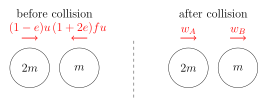
Two particles, \(A\) of mass \(2m\) and \(B\) of mass \(m\), are moving towards each other in a straight line on a smooth horizontal plane, with speeds \(2u\) and \(u\) respectively. They collide directly. Given that the coefficient of restitution between the particles is \(e\), where \(0 < e \le 1\), determine the speeds of the particles after the collision. After the collision, \(B\) collides directly with a smooth vertical wall, rebounding and then colliding directly with \(A\) for a second time. The coefficient of restitution between \(B\) and the wall is \(f\), where \(0 < f \le 1\). Show that the velocity of \(B\) after its second collision with \(A\) is \[ \tfrac23 (1-e^2)u - \tfrac13(1-4e^2)fu \] towards the wall and that \(B\) moves towards (not away from) the wall for all values of \(e\) and \(f\).
Solution:

2011 Paper 2 Q13
What property of a distribution is measured by its skewness?
- One measure of skewness, \(\gamma\), is given by \[ \displaystyle \gamma= \frac{ \E\big((X-\mu)^3\big)}{\sigma^3}\,, \] where \(\mu\) and \(\sigma^2\) are the mean and variance of the random variable \(X\). Show that \[ \gamma = \frac{ \E(X^3) -3\mu \sigma^2 - \mu^3}{\sigma^3}\,. \] The continuous random variable \(X\) has probability density function \(\f\) where \[ \f(x) = \begin{cases} 2x & \text{for } 0\le x\le 1\,, \\[2mm] 0 & \text{otherwise}\,. \end{cases} \] Show that for this distribution \(\gamma= -\dfrac{2\sqrt2}{5}\).
- The decile skewness, \(D\), of a distribution is defined by \[D= \frac { {\rm F}^{-1}(\frac9{10}) - 2{\rm F} ^{-1}(\frac12) + {\rm F}^{-1} (\frac1{10}) } {{\rm F}^{-1}(\frac9{10}) - {\rm F} ^{-1} (\frac1{10})}\,, \] where \({\rm F}^{-1}\) is the inverse of the cumulative distribution function. Show that, for the above distribution, \( D= 2 -\sqrt5\,.\) The Pearson skewness, \(P\), of a distribution is defined by \[ P = \frac{3(\mu-M)}{\sigma} \,,\] where \(M\) is the median. Find \(P\) for the above distribution and show that \(D > P > \gamma\,\).
Solution: Skewness is a measure of the symmetry (specifically the lack-thereof) in the distribution. How much mass is there on one side rather than another.
- \(\,\) \begin{align*} && \gamma &= \frac{\E \left [ (X - \mu)^3 \right ]}{\sigma^3} \\ &&&= \frac{\E \left [ X^3 - 3\mu X^2 + 3\mu^2 X - \mu^3 \right ]}{\sigma^3} \\ &&&= \frac{\E [ X^3 ]- 3\mu \E[X^2] + 3\mu^2 \E[X] - \mu^3 }{\sigma^3} \\ &&&= \frac{\E [ X^3 ]- 3\mu (\mu^2 + \sigma^2) + 3\mu^2\cdot \mu- \mu^3 }{\sigma^3} \\ &&&= \frac{\E [ X^3 ]- 3\mu \sigma^2 - \mu^3 }{\sigma^3} \\ \end{align*} \begin{align*} && f(x) &= \begin{cases} 2x & \text{for } 0\le x\le 1\,, \\[2mm] 0 & \text{otherwise}\,. \end{cases} \\ && \E[X] &= \int_0^1 2x^2 \d x \\ &&&= \frac23 \\ && \E[X^2] &= \int_0^1 2x^3 \d x \\ &&&= \frac12 \\ && \E[X^3] &= \int_0^1 2x^4 \d x \\ &&&= \frac25 \\ \\ && \mu &= \frac23 \\ && \sigma^2 &= \frac12 - \frac49 = \frac{1}{18} \\ && \gamma &= \frac{\frac25 - 3 \cdot \frac23 \cdot \frac1{18} - \frac8{27}}{\frac{1}{54\sqrt2}} \\ &&&= -\frac{2\sqrt2}{5} \end{align*}
- First note that \(\displaystyle F(x) = \int_0^x 2t \d t = x^2\) for \(x \in [0,1]\). In particular, \(F^{-1}(x) = \sqrt{x}\), so \begin{align*} && D &= \frac { {\rm F}^{-1}(\frac9{10}) - 2{\rm F} ^{-1}(\frac12) + {\rm F}^{-1} (\frac1{10}) } {{\rm F}^{-1}(\frac9{10}) - {\rm F} ^{-1} (\frac1{10})} \\ &&&= \frac{\sqrt{\frac9{10}} - 2 \sqrt{\frac5{10}} + \sqrt{\frac1{10}}}{\sqrt{\frac9{10}}-\sqrt{\frac1{10}}} \\ &&&= \frac{3-2\sqrt5+1}{3 - 1} \\ &&&= \frac{4-2\sqrt5}{2} = 2-\sqrt5 \end{align*} \begin{align*} && P &= \frac{3(\mu - M)}{\sigma} \\ &&&= \frac{3(\frac23 - \sqrt{\frac12})}{\frac{1}{3\sqrt2}} \\ &&&= 6 \sqrt2 - 9 \end{align*} First we compare \(P\) and \(D\), \(6\sqrt2-9\) and \(2-\sqrt5\) \begin{align*} && D & > P \\ \Leftrightarrow && 2-\sqrt5 &> 6\sqrt2 - 9 \\ \Leftrightarrow && 11 -6\sqrt2 &> \sqrt 5 \\ \Leftrightarrow && (121 + 72 - 132\sqrt2) & > 5 \\ \Leftrightarrow && 188 & > 132\sqrt2 \\ \Leftrightarrow && 47 & > 33 \sqrt 2\\ \Leftrightarrow && 2209 & > 2178 \end{align*} also \begin{align*} && P &> \gamma \\ \Leftrightarrow && 6\sqrt2 - 9 &> -\frac{2\sqrt2}{5} \\ \Leftrightarrow && 30\sqrt2 - 45 & > -2\sqrt2 \\ \Leftrightarrow && 32 \sqrt 2 &> 45 \\ \Leftrightarrow && 2048 &> 2025 \end{align*}
2011 Paper 3 Q4
The following result applies to any function \(\f\) which is continuous, has positive gradient and satisfies \(\f(0)=0\,\): \[ ab\le \int_0^a\f(x)\, \d x + \int_0^b \f^{-1}(y)\, \d y\,, \tag{\(*\)}\] where \(\f^{-1}\) denotes the inverse function of \(\f\), and \(a\ge 0\) and \(b\ge 0\).
- By considering the graph of \(y=\f(x)\), explain briefly why the inequality \((*)\) holds. In the case \(a>0\) and \(b>0\), state a condition on \(a\) and \(b\) under which equality holds.
- By taking \(\f(x) = x^{p-1}\) in \((*)\), where \(p>1\), show that if \(\displaystyle \frac 1p + \frac 1q =1\) then \[ ab \le \frac{a^p}p + \frac{b^q}q\,. \] Verify that equality holds under the condition you stated above.
- Show that, for \(0\le a \le \frac12 \pi\) and \(0\le b \le 1\), \[ ab \le b\arcsin b + \sqrt{1-b^2} \, - \cos a\,. \] Deduce that, for \(t\ge1\), \[ \arcsin (t^{-1}) \ge t - \sqrt{t^2-1}\,. \]