Problems
Filters
124 problems found
1990 Paper 2 Q2
Prove that if \(A+B+C+D=\pi,\) then \[ \sin\left(A+B\right)\sin\left(A+D\right)-\sin B\sin D=\sin A\sin C. \] The points \(P,Q,R\) and \(S\) lie, in that order, on a circle of centre \(O\). Prove that \[ PQ\times RS+QR\times PS=PR\times QS. \]
Solution: \begin{align*} \sin(A+B)\sin(A+D) - \sin B \sin D &= \sin (A+B)\sin(\pi - B-C) - \sin B \sin (\pi - A - B - C) \\ &= \sin (A+B)\sin(B+C) - \sin B \sin(A+B+C) \\ &= \sin(A+B)\sin (B+C) - \sin B (\sin (A+B)\cos C +\cos(A+B) \sin C) \\ &= \sin(A+B)\cos B \sin C + \cos(A+B)\sin B \sin C \\ &= \sin A \sin C \cos^2 B + \cos A \sin B \cos B \sin C - \cos A \cos B \sin B \sin C + \sin A \sin^2 B \sin C \\ &= \sin A \sin C (\cos^2 B + \sin^2 B) \\ &= \sin A \sin C \end{align*}

1990 Paper 2 Q4
A plane contains \(n\) distinct given lines, no two of which are parallel, and no three of which intersect at a point. By first considering the cases \(n=1,2,3\) and \(4\), provide and justify, by induction or otherwise, a formula for the number of line segments (including the infinite segments). Prove also that the plane is divided into \(\frac{1}{2}(n^{2}+n+2)\) regions (including those extending to infinity).
Solution: With \(n=1\) line, the plane is divided in half. With \(n=2\) lines the plane is divided into four pieces. (Each of the previous pieces are split in half) With \(n=3\) lines the plane is divided into up to \(7\) pieces. (The new line crosses two lines in two places dividing \(3\) regions into \(2\), thus increasing the number of regions by \(3\)). With \(n=4\) lines the plane is divided into \(11\) pieces. (The new line crosses three lines in three places doubling the number of regions of \(4\) places). Claim: With \(n\) lines the plane is divided into \(\frac12(n^2+n+2)\) regions. Proof: (By induction) (Base case) When \(n=1\) clearly the line is divided into \(2\) regions, and \(\frac12 (1^2 + 1^2 + 2) = 2\) so the base case is true. (Inductive step) Suppose our formula is true for \(n=k\), so we have placed \(k\) lines in general position and divided the plane into \(\frac12(k^2+k+2)\) regions. When we place a new line it will meet those \(k\) lines in \(k\) places (since no lines are parallel) and there will be k+1 regions the line will run through (since no three lines meet at a point). Each of those \(k+1\) regios is now split in half, so there are \(k+1\) "new regions". Therefore there are now \(\frac12(k^2+k+2)+(k+1) = \frac12(k^2+k+1+2k+2) = \frac12 ((k+1)^2+(k+1)+1)\) regions, ie our hypothesis is true for \(n=k+1\). (Conclusion) Therefore since our statement is true for \(n=1\) and since if it is true for some \(n=k\) it is true for \(n=k+1\) by the principle of mathematical induction it is true for all \(n \geq 1\) Proof: (Alternative). There are \(\binom{n}{2}\) places where the lines meet. Each intersection is the most extreme point (say lowest) for one region (if two are tied, rotate by a very small amount) so this is a unique mapping. There will be \(n+1\) regions which are infinite and don't have a most extreme point, hence \(\binom{n}{2} + n+1 = \frac12(n^2-n)+n+1 = \frac12(n^2+n+2)\)
1990 Paper 2 Q5
The distinct points \(L,M,P\) and \(Q\) of the Argand diagram lie on a circle \(S\) centred on the origin and the corresponding complex numbers are \(l,m,p\) and \(q\). By considering the perpendicular bisectors of the chords, or otherwise, prove that the chord \(LM\) is perpendicular to the chord \(PQ\) if and only if \(lm+pq=0.\) Let \(A_{1},A_{2}\) and \(A_{3}\) be three distinct points on \(S\). For any given point \(A_{1}'\) on \(S\), the points \(A_{2}',A_{3}'\) and \(A_{1}''\) are chosen on \(S\) such that \(A_{1}'A_{2}',A_{2}'A_{3}'\) and \(A_{3}'A_{1}''\) are perpendicular to \(A_{1}A_{2},A_{2}A_{3}\) and \(A_{3}A_{1},\) respectively. Show that for exactly two positions of \(A_{1}',\) the points \(A_{1}'\) and \(A_{1}''\) coincide. If, instead, \(A_{1},A_{2},A_{3}\) and \(A_{4}\) are four given distinct points on \(S\) and, for any given point \(A_{1}',\) the points \(A_{2}',A_{3}',A_{4}'\) and \(A_{1}''\) are chosen on \(S\) such that \(A_{1}'A_{2}',A_{2}'A_{3}',A_{3}'A_{4}'\) and \(A_{4}'A_{1}''\) are respectively perpendicular to \(A_{1}A_{2},A_{2}A_{3},A_{3}A_{4}\) and \(A_{4}A_{1},\) show that \(A_{1}'\) coincides with \(A_{1}''.\) Give the corresponding result for \(n\) distinct points on \(S\).
Solution: The perpendicular bisector of the chords runs through the origin, therefore \(LM\) is perpendicular to \(PQ\) if and only if \(\frac{l+m}{2}\) is perpendicular to \(\frac{p+q}{2}\), ie \begin{align*} && (l+m) &= it (p+q) \\ \Leftrightarrow && \frac{l+m}{p+q} & \in i \mathbb{R} \\ \Leftrightarrow && 0 &= \frac{l+m}{p+q} + \frac{l^*+m^*}{p^*+q^*} \\ &&&= \frac{l+m}{p+q} + \frac{\frac{r^2}{l}+\frac{r^2}{m}}{\frac{r^2}{p}+\frac{r^2}{q}} \\ &&&=\frac{l+m}{p+q} + \frac{l+m}{p+q} \frac{pq}{lm} \\ &&&= \frac{l+m}{p+q} \left ( \frac{lm+pq}{lm} \right) \end{align*} Therefore as long as \(l+m, p+q \neq 0\) \(lm+pq = 0\) is equivalent to the chords being perpendicular. In the case where (say) \(l,m\) is a diameter, then the condition for the chords to be perpendicular is that \(p,q\) is also a diameter and at right angles, but clearly this is also equivalent to our condition. Suppose \(A_1, A_2, A_3\) are distinct points on \(S\), and \(A_1'\) is given and suppose \(a_i, a_i'\) are the corresponding complex numbers, then the conditions are: \begin{align*} A_1'A_2' \perp A_1A_2: && 0 &= a_1'a_2' + a_1a_2 \\ A_2'A_3' \perp A_2A_3: && 0 &= a_2'a_3' + a_2a_3 \\ A_3'A_1'' \perp A_3A_1: && 0 &= a_3'a_1'' + a_3a_1 \\ \\ \Rightarrow && a_2' &= -\frac{a_1a_2}{a_1'} \\ && a_3' &= -\frac{a_2a_3}{a_2'} \\ &&&= \frac{a_1'a_2a_3}{a_1a_2} \\ &&&= \frac{a_1'a_3}{a_1} \\ && a_1'' &= - \frac{a_3a_1}{a_3'} \\ &&&= \frac{a_3a_1a_1}{a_1'a_3} \\ &&&= \frac{a_1^2}{a_1'} \\ \Rightarrow && a_1'a_1'' &= a_1^2 \end{align*} Therefore \(a_1' = a_1''\) if \(a_1' = \pm a_1\) Suppose we have \(4\) points, then \begin{align*} A_1'A_2' \perp A_1A_2: && 0 &= a_1'a_2' + a_1a_2 \\ A_2'A_3' \perp A_2A_3: && 0 &= a_2'a_3' + a_2a_3 \\ A_3'A_4' \perp A_3A_4: && 0 &= a_3'a_4' + a_3a_4 \\ A_4'A_1'' \perp A_4A_1: && 0 &= a_4'a_1'' + a_4a_1 \\ \\ \Rightarrow && a_4' &= -\frac{a_3a_4}{a_3'} \\ &&&= -\frac{a_1a_3a_4}{a_1'a_3} \\ &&&= -\frac{a_1a_4}{a_1'} \\ \Rightarrow && a_1'' &= -\frac{a_4a_1}{a_4'} \\ &&&= \frac{a_4a_1a_1'}{a_1a_4} \\ &&&= a_1' \end{align*} So they coincide. For \(n\) points if there are an even number of points they coincide, an odd number and there are two points when they coincide.
1989 Paper 1 Q1

Solution: \(AG = r\), therefore the area is: \begin{align*} A &= [AHG] - 2*[ABC] + [CDE] \\ &= \frac12 \pi r^2 - \pi h^2 + \frac12 \pi (r-2h)^2 \\ &= \frac12 \pi \l r^2 - 2h^2 + r^2 -4rh+4h^2 \r \\ &= \frac12 \pi \l 2r^2 -4rh + 2h^2\r \\ &= \pi (r-h)^2 \end{align*} This is the same area as a circle radius \(r-h\) But \(HD = r + (r-2d) = 2(r-d)\), ie the circle with diameter \(HD\) has radius \(r-h\) as required. Suppose \(A = (-h, 0), C = (h, 0), B = (0, h)\) then our parabola is \(y = \frac1{h}(h^2-x^2)\)

1989 Paper 1 Q3
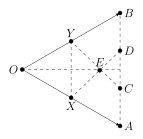
In the triangle \(OAB,\) \(\overrightarrow{OA}=\mathbf{a},\) \(\overrightarrow{OB}=\mathbf{b}\) and \(OA=OB=1\). Points \(C\) and \(D\) trisect \(AB\) (i.e. \(AC=CD=DB=\frac{1}{3}AB\)). \(X\) and \(Y\) lie on the line-segments \(OA\) and \(OB\) respectively, in such a way that \(CY\) and \(DX\) are perpendicular, and \(OX+OY=1\). Denoting \(OX\) by \(x\), obtain a condition relating \(x\) and \(\mathbf{a\cdot b}\), and prove that \[ \frac{8}{17}\leqslant\mathbf{a\cdot b}\leqslant1. \] If the angle \(AOB\) is as large as possible, determine the distance \(OE,\) where \(E\) is the point of intersection of \(CY\) and \(DX\).
Solution:
1989 Paper 2 Q5
- Show that in polar coordinates, the gradient of any curve at the point
\((r,\theta)\) is
\[
\left.\left(\frac{\mathrm{d}r}{\mathrm{d}\theta}\tan\theta+r\right)\right/\left(\frac{\mathrm{d}r}{\mathrm{d}\theta}-r\tan\theta\right).
\]

- A mirror is designed so that any ray of light which hits one side of the mirror and which is parallel to a certain fixed line \(L\) is reflected through a fixed point \(O\) on \(L\). For any ray hitting the mirror, the normal to the mirror at the point of reflection bisects the angle between the incident ray and the reflected ray, as shown in the figure. Prove that the mirror intersects any plane containing \(L\) in a parabola.
Solution:
- Suppose our curve is \(r(\theta)\), then \(y = r \sin \theta, x = r \cos \theta\) and \begin{align*} && \frac{\d y}{\d \theta} &= \frac{\d r}{\d \theta} \sin \theta + r \cos \theta \\ && \frac{\d x}{\d \theta} &= \frac{\d r}{\d \theta} \cos \theta - r \sin \theta \\ \Rightarrow && \frac{\d y}{\d x} &= \frac{\d y}{\d \theta} \Bigg / \frac{\d x}{\d \theta} \\ &&&= \frac{\frac{\d r}{\d \theta} \sin \theta + r \cos \theta}{\frac{\d r}{\d \theta} \cos \theta - r \sin \theta} \\ &&&= \frac{\frac{\d r}{\d \theta} \tan\theta + r }{\frac{\d r}{\d \theta} - r \tan\theta} \end{align*} as required.
- Set up a system of polar coordinates such that the origin is at \(O\) and all points in the plane containing \(L\) are represented by \((r, \theta)\). The constraint we have is that the angle of the normal, is \(\frac12 \theta\). Let \(\tan \tfrac12 \theta = t\), then \(\tan \theta = \frac{2t}{1-t^2}\) \begin{align*} && \tan \frac12 \theta &= -\frac{\frac{\d r}{\d \theta} - r \tan\theta}{\frac{\d r}{\d \theta} \tan\theta + r } \\ \Rightarrow && t &= -\frac{r'-r\frac{2t}{1-t^2}}{r' \frac{2t}{1-t^2}+r} \\ &&&= \frac{2tr-(1-t^2)r'}{2tr'+(1-t^2)r} \\ \Rightarrow && (2t^2+1-t^2)r' &= (2t-t+t^3)r \\ && (1+t^2)r' &= t(t^2+1) r \\ \Rightarrow && r' &= t r \\ \Rightarrow && \frac{\d r}{\d \theta} &= \tan \tfrac12 \theta r \\ \Rightarrow && \int \frac1r \d r &= \int \tan \frac12 \theta \d \theta \\ && \ln r &= -2\ln \cos \tfrac12 \theta+C \\ \Rightarrow && r\cos^2 \frac12 \theta &= C \\ \Rightarrow && r + r\cos \theta &= D \\ \Rightarrow && r &= D-x \\ \Rightarrow && x^2 + y^2 &= D^2 - 2Dx + x^2 \\ \Rightarrow && y^2 &= D^2-2Dx \end{align*} Therefore it is a parabola
1989 Paper 2 Q6
The function \(\mathrm{f}\) satisfies the condition \(\mathrm{f}'(x)>0\) for \(a\leqslant x\leqslant b\), and \(\mathrm{g}\) is the inverse of \(\mathrm{f}.\) By making a suitable change of variable, prove that \[ \int_{a}^{b}\mathrm{f}(x)\,\mathrm{d}x=b\beta-a\alpha-\int_{\alpha}^{\beta}\mathrm{g}(y)\,\mathrm{d}y, \] where \(\alpha=\mathrm{f}(a)\) and \(\beta=\mathrm{f}(b)\). Interpret this formula geometrically, in the case where \(\alpha\) and \(a\) are both positive. Prove similarly and interpret (for \(\alpha>0\) and \(a>0\)) the formula \[ 2\pi\int_{a}^{b}x\mathrm{f}(x)\,\mathrm{d}x=\pi(b^{2}\beta-a^{2}\alpha)-\pi\int_{\alpha}^{\beta}\left[\mathrm{g}(y)\right]^{2}\,\mathrm{d}y. \]
Solution: Let \(u = f(x)\) then \(\frac{\d u}{\d x} = f'(x)\) and \begin{align*} \int_a^b f(x) \d x &\underbrace{=}_{\text{IBP}} \left [ xf(x) \right]_a^b - \int_a^b x f'(x) \d x \\ &\underbrace{=}_{u = f(x)} b \beta - a \alpha - \int_{u = f(a) = \alpha}^{u = f(b) = \beta} g(u) \d u \\ &= b \beta - a \alpha - \int_{\alpha}^{\beta} g(u) \d u \end{align*}

1989 Paper 2 Q10
State carefully the conditions which the fixed vectors \(\mathbf{a,b,u}\) and \(\mathbf{v}\) must satisfy in order to ensure that the line \(\mathbf{r=a+}\lambda\mathbf{u}\) intersects the line \(\mathbf{r=b+\mu}\mathbf{v}\) in exactly one point. Find the two values of the fixed scalar \(b\) for which the planes with equations \[ \left.\begin{array}{c} x+y+bz=b+2\\ bx+by+z=2b+1 \end{array}\right\} \tag{*} \] do not intersect in a line. For other values of \(b\), express the line of intersection of the two planes in the form \(\mathbf{r=a}+\lambda\mathbf{u},\) where \(\mathbf{a\cdot u}=0\). Find the conditions which \(b\) and the fixed scalars \(c\) and \(d\) must satisfy to ensure that there is exactly one point on the line \[ \mathbf{r=}\left(\begin{array}{c} 0\\ 0\\ c \end{array}\right)+\mu\left(\begin{array}{c} 1\\ d\\ 0 \end{array}\right) \] whose coordinates satisfy both equations \((*)\).
Solution: There are two requirements (assuming they are lines not fixed points): 1. They cannot be parallel, ie \(\mathbf{u} \neq \lambda \mathbf{v}\) for any \(\lambda\) 2. They must lie in the same plane, ie \((\mathbf{b}-\mathbf{a})\cdot (\mathbf{u} \times \mathbf{v}) = 0\) The planes will not intersect in a line if they are either parallel and separate or parallel and the same. If \(b = 1\) or \(b=-1\) the planes are parallel. \begin{align*} && (x+y) + b z &= b+ 2\\ &&b(x+y) + z &= 2b + 1 \\ \Rightarrow && (1-b^2)z &= 2b+1 - b^2 -2b \\ &&&= 1-b^2 \\ \Rightarrow && z &= 1 \\ && x+ y &= 2 \\ \end{align*} Therefore our line is \(\mathbf{r} = \begin{pmatrix} 1+t \\ 1-t \\ 1 \end{pmatrix} = \begin{pmatrix} 1 \\ 1 \\ 1 \end{pmatrix} + t \begin{pmatrix} 1 \\ -1 \\ 0 \end{pmatrix} \) We must have: \(d \neq -1\) to ensure that the lines aren't parallel. We must also have: \begin{align*} 0 &= \left ( \begin{pmatrix} 1 \\ 1 \\ 1 \end{pmatrix} -\begin{pmatrix} 0 \\ 0 \\ c \end{pmatrix}\right) \cdot \left ( \begin{pmatrix} 1 \\ -1 \\ 0 \end{pmatrix} \times \begin{pmatrix} 1 \\ d \\ 0 \end{pmatrix} \right) \\ &= \begin{pmatrix} 1 \\ 1 \\ 1-c \end{pmatrix} \cdot \begin{pmatrix} 0 \\ 0 \\ d+1 \end{pmatrix} \\ &= (1-c)(d+1) \end{align*} So \(c =1\)
1989 Paper 2 Q12
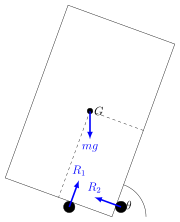
A uniform rectangular lamina of sides \(2a\) and \(2b\) rests in a vertical plane. It is supported in equilibrium by two smooth pegs fixed in the same horizontal plane, a distance \(d\) apart, so that one corner of the lamina is below the level of the pegs. Show that if the distance between this (lowest) corner and the peg upon which the side of length \(2a\) rests is less than \(a\), then the distance between this corner and the other peg is less than \(b\). Show also that \[ b\cos\theta-a\sin\theta=d\cos2\theta, \] where \(\theta\) is the acute angle which the sides of length \(2b\) make with the horizontal.
Solution:
1989 Paper 3 Q7
The linear transformation \(\mathrm{T}\) is a shear which transforms a point \(P\) to the point \(P'\) defined by
- \(\overrightarrow{PP'}\) makes an acute angle \(\alpha\) (anticlockwise) with the \(x\)-axis,
- \(\angle POP'\) is clockwise (i.e. the rotation from \(OP\) to \(OP'\) clockwise is less than \(\pi),\)
- \(PP'=k\times PN,\) where \(PN\) is the perpendicular onto the line \(y=x\tan\alpha,\) where \(k\) is a given non-zero constant.
Solution:

1988 Paper 1 Q3
Two points \(P\) and \(Q\) lie within, or on the boundary of, a square of side 1cm, one corner of which is the point \(O\). Show that the length of at least one of the lines \(OP,PQ\) and \(QO\) must be less than or equal to \((\sqrt{6}-\sqrt{2})\) cm.
Solution: First note that \((\sqrt{6} - \sqrt{2})^2 = 8 - 2\sqrt{12} = 8 - 4\sqrt{3}\) and since \(49 > 16 \times 3\) \(\sqrt{6}-\sqrt{2} > 1\). Therefore we can assume without loss of generality that \(P\) and \(Q\) both do not lie on the same side as each other, a side containing \(O\), otherwise one of those lengths would be \(1 \text{ cm} < (\sqrt{6}-\sqrt{2}) \text{ cm} \). Let \(O = (0,0)\), \(P = (1,x)\), \(Q = (y,1)\), then our lengths squared are: \(1 + x^2, 1 + y^2, (1-x)^2+(1-y)^2\). To maximise the length of the smallest side, each side should be equal in length (otherwise we could increase the length of the smallest side by moving the point between the shortest side and the longest side (without affecting the other side). Therefore \(x = y\) and \(1+x^2 = 2(1-x)^2 \Rightarrow x^2-4x+1 = 0 \Rightarrow x = 2 - \sqrt{3} \). Therefore the distances are all \(\sqrt{1+7-4\sqrt{3}} = \sqrt{8-4\sqrt{3}} = (\sqrt{6}-\sqrt{2}) \text{ cm}\)
1988 Paper 1 Q6
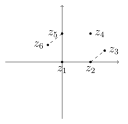
The complex numbers \(z_{1},z_{2},\ldots,z_{6}\) are represented by six distinct points \(P_{1},P_{2},\ldots,P_{6}\) in the Argand diagram. Express the following statements in terms of complex numbers:
- \(\overrightarrow{P_{1}P_{2}}=\overrightarrow{P_{5}P_{4}}\) and \(\overrightarrow{P_{2}P_{3}}=\overrightarrow{P_{6}P_{5}}\,\);
- \(\overrightarrow{P_{2}P_{4}}\) is perpendicular to \(\overrightarrow{P_{3}P_{6}}\,\).
Solution:
- \(\overrightarrow{P_{1}P_{2}}=\overrightarrow{P_{5}P_{4}}\) is equivalent to \(z_2 - z_1 = z_4 - z_5\). \(\overrightarrow{P_{2}P_{3}}=\overrightarrow{P_{6}P_{5}}\) is equivalent to \(z_3-z_2 = z_5 - z_6\).
- \(\overrightarrow{P_{2}P_{4}}\) is perpendicular to \(\overrightarrow{P_{3}P_{6}}\,\) is equivalent to \(\frac{z_4 - z_2}{z_6-z_3} \in i\mathbb{R}\)
1988 Paper 1 Q8
\(ABCD\) is a skew (non-planar) quadrilateral, and its pairs of opposite sides are equal, i.e. \(AB=CD\) and \(BC=AD\). Prove that the line joining the midpoints of the diagonals \(AC\) and \(BD\) is perpendicular to each diagonal.
Solution: Let \(\mathbf{a}\) denote the vector position of \(A\) and similarly for \(B, C, D\). Then we know that \((\mathbf{b}-\mathbf{a})\cdot(\mathbf{b}-\mathbf{a})=(\mathbf{c}-\mathbf{d})\cdot(\mathbf{c}-\mathbf{d})\) and \((\mathbf{b}-\mathbf{c})\cdot(\mathbf{b}-\mathbf{c})=(\mathbf{a}-\mathbf{d})\cdot(\mathbf{a}-\mathbf{d})\). Subtracting these two equations we see that \(|\mathbf{a}|^2 -2\mathbf{a}\cdot\mathbf{b}+2\mathbf{c}\cdot\mathbf{b} - |\mathbf{c}|^2 = |\mathbf{c}|^2-2\mathbf{c}\cdot\mathbf{d}+2\mathbf{a}\cdot\mathbf{d}-|\mathbf{a}|^2\) or \(2|\mathbf{a}|^2 -2\mathbf{a}\cdot\mathbf{b}+2\mathbf{c}\cdot\mathbf{b} - 2|\mathbf{c}|^2 +2\mathbf{c}\cdot\mathbf{d}-2\mathbf{a}\cdot\mathbf{d}=0\) The midpoints of the diagonals \(AC\) and \(BD\) are \(\frac{\mathbf{a}+\mathbf{c}}{2}\) and \(\frac{\mathbf{b}+\mathbf{d}}{2}\), so the line is parallel to: \(\mathbf{a}-\mathbf{b}+\mathbf{c}-\mathbf{d}\). The diagonals are parallel to \(\mathbf{a}-\mathbf{c}\) and \(\mathbf{b}-\mathbf{d}\). So it suffices to prove that \((\mathbf{a}-\mathbf{b}+\mathbf{c}-\mathbf{d}) \cdot (\mathbf{a}-\mathbf{c}) = 0\) (since the other will follow by symmetry, \begin{align*} (\mathbf{a}-\mathbf{b}+\mathbf{c}-\mathbf{d}) \cdot (\mathbf{a}-\mathbf{c}) &= |\mathbf{a}|^2-\mathbf{a}\cdot\mathbf{b}-\mathbf{a}\cdot \mathbf{d}+\mathbf{b}\cdot \mathbf{c}-|\mathbf{c}|^2+\mathbf{c}\cdot \mathbf{d} \\ \end{align*} But this is exactly half the equation we determined earlier, so we are done.
1988 Paper 2 Q10
The surface \(S\) in 3-dimensional space is described by the equation \[ \mathbf{a}\cdot\mathbf{r}+ar=a^{2}, \] where \(\mathbf{r}\) is the position vector with respect to the origin \(O\), \(\mathbf{a}(\neq\mathbf{0})\) is the position vector of a fixed point, \(r=\left|\mathbf{r}\right|\) and \(a=\left|\mathbf{a}\right|.\) Show, with the aid of a diagram, that \(S\) is the locus of points which are equidistant from the origin \(O\) and the plane \(\mathbf{r}\cdot\mathbf{a}=a^{2}.\) The point \(P\), with position vector \(\mathbf{p},\) lies in \(S\), and the line joining \(P\) to \(O\) meets \(S\) again at \(Q\). Find the position vector of \(Q\). The line through \(O\) orthogonal to \(\mathbf{p}\) and \(\mathbf{a}\) meets \(S\) at \(T\) and \(T'\). Show that the position vectors of \(T\) and \(T'\) are \[ \pm\frac{1}{\sqrt{2ap-a^{2}}}\mathbf{a}\times\mathbf{p}, \] where \(p=\left|\mathbf{p}\right|.\) Show that the area of the triangle \(PQT\) is \[ \frac{ap^{2}}{2p-a}. \]
Solution: The plane is the same as the plane \((\mathbf{r} - \mathbf{a}) \cdot \mathbf{a} = 0\), ie the plane through \(\mathbf{a}\) whose normal is parallel to \(\mathbf{a}\) The distance from \(\mathbf{r}\) to the plane therefore is \(\lambda\) where \(\mathbf{r}+\lambda \frac{1}{a}\mathbf{a}\) must be on the plane, ie \((\mathbf{r}+\frac{\lambda}{a} \mathbf{a} - \mathbf{a})\cdot \mathbf{a} = 0 \Rightarrow \lambda = \frac{a^2-\mathbf{a} \cdot \mathbf{r}}{a}\) But if \(\mathbf{a} \cdot \mathbf{r} = a^2 - ar\) then \(\lambda = r\), ie the distance to the plane is the same as the distance to the origin. \(\mathbf{q} = k \mathbf{p}\) and so \(\mathbf{a} \cdot k \mathbf{p} + a |k|p = a^2\) if \(k > 0\) we will find \(k = 1\) the position vector we already know about, therefore suppose \(k < 0\) so: \begin{align*} && \mathbf{a} \cdot k \mathbf{p} - ka p &= a^2 \\ \Rightarrow && k(a^2-ap)-kap &= a^2 \\ \Rightarrow && k(a^2-2ap) &= a^2 \\ \Rightarrow && k &= \frac{a^2}{a^2-2ap} \end{align*} Therefore \(\mathbf{q} = \frac{a^2}{a^2-2ap} \mathbf{p}\) The line through \(O\) orthogonal to \(\mathbf{p}\) and \(\mathbf{a}\) will be parallel to \(\mathbf{a} \times \mathbf{p}\). Therefore we should consider points of the from \(s \mathbf{a} \times \mathbf{p}\) on the surface \(S\). \begin{align*} && s\mathbf{a} \cdot ( \mathbf{a} \times \mathbf{p}) + sa^2p |\sin \theta| &= a^2 \end{align*} The angle between \(\cos \theta = \frac{\mathbf{a} \cdot \mathbf{p}}{ap} = \frac{a^2-ap}{ap} \Rightarrow |\sin \theta| = \sqrt{1-\frac{(a-p)^2}{p^2}} = \frac{1}{p} \sqrt{2ap-a^2}\) Therefore \(sa^2 \sqrt{2ap-a^2} = a^2 \Rightarrow s = \frac{1}{\sqrt{2ap-a^2}}\) and so the points are as required. Noting that \(|\mathbf{p} \times \mathbf{t}| = |\frac{1}{p \sin \theta}\mathbf{p} \times (\mathbf{p} \times \mathbf{a}) | = |\frac{1}{p \sin \theta}p^2a \sin \theta | = pa\) The area of triangle \(PQT\) is : \begin{align*} \frac12 | (\mathbf{p} - \mathbf{t}) \times (\mathbf{q} - \mathbf{t}) | &= \frac12 |\mathbf{p} \times \mathbf{q} - \mathbf{t} \times \mathbf{q} - \mathbf{p} \times \mathbf{t} - \mathbf{t} \times \mathbf{t}| \\ &= \frac12 |\mathbf{t} \times (\mathbf{p} - \mathbf{q})| \\ &= \frac12 \cdot (1 - \frac{a^2}{a^2-2ap})| \mathbf{t} \times \mathbf{p}| \\ &= \frac12 \frac{2ap}{a^2-2ap} \cdot ap \\ &= \frac{ap^2}{a^2-ap} \end{align*}
1988 Paper 3 Q4
A kingdom consists of a vast plane with a central parabolic hill. In a vertical cross-section through the centre of the hill, with the \(x\)-axis horizontal and the \(z\)-axis vertical, the surface of the plane and hill is given by \[ z=\begin{cases} \dfrac{1}{2a}(a^{2}-x^{2}) & \mbox{ for }\left|x\right|\leqslant a,\\ 0 & \mbox{ for }\left|x\right|>a. \end{cases} \] The whole surface is formed by rotating this cross-section about the \(z\)-axis. In the \((x,z)\) plane through the centre of the hill, the king has a summer residence at \((-R,0)\) and a winter residence at \((R,0)\), where \(R>a.\) He wishes to connect them by a road, consisting of the following segments: \begin{itemize} \item a path in the \((x,z)\) plane joining \((-R,0)\) to \((-b,(a^{2}-b^{2})/2a),\) where \(0\leqslant b\leqslant a.\) \item a horizontal semicircular path joining the two points \((\pm b,(a^{2}-b^{2})/2a),\) if \(b\neq0;\) \item a path in the \((x,z)\) plane joining \((b,(a^{2}-b^{2})/2a)\) to \((R,0).\) \end{itemiz} The king wants the road to be as short as possible. Advise him on his choice of \(b.\)
Solution: The path can be broken down into \(5\) sections. 1. The section from \((-R,0)\) to \((-a,0)\) which will have distance \(R-a\) and is unchangeable. 2. The distance from \((-a,0)\) to \((-b, \frac{a^2-b^2}{2a})\) whose distance we will calculate shortly. 3. The distance from \((-b, \frac{a^2-b^2}{2a})\) to \((b, \frac{a^2-b^2}{2a})\) which will have distance \(\pi b\). 4. The distance from \((b, \frac{a^2-b^2}{2a})\) to \((a,0)\) which will have the same distance as 2. 5. The distance from \((a,0)\) to \((R,0)\) which will have distance \(R-a\) and we have no control over. \begin{align*} \text{distance 2.} &= \int_b^a \sqrt{1 + \left ( \frac{x}{a}\right)^2 } \d x \end{align*} We want to minimize the total, by varying \(b\), so it makes sense to differentiate and set to zero. \begin{align*} &&0&= -2\sqrt{1+\frac{b^2}{a^2}} + \pi \\ \Rightarrow && \frac{\pi^2}{4} &= 1 + \frac{b^2}{a^2} \\ \Rightarrow && b &= a \sqrt{\frac{\pi^2}{4}-1} \end{align*} Since \(\pi \approx 3\) this point is outside our range \(0 \leq b \leq a\), and our derivative is always positive. Therefore the distance is always increasing and the king would be better off going around the hill as soon as he arrives at it.