1988 Paper 1 Q6
Year: 1988
Paper: 1
Question Number: 6
Course: LFM Stats And Pure
Section: Complex Numbers (L8th)
Difficulty: 1500.0
Banger: 1516.0
complex numbers
Argand diagram
vectors
perpendicular
convex hexagon
geometric proof
translation
trigonometry
Problem
The complex numbers \(z_{1},z_{2},\ldots,z_{6}\) are represented by six distinct points \(P_{1},P_{2},\ldots,P_{6}\) in the Argand diagram.
Express the following statements in terms of complex numbers:
- \(\overrightarrow{P_{1}P_{2}}=\overrightarrow{P_{5}P_{4}}\) and \(\overrightarrow{P_{2}P_{3}}=\overrightarrow{P_{6}P_{5}}\,\);
- \(\overrightarrow{P_{2}P_{4}}\) is perpendicular to \(\overrightarrow{P_{3}P_{6}}\,\).
Solution
- \(\overrightarrow{P_{1}P_{2}}=\overrightarrow{P_{5}P_{4}}\) is equivalent to \(z_2 - z_1 = z_4 - z_5\). \(\overrightarrow{P_{2}P_{3}}=\overrightarrow{P_{6}P_{5}}\) is equivalent to \(z_3-z_2 = z_5 - z_6\).
- \(\overrightarrow{P_{2}P_{4}}\) is perpendicular to \(\overrightarrow{P_{3}P_{6}}\,\) is equivalent to \(\frac{z_4 - z_2}{z_6-z_3} \in i\mathbb{R}\)
Rating Information
Difficulty Rating: 1500.0
Difficulty Comparisons: 0
Banger Rating: 1516.0
Banger Comparisons: 1
Show LaTeX source
Problem source
The complex numbers $z_{1},z_{2},\ldots,z_{6}$ are represented by six distinct points $P_{1},P_{2},\ldots,P_{6}$ in the Argand diagram.
Express the following statements in terms of complex numbers:
\begin{questionparts}
\item $\overrightarrow{P_{1}P_{2}}=\overrightarrow{P_{5}P_{4}}$ and $\overrightarrow{P_{2}P_{3}}=\overrightarrow{P_{6}P_{5}}\,$;
\item $\overrightarrow{P_{2}P_{4}}$ is perpendicular to $\overrightarrow{P_{3}P_{6}}\,$.
\end{questionparts}
If $\textbf{(i)}$ holds, show that $\overrightarrow{P_{3}P_{4}}=\overrightarrow{P_{1}P_{6}}\,$.
Suppose that the statements $\textbf{(i)}$ and $\textbf{(ii)}$ both hold, and that $z_{1}=0,$ $z_{2}=1,$ $z_{3}=z,$ $z_{5}=\mathrm{i}$ and $z_{6}=w.$ Determine the conditions which $\mathrm{Re}(z)$ and $\mathrm{Re}(w)$ must satisfy in order that $P_{1}P_{2}P_{3}P_{4}P_{5}P_{6}$ should
form a convex hexagon.
Find the distance between $P_{3}$ and $P_{6}$ when $\tan(\angle P_{3}P_{2}P_{6})=-2/3.$
Solution source
\begin{questionparts}
\item $\overrightarrow{P_{1}P_{2}}=\overrightarrow{P_{5}P_{4}}$ is equivalent to $z_2 - z_1 = z_4 - z_5$. $\overrightarrow{P_{2}P_{3}}=\overrightarrow{P_{6}P_{5}}$ is equivalent to $z_3-z_2 = z_5 - z_6$.
\item $\overrightarrow{P_{2}P_{4}}$ is perpendicular to $\overrightarrow{P_{3}P_{6}}\,$ is equivalent to $\frac{z_4 - z_2}{z_6-z_3} \in i\mathbb{R}$
\end{questionparts}

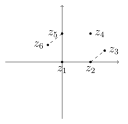
If $z_2 - z_1 =z_4 - z_5$ and $z_3-z_2 = z_5 - z_6$ then adding we get $z_3 - z_1 = z_4 - z_6$ or $z_4 - z_3 = z_6-z_1$, which is equivalent to  $\overrightarrow{P_{3}P_{4}}=\overrightarrow{P_{1}P_{6}}\,$.


\begin{center}
    \begin{tikzpicture}
        \draw[->] (-2,0) -- (2,0);
        \draw[->] (0,-2) -- (0,2);

        \draw[dashed] (0,1) -- (-.5,.6) ;
        \draw[dashed] (1,0) -- (1.5, 0.4);

        \filldraw (0,0) circle (1pt);
        \filldraw (1,0) circle (1pt);
        \filldraw (1,1) circle (1pt);
        \filldraw (0,1) circle (1pt);
        \filldraw (1.5,.4) circle (1pt);
        \filldraw (-.5,.6) circle (1pt);

        \node at (0,0) [left, below] {$z_1$};
        \node at (1,0) [below] {$z_2$};
        \node at (1,1) [right] {$z_4$};
        \node at (0,1) [left] {$z_5$};
        \node at (1.5,.4) [right] {$z_3$};
        \node at  (-.5,.6) [left] {$z_6$};
    \end{tikzpicture}
\end{center}

$\textrm{Re}(z) > 1, \textrm{Re}(w) < 0, \textrm{Re}(z) +\textrm{Re}(w)=1$. (We only need one of the first two constraints, since the other is implied by the former).

Since $\overrightarrow{P_{2}P_{4}}$ is perpendicular to $\overrightarrow{P_{3}P_{6}}\,$  we must have that $\textrm{Im}(z) = \textrm{Im}(w)$. Combined with the vector logic we must have that $\textrm{Im}(z) = \frac12$.

Let $z = a + \frac12i$ and $w = (1-a) + \frac12i$.

Since $w - 1 = k(3-2i)(z-1)$ (the angle constraint) we must have that:

\begin{align*}
&&-a+\frac12i &= k(3-2i)((a-1) \frac12i) \\
&&&= k( 3 a - 2+(\frac72 - 2 a)i) \\
\Rightarrow  && \frac{3a-2}{-a} &= \frac{\frac72-2a}{\frac12} \\
\Rightarrow && 3a-2&= 4a^2-7a \\
\Rightarrow && 0 &= 4a^2-10a+2 \\
\Rightarrow && a &= \frac{5 \pm \sqrt{17}}{4}
\end{align*}

Since $a > 1, a = \frac{5 +\sqrt{17}}{4}$ and the distance is:

\begin{align*}
\left | z - w \right | &= | a+\frac12i - ((1-a) +\frac12i ) | \\
&= |2a-1| \\
&= \frac{5+\sqrt{17}}{2}-1 \\
&= \frac{3+\sqrt{17}}{2}
\end{align*}