Problems
Filters
1531 problems found
1996 Paper 3 Q14
Whenever I go cycling I start with my bike in good working order. However if all is well at time \(t\), the probability that I get a puncture in the small interval \((t,t+\delta t)\) is \(\alpha\,\delta t.\) How many punctures can I expect to get on a journey during which my total cycling time is \(T\)? When I get a puncture I stop immediately to repair it and the probability that, if I am repairing it at time \(t\), the repair will be completed in time \((t,t+\delta t)\) is \(\beta\,\delta t.\) If \(p(t)\) is the probability that I am repairing a puncture at time \(t\), write down an equation relating \(p(t)\) to \(p(t+\delta t)\), and derive from this a differential equation relating \(p'(t)\) and \(p(t).\) Show that \[ p(t)=\frac{\alpha}{\alpha+\beta}(1-\mathrm{e}^{-(\alpha+\beta)t}) \] satisfies this differential equation with the appropriate initial condition. Find an expression, involving \(\alpha,\beta\) and \(T\), for the time expected to be spent mending punctures during a journey of total time \(T\). Hence, or otherwise, show that, the fraction of the journey expected to be spent mending punctures is given approximately by \[ \quad\frac{\alpha T}{2}\quad\ \mbox{ if }(\alpha+\beta)T\text{ is small, } \] and by \[ \frac{\alpha}{\alpha+\beta}\quad\mbox{ if }(\alpha+\beta)T\text{ is large.} \]
1995 Paper 1 Q1
- Find the real values of \(x\) for which \[ x^{3}-4x^{2}-x+4\geqslant0. \]
- Find the three lines in the \((x,y)\) plane on which \[ x^{3}-4x^{2}y-xy^{2}+4y^{3}=0. \]
- On a sketch shade the regions of the \((x,y)\) plane for which \[ x^{3}-4x^{2}y-xy^{2}+4y^{3}\geqslant0. \]
Solution:
- \(\,\) \begin{align*} && 0 & \leq x^3 - 4x^2 - x + 4 \\ &&&= (x-1)(x^2-3x-4) \\ &&&= (x-1)(x-4)(x+1) \\ \Leftrightarrow && x &\in [-1, 1] \cup [4, \infty) \end{align*}
- \(\,\) \begin{align*} && 0 &= x^{3}-4x^{2}y-xy^{2}+4y^{3} \\ && 0 &= (x-y)(x-4y)(x+y) \end{align*} Therefore the lines are \(y = x, 4y = x, y=-x\).
- (quickest way to see this is to check the \(x\) or \(y\)-axis)

1995 Paper 1 Q2
- Suppose that \[ S=\int\frac{\cos x}{\cos x+\sin x}\,\mathrm{d}x\quad\mbox{ and }\quad T=\int\frac{\sin x}{\cos x+\sin x}\,\mathrm{d}x. \] By considering \(S+T\) and \(S-T\) determine \(S\) and \(T\).
- Evaluate \({\displaystyle \int_{\frac{1}{4}}^{\frac{1}{2}}(1-4x)\sqrt{\frac{1}{x}-1}\,\mathrm{d}x}\) by using the substitution \(x=\sin^{2}t.\)
Solution:
- \begin{align*} && S + T &= \int \frac{\cos x + \sin x }{\cos x + \sin x} \d x \\ &&&= \int \d x \\ &&&= x + C \\ && S - T &= \int \frac{\cos x - \sin x}{\cos x + \sin x} \d x \\ &&&= \ln( \cos x + \sin x) + C \\ \Rightarrow && 2S &= x + \ln(\cos x + \sin x) + C \\ \Rightarrow && S &= \frac12 \left ( x + \ln(\cos x + \sin x) \right) + C \\ \Rightarrow && 2T &= x - \ln(\cos x + \sin x) + C \\ \Rightarrow && T &= \frac12 \left ( x - \ln(\cos x + \sin x) \right) + C \end{align*}
- \begin{align*} && I &= \int_{1/4}^{1/2} (1-4x)\sqrt{\frac1x-1} \d x \\ x = \sin^2 t, \d x = 2 \sin t \cos t \d t: &&&= \int_{\pi/6}^{\pi/4} (1-4\sin^2 t) \sqrt{\frac{1-\sin^2 t}{\sin^2 t}} 2 \sin t \cos t \d t\\ &&&=\int_{\pi/6}^{\pi/4} (1-4\sin^2 t)\frac{\cos t}{\sin t} 2 \sin t \cos t \d t \\ &&&= \int_{\pi/6}^{\pi/4} (1-4\sin^2 t) 2 \cos^2 t \d t \\ &&&= \int_{\pi/6}^{\pi/4} \left ( 2\cos^2t - 8 \sin^2t \cos^2 t \right) \d t \\ &&&= \int_{\pi/6}^{\pi/4} \left ( 1+\cos2t - 2 \sin^2 2t \right) \d t \\ &&&= \int_{\pi/6}^{\pi/4} \left ( 1+\cos2t +(\cos 4t-1)\right) \d t \\ &&&= \left[\frac12 \sin 2t + \frac14 \sin 4t \right]_{\pi/6}^{\pi/4} \\ &&&= \left ( \frac12 \right) - \left (\frac12 \frac{\sqrt{3}}{2} + \frac14 \frac{\sqrt{3}}{2} \right) \\ &&&= \frac{4-3\sqrt{3}}{8} \end{align*}
1995 Paper 1 Q3
- If \(\mathrm{f}(r)\) is a function defined for \(r=0,1,2,3,\ldots,\) show that \[ \sum_{r=1}^{n}\left\{ \mathrm{f}(r)-\mathrm{f}(r-1)\right\} =\mathrm{f}(n)-\mathrm{f}(0). \]
- If \(\mathrm{f}(r)=r^{2}(r+1)^{2},\) evaluate \(\mathrm{f}(r)-\mathrm{f}(r-1)\) and hence determine \({\displaystyle \sum_{r=1}^{n}r^{3}.}\)
- Find the sum of the series \(1^{3}-2^{3}+3^{3}-4^{3}+\cdots+(2n+1)^{3}.\)
Solution:
- \(\,\) \begin{align*} && \sum_{r=1}^n \left (f(r) - f(r-1) \right) &= \cancel{f(1)} - f(0) + \cdots\\ &&&\quad\, \cancel{\f(2)}-\cancel{f(1)} + \cdots \\ &&&\quad\, \cancel{f(3)}-\cancel{f(2)} + \cdots \\ &&&\quad\, +\cdots + \cdots \\ &&&\quad\, \cancel{f(n-1)}-\cancel{f(n-2)} + \cdots \\ &&&\quad\, f(n)-\cancel{f(n-1)} \\ &&&=f(n) - f(0) \end{align*}
- If \(f(r) = r^2(r+1)^2\) then \begin{align*} && f(r) - f(r-1) &= r^2(r+1)^2 - (r-1)r^2 \\ &&&= r^2((r+1)^2-(r-1)^2) \\ &&&=4r^3 \end{align*} Therefore \begin{align*} && \sum_{r=1}^n 4r^3 &= n^2(n+1)^2-0 \\ \Rightarrow && \sum_{r=1}^n r^3 &= \frac{n^2(n+1)^2}{4} \\ \end{align*}
- So \begin{align*} && \sum_{r=1}^{2n+1} (-1)^{r-1}r^3 &= \sum_{r=1}^{2n+1} r^3 - 2 \sum_{r=1}^n (2r)^3 \\ &&&= \frac14(2n+1)^2(2n+2)^2 - 8 \frac{n^2(n+1)^2}{4} \\ &&&= (2n+1)^2(n+1)^2 - 2n^2(n+1)^2 \\ &&&= (n+1)^2(4n^2+4n+1 - 2n^2) \\ &&&= (n+1)^2(2n^2+4n+1) \end{align*}
1995 Paper 1 Q4
By applying de Moivre's theorem to \(\cos5\theta+\mathrm{i}\sin5\theta,\) expanding the result using the binomial theorem, and then equating imaginary parts, show that \[ \sin5\theta=\sin\theta\left(16\cos^{4}\theta-12\cos^{2}\theta+1\right). \] Use this identity to evaluate \(\cos^{2}\frac{1}{5}\pi\), and deduce that \(\cos\frac{1}{5}\pi=\frac{1}{4}(1+\sqrt{5}).\)
Solution: \begin{align*} && (\cos \theta + i \sin \theta)^n &= \cos n \theta + i \sin n \theta \\ n = 5: && \cos 5 \theta + i \sin 5 \theta &= (\cos \theta + i \sin \theta)^5 \\ \textrm{Im}: && \sin 5 \theta &= \binom{5}{1}\cos^4 \theta \sin \theta + \binom{5}{3} \cos^2 \theta (- \sin^3 \theta) + \binom{5}{5} \sin^5 \theta \\ &&&= \sin \theta (5\cos^4 \theta-10\cos^2 \theta \sin^2 \theta+\sin^4 \theta) \\ &&&= \sin \theta (5\cos^4 \theta-10\cos^2 \theta (1-\cos^2 \theta)+(1-\cos^2 \theta)^2) \\ &&&= \sin \theta((5+10+1)\cos^4 \theta +(-10-2)\cos^2 \theta + 1) \\ &&&= \sin \theta(16\cos^4 \theta -12\cos^2 \theta + 1) \\ \end{align*} Suppose \(\theta= \frac{\pi}{5}\), then \(\sin 5 \theta = 0, \sin \theta \neq 0\), therefore if \(c = \cos \theta\) we must have \begin{align*} && 0 &= 16c^4-12c^2+1 \\ \Rightarrow && c^2 &= \frac{3 \pm \sqrt{5}}{8} \\ &&&= \frac{6\pm 2\sqrt{5}}{16} \\ &&&= \frac{(1 \pm \sqrt{5})^2}{16} \\ \Rightarrow && c &= \pm \frac{1 \pm \sqrt{5}}{4} \end{align*} Since \(c > 0\) we either have \(\cos \frac15 \pi = \frac{1+\sqrt{5}}4\) or \(\cos \frac15 \pi = \frac{\sqrt{5}-1}4\), however \(\sqrt{5}-1 < 1.5\) and so \(\frac{\sqrt{5}-1}{4} < \frac12 = \cos \frac13 \pi\) we must have \(\cos \frac15 \pi = \frac{1+\sqrt{5}}4\)
1995 Paper 1 Q5
If \[ \mathrm{f}(x)=nx-\binom{n}{2}\frac{x^{2}}{2}+\binom{n}{3}\frac{x^{3}}{3}-\cdots+(-1)^{r+1}\binom{n}{r}\frac{x^{r}}{r}+\cdots+(-1)^{n+1}\frac{x^{n}}{n}\,, \] show that \[ \mathrm{f}'(x)=\frac{1-(1-x)^{n}}{x}\,. \] Deduce that \[ \mathrm{f}(x)=\int_{1-x}^{1}\frac{1-y^{n}}{1-y}\,\mathrm{d}y. \] Hence show that \[ \mathrm{f}(1)=1+\frac{1}{2}+\frac{1}{3}+\cdots+\frac{1}{n}\,. \]
Solution: \begin{align*} f(x) & =nx-\binom{n}{2}\frac{x^{2}}{2}+\binom{n}{3}\frac{x^{3}}{3}-\cdots+(-1)^{r+1}\binom{n}{r}\frac{x^{r}}{r}+\cdots+(-1)^{n+1}\frac{x^{n}}{n} \\ f'(x) &= n - \binom{n}{2} x + \binom{n}{3}x^2 - \cdots (-1)^{r+1} \binom{n}{r} + \cdots + (-1)^{n+1} x^{n-1} \\ &= \frac{1-(1-x)^n}{x} \end{align*} Therefore, since \(\displaystyle f(x) = \int_0^xf'(t)\,dt\) \begin{align*} f(x) &= \int_0^x \frac{1 - (1-t)^n}{t} \, dt \\ &= \int_{1}^{1-x} \frac{1-y^n}{1-y} (-1)\, dy \tag{Let \(y = 1-t, \frac{dy}{dt} = -1\)} \\ &= \boxed{\int_{1-x}^1 \frac{1-y^n}{1-y} dy} \\ &= \int_{1-x}^1 \l 1 + y + y^2 + \cdots + y^{n-1} \r \, dy \\ &= \left [ y + \frac{y^2}{2} + \frac{y^3}{3} + \cdots + \frac{y^n}{n} \right]_{1-x}^1 \\ \end{align*} So when \(x = 1, 1-x = 0\) so we exactly have the sum required.
1995 Paper 1 Q6
- In the differential equation \[ \frac{1}{y^{2}}\frac{\mathrm{d}y}{\mathrm{d}x}+\frac{1}{y}=\mathrm{e}^{2x} \] make the substitution \(u=1/y,\) and hence show that the general solution of the original equation is \[ y=\frac{1}{A\mathrm{e}^{x}-\mathrm{e}^{2x}}\,. \]
- Use a similar method to solve the equation \[ \frac{1}{y^{3}}\frac{\mathrm{d}y}{\mathrm{d}x}+\frac{1}{y^{2}}=\mathrm{e}^{2x}. \]
Solution:
- \(,\) \begin{align*} u = 1/y, \frac{\d u}{\d x} = -1/y^2 y': && -\frac{\d u}{\d x} + u &= e^{2x} \\ \Rightarrow && \frac{\d}{\d x} \left (e^{-x}u \right) = -e^{x} \\ \Rightarrow && e^{-x}u &= -e^x+C \\ \Rightarrow && u &= Ce^x-e^{2x} \\ \Rightarrow && y &= \frac{1}{Ce^x-e^{2x}} \end{align*}
- \(\,\) \begin{align*} u = 1/y^2, u' = -2/y^3 y': && -2u'+u &= e^{2x} \\ \Rightarrow && \frac{\d}{\d x} \left (e^{-1/2x}u\right) &= -\frac12e^{\frac32x} \\ \Rightarrow && e^{-\frac12x}u &= -\frac13e^{\frac32x}+C \\ \Rightarrow && u &= -\frac13e^{2x}+Ce^{\frac12x} \\ \Rightarrow && y &= \left ( \frac{1}{Ce^{\frac12x}-\frac13e^{2x}}\right)^{\frac12} \end{align*}
1995 Paper 1 Q7
Let \(A,B,C\) be three non-collinear points in the plane. Explain briefly why it is possible to choose an origin equidistant from the three points. Let \(O\) be such an origin, let \(G\) be the centroid of the triangle \(ABC,\) let \(Q\) be a point such that \(\overrightarrow{GQ}=2\overrightarrow{OG},\) and let \(N\) be the midpoint of \(OQ.\)
- Show that \(\overrightarrow{AQ}\) is perpendicular to \(\overrightarrow{BC}\) and deduce that the three altitudes of \(\triangle ABC\) are concurrent.
- Show that the midpoints of \(AQ,BQ\) and \(CQ\), and the midpoints of the sides of \(\triangle ABC\) are all equidistant from \(N\).
1995 Paper 1 Q8
Find functions \(\mathrm{f,g}\) and \(\mathrm{h}\) such that \[ \frac{\mathrm{d}^{2}y}{\mathrm{d}x^{2}}+\mathrm{f}(x)\frac{\mathrm{d}y}{\mathrm{d}x}+\mathrm{g}(x)y=\mathrm{h}(x)\tag{\ensuremath{*}} \] is satisfied by all three of the solutions \(y=x,y=1\) and \(y=x^{-1}\) for \(0 < x < 1.\) If \(\mathrm{f,g}\) and \(\mathrm{h}\) are the functions you have found in the first paragraph, what condition must the real numbers \(a,b\) and \(c\) satisfy in order that \[ y=ax+b+\frac{c}{x} \] should be a solution of \((*)\)?
1995 Paper 1 Q9
A particle is projected from a point \(O\) with speed \(\sqrt{2gh},\) where \(g\) is the acceleration due to gravity. Show that it is impossible, whatever the angle of projection, for the particle to reach a point above the parabola \[ x^{2}=4h(h-y), \] where \(x\) is the horizontal distance from \(O\) and \(y\) is the vertical distance above \(O\). State briefly the simplifying assumptions which this solution requires.
Solution: The position of the particle is projected at angle \(\theta\) is \((x,y) = (v \cos \theta t, v \sin \theta t - \frac12 g t^2)\), ie \(t = \frac{x}{v \cos \theta}\), \begin{align*} && y &= x\tan \theta -\frac12 g \frac{x^2}{v^2} \sec^2 \theta \\ && y &= x \tan \theta -\frac{1}{4h} (1+\tan^2 \theta) x^2 \\ && 0 &= \frac{1}{4h} x^2\tan^2 \theta - x \tan \theta + \frac{x^2}{4h} +y \\ \Delta \geq 0: && 0 &\leq \Delta = x^2-4\frac{x^2}{4h}\left (\frac{x^2}{4h}+y \right) \\ &&&=1-\frac{1}{4h^2}(x^2+4hy) \\ \Rightarrow && x^2+4hy &\leq 4h^2 \\ \Rightarrow && x^2 &\leq 4h(h-y) \end{align*} We are assuming that there are no forces acting other than gravity (eg air resistance)
1995 Paper 1 Q10
A small ball of mass \(m\) is suspended in equilibrium by a light elastic string of natural length \(l\) and modulus of elasticity \(\lambda.\) Show that the total length of the string in equilibrium is \(l(1+mg/\lambda).\) If the ball is now projected downwards from the equilibrium position with speed \(u_{0},\) show that the speed \(v\) of the ball at distance \(x\) below the equilibrium position is given by \[ v^{2}+\frac{\lambda}{lm}x^{2}=u_{0}^{2}. \] At distance \(h\), where \(\lambda h^{2} < lmu_{0}^{2},\) below the equilibrium position is a horizontal surface on which the ball bounces with a coefficient of restitution \(e\). Show that after one bounce the velocity \(u_{1}\) at \(x=0\) is given by \[ u_{1}^{2}=e^{2}u_{0}^{2}+\frac{\lambda}{lm}h^{2}(1-e^{2}), \] and that after the second bounce the velocity \(u_{2}\) at \(x=0\) is given by \[ u_{2}^{2}=e^{4}u_{0}^{2}+\frac{\lambda}{lm}h^{2}(1-e^{4}). \]
1995 Paper 1 Q11
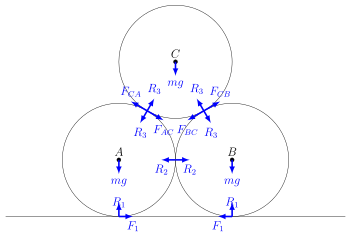
Two identical uniform cylinders, each of mass \(m,\) lie in contact with one another on a horizontal plane and a third identical cylinder rests symmetrically on them in such a way that the axes of the three cylinders are parallel. Assuming that all the surfaces in contact are equally rough, show that the minimum possible coefficient of friction is \(2-\sqrt{3}.\)
Solution:
1995 Paper 1 Q12
A school has \(n\) pupils, of whom \(r\) play hocket, where \(n\geqslant r\geqslant2.\) All \(n\) pupils are arranged in a row at random.
- What is the probability that there is a hockey player at each end of the row?
- What is the probability that all the hockey players are standing together?
- By considering the gaps between the non-hockey-players, find the probability that no two hockey players are standing together, distinguishing between cases when the probability is zero and when it is non-zero.
1995 Paper 1 Q13
A scientist is checking a sequence of microscope slides for cancerous cells, marking each cancerous cell that she detects with a red dye. The number of cancerous cells on a slide is random and has a Poisson distribution with mean \(\mu.\) The probability that the scientist spots any one cancerous cell is \(p\), and is independent of the probability that she spots any other one.
- Show that the number of cancerous cells which she marks on a single slide has a Poisson distribution of mean \(p\mu.\)
- Show that the probability \(Q\) that the second cancerous cell which she marks is on the \(k\)th slide is given by \[ Q=\mathrm{e}^{-\mu p(k-1)}\left\{ (1+k\mu p)(1-\mathrm{e}^{-\mu p})-\mu p\right\} . \]
1995 Paper 1 Q14
- Find the maximum value of \(\sqrt{p(1-p)}\) as \(p\) varies between \(0\) and \(1\).
- Suppose that a proportion \(p\) of the population is female. In order to estimate \(p\) we pick a sample of \(n\) people at random and find the proportion of them who are female. Find the value of \(n\) which ensures that the chance of our estimate of \(p\) being more than \(0.01\) in error is less than 1\%.
- Discuss how the required value of \(n\) would be affected if (a) \(p\) were the proportion of people in the population who are left-handed; (b) \(p\) were the proportion of people in the population who are millionaires.
Solution:
- \(\,\) \begin{align*} && \sqrt{p(1-p)} &= \sqrt{p-p^2} \\ &&&= \sqrt{\tfrac14-(\tfrac12-p)^2} \\ &&&\leq \sqrt{\tfrac14} = \tfrac12 \end{align*} Therefore the maximum is \(\tfrac12\) when \(p=\frac12\)
- Notice that our estimate \(\hat{p}\) will (for large \(n\)) be follow a normal distribution \(N(p, pq/n)\) by either the normal approximation to the binomial or central limit theorem. We would like \(0.01 > \mathbb{P}\left ( |\hat{p}-p| < 0.01 \right)\) or in other words \begin{align*} && 0.01 &> \mathbb{P}\left ( |\hat{p}-p| > 0.01 \right) \\ &&&=\mathbb{P}\left ( |\sqrt{\frac{pq}{n}}Z+p-p| > 0.01 \right) \\ &&&= \mathbb{P} \left (|Z|>\frac{0.01\sqrt{n}}{\sqrt{pq}}\right) \end{align*} therefore we need \(\frac{0.01\sqrt{n}}{\sqrt{pq}}> 2.58 \Rightarrow n > 258^2 pq \approx 2^{14} \approx 16\,000\), where we are using \(pq = \frac14\) as the worst case possibility and \(258 \approx 256 = 2^8\)
- If we were looking at when we are looking at left handed people (maybe ~\(10\%\), we would be looking at \(pq = \frac{9}{100}\) so we need a smaller sample). If we are looking at millionaires (an even smaller again percentage), we would need an even smaller sample. This is surprising since you would expect you would need a larger sample to accurately gauge smaller proportions. However, this surprise can be resolved by considering that this is an absolute error. For smaller values the relative error is larger, but the absolute error is smaller.