Problems
Filters
124 problems found
1995 Paper 3 Q12
The random variables \(X\) and \(Y\) are independently normally distributed with means 0 and variances 1. Show that the joint probability density function for \((X,Y)\) is \[ \mathrm{f}(x,y)=\frac{1}{2\pi}\mathrm{e}^{-\frac{1}{2}(x^{2}+y^{2})}\qquad-\infty < x < \infty,-\infty < y < \infty. \] If \((x,y)\) are the coordinates, referred to rectangular axes, of a point in the plane, explain what is meant by saying that this density is radially symmetrical. The random variables \(U\) and \(V\) have a joint probability density function which is radially symmetrical (in the above sense). By considering the straight line with equation \(U=kV,\) or otherwise, show that \[ \mathrm{P}\left(\frac{U}{V} < k\right)=2\mathrm{P}(U < kV,V > 0). \] Hence, or otherwise, show that the probability density function of \(U/V\) is \[ \mathrm{g}(k)=\frac{1}{\pi(1+k^{2})}\qquad-\infty < k < \infty. \]
1994 Paper 2 Q4
By considering the area of the region defined in terms of Cartesian coordinates \((x,y)\) by \[ \{(x,y):\ x^{2}+y^{2}=1,\ 0\leqslant y,\ 0\leqslant x\leqslant c\}, \] show that \[ \int_{0}^{c}(1-x^{2})^{\frac{1}{2}}\,\mathrm{d}x=\tfrac{1}{2}[c(1-c^{2})^{\frac{1}{2}}+\sin^{-1}c], \] if \(0 < c\leqslant1.\) Show that the area of the region defined by \[ \left\{ (x,y):\ \frac{x^{2}}{a^{2}}+\frac{y^{2}}{b^{2}}=1,\ 0\leqslant y,\ 0\leqslant x\leqslant c\right\} , \] is \[ \frac{ab}{2}\left[\frac{c}{a}\left(1-\frac{c^{2}}{a^{2}}\right)^{\frac{1}{2}}+\sin^{-1}\left(\frac{c}{a}\right)\right], \] if \(0 < c\leqslant a\) and \(0 < b.\) Suppose that \(0 < b\leqslant a.\) Show that the area of intersection \(E\cap F\) of the two regions defined by \[ E=\left\{ (x,y):\ \frac{x^{2}}{a^{2}}+\frac{y^{2}}{b^{2}}\leqslant1\right\} \qquad\mbox{ and }\qquad F=\left\{ (x,y):\ \frac{x^{2}}{b^{2}}+\frac{y^{2}}{a^{2}}\leqslant1\right\} \] is \[ 4ab\sin^{-1}\left(\frac{b}{\sqrt{a^{2}+b^{2}}}\right). \]
1994 Paper 2 Q7
Show that the equation \[ ax^{2}+ay^{2}+2gx+2fy+c=0 \] where \(a>0\) and \(f^{2}+g^{2}>ac\) represents a circle in Cartesian coordinates and find its centre. The smooth and level parade ground of the First Ruritanian Infantry Division is ornamented by two tall vertical flagpoles of heights \(h_{1}\) and \(h_{2}\) a distance \(d\) apart. As part of an initiative test a soldier has to march in such a way that he keeps the angles of elevation of the tops of the two flagpoles equal to one another. Show that if the two flagpoles are of different heights he will march in a circle. What happens if the two flagpoles have the same height? To celebrate the King's birthday a third flagpole is added. Soldiers are then assigned to each of the three different pairs of flagpoles and are told to march in such a way that they always keep the tops of their two assigned flagpoles at equal angles of elevation to one another. Show that, if the three flagpoles have different heights \(h_{1},h_{2}\) and \(h_{3}\) and the circles in which the soldiers march have centres of \((x_{ij},y_{ij})\) (for the flagpoles of height \(h_{i}\) and \(h_{j}\)) relative to Cartesian coordinates fixed in the parade ground, then the \(x_{ij}\) satisfy \[ h_{3}^{2}\left(h_{1}^{2}-h_{2}^{2}\right)x_{12}+h_{1}^{2}\left(h_{2}^{2}-h_{3}^{2}\right)x_{23}+h_{2}^{2}\left(h_{3}^{2}-h_{1}^{2}\right)x_{31}=0, \] and the same equation connects the \(y_{ij}\). Deduce that the three centres lie in a straight line.
1994 Paper 3 Q3
Describe geometrically the possible intersections of a plane with a sphere. Let \(P_{1}\) and \(P_{2}\) be the planes with equations \begin{alignat*}{1} 3x-y-1 & =0,\\ x-y+1 & =0, \end{alignat*} respectively, and let \(S_{1}\) and \(S_{2}\) be the spheres with equations \begin{alignat*}{1} x^{2}+y^{2}+z^{2} & =7,\\ x^{2}+y^{2}+z^{2}-6y-4z+10 & =0, \end{alignat*} respectively. Let \(C_{1}\) be the intersection of \(P_{1}\) and \(S_{1},\) let \(C_{2}\) be the intersection of \(P_{2}\) and \(S_{2}\) and let \(L\) be the intersection of \(P_{1}\) and \(P_{2}.\) Find the points where \(L\) meets each of \(S_{1}\) and \(S_{2}.\) Determine, giving your reasons, whether the circles \(C_{1}\) and \(C_{2}\) are linked.
1993 Paper 1 Q8
- Prove that the intersection of the surface of a sphere with a plane is always a circle, a point or the empty set. Prove that the intersection of the surfaces of two spheres with distinct centres is always a circle, a point or the empty set. {[}If you use coordinate geometry, a careful choice of origin and axes may help.{]}
- The parish council of Little Fitton have just bought a modern sculpture entitled `Truth, Love and Justice pouring forth their blessings on Little Fitton.' It consists of three vertical poles \(AD,BE\) and \(CF\) of heights 2 metres, 3 metres and 4 metres respectively. Show that \(\angle DEF=\cos^{-1}\frac{1}{5}.\) Vandals now shift the pole \(AD\) so that \(A\) is unchanged and the pole is still straight but \(D\) is vertically above \(AB\) with \(\angle BAD=\frac{1}{4}\pi\) (in radians). Find the new angle \(\angle DEF\) in radians correct to four figures.
1993 Paper 2 Q9
\textit{In this question, the argument of a complex number is chosen to satisfy \(0\leqslant\arg z<2\pi.\)} Let \(z\) be a complex number whose imaginary part is positive. What can you say about \(\arg z\)? The complex numbers \(z_{1},z_{2}\) and \(z_{3}\) all have positive imaginary part and \(\arg z_{1}<\arg z_{2}<\arg z_{3}.\) Draw a diagram that shows why \[ \arg z_{1}<\arg(z_{1}+z_{2}+z_{3})<\arg z_{3}. \] Prove that \(\arg(z_{1}z_{2}z_{3})\) is never equal to \(\arg(z_{1}+z_{2}+z_{3}).\)
1993 Paper 3 Q6
The point in the Argand diagram representing the complex number \(z\) lies on the circle with centre \(K\) and radius \(r\), where \(K\) represents the complex number \(k\). Show that $$ zz^* -kz^* -k^*z +kk^* -r^2 =0. $$ The points \(P\), \(Q_1\) and \(Q_2\) represent the complex numbers \(z\), \(w_1\) and \(w_2\) respectively. The point \(P\) lies on the circle with \(OA\) as diameter, where \(O\) and \(A\) represent \(0\) and \(2i\) respectively. Given that \(w_1=z/(z-1)\), find the equation of the locus \(L\) of \(Q_1\) in terms of \(w_1\) and describe the geometrical form of \(L\). Given that \(w_2=z^*\), show that the locus of \(Q_2\) is also \(L\). Determine the positions of \(P\) for which \(Q_1\) coincides with \(Q_2\).
1992 Paper 2 Q9
Let \(\mathbf{a},\mathbf{b}\) and \(\mathbf{c}\) be the position vectors of points \(A,B\) and \(C\) in three-dimensional space. Suppose that \(A,B,C\) and the origin \(O\) are not all in the same plane. Describe the locus of the point whose position vector \(\mathbf{r}\) is given by \[ \mathbf{r}=(1-\lambda-\mu)\mathbf{a}+\lambda\mathbf{b}+\mu\mathbf{c}, \] where \(\lambda\) and \(\mu\) are scalar parameters. By writing this equation in the form \(\mathbf{r}\cdot\mathbf{n}=p\) for a suitable vector \(\mathbf{n}\) and scalar \(p\), show that \[ -(\lambda+\mu)\mathbf{a}\cdot(\mathbf{b}\times\mathbf{c})+\lambda\mathbf{b}\cdot(\mathbf{c}\times\mathbf{a})+\mu\mathbf{c}\cdot(\mathbf{a}\times\mathbf{b})=0 \] for all scalars \(\lambda,\mu.\) Deduce that \[ \mathbf{a}\cdot(\mathbf{b}\times\mathbf{c})=\mathbf{b}\cdot(\mathbf{c}\times\mathbf{a})=\mathbf{c}\cdot(\mathbf{a}\times\mathbf{b}). \] Say briefly what happens if \(A,B,C\) and \(O\) are all in the same plane.
Solution: \(\mathbf{r}=(1-\lambda-\mu)\mathbf{a}+\lambda\mathbf{b}+\mu\mathbf{c} = \mathbf{a} + \lambda(\mathbf{b}-\mathbf{a})+\mu(\mathbf{c}-\mathbf{a})\) Therefore it is the plane through \(\mathbf{a}\) with direction vectors \(\mathbf{b}-\mathbf{a}\) and \(\mathbf{c}-\mathbf{a}\), ie it is the plane through \(\mathbf{a},\mathbf{b},\mathbf{c}\). The normal to this plane will be \((\mathbf{b}-\mathbf{a} ) \times (\mathbf{c}-\mathbf{a}) = \mathbf{b}\times \mathbf{c}-\mathbf{a} \times \mathbf{c}-\mathbf{b}\times \mathbf{a}\), so we must have: \begin{align*} && \mathbf{r} \cdot \left (\mathbf{b}\times \mathbf{c}-\mathbf{a} \times \mathbf{c}-\mathbf{b}\times \mathbf{a} \right) &= \mathbf{a} \cdot \left (\mathbf{b}\times \mathbf{c}-\mathbf{a} \times \mathbf{c}-\mathbf{b}\times \mathbf{a} \right) \\ &&&= \mathbf{a} \cdot (\mathbf{b}\times \mathbf{c}) \end{align*} Therefore, \begin{align*} && \mathbf{a} \cdot (\mathbf{b}\times \mathbf{c}) &= \mathbf{r} \cdot \left (\mathbf{b}\times \mathbf{c}-\mathbf{a} \times \mathbf{c}-\mathbf{b}\times \mathbf{a} \right) \\ &&&= \left ( (1-\lambda-\mu)\mathbf{a}+\lambda\mathbf{b}+\mu\mathbf{c} \right)\cdot \left (\mathbf{b}\times \mathbf{c}-\mathbf{a} \times \mathbf{c}-\mathbf{b}\times \mathbf{a} \right) \\ &&&= (1-\lambda- \mu) \mathbf{a}\cdot (\mathbf{b} \times \mathbf{c})-\lambda \mathbf{b}\cdot(\mathbf{a} \times \mathbf{c})-\mu \mathbf{c}\cdot(\mathbf{b} \times \mathbf{a}) \\ \Rightarrow && 0 &= (-\lambda- \mu) \mathbf{a}\cdot (\mathbf{b} \times \mathbf{c})-\lambda \mathbf{b}\cdot(\mathbf{a} \times \mathbf{c})-\mu \mathbf{c}\cdot(\mathbf{b} \times \mathbf{a}) \\ &&&= -(\lambda+ \mu) \mathbf{a}\cdot (\mathbf{b} \times \mathbf{c})+\lambda \mathbf{b}\cdot(\mathbf{c} \times \mathbf{a})+\mu \mathbf{c}\cdot(\mathbf{a} \times \mathbf{b}) \\ \end{align*} The result follows from setting \(\mu = 0, \lambda = 1\) and \(\mu = 1, \lambda = 0\). If they all lie in the same plane then the plane described is through the origin, and those values are all the same, but equal to \(0\).
1992 Paper 2 Q10
Let \(\alpha\) be a fixed angle, \(0 < \alpha \leqslant\frac{1}{2}\pi.\) In each of the following cases, sketch the locus of \(z\) in the Argand diagram (the complex plane):
- \({\displaystyle \arg\left(\frac{z-1}{z}\right)=\alpha,}\)
- \({\displaystyle \arg\left(\frac{z-1}{z}\right)=\alpha-\pi,}\)
- \(|\dfrac{z-1}{z}|=1.\)
Solution:
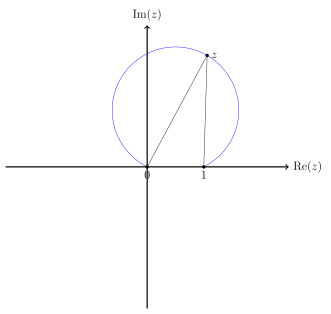
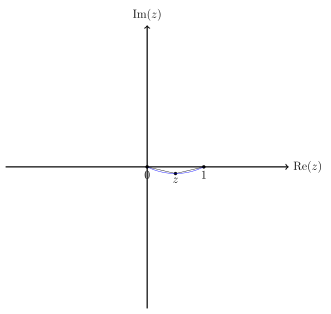
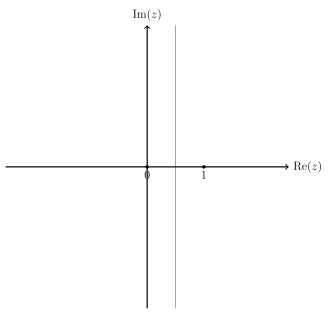
1992 Paper 3 Q7
The points \(P\) and \(R\) lie on the sides \(AB\) and \(AD,\) respectively, of the parallelogram \(ABCD.\) The point \(Q\) is the fourth vertex of the parallelogram \(APQR.\) Prove that \(BR,CQ\) and \(DP\) meet in a point.
Solution: Let \(\overrightarrow{AX} = \mathbf{x}\) for all points, so: \begin{align*} \mathbf{p} &= p\mathbf{b}\\ \mathbf{r} &= r\mathbf{d}\\ \mathbf{q} &= \mathbf{p}+\mathbf{r} \\ &= p\mathbf{b} + r\mathbf{d} \end{align*} Therefore \begin{align*} BR: && \mathbf{b} + \lambda(\mathbf{r}-\mathbf{b}) \\ &&= (1-\lambda) \mathbf{b}+ \lambda r \mathbf{d} \\ CQ: && \mathbf{c} + \mu(\mathbf{q} - \mathbf{c}) \\ &&= \mathbf{b}+\mathbf{d} + \mu(p\mathbf{b}+r\mathbf{d} - (\mathbf{b}+\mathbf{d}) ) \\ &&= (1+\mu(p-1))\mathbf{b} + (1+\mu(r-1))\mathbf{d} \\ DP: && \mathbf{d} + \nu (\mathbf{p} - \mathbf{d}) \\ &&= \nu p\mathbf{b} +(1-\nu) \mathbf{d} \end{align*} So we need \(1-\nu = \lambda r, \nu p = 1-\lambda, \) so lets say \(1 = \nu + \lambda r, 1 = \lambda + \nu p \Rightarrow \lambda(pr-1) = p-1 \Rightarrow \lambda = \frac{p-1}{pr-1}\) so they intersect at \(\frac{rp-r}{pr-1} \mathbf{d} + \frac{pr-p}{pr-1}\mathbf{b}\). If we take \(\mu = -\frac{\lambda}{p-1} = 1-pr\) this is clearly also on \(CQ\) hence they all meet at a point
1991 Paper 1 Q5
A set of \(n\) distinct vectors \(\mathbf{a}_{1},\mathbf{a}_{2},\ldots,\mathbf{a}_{n},\) where \(n\geqslant2\), is called regular if it satisfies the following two conditions:
- there are constants \(\alpha\) and \(\beta\), with \(\alpha>0\), such that for any \(i\) and \(j\), \[ \mathbf{a}_{i}\cdot\mathbf{a}_{j}=\begin{cases} \alpha^{2} & \mbox{ when }i=j\\ \beta & \mbox{ when }i\neq j, \end{cases} \]
- the centroid of \(\mathbf{a}_{1},\mathbf{a}_{2},\ldots,\mathbf{a}_{n}\) is the origin \(\mathbf{0}.\) {[}The centroid of vectors \(\mathbf{b}_{1},\mathbf{b}_{2},\ldots,\mathbf{b}_{m}\) is the vector \(\frac{1}{m}(\mathbf{b}_{1}+\mathbf{b}_{2}+\cdots+\mathbf{b}_{m}).\){]}
Solution: \begin{align*} && \mathbf{0} &= \sum_i \mathbf{a}_i \tag{ii} \\ \Rightarrow && 0 &= \mathbf{a}_i \cdot \mathbf{0} \\ &&&= \sum_j \mathbf{a}_i \cdot \mathbf{a}_j \\ &&&= (n-1)\beta + \alpha^2 \tag{i} \\ \Rightarrow && (n-1)\beta &= -\alpha^2 \end{align*} Suppose we have \(\mathbf{a}_j = \binom{x}{y}\), \(j \neq 1\) then \(x = \beta\). We also must have \(\beta^2 + y^2 = 1\), so there are at most two values for \(y\), ie two extra vectors. ie \(n = 2, 3\). If \(n = 2 \Rightarrow \mathbf{a}_2 = - \mathbf{a}_1\). If \(n = 3\) \begin{align*} && \mathbf{0} &= \binom{1}{0} + \binom{\beta}{y} + \binom{\beta}{-y} \\ \Rightarrow && \beta = -1/2 \\ \Rightarrow && y &= \pm \frac{\sqrt{3}}{2} \end{align*} Suppose $\mathbf{a}_{1}=\begin{pmatrix}1\\ 0\\ 0 \end{pmatrix}\(, \)\mathbf{a}_{2}=\begin{pmatrix}\cos \theta \\ \sin \theta \\ 0 \end{pmatrix}$ (since we need \(\mathbf{a}_2 \cdot \mathbf{a}_2 = 1\)). \(\beta = \cos \theta\)). We can have \(\cos \theta = - 1\). Suppose we have \(\mathbf{a}_j =\begin{pmatrix}x\\ y \\ z \end{pmatrix}\), so \(x = \cos \theta\), and \(y^2 + z^2 = \sin^2 \theta\), so we can write it as: \(\mathbf{a}_j =\begin{pmatrix} \cos \theta \\ \sin \theta \cos \phi \\ \sin \theta \sin \phi \end{pmatrix}\). We must also have \(\beta = \begin{pmatrix} \cos \theta \\ \sin \theta \cos \phi \\ \sin \theta \sin \phi \end{pmatrix} \cdot \begin{pmatrix} \cos \theta \\ \sin \theta\\ 0 \end{pmatrix} = \cos^2 \theta + \sin^2 \theta \cos \phi = \cos \theta\), so \(\cos \phi = \frac{\cos \theta - \cos^2\theta}{1-\cos^2 \theta} = \frac{\cos \theta}{1+\cos \theta}\). Therefore there is one value for \(\cos \phi\), so at most two values for \(\sin \phi\), Therefore we can have either \(2, 3,4\) or \(5\) different values in the set. \(n = 2\), we've already handled. If \(n = 3\), then \(\beta = -\frac12\), \(\cos \phi = -1\), so we can only have two different values for \(\sin \theta\), ie: \(\displaystyle \left \{\begin{pmatrix} 1\\ 0 \\ 0 \end{pmatrix}, \begin{pmatrix} -1/2\\ \frac{\sqrt{3}}{2} \\ 0 \end{pmatrix}, \begin{pmatrix} -1/2\\ -\frac{\sqrt{3}}{2} \\ 0 \end{pmatrix} \right \}\) Finally, if \(n = 4\), we have \(\beta = -\frac13\), \(\cos \phi = \frac{-1/3}{2/3} = -\frac12\). \(\sin \theta = \pm \frac{\sqrt{3}}{2}\) \(\displaystyle \left \{\begin{pmatrix} 1\\ 0 \\ 0 \end{pmatrix}, \begin{pmatrix} -\frac13\\ \frac{2\sqrt{2}}{3} \\ 0 \end{pmatrix}, \begin{pmatrix} -\frac13\\ -\frac{\sqrt{2}}{3} \\ \frac{\sqrt{6}}{3} \end{pmatrix},\begin{pmatrix} -\frac13\\ -\frac{\sqrt{2}}{3} \\ -\frac{\sqrt{6}}{3} \end{pmatrix} \right \}\) \(\displaystyle \left \{\begin{pmatrix} 1\\ 0 \\ 0 \end{pmatrix}, \begin{pmatrix} -\frac13\\ -\frac{2\sqrt{2}}{3} \\ 0 \end{pmatrix}, \begin{pmatrix} -\frac13\\ \frac{\sqrt{2}}{3} \\ \frac{\sqrt{6}}{3} \end{pmatrix},\begin{pmatrix} -\frac13\\ \frac{\sqrt{2}}{3} \\ -\frac{\sqrt{6}}{3} \end{pmatrix} \right \}\) If \(n = 5\), then \(\beta = -\frac14\), \(\cos \phi = \frac{-1/4}{3/4} = -\frac13\). \(\sin \theta = \frac{\sqrt{15}}{4}\), \(\sin \phi = \frac{2\sqrt{2}}{3}\) \(\displaystyle \left \{\begin{pmatrix} 1\\ 0 \\ 0 \end{pmatrix}, \begin{pmatrix} -\frac14\\ \frac{\sqrt{15}}{4} \\ 0 \end{pmatrix}, \begin{pmatrix} -\frac14\\ -\frac{\sqrt{15}}{4} \\ 0 \end{pmatrix}, \begin{pmatrix} -\frac14\\ \frac{\sqrt{15}}{12} \\ \frac{\sqrt{30}}{6} \end{pmatrix}, \begin{pmatrix} -\frac14\\ -\frac{\sqrt{15}}{12} \\ -\frac{\sqrt{30}}{6} \end{pmatrix}, \right \}\)
1991 Paper 3 Q2
The distinct points \(P_{1},P_{2},P_{3},Q_{1},Q_{2}\) and \(Q_{3}\) in the Argand diagram are represented by the complex numbers \(z_{1},z_{2},z_{3},w_{1},w_{2}\) and \(w_{3}\) respectively. Show that the triangles \(P_{1}P_{2}P_{3}\) and \(Q_{1}Q_{2}Q_{3}\) are similar, with \(P_{i}\) corresponding to \(Q_{i}\) (\(i=1,2,3\)) and the rotation from \(1\) to \(2\) to \(3\) being in the same sense for both triangles, if and only if \[ \frac{z_{1}-z_{2}}{z_{2}-z_{3}}=\frac{w_{1}-w_{2}}{w_{1}-w_{3}}. \] Verify that this condition may be written \[ \det\begin{pmatrix}z_{1} & z_{2} & z_{3}\\ w_{1} & w_{2} & w_{3}\\ 1 & 1 & 1 \end{pmatrix}=0. \]
- Show that if \(w_{i}=z_{i}^{2}\) (\(i=1,2,3\)) then triangle \(P_{1}P_{2}P_{3}\) is not similar to triangle \(Q_{1}Q_{2}Q_{3}.\)
- Show that if \(w_{i}=z_{i}^{3}\) (\(i=1,2,3\)) then triangle \(P_{1}P_{2}P_{3}\) is similar to triangle \(Q_{1}Q_{2}Q_{3}\) if and only if the centroid of triangle \(P_{1}P_{2}P_{3}\) is the origin. {[}The centroid of triangle \(P_{1}P_{2}P_{3}\) is represented by the complex number \(\frac{1}{3}(z_{1}+z_{2}+z_{3})\).{]}
- Show that the triangle \(P_{1}P_{2}P_{3}\) is equilateral if and only if \[ z_{2}z_{3}+z_{3}z_{1}+z_{1}z_{2}=z_{1}^{2}+z_{2}^{2}+z_{3}^{2}. \]
1991 Paper 3 Q6
The transformation \(T\) from \(\binom{x}{y}\) to \(\binom{x'}{y'}\) in two-dimensional space is given by \[ \begin{pmatrix}x'\\ y' \end{pmatrix}=\begin{pmatrix}\cosh u & \sinh u\\ \sinh u & \cosh u \end{pmatrix}\begin{pmatrix}x\\ y \end{pmatrix}, \] where \(u\) is a positive real constant. Show that the curve with equation \(x^{2}-y^{2}=1\) is transformed into itself. Find the equations of two straight lines through the origin which transform into themselves. A line, not necessary through the origin, which has gradient \(\tanh v\) transforms under \(T\) into a line with gradient \(\tanh v'\). Show that \(v'=v+u\). The lines \(\ell_{1}\) and \(\ell_{2}\) with gradients \(\tanh v_{1}\) and \(\tanh v_{2}\) transform under \(T\) into lines with gradients \(\tanh v_{1}'\) and \(\tanh v_{2}'\) respectively. Find the relation satisfied by \(v_{1}\) and \(v_{2}\) that is the necessary and sufficient for \(\ell_{1}\) and \(\ell_{2}\) to intersect at the same angle as their transforms. In the case when \(\ell_{1}\) and \(\ell_{2}\) meet at the origin, illustrate in a diagram the relation between \(\ell_{1}\), \(\ell_{2}\) and their transforms.
1990 Paper 1 Q3
Given a curve described by \(y=\mathrm{f}(x)\), and such that \(y\geqslant0\), a push-off of the curve is a new curve obtained as follows: for each point \((x,\mathrm{f}(x))\) with position vector \(\mathbf{r}\) on the original curve, there is a point with position vector \(\mathbf{s}\) on the new curve such that \(\mathbf{s-r}=\mathrm{p}(x)\mathbf{n},\) where \(\mathrm{p}\) is a given function and \(\mathbf{n}\) is the downward-pointing unit normal to the original curve at \(\mathbf{r}\).
- For the curve \(y=x^{k},\) where \(x>0\) and \(k\) is a positive integer, obtain the function \(\mathrm{p}\) for which the push-off is the positive \(x\)-axis, and find the value of \(k\) such that, for all points on the original curve, \(\left|\mathbf{r}\right|=\left|\mathbf{r-s}\right|\).
- Suppose that the original curve is \(y=x^{2}\) and \(\mathrm{p}\) is such that the gradient of the curves at the points with position vectors \(\mathbf{r}\) and \(\mathbf{s}\) are equal (for every point on the original curve). By writing \(\mathrm{p}(x)=\mathrm{q}(x)\sqrt{1+4x^{2}},\) where \(\mathrm{q}\) is to be determined, or otherwise, find the form of \(\mathrm{p}\).
Solution:
- Suppose we have \(y = x^k\), then the tangent at \((t,t^k)\) has gradient \(\frac{\d y}{\d x} = kx^{k-1} = kt^{k-1}\) and the normal has gradient \(-\frac1k x^{1-k}\). For the push-off to be the positive \(x\)-axis, we need \(p(x)\) to be the length of the line. The line will have the equation: \begin{align*} && \frac{y - t^k}{x - t} &= -\frac1k t^{1-k} \\ y = 0: && x-t &= \frac{kt^k}{t^{1-k}} \\ && x& =t + kt^{2k-1} \end{align*} The distance from \((t,t^k)\) to \((t+kt^{2k-1},0)\) is \(\sqrt{t^{2k} + k^2t^{4k-2}} = t^k \sqrt{1+k^2t^{2k-2}} = y \sqrt{1+k^2 \frac{y^2}{x^2}} = \frac{y}{x} \sqrt{x^2 + k^2y^2}\), ie \(p(x) = \frac{y}{x}\sqrt{x^2+k^2y^2}\) If \(\left|\mathbf{r}\right|=\left|\mathbf{r-s}\right|\), then we need \(\sqrt{x^2+y^2} = \frac{y}{x}\sqrt{x^2+ky^2}\), but clearly this is satisfied when \(k = 1\).
- The points are \((t, t^2)\) and the normal has graident \(-\frac{1}{2t}\), the normal vector is \(\frac{1}{\sqrt{1+\frac{1}{4t^2}}}\binom{1}{-\frac1{2t}} = \frac{1}{\sqrt{4t^2+1}} \binom{2t}{-1}\). If we write \(p(x) = q(x)\sqrt{4x^2+1}\) then the the new points are at \(\binom{t+q(t)2t}{t^2-\q(t)}\) an the gradient will be \(\frac{2t-q'(t)}{1+q'(t)2t+2q(t)}\). We need it to be the case that \begin{align*} && 2t &= \frac{2t-q'(t)}{1+2q(t)+2tq'(t)} \\ \Rightarrow && 4tq(t) &= -q'(t)(1+4t^2) \\ \Rightarrow && \frac{q'(t)}{q(t)} &= -\frac{4t}{1+4t^2} \\ \Rightarrow && \ln q(t) &= -\frac12 \ln(1+4t^2)+C \\ \Rightarrow && q(t) &= A(1+4t^2)^{-1/2} \\ \Rightarrow && p(x) &= A \end{align*} So the push-off's are constants.
1990 Paper 1 Q6
Let \(ABCD\) be a parallelogram. By using vectors, or otherwise, prove that:
- \(AB^{2}+BC^{2}+CD^{2}+DA^{2}=AC^{2}+BD^{2}\);
- \(|AC^{2}-BD^{2}|\) is 4 times the area of the rectangle whose sides are any side of the parallelogram and the projection of an adjacent side on that side.
Solution: Set up coordinates such that \(A\) at the origin and \(\vec{AB} = \mathbf{x}\) and \(\vec{AD} = \mathbf{y}\) and so \(\vec{AC} = \mathbf{x}+\mathbf{y}\)
- \begin{align*} AC^2 + BD^2 &= (\mathbf{x}+\mathbf{y})\cdot (\mathbf{x}+\mathbf{y}) + (\mathbf{y}-\mathbf{x})\cdot(\mathbf{y}-\mathbf{x}) \\ &= 2\mathbf{x}\cdot\mathbf{x} + 2\mathbf{y}\cdot\mathbf{y} \\ &= AB^2 + CD^2 +AD^2 + BC^2 \end{align*}
- \begin{align*} AC^2 -BD^2 &= (\mathbf{x}+\mathbf{y})\cdot (\mathbf{x}+\mathbf{y}) - (\mathbf{y}-\mathbf{x})\cdot(\mathbf{y}-\mathbf{x}) \\ &= 4 \mathbf{x}\cdot \mathbf{y} \end{align*} \(\mathbf{x}\cdot\mathbf{y} = |\mathbf{x}||\mathbf{y}|\cos \theta\) which is exactly the lenth of one side mutliplied by the length of the projection to that same side.