Problems
Filters
87 problems found
1993 Paper 1 Q8
- Prove that the intersection of the surface of a sphere with a plane is always a circle, a point or the empty set. Prove that the intersection of the surfaces of two spheres with distinct centres is always a circle, a point or the empty set. {[}If you use coordinate geometry, a careful choice of origin and axes may help.{]}
- The parish council of Little Fitton have just bought a modern sculpture entitled `Truth, Love and Justice pouring forth their blessings on Little Fitton.' It consists of three vertical poles \(AD,BE\) and \(CF\) of heights 2 metres, 3 metres and 4 metres respectively. Show that \(\angle DEF=\cos^{-1}\frac{1}{5}.\) Vandals now shift the pole \(AD\) so that \(A\) is unchanged and the pole is still straight but \(D\) is vertically above \(AB\) with \(\angle BAD=\frac{1}{4}\pi\) (in radians). Find the new angle \(\angle DEF\) in radians correct to four figures.
1993 Paper 1 Q10
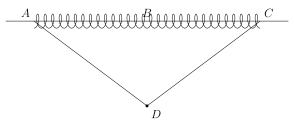
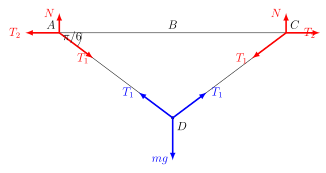
A small lamp of mass \(m\) is at the end \(A\) of a light rod \(AB\) of length \(2a\) attached at \(B\) to a vertical wall in such a way that the rod can rotate freely about \(B\) in a vertical plane perpendicular to the wall. A spring \(CD\) of natural length \(a\) and modulus of elasticity \(\lambda\) is joined to the rod at its mid-point \(C\) and to the wall at a point \(D\) a distance \(a\) vertically above \(B\). The arrangement is sketched below. \noindent
1993 Paper 1 Q12
In a clay pigeon shoot the target is launched vertically from ground level with speed \(v\). At a time \(T\) later the competitor fires a rifle inclined at angle \(\alpha\) to the horizontal. The competitor is also at ground level and is a distance \(l\) from the launcher. The speed of the bullet leaving the rifle is \(u\). Show that, if the competitor scores a hit, then \[ l\sin\alpha-\left(vT-\tfrac{1}{2}gT^{2}\right)\cos\alpha=\frac{v-gT}{u}l. \] Suppose now that \(T=0\). Show that if the competitor can hit the target before it hits the ground then \(v < u\) and \[ \frac{2v\sqrt{u^{2}-v^{2}}}{g}>l. \]
1992 Paper 1 Q6
Explain briefly, by means of a diagram, or otherwise, why \[ \mathrm{f}(\theta+\delta\theta)\approx\mathrm{f}(\theta)+\mathrm{f}'(\theta)\delta\theta, \] when \(\delta\theta\) is small. Two powerful telescopes are placed at points \(A\) and \(B\) which are a distance \(a\) apart. A very distant point \(C\) is such that \(AC\) makes an angle \(\theta\) with \(AB\) and \(BC\) makes an angle \(\theta+\phi\) with \(AB\) produced. (A sketch of the arrangement is given in the diagram.) \noindent
1991 Paper 1 Q1
If \(\theta+\phi+\psi=\tfrac{1}{2}\pi,\) show that \[ \sin^{2}\theta+\sin^{2}\phi+\sin^{2}\psi+2\sin\theta\sin\phi\sin\psi=1. \] By taking \(\theta=\phi=\tfrac{1}{5}\pi\) in this equation, or otherwise, show that \(\sin\tfrac{1}{10}\pi\) satisfies the equation \[ 8x^{3}+8x^{2}-1=0. \]
Solution: \begin{align*} S &= \sin^{2}\theta+\sin^{2}\phi+\sin^{2}\psi+2\sin\theta\sin\phi\sin\psi \\ &= \sin^{2}\theta+\sin^{2}\phi+\sin^{2}(\tfrac\pi2-\theta-\phi)+2\sin\theta\sin\phi\sin(\tfrac\pi2-\theta-\phi) \\ &= \sin^{2}\theta+\sin^{2}\phi+\cos^{2}(\theta+\phi)+2\sin\theta\sin\phi\cos(\theta+\phi) \\ &= \sin^{2}\theta+\sin^{2}\phi+\left ( \cos(\theta)\cos(\phi)-\sin(\theta)\sin(\phi)\right)^2+2\sin\theta\sin\phi\left ( \cos(\theta)\cos(\phi)-\sin(\theta)\sin(\phi)\right) \\ &= \sin^{2}\theta+\sin^{2}\phi+\cos^2 \theta\cos^2 \phi-\sin^2 \theta \sin^2 \phi \\ &= \sin^{2}\theta(1-\sin^2 \phi)+\sin^{2}\phi+\cos^2 \theta\cos^2 \phi \\ &= \sin^{2}\theta\cos^2 \phi+\sin^{2}\phi+\cos^2 \theta\cos^2 \phi \\ &= \sin^{2}\phi+\cos^2 \phi \\ &= 1 \end{align*} Suppose \(\theta = \phi = \tfrac15 \pi, \psi = \tfrac1{10}\pi\). Also let \(s = \sin \tfrac1{10}\) \begin{align*} 1 &= 2\sin^2 \tfrac15 \pi + \sin^2 \tfrac1{10} \pi + 2 \sin^2\tfrac15 \pi \sin \tfrac1{10} \pi \\ &= 8\sin^2 \tfrac1{10} \pi \cos^2 \tfrac1{10} \pi + \sin^2 \tfrac1{10} \pi + 8 \sin^2 \tfrac1{10} \pi \cos^2 \tfrac1{10} \pi \sin \tfrac1{10} \pi \\ &= 8\sin^2 \tfrac1{10} \pi(1- \sin^2 \tfrac1{10} \pi) + \sin^2 \tfrac1{10} \pi + 8 \sin^2 \tfrac1{10} \pi (1-\sin^2 \tfrac1{10} \pi) \sin \tfrac1{10} \pi \\ &= 8s^2(1-s^2)+s^2 + 8s^2(1-s^2)s \\ &= -8 s^5 - 8 s^4 + 8 s^3 + 9 s^2 \end{align*} Therefore \(s\) is a root of \(8s^5+8s^4-8s^3-9s^2+1 = 0\), but notice that \begin{align*} 8s^5+8s^4-8s^3-9s^2+1 &= (s-1)(8 s^4 + 16 s^3 + 8 s^2 - s - 1 ) \\ &= (s-1)(s+1)(8s^3+8s^2-1) \end{align*} Therefore since \(\sin \tfrac{1}{10} \pi \neq \pm 1\) it must be a root of \(8x^3+8x^2-1=0\)
1991 Paper 2 Q4
Let \(y=\cos\phi+\cos2\phi\), where \(\phi=\dfrac{2\pi}{5}.\) Verify by direct substitution that \(y\) satisfies the quadratic equation \(2y^{2}=3y+2\) and deduce that the value of \(y\) is \(-\frac{1}{2}.\) Let \(\theta=\dfrac{2\pi}{17}.\) Show that \[ \sum_{k=0}^{16}\cos k\theta=0. \] If \(z=\cos\theta+\cos2\theta+\cos4\theta+\cos8\theta,\) show that the value of \(z\) is \(-(1-\sqrt{17})/4\).
Solution: Note that \(\cos 4 \phi = \cos \phi, \cos 3 \phi = \cos 2 \phi\) \begin{align*} && LHS & = 2y^2 \\ &&&= 2 \left ( \cos \phi + \cos 2 \phi \right)^2 \\ &&&= 2 \cos ^2 \phi + 2 \cos^2 2 \phi + 4 \cos \phi \cos 2 \phi \\ &&&= \cos 2 \phi+1+ \cos4 \phi+1+2 \left ( \cos \phi + \cos 3 \phi \right) \\ &&&= \cos 2 \phi + 2 + \cos \phi + 2 \cos \phi + 2 \cos 2 \phi \\ &&&= 3(\cos \phi + \cos 2 \phi) + 2 \\ &&&= 3 y + 2 \\ &&&= RHS \end{align*} Therefore \(y\) satisfies \(2y^2 = 3y+2\), which we can solve: \begin{align*} && 0 &= 2y^2-3y-2 \\ &&&= (2y+1)(y-2) \\ \Rightarrow && y &= -\frac12,2 \end{align*} Since \(\cos \phi \neq 1\), \(y \neq 2\), therefore \(y = -\frac12\). \begin{align*} && \sum_{k=0}^{16} \cos k \theta &= \sum_{k=0}^{17} \textrm{Re} \left ( e^{ k \theta i} \right ) \\ &&&= \textrm{Re} \left ( \sum_{k=0}^{16}e^{ k \theta i} \right ) \\ &&&= \textrm{Re} \left ( \frac{1-e^{17 \theta i}}{1-e^{i \theta}} \right ) \\ &&&= 0 \end{align*} Suppose \(z = \cos \theta + \cos 2 \theta + \cos 4 \theta + \cos 8 \theta\) \begin{align*} z^2 &= \left (\cos \theta + \cos 2 \theta + \cos 4 \theta + \cos 8 \theta \right)^2 \\ &= \cos^2 \theta + \cos^2 2 \theta + \cos^2 4 \theta + \cos^2 8 \theta \\ & \quad \quad 2( \cos \theta \cos 2 \theta + \cos \theta \cos 4 \theta + \cos \theta \cos 8 \theta + \\ & \quad \quad \quad \cos 2 \theta \cos 4 \theta + \cos 2 \theta \cos 8 \theta + \cos 4 \theta \cos 8 \theta) \\ &= \frac12 \left (\cos 2 \theta + 1+ \cos 4 \theta + 1 + \cos 8 \theta + 1 + \cos 16 \theta + 1 \right ) + \\ &\quad \quad ( \cos \theta + \cos 3 \theta + \cos 3 \theta + \cos 5 \theta + \cos 7 \theta + \cos 9 \theta + \\ & \quad \quad \quad \cos 2 \theta + \cos 6 \theta + \cos 6 \theta + \cos 10 \theta +\cos 4 \theta + \cos 12 \theta ) \\ &= \frac12 z + 2 + \\ & \quad \quad ( \cos 3 \theta + \cos 6 \theta - \cos 8 \theta - \cos 11 \theta \\ & \quad \quad \quad - \cos 13 \theta - \cos 14 \theta - \cos 15 \theta - \cos 16 \theta - 1) \\ &= \frac12 z + 1 - z \\ &= -\frac12 z +1 \end{align*} Therefore \(z\) satisfies \(z^2=-\frac12 z+1 \Rightarrow z = \frac{-\frac12 \pm \sqrt{\frac14+4}}{2} = \frac{-1 \pm \sqrt{17}}{4}\) Therefore \(z = \frac{\sqrt{17}-1}{4}\) since \(z > 0\)
1990 Paper 1 Q1
\(\,\)
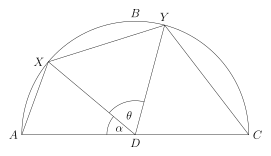
Solution: The area for \(\alpha\) fixed is \(\frac12 r^2 \sin \alpha + \frac12 r^2 \sin \theta + \frac12 r^2 \sin (\pi - \theta - \alpha)\) So we wish to maximise \(V = \sin \theta + \sin(\pi - \theta-\alpha)\) \begin{align*} && V &= \sin \theta + \sin(\pi - \theta-\alpha)\\ &&&= 2\sin \l \frac{\pi-\alpha}2\r\cos \l \frac{2\theta + \alpha - \pi}{2}\r \end{align*} The largest \(\cos\) can be is \(1\) when \(\displaystyle 2\theta + \alpha - \pi = 0 \Rightarrow \theta = \frac{\pi-\alpha}2\). (ie we split the remaining area exactly in half). We are now trying to maximise \(W = \sin \alpha + 2 \sin \frac{\pi - \alpha}2\) ie \begin{align*} && W &= \sin \alpha + 2 \cos \frac{\alpha}{2} \\ \Rightarrow && \frac{\d W}{\d \alpha} &= \cos \alpha-\sin \frac{\alpha}{2} \\ &&&= 1-2 \sin^2 \frac{\alpha}{2} - \sin \frac{\alpha}{2} \\ &&&= (1+\sin \frac{\alpha}{2})(1-2\sin \frac{\alpha}{2}) \end{align*} Therefore \(\frac{\alpha}{2} = -\frac{3\pi}{2}, \frac{\alpha}{2} = \frac{\pi}{6}, \frac{5\pi}{6} \Rightarrow \alpha = -3\pi, \frac{\pi}{3}, \frac{5\pi}{3}\). The only turning point in our range is \(\frac{\pi}{3}\). This is obvious a a maximum by symmetry or checking the end points, but we could also check the second derivative \(\frac{\d^2 W}{\d \alpha^2} = -\sin \frac{\pi}{3}-\cos \frac{\pi}{3} < 0\) so we have a maximum. Therefore the largest possible area is: \(\displaystyle \frac{3\sqrt{3}}{4}r^2\)
1990 Paper 1 Q12
\(\,\)
Solution:
1990 Paper 2 Q2
Prove that if \(A+B+C+D=\pi,\) then \[ \sin\left(A+B\right)\sin\left(A+D\right)-\sin B\sin D=\sin A\sin C. \] The points \(P,Q,R\) and \(S\) lie, in that order, on a circle of centre \(O\). Prove that \[ PQ\times RS+QR\times PS=PR\times QS. \]
Solution: \begin{align*} \sin(A+B)\sin(A+D) - \sin B \sin D &= \sin (A+B)\sin(\pi - B-C) - \sin B \sin (\pi - A - B - C) \\ &= \sin (A+B)\sin(B+C) - \sin B \sin(A+B+C) \\ &= \sin(A+B)\sin (B+C) - \sin B (\sin (A+B)\cos C +\cos(A+B) \sin C) \\ &= \sin(A+B)\cos B \sin C + \cos(A+B)\sin B \sin C \\ &= \sin A \sin C \cos^2 B + \cos A \sin B \cos B \sin C - \cos A \cos B \sin B \sin C + \sin A \sin^2 B \sin C \\ &= \sin A \sin C (\cos^2 B + \sin^2 B) \\ &= \sin A \sin C \end{align*}

1989 Paper 2 Q1
Prove that \(\cos3\theta=4\cos^{3}\theta-3\cos\theta\). Show how the cubic equation \[ 24x^{3}-72x^{2}+66x-19=0\tag{*} \] can be reduced to the form \[ 4z^{3}-3z=k \] by means of the substitution \(y=x+a\) and \(z=by\), for suitable values of the constants \(a\) and \(b\). Hence find the three roots of the equation \((*)\), to three significant figures. Show, by means of a counterexample, or otherwise, that not all cubic equations of the form \[ x^{3}+\alpha x^{2}+\beta x+\gamma=0 \] can be solved by this method.
Solution: \begin{align*} \cos 3\theta &= \cos 2\theta\cos\theta - \sin 2\theta \sin \theta \\ &= (2\cos^2\theta-1)\cos \theta - 2\cos \theta \sin^2 \theta \\ &= 2\cos^3\theta-\cos \theta - 2\cos \theta(1- \cos^2 \theta) \\ &= 4\cos^3 \theta - 3\cos \theta \end{align*} \begin{align*} 0 &= 24x^{3}-72x^{2}+66x-19 \\ &= 24(y+1)^3-72(y+1)^2+66(y+1)-19 \\ &= 24(y^3+3y^2+3y+1)-72(y^2+2y+1)+66(y+1)-19\\ &= 24y^3+(72-144+66)y+(24-72+66-19) \\ &= 24y^3-6y-1 \\ &= 24b'^3z^3 - 6b'z - 1 \\ &= \frac{2}{\sqrt{3}}(4 z^3 -3z) - 1 \\ \end{align*} Therefore if \(b = \sqrt{3}, a = 1\), we have: \(4z^3 - 3z = \frac{\sqrt{3}}{2}\) So if \(z = \cos \theta \Rightarrow \cos 3\theta = \frac{\sqrt{3}}2 \Rightarrow 3 \theta = \frac{\pi}{6}, \frac{11\pi}{6}, \frac{13\pi}{6} \Rightarrow \theta = \frac{\pi}{18}, \frac{11\pi}{18}, \frac{13\pi}{18}\). Since \(\frac{\cos x}{\sqrt{3}} < 1\) we only need to approximate the first part to 2 significant figures. Therefore: \begin{align*} \sqrt{3} &\approx 1 + \frac{1}{1 + \frac{1}{2+\frac11}} = \frac{7}{4} = 1.75\\ \cos \tfrac{\pi}{18} &\approx \cos \frac{1}{6} \approx 1 - \frac{1}{2} \frac{1}{6^2} = \frac{71}{72} \approx 1 - \frac{1}{70} = 1 - 0.014 = 0.986 \\ \frac{\cos \tfrac{\pi}{18}}{\sqrt{3}} & \approx \frac{.986}{1.75} = 0.57 \\ \end{align*} Final answers: \(1.57, 0.803, 0.629\). We wouldn't be able to solve \(x^3 + 1= 0\) using this method, as we would have 2 non-real roots
1988 Paper 1 Q6
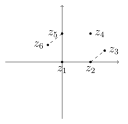
The complex numbers \(z_{1},z_{2},\ldots,z_{6}\) are represented by six distinct points \(P_{1},P_{2},\ldots,P_{6}\) in the Argand diagram. Express the following statements in terms of complex numbers:
- \(\overrightarrow{P_{1}P_{2}}=\overrightarrow{P_{5}P_{4}}\) and \(\overrightarrow{P_{2}P_{3}}=\overrightarrow{P_{6}P_{5}}\,\);
- \(\overrightarrow{P_{2}P_{4}}\) is perpendicular to \(\overrightarrow{P_{3}P_{6}}\,\).
Solution:
- \(\overrightarrow{P_{1}P_{2}}=\overrightarrow{P_{5}P_{4}}\) is equivalent to \(z_2 - z_1 = z_4 - z_5\). \(\overrightarrow{P_{2}P_{3}}=\overrightarrow{P_{6}P_{5}}\) is equivalent to \(z_3-z_2 = z_5 - z_6\).
- \(\overrightarrow{P_{2}P_{4}}\) is perpendicular to \(\overrightarrow{P_{3}P_{6}}\,\) is equivalent to \(\frac{z_4 - z_2}{z_6-z_3} \in i\mathbb{R}\)
1987 Paper 2 Q2
Show that if at least one of the four angles \(A\pm B\pm C\) is a multiple of \(\pi\), then \begin{alignat*}{1} \sin^{4}A+\sin^{4}B+\sin^{4}C & -2\sin^{2}B\sin^{2}C-2\sin^{2}C\sin^{2}A\\ & -2\sin^{2}A\sin^{2}B+4\sin^{2}A\sin^{2}B\sin^{2}C=0. \end{alignat*}