Problems
Filters
298 problems found
2015 Paper 1 Q10
A bus has the shape of a cuboid of length \(a\) and height \(h\). It is travelling northwards on a journey of fixed distance at constant speed \(u\) (chosen by the driver). The maximum speed of the bus is \(w\). Rain is falling from the southerly direction at speed \(v\) in straight lines inclined to the horizontal at angle \(\theta\), where \(0<\theta<\frac12\pi\). By considering first the case \(u=0\), show that for \(u>0\) the total amount of rain that hits the roof and the back or front of the bus in unit time is proportional to \[ h\big \vert v\cos\theta - u \big\vert + av\sin\theta \,. \] Show that, in order to encounter as little rain as possible on the journey, the driver should choose \( u=w\) if either \(w< v\cos\theta\) or \( a\sin\theta > h\cos\theta\). How should the speed be chosen if \(w>v\cos\theta\) and \( a\sin\theta < h\cos\theta\)? Comment on the case \( a\sin\theta = h\cos\theta\). How should the driver choose \(u\) on the return journey?
2015 Paper 1 Q11
Two long circular cylinders of equal radius lie in equilibrium on an inclined plane, in \mbox{contact} with one another and with their axes horizontal. The weights of the upper and lower \mbox{cylinders} are \(W_1\) and \(W_2\), respectively, where \(W_1>W_2\)\,. The coefficients of friction \mbox{between} the \mbox{inclined} plane and the upper and lower cylinders are \(\mu_1\) and \(\mu_2\), respectively, and the \mbox{coefficient} of friction \mbox{between} the two cylinders is \(\mu\). The angle of inclination of the plane is~\(\alpha\) (which is positive).
- Let \(F\) be the magnitude of the frictional force between the two cylinders, and let \(F_1\) and \(F_2\) be the magnitudes of the frictional forces between the upper cylinder and the plane, and the lower cylinder and the plane, respectively. Show that \(F=F_1=F_2\,\).
- Show that \[ \mu \ge \dfrac{W_1+W_2}{W_1-W_2} \,,\] and that \[ \tan\alpha \le \frac{ 2 \mu_1 W_1}{(1+\mu_1)(W_1+ W_2)}\,. \]
2015 Paper 2 Q1
- By use of calculus, show that \(x- \ln(1+x)\) is positive for all positive \(x\). Use this result to show that \[ \sum_{k=1}^n \frac 1 k > \ln (n+1) \,. \]
- By considering \( x+\ln (1-x)\), show that \[ \sum_{k=1}^\infty \frac 1 {k^2} <1+ \ln 2 \,. \]
Solution:
- Consider \(f(x) = x - \ln (1+ x)\), then \(f'(x) = 1 - \frac{1}{1+x} = \frac{x}{1+x} > 0\) if \(x >0\). Therefore \(f(x)\) is strictly increasing on the positive reals. Since \(f(0) = 0\) we must have \(f(x) > 0\) for all positive \(x\), ie \(x - \ln(1+x)\) is positive for all positive \(x\). \begin{align*} \sum_{k=1}^n \frac1k &\underbrace{>}_{x > \ln(1+x)} \sum_{k=1}^n \ln \left (1 + \frac1k \right ) \\ &= \sum_{k=1}^n \ln \left ( \frac{k+1}{k} \right ) \\ &= \sum_{k=1}^n \left ( \ln (k+1) - \ln (k) \right) \\ &= \ln (n+1) - \ln 1 \\ &= \ln (n+1) \end{align*}
- Let \(g(x) = x + \ln (1-x)\) ,then \(g'(x) = 1 - \frac{1}{1-x} = \frac{-x}{1-x} < 0\) if \(0 < x < 1\) and \(g(0) = 0\). Therefore \(g(x)\) is decreasing and hence negative on \(0 < x < 1\), in particular \(x < -\ln(1-x) \) \begin{align*} \sum_{k=2}^n \frac1{k^2} &\underbrace{<}_{x < -\ln(1+x)} \sum_{k=2}^n - \ln \left (1-\frac1{k^2} \right) \\ &= -\sum_{k=2}^n \ln \left ( \frac{k^2-1}{k^2}\right) \\ &= \sum_{k=2}^n \l 2 \ln k - \ln(k-1) - \ln(k+1) \r \\ &= \ln n - \ln(n+1) - \ln 0+\ln 2 \\ &= \ln 2 + \ln \frac{n}{n+1} \end{align*} as \(n \to \infty\) we must have \(\displaystyle \sum_{k=2}^{\infty} \frac1{k^2} < \ln 2\) ie \[ \sum_{k=1}^\infty \frac 1 {k^2} <1+ \ln 2\]
2015 Paper 2 Q7
A circle \(C\) is said to be bisected by a curve \(X\) if \(X\) meets \(C\) in exactly two points and these points are diametrically opposite each other on \(C\).
- Let \(C\) be the circle of radius \(a\) in the \(x\)-\(y\) plane with centre at the origin. Show, by giving its equation, that it is possible to find a circle of given radius \(r\) that bisects \(C\) provided \(r > a\). Show that no circle of radius \(r\) bisects \(C\) if \(r\le a\,\).
- Let \(C_1\) and \(C_2\) be circles with centres at \((-d,0)\) and \((d,0)\) and radii \(a_1\) and \(a_2\), respectively, where \(d > a_1\) and \(d > a_2\). Let \(D\) be a circle of radius \(r\) that bisects both \(C_1\) and \(C_2\). Show that the \(x\)-coordinate of the centre of \(D\) is \(\dfrac{a_2^2 - a_1^2}{4d}\). Obtain an expression in terms of \(d\), \(r\), \(a_1\) and \(a_2\) for the \(y\)-coordinate of the centre of \(D\), and deduce that \(r\) must satisfy \[ 16r^2d^2 \ge \big (4d^2 +(a_2-a_1)^2\big) \, \big (4d^2 +(a_2+a_1)^2\big) \,. \]
Solution:
- \(C\) has the equation \(x^2 + y^2 = a^2\). One suitable circle would ideally pass through \((0,a)\) and \((0,-a)\) have a centre on the positive \(x\)-axis, so we would need \(a^2+c^2 = r^2\) so \(c = \sqrt{r^2-a^2}\) and the equation would be \((x-\sqrt{r^2-a^2})^2 + y^2 = r^2\). Clearly a circle with radius \(r < a\) cannot pass through two diametrically opposed points of a circle radius \(a\), since the furthest two points can be on a circle is \(2r\), and diametrically opposed points are \(2a\) apart. Similarly if they are exactly the same radii, then if they pass through diametrically opposed points they must be the same circle.
- Let the centre of \(D\) be at \((x,y)\), then it must be a distance of \(\sqrt{r^2-a_i}\) from each circle centre, ie \begin{align*} && (x-d)^2+y^2 &= r^2-a_2^2 \\ && (x+d)^2 + y^2 &= r^2-a_1^2 \\ \Rightarrow && 4dx &= a_2^2 - a_1^2 \\ \Rightarrow && x &= \frac{a_2^2-a_1^2}{4d} \\ \Rightarrow && y^2 &= r^2-a_1^2 - \left (\frac{a_2^2-a_1^2}{4d}+d \right)^2 \\ &&&= r^2 - a_1^2 - \frac{(a_2^2-a_1^2+4d^2)^2}{16d^2} \\ &&&= \frac{16d^2r^2-16d^2a_1^2 - a_2^4-a_1^4-16d^4+2a_1^2a_2^2+8a_1^2d^2-8a_2^2d^2}{16d^2} \\ &&&= \frac{16d^2r^2-8d^2a_1^2 - a_2^4-a_1^4-16d^4+2a_1^2a_2^2-8a_2^2d^2}{16d^2} \\ \Rightarrow && y &= \pm \sqrt{ \frac{16d^2r^2-8d^2a_1^2 - a_2^4-a_1^4-16d^4+2a_1^2a_2^2-8a_2^2d^2}{16d^2}} \end{align*} and we need \begin{align*} && 0 &\leq 16d^2r^2-8d^2a_1^2 - a_2^4-a_1^4-16d^4+2a_1^2a_2^2-8a_2^2d^2 \\ \Rightarrow && 16d^2 d^2 &\geq 8d^2a_1^2 + a_2^4+a_1^4+16d^4+2a_1^2a_2^2+8a_2^2d^2 \\ &&&= (4d^2+(a_2-a_1)^2)(4d^2+(a_2+a_1)^2) \end{align*}
2015 Paper 3 Q2
If \(s_1\), \(s_2\), \(s_3\), \(\ldots\) and \(t_1\), \(t_2\), \(t_3\), \(\ldots\) are sequences of positive numbers, we write \[ (s_n)\le (t_n) \] to mean
- \((1000n) \le (n^2)\,\).
- If it is not the case that \((s_n)\le (t_n)\), then it is the case that \((t_n)\le (s_n)\,\).
- If \((s_n)\le (t_n)\) and \((t_n) \le (u_n)\), then \((s_n)\le (u_n)\,\).
- \((n^2)\le (2^n)\,\).
Solution:
- If \(m = 1000\), then \(n \geq m \Rightarrow n^2 \geq 1000n \Rightarrow (1000n) \leq (n^2)\)
- This is false. Let \(s_i = 1,2,1,2,\cdots\) and \(t_i = 2,1,2,1,\cdots\).
- Suppose that for \(n \geq m_1, s_n \le t_n\) and for \(n \geq m_2, s_t \le u_n\), then for \(n \geq m = \max(m_1, m_2), s_n \leq t_n \leq u_n \Rightarrow s_n \leq u_n \Rightarrow (s_n) \leq (u_n)\)
- Let \(m = 6\), then if \(n \geq m, 2^n \geq 1 + n + \frac{n(n-1)}{2} + \frac{n(n-1)}{2} + n + 1 = n^2 + n + 2 \geq n^2\), so \((2^n) \geq (n^2)\)
2015 Paper 3 Q6
- Let \(w\) and \(z\) be complex numbers, and let \(u= w+z\) and \(v=w^2+z^2\). Prove that \(w\) and \(z\) are real if and only if \(u\) and \(v\) are real and \(u^2\le2v\).
- The complex numbers \(u\), \(w\) and \(z\) satisfy the equations \begin{align*} w+z-u&=0 \\ w^2+z^2 -u^2 &= - \tfrac 23 \\ w^3+z^3 -\lambda u &= -\lambda\, \end{align*} where \(\lambda \) is a positive real number. Show that for all values of \(\lambda\) except one (which you should find) there are three possible values of \(u\), all real. Are \(w\) and \(z\) necessarily real? Give a proof or counterexample.
Solution:
- Notice that \(u^2 = v+2wz\), so \(w,z\) are roots of the quadratic \(t^2 -ut+\frac{u^2-v}{2}\). Therefore they are both real if \(u^2 \geq 2(u^2-v) \Rightarrow 2v \geq u^2\).
- \begin{align*} && w+z &= u \\ && w^2+z^2 &= u^2 - \tfrac23 \\ && w^3+z^3 &= \lambda(u-1) \\ \\ && wz &= \frac{u^2 - (u^2-\tfrac23)}{2} = \tfrac13\\ \\ && (w+z)(w^2+z^2) &= w^3+z^3+wz(w+z) \\ &&u(u^2-\tfrac23)&= \lambda(u-1)+\frac13u \\ \Rightarrow && u^3-u&= \lambda (u-1) \\ \Rightarrow && 0 &= (u-1)(u(u+1) - \lambda) \\ \Rightarrow && 0 &= (u-1)(u^2+u - \lambda) \end{align*} Therefore there will be at most 3 values for \(u\), unless \(1\) is a root of \(u^2+u-\lambda\), ie \(\lambda = 2\). Suppose \(u = 1\), then we have: \(w+z = 1, wz = 1/3 \Rightarrow w,z = \frac{-1 \pm \sqrt{-1/3}}{2}\) which are clearly complex.
2014 Paper 1 Q3
The numbers \(a\) and \(b\), where \(b > a\ge0\), are such that \[ \int_a^b x^2 \d x = \left ( \int_a^b x \d x\right)^{\!\!2}\,. \]
- In the case \(a=0\) and \(b>0\), find the value of \(b\).
- In the case \(a=1\), show that \(b\) satisfies \[ 3b^3 -b^2-7b -7 =0\,. \] Show further, with the help of a sketch, that there is only one (real) value of \(b\) that satisfies this equation and that it lies between \(2\) and \(3\).
- Show that \(3p^2 + q^2 = 3p^2q\), where \(p=b+a\) and \(q=b-a\), and express \(p^2\) in terms of \(q\). Deduce that \(1< b-a\le\frac43\).
Solution:
- \(\,\) \begin{align*} && \int_0^b x^2 \d x &= \left ( \int_0^b x \d x \right)^2 \\ \Rightarrow && \frac{b^3}{3} &= \left ( \frac{b^2}{2} \right)^2 \\ \Rightarrow && b &= \frac{4}{3} \end{align*}
- \(\,\)
\begin{align*}
&& \int_1^b x^2 \d x &= \left ( \int_1^b x \d x \right)^2 \\
\Rightarrow && \frac{b^3}{3} - \frac{1}{3} &= \left ( \frac{b^2}{2} - \frac{1}{2} \right)^2 \\
\Rightarrow && 4(b^3 - 1) &= 3(b^2-1)^2 \\
\Rightarrow && 4(b^3-1) &= 3(b^4-2b^2+1) \\
\Rightarrow && 0 &= 3b^4-4b^3-6b^2+7 \\
&&&= (b-1)(3b^3-b^2-7b-7) \\
\Rightarrow && 0 &= 3b^3-b^2-7b-7
\end{align*}
Let \(f(x) = 3x^3-x^2-7x-7\) then \(f(2) = 3 \cdot 8 - 4 - 14 - 7 = -1 < 0\), \(f(3) = 3 \cdot 27 - 9 - 21 - 7 = 44 > 0\) therefore the root must lie between \(2\) and \(3\).
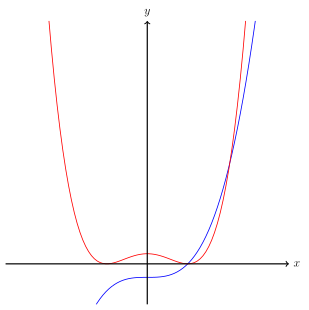
- \(,\) \begin{align*} && \int_a^b x^2 \d x &= \left ( \int_a^b x \d x \right)^2 \\ \Rightarrow && \frac{b^3}{3} - \frac{a^3}{3} &= \left ( \frac{b^2}{2} - \frac{a^2}{2} \right)^2 \\ \Rightarrow && 4(b^3 - a^3) &= 3(b^2-a^2)^2 \\ \Rightarrow && 4(b^2+ab+a^2) &= 3(b-a)(b+a)^2 \\ \Rightarrow && 4 \left ( \left ( \frac{p+q}{2}\right)^2+\left ( \frac{p+q}{2}\right)\left ( \frac{p-q}{2}\right)+\left ( \frac{p-q}{2}\right)^2\right) &= 3qp^2 \\ \Rightarrow && 3p^2 + q^2 &= 3qp^2 \\ \Rightarrow && 3p^2(q-1) &= q^2 \\ \Rightarrow && p^2 &= \frac{q^2}{3(q-1)} \\ \Rightarrow && 1 &\leq \frac{1}{3(q-1)} \\ \Rightarrow && 3(q-1) &\leq 1 \\ \Rightarrow && q & \leq \frac{4}{3} \\ \end{align*}
2014 Paper 1 Q5
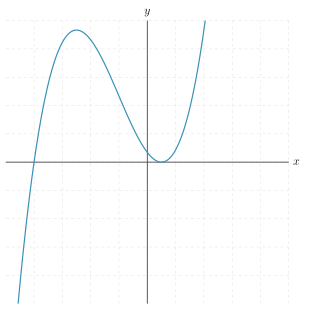
- Let \(f(x) = (x+2a)^3 -27 a^2 x\), where \(a\ge 0\). By sketching \(f(x)\), show that \(f(x)\ge 0\) for \(x \ge0\).
- Use part (i) to find the greatest value of \(xy^2\) in the region of the \(x\)-\(y\) plane given by \(x\ge0\), \(y\ge0\) and \(x+2y\le 3\,\). For what values of \(x\) and \(y\) is this greatest value achieved?
- Use part (i) to show that \((p+q+r)^3 \ge 27pqr\) for any non-negative numbers \(p\), \(q\) and \(r\). If \((p+q+r)^3 = 27pqr\), what relationship must \(p\), \(q\) and \(r\) satisfy?
Solution:
- Note that \(f(x) = (x+2a)^3 - 27a^2x\) so \(f'(x) = 3(x+2a)^2-27a^2 = 3x^2+12ax-15a^2 = (x-a)(3x+15a)\) so the turning points are at \(x = a, x = -5a\). But \(f(a) = 0\), so the curve just touches the \(x\)-axis. Note also that \(f(0) = 8a^3 \geq 0\) so:
- \(\,\) \begin{align*} && 0 &\leq (x+2y)^3 - 27y^2 x \\ &&& \leq 3^3 - 27 y^2 x \\ &&&= 27(1-y^2x) \\ \Rightarrow && xy^2 &\leq1 \end{align*} with equality when \(x = y = 1\)
- Notice that \begin{align*} && 0 &\leq (p+q+r)^3 - 27\left (\frac{q+r}{2}\right)^2 p \\ \Rightarrow && (p+q+r)^3 &\geq 27\left (\frac{q+r}{2}\right)^2 p \\ &&&\underbrace{\geq}_{AM-GM} 27\left (\sqrt{qr}\right)^2 p \\ &&&= 27pqr \end{align*} Equality can only hold if \(p = \frac{q+r}{2}\), but by symmetry we must also have \(q = \frac{r+p}{2}, r = \frac{p+q}{2}\) ie \(p = q = r\). And indeed equality does hold in this case.
2014 Paper 1 Q9
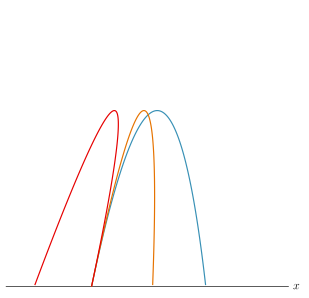
A particle of mass \(m\) is projected due east at speed \(U\) from a point on horizontal ground at an angle \(\theta\) above the horizontal, where \(0 < \theta < 90^\circ\). In addition to the gravitational force \(mg\), it experiences a horizontal force of magnitude \(mkg\), where \(k\) is a positive constant, acting due west in the plane of motion of the particle. Determine expressions in terms of \(U\), \(\theta\) and \(g\) for the time, \(T_H\), at which the particle reaches its greatest height and the time, \(T_L \), at which it lands. Let \(T = U\cos\theta /(kg)\). By considering the relative magnitudes of \(T_H\), \(T_L \) and \(T\), or otherwise, sketch the trajectory of the particle in the cases \(k\tan\theta<\frac12\), \(\frac12 < k\tan\theta<1\), and \(k\tan\theta>1\). What happens when \(k\tan\theta =1\)?
Solution: \begin{align*} && v_{\uparrow} &= U\sin \theta - g t \\ \Rightarrow && T_H &= \frac{U \sin \theta}{g} \\ \\ && s_{\uparrow} &= U \sin \theta t - \frac12 g t^2 \\ \Rightarrow && 0 &= U\sin \theta T_L - \frac12 g T_L^2 \\ && T_L &= \frac{2 U \sin \theta}{g} \end{align*} \(T = U\cos \theta / (kg)\) is the point when the particle's horizontal motion is reversed.
2014 Paper 1 Q11
The diagrams below show two separate systems of particles, strings and pulleys.In both systems, the pulleys are smooth and light, the strings are light and inextensible, the particles move vertically and the pulleys labelled with \(P\) are fixed. The masses of the particles are as indicated on the diagrams.
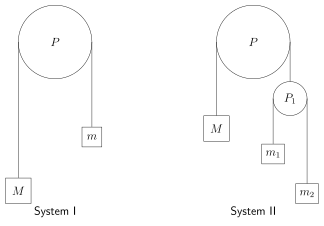
- For system I show that the acceleration, \(a_1\), of the particle of mass \(M\), measured in the downwards direction, is given by \[ a_1= \frac{M-m}{M+m} \, g \,, \] where \(g\) is the acceleration due to gravity. Give an expression for the force on the pulley due to the tension in the string.
- For system II show that the acceleration, \(a_2\), of the particle of mass \(M\), measured in the downwards direction, is given by \[ a_2= \frac{ M - 4\mu}{M+4\mu}\,g \,, \] where \(\mu = \dfrac{m_1m_2}{m_1+m_2}\). In the case \(m= m_1+m_2\), show that \(a_1= a_2\) if and only if \(m_1=m_2\).
Solution:
- \(\,\)
\begin{align*} \text{N2}(\uparrow, m): && T - mg &= ma_1 \\ \text{N2}(\uparrow, M): && T-Mg &= -Ma_1 \\ \Rightarrow && (M-m)g &= a_1(m+M) \\ \Rightarrow && a_1 &= \frac{M-m}{M+m}g \\ && T &= mg + ma_1 \\ &&&= \frac{2mM}{M+m}g \end{align*}
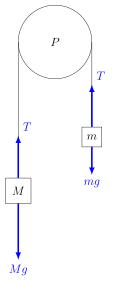
- System II is the same as system I, but with \(m\) replaced with \(2\frac{T}{g} = \frac{4mM}{M+m}\). In particular, this means that: \begin{align*} && a_2 &= \frac{M - \frac{4m_1m_2}{m_1+m_2}}{M + \frac{4m_1m_2}{m_1+m_2}} g \\ &&&= \frac{M-4\mu}{M+4\mu}g \end{align*} If \(m = m_1 + m_2\) then \begin{align*} && a_1 &= a_2 \\ \Leftrightarrow && \frac{M-m_1-m_2}{M+m_1+m_2} &= \frac{M - \frac{4m_1m_2}{m_1+m_2}}{M + \frac{4m_1m_2}{m_1+m_2}} \\ \Leftrightarrow && \frac{M-m_1-m_2}{M+m_1+m_2} &= \frac{M(m_1+m_2) -4m_1m_2}{M(m_1+m_2) + 4m_1m_2} \\ \Leftrightarrow && M^2(m_1+m_2)+4m_1m_2M &- M(m_1+m_2)^2 - 4m_1m_2(m_1+m_2) \\ &&\quad \quad = M^2(m_1+m_2) - 4m_1m_2M &+M(m_1+m_2)^2-4m_1m_2(m_1+m_2) \\ \Leftrightarrow && 8m_1m_2M&= 2M(m_1+m_2)^2 \\ \Leftrightarrow && 0 &= (m_1-m_2)^2 \\ \Leftrightarrow && m_1 &= m_2 \end{align*}
2014 Paper 2 Q2
This question concerns the inequality \begin{equation} \int_0^\pi \bigl( f(x) \bigr)^2 \d x \le \int_0^\pi \bigl( f'(x)\bigr)^2 \d x\,.\tag{\(*\)} \end{equation}
- Show that \((*)\) is satisfied in the case \(f(x)=\sin nx\), where \(n\) is a positive integer. Show by means of counterexamples that \((*)\) is not necessarily satisfied if either \(f(0) \ne 0\) or \(f(\pi)\ne0\).
- You may now assume that \((*)\) is satisfied for any (differentiable) function \(f\) for which \(f(0)=f(\pi)=0\). By setting \(f(x) = ax^2 + bx +c\), where \(a\), \(b\) and \(c\) are suitably chosen, show that \(\pi^2\le 10\). By setting \(f(x) = p \sin \frac12 x + q\cos \frac12 x +r\), where \(p\), \(q\) and \(r\) are suitably chosen, obtain another inequality for \(\pi\). Which of these inequalities leads to a better estimate for \(\pi^2\,\)?
Solution:
- If \(f(x) = \sin nx\) then \(f'(x) = n \cos n x\) and so \begin{align*} && LHS &= \int_0^\pi \sin^2 n x \d x \\ &&&= \left [ \frac{x+\frac1{2n}\sin 2n x}{2} \right ]_0^{\pi} \\ &&&= \frac{\pi}{2} \\ \\ && RHS &= \int_0^{\pi} n^2 \cos^2 n x \d x \\ &&&= n^2 \left [ \frac{\frac{1}{2n}\sin 2n x + x}{2} \right]_0^{\pi} \\ &&&= n^2\frac{\pi}{2} \geq LHS \end{align*} [\(f(0) = 0, f(\pi) \neq 0\)] Suppose \(f(x) = x\) then \(f'(x) = 1\) and \(LHS = \frac{\pi^3}{3} > \pi = RHS\). [\(f(0) \neq 0, f(\pi) = 0\)] Suppose \(f(x) = \pi - x\) then \(f'(x) = -1\) and \(LHS = \frac{\pi^3}{3} > \pi = RHS\)
- Suppose \(f(x) = x(\pi - x)\) then \(f'(x) = \pi - 2x\) and so \begin{align*} && \int_0^\pi x^2(\pi-x)^2 \d x &\leq \int_0^\pi (\pi-2x)^2 \d x \\ \Leftrightarrow && \left [\pi^2 \frac{x^3}{3} - 2\pi \frac{x^4}{4} + \frac{x^5}{5} \right]_0^{\pi} &\leq \left [ \pi^2x - 4\pi \frac{x^2}{2} + \frac{4x^3}{3} \right]_0^{\pi} \\ \Leftrightarrow && \pi^5 \left (\frac13 - \frac12+\frac15 \right) &\leq \pi^3 \left ( 1 - 2+\frac43 \right) \\ \Leftrightarrow && \pi^2 \frac{1}{30} &\leq \frac13 \\ \Leftrightarrow && \pi^2 &\leq 10 \end{align*} Suppose \(f(x) = p\sin \tfrac12 x + q \cos \tfrac12 x + r\), so \(f(0) = q + r\) and \(f(\pi) = p + r\), so say \(p = q = 1, r = -1\) \begin{align*} && LHS &= \int_0^{\pi} \left ( \sin \tfrac12 x + \cos \tfrac12 x-1\right)^2 \d x \\ &&&=\int_0^\pi \left ( \sin^2 \tfrac12 x + \cos^2 \tfrac12 x+1-2\sin \tfrac12 x - 2\cos \tfrac12 x+ \sin x \right)\\ &&&= \left [2x + 4\cos \tfrac12 x - 4\sin \tfrac12 x - \cos x \right]_0^{\pi} \\ &&&= \left ( 2\pi -4+1 \right) - \left ( 4-1 \right) \\ &&&= 2\pi -6\\ \\ && RHS&= \int_0^{\pi} \left ( \tfrac12 \cos \tfrac12 x -\tfrac12 \sin \tfrac12 x\right)^2 \d x \\ &&&= \int_0^{\pi} \left ( \tfrac14 \cos^2 \tfrac12 x +\tfrac14 \sin^2 \tfrac12 x-\tfrac14 \sin x\right) \d x \\ &&&= \frac{\pi}{4} - \frac12 \\ \Rightarrow && 2\pi -6 &\leq \frac{\pi}{4} - \frac12 \\ \Rightarrow && \frac{7\pi}{4} &\leq \frac{11}{2} \\ \Rightarrow && \pi &\leq \frac{22}{7} \end{align*} \(22^2/7^2 = 484/49 < 10\) therefore \(\pi \leq \frac{22}{7}\) is the better estimate.
2014 Paper 2 Q6
By simplifying \(\sin(r+\frac12)x - \sin(r-\frac12)x\) or otherwise show that, for \(\sin\frac12 x \ne0\), \[ \cos x + \cos 2x +\cdots + \cos nx = \frac{\sin(n+\frac12)x - \sin\frac12 x}{2\sin\frac12x}\,. \] The functions \(S_n\), for \(n=1, 2, \dots\), are defined by \[ S_n(x) = \sum_{r=1}^n \frac 1 r \sin rx \qquad (0\le x \le \pi). \]
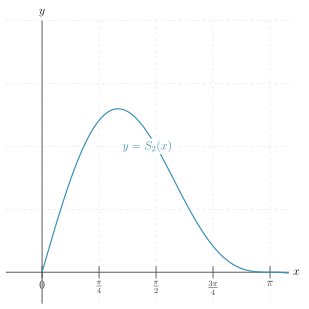
- Find the stationary points of \(S_2(x)\) for \(0\le x\le\pi\), and sketch this function.
- Show that if \(S_n(x)\) has a stationary point at \(x=x_0\), where \(0< x_0 < \pi\), then \[ \sin nx_0 = (1-\cos nx_0) \tan\tfrac12 x_0 \] and hence that \(S_n(x_0) \ge S_{n-1}(x_0)\). Deduce that if \(S_{n-1}(x) > 0\) for all \(x\) in the interval \(0 < x < \pi\), then \(S_{n}(x) > 0\) for all \(x\) in this interval.
- Prove that \(S_n(x)\ge0\) for \(n\ge1\) and \(0\le x\le\pi\).
Solution: \begin{align*} && \sin(r + \tfrac12)x - \sin(r - \tfrac12) x &= \sin rx \cos \tfrac12x + \cos r x\sin\tfrac12x - \sin r x \cos \tfrac12 x + \cos rx \sin \tfrac12 x \\ &&&= 2\cos r x \sin\tfrac12 x \\ \\ && S &= \cos x + \cos 2x + \cdots + \cos n x \\ && 2\sin \tfrac12 x S &= \sin(1 + \tfrac12)x - \sin \tfrac12 x + \\ &&&\quad+ \sin(2+\tfrac12)x - \sin(2- \tfrac12)x + \\ &&&\quad+ \sin(3+\tfrac12)x - \sin(3 - \tfrac12)x + \\ &&& \quad + \cdots + \\ &&&\quad + \sin(n+\tfrac12)x - \sin(n-\tfrac12)x \\ &&&=\sin(n+\tfrac12)x - \sin\tfrac12 x \\ \Rightarrow && S &= \frac{\sin(n+\tfrac12)x - \sin\tfrac12 x}{2 \sin \tfrac12 x} \end{align*}
- \(\,\) \begin{align*}
&& S_2(x) &= \sin x + \tfrac12 \sin 2 x \\
&& S'_2(x) &= \cos x + \cos 2x \\
&&&= \cos x + 2\cos^2 x - 1 \\
&&&= (2\cos x -1)(\cos x + 1) \\
\end{align*}
Therefore the turning points are \(\cos x= \frac12 \Rightarrow x = \frac{\pi}{3}\) and \(\cos x = -1 \Rightarrow x = \pi\)
- Suppose \(S_n(x)\) has a stationary point at \(x_0\), then $$ therefore \begin{align*} &&0 &= S_n'(x_0) \\ &&&= \cos x_0 + \cos 2x_0 + \cdots + \cos n x_0 \\ &&&= \frac{\sin(n+\tfrac12)x_0 - \sin \tfrac12x_0}{2 \sin \tfrac12 x_0} \\ \Rightarrow &&\sin\tfrac12 x_0&= \sin nx_0 \cos \tfrac12 x_0 + \cos nx_0 \sin \tfrac12x_0 \\ \Rightarrow && \sin nx_0 &= (1-\cos nx_0)\tan \tfrac12 x_0 \end{align*} Therefore \(S_n(x_0) -S_{n-1}(x_0) = \tfrac1n \sin n x_0 = \tfrac1n \underbrace{(1-\cos nx_0)}_{\geq 0}\underbrace{\tan\tfrac12 x_0}_{\geq 0} \geq 0\). Therefore if \(S_{n-1}(x) > 0\) for all \(x\) on \(0 < x < \pi\) then since \(S_n(x) > S_{n-1}(x)\) at the turning points and since they agree at the end points, it must be larger at all points inbetween.
- Notice that \(S_1(x) = \sin x \geq 0\) for all \(x \in [0,1]\) and by our previous argument we can show \(S_n > S_{n-1}\) inside the interval and equal on the boundary we must have \(S_n(x) \geq 0\) for \(x \in [0, \pi]\)
2014 Paper 2 Q7
- The function \(\f\) is defined by \(\f(x)= |x-a| + |x-b| \), where \(a < b\). Sketch the graph of \(\f(x)\), giving the gradient in each of the regions \(x < a\), \(a < x < b\) and \(x > b\). Sketch on the same diagram the graph of \(\g(x)\), where \(\g(x)= |2x-a-b|\). What shape is the quadrilateral with vertices \((a,0)\), \((b,0)\), \((b,\f(b))\) and \((a, \f(a))\)?
- Show graphically that the equation \[ |x-a| + |x-b| = |x-c|\,, \] where \(a < b\), has \(0\), \(1\) or \(2\) solutions, stating the relationship of \(c\) to \(a\) and \(b\) in each case.
- For the equation \[ |x-a| + |x-b| = |x-c|+|x-d|\,, \] where \(a < b\), \(c < d\) and \(d-c < b-a\), determine the number of solutions in the various cases that arise, stating the relationship between \(a\), \(b\), \(c\) and \(d\) in each case.
Solution:
- \(\,\)
\((a,0)\), \((b,0)\), \((b,\f(b))\) and \((a, \f(a))\) forms a rectangle.

- There are no solutions if \(a < c < b\):
There is one solution if \(a=c\) or \(a = b\)
 And there are two solution if \(c \not \in [a,b]\)
 There is exactly one solution unless....
 ... there are infinitely many solutions when the gradients line up perfectly, ie when \(a+b=c+d\)

2014 Paper 2 Q8
For positive integers \(n\), \(a\) and \(b\), the integer \(c_r\) (\(0\le r\le n\)) is defined to be the coefficient of \(x^r\) in the expansion in powers of \(x\) of \((a+bx)^n\). Write down an expression for \(c_r\) in terms of \(r\), \(n\), \(a\) and \(b\). For given \(n\), \(a\) and \(b\), let \(m\) denote a value of \(r\) for which \(c_r\) is greatest (that is, \(c_m \ge c_r\) for \(0\le r\le n\)). Show that \[ \frac{b(n+1)}{a+b} - 1 \le m \le \frac {b(n+1)}{a+b} \,. \] Deduce that \(m\) is either a unique integer or one of two consecutive integers. Let \(G(n,a,b)\) denote the unique value of \(m\) (if there is one) or the larger of the two possible values of \(m\).
- Evaluate \(G(9,1,3)\) and \(G(9,2,3)\).
- For any positive integer \(k\), find \(G(2k,a,a)\) and \(G(2k-1,a,a)\) in terms of \(k\).
- For fixed \(n\) and \(b\), determine a value of \(a\) for which \(G(n,a,b)\) is greatest.
- For fixed \(n\), find the greatest possible value of \(G(n,1,b)\). For which values of \(b\) is this greatest value achieved?
Solution: \(c_r = \binom{n}{r}a^{n-r}b^r\) \begin{align*} && c_m &\geq c_{m+1} \\ \Rightarrow && \binom{n}{m} a^{n-m}b^m &\geq \binom{n}{m+1} a^{n-m-1}b^{m+1} \\ \Rightarrow && \frac{1}{(n-m)}a &\geq \frac{1}{m+1}b \\ \Rightarrow && (m+1)a &\geq (n-m)b \\ \Rightarrow && m(a+b) &\geq nb -a \\ \Rightarrow && m &\geq \frac{n(b+1)-a-b}{a+b}=\frac{n(b+1)}{a+b} - 1 \\ \\ && c_m &\geq c_{m-1} \\ \Rightarrow && \binom{n}{m} a^{n-m}b^m &\geq \binom{n}{m-1} a^{n-m+1}b^{m-1} \\ \Rightarrow && \frac{1}m b &\geq \frac{a}{(n-m+1)} \\ \Rightarrow && (n-m+1)b &\geq ma \\ \Rightarrow && (n+1)b &\geq m(a+b) \\ \Rightarrow && m &\leq \frac{(n+1)b}{a+b} \end{align*} Since \(m\) lies between two values \(1\) apart is is either equal to one of those two values or is the unique integer between them. Let \(\displaystyle G(n,a,b) = \left \lfloor \frac{b(n+1)}{a+b} \right \rfloor\), so
- \(\,\) \begin{align*} && G(9,1,3) &= \left \lfloor \frac{3(9+1)}{1+3} \right \rfloor \\ &&&= \left \lfloor \frac{30}{4} \right \rfloor \\ &&&= 7 \\ \\ && G(9,2,3) &= \left \lfloor \frac{3(9+1)}{2+3} \right \rfloor \\ &&&= \left \lfloor \frac{30}{5} \right \rfloor \\ &&&= 6 \end{align*}
- \(\,\) \begin{align*} && G(2k, a, a) &= \left \lfloor \frac{a(2k+1)}{a+a} \right \rfloor \\ && &= \left \lfloor \frac{2k+1}{2} \right \rfloor \\ &&&= k \\ \\ && G(2k-1, a, a) &= \left \lfloor \frac{a(2k-1+1)}{a+a} \right \rfloor \\ && &= \left \lfloor k\right \rfloor \\ &&&= k \\ \end{align*}
- \(G(n,a,b)\) is decreasing in \(a\), therefore take \(a = 1\).
- For fixed \(n\), we are looking at \(\frac{a(n+1)}{a+b}\) and we want this to be as large as possible. By considering \((n+1) - \frac{b(n+1)}{a+b}\) we can see this is increasing in \(b\) and the largest value possible is \(n\). This is achieved when \begin{align*} && \frac{b(n+1)}{a+b} & \geq n \\ \Leftrightarrow && bn + b &\geq na + bn \\ \Leftrightarrow && b& \geq na \end{align*}
2014 Paper 3 Q4
- Let \[ I = \int_0^1 \bigl((y')^2 -y^2\bigr)\d x \qquad\text{and}\qquad I_1=\int_0^1 (y'+y\tan x)^2 \d x \,, \] where \(y\) is a given function of \(x\) satisfying \(y=0\) at \(x=1\). Show that \(I-I_1=0\) and deduce that \(I\ge0\). Show further that \(I=0\) only if \(y=0\) for all \(x\) (\(0\le x \le 1\)).
- Let \[ J = \int_0^1 \bigl((y')^2 -a^2y^2\bigr)\d x \,, \] where \(a\) is a given positive constant and \(y\) is a given function of \(x\), not identically zero, satisfying \(y=0\) at \(x=1\). By considering an integral of the form \[ \int_0^1 (y'+ay\tan bx)^2 \d x \,, \] where \(b\) is suitably chosen, show that \(J\ge0\). You should state the range of values of \(a\), in the form \(a < k\), for which your proof is valid. In the case \(a=k\), find a function \(y\) (not everywhere zero) such that \(J=0\).
Solution:
- \begin{align*} && I - I_1 &= \int_0^1 \left ( \left ( y' \right)^2 - y^2 \right) \d x - \int_0^1 \left ( y' + y \tan x \right)^2 \d x\\ &&&= \int_0^1 \left ( \left ( y' \right)^2 - y^2 \right) - \left ( y' + y \tan x \right)^2 \d x\\ &&&= \int_0^1 \left (-y^2-2yy' \tan x - y^2 \tan^2 x \right) \d x\\ &&&= \int_0^1 \left (-2yy' \tan x - y^2(1+ \tan^2 x )\right) \d x\\ &&&= \int_0^1 \left (-2yy' \tan x - y^2 \sec^2 x\right) \d x\\ &&&= \int_0^1 -\frac{\d}{\d x} \left (y^2 \tan x \right) \d x\\ &&&= \left [-y^2 \tan x \right]_0^1 \\ &&&= 0 \\ \\ \Rightarrow && I &= I_1 = \int_0^1 \left ( y' + y \tan x \right)^2 d x \geq 0 \end{align*} The only way \(I_0 = 0\) is is \(y' + y \tan x =0\), so \begin{align*} && \frac{\d y}{\d x} &= - y \tan x \\ \Rightarrow && \int \frac{1}{y} &= \int -\tan x \d x \\ \Rightarrow && \ln |y| &= \ln |\cos x| + C \\ \Rightarrow && y &= A \cos x \\ \Rightarrow && A &= 0 \Rightarrow y = 0 \end{align*}
- Let \(J_1 = \int_0^1 (y'+ay\tan ax)^2 \d x\), then \begin{align*} && J-J_1 &= \int_0^1 \left ( \left ( y' \right)^2 - a^2y^2 \right) - \left ( y' + ya \tan ax \right)^2 \d x\\ &&&= \int_0^1 \left (-a^2y^2-2yy' a \tan a x-y^2a^2 \tan^2 ax \right) \d x \\ &&&= \int_0^1 \left (-2yy' a \tan ax - a^2y^2(1+\tan^2 ax) \right) \d x \\ &&&= \int_0^1 \left (-2yy' a \tan ax - a^2y^2\sec^2 ax \right) \d x \\ &&&= \left [ - a y^2 \tan a x \right]_0^1 = 0 \end{align*} This is true if \(a < \frac{\pi}{2}\), since otherwise we might care about the order of the zero for \(y\) at \(x = 1\). Consider \(y = \cos \frac{\pi}{2} x\), then \(y' = -\frac{\pi}{2} \sin^2\frac{\pi}{2} x\) and \begin{align*} && \int_0^1 \frac{\pi^2}{4} \left (\sin^2 \frac{\pi}{2}x - \cos^2 \frac{\pi}{2} x \right) \d x &= -\frac{\pi^2}{4} \int_0^1 \cos(\pi x) \d x \\ &&&= 0 \end{align*}