Problems
Filters
124 problems found
2000 Paper 3 Q5
Given two non-zero vectors $\mathbf{a}=\begin{pmatrix}a_{1}\\ a_{2} \end{pmatrix}\( and \)\mathbf{b}=\begin{pmatrix}b_{1}\\ b_{2} \end{pmatrix}\( define \)\Delta\!\! \left( \bf a, \bf b \right)\( by \)\Delta\!\! \left( \bf a, \bf b \right) = a_1 b_2 - a_2 b_1$. Let \(A\), \(B\) and \(C\) be points with position vectors \(\bf a\), \(\bf b\) and \(\bf c\), respectively, no two of which are parallel. Let \(P\), \(Q\) and \(R\) be points with position vectors \(\bf p\), \(\bf q\) and \(\bf r\), respectively, none of which are parallel.
- Show that there exists a \(2 \times 2\) matrix \(\bf M\) such that \(P\) and \(Q\) are the images of \(A\) and \(B\) under the transformation represented by \(\bf M\).
- Show that \( \Delta\!\! \left( \bf a, \bf b \right) \bf c + \Delta\!\! \left( \bf c, \bf a \right) \bf b + \Delta\!\! \left( \bf b, \bf c \right) \bf a = 0. \) Hence, or otherwise, prove that a necessary and sufficient condition for the points \(P\), \(Q\), and \(R\) to be the images of points \(A\), \(B\) and \(C\) under the transformation represented by some \(2 \times 2\) matrix \(\bf M\) is that \[ \Delta\!\! \left( \bf a, \bf b \right) : \Delta\!\! \left( \bf b, \bf c \right) : \Delta\!\! \left( \bf c, \bf a \right) = \Delta\!\! \left( \bf p, \bf q \right) : \Delta\!\! \left( \bf q, \bf r \right) : \Delta\!\! \left( \bf r, \bf p \right). \]
Solution:
- First notice that there is a matrix taking \((1,0)\) and \((0,1)\) to \(P\) and \(Q\). Notice there is also a matrix taking \((1,0)\) and \((0,1)\) to \(A\) and \(B\). Since \(A\) and \(B\) are not parallel, this map is invertible. Then we must be able to compose this inverse with the second map to obtain a matrix \(\mathbf{M}\) satisfying our conditions.
- \(\,\) \begin{align*} && LHS &= \Delta\!\! \left( \bf a, \bf b \right) \bf c + \Delta\!\! \left( \bf c, \bf a \right) \bf b + \Delta\!\! \left( \bf b, \bf c \right) \bf a \\ &&&= (a_1b_2-a_2b_1) \binom{c_1}{c_2} + (c_1a_2-c_2a_1)\binom{b_1}{b_2} + (b_1c_2-b_2c_1)\binom{a_1}{a_2} \\ &&&= \binom{a_1b_2c_1-a_2b_1c_1+c_1a_2b_1-c_2a_1b_1+b_1c_2a_1-b_2c_1a_1}{a_1b_2c_2-a_2b_1c_2+c_1a_2b_2-c_2a_1b_2+b_1c_1a_2-b_2c_1a_2} \\ &&&= \binom{0}{0} \\ &&&= \mathbf{0} \end{align*} First note that the matrix taking \(P\), \(Q\) to \(A\), \(B\) is unique. (\(\Rightarrow\)) Suppose \(\mathbf{Ma} = \mathbf{p}\) and \(\mathbf{Mb} = \mathbf{q}\) and \(\mathbf{Mc} = \mathbf{r}\). Then notice that \begin{align*} && \mathbf{0} &= \mathbf{M0} \\ &&&= \mathbf{M}\left ( \Delta\!\! \left( \bf a, \bf b \right) \bf c + \Delta\!\! \left( \bf c, \bf a \right) \bf b + \Delta\!\! \left( \bf b, \bf c \right) \bf a\right) \\ &&&= \Delta\!\! \left( \bf a, \bf b \right)\mathbf{M} \bf c + \Delta\!\! \left( \bf c, \bf a \right) \mathbf{M}\bf b + \Delta\!\! \left( \bf b, \bf c \right) \mathbf{M}\bf a\\ &&&= \Delta\!\! \left( \bf a, \bf b \right)\bf r + \Delta\!\! \left( \bf c, \bf a \right)\bf q + \Delta\!\! \left( \bf b, \bf c \right) \bf p\\ \end{align*} However, since \(\mathbf{p}, \mathbf{q}, \mathbf{r}\) are not parallel, then these coefficients must be a scalar multiples of \(\Delta(\mathbf{p}, \mathbf{q}), \cdots\) as required. \((\Leftarrow)\) Suppose we have this relationship, and \(\mathbf{Ma} = \mathbf{p}\) and \(\mathbf{Mb} = \mathbf{q}\), then \begin{align*} && \mathbf{0} &= \mathbf{M0} \\ &&&= \mathbf{M}\left ( \Delta\!\! \left( \bf a, \bf b \right) \bf c + \Delta\!\! \left( \bf c, \bf a \right) \bf b + \Delta\!\! \left( \bf b, \bf c \right) \bf a\right) \\ &&&= \Delta\!\! \left( \bf a, \bf b \right)\mathbf{M} \bf c + \Delta\!\! \left( \bf c, \bf a \right) \mathbf{M}\bf b + \Delta\!\! \left( \bf b, \bf c \right) \mathbf{M}\bf a\\ &&&= \Delta\!\! \left( \bf a, \bf b \right)\mathbf{Mc} + \Delta\!\! \left( \bf c, \bf a \right)\bf q + \Delta\!\! \left( \bf b, \bf c \right) \bf p\\ \end{align*} Since these are scalar multiples of \(\Delta(\mathbf{p}, \mathbf{q}), \cdots\) and we write this as \begin{align*} && \mathbf{0} &= \Delta(\mathbf{p}, \mathbf{q})\mathbf{Mc} + \Delta(\mathbf{r}, \mathbf{p})\mathbf{q} + \Delta (\mathbf{q}, \mathbf{r})\mathbf{p} \end{align*} But since \(\mathbf{p}, \mathbf{q}, \mathbf{r}\) are not parallel, this means that \(\mathbf{Mc}\) is uniquely defined to be \(\mathbf{r}\) as required.
1999 Paper 3 Q9
The gravitational force between two point particles of masses \(m\) and \(m'\) is mutually attractive and has magnitude $$ {G m m' \over r^2}\,, $$ where \(G\) is a constant and \(r\) is the distance between them. A particle of unit mass lies on the axis of a thin uniform circular ring of radius \(r\) and mass \(m\), at a distance \(x\) from its centre. Explain why the net force on the particle is directed towards the centre of the ring and show that its magnitude is $$ {G m x \over (x^2 + r^2)^{3/2}} \,. $$ The particle now lies inside a thin hollow spherical shell of uniform density, mass \(M\) and radius \(a\), at a distance \(b\) from its centre. Show that the particle experiences no gravitational force due to the shell. %Explain without calculation the effect on this result if %the shell has finite thickness \(x\).
1998 Paper 1 Q4
Prove that the rectangle of greatest perimeter which can be inscribed in a given circle is a square. The result changes if, instead of maximising the sum of lengths of sides of the rectangle, we seek to maximise the sum of \(n\)th powers of the lengths of those sides for \(n\geqslant 2\). What happens if \(n=2\)? What happens if \(n=3\)? Justify your answers.
Solution: We can always rotate the circle so that sides are parallel to the \(x\) and \(y\) axes. Therefore if one corner is \((a,b)\) the other coordinates are \((-a,b), (a,-b), (-a,-b)\) and the perimeter will be \(4(a+b)\). Therefore we wish to maximise \(4(a+b)\) subject to \(a^2+b^2 = \text{some constant}\). Notice that \(\frac{a+b}{2} \leq \sqrt{\frac{a^2+b^2}{2}}\) with equality when \(a = b\), therefore the maximum is a square. If \(n = 2\) then we are looking at \(2((2a)^2+(2b)^2) = 8(a^2+b^2)\) which is constant for all rectangles. If \(n=3\) we are maximising \(16(a^3+b^3) = 16(a^3+(c^2-a^2)^{3/2})\) which is maximised when \(a = 0, c\)
1998 Paper 2 Q5
Define the modulus of a complex number \(z\) and give the geometric interpretation of \(\vert\,z_1-z_2\,\vert\) for two complex numbers \(z_1\) and \(z_2\). On the basis of this interpretation establish the inequality $$\vert\,z_1+z_2\,\vert\le \vert\,z_1\,\vert+\vert\,z_2\,\vert.$$ Use this result to prove, by induction, the corresponding inequality for \(\vert\,z_1+\cdots+z_n\,\vert\). The complex numbers \(a_1,\,a_2,\,\ldots,\,a_n\) satisfy \(|a_i|\le 3\) (\(i=1, 2, \ldots , n\)). Prove that the equation $$a_1z+a_2z^2\cdots +a_nz^n=1$$ has no solution \(z\) with \(\vert\,z\,\vert\le 1/4\).
Solution: Suppose \(z = a+ib\), where \(a,b \in \mathbb{R}\) then the modulus of \(z\), \(|z| = \sqrt{a^2+b^2}\). Noting the similarity to the Pythagorean theorem, we can say that \(|z_1 - z_2|\) is the distance between \(z_1\) and \(z_2\) in the Argand diagram. \begin{align*} |z_1 + z_2| &= |(z_1 - 0) + (0 -z_2)| \\ &\underbrace{\leq}_{\text{the direct distance is shorter than going via }0} |z_1 - 0| + |0 - z_2| \\ &= |z_1| + |-z_2| \\ &= |z_1| + |z_2| \end{align*} Claim: \(\displaystyle \vert\,z_1+\cdots+z_n\,\vert \leq \sum_{i=1}^n |z_i|\) Proof: (By Induction) Base Case: \(n = 1, 2\) have been proven. Inductive step, suppose it is true for \(n = k\), then consider \(n = k+1\), ie \begin{align*} \vert\,z_1+\cdots+z_k+z_{k+1}\,\vert &\leq \vert\,z_1+\cdots+z_k\vert + \vert z_{k+1}\,\vert \\ &\underbrace{\leq}_{\text{inductive hypothesis}} \sum_{i=1}^k |z_i| + |z_{k+1}| \\ &= \sum_{i=1}^{k+1} |z_i| \end{align*} Therefore if our hypothesis is true for \(n = k\) it is true for \(n = k+1\), and so since it is true for \(n = 1\) it is true by the principle of mathematical induction for all integers \(n \geq 1\). Suppose \(|z| \leq 1/4\), then consider: \begin{align*} \vert a_1z+a_2z^2+\cdots +a_nz^n \vert &\leq \vert a_1 z\vert + \vert a_2z^2\vert + \cdots + \vert a_n z_n\ \vert \\ &= \vert a_1\vert\vert z\vert + \vert a_2\vert\vert z^2\vert + \cdots + \vert a_n\vert\vert z^n\ \vert \\ &\leq 3\left ( |z| + |z|^2 + \cdots + |z|^n \right) \\ &\leq 3 \left ( \frac{1}{4} + \frac1{4^2} + \cdots + \frac{1}{4^n} \right) \\ &< 3 \frac{1/4}{1-1/4} \\ &= 1 \end{align*} Therefore we cannot have equality and there are no solutions.
1998 Paper 2 Q8
Points \(\mathbf{A},\mathbf{B},\mathbf{C}\) in three dimensions have coordinate vectors \(\mathbf{a},\mathbf{b},\mathbf{c}\), respectively. Show that the lines joining the vertices of the triangle \(ABC\) to the mid-points of the opposite sides meet at a point \(R\). \(P\) is a point which is {\bf not} in the plane \(ABC\). Lines are drawn through the mid-points of \(BC\), \(CA\) and \(AB\) parallel to \(PA\), \(PB\) and \(PC\) respectively. Write down the vector equations of the lines and show by inspection that these lines meet at a common point \(Q\). Prove further that the line \(PQ\) meets the plane \(ABC\) at \(R\).
1998 Paper 3 Q5
The exponential of a square matrix \({\bf A}\) is defined to be $$ \exp ({\bf A}) = \sum_{r=0}^\infty {1\over r!} {\bf A}^r \,, $$ where \({\bf A}^0={\bf I}\) and \(\bf I\) is the identity matrix. Let $$ {\bf M}=\left(\begin{array}{cc} 0 & -1 \\ 1 & \phantom{-} 0 \end{array} \right) \,. $$ Show that \({\bf M}^2=-{\bf I}\) and hence express \(\exp({\theta {\bf M}})\) as a single \(2\times 2\) matrix, where \(\theta\) is a real number. Explain the geometrical significance of \(\exp({\theta {\bf M}})\). Let $$ {\bf N}=\left(\begin{array}{rr} 0 & 1 \\ 0 & 0 \end{array}\right) \,. $$ Express similarly \(\exp({s{\bf N}})\), where \(s\) is a real number, and explain the geometrical significance of \(\exp({s{\bf N}})\). For which values of \(\theta\) does $$ \exp({s{\bf N}})\; \exp({\theta {\bf M}})\, = \, \exp({\theta {\bf M}})\;\exp({s{\bf N}}) $$ for all \(s\)? Interpret this fact geometrically.
Solution: \begin{align*} \mathbf{M}^2 &= \begin{pmatrix} 0 & - 1 \\ 1 & 0 \end{pmatrix}^2 \\ &= \begin{pmatrix} 0 \cdot 0 + (-1) \cdot 1 & 0 \cdot (-1) + (-1) \cdot 0 \\ 1 \cdot 0 + 0 \cdot 1 & 1 \cdot (-1) + 0 \cdot 0 \end{pmatrix} \\ &= \begin{pmatrix} -1 & 0 \\ 0 & -1\end{pmatrix} \\ &= - \mathbf{I} \end{align*} \begin{align*} \exp(\theta \mathbf{M}) &= \sum_{r=0}^\infty \frac1{r!} (\theta \mathbf{M})^r \\ &= \sum_{r=0}^\infty \frac{1}{r!} \theta^r \mathbf{M}^r \\ &= \cos \theta \mathbf{I} + \sin \theta \mathbf{M} \\ &= \begin{pmatrix} \cos \theta & -\sin \theta \\ \sin \theta & \cos \theta \end{pmatrix} \end{align*} This is a rotation of \(\theta\) degrees about the origin. \begin{align*} && \mathbf{N}^2 &= \begin{pmatrix} 0 & 1 \\ 0 & 0 \end{pmatrix}^2 \\ && &= \begin{pmatrix} 0 & 0 \\ 0 & 0 \end{pmatrix} \\ \Rightarrow && \exp(s\mathbf{N}) &= \sum_{r=0}^\infty \frac{1}{r!} (s\mathbf{N})^r \\ &&&= \mathbf{I} + s \mathbf{N} \\ &&&= \begin{pmatrix} 1 &s \\ 0 & 1 \end{pmatrix} \end{align*} This is a shear, leaving the \(y\)-axis invariant, sending \((1,1)\) to \((1+s, 1)\). Suppose those matrices commute, for all \(s\), ie \begin{align*} && \begin{pmatrix} 1 &s \\ 0 & 1 \end{pmatrix}\begin{pmatrix} \cos \theta & -\sin \theta \\ \sin \theta & \cos \theta \end{pmatrix} &= \begin{pmatrix} \cos \theta & -\sin \theta \\ \sin \theta & \cos \theta \end{pmatrix}\begin{pmatrix} 1 &s \\ 0 & 1 \end{pmatrix} \\ \Rightarrow && \begin{pmatrix} \cos \theta - s \sin \theta & -\sin \theta + s \cos \theta \\ \sin \theta & \cos \theta \end{pmatrix} &= \begin{pmatrix} \cos \theta & s \cos \theta - \sin \theta \\ \sin \theta & s \sin \theta + \cos \theta \end{pmatrix} \\ \Rightarrow && \sin \theta &= 0 \\ \Rightarrow && \theta &=n \pi, n \in \mathbb{Z} \end{align*} Clearly it doesn't matter when we do nothing. If we are rotating by \(\pi\) then it also doesn't matter which order we do it in as the stretch happens in both directions equally.
1998 Paper 3 Q6
- Show that four vertices of a cube, no two of which are adjacent, form the vertices of a regular tetrahedron. Hence, or otherwise, find the volume of a regular tetrahedron whose edges are of unit length.
- Find the volume of a regular octahedron whose edges are of unit length.
- Show that the centres of the faces of a cube form the vertices of a regular octahedron. Show that its volume is half that of the tetrahedron whose vertices are the vertices of the cube.
1998 Paper 3 Q8
- Consider the sphere of radius \(a\) and centre the origin. %Show that the line through the point with position vector %\({\bf b}\) and parallel to a unit %vector \({\bf m}\) intersects the sphere at two points if %$$ %a^2 > {\bf b}.{\bf b} -({\bf b}.{\bf m})^2 \,. %$$ %What is the corresponding condition for there to be precisely one %point of intersection? %If this point has position vector \({\bf p}\), show that the line %is perpendicular to \({\bf p}\).
- Show that the line \({\bf r} ={\bf b} + \lambda {\bf m}\), where \(\bf m\) is a unit vector, intersects the sphere \({\bf r}\cdot {\bf r} = a^2\) at two points if $$ a^2 > {\bf b}\cdot{\bf b} -({\bf b}\cdot{\bf m})^2 \,. $$ Write down the corresponding condition for there to be precisely one point of intersection. If this point has position vector \({\bf p}\), show that \({\bf m}\cdot{\bf p}=0\).
- Now consider a second sphere of radius \(a\) and a plane perpendicular to a unit vector~\({\bf n}\). The centre of the sphere has position vector \({\bf d}\) and the minimum distance from the origin to the plane is \(l\). What is the condition for the plane to be tangential to this second sphere?
- Show that the first and second spheres intersect at right angles ({\em i.e.\ }the two radii to each point of intersection are perpendicular) if $$ {\bf d}\cdot{\bf d} = 2 a^2 \,. $$
1997 Paper 1 Q5
Four rigid rods \(AB\), \(BC\), \(CD\) and \(DA\) are freely jointed together to form a quadrilateral in the plane. Show that if \(P\), \(Q\), \(R\), \(S\) are the mid-points of the sides \(AB\), \(BC\), \(CD\), \(DA\), respectively, then \[|AB|^{2}+|CD|^{2}+2|PR|^{2}=|AD|^{2}+|BC|^{2}+2|QS|^{2}.\] Deduce that \(|PR|^{2}-|QS|^{2}\) remains constant however the vertices move. (Here \(|PR|\) denotes the length of \(PR\).)
1997 Paper 3 Q3
By considering the solutions of the equation \(z^n-1=0\), or otherwise, show that \[(z-\omega)(z-\omega^2)\dots(z-\omega^{n-1})=1+z+z^2+\dots+z^{n-1},\] where \(z\) is any complex number and \(\omega={\rm e}^{2\pi i/n}\). Let \(A_1,A_2,A_3,\dots,A_n\) be points equally spaced around a circle of radius \(r\) centred at \(O\) (so that they are the vertices of a regular \(n\)-sided polygon). Show that \[\overrightarrow{OA_1}+\overrightarrow{OA_2}+\overrightarrow{OA_3} +\dots+\overrightarrow{OA_n}=\mathbf0.\] Deduce, or prove otherwise, that \[\sum_{k=1}^n|A_1A_k|^2=2r^2n.\]
1996 Paper 1 Q1
A cylindrical biscuit tin has volume \(V\) and surface area \(S\) (including the ends). Show that the minimum possible surface area for a given value of \(V\) is \(S=3(2\pi V^{2})^{1/3}.\) For this value of \(S\) show that the volume of the largest sphere which can fit inside the tin is \(\frac{2}{3}V\), and find the volume of the smallest sphere into which the tin fits.
Solution: Suppose we have height \(h\) and radius \(r\), then: \(V = \pi r^2 h\) and \(S = 2\pi r^2 + 2\pi r h\). \(h = \frac{V}{\pi r^2}\), so \begin{align*} S &= 2 \pi r^2 + 2 \pi r\frac{V}{\pi r^2} \\ &= 2\pi r^2 +V \frac1{r}+V \frac1{r} \\ &\underbrace{ \geq }_{\text{AM-GM}} 3 \sqrt[3]{2\pi r^2 \frac{V^2}{r^2} } = 3 (2 \pi V^2)^{1/3} \end{align*} Equality holds when \(r = \sqrt[3]{\frac{V}{2 \pi}}, h = \frac{V}{\pi (V/2\pi)^{2/3}} = \sqrt[3]{\frac{4V}{\pi}}\) Since \(h > r\) the sphere has a maximum radius of \(r\) and so it's largest volume is \(\frac43 \pi r^3 = \frac43 \pi \frac{V}{2 \pi} = \frac23 V\).

1996 Paper 2 Q7
Consider a fixed square \(ABCD\) and a variable point \(P\) in the plane of the square. We write the perpendicular distance from \(P\) to \(AB\) as \(p\), from \(P\) to \(BC\) as \(q\), from \(P\) to \(CD\) as \(r\) and from \(P\) to \(DA\) as \(s\). (Remember that distance is never negative, so \(p,q,r,s\geqslant 0\).) If \(pr=qs\), show that the only possible positions of \(P\) lie on two straight lines and a circle and that every point on these two lines and a circle is indeed a possible position of \(P\).
1995 Paper 1 Q7
Let \(A,B,C\) be three non-collinear points in the plane. Explain briefly why it is possible to choose an origin equidistant from the three points. Let \(O\) be such an origin, let \(G\) be the centroid of the triangle \(ABC,\) let \(Q\) be a point such that \(\overrightarrow{GQ}=2\overrightarrow{OG},\) and let \(N\) be the midpoint of \(OQ.\)
- Show that \(\overrightarrow{AQ}\) is perpendicular to \(\overrightarrow{BC}\) and deduce that the three altitudes of \(\triangle ABC\) are concurrent.
- Show that the midpoints of \(AQ,BQ\) and \(CQ\), and the midpoints of the sides of \(\triangle ABC\) are all equidistant from \(N\).
1995 Paper 1 Q11
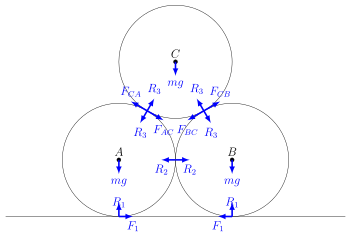
Two identical uniform cylinders, each of mass \(m,\) lie in contact with one another on a horizontal plane and a third identical cylinder rests symmetrically on them in such a way that the axes of the three cylinders are parallel. Assuming that all the surfaces in contact are equally rough, show that the minimum possible coefficient of friction is \(2-\sqrt{3}.\)
Solution:
1995 Paper 3 Q8
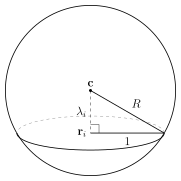
A plane \(\pi\) in 3-dimensional space is given by the vector equation \(\mathbf{r}\cdot\mathbf{n}=p,\) where \(\mathbf{n}\) is a unit vector and \(p\) is a non-negative real number. If \(\mathbf{x}\) is the position vector of a general point \(X\), find the equation of the normal to \(\pi\) through \(X\) and the perpendicular distance of \(X\) from \(\pi\). The unit circles \(C_{i},\) \(i=1,2,\) with centres \(\mathbf{r}_{i},\) lie in the planes \(\pi_{i}\) given by \(\mathbf{r}\cdot\mathbf{n}_{i}=p_{i},\) where the \(\mathbf{n}_{i}\) are unit vectors, and \(p_{i}\) are non-negative real numbers. Prove that there is a sphere whose surface contains both circles only if there is a real number \(\lambda\) such that \[ \mathbf{r}_{1}+\lambda\mathbf{n}_{1}=\mathbf{r}_{2}\pm\lambda\mathbf{n}_{2}. \] Hence, or otherwise, deduce the necessary conditions that \[ (\mathbf{r}_{1}-\mathbf{r}_{2})\cdot(\mathbf{n}_{1}\times\mathbf{n}_{2})=0 \] and that \[ (p_{1}-\mathbf{n}_{1}\cdot\mathbf{r}_{2})^{2}=(p_{2}-\mathbf{n}_{2}\cdot\mathbf{r}_{1})^{2}. \] Interpret each of these two conditions geometrically.
Solution: The equation of the normal to \(\pi\) through \(X\) is \(\mathbf{x} + \lambda \mathbf{n}\). The distance is \(|\mathbf{x}\cdot \mathbf{n}-p|\) We know that the centre of the sphere must lie above the centre of the circle following the normal, ie \(\mathbf{c} = \mathbf{r}_1+\lambda_1 \mathbf{n}_1 = \mathbf{r}_2+\lambda_2 \mathbf{n}_2\)