Problems
Filters
142 problems found
2006 Paper 2 Q7
An ellipse has equation $\dfrac{x^2}{a^2} +\dfrac {y^2}{b^2} = 1$. Show that the equation of the tangent at the point \((a\cos\alpha, b\sin\alpha)\) is \[ y=- \frac {b \cot \alpha} a \, x + b\, {\rm cosec\,}\alpha\,. \] The point \(A\) has coordinates \((-a,-b)\), where \(a\) and \(b\) are positive. The point \(E\) has coordinates \((-a,0)\) and the point \(P\) has coordinates \((a,kb)\), where \(0 < k < 1\). The line through \(E\) parallel to \(AP\) meets the line \(y=b\) at the point \(Q\). Show that the line \(PQ\) is tangent to the above ellipse at the point given by \(\tan(\alpha/2)=k\). Determine by means of sketches, or otherwise, whether this result holds also for \(k=0\) and \(k=1\).
2006 Paper 2 Q11
A projectile of unit mass is fired in a northerly direction from a point on a horizontal plain at speed \(u\) and an angle \(\theta\) above the horizontal. It lands at a point \(A\) on the plain. In flight, the projectile experiences two forces: gravity, of magnitude \(g\); and a horizontal force of constant magnitude \(f\) due to a wind blowing from North to South. Derive an expression, in terms of \(u\), \(g\), \(f\) and \(\theta\) for the distance \(OA\).
- Determine the angle \(\alpha\) such that, for all \(\theta>\alpha\), the wind starts to blow the projectile back towards \(O\) before it lands at \(A\).
- An identical projectile, which experiences the same forces, is fired from \(O\) in a northerly direction at speed \(u\) and angle \(45^\circ\) above the horizontal and lands at a point \(B\) on the plain. Given that \(\theta\) is chosen to maximise \(OA\), show that \[ \frac{OB}{OA} = \frac{ g-f}{\; \sqrt{g^2+f^2\;}- f \;\;}\;. \] Describe carefully the motion of the second projectile when \(f=g\).
2006 Paper 3 Q2
Let \[ I = \int_{-\frac12 \pi}^{\frac12\pi} \frac {\cos^2\theta}{1-\sin\theta\sin2\alpha} \, \d\theta \text{ and } J = \int_{-\frac12 \pi}^{\frac12\pi} \frac {\sec^2\theta}{1+\tan^2\theta\cos^22\alpha} \, \d\theta \] where \(0 < \alpha < \frac14\pi\,\).
- Show that \[ I = \int_{-\frac12 \pi}^{\frac12\pi} \frac {\cos^2\theta}{1+\sin\theta\sin2\alpha} \d\theta \] and hence that \[ \displaystyle 2I = \int_{-\frac12 \pi}^{\frac12\pi} \frac {2}{1+\tan^2\theta\cos^22\alpha} \, \d\theta \]
- Find \(J\).
- By considering \(I\sin^2 2\alpha +J\cos^2 2\alpha \), or otherwise, show that \(I =\frac12 \pi \sec^2\alpha\).
- Evaluate \(I\) in the case \(\frac14\pi < \alpha < \frac12\pi\).
Solution:
- \(\,\) \begin{align*} && I &= \int_{-\frac12 \pi}^{\frac12\pi} \frac {\cos^2\theta}{1-\sin\theta\sin2\alpha} \, \d\theta \\ \phi = -\theta, \d \phi = - \d \theta: &&&= \int_{\phi=\frac12\pi}^{\phi=-\frac12\pi} \frac{\cos^2(-\phi)}{1-\sin(-\phi)\sin 2 \alpha} (-1) \d \phi \\ &&&= \int_{-\frac12 \pi}^{\frac12\pi} \frac {\cos^2\phi}{1+\sin\phi\sin2\alpha} \d\phi \\ \\ && 2I &= \int_{-\frac12 \pi}^{\frac12\pi} \frac {\cos^2\theta}{1-\sin\theta\sin2\alpha} \, \d\theta +\int_{-\frac12 \pi}^{\frac12\pi} \frac {\cos^2\theta}{1+\sin\theta\sin2\alpha} \, \d\theta \\ &&&= \int_{-\frac12 \pi}^{\frac12\pi} \left ( \frac {\cos^2\theta}{1-\sin\theta\sin2\alpha} +\frac {\cos^2\theta}{1+\sin\theta\sin2\alpha} \right) \, \d\theta \\ &&&= \int_{-\frac12 \pi}^{\frac12\pi} \left ( \frac {2\cos^2\theta}{1-\sin^2\theta\sin^22\alpha} \right) \, \d\theta \\ &&&= \int_{-\frac12 \pi}^{\frac12\pi} \left ( \frac {2\cos^2\theta}{1-(1-\cos^2\theta)(1-\cos^22\alpha)} \right) \, \d\theta \\ &&&= \int_{-\frac12 \pi}^{\frac12\pi} \left ( \frac {2\cos^2\theta}{\cos^2\theta+\cos^22\alpha-\cos^2 \theta \cos^2 2 \alpha)} \right) \, \d\theta \\ &&&= \int_{-\frac12 \pi}^{\frac12\pi} \left ( \frac {2}{1+\cos^22\alpha(\sec^2 \theta - 1))} \right) \, \d\theta \\ &&&= \int_{-\frac12 \pi}^{\frac12\pi} \left ( \frac {2}{1+\tan^2 \theta \cos^22\alpha} \right) \, \d\theta \\ \end{align*}
- \(\,\) \begin{align*} && J &= \int_{-\frac12 \pi}^{\frac12\pi} \frac {\sec^2\theta}{1+\tan^2\theta\cos^22\alpha} \, \d\theta \\ &&&= \left [\sec 2 \alpha \tan^{-1} \left ( \cos 2 \alpha \tan \theta \right) \right]_{-\frac12 \pi}^{\frac12\pi} \\ &&&= \sec(2\alpha)\pi = \frac{\pi}{\cos 2 \alpha} \end{align*}
- \(\,\) \begin{align*} && I\sin^2 2\alpha +J\cos^2 2\alpha &= \int_{-\frac12\pi}^{\frac12 \pi} \frac{\sin^2 2 \alpha+\cos^2 2 \alpha \sec^2 \theta}{1+\tan^2 \theta \cos^2 2\alpha} \d \theta \\ &&&= \int_{-\frac12\pi}^{\frac12 \pi} \frac{\sin^2 2 \alpha+\cos^2 2 \alpha (1 + \tan^2 \theta)}{1+\tan^2 \theta \cos^2 2\alpha} \d \theta \\ &&&= \pi \\ \\ \Rightarrow && I &= \frac{\pi - \pi \cos 2 \alpha}{\sin^2 2 \alpha} \\ &&&= \pi \frac{2\sin^2 \alpha}{4 \sin^2 \alpha \cos^2 \alpha} \\ &&&= \frac12 \pi \sec^2 \alpha \end{align*}
- If \(\frac14 \pi < \alpha < \frac12 \pi\) then our calculation for \(J\) is not correct. \begin{align*} && J &= \int_{-\frac12 \pi}^{\frac12\pi} \frac {\sec^2\theta}{1+\tan^2\theta\cos^22\alpha} \, \d\theta \\ &&&= \left [\sec 2 \alpha \tan^{-1} \left ( \cos 2 \alpha \tan \theta \right) \right]_{-\frac12 \pi}^{\frac12\pi} \\ &&&= \sec(2\alpha) \left ( \lim_{\theta \to \frac{\pi}{2}} \tan^{-1} \left ( \cos 2 \alpha \tan \theta \right) - \lim_{\theta \to -\frac{\pi}{2}} \tan^{-1} \left ( \cos 2 \alpha \tan \theta \right) \right) \\ &&&= \sec(2\alpha) \left ( \tan^{-1} \left ( \lim_{x\to -\infty} x \right) - \tan^{-1} \left ( \lim_{x\to \infty} x \right) \right) \\ &&&= -\pi \sec 2 \alpha \end{align*} Still using the same logic, we can say \begin{align*} && I &= \frac{\pi+\pi\cos 2 \alpha}{\sin^2 2 \alpha} \\ &&&= \pi \frac{2 \cos^2 \alpha}{4 \sin^2 \alpha \cos^2 \alpha}\\ &&&= \frac12 \pi \cosec^2 \alpha \end{align*}
2006 Paper 3 Q3
- Let \[ \tan x = \sum\limits_{n=0}^\infty a_n x^n \text{ and } \cot x = \dfrac 1 x +\sum\limits_{n=0}^\infty b_nx^n \] for \(0< x < \frac12\pi\,\). Explain why \(a_n=0\) for even \(n\). Prove the identity \[ \cot x - \tan x \equiv 2 \cot 2x\, \] and show that \[a_{n} = (1-2^{n+1})b_n\,.\]
- Let $ \displaystyle {\rm cosec}\, x = \frac1x +\sum\limits _{n=0}^\infty c_n x^n\,$ for \(0< x < \frac12\pi\,\). By considering \(\cot x + \tan x\), or otherwise, show that \[ c_n = (2^{-n} -1)b_n \,. \]
- Show that \[ \left(1+x{ \sum\limits_{n=0}^\infty} b_n x^n \right)^2 +x^2 = \left(1+x{ \sum\limits_{n=0} ^\infty} c_n x^n \right)^2\,. \] Deduce from this and the previous results that \(a_1=1\), and find \(a_3\).
Solution:
- Since \(\tan (-x) = -\tan x\), \(\tan\) is an odd function, and in particular all it's even coefficients are zero. \begin{align*} && 2 \cot 2x &\equiv \frac{2 cos 2x}{\sin 2 x} \\ &&&\equiv \frac{2(\cos^2 x- \sin^2 x)}{2 \sin x \cos x} \\ &&&\equiv \frac{\cos x}{\sin x} - \frac{\sin x}{ \cos x} \\ &&&\equiv \cot x - \tan x \end{align*} Therefore \begin{align*} && \underbrace{\frac1x + \sum_{n=0}^\infty b_nx^n}_{\cot x} - \underbrace{\sum_{n=0}^\infty a_n x^n}_{\tan x} &= 2 \left (\underbrace{\frac{1}{2x} + \sum_{n=0}^\infty b_n(2x)^n}_{\cot 2x} \right) \\ \Rightarrow && \sum_{n=0}^\infty a_n x^n &= \sum_{n=0}^\infty b_nx^n - 2\sum_{n=0}^\infty b_n(2x)^n \\ &&&= \sum_{n=0}^{\infty}b_n(1-2^{n+1})x^n \\ [x^n]: && a_n &= (1-2^{n+1})b_n \end{align*}
- \(\,\) \begin{align*} && \cot x + \tan x &= \frac{\cos x}{\sin x} + \frac{\sin x}{\cos x} \\ &&&= \frac{1}{\sin x \cos x} \\ &&&=2\cosec 2x \\ \\ \Rightarrow && \underbrace{\frac1x + \sum_{n=0}^\infty b_nx^n}_{\cot x} + \underbrace{\sum_{n=0}^\infty a_n x^n}_{\tan x} &= 2\left (\underbrace{ \frac1{2x} +\sum\limits _{n=0}^\infty c_n (2x)^n}_{\cosec 2x} \right) \\ \Rightarrow && \sum_{n=0}^\infty 2^{n+1}c_n x^n &= \sum_{n=0}^{\infty}(a_n+b_n)x^n \\ &&&= \sum_{n=0}^{\infty}\left((1-2^{n+1})b_n+ b_n\right)x^n \\ &&&= \sum_{n=0}^{\infty}\left(2-2^{n+1}\right)b_nx^n \\ [x^n]: && c_n &= (2^{-n}-1)b_n \end{align*}
- \(\,\) \begin{align*} && \cot^2 x + 1 &= \cosec^2 x \\ \Rightarrow && x^2 \cot^2 x + x^2 &= x^2 \cosec^2 x \\ \Rightarrow && x^2 \left ( \underbrace{\frac1x + \sum_{n=0}^\infty b_nx^n}_{\cot x} \right)^2 + x^2 &= x^2 \left (\underbrace{ \frac1{x} +\sum\limits _{n=0}^\infty c_n x^n}_{\cosec x} \right)^2 \\ \Rightarrow && \left ( 1 + x\sum_{n=0}^\infty b_nx^{n} \right)^2 + x^2 &= \left ( 1 +x\sum\limits _{n=0}^\infty c_n x^{n} \right)^2 \\ \\ \Rightarrow && \left ( 1 + x(b_1x + b_3 x^3 + \cdots) \right)^2 + x^2 &= \left ( 1 + x(c_1x + c_3 x^3 + \cdots) \right)^2 \\ \Rightarrow && 1 + (1+2b_1)x^2+(2b_3+b_1^2)x^4 + \cdots &= 1 + 2c_1x^2 + (2c_3+c_1^2)x^4 + \cdots \\ \Rightarrow && 1 + 2b_1 &= 2(2^{-1}-1)b_1 \\ \Rightarrow && b_1 &= -\frac13 \\ \Rightarrow && a_1 &= (1-2^{2})(-\tfrac13) = 1 \\ && c_1 &= \frac16\\ \Rightarrow && 2b_3+\frac19&= 2c_3+\frac1{36} \\ \Rightarrow && 2b_3 -2(2^{-3}-1)b_3 &= -\frac{1}{12} \\ \Rightarrow && \frac{15}{4}b_3 &= -\frac{1}{12} \\ \Rightarrow && b_3 &= -\frac{1}{45} \\ \Rightarrow && a_3 &= -(1-2^4)\frac{1}{45} = \frac13 \end{align*}
2005 Paper 1 Q11
A particle moves so that \({\bf r}\), its displacement from a fixed origin at time \(t\), is given by \[{\bf r} = \l \sin{2t} \r {\bf i} + \l 2\cos t \r \bf{j}\,,\] where \(0 \le t < 2\pi\).
- Show that the particle passes through the origin exactly twice.
- Determine the times when the velocity of the particle is perpendicular to its displacement.
- Show that, when the particle is not at the origin, its velocity is never parallel to its displacement.
- Determine the maximum distance of the particle from the origin, and sketch the path of the particle.
Solution:
- It is at the origin when both \(\sin 2t\) and \(\cos t = 0\), but this \(\sin 2t = 2 \sin t \cos t\) so this happens precisely when \(\cos t = 0\), ie when \(t = \frac{\pi}{2}, \frac{3\pi}{2}\)
- \(\,\) \begin{align*} && \dot{\mathbf{r}} &= 2 \cos 2t \mathbf{i} - 2 \sin t \mathbf{j} \\ && \mathbf{r} \cdot \dot{\mathbf{r}} &= 2\cos 2t \sin 2t - 2 \sin t 2 \cos t \\ &&&= \sin 2t \left (2\cos 2t - 2 \right) \end{align*} Therefore they are perpendicular when \(\sin 2t = 0 \Rightarrow t = 0, \frac{\pi}{2}, \pi, \frac{3\pi}{2}, 2\pi\) and when \(\cos 2t = 1 \Rightarrow 2t = 0, 2\pi, 4\pi \Rightarrow t = 0, \pi, 2\pi\), therefore all solutions are \( t = 0, \frac{\pi}{2}, \pi, \frac{3\pi}{2}, 2\pi\)
- For \(\mathbf{r}\) and \(\dot{\mathbf{r}}\) to be parallel, we would need \begin{align*} && \frac{2 \cos 2t}{\sin 2t} &= \frac{-2 \sin t}{2 \cos t}\\ && 2 \cos 2t \cos t &= - \sin t \sin 2t \\ && 0 &= 2\cos t (\cos 2t + \sin ^2 t) \\ &&&= 2 \cos t (\cos^2 t) \\ &&&= 2 \cos^3 t \end{align*} Therefore the only time we can be parallel is when \(\cos t = 0\), which is when we are at the origin.
- \(\frac{\d }{\d t} (\mathbf{r} \cdot \mathbf{r}) = 2 \mathbf{r} \cdot \mathbf{\dot{r}}\) so we should check the values when velocity and displacement are perpendicular, ie \( t = 0, \frac{\pi}{2}, \pi, \frac{3\pi}{2}, 2\pi\) which have values \(\mathbf{r} = \binom{0}{2}, \binom{0}{0}, \binom{0}{-2}, \binom{0}{0}, \binom{0}{2}\). Therefore the maximum distance is \(2\).

2005 Paper 2 Q3
Give a sketch, for \(0 \le x \le \frac{1}{2}\pi\), of the curve $$ y = (\sin x - x\cos x)\;, $$ and show that \(0\le y \le 1\,\). Show that:
- \(\displaystyle \int_0^{\frac{1}{2}\pi}\,y\;\d x = 2 -\frac \pi 2 \)
- \(\displaystyle \int_0^{\frac{1}{2}\pi}\,y^2\,\d x = \frac{\pi^3}{48}-\frac \pi 8 \)
Solution:
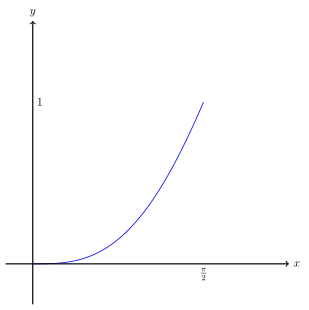
- \(\,\) \begin{align*} \int_0^{\frac{1}{2}\pi}\,y\;\d x &= \int_0^{\frac{1}{2}\pi} (\sin x - x \cos x) \d x \\ &= \left [-\cos x \right]_0^{\frac{1}{2}\pi} +\left [ -x \sin x \right]_0^{\frac{1}{2}\pi} + \int_0^{\frac{1}{2}\pi} \sin x \d x \\ &= 1-\frac{\pi}{2} + 1 = 2 - \frac{\pi}{2} \end{align*}
- \(\,\) \begin{align*} \int_0^{\frac{1}{2}\pi}y^2\d x &= \int_0^{\frac{1}{2}\pi} (\sin x - x \cos x)^2 \d x \\ &= \int_0^{\frac{1}{2}\pi} (\sin^2x - 2x\sin x \cos x+x^2\cos^2 x) \d x\\ &= \int_0^{\frac{1}{2}\pi} (\sin^2x -x \sin 2x+\tfrac12x^2(\cos 2 x + 1)) \d x\\ &= \frac{\pi}{4} + \frac{\pi^3}{48} + \int_0^{\frac{1}{2}\pi} (-x \sin 2x+\tfrac12x^2\cos 2 x) \d x \\ &= \frac{\pi}{4} + \frac{\pi^3}{48} + \left [\frac12 x \cos 2x +\frac14 x^2 \sin2x\right]_0^{\frac{1}{2}\pi}-\int_0^{\frac{1}{2}\pi}(\tfrac12 \cos 2x +\tfrac12 x \sin 2x) \d x\\ &= \frac{\pi}{4} + \frac{\pi^3}{48} - \frac{\pi}{4} - \left [ \frac14 \sin 2x \right]_0^{\frac{1}{2}\pi} - \int_0^{\frac{1}{2}\pi} \tfrac12 x \sin 2x \d x\\ &= \frac{\pi^3}{48} - \left( \left[ -\frac14 x \cos 2x \right]_0^{\frac{1}{2}\pi} - \int_0^{\frac{1}{2}\pi} -\frac14 \cos 2x \d x \right)\\ &= \frac{\pi^3}{48} - \left( \frac{\pi}{8} + \left[ \frac18 \sin 2x \right]_0^{\frac{1}{2}\pi} \right)\\ &= \frac{\pi^3}{48} - \frac{\pi}{8} \end{align*}
2005 Paper 2 Q7
The position vectors, relative to an origin \(O\), at time \(t\) of the particles \(P\) and \(Q\) are $$\cos t \; {\bf i} + \sin t\;{\bf j} + 0 \; {\bf k} \text{ and } \cos (t+\tfrac14{\pi})\, \big[{\tfrac32}{\bf i} + { \tfrac {3\sqrt{3}}2} {\bf k}\big] + 3\sin(t+\tfrac14{\pi}) \; {\bf j}\;,$$ respectively, where \(0\le t \le 2\pi\,\).
- Give a geometrical description of the motion of \(P\) and \(Q\).
- Let \(\theta\) be the angle \(POQ\) at time \(t\) that satisfies \(0\le\theta\le\pi\,\). Show that \[ \cos\theta = \tfrac{3\surd2}{8} -\tfrac14 \cos( 2t +\tfrac14 \pi)\;. \]
- Show that the total time for which \(\theta \ge \frac14 \pi\) is \(\tfrac32 \pi\,\).
Solution:
- \(P\) is travelling in a unit circle about the origin in the \(\mathbf{i}-\mathbf{j}\) plane. \(Q\) is travelling in a circle (also about the origin, but in a different plane with radius \(3\)).
- \(\,\) \begin{align*} && \mathbf{p}\cdot \mathbf{q} &= |\mathbf{p}||\mathbf{q}| \cos \theta \\ \Rightarrow && \cos \theta &= \frac{\tfrac32\cos t \cos(t + \tfrac{\pi}4)+3\sin t \sin (t + \tfrac{\pi}{4})}{3} \\ &&&= \tfrac12\cos t \cos(t + \tfrac{\pi}4)+\sin t \sin (t + \tfrac{\pi}{4}) \\ &&&= \tfrac14 (\cos (2t + \tfrac{\pi}{4}) + \cos(\tfrac{\pi}{4} ))+\tfrac12(\cos(\tfrac{\pi}{4})-\cos(2t + \tfrac{\pi}{4})) \\ &&&= \tfrac{3\sqrt{2}}8 - \tfrac14 \cos ( 2t +\tfrac{\pi}{4}) \end{align*}
- If \(\theta \geq \frac14\pi\), then \(\cos \theta \leq \frac{\sqrt{2}}2\) \begin{align*} && \frac{\sqrt{2}}2 & \geq \frac{3\sqrt{2}}8 - \frac14 \cos ( 2t +\tfrac{\pi}{4}) \\ \Rightarrow && \frac{\sqrt{2}}2 &\geq -\cos(2t + \tfrac{\pi}{4}) \\ \Rightarrow && \cos(2t + \tfrac{\pi}{4}) &\geq -\frac{1}{\sqrt{2}} \\ \Rightarrow && 2t + \tfrac{\pi}{4} &\not\in (\tfrac{3\pi}{4},\tfrac{5\pi}{4}) \cup (\tfrac{11\pi}{4},\tfrac{13\pi}{4}) \\ \Rightarrow && t &\not\in (\tfrac{\pi}{4}, \tfrac{\pi}{2})\cup (\tfrac{5\pi}{4}, \tfrac{3\pi}{2}) \end{align*} which is is a time of \(\frac{\pi}{2}\), therefore the left over time is \(\frac32\pi\)
2005 Paper 2 Q10
The points \(A\) and \(B\) are \(180\) metres apart and lie on horizontal ground. A missile is launched from \(A\) at speed of \(100\,\)m\,s\(^{-1}\) and at an acute angle of elevation to the line \(AB\) of \(\arcsin \frac35\). A time \(T\) seconds later, an anti-missile missile is launched from \(B\), at speed of \(200\,\)m\,s\(^{-1}\) and at an acute angle of elevation to the line \(BA\) of \(\arcsin \frac45\). The motion of both missiles takes place in the vertical plane containing \(A\) and \(B\), and the missiles collide. Taking \(g =10\,\)m\,s\(^{-2}\) and ignoring air resistance, find \(T\). \noindent [Note that \(\arcsin \frac35\) is another notation for \(\sin^{-1} \frac35\,\).]
2004 Paper 2 Q5
Evaluate \(\int_0^{{\pi}} x \sin x\,\d x\) and \(\int_0^{{\pi}} x \cos x\,\d x\;\). The function \(\f\) satisfies the equation \begin{equation} \f(t)=t + \int_0^{{\pi}} \f(x)\sin(x+t)\,\d x\;. \tag{\(*\)} \end{equation} Show that \[ \f(t)=t + A\sin t + B\cos t\;, \] where \(A= \int_0^{{\pi}}\,\f(x)\cos x\,\d x\;\) and \(B= \int_0^{{\pi}}\,\f(x)\sin x\,\d x\;\). Find \(A\) and \(B\) by substituting for \(\f(t)\) and \(\f(x)\) in \((*)\) and equating coefficients of \(\sin t\) and \(\cos t\,\).
Solution: \begin{align*} && I &= \int_0^\pi x \sin x \d x \\ &&&= \left [ -x \cos x \right]_0^\pi + \int_0^{\pi} \cos x \d x \\ &&&= \pi \\ \\ && J &= \int_0^\pi x \cos x \d x \\ &&&= \left [ x \sin x \right]_0^\pi - \int_0^\pi \sin x \d x \\ &&&= -2 \end{align*} \begin{align*} && f(t) &= t + \int_0^\pi f(x) \sin (x+t) \d x \\ &&&= t + \int_0^\pi f(x) \left ( \sin t \cos x + \cos t \sin x \right) \d x \\ &&&= t + \sin t \int_0^{\pi} f(x) \cos x \d x + \cos t \int_0^{\pi} f(x) \sin x \d x \\ \\ && A &= \int_0^\pi (x + A \sin x + B \cos x) \cos x \d x \\ &&&= -2+ \frac{\pi}{2} B \\ && B &= \int_0^{\pi} (x + A \sin x + B \cos x ) \sin x \d x \\ &&&= \pi + \frac{\pi}{2} A \\ \Rightarrow && (A,B) &= (-2,0) \end{align*}
2004 Paper 2 Q7
The function f is defined by $$\f(x) = 2\sin x - x\,.$$ Show graphically that the equation \(\f(x)=0\) has exactly one root in the interval \([\frac12\pi ,\,{\pi}]\,\). This interval is denoted \(I_0\). In order to determine the root, a sequence of intervals \(I_1\), \(I_2, \,\ldots\) is generated in the following way. If the interval \(I_n=[a_n,b_n]\,\), and \(c_n=(a_n+b_n)/2\,\), then \begin{equation*} I_{n+1}= \begin{cases} [a_n,c_n] & \text{if \(\; \f(a_n)\f(c_n)<0 \,\)}; \\[5pt] [c_n,b_n] & \text{if \(\; \f(c_n)\f(b_n)<0 \,\)}. \end{cases} \end{equation*} By using the approximations \(\displaystyle \frac 1{\sqrt{2}} \approx 0.7\) and \({\pi} \approx \sqrt{10} \,\), show that \(I_2=[\frac12{\pi},\,\frac58{\pi}]\) and find \(I_3\,\).
Solution: \begin{array}{c|c|c|c|c|c} n & a_n & b_n & c_n & f(a_n) & f(c_n) & f(b_n) \\ \hline 0 & \tfrac12 \pi & \pi & \tfrac34\pi & 2\sin(\tfrac12\pi)-\tfrac12\pi = 2-\tfrac12\pi & 2\sin(\tfrac34\pi)-\tfrac34\pi = \frac{2}{\sqrt{2}}-\tfrac34\pi & 2\sin(\pi)-\pi =-\pi \\ 0 & \tfrac12 \pi & \pi & \tfrac34\pi & >0 & 2-\frac{9}{16}10 < 0& <0 \\ \hline 1 & \frac12 \pi & \frac34\pi & \frac58\pi & >0 &2\sin \tfrac58\pi - \tfrac58\pi & < 0\\ 1 & \frac12 \pi & \frac34\pi & \frac58\pi & >0 & \approx 1.4 \cdot \sqrt{1.7} -\frac58\sqrt{10} < 0 & <0 \\ \hline 2 & \frac12 \pi & \frac58\pi & \frac9{16}\pi & >0 & 2\sin \frac{9}{16}\pi-\frac{9}{16}\pi & <0 \\ 2 & \frac12 \pi & \frac58\pi & \frac9{16}\pi & >0 & > 0 & <0 \\ \end{array} Threfore \(I_3 = [\frac9{16}\pi,\frac58\pi]\) \(\sin \frac{5\pi}{8} = \cos \frac{\pi}{8} = \sqrt{\frac12(\cos \frac{\pi}{4}+1)} = \frac{1}{\sqrt{2}}\sqrt{1 + \frac{1}{\sqrt{2}}} \approx 0.7 \cdot \sqrt{1.7}\) \(\sin \frac{9\pi}{16} = \cos \frac{\pi}{16} = \sqrt{\frac12\left ( \cos \frac{\pi}{8}+1 \right)} \) So we are comparing \(2\cos \frac{\pi}{16}\) with \(\frac{9}{16}\pi\) or \(4 \cos^2 \frac{\pi}{16} = 2\cos \frac{\pi}{8}+2\) with \(\frac{90}{16}\)
2004 Paper 2 Q8
Let \(x\) satisfy the differential equation $$ \frac {\d x}{\d t} = {\big( 1-x^n\big)\vphantom{\Big)}}^{\!1/n} $$ and the condition \(x=0\) when \(t=0 \,\).
- Solve the equation in the case \(n=1\) and sketch the graph of the solution for \(t > 0 \,\).
- Prove that \(1-x < (1-x^2)^{1/2} \) for \(0 < x < 1 \,\). Use this result to sketch the graph of the solution in the case \(n=2\) for \(0 < t < \frac12 \pi \,\), using the same axes as your previous sketch. By setting \(x=\sin y\,\), solve the equation in this case.
- Use the result (which you need not prove) \[ (1-x^2)^{1/2} < (1-x^3)^{1/3} \text{ \ \ for \ \ } 0 < x < 1 \;, \] to sketch, without solving the equation, the graph of the solution of the equation in the case \(n=3\) using the same axes as your previous sketches. Use your sketch to show that \(x=1\) at a value of \(t\) less than \(\frac12 \pi \,\).
Solution:
- \(\,\) \begin{align*}
&& \dot{x} &= (1-x) \\
\Rightarrow &&\int \frac{1}{1-x} \d x &= \int \d t \\
\Rightarrow && -\ln |1-x| &= t + C \\
t=0, x = 0: && -\ln 1 &= C \Rightarrow C = 0\\
\Rightarrow && -\ln|1-x| &= t \\
\Rightarrow && 1-x&= e^{-t} \\
\Rightarrow && x &= 1-e^{-t}
\end{align*}

- Notice that \((1-x^2)^{1/2} = (1-x)^{1/2}(1+x)^{1/2} > (1-x)^{1/2} > 1-x\)
\begin{align*} && \dot{x} &= \sqrt{1-x^2} \\ \Rightarrow && \int \frac{1}{\sqrt{1-x^2}} \d x &= t + C \\ x = \sin y, \d x = \cos y && \int \frac{\cos y}{\cos y} \d y &= t + C \\ \Rightarrow && y &= t + C \\ \Rightarrow && \sin^{-1} x &= t + C \\ t = 0, x = 0: && x &= \sin t \end{align*}

- \(\,\)
We know the gradient is steeper, so the solution must always be above \(\sin t\), which means it reaches \(1\) before \(\frac{\pi}{2}\)

2003 Paper 2 Q6
The function \(\f\) is defined by $$ \f(x)= \vert x-1 \vert\;, $$ where the domain is \({\bf R}\,\), the set of all real numbers. The function \(\g_n =\f^n\), with domain \({\bf R}\,\), so for example \(\g_3(x) = \f(\f(\f(x)))\,\). In separate diagrams, sketch graphs of \(\g_1\,\), \(\g_2\,\), \(\g_3\,\) and \(\g_4\,\). The function \(\h\) is defined by \[ \h(x) = |\sin {{{\pi}x} \over 2}|, \] where the domain is \({\bf R}\,\). Show that if \(n\) is even, \[ \int_0^n\,\big( \h(x)-\g_n(x)\big)\,\d x = \frac{2n}{\pi} -\frac{n}2\;. \]
Solution:
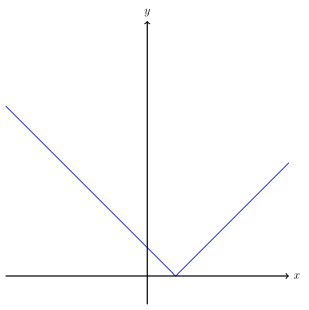
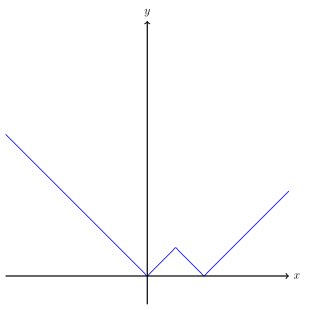
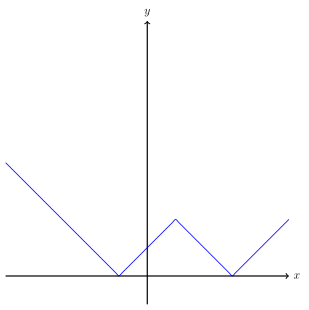
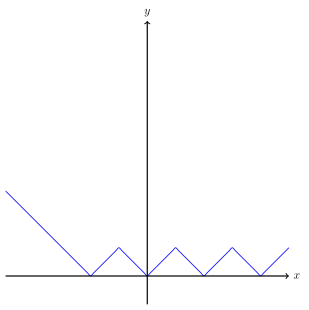
2003 Paper 2 Q9
\(AB\) is a uniform rod of weight \(W\,\). The point \(C\) on \(AB\) is such that \(AC>CB\,\). The rod is in contact with a rough horizontal floor at \(A\,\) and with a cylinder at \(C\,\). The cylinder is fixed to the floor with its axis horizontal. The rod makes an angle \({\alpha}\) with the horizontal and lies in a vertical plane perpendicular to the axis of the cylinder. The coefficient of friction between the rod and the floor is \(\tan \lambda_1\) and the coefficient of friction between the rod and the cylinder is \(\tan \lambda_2\,\). Show that if friction is limiting both at \(A\) and at \(C\), and \({\alpha} \ne {\lambda}_2 - {\lambda}_1\,\), then the frictional force acting on the rod at \(A\) has magnitude $$ \frac{ W\sin {\lambda}_1 \, \sin({\alpha}-{\lambda}_2)} {\sin ({\alpha}+{\lambda}_1-{\lambda}_2)} \;.$$ %and that %$$ %p=\frac{\cos{\alpha} \, \sin({\alpha}+{\lambda}_1-{\lambda}_2)} %{2\cos{\lambda}_1 \, \sin {\lambda}_2}\;. %$$
2003 Paper 2 Q11
A particle \(P_1\) is projected with speed \(V\) at an angle of elevation \({\alpha}\,\,\,( > 45^{\circ})\,,\,\,\,\) from a point in a horizontal plane. Find \(T_1\), the flight time of \(P_1\), in terms of \({\alpha}, V \hbox{ and } g\,\). Show that the time after projection at which the direction of motion of \(P_1\) first makes an angle of \(45^{\circ}\) with the horizontal is \(\frac12 (1-\cot \alpha)T_1\,\). A particle \(P_2\) is projected under the same conditions. When the direction of the motion of \(P_2\) first makes an angle of \(45^{\circ}\) with the horizontal, the speed of \(P_2\) is instantaneously doubled. If \(T_2\) is the total flight time of \(P_2\), show that $$ \frac{2T_2}{T_1} = 1+\cot{\alpha} +\sqrt{1+3\cot^2{\alpha}} \;. $$
2003 Paper 3 Q4
A curve is defined parametrically by \[ x=t^2 \;, \ \ \ y=t (1 + t^2 ) \;. \] The tangent at the point with parameter \(t\), where \(t\ne0\,\), meets the curve again at the point with parameter \(T\), where \(T\ne t\,\). Show that \[ T = \frac{1 - t^2 }{2t} \mbox { \ \ \ and \ \ \ } 3t^2\ne 1\;. \] Given a point \(P_0\,\) on the curve, with parameter \(t_0\,\), a sequence of points \(P_0 \, , \; P_1 \, , \; P_2 \, , \ldots\) on the curve is constructed such that the tangent at \(P_i\) meets the curve again at \(P_{i+1}\). If \(t_0 = \tan \frac{ 7 } {18}\pi\,\), show that \(P_3 = P_0\) but \(P_1\ne P_0\,\). Find a second value of \(t_0\,\), with \(t_0>0\,\), for which \(P_3 = P_0\) but \(P_1\ne P_0\,\).