Problems
Filters
233 problems found
2013 Paper 2 Q8
The function \(\f\) satisfies \(\f(x)>0\) for \(x\ge0\) and is strictly decreasing (which means that \(\f(b)<\f(a)\) for \(b>a\)).
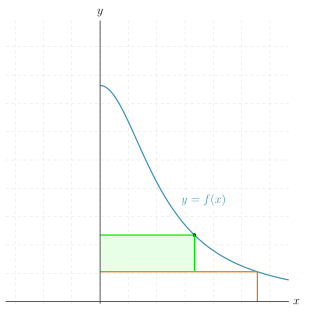
- For \(t\ge0\), let \(A_0(t)\) be the area of the largest rectangle with sides parallel to the coordinate axes that can fit in the region bounded by the curve \(y=\f(x)\), the \(y\)-axis and the line \(y=\f(t)\). Show that \(A_0(t)\) can be written in the form \[ A_0(t) =x_0\left( \f(x_0) -\f(t)\right), \] where \(x_0\) satisfies \(x_0 \f'(x_0) +\f(x_0) = \f(t)\,\).
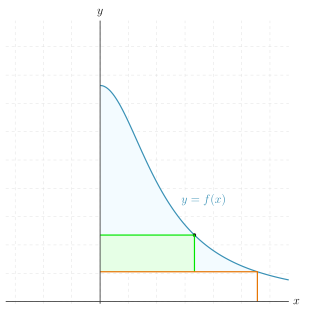
- The function g is defined, for \(t> 0\), by \[ \g(t) =\frac 1t \int_0^t \f(x) \d x\,. \] Show that \(t \g'(t) = \f(t) -\g(t)\,\). Making use of a sketch show that, for \(t>0\), \[ \int_0^t \left( \f(x) - \f(t)\right) \d x > A_0(t) \] and deduce that \(-t^2 \g'(t)> A_0(t)\).
- In the case \(\f(x)= \dfrac 1 {1+x}\,\), use the above to establish the inequality \[ \ln \sqrt{1+t} > 1 - \frac 1 {\sqrt{1+t}} \,, \] for \(t>0\).
Solution:
- First, not that the point must be ony the curve:
Since otherwise it's pretty clear we could make the area of the rectangle larger by moving the point onto the curve. Therefore \(A = x(f(x)-f(t))\). To maximise this we need \(xf'(x) + f(x)-f(t) = 0\), ie \(x_0f'(x_0) + f(x_0) = f(t)\)
- Suppose \(\displaystyle \g(t) =\frac 1t \int_0^t \f(x) \d x\) then
\begin{align*}
&& \g(t) &=\frac 1t \int_0^t \f(x) \d x\\
\Rightarrow && tg(t) &= \int_0^t \f(x) \d x \\
\Rightarrow && tg'(t) +g(t) &= f(t) \\
\Rightarrow && tg'(t) &= f(t) - g(t)
\end{align*}
Clearly the blue area + green area is larger than the green area. So \(\displaystyle \int_0^t (f(x) - f(t))\d x > A_0(t)\). Notice that \(f(t) = \frac1{t} \int_0^t f(t) \d x \) so \(-t^2g'(t) = \int_0^t f(x) \d x > A_0(t)\)
- Not that if \(f(x) = \dfrac{1}{1+x}\), the \(f'(x) = -\frac{1}{(1+x)^2}\) and so \begin{align*} && -\frac{x_0}{(1+x_0)^2} + \frac{1}{1+x_0} &= \frac{1}{1+t} \\ && \frac{1}{(1+x_0)^2} &= \frac{1}{1+t} \\ \Rightarrow && x_0 &= \sqrt{1+t} - 1 \\ && A_0(t) &= (\sqrt{1+t} - 1) \left ( \frac{1}{\sqrt{1+t}} - \frac{1}{t+1} \right) \\ &&&= 1 - \frac{1}{\sqrt{1+t}} - \frac{1}{\sqrt{1+t}} + \frac{1}{1+t} \\ &&&= \frac{2+t}{1+t} - \frac{2}{\sqrt{1+t}} \\ && g(t) &= \frac{1}{t} \int_0^t \frac{1}{1+x} \d x \\ &&&= \frac{\ln(1+t)}{t} \\ \Rightarrow && g'(t) &= \frac{\frac{t}{1+t} - \ln(1+t)}{t^2} \\ \Rightarrow && -t^2g(t) &= \ln(1+t) - \frac{t}{1+t} \\ \Rightarrow && \ln(1+t) - \frac{t}{1+t} &> \frac{2+t}{1+t} - \frac{2}{\sqrt{1+t}} \\ \Rightarrow && \ln \sqrt{1+t} & > 1 - \frac{1}{\sqrt{1+t}} \end{align*}
2013 Paper 3 Q1
Given that \(t= \tan \frac12 x\), show that \(\dfrac {\d t}{\d x} = \frac12(1+t^2)\) and \( \sin x = \dfrac {2t}{1+t^2}\,\). Hence show that \[ \int_0^{\frac12\pi} \frac 1{1+a \sin x}\, \d x = \frac2 {\sqrt{1-a^2}} \arctan \frac{\sqrt{1-a}}{\sqrt{1+a}}\, \qquad \quad (0 < a < 1). \] Let \[ I_n = \int_0^{\frac12\pi} \frac{ \sin ^nx}{2+\sin x} \, \d x \qquad \quad (n\ge0). \] By considering \(I_{n+1}+2I_{n}\,\), or otherwise, evaluate \(I_3\).
Solution: Let \(t = \tan \frac12 x\), then \begin{align*} \frac{\d t}{\d x} &= \tfrac12 \sec^2 \tfrac12 t \\ &= \tfrac12 (1 + \tan^2 \tfrac12 ) \\ &= \tfrac12 (1 + t^2) \\ \\ \sin x &= 2 \sin \tfrac12 x \cos \tfrac12 \\ &= \frac{2 \frac{\sin \tfrac12 x}{ \cos \tfrac12x}}{\frac{1}{\cos^2 \tfrac12 x}} \\ &= \frac{2 \tan \tfrac12 x}{\sec^2 \tfrac12 } \\ &= \frac{2t }{1+t^2} \end{align*} Now consider \begin{align*} t = \tan \tfrac12 x: && \int_0^{\frac12\pi} \frac 1{1+a \sin x}\, \d x &= \int_{t=0}^{t = 1} \frac{1}{1 + a \frac{2t}{1+t^2}} \frac{2}{1+t^2} \d t \\ &&&= \int_0^1 \frac{2}{1+2at+t^2} \d t \\ &&&= \int_0^1 \frac{2}{(t+a)^2 + 1-a^2} \d t \\ (1-a^2) > 0: &&&= \left [ \frac{2}{\sqrt{1-a^2}} \arctan \frac{t+a}{\sqrt{1-a^2}} \right]_0^1 \\ &&&= \frac{2}{\sqrt{1-a^2}} \left ( \arctan \frac{1+a}{\sqrt{1-a^2}} - \arctan \frac{a}{\sqrt{1-a^2}} \right) \\ &&&= \frac{2}{\sqrt{1-a^2}} \arctan \left ( \frac{\frac{1+a}{\sqrt{1-a^2}}-\frac{a}{\sqrt{1-a^2}}}{1+\frac{1+a}{\sqrt{1-a^2}}\frac{a}{\sqrt{1-a^2}}} \right) \\ &&&= \frac{2}{\sqrt{1-a^2}} \arctan \left ( \frac{\frac{1}{\sqrt{1-a^2}}}{\frac{1+a}{1-a^2}} \right) \\ &&&= \frac{2}{\sqrt{1-a^2}} \arctan \left ( \frac{\sqrt{1-a}}{\sqrt{1+a}} \right) \end{align*} as required. Let \[ I_n = \int_0^{\frac12\pi} \frac{ \sin ^nx}{2+\sin x} \, \d x \qquad \quad (n\ge0). \] and consider \begin{align*} I_{n+1} + 2I_n &= \int_0^{\frac12\pi} \frac{ \sin ^{n+1}x+2\sin^{n} x}{2+\sin x} \, \d x \\ &= \int_0^{\frac12\pi} \frac{ \sin^n x (2 + \sin x)}{2+\sin x} \, \d x \\ &= \int_0^{\frac12\pi} \sin^n x \d x \end{align*} Therefore we can compute \begin{align*} I_0 &= \int_0^{\pi/2} \frac{1}{2 + \sin x} \d x \\ &= \frac12 \int_0^{\pi/2} \frac{1}{1 + \frac12 \sin x} \d x \\ &= \frac{1}{\sqrt{3/4}} \arctan \frac{\sqrt{1/2}}{\sqrt{3/2}} \\ &= \frac{2}{\sqrt{3}} \arctan \frac{1}{\sqrt{3}} \\ &= \frac{\pi}{3\sqrt{3}} \\ \\ I_1 &= \int_0^{\pi/2} 1 \d x - 2 I_0 \\ &= \frac{\pi}{2} - \frac{2\pi}{3\sqrt{3}} \\ I_2 &= \int_0^{\pi/2} \sin x \d x - 2I_1 \\ &= 1 - \pi + \frac{4\pi}{3\sqrt{3}} \\ I_3 &= \int_0^{\pi/2} \sin^2 x \d x - 2I_2 \\ &= \frac12 \int_0^{\pi/2} \sin^2 + \cos^2 x \d x - 2I_2 \\ &= \frac{\pi}{4} - 2 + 2\pi - \frac{8\pi}{3\sqrt{3}} \\ &= -2 + \frac{9\pi}{4} - \frac{8\pi}{3\sqrt{3}} \end{align*}
2012 Paper 1 Q3
- Sketch the curve \(y=\sin x\) for \(0\le x \le \tfrac12 \pi\) and add to your diagram the tangent to the curve at the origin and the chord joining the origin to the point \((b, \sin b)\), where \(0 < b < \frac12\pi\). By considering areas, show that \[ 1-\tfrac12 b^2 <\cos b < 1-\tfrac 12 b \sin b\,. \]
- By considering the curve \(y=a^x\), where \(a>1\), show that \[ \frac{2(a-1)}{a+1} < \ln a < -1 + \sqrt{2a-1\,}\,. \] [Hint: You may wish to write \(a^x\) as \(\e^{x\ln a}\).]
Solution:
- \(\,\)
The area under the blue curve is \(1-\cos b\). The area under the green line is \(\frac12 b \sin b\) The area under the red line is \(\frac12 b^2\) Therefore \(\frac12 b \sin b < 1- \cos b < \frac12 b^2 \Rightarrow 1- \frac12 b^2 < \cos b < 1 - \frac12 b \sin b\)

- \(\,\)
\begin{align*} &&\text{Area under blue curve}: &= \int_0^1 a^x \d x\\ &&&= \left [ \frac{1}{\ln a}e^{x \ln a} \right]_0^1 \\ &&&= \frac{a-1}{\ln a} \\ \\ &&\text{Area under green line}: &=\frac12 \cdot 1 \cdot (a + 1)\\ &&&= \frac{a+1}{2} \\ \\ &&\text{Area under tangent}: &=\frac12 \cdot 1 \cdot (1+\ln a + 1)\\ &&&= \frac{\ln a+2}{2} \\ \\ \Rightarrow && \frac{a+1}{2} & > \frac{a-1}{\ln a} \\ \Rightarrow && \ln a& > \frac{2(a-1)}{a+1} \\ \\ \Rightarrow && \frac{a-1}{\ln a} &> \frac{\ln a +2}{2} \\ \Rightarrow && 2(a-1) -2\ln a - (\ln a)^2 &> 0 \\ \Rightarrow && \ln a & < -1 + \sqrt{2a-1} \end{align*}

2012 Paper 1 Q5
Show that \[ \int_0^{\frac14\pi} \sin (2x) \ln(\cos x)\, \d x = \frac14(\ln 2 -1)\,, \] and that \[ \int_0^{\frac14\pi} \cos (2x) \ln(\cos x)\, \d x = \frac18(\pi -\ln 4-2)\,. \] Hence evaluate \[ \int_{\frac14\pi}^{\frac12\pi} \big ( \cos(2x) + \sin (2x)\big) \, \ln \big( \cos x + \sin x\big)\, \d x\,. \]
Solution: \begin{align*} &&\int_0^{\frac14\pi} \sin (2x) \ln(\cos x)\, \d x &= \int_0^{\frac14 \pi} 2 \sin x \cos x \ln (\cos x) \d x \\ u = \cos \theta :&&&= \int_{u=1}^{u=\frac1{\sqrt2}} -2u \ln u \d u \\ &&&= \int_{\frac1{\sqrt{2}}}^1 2u \ln u \d u \\ &&&= \left [u^2 \ln u \right]_{\frac1{\sqrt{2}}}^1-\int_{\frac1{\sqrt{2}}}^1 u \d u \\ &&&= -\frac12 \ln \frac{1}{\sqrt{2}} - \l\frac12 - \frac14 \r \\ &&&= \frac14 (\ln 2 - 1) \end{align*} \begin{align*} && \int_0^{\frac14\pi} \cos (2x) \ln(\cos x)\, \d x &= \left [ \frac12 \sin 2x \ln (\cos x) \right]_0^{\frac14\pi}- \int_0^{\frac14\pi} \frac12 \sin 2x \frac{-\sin x}{\cos x} \d x \\ &&&=\frac12 \ln \frac{1}{\sqrt{2}}+\int_0^{\frac14\pi} \sin^2 x \d x \\ &&&= -\frac14 \ln 2 + \int_0^{\frac14\pi} \frac{1-\cos 2x }{2} \d x \\ &&&= -\frac14 \ln 2 +\frac{\pi}{8} -\frac{1}{4} \\ &&&= \frac18 (\pi - 2\ln 2 - 2) \\ &&&= \frac18 (\pi - \ln 4 - 2) \\ \end{align*} Notice that \(\cos x + \sin x = \sqrt{2} \cos (x -\frac{\pi}{4})\), so: \begin{align*} &&\int_{\frac14\pi}^{\frac12\pi} \big ( \cos(2x) + \sin (2x)\big) \ln \big( \cos x + \sin x\big)\d x &= \int_{\frac14\pi}^{\frac12\pi} \big ( \cos(2x) + \sin (2x)\big) \ln (\sqrt{2} \cos ( x - \frac{\pi}{4}) ) \d x \\ &&&= \int_{u=0}^{u=\frac{\pi}{4}} \l \cos(2u+\frac{\pi}{2})+\sin(2u+\frac{\pi}{2}) \r \cdot \l \frac12 \ln 2 +\ln (\cos u) \r \d x \\ &&&= \int_{0}^{\frac{\pi}{4}} \l -\sin 2u+\cos 2u \r \cdot \l \frac12 \ln 2 +\ln (\cos u) \r \d x \\ &&&= \frac14 \ln 2\left [ \cos 2u + \sin 2u \ \right]_{0}^{\frac{\pi}{4}} - \frac14(\ln2 - 1) + \frac18\pi - \frac14(\ln 2 +1) \\ &&&= \frac{\pi}{8}-\frac12 \ln 2 \end{align*}
2012 Paper 1 Q12
Fire extinguishers may become faulty at any time after manufacture and are tested annually on the anniversary of manufacture. The time \(T\) years after manufacture until a fire extinguisher becomes faulty is modelled by the continuous probability density function \[ f(t) = \begin{cases} \frac{2t}{(1+t^2)^2}& \text{for \(t\ge0\)}\,,\\[4mm] \ \ \ \ 0& \text{otherwise}. \end{cases} \] A faulty fire extinguisher will fail an annual test with probability \(p\), in which case it is destroyed immediately. A non-faulty fire extinguisher will always pass the test. All of the annual tests are independent. Show that the probability that a randomly chosen fire extinguisher will be destroyed exactly three years after its manufacture is \(p(5p^2-13p +9)/10\). Find the probability that a randomly chosen fire extinguisher that was destroyed exactly three years after its manufacture was faulty 18 months after its manufacture.
Solution: The probability it becomes faulty in each year is: \begin{align*} \mathbb{P}(\text{faulty in Y}1) &= \int_0^1 \frac{2t}{(1+t^2)^2} \, dt \\ &= \left [ -\frac{1}{(1+t^2)} \right]_0^1 \\ &= 1 - \frac{1}{2} = \frac{1}{2} \\ \mathbb{P}(\text{faulty in Y}2) &= \frac{1}{2} - \frac{1}{5} = \frac{3}{10} \\ \mathbb{P}(\text{faulty in Y}3) &= \frac{1}{5} - \frac{1}{10} = \frac{1}{10} \end{align*} The probability of failing for the first time after exactly \(3\) years is: \begin{align*} \mathbb{P}(\text{faulty in Y1, }PPF) &+ \mathbb{P}(\text{faulty in Y2, }PF) + + \mathbb{P}(\text{faulty in Y3, }F) \\ &= \frac12 (1-p)^2p + \frac3{10}(1-p)p + \frac1{10}p \\ &= \frac{p}{10} \l 5(1-p)^2 + 3(1-p) + 1 \r \\ &= \frac{p}{10} \l 5 - 10p + 5p^2 + 3 -3p +1 \r \\ &= \frac{p}{10} \l 9 - 13p + 5p^2 \r \end{align*} as required. The probability that a randomly chosen fire extinguisher that was destroyed exactly three years after its manufacture was faulty 18 months after its manufacture is: \begin{align*} \mathbb{P}(\text{faulty 18 months after} | \text{fails after 3 tries}) &= \frac{\mathbb{P}(\text{faulty 18 months after and fails after 3 tries})}{\mathbb{P}(\text{fails after exactly 3 tries})} \end{align*} We can compute \(\mathbb{P}(\text{faulty 18 months after and fails after 3 tries})\) by looking at \(2\) cases, fails between \(12\) months and \(18\) years, and between \(0\) years and \(1\) year. \begin{align*} \mathbb{P}(\text{faulty between 1y and 18m}) &= \int_{1}^{\frac32} \frac{2t}{(1+t^2)^2} \, dt \\ &= \left [ -\frac{1}{(1+t^2)} \right]_{1}^{\frac32} \\ &= \frac12 - \frac{4}{13} = \frac{5}{26} \\ \end{align*} So the probability is: \begin{align*} \mathbb{P} &= \frac{\frac{5}{26}(1-p)p + \frac12(1-p)^2p}{\frac{p}{10} \l 9 - 13p + 5p^2 \r} \\ &= \frac{\frac{25}{13}(1-p) + 5(1-p)^2}{9 - 13p + 5p^2} \\ &= \frac{5}{13} \frac{(1-p)\l 5 + 13(1-p) \r}{9 - 13p + 5p^2} \\ &= \frac{5}{13} \frac{(1-p)\l 18 - 13p \r}{9 - 13p + 5p^2} \\ \end{align*}
2012 Paper 2 Q3
Show that, for any function f (for which the integrals exist), \[ \int_0^\infty \f\big(x+\sqrt{1+x^2}\big) \,\d x = \frac12 \int_1^\infty \left(1+\frac 1 {t^2}\right) \f(t)\, \d t \,. \] Hence evaluate \[ \int_0^\infty \frac1 {2x^2 +1 + 2 x\sqrt{x^2+1} \ } \, \, \d x \,, \] and, using the substitution \(x=\tan\theta\), \[ \int_0^{\frac12\pi} \frac{1}{(1+\sin\theta)^3}\,\d \theta \,. \]
Solution: \begin{align*} && t &= x + \sqrt{1+x^2} \\ &&\frac1t &= \frac{1}{x+\sqrt{1+x^2}} \\ &&&= \frac{\sqrt{1+x^2}-x}{1+x^2-1} \\ &&&= \sqrt{1+x^2}-x \\ \Rightarrow && x &=\frac12 \left ( t - \frac1t\right) \\ \Rightarrow && \d x &=\frac12 \left (1 + \frac1{t^2} \right)\d t \\ \\ \Rightarrow && \int_0^\infty \f\big(x+\sqrt{1+x^2}\big) \,\d x &= \int_{t=1}^{t = \infty}f(t) \frac12\left (1 + \frac1{t^2} \right)\d t \\ &&&= \frac12 \int_1^\infty \left (1 + \frac1{t^2} \right)f(t) \d t \end{align*} \begin{align*} && I &= \int_0^\infty \frac1 {2x^2 +1 + 2 x\sqrt{x^2+1} \ } \d x \\ &&&= \int_0^\infty \frac1 {(x+\sqrt{x^2+1})^2} \d x \\ &&&= \frac12 \int_1^\infty \left (1 + \frac1{t^2} \right) \frac{1}{t^2} \d t \\ &&&= \frac12 \left [-\frac1t-\frac13\frac1{t^3} \right]_1^{\infty} \\ &&&= \frac12 \cdot \frac43 = \frac23 \end{align*} \begin{align*} && J &= \int_0^{\frac12 \pi} \frac{1}{(1+\sin \theta)^3} \d \theta \\ &&x &= \tan \theta\\ && \d x &= \sec^2 \theta = (1+x^2) \d \theta\\ && \tan\theta &= \frac{s}{\sqrt{1-s^2}}\\ \Rightarrow && \tan^2 \theta &= \frac{s^2}{1-s^2} \\ \Rightarrow && \sin \theta &= \frac{\tan\theta}{\sqrt{1+\tan^2\theta}} \\ && J &= \int_0^{\frac12 \pi} \frac{1}{(1+\sin \theta)^3} \d \theta \\ &&&= \int_0^{\frac12 \pi} \frac{1}{\left (1+ \frac{\tan\theta}{\sqrt{1+\tan^2\theta}} \right )^3} \d \theta \\ &&&= \int_{x=0}^{x=\infty} \frac{1}{\left(1 + \frac{x}{\sqrt{1+x^2}} \right)^3} \frac{1}{1+x^2} \d x \\ &&&= \int_0^{\infty} \frac{\sqrt{1+x^2}}{(\sqrt{1+x^2}+x)^3} \d x \\ &&J_a &= \int_0^{\infty} \frac{\sqrt{1+x^2}+x}{(\sqrt{1+x^2}+x)^3} \d x \\ &&&= \frac23 \\ &&J_b &= \int_0^{\infty} \frac{\sqrt{1+x^2}-x}{(\sqrt{1+x^2}+x)^3} \d x \\ &&&= \int_0^{\infty} \frac{1}{(\sqrt{1+x^2}+x)^4} \d x\\ &&&= \frac12\int_1^{\infty} \left (1 +\frac1{t^2} \right)\frac{1}{t^4} \d t \\ &&&= \frac12 \left [-\frac13 t^{-3}-\frac15t^{-5} \right]_1^{\infty} \\ &&&= \frac12 \cdot \frac8{15} = \frac4{15} \\ \Rightarrow && J &= \frac12(J_a+J_b) = \frac7{15} \end{align*}
2012 Paper 3 Q13
- The random variable \(Z\) has a Normal distribution with mean \(0\) and variance \(1\). Show that the expectation of \(Z\) given that \(a < Z < b\) is \[ \frac{\exp(- \frac12 a^2) - \exp(- \frac12 b^2) } {\sqrt{2\pi\,} \,\big(\Phi(b) - \Phi(a)\big)}, \] where \(\Phi\) denotes the cumulative distribution function for \(Z\).
- The random variable \(X\) has a Normal distribution with mean \(\mu\) and variance \(\sigma^2\). Show that \[ \E(X \,\vert\, X>0) = \mu + \sigma \E(Z \,\vert\,Z > -\mu/\sigma). \] Hence, or otherwise, show that the expectation, \(m\), of \(\vert X\vert \) is given by \[ m= \mu \big(1 - 2 \Phi(- \mu / \sigma)\big) + \sigma \sqrt{2 / \pi}\; \exp(- \tfrac12 \mu^2 / \sigma^2) \,. \] Obtain an expression for the variance of \(\vert X \vert\) in terms of \(\mu \), \(\sigma \) and \(m\).
Solution:
- \(\,\) \begin{align*} && \mathbb{E}(Z| a < Z < b) &= \mathbb{E}(Z\mathbb{1}_{(a,b)}) /\mathbb{E}(\mathbb{1}_{(a,b)}) \\ &&&= \int_a^b z \phi(z) \d z \Big / (\Phi(b) - \Phi(a)) \\ &&&= \frac{\int_a^b \frac{1}{\sqrt{2 \pi}}z e^{-\frac12 z^2} \d z}{\Phi(b) - \Phi(a)} \\ &&&= \frac{\frac1{\sqrt{2\pi}} \left [-e^{-\frac12 z^2} \right]_a^b}{\Phi(b) - \Phi(a)} \\ &&&= \frac{\frac1{\sqrt{2\pi}} \left (e^{-\frac12 a^2}-e^{-\frac12 b^2} \right)}{\Phi(b) - \Phi(a)} \\ \end{align*}
- \(\,\) \begin{align*} && \mathbb{E}(X |X > 0) &= \mathbb{E}(\mu + \sigma Z | \mu + \sigma Z > 0) \\ &&&= \mathbb{E}(\mu + \sigma Z | Z > -\tfrac{\mu}{\sigma}) \\ &&&= \mathbb{E}(\mu| Z > -\tfrac{\mu}{\sigma})+ \sigma \mathbb{E}(Z | Z > -\tfrac{\mu}{\sigma})\\ &&&= \mu+ \sigma \mathbb{E}(Z | Z > -\tfrac{\mu}{\sigma})\\ \end{align*} Hence \begin{align*} &&\mathbb{E}(|X|) &= \mathbb{E}(X | X > 0)\mathbb{P}(X > 0) - \mathbb{E}(X | X < 0)\mathbb{P}(X < 0) \\ &&&=\left ( \mu+ \sigma \mathbb{E}(Z | Z > -\mu /\sigma)\right)(1-\Phi(-\mu/\sigma)) - \left ( \mu+ \sigma \mathbb{E}(Z | Z < -\mu /\sigma)\right)\Phi(-\mu/\sigma) \\ &&&= \mu(1 - 2\Phi(-\mu/\sigma)) + \sigma \frac{e^{-\frac12\mu^2/\sigma^2}}{\sqrt{2\pi}(1-\Phi(-\mu/\sigma))}(1-\Phi(-\mu/\sigma)) + \sigma \frac{e^{-\frac12\mu^2/\sigma^2}}{\sqrt{2 \pi} \Phi(-\mu/\sigma)} \Phi(-\mu/\sigma) \\ &&&= \mu(1 - 2\Phi(-\mu/\sigma)) + \sigma \sqrt{\frac{2}{\pi}} \exp(-\tfrac12 \mu^2/\sigma^2) \end{align*} Finally, \begin{align*} && \textrm{Var}(|X|) &= \mathbb{E}(|X|^2) - [\mathbb{E}(|X|)]^2 \\ &&&= \mu^2 + \sigma^2 - m^2 \end{align*}
2011 Paper 1 Q2
The number \(E\) is defined by $\displaystyle E= \int_0^1 \frac{\e^x}{1+x} \, \d x\,.$ Show that \[ \int_0^1 \frac{x \e^x}{1+x} \, \d x = \e -1 -E\, ,\] and evaluate \(\ds \int_0^1 \frac{x^2\e^x}{1+x} \, \d x\) in terms of \(\e\) and \(E\). Evaluate also, in terms of \(E\) and \(\rm e\) as appropriate:
- \[ \int_0^1 \frac{\e^{\frac{1-x}{1+x}}}{1+x}\, \d x\,\]
- \[ \int_1^{\sqrt2} \frac {\e^{x^2}}x \, \d x \, \]
Solution: \begin{align*} \int_0^1 \frac{x \e^x}{1+x} \, \d x &= \int_0^1 \frac{(x+1-1) \e^x}{1+x} \, \d x \\ &= \int_0^1 \left ( e^x -\frac{\e^x}{1+x} \right )\, \d x \\ &= \e-1-E \end{align*} \begin{align*} \int_0^1 \frac{x^2 \e^x}{1+x} \, \d x &= \int_0^1 \frac{(x^2+x-x) \e^x}{1+x} \, \d x \\ &= \int_0^1 \left ( xe^x -\frac{x\e^x}{1+x} \right )\, \d x \\ &= \left [xe^{x} \right]_0^1 - \int_0^1 e^x \, \d x -(\e-1-E) \\ &= \e-(\e-1)-(\e -1 -E) \\ &= 2-\e + E \end{align*}
- Since \(\displaystyle u = \frac{1-x}{1+x},\frac{\d u}{\d x} = \frac{-(1+x)-(1-x)}{(1+x)^2}\), \begin{align*} && \int_0^1 \frac{\e^{\frac{1-x}{1+x}}}{1+x}\, \d x &= \int_{u=1}^{u=0} \frac{e^u}{1+x} \cdot \frac{(1+x)^2}{-2} \d u \\ &&&= \int_0^1 \frac{(1+x) e^u}{2} \d u \\ &&&= \int_0^1 \frac{\left ( 1 + \frac{1-u}{1+u} \right) e^u}{2}\, \d u \\ &&&= \frac12 \int_0^1 \left (e^u + \frac{e^{u}}{1+u} - \frac{ue^u}{1+u} \right) \, \d u \\ &&&= \frac12 \left( \e-1 + E - (\e - 1 - E) \right) \\ &&&= E \end{align*}
- Since \(\displaystyle u = x^2-1, \d u = 2x \d x\)\begin{align*} \int_1^{\sqrt2} \frac {\e^{x^2}}x \, \d x &= \int_{u=0}^{u=1} \frac{e^{u+1}}{x} \frac{1}{2x} \d u \\ &= \int_0^1 \frac{e^{u+1}}{2(u+1)} \d u \\ &= \frac{\e}{2} E \\ &= \frac{E\e}{2} \end{align*}
2011 Paper 1 Q5
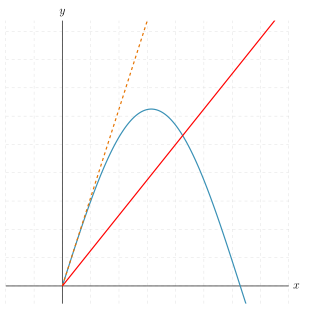
Given that \(0 < k < 1\), show with the help of a sketch that the equation \[ \sin x = k x \tag{\(*\)}\] has a unique solution in the range \(0 < x < \pi\). Let \[ I= \int_0^\pi \big\vert \sin x -kx\big\vert \, \d x\,. \] Show that \[ I= \frac{\pi^2 \sin\alpha }{2\alpha} -2\cos\alpha - \alpha \sin\alpha\,, \] where \(\alpha\) is the unique solution of \((*)\). Show that \(I\), regarded as a function of \(\alpha\), has a unique stationary value and that this stationary value is a minimum. Deduce that the smallest value of \(I\) is \[ -2 \cos \frac{\pi}{\sqrt2}\, .\]
Solution:
2011 Paper 1 Q7
In this question, you may assume that \(\ln (1+x) \approx x -\frac12 x^2\) when \(\vert x \vert \) is small. The height of the water in a tank at time \(t\) is \(h\). The initial height of the water is \(H\) and water flows into the tank at a constant rate. The cross-sectional area of the tank is constant.
- Suppose that water leaks out at a rate proportional to the height of the water in the tank, and that when the height reaches \(\alpha^2 H\), where \(\alpha\) is a constant greater than 1, the height remains constant. Show that \[ \frac {\d h}{\d t } = k( \alpha^2 H -h)\,, \] for some positive constant \(k\). Deduce that the time \(T\) taken for the water to reach height \(\alpha H\) is given by \[ kT = \ln \left(1+\frac1\alpha\right)\,, \] and that \(kT\approx \alpha^{-1}\) for large values of \(\alpha\).
- Suppose that the rate at which water leaks out of the tank is proportional to \(\sqrt h\) (instead of \(h\)), and that when the height reaches \(\alpha^2 H\), where \(\alpha\) is a constant greater than 1, the height remains constant. Show that the time \(T'\) taken for the water to reach height \(\alpha H\) is given by \[ cT'=2\sqrt H \left( 1 - \sqrt\alpha +\alpha \ln \left(1+\frac1 {\sqrt\alpha} \right)\right)\, \] for some positive constant \(c\), and that \(cT'\approx \sqrt H\) for large values of \(\alpha\).
Solution:
- \begin{align*} \frac{\d h}{\d t} &= \underbrace{c}_{\text{flow in}} - \underbrace{kh}_{\text{flow out}} \end{align*}. We also know that when \(h = \alpha^2 H\), \(\frac{\d h}{\d t} = 0\), ie \(c - k \alpha^2 H = 0\) therefore: \[ \frac{\d h}{\d t} = k(\alpha^2 H - h) \] \begin{align*} && \frac{\d h}{\d t} &= k(\alpha^2 H - h) \\ && \int \frac{1}{\alpha^2 H - h} \d h &= \int k \d t \\ && - \ln |\alpha^2H -h| &= kt + C \\ t = 0, h = H: && -\ln |(1-\alpha^2 )H| &= C \\ \Rightarrow && kt &= \ln \left | \frac{(\alpha^2-1)H}{h-\alpha^2 H }\right | \\ && kT &= \ln \frac{(\alpha^2-1)H}{\alpha H - \alpha^2 H} \\ &&&= \ln \frac{1+\alpha}{\alpha} \\ &&&= \ln \left (1 + \frac1{\alpha} \right) \\ &&&\approx \frac1{\alpha} - \frac12 \frac1{\alpha^2}\\ &&&\approx \alpha^{-1} \end{align*}
- \begin{align*} && \frac{\d h}{\d t} &=c(\alpha \sqrt{H} - \sqrt{h}) \\ \Leftrightarrow && c \int_0^{T'} \d t&= \int_{H}^{\alpha H} \frac{1}{\alpha \sqrt{H}-\sqrt{h}} \d h \\ u = \sqrt{h/H}: && cT' &= \int_1^{\sqrt{\alpha}} \frac{1}{\alpha \sqrt{H} - \sqrt{H}u} 2\sqrt{H}u \d u \\ &&&= 2\sqrt{H}\int_1^{\sqrt{\alpha}} \frac{u}{\alpha - u} \d u \\ &&&= 2\sqrt{H}\int_1^{\sqrt{\alpha}} \frac{u - \alpha + \alpha}{\alpha - u} \d u \\ &&&= 2\sqrt{H}\left [-u - \alpha \ln |\alpha - u| \right]_1^{\sqrt{\alpha}} \\ &&&= 2\sqrt{H}\left ( -\sqrt{\alpha} + 1- \alpha \ln (\alpha - \sqrt{\alpha}) + \alpha \ln |\alpha - 1| \right) \\ &&&= 2\sqrt{H}\left (1-\sqrt{\alpha} + \alpha \ln \left ( \frac{\alpha-1}{\alpha - \sqrt{\alpha}} \right)\right)\\ &&&= 2\sqrt{H}\left (1-\sqrt{\alpha} + \alpha \ln \left ( \frac{\sqrt{\alpha}^2-1}{\sqrt{\alpha}(\sqrt{\alpha}-1)} \right)\right)\\ &&&= 2\sqrt{H}\left (1-\sqrt{\alpha} + \alpha \ln \left ( \frac{\sqrt{\alpha}+1}{\sqrt{\alpha}} \right)\right)\\ &&&= \boxed{2\sqrt{H}\left (1-\sqrt{\alpha} + \alpha \ln \left ( 1+\frac{1}{\sqrt{\alpha}} \right)\right)}\\ &&&\approx2\sqrt{H}\left (1-\sqrt{\alpha} + \alpha \left ( \frac{1}{\sqrt{\alpha}}-\frac12 \frac{1}{\alpha} \right)\right) \\ &&&=2\sqrt{H} \left ( 1 - \frac12 \right) \\ &&&= \sqrt{H} \end{align*} as required.
2011 Paper 1 Q13
In this question, you may use without proof the following result: \[ \int \sqrt{4-x^2}\, \d x = 2 \arcsin (\tfrac12 x ) + \tfrac 12 x \sqrt{4-x^2} +c\,. \] A random variable \(X\) has probability density function \(\f\) given by \[ \f(x) = \begin{cases} 2k & -a\le x <0 \\[3mm] k\sqrt{4-x^2} & \phantom{-} 0\le x \le 2 \\[3mm] 0 & \phantom{-}\text{otherwise}, \end{cases} \] where \(k\) and \(a\) are positive constants.
- Find, in terms of \(a\), the mean of \(X\).
- Let \(d\) be the value of \(X\) such that \(\P(X> d)=\frac1 {10}\,\). Show that \(d < 0\) if \(2a> 9\pi\) and find an expression for \(d\) in terms of \(a\) in this case.
- Given that \(d=\sqrt 2\), find \(a\).
Solution: First notice that \begin{align*} && 1 &= \int_{-a}^2 f(x) \d x \\ &&&= 2ka + k\pi \\ \Rightarrow && k &= (\pi + 2a)^{-1} \end{align*}
- \(\,\) \begin{align*} && \E[X] &= \int_{-a}^2 x f(x) \d x\\ &&&= \int_{-a}^0 2kx \d x + k\int_0^{2} x\sqrt{4-x^2} \d x\\ &&&= \left [kx^2 \right]_{-a}^0 +k \left [-\frac13(4-x^2)^{\frac32} \right]_0^2 \\ &&&= -ka^2 + \frac83k \\ &&&= \frac{\frac83-a^2}{\pi + 2a} \end{align*}
- Consider \(\mathbb{P}(X < 0)\) then \(d < 0 \Leftrightarrow \mathbb{P}(X < 0) > \frac{9}{10}\) \begin{align*} && \frac{9}{10} &< \mathbb{P}(X < 0) \\ &&&= \int_{-a}^0 2k \d x \\ &&&= \frac{2a}{\pi+2a} \\ \Leftrightarrow && 9\pi &< 2a \\ \\ && \frac{9}{10} &= \int_{-a}^d 2k \d x \\ &&&= \frac{2(d+a)}{\pi + 2a} \\ \Rightarrow && 9\pi &= 2a + 20d \\ \Rightarrow && d &= \frac{2a-9\pi}{20} \end{align*}
- Suppose \(d=\sqrt 2\) then \begin{align*} && \frac1{10} &= \int_{\sqrt{2}}^2 f(x) \d x \\ &&&= \int_{\sqrt{2}}^2 k\sqrt{4-x^2} \d x \\ &&&= k\left [ 2 \sin^{-1} \tfrac12 x + \tfrac12 x \sqrt{4-x^2}\right]_{\sqrt{2}}^2 \\ &&&= k\left (\pi -\frac{\pi}{2} - 1 \right) \\ \Rightarrow && \pi + 2a &= 5\pi - 10 \\ \Rightarrow && a &= 2\pi-5 \end{align*}
2011 Paper 2 Q6
For any given function \(\f\), let \[ I = \int [\f'(x)]^2 \,[\f(x)]^n \d x\,, \tag{\(*\)} \] where \(n\) is a positive integer. Show that, if \(\f(x)\) satisfies \(\f''(x) =k \f(x)\f'(x)\) for some constant \(k\), then (\(*\)) can be integrated to obtain an expression for \(I\) in terms of \(\f(x)\), \(\f'(x)\), \(k\) and \(n\).
- Verify your result in the case \(\f(x) = \tan x\,\). Hence find \[ \displaystyle \int \frac{\sin^4x}{\cos^{8}x} \, \d x\;. \]
- Find \[ \displaystyle \int \sec^2x\, (\sec x + \tan x)^6\,\d x\;. \]
Solution: If \(f''(x) = kf(x)f'(x)\) then we can see \begin{align*} && I &= \int [\f'(x)]^2 \,[\f(x)]^n \d x \\ &&&= \int f'(x) \cdot f'(x) [f(x)]^n \d x \\ &&&= \left[ f'(x) \cdot \frac{[f(x)]^{n+1}}{n+1} \right] - \int f''(x) \frac{[f(x)]^{n+1}}{n+1} \d x \\ &&&= \frac{1}{n+1} \left (f'(x) [f(x)]^{n+1} - \int kf'(x) [f(x)]^{n+2} \d x \right) \\ &&&= \frac{1}{n+1} \left (f'(x) [f(x)]^{n+1} - k \frac{[f(x)]^{n+3}}{n+3} \right) +C\\ &&&= \frac{[f(x)]^{n+1}}{n+1} \left ( f'(x) - \frac{k[f(x)]^2}{n+3} \right) + C \end{align*}
- If \(f(x) = \tan x, f'(x) = \sec^2 x, f''(x) = 2 \sec^2 x \tan x = 2 \cdot f(x) \cdot f'(x)\), so \(\tan\) satisfies the conditions for the theorem. \begin{align*} && I &= \int \sec^4 x \tan^n x \d x \\ &&&= \left [\sec^2x \cdot \frac{\tan^{n+1} x}{n+1} \right] - \int 2 \sec^2 x \tan x \cdot \frac{\tan^{n+1} x}{n+1} \d x \\ &&&= \left [\sec^2x \cdot \frac{\tan^{n+1} x}{n+1} \right] - 2 \cdot \frac{\tan^{n+3} x}{(n+1)(n+3)} \\ \end{align*} So \begin{align*} && I &= \int \frac{\sin^4 x}{\cos^8 x} \d x \\ &&&= \int \tan^4 x \sec^4 x \d x \\ &&&= \int [\sec^2 x]^2 [\tan x]^4 \d x \\ &&&= \frac{\tan^{5}x}{5} \left ( \sec^2 x - \frac{2 \tan^2 x}{7} \right) + C \end{align*}
- \begin{align*} && I &= \int \sec^2x\, (\sec x + \tan x)^6\,\d x \\ &&&= \int (\sec x (\sec x + \tan x))^2 \cdot (\sec x + \tan x )^4 \d x \\ &&&= \frac{(\sec x + \tan x)^5}{5} \left ( \sec x (\sec x + \tan x) - \frac{(\sec x + \tan x)^2}{7} \right) + C \end{align*}
2011 Paper 3 Q4
The following result applies to any function \(\f\) which is continuous, has positive gradient and satisfies \(\f(0)=0\,\): \[ ab\le \int_0^a\f(x)\, \d x + \int_0^b \f^{-1}(y)\, \d y\,, \tag{\(*\)}\] where \(\f^{-1}\) denotes the inverse function of \(\f\), and \(a\ge 0\) and \(b\ge 0\).
- By considering the graph of \(y=\f(x)\), explain briefly why the inequality \((*)\) holds. In the case \(a>0\) and \(b>0\), state a condition on \(a\) and \(b\) under which equality holds.
- By taking \(\f(x) = x^{p-1}\) in \((*)\), where \(p>1\), show that if \(\displaystyle \frac 1p + \frac 1q =1\) then \[ ab \le \frac{a^p}p + \frac{b^q}q\,. \] Verify that equality holds under the condition you stated above.
- Show that, for \(0\le a \le \frac12 \pi\) and \(0\le b \le 1\), \[ ab \le b\arcsin b + \sqrt{1-b^2} \, - \cos a\,. \] Deduce that, for \(t\ge1\), \[ \arcsin (t^{-1}) \ge t - \sqrt{t^2-1}\,. \]
2011 Paper 3 Q5
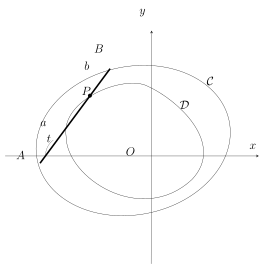
A movable point \(P\) has cartesian coordinates \((x,y)\), where \(x\) and \(y\) are functions of \(t\). The polar coordinates of \(P\) with respect to the origin \(O\) are \(r\) and \(\theta\). Starting with the expression \[ \tfrac12 \int r^2 \, \d \theta \] for the area swept out by \(OP\), obtain the equivalent expression \[ \tfrac12 \int \left( x\frac{\d y}{\d t} - y \frac{\d x}{\d t}\right)\d t \,. \tag{\(*\)} \] The ends of a thin straight rod \(AB\) lie on a closed convex curve \(\cal C\). The point \(P\) on the rod is a fixed distance \(a\) from \(A\) and a fixed distance \(b\) from \(B\). The angle between \(AB\) and the positive \(x\) direction is \(t\). As \(A\) and \(B\) move anticlockwise round \(\cal C\), the angle \(t\) increases from \(0\) to \(2\pi\) and \(P\) traces a closed convex curve \(\cal D\) inside \(\cal C\), with the origin \(O\) lying inside \(\cal D\), as shown in the diagram.
Solution: \begin{align*} && \tan \theta &= y/x \\ \Rightarrow && \sec^2 \theta \frac{\d \theta}{\d t} &= \frac{x \frac{\d y}{\d t} - y \frac{\d x}{\d t}}{x^2} \\ \Rightarrow && \frac{\d \theta}{\d t} &=\left (x \frac{\d y}{\d t} - y \frac{\d x}{\d t} \right) \frac{\cos^2 \theta}{x^2} \\ &&&=\left (x \frac{\d y}{\d t} - y \frac{\d x}{\d t} \right) \frac{\cos^2 \theta}{r^2 \cos^2 \theta } \\ &&&=\left (x \frac{\d y}{\d t} - y \frac{\d x}{\d t} \right) \frac{1}{r^2 } \\ && \tfrac12 \int r^2 \, \d \theta &= \tfrac12 \int \left (x \frac{\d y}{\d t} - y \frac{\d x}{\d t} \right) \d t \end{align*} \(A = (x - a \cos t, y - a \sin t), B = (x + b \cos t , y + b \sin t)\) \begin{align*} && [A] &= \tfrac12 \int_0^{2\pi} \left ((x-a \cos t) \frac{\d (y-a \sin t)}{\d t} - (y-a \sin t) \frac{\d (x-a \cos t)}{\d t} \right) \d t \\ &&&= \tfrac12 \int_0^{2\pi} \left ((x - a \cos t) \left ( \frac{\d y}{\d t} - a \cos t \right) - (y - a \sin t) \left ( \frac{\d x}{\d t} + a \sin t \right)\right) \d t \\ &&&= \tfrac12 \int_0^{2\pi} \left ( x \frac{\d y}{\d t} - y \frac{\d x}{\d t} - a \cos t \frac{\d y}{\d t}-ax \cos t +a^2 \cos^2 t + a \sin t \frac{\d x}{\d t}-y a \sin t + a^2 \sin^2 t \right) \d t \\ &&&= \tfrac12 \int_0^{2\pi} \left ( \underbrace{x \frac{\d y}{\d t} - y \frac{\d x}{\d t}}_{[P]}-a\left ((x + \frac{\d y}{\d x}) \cos t + (y - \frac{\d x}{\d t}) \sin t \right) + \underbrace{a^2}_{\pi a^2} \right) \d t \\ &&&= [P] + \pi a^2 - af \end{align*} \begin{align*} && [B] &= \tfrac12 \int_0^{2\pi} \left ((x+b \cos t) \frac{\d (y+b \sin t)}{\d t} - (y+b \sin t) \frac{\d (x+b \cos t)}{\d t} \right) \d t \\ &&&= \tfrac12 \int_0^{2\pi} \left ((x+b \cos t) (\frac{\d y}{\d t} + b \cos t) - (y+b \sin t)(\frac{\d x}{\d t} - b \sin t) \right) \d t \\ &&&= \tfrac12 \int_0^{2\pi} \left (x \frac{\d y}{\d t} - y \frac{\d x}{\d t} + b^2 + b(\cos t (x + \frac{\d y}{\d t}) +(y - \frac{\d x}{\d t})\sin t\right) \d t \\ &&&= [P] + \pi b^2 + b f \end{align*} Since \(A\) and \(B\) trace out the same area, we must have \(\pi a^2 - af = \pi b^2 + bf \Rightarrow \pi (a^2-b^2) = f(b+a) \Rightarrow f = \pi (a-b)\). In particular the area inbetween is \([A] - [P] = \pi a^2 - a \pi (a-b)\)
2011 Paper 3 Q6
The definite integrals \(T\), \(U\), \(V\) and \(X\) are defined by \begin{align*} T&= \int_{\frac13}^{\frac12} \frac{{\rm artanh}\, t}t \,\d t\,, & U&= \int _{\ln 2 }^{\ln 3 } \frac{u}{2\sinh u}\, \d u \,, \\[3mm] V&= - \int_{\frac13}^{\frac12} \frac{\ln v}{1-v^2} \,\d v \,, & X&= \int _{\frac12\ln2}^{\frac12\ln3} \ln ({\coth x})\, \d x\,. \end{align*} Show, without evaluating any of them, that \(T\), \(U\), \(V\) and \(X\) are all equal.
Solution: \begin{align*} && T &= \int_{\frac13}^{\frac12} \frac{{\rm artanh}\, t}t \,\d t \\ && &=\int_{\frac13}^{\frac12} \frac{1}{2t}\ln \left ( \frac{1+t}{1-t} \right) \,\d t \\ u = \tfrac{1+t}{1-t}, t= \tfrac{u-1}{u+1}, \d t = \tfrac{2}{(u+1)^2} \d t &&&= \int_{u=2}^{u=3} \frac{1}{2t} \ln u \frac{2}{(u+1)^2} \d u \\ &&&= \int_2^3 \frac{u+1}{u-1} \ln u \frac{1}{(u+1)^2} \d u \\ &&&= \int_2^3 \frac{1}{u^2-1} \ln u \d u \end{align*} \begin{align*} && U&= \int _{\ln 2 }^{\ln 3 } \frac{u}{2\sinh u}\, \d u \\ v = e^u, \d v = e^u \d u &&&= \int_{v=2}^{v=3} \frac{\ln v}{v - \frac{1}{v}} \frac{1}{v} \d v \\ &&&= \int_2^3 \frac{1}{v^2-1} \ln v \d v \end{align*} \begin{align*} &&V &= - \int_{\frac13}^{\frac12} \frac{\ln v}{1-v^2} \,\d v \\ u = \tfrac1v, \d u = -\tfrac1{v^2} \d v &&&= -\int_{u=3}^{u=2} \frac{-\ln u}{1 - \frac{1}{u^2}} \frac{-1}{u^2} \d u \\ &&&= -\int_3^2 \frac{\ln u}{u^2-1} \d u \\ &&&= \int_2^3 \frac{1}{u^2-1} \ln u \d u \end{align*} \begin{align*} &&X&= \int _{\frac12\ln2}^{\frac12\ln3} \ln ({\coth x})\, \d x \\ u = \coth x, \d u =(1-u^2) \d x &&&= \int_{u = 3}^{u=2} \ln u \frac{1}{1-u^2} \d u \\ &&&= \int_2^3 \frac{\ln u}{u^2-1} \d u \end{align*} Therefore all integrals are equal to the same integral, namely \(\displaystyle \int_2^3 \frac{\ln u}{u^2-1} \d u\)