Problems

Filters
Clear Filters

83 problems found

1993 Paper 2 Q12
D: 1600.0 B: 1484.0

TikZ diagram
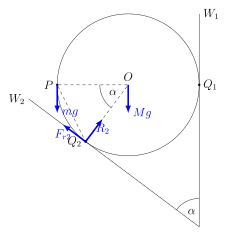
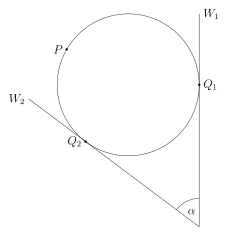
A uniform sphere of mass \(M\) and radius \(r\) rests between a vertical wall \(W_{1}\) and an inclined plane \(W_{2}\) that meets \(W_{1}\) at an angle \(\alpha.\) \(Q_{1}\) and \(Q_{2}\) are the points of contact of the sphere with \(W_{1}\) and \(W_{2}\) resectively, as shown in the diagram. A particle of mass \(m\) is attached to the sphere at \(P\), where \(PQ_{1}\) is a diameter, and the system is released. The sphere is on the point of slipping at \(Q_{1}\) and at \(Q_{2}.\) Show that if the coefficients of friction between the sphere and \(W_{1}\) and \(W_{2}\) are \(\mu_{1}\) and \(\mu_{2}\) respectively, then \[ m=\frac{\mu_{2}+\mu_{1}\cos\alpha-\mu_{1}\mu_{2}\sin\alpha}{(2\mu_{1}\mu_{2}+1)\sin\alpha+(\mu_{2}-2\mu_{1})\cos\alpha-\mu_{2}}M. \] If the sphere is on the point of rolling about \(Q_{2}\) instead of slipping, show that \[ m=\frac{M}{\sec\alpha-1}. \]


Solution:

TikZ diagram
Since the sphere is on the point of slipping at both \(Q_1\) and \(Q_2\), \(F_{r1} = \mu_1 R_1\) and \(F_{r2} = \mu_2 R_2\) \begin{align*} \text{N2}(\uparrow): && -mg-Mg-\mu_1 R_1 + R_2 \sin \alpha + \mu_2 R_2 \cos \alpha &= 0 \\ \text{N2}(\rightarrow): && -R_1 + R_2 \cos \alpha - \mu_2 R_2 \sin \alpha &= 0 \\ \\ \Rightarrow && R_2 \cos \alpha - \mu_2 R_2 \sin \alpha &= R_1 \\ % && -mg-Mg+\mu_1 (R_2 \cos \alpha - \mu_2 R_2 \sin \alpha) + R_2 \sin \alpha + \mu_2 R_2 \cos \alpha &= 0 \\ % \\ \overset{\curvearrowleft}{O}: && mg - \mu_1 R_1 - \mu_2R_2 &= 0 \\ \Rightarrow && \mu_1 R_2 \l \cos \alpha - \mu_2 \sin \alpha \r - \mu_2 R_2 &= -mg \\ && \mu_1 (R_2 \cos \alpha - \mu_2 R_2 \sin \alpha) + R_2 \sin \alpha + \\ && \quad \quad \mu_2 R_2 \cos \alpha - \mu_1 R_2 \l \cos \alpha - \mu_2 \sin \alpha \r - \mu_2 R_2 &= Mg \\ \Rightarrow && \frac{\mu_2+\mu_1 \l \cos \alpha - \mu_2 \sin \alpha \r }{\mu_1 ( \cos \alpha - \mu_2 \sin \alpha) + \sin \alpha + \mu_2 \cos \alpha - \mu_1 \l \cos \alpha - \mu_2 \sin \alpha \r - \mu_2 } &= \frac{m}{M} \\ && \frac{\mu_2+\mu_1 \cos \alpha - \mu_1\mu_2 \sin \alpha }{\cos \alpha (-2\mu_1+\mu_2) + \sin \alpha (1 +2\mu_1\mu_2) -\mu_2} &= \frac{m}{M} \end{align*} If instead the sphere is about to roll about \(Q_2\), then the forces at \(Q_1\) will be \(0\), we can then take moments about \(Q_2\).
TikZ diagram
Looking at perpendicular distances from \(Q_2\) to \(O\) and \(P\) we have \(r \cos \alpha\) and \(r(1-\cos \alpha)\) \begin{align*} \overset{\curvearrowleft}{Q_2}: && mg (1 - \cos \alpha) - Mg \cos \alpha &= 0 \\ \Rightarrow && \frac{1}{\sec \alpha-1} &= \frac{m}{M} \end{align*}

1993 Paper 2 Q13
D: 1600.0 B: 1500.0

The force \(F\) of repulsion between two particles with positive charges \(Q\) and \(Q'\) is given by \(F=kQQ'/r^{2},\) where \(k\) is a positive constant and \(r\) is the distance between the particles. Two small beads \(P_{1}\) and \(P_{2}\) are fixed to a straight horizontal smooth wire, a distance \(d\) apart. A third bead \(P_{3}\) of mass \(m\) is free to move along the wire between \(P_{1}\) and \(P_{3}.\) The beads carry positive electrical charges \(Q_{1},Q_{2}\) and \(Q_{3}.\) If \(P_{3}\) is in equilibrium at a distance \(a\) from \(P_{1},\) show that \[ a=\frac{d\sqrt{Q_{1}}}{\sqrt{Q_{1}}+\sqrt{Q_{2}}}. \] Suppose that \(P_{3}\) is displaced slightly from its equilibrium position and released from rest. Show that it performs approximate simple harmonic motion with period \[ \frac{\pi d}{(\sqrt{Q_{1}}+\sqrt{Q_{2}})^{2}}\sqrt{\frac{2md\sqrt{Q_{1}Q_{2}}}{kQ_{3}}.} \] {[}You may use the fact that \(\dfrac{1}{(a+y)^{2}}\approx\dfrac{1}{a^{2}}-\dfrac{2y}{a^{3}}\) for small \(y.\){]}

1993 Paper 3 Q12
D: 1700.0 B: 1432.3

\(ABCD\) is a horizontal line with \(AB=CD=a\) and \(BC=6a\). There are fixed smooth pegs at \(B\) and \(C\). A uniform string of natural length \(2a\) and modulus of elasticity \(kmg\) is stretched from \(A\) to \(D\), passing over the pegs at \(B\) and \(C\). A particle of mass \(m\) is attached to the midpoint \(P\) of the string. When the system is in equilibrium, \(P\) is a distance \(a/4\) below \(BC\). Evaluate \(k\). The particle is pulled down to a point \(Q\), which is at a distance \(pa\) below the mid-point of \(BC\), and is released from rest. \(P\) rises to a point \(R\), which is at a distance \(3a\) above \(BC\). Show that \(2p^2-p-17=0\). Show also that the tension in the strings is less when the particle is at \(R\) than when the particle is at \(Q\).

1992 Paper 1 Q9
D: 1500.0 B: 1500.0

The diagram shows a coffee filter consisting of an inverted hollow right circular cone of height \(H\) cm and base radius \(a\) cm. \noindent

\psset{xunit=1.0cm,yunit=0.8cm,algebraic=true,dimen=middle,dotstyle=o,dotsize=3pt 0,linewidth=0.5pt,arrowsize=3pt 2,arrowinset=0.25} \begin{pspicture*}(-1.67,-2.3)(2.85,3.85) \rput{0}(0,3){\psellipse(0,0)(1.23,0.72)} \rput{0.69}(0,0.01){\psellipse(0,0)(0.49,0.23)} \psline(-1.23,2.95)(0,-2) \psline(0,-2)(1.23,2.96) \psline{->}(0,3)(0.66,3.61) \psline{->}(0.66,3.61)(0,3) \rput[tl](0.35,3.27){\(a\)} \psline{<->}(1,0)(1,-2) \rput[tl](1.05,-0.86){\(x\)} \psline{<->}(2,3)(2,-2) \rput[tl](2.09,0.97){\(H\)} \end{pspicture*} \par
When the water level is \(x\) cm above the vertex, water leaves the cone at a rate \(Ax\) \(\mathrm{cm}^{3}\mathrm{sec}^{-1},\) where \(A\) is a positive constant. Suppose that the cone is initially filled to a height \(h\) cm with \(0 < h < H.\) Show that it will take \(\pi a^{2}h^{2}/(2AH^{2})\) seconds to empty. Suppose now that the cone is initially filled to a height \(h\) cm, but that water is poured in at a constant rate \(B\) \(\mathrm{cm}^{3}\mathrm{sec}^{-1}\) and continues to drain as before. Establish, by considering the sign of \(\mathrm{d}x/\mathrm{d}t\), or otherwise, what will happen subsequently to the water level in the different cases that arise. (You are not asked to find an explicit formula for \(x\).)

1992 Paper 1 Q11
D: 1500.0 B: 1470.8

Three light elastic strings \(AB,BC\) and \(CD\), each of natural length \(a\) and modulus of elasticity \(\lambda,\) are joined together as shown in the diagram. \noindent

\psset{xunit=1.0cm,yunit=1.0cm,algebraic=true,dimen=middle,dotstyle=o,dotsize=3pt 0,linewidth=0.5pt,arrowsize=3pt 2,arrowinset=0.25} \begin{pspicture*}(-2.46,-1.7)(5.55,2.55) \psline(-2,2)(-2,-1) \psline(-2,-1)(4,-1) \psline(4,-1)(4,2) \psline(4,2)(-2,2) \psline[linestyle=dashed,dash=2pt 2pt](1,2)(1,-1) \psline{<->}(5,2)(5,-1) \rput[tl](5.15,0.77){\(3d\)} \rput[tl](1.08,2.35){\(A\)} \rput[tl](1.14,0.63){\(B\)} \rput[tl](1.17,-0.32){\(C\)} \rput[tl](1.14,-1.1){\(D\)} \begin{scriptsize} \psdots[dotstyle=*](1,2) \psdots[dotstyle=*](1,-1) \psdots[dotstyle=*](1,0.5) \psdots[dotstyle=*](1,-0.37) \end{scriptsize} \end{pspicture*} \par
\(A\) is attached to the ceiling and \(D\) to the floor of a room of height \(3d\) in such a way that \(A,B,C\) and \(D\) are in a vertical line. Particles of mass \(m\) are attached at \(B\) and \(C\). Find the heights of \(B\) and \(C\) above the floor. Find the set of values of \(d\) for which it is possible, by choosing \(m\) suitably, to have \(CD=a\)?

1992 Paper 2 Q12
D: 1600.0 B: 1500.0

In the figure, \(W_{1}\) and \(W_{2}\) are wheels, both of radius \(r\). Their centres \(C_{1}\) and \(C_{2}\) are fixed at the same height, a distance \(d\) apart, and each wheel is free to rotate, without friction, about its centre. Both wheels are in the same vertical plane. Particles of mass \(m\) are suspended from \(W_{1}\) and \(W_{2}\) as shown, by light inextensible strings would round the wheels. A light elastic string of natural length \(d\) and modulus elasticity \(\lambda\) is fixed to the rims of the wheels at the points \(P_{1}\) and \(P_{2}.\) The lines joining \(C_{1}\) to \(P_{1}\) and \(C_{2}\) to \(P_{2}\) both make an angle \(\theta\) with the vertical. The system is in equilibrium. \noindent

\psset{xunit=1.0cm,yunit=1.0cm,algebraic=true,dimen=middle,dotstyle=o,dotsize=3pt 0,linewidth=0.5pt,arrowsize=3pt 2,arrowinset=0.25} \begin{pspicture*}(-4.94,-1.8)(5.1,3.96) \psline(-4,1)(4,1) \pscircle(-3,2){1.41} \pscircle(3,2){1.41} \psline(-3,2)(-4,1) \psline(-3,2)(-3,0.59) \psline(3,2)(4,1) \psline(3,2)(3,0.59) \psline(1.59,1.98)(1.58,-1) \psline(-1.59,1.96)(-1.6,-1.06) \parametricplot{-2.356194490192345}{-1.5707963267948966}{0.4*cos(t)+-3|0.4*sin(t)+2} \parametricplot{-1.5707963267948966}{-0.7853981633974483}{0.4*cos(t)+3|0.4*sin(t)+2} \rput[tl](-2.88,2.24){\(C_1\)} \rput[tl](3.22,2.24){\(C_2\)} \rput[tl](-4.58,1.04){\(P_1\)} \rput[tl](4.32,1.02){\(P_2\)} \rput[tl](-1.7,-1.36){\(m\)} \rput[tl](1.44,-1.4){\(m\)} \rput[tl](-3.24,3.88){\(W_1\)} \rput[tl](2.76,3.86){\(W_2\)} \rput[tl](-3.42,1.5){\(\theta\)} \rput[tl](3.14,1.52){\(\theta\)} \begin{scriptsize} \psdots[dotstyle=*](-4,1) \psdots[dotstyle=*](4,1) \psdots[dotstyle=*](1.58,-1) \psdots[dotstyle=*](-1.6,-1.06) \end{scriptsize} \end{pspicture*} \par
\vspace{-0.5cm} Show that \[ \sin2\theta=\frac{mgd}{\lambda r}. \]For what value or values of \(\lambda\) (in terms of \(m,d,r\) and \(g\)) are there
  • sep}{3mm}
  • \(\bf (i)\) no equilibrium positions,
  • \(\bf (ii)\) just one equilibrium position,
  • \(\bf (iii)\) exactly two equilibrium positions,
  • \(\bf (iv)\) more than two equilibrium positions?

1991 Paper 1 Q10
D: 1500.0 B: 1484.0

\(\ \)\vspace{-1cm} \noindent

\psset{xunit=1.1cm,yunit=0.7cm,algebraic=true,dotstyle=o,dotsize=3pt 0,linewidth=0.5pt,arrowsize=3pt 2,arrowinset=0.25} \begin{pspicture*}(-0.32,-0.43)(11.1,8.55) \pspolygon[linewidth=0pt,linecolor=white,hatchcolor=black,fillstyle=hlines,hatchangle=45.0,hatchsep=0.11](0,0)(0,-0.2)(10,-0.2)(10,0) \psline(0,0)(10,0) \psline(0,8)(1,5.5) \psline(1,5.5)(2,4) \psline(3,3)(4,2.5) \psline(5,2.3)(6,2.5) \psline(2,4)(3,3) \psline[linestyle=dashed,dash=1pt 1pt](4,2.5)(5,2.3) \parametricplot[linestyle=dashed,dash=1pt 1pt]{5.080052976030177}{5.934024592002003}{1*5.25*cos(t)+0*5.25*sin(t)+4.11|0*5.25*cos(t)+1*5.25*sin(t)+7.4} \psline(9,5.5)(10,8) \psline(1,5.5)(1,0) \psline(2,4)(2,0) \psline(3,3)(3,0) \psline(4,2.5)(4,0) \psline(5,2.3)(5,0) \psline(6,2.51)(6,0) \psline(9,5.5)(9,0) \rput[tl](0.02,8.53){\(A_0\)} \rput[tl](1.03,6.06){\(A_1\)} \rput[tl](2.01,4.52){\(A_2\)} \rput[tl](2.98,3.56){\(A_3\)} \rput[tl](3.98,3.12){\(A_n\)} \rput[tl](4.8,2.9){\(A_{n+1}\)} \rput[tl](5.75,3.2){\(A_{n+2}\)} \rput[tl](8.1,6.1){\(A_{2n+1}\)} \rput[tl](10.13,8.19){\(A_{2n+2}\)} \end{pspicture*} \par
The above diagram represents a suspension bridge. A heavy uniform horizontal roadway is attached by vertical struts to a light flexible chain at points \(A_{1}=(x_{1},y_{1}),\) \(A_{2}=(x_{2},y_{2}),\ldots,\) \(A_{2n+1}=(x_{2n+1},y_{2n+1}),\) where the coordinates are referred to horizontal and vertically upward axes \(Ox,Oy\). The chain is fixed to external supports at points \[ A_{0}=(x_{0},y_{0})\quad\mbox{ and }\quad A_{2n+2}=(x_{2n+2},y_{2n+2}) \] at the same height. The weight of the chain and struts may be neglected. Each strut carries the same weight \(w\). The horizontal spacing \(h\) between \(A_{i}\) and \(A_{i+1}\) (for \(0\leqslant i\leqslant2n+1\)) is constant. Write down equations satisfied by the tensions \(T_{i}\) in the portion \(A_{i-1}A_{i}\) of the chain for \(1\leqslant i\leqslant n+1\). Hence or otherwise show that \[ \frac{h}{y_{n}-y_{n+1}}=\frac{3h}{y_{n-1}-y_{n}}=\cdots=\frac{(2n+1)y}{y_{0}-y_{1}}. \] Verify that the points \(A_{0},A_{1},\ldots,A_{2n+1},A_{2n+2}\) lie on a parabola.

1991 Paper 1 Q12
D: 1484.0 B: 1500.0

\(\ \)\vspace{-1.5cm} \noindent

\psset{xunit=0.8cm,yunit=0.8cm,algebraic=true,dotstyle=o,dotsize=3pt 0,linewidth=0.5pt,arrowsize=3pt 2,arrowinset=0.25} \begin{pspicture*}(-2.4,-1.16)(12.46,5.7) \psline(0,0)(6,4) \psline(10,0)(5,5) \rput[tl](5.08,5.53){\(D\)} \rput[tl](5.31,4.3){\(B\)} \rput[tl](3.39,2.99){\(2l\)} \pscustom[fillcolor=black,fillstyle=solid,opacity=0]{\parametricplot{0.0}{0.5880026035475675}{1.23*cos(t)+0|1.23*sin(t)+0}\lineto(0,0)\closepath} \rput[tl](0.67,0.39){\(\alpha\)} \pscustom[fillcolor=black,fillstyle=solid,opacity=0]{\parametricplot{2.356194490192345}{3.141592653589793}{1.23*cos(t)+10|1.23*sin(t)+0}\lineto(10,0)\closepath} \rput[tl](9.09,0.56){\(\beta\)} \psline{->}(8,2)(8,1.3) \rput[tl](7.64,1.31){\(Mg\)} \rput[tl](9.17,1.38){\(x\)} \rput[tl](7.27,3.32){\(x\)} \rput[tl](-0.29,-0.18){\(A\)} \rput[tl](10.15,-0.2){\(C\)} \psline(-2,0)(12,0) \end{pspicture*} \par
The above diagram illustrates a makeshift stepladder, made from two equal light planks \(AB\) and \(CD\), each of length \(2l\). The plank \(AB\) is smoothly hinged to the ground at \(A\) and makes an angle of \(\alpha\) with the horizontal. The other plank \(CD\) has its bottom end \(C\) resting on the same horizontal ground and makes an angle \(\beta\) with the horizontal. It is pivoted smoothly to \(B\) at a point distance \(2x\) from \(C\). The coefficient of friction between \(CD\) and the ground is \(\mu.\) A painter of mass \(M\) stands on \(CD\), half between \(C\) and \(B\). Show that, for equilibrium to be possible, \[ \mu\geqslant\frac{\cot\alpha\cot\beta}{2\cot\alpha+\cot\beta}. \] Suppose now that \(B\) coincides with \(D\). Show that, as \(\alpha\) varies, the maximum distance from \(A\) at which the painter will be standing is \[ l\sqrt{\frac{1+81\mu^{2}}{1+9\mu^{2}}}. \]

1991 Paper 3 Q11
D: 1700.0 B: 1484.0

TikZ diagram
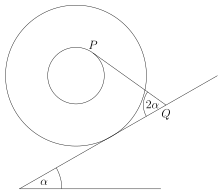
A uniform circular cylinder of radius \(2a\) with a groove of radius \(a\) cut in its central cross-section has mass \(M\). It rests, as shown in the diagram, on a rough plane inclined at an acute angle \(\alpha\) to the horizontal. It is supported by a light inextensible string would round the groove and attached to the cylinder at one end. The other end of the string is attached to the plane at \(Q\), the free part of the string, \(PQ,\) making an angle \(2\alpha\) with the inclined plane. The coefficient of friction at the contact between the cylinder and the plane is \(\mu.\) Show that \(\mu\geqslant\frac{1}{3}\tan\alpha.\) The string \(PQ\) is now detached from the plane and the end \(Q\) is fastened to a particle of mass \(3M\) which is placed on the plane, the position of the string remain unchanged. Given that \(\tan\alpha=\frac{1}{2}\) and that the system remains in equilibrium, find the least value of the coefficient of friction between the particle and the plane.

1991 Paper 3 Q14
D: 1700.0 B: 1486.2

TikZ diagram
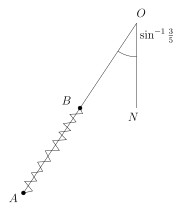
The end \(O\) of a smooth light rod \(OA\) of length \(2a\) is a fixed point. The rod \(OA\) makes a fixed angle \(\sin^{-1}\frac{3}{5}\) with the downward vertical \(ON,\) but is free to rotate about \(ON.\) A particle of mass \(m\) is attached to the rod at \(A\) and a small ring \(B\) of mass \(m\) is free to slide on the rod but is joined to a spring of natural length \(a\) and modulus of elasticity \(kmg\). The vertical plane containing the rod \(OA\) rotates about \(ON\) with constant angular velocity \(\sqrt{5g/2a}\) and \(B\) is at rest relative to the rod. Show that the length of \(OB\) is \[ \frac{(10k+8)a}{10k-9}. \] Given that the reaction of the rod on the particle at \(A\) makes an angle \(\tan^{-1}\frac{13}{21}\) with the horizontal, find the value of \(k\). Find also the magnitude of the reaction between the rod and the ring \(B\).

1990 Paper 1 Q12
D: 1516.0 B: 1484.0

\(\,\)

TikZ diagram
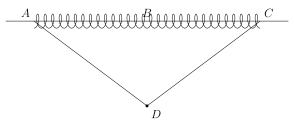
In the above diagram, \(ABC\) represents a light spring of natural length \(2l\) and modulus of elasticity \(\lambda,\) which is coiled round a smooth fixed horizontal rod. \(B\) is the midpoint of \(AC.\) The two ends of a light inelastic string of length \(2l\) are attached to the spring at \(A\) and \(C\). A particle of mass \(m\) is fixed to the string at \(D\), the midpoint of the string. The system can be in equilibrium with the angle \(CAD\) equal to \(\pi/6.\) Show that \[ mg=\lambda\left(\frac{2}{\sqrt{3}}-1\right). \] Write the length \(AC\) as \(2xl\), obtain an expression for the potential energy of the system as a function of \(x\). The particle is held at \(B\), and the spring is restored to its natural length \(2l.\) The particle is then released and falls vertically. Obtain an equation satisfied by \(x\) when the particle next comes to rest. Verify numerically that a possible solution for \(x\) is approximately \(0.66.\)


Solution:

TikZ diagram
\(|AB| = l \cos \tfrac{\pi}{6} = \frac{\sqrt{3}}{2}l\) therefore \(|AC| = \sqrt{3}l\) and the compression is \((2l - \sqrt{3}l)\) and so \(T_2 = \frac{\lambda}{2l} (2l - \sqrt{3}l) = \frac12\lambda(2- \sqrt{3})\) \begin{align*} \text{N2}(\rightarrow, A): && T_1 \cos \tfrac{\pi}{6} - T_2 &= 0 \\ \Rightarrow && T_1 &= \frac12 \frac{2\lambda(2-\sqrt{3})}{\sqrt{3}} \\ &&&= \lambda \left ( \frac{2}{\sqrt{3}} - 1 \right) \\ \\ \text{N2}(\uparrow, D): && 2T_1 \cos \frac{\pi}{3} - mg &= 0 \\ \Rightarrow && mg &= \lambda \left ( \frac{2}{\sqrt{3}} - 1 \right) \end{align*} Suppose \(|AC| = 2xl\), then: \begin{array}{c|c} \text{energy} & \\ \hline \text{GPE} & -mg \sqrt{l^2 - x^2l^2} \\ \text{EPE} & \frac12 \frac{\lambda (2l - 2lx)^2}{2l} \\ \text{KE} & \frac12 m v^2 \end{array} Therefore \[ E = \frac12 mv^2 + \lambda l (1-x)^2-mgl \sqrt{1-x^2}\] Initially, \(E = 0 + 0 + 0 = 0\). When the particle first comes to rest: \begin{align*} \text{COE}: && 0 &= E \\ &&&= \lambda l^2 (1-x)^2 - mgl \sqrt{1-x^2} \\ &&&= \lambda l (1-x)^2 - l \lambda \left ( \frac{2}{\sqrt{3}} - 1 \right) \sqrt{1-x^2} \\ \Rightarrow && (1-x)^2 &= \sqrt{1-x^2} \left ( \frac{2}{\sqrt{3}} - 1 \right) \\ \Rightarrow && (1-x)^2(1-x^2)^{-1/2} &= \left ( \frac{2}{\sqrt{3}} - 1 \right) \\ \Rightarrow && (1-2x+x^2)(1+\frac12 x^2+\cdots) &= \left ( \frac{2}{\sqrt{3}} - 1 \right) \\ \end{align*} If \(x = \frac23\) then \((1-x)^2(1-x^2)^{-1/2} = \frac19 \cdot \left ( \frac{5}{9} \right)^{-1/2} = \frac{\sqrt{5}}{15}\) If \(2\sqrt{3}-3 \approx \frac{\sqrt{5}}5\) we're done.

1990 Paper 1 Q13
D: 1500.0 B: 1484.0

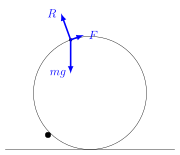
A rough circular cylinder of mass \(M\) and radius \(a\) rests on a rough horizontal plane. The curved surface of the cylinder is in contact with a smooth rail, parallel to the axis of the cylinder, which touches the cylinder at a height \(a/2\) above the plane. Initially the cylinder is held at rest. A particle of mass \(m\) rests in equilibrium on the cylinder, and the normal reaction of the cylinder on the particle makes an angle of \(\theta\) with the upward vertical. The particle is on the same side of the centre of the cylinder as the rail. The coefficient of friction between the cylinder and the particle and between the cylinder and the plane are both \(\mu\). Obtain the condition on \(\theta\) for the particle to rest in equilibrium. Show that, if the cylinder is released, equilibrium of both particle and cylinder is possible provided another inequality involving \(\mu\) and \(\theta\) (which should be found explicitly) is satisfied. Determine the largest possible value of \(\theta\) for equilibrium, if \(m=7M\) and \(\mu=0.75\).


Solution:
TikZ diagram
\begin{align*} \text{N2}(\nwarrow): && R -mg \cos \theta &= 0 \\ \text{N2}(\rightarrow): && -R \sin \theta + F \cos \theta &= 0 \\ \\ \Rightarrow && F &= \tan \theta R \\ \\ && F & \leq \mu R \\ \Rightarrow && \tan \theta R &\leq \mu R \\ \Rightarrow && \tan \theta &\leq \mu \end{align*} (Notice also \(F = mg \sin \theta\)) Once everything is released, we have the following situation. (Red forces act on the cylinder, blue forces on the particle).
TikZ diagram
\begin{align*} \text{N2}(\uparrow): && 0 &= R_g - Mg - \underbrace{mg}_{R_p \text{ and } F_p} + \frac{1}{\sqrt{2}}R_r \\ \text{N2}(\rightarrow): && 0 &= \frac{1}{\sqrt{2}}R_r - F_g \\ \overset{\curvearrowleft}{O}: && 0 &= aF_p - aF_g \\ \Rightarrow && F_g &= mg \sin \theta \\ \Rightarrow && R_r &= \sqrt{2} mg \sin \theta \\ \Rightarrow && R_g &=(M+m)g + mg \sin \theta \\ \\ && F_g &\leq \mu R_g \\ \Rightarrow && mg \sin \theta &\leq \mu (M+m(1+\sin \theta))g \\ \Rightarrow && \mu &\geq \frac{m \sin \theta}{M+m(1+\sin \theta)} \end{align*} If \(m = 7M\) and \(\mu = \frac34\) we have: \begin{align*} && \tan \theta &\leq \frac34 \\ && 3(M+7M(1 + \sin \theta)) &\geq 4 \cdot 7 M \sin \theta \\ \Rightarrow && 10 + 7 \sin \theta & \geq 28 \sin \theta \\ \Rightarrow && 10 &\geq 21 \sin \theta \\ \Rightarrow && \sin \theta &\leq \frac{10}{21} \end{align*} If \(\tan \theta = \frac{3}{4}, \sin \theta = \frac35 > \frac{10}{21}\), so the critical bound is \(\sin \theta \leq \frac{10}{21}\), ie \( \theta \leq \sin^{-1} \frac{10}{21} \approx 30^{\circ}\)

1990 Paper 2 Q13
D: 1600.0 B: 1484.0

A thin non-uniform rod \(PQ\) of length \(2a\) has its centre of gravity a distance \(a+d\) from \(P\). It hangs (not vertically) in equilibrium suspended from a small smooth peg \(O\) by means of a light inextensible string of length \(2b\) which passes over the peg and is attached at its ends to \(P\) and \(Q\). Express \(OP\) and \(OQ\) in terms of \(a,b\) and \(d\). By considering the angle \(POQ\), or otherwise, show that \(d < a^{2}/b\).


Solution:

TikZ diagram
Resolving horizontally, it's clear that \(\angle POG = \angle GOQ\), in particular applying the sine rule: \begin{align*} && \sin \angle POG &= \frac{a+d}{2b-x} \sin \angle PGO \\ && \sin \angle GOP &= \frac{a-d}{x} \sin \angle OGQ \\ \Rightarrow && \frac{a+d}{2b-x} &= \frac{a-d}{x} \\ \Rightarrow && x(a+d) &= (2b-x)(a-d) \\ \Rightarrow && 2ax &= 2b(a-d) \\ \Rightarrow && x &= b - \frac{db}{a} \\ \Rightarrow && PO &= b+\frac{db}{a} \\ && OQ &= b - \frac{d}{a} \end{align*} Applying the cosine rule: \begin{align*} && \cos POQ &= \frac{(b + \frac{db}{a})^2 + (b - \frac{db}{a})^2 -4a^2}{2(b^2 - \frac{d^2b^2}{a^2})} \\ &&&= \frac{2b^2 + \frac{2d^2b^2}{a^2}-4a^2}{2(b^2 - \frac{d^2b^2}{a^2})} \\ &&&= \frac{2a^2b^2 + 2d^2b^2-4a^4}{2b^2(a^2 - d^2)} \\ &&&< 1 \\ \Leftrightarrow && 2a^2b^2 + 2d^2b^2-4a^4 &< 2b^2(a^2-d^2) \\ \Leftrightarrow && 2d^2b^2-4a^4 &< -2b^2d^2 \\ \Leftrightarrow && 4d^2b^2&< 4a^4 \\ \Leftrightarrow && d^2&< \frac{a^4}{b^2} \\ \Leftrightarrow && d&< \frac{a^2}{b} \\ \end{align*}

1990 Paper 3 Q14
D: 1700.0 B: 1484.0

The edges \(OA,OB,OC\) of a rigid cube are taken as coordinate axes and \(O',A',B',C'\) are the vertices diagonally opposite \(O,A,B,C,\) respectively. The four forces acting on the cube are \[ \begin{pmatrix}\alpha\\ \beta\\ \gamma \end{pmatrix}\mbox{ at }O\ (0,0,0),\ \begin{pmatrix}\lambda\\ 0\\ 1 \end{pmatrix}\mbox{ at }O'\ (a,a,a),\ \begin{pmatrix}-1\\ 0\\ 2 \end{pmatrix}\mbox{ at }B\ (0,a,0),\ \mbox{ and }\begin{pmatrix}1\\ \mu\\ \nu \end{pmatrix}\mbox{ at }B'\ (a,0,a). \] The moment of the system about \(O\) is zero: find \(\lambda,\mu\) and \(\nu\).

  1. Given that \(\alpha=\beta=\gamma=0,\) find the system consisting of a single force at \(B\) together with a couple which is equivalent to the given system.
  2. Given that \(\alpha=2,\beta=3\) and \(\gamma=2,\) find the equation of the locus about each point of which the moment of the system is zero. Find the number of units of work done on the cube when it moves (without rotation) a distance in the direction of this line under the action of the given forces only.


Solution: \begin{align*} &&\mathbf{M} &= \begin{pmatrix}\lambda \\ 0\\ 1 \end{pmatrix} \times \begin{pmatrix}a\\ a \\ a \end{pmatrix} + \begin{pmatrix}-1\\ 0\\ 2 \end{pmatrix} \times \begin{pmatrix} 0 \\ a \\ 0 \end{pmatrix} + \begin{pmatrix}1\\ \mu\\ \nu \end{pmatrix} \times \begin{pmatrix} a \\ 0 \\ a \end{pmatrix} \\ &&&= \begin{pmatrix} -a \\ -a(\lambda -1) \\ \lambda a \end{pmatrix} + \begin{pmatrix} -2a \\ 0 \\ -a \end{pmatrix} + \begin{pmatrix} \mu a \\ -a(1-\nu) \\ -a \mu \end{pmatrix} \\ &&&=a \begin{pmatrix} \mu - 3 \\ \nu - \lambda \\ \lambda-1-\mu \end{pmatrix} \\ \Rightarrow && \mu &= 3, \lambda = 4, \nu = 4 \end{align*}

  1. To find the force we add all vectors: \begin{align*} \mathbf{F} &= \begin{pmatrix}\lambda \\ 0\\ 1 \end{pmatrix} + \begin{pmatrix}-1\\ 0\\ 2 \end{pmatrix} + \begin{pmatrix}1\\ \mu\\ \nu \end{pmatrix} \\ &= \begin{pmatrix}4\\ 0\\ 1 \end{pmatrix} + \begin{pmatrix}-1\\ 0\\ 2 \end{pmatrix} + \begin{pmatrix}1\\ 3 \\ 4 \end{pmatrix} \\ &= \begin{pmatrix} 4 \\ 3 \\ 7 \end{pmatrix} \end{align*} Since the moment about \(O\) is \(0\), we have the moment about \(B\) is: \begin{align*} \mathbf{M} &= \begin{pmatrix} 0 \\ a \\ 0 \end{pmatrix} \times \begin{pmatrix} 4 \\ 3 \\ 7\end{pmatrix} \\ &= \begin{pmatrix} 7a \\ 0 \\ -4a\end{pmatrix} \end{align*}
  2. \begin{align*} \mathbf{0} &= \mathbf{r} \times \begin{pmatrix} 4 + 2 \\ 3+3 \\ 7+2 \end{pmatrix} \\ &= \mathbf{r} \times \begin{pmatrix} 6 \\ 6 \\ 9 \end{pmatrix} \\ \end{align*} Therefore \(\mathbf{r} = t\begin{pmatrix} 2 \\ 2 \\ 3 \end{pmatrix}\) (ie a line) \begin{align*} \text{Work done} &= \text{Force} \cdot \text{distance} \end{align*} Since they are parallel, it's just the magnitude of the force, which is \(3\sqrt{2^2+2^2+3^2} = 3\sqrt{17}\)

1989 Paper 1 Q13
D: 1516.0 B: 1540.5

A uniform ladder of mass \(M\) rests with its upper end against a smooth vertical wall, and with its lower end on a rough slope which rises upwards towards the wall and makes an angle of \(\phi\) with the horizontal. The acute angle between the ladder and the wall is \(\theta\). If the ladder is in equilibrium, show that \(N\) and \(F\), the normal reaction and frictional force at the foot of the ladder are given by \[ N=Mg\left(\cos\phi-\frac{\tan\theta\sin\phi}{2}\right), \] \[ F=Mg\left(\sin\phi+\frac{\tan\theta\cos\phi}{2}\right). \] If the coefficient of friction between the ladder and the slope is \(2\), and \(\phi=45^{\circ}\), what is the largest value of \(\theta\) for which the ladder can rest in equilibrium?


Solution: \begin{align*} \overset{\curvearrowleft}{X}: && 0&= \frac{l}{2} Mg\sin \theta - l R_1 \cos \theta \\ \Rightarrow && R_1 &= \frac12 \tan \theta Mg \\ \text{N2}(\uparrow): && 0 &= R\cos \phi +F \sin \phi - Mg \\ \text{N2}(\rightarrow):&& 0&=R_1-F \cos \phi + R \sin \phi \\ \Rightarrow && \frac12 \tan \theta Mg &= F \cos \phi- R \sin \phi \\ && Mg &= F \sin \phi +R \cos \phi \\ \Rightarrow && F &= Mg \left ( \sin \phi + \frac12 \tan \theta \cos \phi \right) \\ && N &= Mg \left (\cos \phi - \frac12 \tan \theta \sin \phi \right ) \end{align*} If \(\mu = 2\) and \(\phi = 45^{\circ}\), we must have \(F \leq 2 N\), so: \begin{align*} && Mg \left ( \sin \phi + \frac12 \tan \theta \cos \phi \right) &\leq 2 Mg \left (\cos \phi - \frac12 \tan \theta \sin \phi \right ) \\ \Rightarrow && 1 + \frac12 \tan \theta \leq 2-\tan \theta \\ \Rightarrow && \frac 32 \tan \theta \leq 1 \\ \Rightarrow && \tan \theta \leq \frac23 \\ \Rightarrow && \theta \leq \tan^{-1} \frac23 \end{align*}