Problems
Filters
1531 problems found
2007 Paper 3 Q11
- A wheel consists of a thin
light circular rim attached by light spokes of length \(a\)
to a small hub of mass
\(m\). The wheel rolls without slipping
on a rough horizontal table
directly towards a straight edge of the table.
The plane of the wheel is vertical throughout the motion.
The speed of the wheel is \(u\), where
\(u^2
- Two particles, each of mass \(m/2\), are attached to a light circular hoop of radius \(a\), at the ends of a diameter. The hoop rolls without slipping on a rough horizontal table directly towards a straight edge of the table. The plane of the hoop is vertical throughout the motion. When the centre of the hoop is vertically above the edge of the table it has speed \(u\), where \(u^2
- Two particles, each of mass \(m/2\), are attached to a light circular hoop of radius \(a\), at the ends of a diameter. The hoop rolls without slipping on a rough horizontal table directly towards a straight edge of the table. The plane of the hoop is vertical throughout the motion. When the centre of the hoop is vertically above the edge of the table it has speed \(u\), where \(u^2
2007 Paper 3 Q12
I choose a number from the integers \(1, 2, \ldots, (2n-1)\) and the outcome is the random variable \(N\). Calculate \( \E(N)\) and \(\E(N^2)\). I then repeat a certain experiment \(N\) times, the outcome of the \(i\)th experiment being the random variable \(X_i\) (\(1\le i \le N\)). For each \(i\), the random variable \(X_i\) has mean \(\mu\) and variance \(\sigma^2\), and \(X_i\) is independent of \(X_j\) for \(i\ne j\) and also independent of \(N\). The random variable \(Y\) is defined by \(Y= \sum\limits_{i=1}^NX_i\). Show that \(\E(Y)=n\mu\) and that \(\mathrm{Cov}(Y,N) = \frac13n(n-1)\mu\). Find \(\var(Y) \) in terms of \(n\), \(\sigma^2\) and \(\mu\).
Solution: \begin{align*} && \E[N] &= \sum_{i=1}^{2n-1} \frac{i}{2n-1} \\ &&&= \frac{2n(2n-1)}{2(2n-1)} = n\\ && \E[N^2] &= \sum_{i=1}^{2n-1} \frac{i^2}{2n-1} \\ &&&= \frac{(2n-1)(2n)(4n-1)}{6(2n-1)} \\ &&&= \frac{n(4n-1)}{3} \\ && \var[N] &= \frac{n(4n-1)}{3} - n^2 \\ &&&= \frac{n^2-n}{3} \end{align*} \begin{align*} && \E[Y] &= \E \left [ \E \left [ \sum_{i=1}^N X_i | N = k\right] \right]\\ &&&= \E \left[ N\mu \right] = n\mu \\ \\ && \mathrm{Cov}(Y,N) &= \mathbb{E}[XY] - \E[X]\E[Y] \\ &&&= \E \left [ \E \left [N \sum_{i=1}^N X_i | N = k\right] \right] - n^2 \mu \\ &&&= \E[N^2\mu] - n^2 \mu \\ &&&= \left ( \frac{n^2(4n-1)}{3} - n^2 \right) \mu \\ &&&= \frac{n^2-n}{3}\mu \\ \\ && \E[Y^2] &= \E \left [ \E \left [ \left ( \sum_{i=1}^N X_i \right) ^2\right ] \right] \\ &&&= \E \left [ \E \left [ \sum_{i=1}^N X_i ^2 + 2\sum_{i,j} X_iX_j\right ] \right] \\ &&&= \E \left [ \sum_{i=1}^N \left ( \E[X_i ^2] + 2\sum_{i,j} \E[X_i]\E[X_j]\right ) \right] \\ &&&= \E \left [ N(\sigma^2 + \mu^2) + (N^2-N)\mu^2\right] \\ &&&= n(\sigma^2+\mu^2) + \left ( \frac{n^2-n}{3}-n \right)\mu^2 \\ &&&= n\sigma^2 + \frac{n^2-n}{3} \mu^2 \\ \Rightarrow && \var[Y] &= n\sigma^2 + \frac{n^2-n}{3} \mu^2 - n^2\mu^2 \\ &&&= n\sigma^2 - \frac{2n^2+n}{3} \mu^2 \end{align*}
2007 Paper 3 Q13
A frog jumps towards a large pond. Each jump takes the frog either \(1\,\)m or \(2\,\)m nearer to the pond. The probability of a \(1\,\)m jump is \(p\) and the probability of a \(2\,\)m jump is \(q\), where \(p+q=1\), the occurence of long and short jumps being independent.
- Let \(p_n(j)\) be the probability that the frog, starting at a point \((n-\frac12)\,\)m away from the edge of the pond, lands in the pond for the first time on its \(j\)th jump. Show that \(p_2(2)=p\).
- Let \(u_n\) be the expected number of jumps, starting at a point \((n-\frac12)\,\)m away from the edge of the pond, required to land in the pond for the first time. Write down the value of \(u_1\). By finding first the relevant values of \(p_n(m)\), calculate \(u_2\) and show that $u_3= 3-2q+q^2\(.
- Given that \)u_n\( can be expressed in the form \)u_n= A(-q)^{n-1} +B +Cn$, where \(A\), \(B\) and \(C\) are constants (independent of \(n\)), show that \(C= (1+q)^{-1}\) and find \(A\) and \(B\) in terms of \(q\). Hence show that, for large \(n\), \(u_n \approx \dfrac n{p+2q}\) and explain carefully why this result is to be expected.
2007 Paper 3 Q14
- My favourite dartboard is a disc of unit radius and centre \(O\). I never miss the board, and the probability of my hitting any given area of the dartboard is proportional to the area. Each throw is independent of any other throw. I throw a dart \(n\) times (where \(n>1\)). Find the expected area of the smallest circle, with centre \(O\), that encloses all the \(n\) holes made by my dart. Find also the expected area of the smallest circle, with centre \(O\), that encloses all the \((n-1)\) holes nearest to \(O\).
- My other dartboard is a square of side 2 units, with centre \(Q\). I never miss the board, and the probability of my hitting any given area of the dartboard is proportional to the area. Each throw is independent of any other throw. I throw a dart \(n\) times (where \(n>1\)). Find the expected area of the smallest square, with centre \(Q\), that encloses all the \(n\) holes made by my dart.
- Determine, without detailed calculations, whether the expected area of the smallest circle, with centre \(Q\), on my square dartboard that encloses all the \(n\) holes made by my darts is larger or smaller than that for my circular dartboard.
Solution:
- Firstly, we consider the probability that all darts lie within a distance \(s\) from the centre, ie \begin{align*} \mathbb{P}(\text{all darts within }s) &= \prod_{k=1}^s \mathbb{P}(\text{dart within }s) \\ &= \left ( \frac{\pi s^2}{\pi} \right)^n \\ &= s^{2n} \end{align*} Therefore the pdf is \(2ns^{2n-1}\), and the expected area is \(\int_{s=0}^1 \pi s^2 \cdot 2n s^{2n-1} \d s = 2n \pi \frac{1}{2n+2} = \frac{n}{n+1} \pi\). \begin{align*} \mathbb{P}(\text{n-1 within }s) &= \underbrace{s^{2n}}_{\text{all within }s} + \underbrace{ns^{2n-2}(1-s^2)}_{\text{all but 1 within }s}\\ &= ns^{2n-2}-(n-1)s^{2n} \end{align*} Therefore the pdf is \(n(2n-2)s^{2n-3} - 2n(n-1)s^{2n-1} = 2n(n-1)(s^{2n-3}-s^{2n-1})\) and the expected area is: \begin{align*} \int \pi s^2 \cdot2n(n-1)(s^{2n-3}-s^{2n-1})\d s &= 2n(n-1) \pi \left ( \frac{1}{2n} - \frac{1}{2n+2} \right) \\ &= n(n-1)\pi \frac{2}{n(n+1)} \\ &= \frac{n-1}{n+1} \pi \end{align*}
- Now consider a square of side-length \(s\), we must have \(\mathbb{P}(\text{all darts within square}) = \left ( \frac{s^2}{4} \right)^n\) and therefore the pdf is \(n \frac{s^{n-1}}{4^n}\). Therefore the expected area is \(\displaystyle \int_0^2 s^2 \cdot n \frac{s^{n-1}}{4^n} \d s = \frac{n}{n+1} \frac{2^{2n+1}}{2^{2n}} = \frac{4n}{n+1}\)
- It is clearly larger as the square dartboard contains all of the circular dartboard, and there will be some probability that the darts land outside the circular dartboard, making the circle much larger.
2006 Paper 1 Q1
Find the integer, \(n\), that satisfies \(n^2 < 33\,127< (n+1)^2\). Find also a small integer \(m\) such that \((n+m)^2-33\,127\) is a perfect square. Hence express \(33\,127\) in the form \(pq\), where \(p\) and \(q\) are integers greater than \(1\). By considering the possible factorisations of \(33\, 127\), show that there are exactly two values of \(m\) for which \((n+m)^2 -33\,127\) is a perfect square, and find the other value.
Solution: \begin{align*} 180^2 &= 32400 \\ 181^2 &= 32761 \\ 182^2 &= 33124 \\ 183^2 &= 33489 \\ 184^2 &= 33856 \end{align*} Therefore \(182^2 < 33\,127 < (182+1)^2\). and \((182+2)^2 - 33\,127 = 729 = 27^2\). Therefore \(33\,127 = 184^2 - 27^2 = 211 \times 157\). (Note both of these numbers are prime). Suppose \((n+m)^2 - 33\,127 = k^2\) then \(33\,127 = (n+m)^2-k^2 = (n+m-k)(n+m+k)\). Since there are only two factorisations of \(33\,127\) into positive integer factors with one factor larger than the other, the other factorisation must be: \(n+m+k = 33\,127, n+m-k = 1 \Rightarrow k = \frac{33\, 126}{2} = 16563\), ie \(16564^2 - 33\,127 = 16563^2\)
2006 Paper 1 Q2
A small goat is tethered by a rope to a point at ground level on a side of a square barn which stands in a large horizontal field of grass. The sides of the barn are of length \(2a\) and the rope is of length \(4a\). Let \(A\) be the area of the grass that the goat can graze. Prove that \(A\le14\pi a^2\) and determine the minimum value of \(A\).
Solution:

2006 Paper 1 Q3
In this question \(b\), \(c\), \(p\) and \(q\) are real numbers.
- By considering the graph \(y=x^2 + bx + c\) show that \(c < 0\) is a sufficient condition for the equation \(\displaystyle x^2 + bx + c = 0\) to have distinct real roots. Determine whether \(c < 0\) is a necessary condition for the equation to have distinct real roots.
- Determine necessary and sufficient conditions for the equation \(\displaystyle x^2 + bx + c = 0\) to have distinct positive real roots.
- What can be deduced about the number and the nature of the roots of the equation \(x^3 + px + q = 0\) if \(p>0\) and \(q<0\)? What can be deduced if \(p<0\,\) and \(q<0\)? You should consider the different cases that arise according to the value of \(4p^3+ 27q^2\,\).
Solution:
- Since \(y(0) < 0\) and \(y(\pm \infty) > 0\) we must cross the axis twice. Therefore there are two distinct real roots. It is not necessary, for example \((x-2)(x-3)\) has distinct real roots by the constant term is \(6 > 0\)

- For \(x^2+bx+c=0\) to have distinct, positive real roots we need \(\Delta > 0\) and \(\frac{-b -\sqrt{\Delta}}{2a} > 0\) where \(\Delta = b^2-4ac\), ie \(b < 0\) and \(b^2 > \Delta = b^2-4ac\) or \(4ac > 0\). Therefore we need \(b^2-4ac > 0, b < 0, 4ac > 0\)
- Since \(q < 0\) at least one of the roots is positive. The gradient is \(3x^2+p > 0\) therefore there is exactly one positive root. If \(p < 0\) then there are turning points when \(3x^2+p = 0\) ie \(x = \pm \sqrt{\frac{-p}{3}}\). If the first turning point is above the \(x\)-axis then there will be 3 roots. If it is on the \(x\)-axis then 2, otherwise only 1. \begin{align*} y &= \left (-\sqrt{\frac{-p}{3}}\right)^3 + p\left (-\sqrt{\frac{-p}{3}}\right)+q \\ &= \sqrt{\frac{-p}{3}} \left (p - \frac{p}{3} \right) + q \\ &= \frac{2}{3} \sqrt{\frac{-p}{3}}p +q \\ \end{align*} Therefore it is positive if \(-\frac{4}{27}p^3 >q^2\) ie if \(4p^3+27q^2 < 0\)
2006 Paper 1 Q4
By sketching on the same axes the graphs of \(y=\sin x\) and \(y=x\), show that, for \(x>0\):
- \(x>\sin x\,\);
- \(\dfrac {\sin x} {x} \approx 1\) for small \(x\).
2006 Paper 1 Q5
- Use the substitution \(u^2=2x+1\) to show that, for \(x>4\), \[ \int \frac{3} { ( x-4 ) \sqrt {2x+1}} \; \d x = \ln \l \frac{\sqrt{2x+1}-3} {\sqrt{2x+1}+3} \r + K\,, \] where \(K\) is a constant.
- Show that $ \displaystyle \int_{\ln 3}^{\ln 8} \frac{2} { \e^x \sqrt{ \e^x + 1}}\; \mathrm{d}x\, = \frac 7{12} + \ln \frac23 $ .
Solution:
- \begin{align*} && I &= \int \frac{3}{(x-4)\sqrt{2x+1}}\, \d x \\ u^2 =2x+1, 2u \frac{\d u}{\d x}=2: && &= \int \frac{3}{\left(\frac{u^2-1}{2}-4\right)u} u \d u \\ &&&= \int \frac{6}{u^2-9} \d u \\ &&&= \int \frac{6}{(u-3)(u+3)} \d u\\ &&&= \int \left ( \frac{1}{u-3} - \frac{1}{u+3} \right )\d u \\ &&&= \ln (u-3) - \ln (u+3) + C \\ &&&= \ln \frac{u-3}{u+3} + C \\ &&&= \ln \left (\frac{\sqrt{2x+1}-3}{\sqrt{2x+1}+3} \right) + C \end{align*}
- \begin{align*} && I &= \int_{\ln 3}^{\ln 8} \frac{2}{e^x\sqrt{e^x+1}} \d x \\ u = e^x, \frac{\d u}{\d x} = e^x: &&&= \int_{u=3}^{u=8} \frac{2}{u\sqrt{u+1}} \frac{1}{u} \d u \\ v^2=u+1, 2v \frac{\d v}{\d u} = 1: &&&= \int_{v=2}^{v=3} \frac{2}{v(v^2-1)^2} \d v \\ &&&= \int_2^3 \left ( \frac{2}{v} - \frac{}{v-1} - \frac{1}{2(v-1)^2} - \frac{1}{v+1} - \frac{1}{2(v+1)^2}\right) \d v \\ &&&= \left [2\ln v - \ln(v^2-1)+\frac12(v-1)^{-1}+\frac12(v+1)^{-1} \right]_2^3 \\ &&&= \left ( 2\ln3-\ln 8+\frac14+\frac18\right)-\left ( 2\ln2-\ln 3+\frac12+\frac16\right) \\ &&&= \end{align*}
2006 Paper 1 Q6
- Show that, if \(\l a \, , b\r\) is any point on the curve \(x^2 - 2y^2 = 1\), then \(\l 3a + 4b \, , 2a + 3b \r\,\) also lies on the curve.
- Determine the smallest positive integers \(M\) and \(N\) such that, if \(\l a \,, b\r\) is any point on the curve \(Mx^2 - Ny^2 = 1\), then \((5a+6b\,, 4a+5b)\) also lies on the curve.
- Given that the point \(\l a \, , b\r\) lies on the curve \(x^2 - 3y^2 = 1\,\), find positive integers \(P\), \(Q\), \(R\) and \(S\) such that the point \((P a +Q b\,, R a + Sb)\) also lies on the curve.
Solution:
- Suppose \(a^2-2b^2=1\) then \begin{align*} (3a+4b)^2-2(2a+3b)^2 &= 9a^2+24ab+16b^2-2\cdot(4a^2+12ab+9b^2) \\ &=a^2-2b^2 \\ &= 1 \end{align*} Therefore \((3a+4b,2a+3b)\) also lies on the curve.
- Suppose \(Ma^2-Nb^2 = 1\) then \begin{align*} M(5a+6b)^2-N(4a+5b)^2 &= M\cdot(25a^2+60ab+36b^2) - N\cdot(16a^2+40ab+25b^2) \\ &= (25M-16N)a^2+20\cdot(3M-2N)ab+(36M-25N)b^2 \end{align*} Therefore we need \(3M = 2N\) so the smallest possible value would have to be \(M = 2, N = 3\), which does work
- Consider \(x + \sqrt{3}y\), then consider \((x+\sqrt{3}y)(2+\sqrt{3}) = (2x+3y)+(x+2y)\sqrt{3}\). Notice that \((x+\sqrt{3}y)(x-\sqrt{3}y) = 1\) and \((2+\sqrt{3})(2-\sqrt{3}) = 1\) so \(((2x+3y)+(x+2y)\sqrt{3})((2x+3y)-(x+2y)\sqrt{3}) = 1\), so we can take \(P=2,Q=3,R=1,S=2\)
2006 Paper 1 Q7
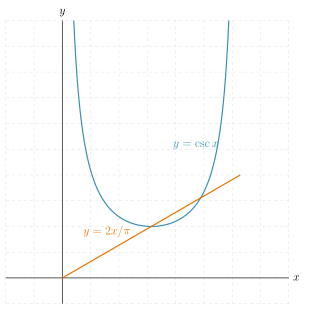
- Sketch on the same axes the functions \({\rm cosec}\, x\) and \(2x/ \pi\), for \(0 < x < \pi\,\). Deduce that the equation \(x\sin x = \pi/2 \) has exactly two roots in the interval \(0 < x < \pi\,\). Show that \[ \displaystyle \int_{\pi/2}^{\pi} \left \vert x\sin x - \frac{\pi} { 2} \right \vert \; \mathrm{d}x = 2\sin\alpha +\frac{3\pi^2} 4 - \alpha \pi -\pi -2\alpha \cos\alpha -1 \] where \(\alpha\) is the larger of the roots referred to above.
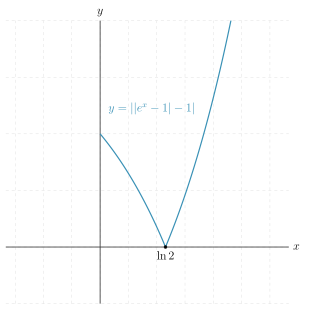
- Show that the region bounded by the positive \(x\)-axis, the \(y\)-axis and the curve \[y = \Bigl| \vert \e^x - 1 \vert - 1 \Bigr|\] has area \(\ln 4-1\).
Solution:
- \(\,\)
Notice that they are equal at \(1\) when \(x = \pi/2\), but this is a local minimum for \(\csc x\) whereas \(2x/\pi\) is increasing so there is a second intersection. Notice that \(\csc x = \frac{2x}{\pi} \Leftrightarrow x \sin x = \frac{\pi}{2}\) therefore our intersections are also the roots of \(x \sin x = \frac{\pi}{2}\) and the larger one is greater than \(\pi/2\) \begin{align*} && I &= \int_{\pi/2}^{\pi} \Bigl| x \sin x - \frac{\pi}{2} \Bigr| \d x \\ &&&= \int_{\pi/2}^{\alpha} \left ( x \sin x - \frac{\pi}{2} \right )\d x +\int_{\alpha}^{\pi} \left ( \frac{\pi}{2} -x \sin x \right) \d x \\ &&&= \left ( \pi - 2\alpha + \frac{\pi}{2}\right) \frac{\pi}{2} + \int_{\pi/2}^{\alpha} x \sin x\d x -\int_{\alpha}^{\pi} x \sin x \d x \\ &&&= \frac{3\pi^2}{4} - \alpha \pi + \left [-x \cos x \right]_{\pi/2}^{\alpha}+\left[x \cos x \right]_{\alpha}^{\pi} + \int_{\pi/2}^{\alpha} \cos x \d x - \int_{\alpha}^{\pi} \cos x \d x \\ &&&= \frac{3\pi^2}{4} - \alpha \pi -\alpha \cos \alpha -\pi -\alpha \cos \alpha+ \sin \alpha - 1+\sin \alpha \\ &&&= 2\sin \alpha + \frac{3\pi^2}{4} - \alpha \pi - 2\alpha \cos \alpha - 1 \end{align*}
- \(\,\)
\begin{align*} && A &= \int_0^{\ln 2} ||e^x-1|-1| \d x \\ &&&= \int_0^{\ln 2} |e^x-2| \d x \\ &&&=\int_0^{\ln 2} (2-e^x) \d x \\ &&&= 2 \ln 2 - \left [e^x \right]_0^{\ln 2} \\ &&&= \ln 4 - (2-1) = \ln 4 - 1 \end{align*}
2006 Paper 1 Q8
{\it Note that the volume of a tetrahedron is equal to \(\frac1 3\) \(\times\) the area of the base \(\times\) the height.} The points \(O\), \(A\), \(B\) and \(C\) have coordinates \((0,0,0)\), \((a,0,0)\), \((0,b,0)\) and \((0,0,c)\), respectively, where \(a\), \(b\) and \(c\) are positive.
- Find, in terms of \(a\), \(b\) and \(c\), the volume of the tetrahedron \(OABC\).
- Let angle \(ACB = \theta\). Show that \[ \cos\theta = \frac {c^2} { { \sqrt{\vphantom{ \dot b} (a^2+c^2)(b^2+c^2)} } ^{\vphantom A} \ } \] and find, in terms of \(a\), \(b\) and \(c\), the area of triangle \(ABC\). % is %\(\displaystyle \tfrac12 \sqrt{ \vphantom{\dot A } a^2b^2 +b^2c^2 + c^2 a^2 \;} \;\).
2006 Paper 1 Q9
A block of mass \(4\,\)kg is at rest on a smooth, horizontal table. A smooth pulley \(P\) is fixed to one edge of the table and a smooth pulley \(Q\) is fixed to the opposite edge. The two pulleys and the block lie in a straight line. Two horizontal strings are attached to the block. One string runs over pulley \(P\); a particle of mass \(x\,\)kg hangs at the end of this string. The other string runs over pulley \(Q\); a particle of mass \(y\,\)kg hangs at the end of this string, where \(x > y\) and \(x + y = 6\,\). The system is released from rest with the strings taut. When the \(4\,\)kg block has moved a distance \(d\), the string connecting it to the particle of mass \(x\,\)kg is cut. Show that the time taken by the block from the start of the motion until it first returns to rest (assuming that it does not reach the edge of the table) is \(\sqrt{d/(5g)\,} \,\f(y)\), where \[ \f(y)= \frac{10}{ \sqrt{6-2y}}+ \left(1 + \frac{4}{ y} \right) \sqrt {6 -2y}. \] Calculate the value of \(y\) for which \(\f'(y)=0\).
2006 Paper 1 Q10
A particle \(P\) is projected in the \(x\)-\(y\) plane, where the \(y\)-axis is vertical and the \(x\)-axis is horizontal. The particle is projected with speed \(V\) from the origin at an angle of \(45 ^\circ\) above the positive \(x\)-axis. Determine the equation of the trajectory of \(P\). The point of projection (the origin) is on the floor of a barn. The roof of the barn is given by the equation \(y= x \tan \alpha +b\,\), where \(b>0\) and \(\alpha\) is an acute angle. Show that, if the particle just touches the roof, then \(V(-1+ \tan\alpha) =-2 \sqrt{bg}\); you should justify the choice of the negative root. If this condition is satisfied, find, in terms of \(\alpha\), \(V\) and \(g\), the time after projection at which touching takes place. A particle \(Q\) can slide along a smooth rail fixed, in the \(x\)-\(y\) plane, to the under-side of the roof. It is projected from the point \((0,b)\) with speed \(U\) at the same time as \(P\) is projected from the origin. Given that the particles just touch in the course of their motions, show that \[ 2 \sqrt 2 \, U \cos \alpha = V \big(2 + \sin\alpha\cos\alpha -\sin^2\alpha) . \]
2006 Paper 1 Q11
Particles \(A_1\), \(A_2\), \(A_3\), \(\ldots\), \(A_n\) (where \(n\ge 2\)) lie at rest in that order in a smooth straight horizontal trough. The mass of \(A_{n-1}\) is \(m\) and the mass of \(A_n\) is \(\lambda m\), where \(\lambda>1\). Another particle, \(A_0\), of mass \(m\), slides along the trough with speed \(u\) towards the particles and collides with \(A_1\). Momentum and energy are conserved in all collisions.
- Show that it is not possible for there to be exactly one particle moving after all collisions have taken place.
- Show that it is not possible for \(A_{n-1}\) and \(A_n\) to be the only particles moving after all collisions have taken place.
- Show that it is not possible for \(A_{n-2}\), \(A_{n-1}\) and \(A_n\) to be the only particles moving after all collisions have taken place.
- Given that there are exactly two particles moving after all collisions have taken place, find the speeds of these particles in terms of \(u\) and \(\lambda\).