Problems
Filters
74 problems found
1998 Paper 3 Q8
- Consider the sphere of radius \(a\) and centre the origin. %Show that the line through the point with position vector %\({\bf b}\) and parallel to a unit %vector \({\bf m}\) intersects the sphere at two points if %$$ %a^2 > {\bf b}.{\bf b} -({\bf b}.{\bf m})^2 \,. %$$ %What is the corresponding condition for there to be precisely one %point of intersection? %If this point has position vector \({\bf p}\), show that the line %is perpendicular to \({\bf p}\).
- Show that the line \({\bf r} ={\bf b} + \lambda {\bf m}\), where \(\bf m\) is a unit vector, intersects the sphere \({\bf r}\cdot {\bf r} = a^2\) at two points if $$ a^2 > {\bf b}\cdot{\bf b} -({\bf b}\cdot{\bf m})^2 \,. $$ Write down the corresponding condition for there to be precisely one point of intersection. If this point has position vector \({\bf p}\), show that \({\bf m}\cdot{\bf p}=0\).
- Now consider a second sphere of radius \(a\) and a plane perpendicular to a unit vector~\({\bf n}\). The centre of the sphere has position vector \({\bf d}\) and the minimum distance from the origin to the plane is \(l\). What is the condition for the plane to be tangential to this second sphere?
- Show that the first and second spheres intersect at right angles ({\em i.e.\ }the two radii to each point of intersection are perpendicular) if $$ {\bf d}\cdot{\bf d} = 2 a^2 \,. $$
1997 Paper 1 Q5
Four rigid rods \(AB\), \(BC\), \(CD\) and \(DA\) are freely jointed together to form a quadrilateral in the plane. Show that if \(P\), \(Q\), \(R\), \(S\) are the mid-points of the sides \(AB\), \(BC\), \(CD\), \(DA\), respectively, then \[|AB|^{2}+|CD|^{2}+2|PR|^{2}=|AD|^{2}+|BC|^{2}+2|QS|^{2}.\] Deduce that \(|PR|^{2}-|QS|^{2}\) remains constant however the vertices move. (Here \(|PR|\) denotes the length of \(PR\).)
1997 Paper 1 Q9
A single stream of cars, each of width \(a\) and exactly in line, is passing along a straight road of breadth \(b\) with speed \(V\). The distance between the successive cars is \(c\).
1997 Paper 3 Q3
By considering the solutions of the equation \(z^n-1=0\), or otherwise, show that \[(z-\omega)(z-\omega^2)\dots(z-\omega^{n-1})=1+z+z^2+\dots+z^{n-1},\] where \(z\) is any complex number and \(\omega={\rm e}^{2\pi i/n}\). Let \(A_1,A_2,A_3,\dots,A_n\) be points equally spaced around a circle of radius \(r\) centred at \(O\) (so that they are the vertices of a regular \(n\)-sided polygon). Show that \[\overrightarrow{OA_1}+\overrightarrow{OA_2}+\overrightarrow{OA_3} +\dots+\overrightarrow{OA_n}=\mathbf0.\] Deduce, or prove otherwise, that \[\sum_{k=1}^n|A_1A_k|^2=2r^2n.\]
1995 Paper 1 Q7
Let \(A,B,C\) be three non-collinear points in the plane. Explain briefly why it is possible to choose an origin equidistant from the three points. Let \(O\) be such an origin, let \(G\) be the centroid of the triangle \(ABC,\) let \(Q\) be a point such that \(\overrightarrow{GQ}=2\overrightarrow{OG},\) and let \(N\) be the midpoint of \(OQ.\)
- Show that \(\overrightarrow{AQ}\) is perpendicular to \(\overrightarrow{BC}\) and deduce that the three altitudes of \(\triangle ABC\) are concurrent.
- Show that the midpoints of \(AQ,BQ\) and \(CQ\), and the midpoints of the sides of \(\triangle ABC\) are all equidistant from \(N\).
1995 Paper 3 Q8
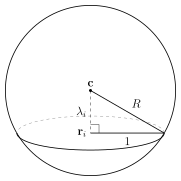
A plane \(\pi\) in 3-dimensional space is given by the vector equation \(\mathbf{r}\cdot\mathbf{n}=p,\) where \(\mathbf{n}\) is a unit vector and \(p\) is a non-negative real number. If \(\mathbf{x}\) is the position vector of a general point \(X\), find the equation of the normal to \(\pi\) through \(X\) and the perpendicular distance of \(X\) from \(\pi\). The unit circles \(C_{i},\) \(i=1,2,\) with centres \(\mathbf{r}_{i},\) lie in the planes \(\pi_{i}\) given by \(\mathbf{r}\cdot\mathbf{n}_{i}=p_{i},\) where the \(\mathbf{n}_{i}\) are unit vectors, and \(p_{i}\) are non-negative real numbers. Prove that there is a sphere whose surface contains both circles only if there is a real number \(\lambda\) such that \[ \mathbf{r}_{1}+\lambda\mathbf{n}_{1}=\mathbf{r}_{2}\pm\lambda\mathbf{n}_{2}. \] Hence, or otherwise, deduce the necessary conditions that \[ (\mathbf{r}_{1}-\mathbf{r}_{2})\cdot(\mathbf{n}_{1}\times\mathbf{n}_{2})=0 \] and that \[ (p_{1}-\mathbf{n}_{1}\cdot\mathbf{r}_{2})^{2}=(p_{2}-\mathbf{n}_{2}\cdot\mathbf{r}_{1})^{2}. \] Interpret each of these two conditions geometrically.
Solution: The equation of the normal to \(\pi\) through \(X\) is \(\mathbf{x} + \lambda \mathbf{n}\). The distance is \(|\mathbf{x}\cdot \mathbf{n}-p|\) We know that the centre of the sphere must lie above the centre of the circle following the normal, ie \(\mathbf{c} = \mathbf{r}_1+\lambda_1 \mathbf{n}_1 = \mathbf{r}_2+\lambda_2 \mathbf{n}_2\)
1995 Paper 3 Q11
A ship is sailing due west at \(V\) knots while a plane, with an airspeed of \(kV\) knots, where \(k>\sqrt{2},\) patrols so that it is always to the north west of the ship. If the wind in the area is blowing from north to south at \(V\) knots and the pilot is instructed to return to the ship every thirty minutes, how long will her outward flight last? Assume that the maximum distance of the plane from the ship during the above patrol was \(d_{w}\) miles. If the air now becomes dead calm, and the pilot's orders are maintained, show that the ratio \(d_{w}/d_{c}\) of \(d_{w}\) to the new maximum distance, \(d_{c}\) miles, of the plane from the ship is \[ \frac{k^{2}-2}{2k(k^{2}-1)}\sqrt{4k^{2}-2}. \]
1994 Paper 3 Q3
Describe geometrically the possible intersections of a plane with a sphere. Let \(P_{1}\) and \(P_{2}\) be the planes with equations \begin{alignat*}{1} 3x-y-1 & =0,\\ x-y+1 & =0, \end{alignat*} respectively, and let \(S_{1}\) and \(S_{2}\) be the spheres with equations \begin{alignat*}{1} x^{2}+y^{2}+z^{2} & =7,\\ x^{2}+y^{2}+z^{2}-6y-4z+10 & =0, \end{alignat*} respectively. Let \(C_{1}\) be the intersection of \(P_{1}\) and \(S_{1},\) let \(C_{2}\) be the intersection of \(P_{2}\) and \(S_{2}\) and let \(L\) be the intersection of \(P_{1}\) and \(P_{2}.\) Find the points where \(L\) meets each of \(S_{1}\) and \(S_{2}.\) Determine, giving your reasons, whether the circles \(C_{1}\) and \(C_{2}\) are linked.
1994 Paper 3 Q10
The island of Gammaland is totally flat and subject to a constant wind of \(w\) kh\(^{-1},\) blowing from the West. Its southernmost shore stretches almost indefinitely, due east and west, from the coastal city of Alphabet. A novice pilot is making her first solo flight from Alphaport to the town of Betaville which lies north-east of Alphaport. Her instructor has given her the correct heading to reach Betaville, flying at the plane's recommended airspeed of \(v\) kh\(^{-1},\) where \(v>w.\) On reaching Betaport the pilot returns with the opposite heading to that of the outward flight and, so featureless is Gammaland, that she only realises her error as she crosses the coast with Alphaport nowhere in sight. Assuming that she then turns West along the coast, and that her outward flight took \(t\) hours, show that her return flight takes \[ \left(\frac{v+w}{v-w}\right)t\ \text{hours.} \] If Betaville is \(d\) kilometres from Alphaport, show that, with the correct heading, the return flight should have taken \[ t+\frac{\sqrt{2}wd}{v^{2}-w^{2}}\ \text{hours.} \]
1993 Paper 2 Q4
Two non-parallel lines in 3-dimensional space are given by \(\mathbf{r}=\mathbf{p}_{1}+t_{1}\mathbf{m}_{1}\) and \(\mathbf{r}=\mathbf{p}_{2}+t_{2}\mathbf{m}_{2}\) respectively, where \(\mathbf{m}_{1}\) and \(\mathbf{m}_{2}\) are unit vectors. Explain by means of a sketch why the shortest distance between the two lines is \[ \frac{\left|(\mathbf{p}_{1}-\mathbf{p}_{2})\cdot(\mathbf{m}_{1}\times\mathbf{m}_{2})\right|}{\left|(\mathbf{m}_{1}\times\mathbf{m}_{2})\right|}. \]
- Find the shortest distance between the lines in the case \[ \mathbf{p}_{1}=(2,1,-1)\qquad\mathbf{p}_{2}=(1,0,-2)\qquad\mathbf{m}_{1}=\tfrac{1}{5}(4,3,0)\qquad\mathbf{m}_{2}=\tfrac{1}{\sqrt{10}}(0,-3,1). \]
- Two aircraft, \(A_{1}\) and \(A_{2},\) are flying in the directions given by the unit vectors \(\mathbf{m}_{1}\) and \(\mathbf{m}_{2}\) at constant speeds \(v_{1}\) and \(v_{2}.\) At time \(t=0\) they pass the points \(\mathbf{p}_{1}\) and \(\mathbf{p}_{2}\), respectively. If \(d\) is the shortest distance between the two aircraft during the flight, show that \[ d^{2}=\frac{\left|\mathbf{p}_{1}-\mathbf{p}_{2}\right|^{2}\left|v_{1}\mathbf{m}_{1}-v_{2}\mathbf{m}_{2}\right|^{2}-[(\mathbf{p}_{1}-\mathbf{p}_{2})\cdot(v_{1}\mathbf{m}_{1}-v_{2}\mathbf{m}_{2})]^{2}}{\left|v_{1}\mathbf{m}_{1}-v_{2}\mathbf{m}_{2}\right|^{2}}. \]
- Suppose that \(v_{1}\) is fixed. The pilot of \(A_{2}\) has chosen \(v_{2}\) so that \(A_{2}\) comes as close as possible to \(A_{1}.\) How close is that, if \(\mathbf{p}_{1},\mathbf{p}_{2},\mathbf{m}_{1}\) and \(\mathbf{m}_{2}\) are as in (i)?
1993 Paper 3 Q8
A square pyramid has its base vertices at the points \(A\) \((a,0,0)\), \(B\) \((0,a,0)\), \(C\) \((-a,0,0)\) and \(D\) \((0,-a,0)\), and its vertex at \(E\) \((0,0,a)\). The point \(P\) lies on \(AE\) with \(x\)-coordinate \(\lambda a\), where \(0<\lambda<1\), and the point \(Q\) lies on \(CE\) with \(x\)-coordinate \(-\mu a\), where \(0<\mu<1\). The plane \(BPQ\) cuts \(DE\) at \(R\) and the \(y\)-coordinate of \(R\) is \(-\gamma a\). Prove that $$ \gamma = {\lambda \mu \over \lambda + \mu - \lambda \mu}. $$ Show that the quadrilateral \(BPRQ\) cannot be a parallelogram.
1992 Paper 2 Q9
Let \(\mathbf{a},\mathbf{b}\) and \(\mathbf{c}\) be the position vectors of points \(A,B\) and \(C\) in three-dimensional space. Suppose that \(A,B,C\) and the origin \(O\) are not all in the same plane. Describe the locus of the point whose position vector \(\mathbf{r}\) is given by \[ \mathbf{r}=(1-\lambda-\mu)\mathbf{a}+\lambda\mathbf{b}+\mu\mathbf{c}, \] where \(\lambda\) and \(\mu\) are scalar parameters. By writing this equation in the form \(\mathbf{r}\cdot\mathbf{n}=p\) for a suitable vector \(\mathbf{n}\) and scalar \(p\), show that \[ -(\lambda+\mu)\mathbf{a}\cdot(\mathbf{b}\times\mathbf{c})+\lambda\mathbf{b}\cdot(\mathbf{c}\times\mathbf{a})+\mu\mathbf{c}\cdot(\mathbf{a}\times\mathbf{b})=0 \] for all scalars \(\lambda,\mu.\) Deduce that \[ \mathbf{a}\cdot(\mathbf{b}\times\mathbf{c})=\mathbf{b}\cdot(\mathbf{c}\times\mathbf{a})=\mathbf{c}\cdot(\mathbf{a}\times\mathbf{b}). \] Say briefly what happens if \(A,B,C\) and \(O\) are all in the same plane.
Solution: \(\mathbf{r}=(1-\lambda-\mu)\mathbf{a}+\lambda\mathbf{b}+\mu\mathbf{c} = \mathbf{a} + \lambda(\mathbf{b}-\mathbf{a})+\mu(\mathbf{c}-\mathbf{a})\) Therefore it is the plane through \(\mathbf{a}\) with direction vectors \(\mathbf{b}-\mathbf{a}\) and \(\mathbf{c}-\mathbf{a}\), ie it is the plane through \(\mathbf{a},\mathbf{b},\mathbf{c}\). The normal to this plane will be \((\mathbf{b}-\mathbf{a} ) \times (\mathbf{c}-\mathbf{a}) = \mathbf{b}\times \mathbf{c}-\mathbf{a} \times \mathbf{c}-\mathbf{b}\times \mathbf{a}\), so we must have: \begin{align*} && \mathbf{r} \cdot \left (\mathbf{b}\times \mathbf{c}-\mathbf{a} \times \mathbf{c}-\mathbf{b}\times \mathbf{a} \right) &= \mathbf{a} \cdot \left (\mathbf{b}\times \mathbf{c}-\mathbf{a} \times \mathbf{c}-\mathbf{b}\times \mathbf{a} \right) \\ &&&= \mathbf{a} \cdot (\mathbf{b}\times \mathbf{c}) \end{align*} Therefore, \begin{align*} && \mathbf{a} \cdot (\mathbf{b}\times \mathbf{c}) &= \mathbf{r} \cdot \left (\mathbf{b}\times \mathbf{c}-\mathbf{a} \times \mathbf{c}-\mathbf{b}\times \mathbf{a} \right) \\ &&&= \left ( (1-\lambda-\mu)\mathbf{a}+\lambda\mathbf{b}+\mu\mathbf{c} \right)\cdot \left (\mathbf{b}\times \mathbf{c}-\mathbf{a} \times \mathbf{c}-\mathbf{b}\times \mathbf{a} \right) \\ &&&= (1-\lambda- \mu) \mathbf{a}\cdot (\mathbf{b} \times \mathbf{c})-\lambda \mathbf{b}\cdot(\mathbf{a} \times \mathbf{c})-\mu \mathbf{c}\cdot(\mathbf{b} \times \mathbf{a}) \\ \Rightarrow && 0 &= (-\lambda- \mu) \mathbf{a}\cdot (\mathbf{b} \times \mathbf{c})-\lambda \mathbf{b}\cdot(\mathbf{a} \times \mathbf{c})-\mu \mathbf{c}\cdot(\mathbf{b} \times \mathbf{a}) \\ &&&= -(\lambda+ \mu) \mathbf{a}\cdot (\mathbf{b} \times \mathbf{c})+\lambda \mathbf{b}\cdot(\mathbf{c} \times \mathbf{a})+\mu \mathbf{c}\cdot(\mathbf{a} \times \mathbf{b}) \\ \end{align*} The result follows from setting \(\mu = 0, \lambda = 1\) and \(\mu = 1, \lambda = 0\). If they all lie in the same plane then the plane described is through the origin, and those values are all the same, but equal to \(0\).
1992 Paper 3 Q5
The tetrahedron \(ABCD\) has \(A\) at the point \((0,4,-2)\). It is symmetrical about the plane \(y+z=2,\) which passes through \(A\) and \(D\). The mid-point of \(BC\) is \(N\). The centre, \(Y\), of the sphere \(ABCD\) is at the point \((3,-2,4)\) and lies on \(AN\) such that \(\overrightarrow{AY}=3\overrightarrow{YN}.\) Show that \(BN=6\sqrt{2}\) and find the coordinates of \(B\) and \(C\). The angle \(AYD\) is \(\cos^{-1}\frac{1}{3}.\) Find the coordinates of \(D\). [There are two alternative answers for each point.]
Solution: Since \(B\) and \(C\) are reflections of each other in the plane \(y+z=2\) (since that's what it means to be symmetrical), we must have that \(N\) also lies on the plane \(y+z=2\). Since \(\overrightarrow{AY}=3\overrightarrow{YN}.\) we must have \(\overrightarrow{AN}=\overrightarrow{AY}+\overrightarrow{YN} = \frac43\overrightarrow{AY} = \frac43\begin{pmatrix} 3\\-6\\6\end{pmatrix} = \begin{pmatrix} 4\\-8\\8\end{pmatrix}\) and \(N\) is the point \((4,-4,6)\) (which fortunately is on our plane as expected). \(Y\) is the point \((3,-2,4)\) \(|\overrightarrow{AY}| = \sqrt{3^2+(-6)^2+6^2} = 3\sqrt{1+4+4} = 9\)

1992 Paper 3 Q7
The points \(P\) and \(R\) lie on the sides \(AB\) and \(AD,\) respectively, of the parallelogram \(ABCD.\) The point \(Q\) is the fourth vertex of the parallelogram \(APQR.\) Prove that \(BR,CQ\) and \(DP\) meet in a point.
Solution: Let \(\overrightarrow{AX} = \mathbf{x}\) for all points, so: \begin{align*} \mathbf{p} &= p\mathbf{b}\\ \mathbf{r} &= r\mathbf{d}\\ \mathbf{q} &= \mathbf{p}+\mathbf{r} \\ &= p\mathbf{b} + r\mathbf{d} \end{align*} Therefore \begin{align*} BR: && \mathbf{b} + \lambda(\mathbf{r}-\mathbf{b}) \\ &&= (1-\lambda) \mathbf{b}+ \lambda r \mathbf{d} \\ CQ: && \mathbf{c} + \mu(\mathbf{q} - \mathbf{c}) \\ &&= \mathbf{b}+\mathbf{d} + \mu(p\mathbf{b}+r\mathbf{d} - (\mathbf{b}+\mathbf{d}) ) \\ &&= (1+\mu(p-1))\mathbf{b} + (1+\mu(r-1))\mathbf{d} \\ DP: && \mathbf{d} + \nu (\mathbf{p} - \mathbf{d}) \\ &&= \nu p\mathbf{b} +(1-\nu) \mathbf{d} \end{align*} So we need \(1-\nu = \lambda r, \nu p = 1-\lambda, \) so lets say \(1 = \nu + \lambda r, 1 = \lambda + \nu p \Rightarrow \lambda(pr-1) = p-1 \Rightarrow \lambda = \frac{p-1}{pr-1}\) so they intersect at \(\frac{rp-r}{pr-1} \mathbf{d} + \frac{pr-p}{pr-1}\mathbf{b}\). If we take \(\mu = -\frac{\lambda}{p-1} = 1-pr\) this is clearly also on \(CQ\) hence they all meet at a point
1991 Paper 1 Q5
A set of \(n\) distinct vectors \(\mathbf{a}_{1},\mathbf{a}_{2},\ldots,\mathbf{a}_{n},\) where \(n\geqslant2\), is called regular if it satisfies the following two conditions:
- there are constants \(\alpha\) and \(\beta\), with \(\alpha>0\), such that for any \(i\) and \(j\), \[ \mathbf{a}_{i}\cdot\mathbf{a}_{j}=\begin{cases} \alpha^{2} & \mbox{ when }i=j\\ \beta & \mbox{ when }i\neq j, \end{cases} \]
- the centroid of \(\mathbf{a}_{1},\mathbf{a}_{2},\ldots,\mathbf{a}_{n}\) is the origin \(\mathbf{0}.\) {[}The centroid of vectors \(\mathbf{b}_{1},\mathbf{b}_{2},\ldots,\mathbf{b}_{m}\) is the vector \(\frac{1}{m}(\mathbf{b}_{1}+\mathbf{b}_{2}+\cdots+\mathbf{b}_{m}).\){]}
Solution: \begin{align*} && \mathbf{0} &= \sum_i \mathbf{a}_i \tag{ii} \\ \Rightarrow && 0 &= \mathbf{a}_i \cdot \mathbf{0} \\ &&&= \sum_j \mathbf{a}_i \cdot \mathbf{a}_j \\ &&&= (n-1)\beta + \alpha^2 \tag{i} \\ \Rightarrow && (n-1)\beta &= -\alpha^2 \end{align*} Suppose we have \(\mathbf{a}_j = \binom{x}{y}\), \(j \neq 1\) then \(x = \beta\). We also must have \(\beta^2 + y^2 = 1\), so there are at most two values for \(y\), ie two extra vectors. ie \(n = 2, 3\). If \(n = 2 \Rightarrow \mathbf{a}_2 = - \mathbf{a}_1\). If \(n = 3\) \begin{align*} && \mathbf{0} &= \binom{1}{0} + \binom{\beta}{y} + \binom{\beta}{-y} \\ \Rightarrow && \beta = -1/2 \\ \Rightarrow && y &= \pm \frac{\sqrt{3}}{2} \end{align*} Suppose $\mathbf{a}_{1}=\begin{pmatrix}1\\ 0\\ 0 \end{pmatrix}\(, \)\mathbf{a}_{2}=\begin{pmatrix}\cos \theta \\ \sin \theta \\ 0 \end{pmatrix}$ (since we need \(\mathbf{a}_2 \cdot \mathbf{a}_2 = 1\)). \(\beta = \cos \theta\)). We can have \(\cos \theta = - 1\). Suppose we have \(\mathbf{a}_j =\begin{pmatrix}x\\ y \\ z \end{pmatrix}\), so \(x = \cos \theta\), and \(y^2 + z^2 = \sin^2 \theta\), so we can write it as: \(\mathbf{a}_j =\begin{pmatrix} \cos \theta \\ \sin \theta \cos \phi \\ \sin \theta \sin \phi \end{pmatrix}\). We must also have \(\beta = \begin{pmatrix} \cos \theta \\ \sin \theta \cos \phi \\ \sin \theta \sin \phi \end{pmatrix} \cdot \begin{pmatrix} \cos \theta \\ \sin \theta\\ 0 \end{pmatrix} = \cos^2 \theta + \sin^2 \theta \cos \phi = \cos \theta\), so \(\cos \phi = \frac{\cos \theta - \cos^2\theta}{1-\cos^2 \theta} = \frac{\cos \theta}{1+\cos \theta}\). Therefore there is one value for \(\cos \phi\), so at most two values for \(\sin \phi\), Therefore we can have either \(2, 3,4\) or \(5\) different values in the set. \(n = 2\), we've already handled. If \(n = 3\), then \(\beta = -\frac12\), \(\cos \phi = -1\), so we can only have two different values for \(\sin \theta\), ie: \(\displaystyle \left \{\begin{pmatrix} 1\\ 0 \\ 0 \end{pmatrix}, \begin{pmatrix} -1/2\\ \frac{\sqrt{3}}{2} \\ 0 \end{pmatrix}, \begin{pmatrix} -1/2\\ -\frac{\sqrt{3}}{2} \\ 0 \end{pmatrix} \right \}\) Finally, if \(n = 4\), we have \(\beta = -\frac13\), \(\cos \phi = \frac{-1/3}{2/3} = -\frac12\). \(\sin \theta = \pm \frac{\sqrt{3}}{2}\) \(\displaystyle \left \{\begin{pmatrix} 1\\ 0 \\ 0 \end{pmatrix}, \begin{pmatrix} -\frac13\\ \frac{2\sqrt{2}}{3} \\ 0 \end{pmatrix}, \begin{pmatrix} -\frac13\\ -\frac{\sqrt{2}}{3} \\ \frac{\sqrt{6}}{3} \end{pmatrix},\begin{pmatrix} -\frac13\\ -\frac{\sqrt{2}}{3} \\ -\frac{\sqrt{6}}{3} \end{pmatrix} \right \}\) \(\displaystyle \left \{\begin{pmatrix} 1\\ 0 \\ 0 \end{pmatrix}, \begin{pmatrix} -\frac13\\ -\frac{2\sqrt{2}}{3} \\ 0 \end{pmatrix}, \begin{pmatrix} -\frac13\\ \frac{\sqrt{2}}{3} \\ \frac{\sqrt{6}}{3} \end{pmatrix},\begin{pmatrix} -\frac13\\ \frac{\sqrt{2}}{3} \\ -\frac{\sqrt{6}}{3} \end{pmatrix} \right \}\) If \(n = 5\), then \(\beta = -\frac14\), \(\cos \phi = \frac{-1/4}{3/4} = -\frac13\). \(\sin \theta = \frac{\sqrt{15}}{4}\), \(\sin \phi = \frac{2\sqrt{2}}{3}\) \(\displaystyle \left \{\begin{pmatrix} 1\\ 0 \\ 0 \end{pmatrix}, \begin{pmatrix} -\frac14\\ \frac{\sqrt{15}}{4} \\ 0 \end{pmatrix}, \begin{pmatrix} -\frac14\\ -\frac{\sqrt{15}}{4} \\ 0 \end{pmatrix}, \begin{pmatrix} -\frac14\\ \frac{\sqrt{15}}{12} \\ \frac{\sqrt{30}}{6} \end{pmatrix}, \begin{pmatrix} -\frac14\\ -\frac{\sqrt{15}}{12} \\ -\frac{\sqrt{30}}{6} \end{pmatrix}, \right \}\)