Problems
Filters
142 problems found
2009 Paper 1 Q7
Show that, for any integer \(m\), \[ \int_0^{2\pi} \e^x \cos mx \, \d x = \frac {1}{m^2+1}\big(\e^{2\pi}-1\big)\,. \]
- Expand \(\cos(A+B) +\cos(A-B)\). Hence show that \[\displaystyle \int_0^{2\pi} \e^x \cos x \cos 6x \, \d x\, = \tfrac{19}{650}\big( \e^{2\pi}-1\big)\,. \]
- Evaluate $\displaystyle \int_0^{2\pi} \e^x \sin 2x \sin 4x \cos x \, \d x\,$.
Solution: \begin{align*} && I &= \int_0^{2 \pi} e^{x} \cos m x \d x \\ &&&= \left [e^x \cos m x \right]_0^{2 \pi}-\int_0^{2 \pi} e^x m (-\sin mx) \d x\\ &&&= e^{2\pi}-1 + m\int_0^{2\pi}e^x \sin m x \d x \\ &&&= e^{2\pi}-1 + m\left [e^x \sin m x \right]_0^{2\pi} - m \int_0^{2\pi} e^x m \cos x \d x \\ &&&= e^{2\pi}-1+0 - m^2 I\\ \Rightarrow && (m^2+1)I &= e^{2\pi}-1 \\ \Rightarrow && I &= \frac{1}{m^2+1} (e^{2\pi}-1) \end{align*}
- \(\,\) \begin{align*} && \cos(A+B) + \cos(A-B) &= \cos A\cos B - \sin A \sin B + \cos A \cos B + \sin A \sin B \\ &&&= 2 \cos A \cos B \end{align*} Therefore \begin{align*} && I &= \int_0^{2\pi} e^x \cos x \cos 6x \d x \\ &&&= \int_0^{2\pi} e^x \frac12\left (\cos 7x + \cos 5x \right) \d x\\ &&&= \left ( \frac{1}{2(1+7^2)} + \frac1{2(1+5^2)}\right)(e^{2\pi}-1) \\ &&&= \left (\frac{1}{100}+\frac{1}{52} \right) (e^{2\pi}-1) \\ &&&= \frac{19}{650}(e^{2\pi}-1) \end{align*}
- \(\,\) \begin{align*} && I &= \int_0^{2\pi} e^x \sin 2x \sin 4x \cos x \d x\\ &&&= \int_0^{2\pi} e^x \tfrac12(\cos2x-\cos 6x) \cos x \d x\\ &&&= \frac12 \int_0^{2\pi} e^x \left (\cos 2x \cos x -\cos 6x \cos x \right) \d x \\ &&&= \frac14 \int_0^{2\pi} e^x \left (\cos 3x + \cos x-\cos 7x-\cos 5x \right) \d x \\ &&&= \frac14 \left (\frac{1}{1+3^2}+\frac{1}{1+1^2}-\frac{1}{1+7^2} - \frac{1}{1+5^2} \right)(e^{2\pi}-1) \\ &&&= \frac14 \left (\frac{1}{10}+\frac{1}{2}-\frac{1}{50} - \frac{1}{26} \right)(e^{2\pi}-1) \\ &&&= \frac{44}{325}(e^{2\pi}-1) \end{align*}
2009 Paper 2 Q2
The curve \(C\) has equation \[ y= a^{\sin (\pi \e^ x)}\,, \] where \(a>1\).
- Find the coordinates of the stationary points on \(C\).
- Use the approximations \(\e^t \approx 1+t\) and \(\sin t \approx t\) (both valid for small values of \(t\)) to show that \[ y\approx 1-\pi x \ln a \; \] for small values of \(x\).
- Sketch \(C\).
- By approximating \(C\) by means of straight lines joining consecutive stationary points, show that the area between \(C\) and the \(x\)-axis between the \(k\)th and \((k+1)\)th maxima is approximately \[ \Big( \frac {a^2+1}{2a} \Big) \ln \Big ( 1+ \big( k-\tfrac34)^{-1} \Big)\,. \]
Solution:
- \(\,\) \begin{align*} && y & = a^{\sin(\pi e^x)} \\ \Rightarrow && \frac{\d y}{\d x} &= a^{\sin(\pi e^x)} \cdot ( \ln a) \cdot (\cos (\pi e^x)) \cdot \pi e^x \\ \frac{\d y}{\d x} = 0: && 0 &= \cos(\pi e^x) \\ \Rightarrow && \pi e^x &= \left ( \frac{2n+1}{2} \right) \pi \\ \Rightarrow && x &= \ln \left ( \frac{2n+1}{2} \right) \\ && y &= a^{(-1)^n} \\ &&(x,y) &= \left (\ln \left ( \frac{2n+1}{2} \right), a^{(-1)^n} \right) \end{align*}
- \(\,\) \begin{align*} && y &= a^{\sin(\pi e^x)} \\ &&&= e^{\ln a \cdot \sin(\pi e^x)} \\ &&&\approx e^{\ln a \cdot \sin(\pi (1+x))} \\ &&&\approx e^{-\ln a \cdot \sin(\pi x)} \\ &&&\approx e^{-\ln a \cdot \pi x} \\ &&&\approx 1-( \pi\ln a) x \end{align*}
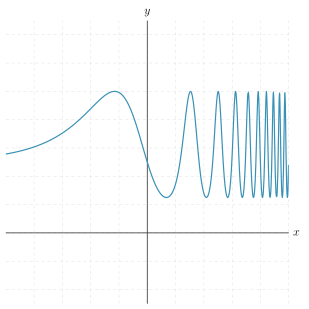
- The \(k\)th maxima is at \(\ln \left ( \frac{4(k-1)+1}{2}\right)\) and \(a\) ,and the \((k+1)\)th is at \(\ln \left ( \frac{4k+1}{2}\right)\). They have a minima between at \(\ln \left ( \frac{4k-3}{2}\right)\). \begin{align*} && \text{Area} &\approx \frac12 \left (\ln \left ( \frac{4k-1}{2}\right)- \ln \left ( \frac{4k-3}{2}\right)\right) \left ( a + \frac1a \right) + \frac12 \left ( \ln \left ( \frac{4k+1}{2}\right)-\ln \left ( \frac{4k-1}{2}\right)\right) \left ( a + \frac1a \right) \\ &&&= \frac{a^2+1}{2a} \ln \left (\frac{4k+1}{4k-3} \right) \\ &&&= \frac{a^2+1}{2a} \ln \left (1 + \frac{4}{4k-3} \right) \\ &&&= \frac{a^2+1}{2a} \ln \left (1 + \frac{1}{k-\tfrac34} \right) \\ &&&= \frac{a^2+1}{2a} \ln \left (1 + (k-\tfrac34)^{-1} \right) \\ \end{align*}
2009 Paper 3 Q2
- Let \(\displaystyle y= \sum_{n=0}^\infty a_n x^n\,\), where the coefficients \(a_n\) are independent of \(x\) and are such that this series and all others in this question converge. Show that \[ \displaystyle y'= \sum_{n=1}^\infty na_n x^{n-1}\,, \] and write down a similar expression for \(y''\). Write out explicitly each of the three series as far as the term containing \(a_3\).
- It is given that \(y\) satisfies the differential equation \[ xy''-y'+4x^3y =0\,. \] By substituting the series of part (i) into the differential equation and comparing coefficients, show that \(a_1=0\). Show that, for \(n\ge4\), \[ a_n =- \frac{4}{n(n-2)}\, a_{n-4}\,, \] and that, if \(a_0=1\) and \(a_2=0\), then \( y=\cos (x^2)\,\). Find the corresponding result when \(a_0=0\) and \(a_2=1\).
Solution:
- Let \(\displaystyle y= \sum_{n=0}^\infty a_n x^n\,\) then \begin{align*} y' &= \frac{\d}{\d x} \l \sum_{n=0}^\infty a_n x^n \r \\ &= \sum_{n=0}^\infty \frac{\d}{\d x} \l a_n x^n \r \\ &= \sum_{n=0}^\infty n a_n x^{n-1} \\ &= \sum_{n=1}^\infty n a_n x^{n-1} \\ \\ y'' &= \frac{\d}{\d x} \l\sum_{n=1}^\infty n a_n x^{n-1} \r \\ &= \sum_{n=1}^\infty \frac{\d}{\d x} \l n a_n x^{n-1} \r \\ &= \sum_{n=1}^\infty n(n-1) a_n x^{n-2} \\ &= \sum_{n=2}^\infty n(n-1) a_n x^{n-2} \\ \\ y &= a_0 + a_1 x+ a_2x^2 + a_3x^3 + \cdots \\ y'&= a_1 + 2a_2x+3a_3x^2 + \cdots \\ y'' &= 2a_2 + 6a_3x + \cdots \end{align*}
- \begin{align*} && 0 &= xy''-y'+4x^3y \\ &&&= x\sum_{n=2}^\infty n(n-1) a_n x^{n-2} - \sum_{n=1}^\infty n a_n x^{n-1} + 4x^3 \sum_{n=0}^\infty a_n x^n \\ &&&= \sum_{n=2}^\infty n(n-1) a_n x^{n-1} - \sum_{n=1}^\infty n a_n x^{n-1} + \sum_{n=0}^\infty 4a_n x^{n+3} \\ &&&= \sum_{n=2}^\infty n(n-1) a_n x^{n-1} - \sum_{n=1}^\infty n a_n x^{n-1} + \sum_{n=4}^\infty 4a_{n-4} x^{n-1} \\ &&&= \sum_{n=4}^{\infty} \l n(n-1) a_n- n a_n +4a_{n-4} \r x^{n-1} + 2a_2x + 6a_3x^2-a_1-2a_2x-3a_3x^2 \\ &&&= \sum_{n=4}^{\infty} \l n(n-2) a_n +4a_{n-4} \r x^{n-1}+ 3a_3x^2-a_1 \\ \end{align*} Therefore since all coefficients are \(0\), \(a_1 = 0\), \(a_3 = 0\) and \(\displaystyle a_n = -\frac{4}{n(n-2)}a_{n-4}\). If \(a_0 = 1, a_2 = 0\), and since \(a_1 = 0, a_3 = 0\) the only values which will take non-zero value are \(a_{4k}\). We can compute these values as: \(a_{4k} = -\frac{4}{(4k)(4k-2)} a_{4k-4} = \frac{1}{2k(2k-1)}a_{4k-r}\) so \(a_{4k} = \frac{(-1)^k}{(2k)!}\), which are precisely the coefficients in the expansion \(\cos x^2\). If \(a_0 = 0, a_2 = 1\) then since \(a_1 = 0, a_3 = 0\) the only values which take non-zero values are \(a_{4k+2}\) we can compute these values as: \(a_{4k+2} = -\frac{4}{(4k+2)(4k)}a_{4k-2} = -\frac{1}{(2k+1)2k}a_{4k-2}\) so we can see that \(a_{4k+2}= \frac{(-1)^k}{(2k+1)!}\) precisely the coefficients of \(\sin x^2\)
2009 Paper 3 Q4
For any given (suitable) function \(\f\), the Laplace transform of \(\f\) is the function \(\F\) defined by \[ \F(s) = \int_0^\infty \e^{-st}\f(t)\d t \quad \quad \, (s>0) \,. \]
- Show that the Laplace transform of \(\e^{-bt}\f(t)\), where \(b>0\), is \(\F(s+b)\).
- Show that the Laplace transform of \(\f(at)\), where \(a>0\), is \(a^{-1}\F(\frac s a)\,\).
- Show that the Laplace transform of \(\f'(t)\) is \(s\F(s) -\f(0)\,\).
- In the case \(\f(t)=\sin t\), show that \(\F(s)= \dfrac 1 {s^2+1}\,\).
Solution:
- \begin{align*} \mathcal{L}\{e^{-bt}f(t)\}(s) &= \int_0^{\infty}e^{-st}\{ e^{-bt}f(t) \} \d t \\ &= \int_0^{\infty} e^{-(s+b)t}f(t) \d t \\ &= F(s+b) \end{align*}
- \begin{align*} \mathcal{L}\{f(at)\}(s) &= \int_0^{\infty} e^{-st}f(at) \d t \\ &= \int_{u=0}^{\infty}e^{-s \frac{u}{a}} f\left(a \tfrac{u}{a}\right)\frac{1}{a} \d u \\ &= \int_0^{\infty}e^{-su/a}f(u) a^{-1} \d u \\ &= a^{-1} \int_0^{\infty} e^{-(s/a)u}f(u) \d u \\ &= a^{-1} F\left (\frac{s}{a} \right) \end{align*}
- \begin{align*} \mathcal{L}\{f'(t)\}(s) &= \int_0^{\infty} e^{-st}f'(t) \d t \\ &= \left [e^{-st} f(t) \right]_0^{\infty} - \int_0^{\infty} -s e^{-st} f(t) \d t\\ &= -f(0)+sF(s) \\ &= sF(s) - f(0) \end{align*}
- Since \(f''(t) = -f(t)\) we must have: \begin{align*} && -\mathcal{L}(f)&= \mathcal{L}(f'') \\ &&&= s\mathcal{L}(f') -f'(0) \\ &&&= s(s\mathcal{L}(f)-f(0)) - f'(0) \\ &&&= s^2\mathcal{L}(f) - 1 \\ \Rightarrow && (1+s^2) \mathcal{L}(f) &= 1 \\ \Rightarrow && F(s) &= \frac{1}{1+s^2} \end{align*}
2009 Paper 3 Q10
A light spring is fixed at its lower end and its axis is vertical. When a certain particle \(P\) rests on the top of the spring, the compression is \(d\). When, instead, \(P\) is dropped onto the top of the spring from a height \(h\) above it, the compression at time \(t\) after \(P\) hits the top of the spring is \(x\). Obtain a second-order differential equation relating \(x\) and \(t\) for \(0\le t \le T\), where \(T\) is the time at which \(P\) first loses contact with the spring. Find the solution of this equation in the form \[ x= A + B\cos (\omega t) + C\sin(\omega t)\,, \] where the constants \(A\), \(B\), \(C\) and \(\omega\) are to be given in terms of \(d\), \(g\) and \(h\) as appropriate. Show that \[ T = \sqrt{d/g\;} \left (2 \pi - 2 \arctan \sqrt{2h/d\;}\;\right)\,. \]
2009 Paper 3 Q13
- The point \(P\) lies on the circumference of a circle of unit radius and centre \(O\). The angle, \(\theta\), between \(OP\) and the positive \(x\)-axis is a random variable, uniformly distributed on the interval \(0\le\theta<2\pi\). The cartesian coordinates of \(P\) with respect to \(O\) are \((X,Y)\). Find the probability density function for \(X\), and calculate \(\var (X)\). Show that \(X\) and \(Y\) are uncorrelated and discuss briefly whether they are independent.
- The points \(P_i\) (\(i=1\), \(2\), \(\ldots\) , \(n\)) are chosen independently on the circumference of the circle, as in part (i), and have cartesian coordinates \((X_i, Y_i)\). The point \(\overline P\) has coordinates \((\overline X, \overline Y)\), where \(\overline X =\dfrac1n \sum\limits _{i=1}^n X_i\) and \(\overline Y =\dfrac1n \sum\limits _{i=1}^n Y_i\). Show that \(\overline X\) and \(\overline Y\) are uncorrelated. Show that, for large \(n\), \(\displaystyle \P\left(\vert \overline X \vert \le \sqrt{\frac2n}\right)\approx 0.95\,\).
Solution:
- \(X = \cos \theta\) \(\theta \sim U(0, 2\pi)\). Noting that \(\mathbb{P}(X \geq t ) = \frac{2}{2\pi}\cos^{-1} t\) so \(f_X(t) = \frac{1}{\pi} \frac{1}{\sqrt{1-x^2}}\) \begin{align*} && \E[X] &= 0 \tag{by symmetry} \\ && \E[X^2] &= \int_0^{2\pi} \cos^2 \theta \frac{1}{2 \pi} \d \theta \\ &&&= \frac{1}{2} \cdot 2\pi \cdot \frac{1}{2\pi} \\ &&&= \frac12 \\ \Rightarrow & &\var[X] &= \frac12 \\ \\ && \E[XY] &= \int_0^{2\pi} \cos \theta \sin \theta \frac{1}{2 \pi} \d \theta \\ &&&= \frac{1}{4\pi} \int_0^{2\pi} \sin 2\theta \d \theta \\ &&& =0 = \E[X]\E[Y] \end{align*} But note that clearly \(X\) and \(Y\) are not independent, since given \(X\) there are only two possible values of \(Y\).
- \(\,\) \begin{align*} && \E \left [ XY \right] &= \E \left [ \left ( \frac1n \sum_{i=1}^n X_i \right)\left ( \frac1n \sum_{i=1}^n Y_i\right) \right] \\ &&&= \frac{1}{n^2} \sum_{i=1}^n \sum_{j=1}^n \E [X_i Y_j] \\ &&&= 0 = \E[X] \E[Y] \end{align*} Therefore \(X\) and \(Y\) are uncorrelated. Note that \(\E[X_i] = 0, \var[X_i] = \frac12\) so we can apply the central limit theorem to see that \(X \approx N(0, \frac{1}{2n})\), in particular \begin{align*} && 0.95 &\approx \mathbb{P}(|Z| < 2) \\ &&&= \mathbb{P} \left ( \Big |\frac{X}{\sqrt{\frac{1}{2n}}} \Big | < 2 \right ) \\ &&&= \mathbb{P}\left (|X| < \sqrt{\frac{2}{n}} \right) \end{align*}
2008 Paper 1 Q4
A function \(\f(x)\) is said to be convex in the interval \(a < x < b\) if \(\f''(x)\ge0\) for all \(x\) in this interval.
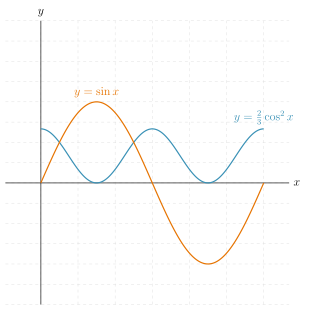
- Sketch on the same axes the graphs of \(y= \frac23 \cos^2 x\) and \(y=\sin x\) in the interval \(0\le x \le 2\pi\). The function \(\f(x)\) is defined for \(0 < x < 2\pi\) by \[\f(x) = \e^{\frac23 \sin x}. \] Determine the intervals in which \(\f(x)\) is convex.
- The function \(\g(x)\) is defined for \(0 < x < \frac12\pi\) by \[\g(x) = \e^{-k \tan x}. \] If \(k=\sin 2 \alpha\) and \(0 < \alpha < \frac{1}{4}\pi\), show that \(\g(x)\) is convex in the interval \(0 < x < \alpha\), and give one other interval in which \(\g(x)\) is convex.
Solution:
- \begin{align*} && f(x) &= \exp\left (\tfrac23\sin x \right) \\ && f'(x) &= \exp\left (\tfrac23\sin x \right) \cdot \tfrac23 \cos x \\ && f''(x) &= \left ( \exp\left (\tfrac23\sin x \right) \cdot \tfrac23\right) \left ( \tfrac23 \cos^2 x - \sin x \right) \end{align*} Therefore \(f(x)\) is convex when \(\frac23 \cos^2 x \geq \sin x\). Note that we can find the equality points when \begin{align*} && \sin x &= \frac23 \cos^2 x \\ &&&= \frac23 (1- \sin^2 x) \\ \Rightarrow && 0 &= 2\sin^2 x + 3 \sin x - 2 \\ &&&= (2 \sin x -1) (\sin x+2) \end{align*} ie \(\sin x = \frac12 \Rightarrow x = \frac{\pi}{6}, \frac{5\pi}{6}\). Therefore \(f\) is convex on \([0, \frac{\pi}{6}] \cup [\frac{5\pi}{6}, 2\pi]\)
- Suppose \(g(x) = \exp \left ( -k \tan x \right)\) then \begin{align*} && g'(x) &= \exp \left ( -k \tan x \right) \cdot (-k \sec^2 x ) \\ && g''(x) &= \left ( -k \exp \left ( -k \tan x \right) \right) \left ( -k\sec^4 x + 2 \sec x \cdot \sec x \tan x\right) \\ &&&= -k \exp \left ( -k \tan x \right) \sec^4 x \left ( -k + 2\sin x \cos x \right) \\ &&&= -k \exp \left ( -k \tan x \right) \sec^4 x \left ( -k + \sin 2x \right) \\ \end{align*} If \(0 < \alpha < \frac{\pi}{4}\) then \(k > 0\) so \(g\) is convex if \(-k + \sin 2x < 0\), ie \(\sin 2x < \sin 2\alpha\), ie on \((0, \alpha)\) and \((\frac{\pi}{2} - \alpha, \frac{\pi}{2})\)
2008 Paper 2 Q5
Evaluate the integrals \[\int_0^{\frac{1}{2}\pi} \frac{\sin 2x}{1+\sin^2x} \d x \text{ and } \int_0^{\frac{1}{2}\pi} \frac{\sin x}{1+\sin^2x} \d x\] Show, using the binomial expansion, that \((1+\sqrt2\,)^5<99\). Show also that \(\sqrt 2 > 1.4\). Deduce that \(2^{\sqrt2} > 1+ \sqrt2\,\). Use this result to determine which of the above integrals is greater.
Solution: \begin{align*} && I &= \int_0^{\frac{1}{2}\pi} \frac{\sin 2x}{1+\sin^2x} \d x \\ &&&= \int_0^{\frac{1}{2}\pi} \frac{2 \sin x \cos x}{1+\sin^2x} \d x \\ &&&= \left [\ln (1 + \sin^2 x) \right]_0^{\pi/2} \\ &&&= \ln 2 \\ \\ && J &= \int_0^{\frac{1}{2}\pi} \frac{\sin x}{1+\sin^2x} \d x \\ &&&= \int_0^{\frac{1}{2}\pi} \frac{\sin x}{2-\cos^2x} \d x \\ &&&= \frac{1}{2\sqrt{2}}\int_0^{\frac{1}{2}\pi} \left ( \frac{\sin x}{\sqrt{2}-\cos x}+ \frac{\sin x}{\sqrt{2}+\cos x} \right) \d x \\ &&&= \frac{1}{2\sqrt{2}} \left [\ln (\sqrt{2}-\cos x) - \ln (\sqrt{2}+\cos x) \right]_0^{\pi/2} \\ &&&= \frac{1}{2\sqrt{2}} \left (-\ln(\sqrt{2}-1)+\ln(\sqrt{2}+1) \right) \\ &&&= \frac1{2\sqrt{2}} \ln \left (\frac{\sqrt{2}+1}{\sqrt{2}-1} \right)\\ &&&= \frac1{\sqrt{2}} \ln (\sqrt{2}+1) \end{align*} \begin{align*} && (1+\sqrt{2})^5 + (1-\sqrt{2})^5 &= 2(1+10\cdot2+5\cdot2^2) \\ &&&= 82 \\ && |(1-\sqrt{2})^5| & < 1 \\ && (1+\sqrt{2})^5 &< 83 < 99 \\ \\ && 1.4^2 &= 1.96 \\ &&&< 2 \\ \Rightarrow && 1.4 &<\sqrt{2} \\ \\ \Rightarrow && 2^{\sqrt{2}} &> 2^{1.4} \\ &&&=2^{7/5} \\ &&&= {128}^{1/5} \\ &&&>99^{1/5} \\ &&&>1+\sqrt{2} \end{align*} \begin{align*} && \ln 2 & > \frac{1}{\sqrt{2}} \ln(\sqrt{2}+1) \\ \Leftrightarrow && \sqrt{2} \ln 2 &> \ln(\sqrt{2}+1) \\ \Leftrightarrow && 2^{\sqrt{2}} &> 1+\sqrt{2} \end{align*} which we have already shown, so the first integral is larger.
2007 Paper 1 Q3
Prove the identities \(\cos^4\theta -\sin^4\theta \equiv \cos 2\theta\) and $\cos^4 \theta + \sin^4 \theta \equiv 1 - {\frac12} \sin^2 2 \theta$. Hence or otherwise evaluate \[ \int_0^{\frac{1}{2}\pi} \cos^4 \theta \; \d \theta \;\;\;\; \mbox{and}\;\;\;\; \int_0^{\frac{1}{2}\pi} \sin^4 \theta \; \d \theta \,. \] Evaluate also \[ \int_0^{\frac{1}{2}\pi} \cos^6 \theta \; \d \theta \;\;\;\; \mbox{and}\;\;\;\; \int_0^{\frac{1}{2}\pi} \sin^6 \theta \; \d \theta \,. \]
Solution: \begin{align*} && \cos^4 \theta - \sin^4 \theta &= (\cos^2 \theta - \sin^2 \theta)(\cos^2 \theta + \sin^2 \theta) \\ &&&= \cos^2 \theta - \sin^2 \theta \\ &&&= \cos 2 \theta \\ \\ && 1&= (\cos^2 \theta + \sin^2 \theta)^2 \\ &&&= \cos^4 \theta + \sin^4 \theta + 2 \sin^2 \theta \cos^2 \theta \\ &&&= \cos^4 \theta + \sin^4 \theta + \frac12 ( \sin^2 2 \theta) \\ \Rightarrow && \cos^4 \theta + \sin^4 \theta &= 1 - \tfrac12 \sin^2 2 \theta \end{align*} \begin{align*} && I &= \int_{0}^{\pi/2} \cos^4 \theta \d \theta \\ && J &= \int_0^{\pi/2} \sin^4 \theta \d \theta \\ && I-J &= \int_0^{\pi/2} \cos 2 \theta \d \theta = 0 \\ && I+J &= \int_0^{\pi/2} (1- \frac12 \sin^2 2 \theta) \d \theta \\ &&&= \frac{\pi}{2} - \frac14 \int_0^{\pi} \sin^2 \theta \d \theta \\ &&&= \frac{\pi}{2} - \frac{\pi}{8} \\ &&&= \frac{3\pi}{8} \\ \Rightarrow && I=J &= \frac{3\pi}{16} \end{align*} \begin{align*} && \cos^6 \theta + \sin^6 \theta &= (\cos^2 \theta + \sin^2 \theta)(\cos^4 \theta - \cos^2 \theta \sin^2 \theta + \sin^4 \theta) \\ &&&= 1-\tfrac12 \sin^2 2\theta - \tfrac14 \sin^2 2 \theta \\ &&&= 1 - \tfrac34 \sin^2 2 \theta \\ %&& \cos^6 \theta - \sin^6 \theta &= (\cos^2 \theta - \sin^2 \theta)(\cos^4 \theta + \cos^2 \theta \sin^2 \theta + \sin^4 \theta) \\ %&&&= \cos 2 \theta (1 - \tfrac12 \sin^2 2 \theta + \tfrac14 \sin^2 2 \theta) \\ %&&&= \cos 2 \theta (1 - \tfrac14 \sin^2 2 \theta) \\ \end{align*} \begin{align*} && I &= \int_{0}^{\pi/2} \cos^6 \theta \d \theta \\ && J &= \int_0^{\pi/2} \sin^6 \theta \d \theta \\ && I-J &= 0 \\ && I+J &= \int_0^{\pi/2} (1 - \tfrac34 \sin^2 2 \theta) \d \theta \\ &&&= \frac{\pi}{2} - \frac{3\pi}{16} = \frac{5\pi}{16} \\ \Rightarrow && I = J &= \frac{5\pi}{32} \end{align*}
2007 Paper 2 Q7
A function \(\f(x)\) is said to be concave on some interval if \(\f''(x)<0\) in that interval. Show that \(\sin x\) is concave for \(0< x < \pi\) and that \(\ln x\) is concave for \(x > 0\). Let \(\f(x)\) be concave on a given interval and let \(x_1\), \(x_2\), \(\ldots\), \(x_n\) lie in the interval. Jensen's inequality states that \[ \frac1 n \sum_{k=1}^n\f(x_k) \le \f \bigg (\frac1 n \sum_{k=1}^n x_k\bigg) \] and that equality holds if and only if \(x_1=x_2= \cdots =x_n\). You may use this result without proving it.
- Given that \(A\), \(B\) and \(C\) are angles of a triangle, show that \[ \sin A + \sin B + \sin C \le \frac{3\sqrt3}2 \,. \]
- By choosing a suitable function \(\f\), prove that
\[
\sqrt[n]{t_1t_2\cdots t_n}\; \le \; \frac{t_1+t_2+\cdots+t_n}n
\]
for any positive integer \(n\) and for any positive numbers \(t_1\), \(t_2\), \(\ldots\), \(t_n\).
Hence:
- show that \(x^4+y^4+z^4 +16 \ge 8xyz\), where \(x\), \(y\) and \(z\) are any positive numbers;
- find the minimum value of \(x^5+y^5+z^5 -5xyz\), where \(x\), \(y\) and \(z\) are any positive numbers.
Solution: \begin{align*} && f(x) &= \sin x \\ \Rightarrow && f''(x) &= -\sin x \end{align*} which is clearly negative on \((0,\pi)\) since \(\sin\) is positive on this interval. \begin{align*} && f(x) &= \ln x \\ \Rightarrow && f''(x) &= -1/x^2 \end{align*} which is clearly negative for \(x > 0\)
- Since \(A,B,C\) are angles in a triangle, we must have \(0 < A,B,C< \pi\) and so we can apply Jensen with \(f = \sin\) to obtain: \begin{align*} &&\frac13( \sin A + \sin B + \sin C) &\leq \sin \left ( \frac{A+B+C}{3}\right) \\ &&&= \sin \frac{\pi}{3} = \frac{\sqrt{3}}2 \\ \Rightarrow && \sin A + \sin B + \sin C &\leq\frac{3\sqrt{3}}2 \end{align*}
- Suppose \(f(x) = \ln x\), then applying Jensen on the positive numbers \(t_1, \ldots, t_n\) we obtain
\begin{align*}
&& \frac1n \left ( \sum_{i=1}^n \ln t_n \right) &\leq \ln \left ( \frac1n\sum_{i=1}^n t_n \right) \\
\Rightarrow && \frac1n \ln\left (\prod_{i=1} t_n\right)&\leq \ln \left ( \frac1n\sum_{i=1}^n t_n \right) \\
\Rightarrow && \ln\left (\left (\prod_{i=1} t_n\right)^{1/n}\right)&\leq \ln \left ( \frac1n\sum_{i=1}^n t_n \right) \\
\Rightarrow && \left (\prod_{i=1} t_n\right)^{1/n}&\leq\frac1n\sum_{i=1}^n t_n \\
\Rightarrow && \sqrt[n]{t_1t_2 \cdots t_n}&\leq\frac1n(t_1 + t_2 + \cdots + t_n) \tag{AM-GM}\\
\end{align*}
- Applying AM-GM with \(t_1 = x^4, t_2 = y^4, t_3 = z^4, t_4 = 2^4\) we have \begin{align*} && \frac{x^4+y^4+z^4+16}{4} & \geq \sqrt[4]{x^4y^4z^42^4} \\ \Rightarrow && x^4+y^4+z^4+16 &\geq 8xyz \end{align*}
- Applying AM-GM with \(t_1 = x^5, t_2 = y^5, t_3 = z^5, t_4 = 1^5, t_5 = 1^5\) we have \begin{align*} && \frac{x^5+y^5+z^5+1+1}{5} & \geq \sqrt[5]{x^5y^5z^5} \\ \Rightarrow && x^5+y^5+z^5+2 &\geq 5xyz \\ \Rightarrow && x^5+y^5+z^5 - 5xyz &\geq -2 \end{align*} Therefore the minimum is \(-2\)
2007 Paper 3 Q4
A curve is given parametrically by \begin{align*} x&= a\big( \cos t +\ln \tan \tfrac12 t\big)\,,\\ y&= a\sin t\,, \end{align*} where \(0 < t < \frac12 \pi\) and \(a\) is a positive constant. Show that \(\ds \frac{\d y}{\d x} = \tan t\) and sketch the curve. Let \(P\) be the point with parameter \(t\) and let \(Q\) be the point where the tangent to the curve at \(P\) meets the \(x\)-axis. Show that \(PQ=a\). The {\sl radius of curvature}, \(\rho\), at \(P\) is defined by \[ \rho= \frac {\big(\dot x ^2+\dot y^2\big)^{\frac32}} {\vert \dot x \ddot y - \dot y \ddot x\vert \ \ } \,, \] where the dots denote differentiation with respect to \(t\). Show that \(\rho =a\cot t\). The point \(C\) lies on the normal to the curve at \(P\), a distance \(\rho\) from \(P\) and above the curve. Show that \(CQ\) is parallel to the \(y\)-axis.
2007 Paper 3 Q7
The functions \(\s(x)\) (\(0\le x<1\)) and \(t(x)\) (\(x\ge0\)), and the real number \(p\), are defined by \[ \s(x) = \int_0^x \frac 1 {\sqrt{1-u^2}}\, \d u\;, \ \ \ \ t(x) = \int_0^x \frac 1 {1+u^2}\, \d u\;, \ \ \ \ p= 2 \int_0^\infty \frac 1 {1+u^2}\, \d u \;. \] For this question, do not evaluate any of the above integrals explicitly in terms of inverse trigonometric functions or the number \(\pi\).
- Use the substitution \(u=v^{-1}\) to show that \(\displaystyle t(x) =\int_{1/x}^\infty\frac 1 {1+v^2}\, \d v \, \). Hence evaluate \(t(1/x) + t(x)\) in terms of \(p\) and deduce that \(2t(1)= \frac12 p\,\).
- Let \(y=\dfrac{u}{\sqrt{1+u^2}}\). Express \(u\) in terms of \(y\), and show that \(\displaystyle \frac{\d u}{\d y} = \frac 1 {\sqrt{(1-y^2)^3}}\). By making a substitution in the integral for \(t(x)\), show that \[ t(x) = \s\left(\frac{x}{\sqrt{1+x^2}}\right)\!. \] Deduce that \(\s\big(\frac1{\sqrt2}\big) =\frac1 4 p\,\).
- Let \(z= \dfrac{u+ \frac1{\sqrt3}}{1-\frac 1{\sqrt3}u}\,\). Show that \(\displaystyle t(\tfrac1{\sqrt3}) = \int_{\frac1{\sqrt3}}^{\sqrt3} \frac1 {1+z^2} \,\d z\;, \) and hence that \(3t(\frac1{\sqrt3}) = \frac12 p\,\).
Solution:
- \begin{align*} && t(x) &= \int_0^x \frac{1}{1+u^2} \d u \\ u = v^{-1}, \d u = -v^{-2} \d v&&&= \int_{v = \infty}^{v = 1/x} \frac{1}{1+v^{-2}} \frac{-1}{v^2} \d v \\ &&&= \int_{1/x}^\infty \frac{1}{1+v^2} \d v \\ \\ \Rightarrow && t(x) + t(1/x) &= \int_0^x \frac{1}{1+u^2} \d u + \int_0^{1/x} \frac{1}{1+u^2} \d u \\ &&&= \int_{1/x}^{\infty} \frac{1}{1+u^2} \d u + \int_0^{1/x} \frac{1}{1+u^2} \d u \\ &&&= \int_0^{\infty} \frac{1}{1+u^2} \d u \\ &&&= \frac12 p \\ \\ \Rightarrow && t(1) +t(1/1) = 2t(1) &= \frac12 p \end{align*}
- \(\,\) \begin{align*} && y &= \frac{u}{\sqrt{1+u^2}} \\ \Rightarrow && y^2 &= \frac{u^2}{1+u^2} \\ &&&= 1-\frac{1}{1+u^2} \\ \Rightarrow && 1+u^2 &= \frac{1}{1-y^2} \\ \Rightarrow && u &= \frac{y}{\sqrt{1-y^2}} \\ \\ && \frac{\d u}{\d y} &= \frac{\sqrt{1-y^2} + y^2(1-y^2)^{-1/2}}{1-y^2} \\ &&&= \frac{1}{(1-y^2)^{3/2}} \\ \\ && t(x) &= \int_0^x \frac{1}{1+u^2} \d u \\ &&&= \int_0^{y = x/\sqrt{1+x^2}} \frac{1}{1 + \frac{y^2}{1-y^2}} \frac{1}{(1-y^2)^{3/2}} \d y \\ &&&= \int_0^{x/\sqrt{1+x^2}} \frac{1-y^2}{(1-y^2)^{3/2}} \d y \\ &&&= \int_0^{x/\sqrt{1+x^2}} \frac{1}{(1-y^2)^{1/2}} \d y \\ &&&= s\left ( \frac{x}{\sqrt{1+x^2}} \right) \\ \\ \Rightarrow && s\left ( \frac{1}{\sqrt{2}} \right) &= t(1) = \frac14p \end{align*}
- \(\,\) \begin{align*} && z &= \frac{u + \frac1{\sqrt{3}}}{1- \frac{1}{\sqrt{3}} u}\\ \Rightarrow && z - \frac{z}{\sqrt{3}}u &= u + \frac{1}{\sqrt{3}} \\ \Rightarrow && u &= \frac{z-\frac{1}{\sqrt{3}}}{1 + \frac{z}{\sqrt{3}}} \\ \\ \Rightarrow && \frac{\d u}{\d z} &= \frac{\sqrt{3}(\sqrt{3}+z ) -(\sqrt{3}z-1)}{\left (\sqrt{3}+z \right)^2} \\ &&&= \frac{4}{(\sqrt{3}+z)^2} \\ \\ \Rightarrow && t \left ( \frac{1}{\sqrt{3}} \right) &= \int_0^{1/\sqrt{3}} \frac{1}{1+u^2} \d u \\ &&&= \int_{z=1/\sqrt{3}}^{z=\sqrt{3}} \frac{1}{1 + \left ( \frac{\sqrt{3}z-1}{\sqrt{3}+z}\right)^2} \frac{4}{(\sqrt{3}+z)^2} \d z\\ &&&= \int_{1/\sqrt{3}}^{\sqrt{3}} \frac{4}{(\sqrt{3}+z)^2+(\sqrt{3}z-1)^2} \d z \\ &&&= \int_{1/\sqrt{3}}^{\sqrt{3}} \frac{4}{4+4z^2} \d z \\ &&&= \int_{1/\sqrt{3}}^{\sqrt{3}} \frac{1}{1+z^2} \d z \end{align*} Notice that \(t(1/\sqrt{3})+t(\sqrt{3}) = \frac12p\) and also notice that \(t(1/\sqrt{3}) + t(1/\sqrt{3}) =t(\sqrt{3})\) so \(3t(1/\sqrt{3}) = \frac12p\)
2006 Paper 1 Q4
By sketching on the same axes the graphs of \(y=\sin x\) and \(y=x\), show that, for \(x>0\):
- \(x>\sin x\,\);
- \(\dfrac {\sin x} {x} \approx 1\) for small \(x\).
2006 Paper 1 Q7
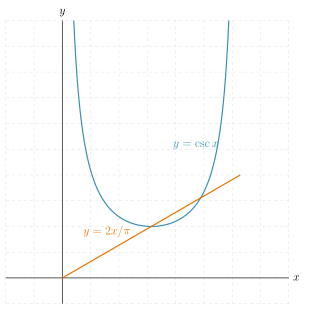
- Sketch on the same axes the functions \({\rm cosec}\, x\) and \(2x/ \pi\), for \(0 < x < \pi\,\). Deduce that the equation \(x\sin x = \pi/2 \) has exactly two roots in the interval \(0 < x < \pi\,\). Show that \[ \displaystyle \int_{\pi/2}^{\pi} \left \vert x\sin x - \frac{\pi} { 2} \right \vert \; \mathrm{d}x = 2\sin\alpha +\frac{3\pi^2} 4 - \alpha \pi -\pi -2\alpha \cos\alpha -1 \] where \(\alpha\) is the larger of the roots referred to above.
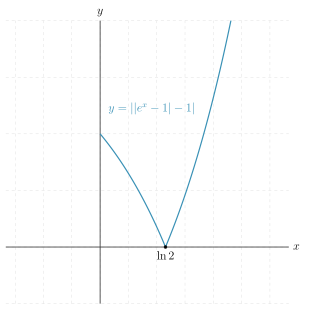
- Show that the region bounded by the positive \(x\)-axis, the \(y\)-axis and the curve \[y = \Bigl| \vert \e^x - 1 \vert - 1 \Bigr|\] has area \(\ln 4-1\).
Solution:
- \(\,\)
Notice that they are equal at \(1\) when \(x = \pi/2\), but this is a local minimum for \(\csc x\) whereas \(2x/\pi\) is increasing so there is a second intersection. Notice that \(\csc x = \frac{2x}{\pi} \Leftrightarrow x \sin x = \frac{\pi}{2}\) therefore our intersections are also the roots of \(x \sin x = \frac{\pi}{2}\) and the larger one is greater than \(\pi/2\) \begin{align*} && I &= \int_{\pi/2}^{\pi} \Bigl| x \sin x - \frac{\pi}{2} \Bigr| \d x \\ &&&= \int_{\pi/2}^{\alpha} \left ( x \sin x - \frac{\pi}{2} \right )\d x +\int_{\alpha}^{\pi} \left ( \frac{\pi}{2} -x \sin x \right) \d x \\ &&&= \left ( \pi - 2\alpha + \frac{\pi}{2}\right) \frac{\pi}{2} + \int_{\pi/2}^{\alpha} x \sin x\d x -\int_{\alpha}^{\pi} x \sin x \d x \\ &&&= \frac{3\pi^2}{4} - \alpha \pi + \left [-x \cos x \right]_{\pi/2}^{\alpha}+\left[x \cos x \right]_{\alpha}^{\pi} + \int_{\pi/2}^{\alpha} \cos x \d x - \int_{\alpha}^{\pi} \cos x \d x \\ &&&= \frac{3\pi^2}{4} - \alpha \pi -\alpha \cos \alpha -\pi -\alpha \cos \alpha+ \sin \alpha - 1+\sin \alpha \\ &&&= 2\sin \alpha + \frac{3\pi^2}{4} - \alpha \pi - 2\alpha \cos \alpha - 1 \end{align*}
- \(\,\)
\begin{align*} && A &= \int_0^{\ln 2} ||e^x-1|-1| \d x \\ &&&= \int_0^{\ln 2} |e^x-2| \d x \\ &&&=\int_0^{\ln 2} (2-e^x) \d x \\ &&&= 2 \ln 2 - \left [e^x \right]_0^{\ln 2} \\ &&&= \ln 4 - (2-1) = \ln 4 - 1 \end{align*}
2006 Paper 2 Q4
By making the substitution \(x=\pi-t\,\), show that \[ \! \int_0^\pi x\f(\sin x) \d x = \tfrac12 \pi \! \int_0^\pi \f(\sin x) \d x\,, \] where \(\f(\sin x)\) is a given function of \(\sin x\). Evaluate the following integrals:
- \(\displaystyle \int_0^\pi \frac {x \sin x}{3+\sin^2 x}\,\d x\,\);
- $\displaystyle \int_0^{2\pi} \frac {x \sin x}{3+\sin^2 x}\,\d x\,\(;
- \)\displaystyle \int_{0}^{\pi} \frac {x \big\vert\sin 2x\big\vert}{3+\sin^2 x}\,\d x\,$.