Problems
Filters
54 problems found
1991 Paper 1 Q4
\(\ \)
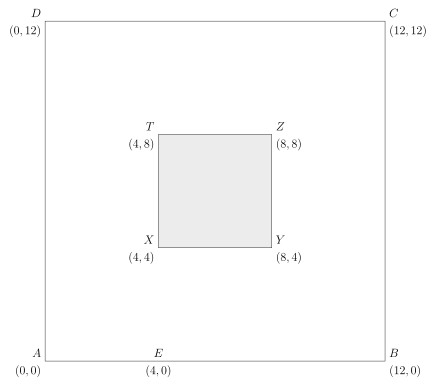
- as small as possible,
- as large as possible.
Solution:
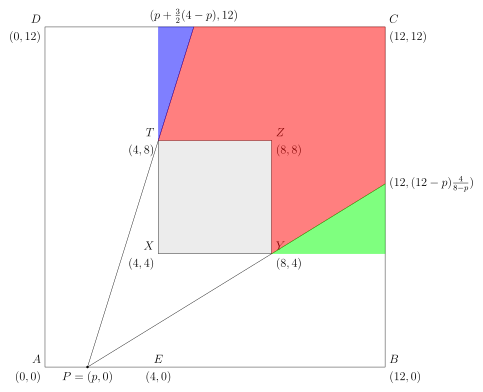
- Since the area not visible is increasing as \(p\) increases, we would like \(p\) to be as large as possible, ie \(p = 4\).
- Similarly, he can see the most when \(p =0\)
1991 Paper 1 Q6
Criticise each step of the following arguments. You should correct the arguments where necessary and possible, and say (with justification) whether you think the conclusion are true even though the argument is incorrect.
- The function \(g\) defined by \[ \mathrm{g}(x)=\frac{2x^{3}+3}{x^{4}+4} \] satisfies \(\mathrm{g}'(x)=0\) only for \(x=0\) or \(x=\pm1.\) Hence the stationary values are given by \(x=0\), \(\mathrm{g}(x)=\frac{3}{4}\) and \(x=\pm1,\) \(\mathrm{g}(x)=1.\) Since \(\frac{3}{4}<1,\) there is a minimum at \(x=0\) and maxima at \(x=\pm1.\) Thus we must have \(\frac{3}{4}\leqslant\mathrm{g}(x)\leqslant1\) for all \(x\).
- \({\displaystyle \int(1-x)^{-3}\,\mathrm{d}x=-3(1-x)^{-4}}\quad\) and so \(\quad{\displaystyle \int_{-1}^{3}(1-x)^{-3}\,\mathrm{d}x=0.}\)
Solution:
- \begin{align*} && g(x) &= \frac{2x^3+3}{x^4+4} \\ \Rightarrow && g'(x) &= \frac{6x^2(x^4+4) - (2x^3+3)(4x^3)}{(x^4+4)^2} \\ &&&= \frac{-2x^6-12x^3+24x^2}{(x^4+4)} \\ &&&= \frac{-2x^2(x^4+6x-12)}{(x^4+4)} \end{align*} So \(g'(x)\) is not \(0\) for \(x = \pm 1\). We can also note that \(g(-1) = \frac1{5} \neq 1\) Even if the other turning point was \(1\), we would also need to check the behaviour as \(x \to \pm \infty\). We can also note that \(g(-1) = \frac{1}{5} < \frac34\) so the conclusion is also not true.
- There are several errors. \[ \int (1-x)^{-3} \d x = \underbrace{\frac{1}{4}}_{\text{correct constant}}(1-x)^{-4} + \underbrace{C}_{\text{constant of integration}} \] We cannot integrate through the asymptote at \(1\). There is a sense in which we could argue \(\displaystyle \int_{-1}^3 (1-x)^{-3} \d x = 0\), specifically using Cauchy principal value \begin{align*} \mathrm {p.v.} \int_{-1}^3 (1-x)^{-3} &=\lim_{\epsilon \to 0} \left [ \int_{-1}^{1-\epsilon} (1-x)^{-3} \d x+ \int_{1+\epsilon}^{3} (1-x)^{-3} \d x\right] \\ &=\lim_{\epsilon \to 0} \left [ \left[ \frac14 (1-x)^{-4}\right]_{-1}^{1-\epsilon}+ \left[ \frac14 (1-x)^{-4}\right]_{1+\epsilon}^3\right] \\ &=\lim_{\epsilon \to 0} \left [ \frac14 \epsilon^{-4}-\frac14 \frac1{2^4} + \frac14 \frac1{2^4} - \frac14 \epsilon^{-4} \right] \\ &= \lim_{\epsilon \to 0} 0 \\ &= 0 \end{align*} However, in many normal ways of treating this integral it would be undefined.
1991 Paper 3 Q3
The function \(\mathrm{f}\) is defined for \(x<2\) by \[ \mathrm{f}(x)=2| x^{2}-x|+|x^{2}-1|-2|x^{2}+x|. \] Find the maximum and minimum points and the points of inflection of the graph of \(\mathrm{f}\) and sketch this graph. Is \(\mathrm{f}\) continuous everywhere? Is \(\mathrm{f}\) differentiable everywhere? Find the inverse of the function \(\mathrm{f}\), i.e. expressions for \(\mathrm{f}^{-1}(x),\) defined in the various appropriate intervals.
Solution: \[ f(x) = 2|x(x-1)| + |(x-1)(x+1)|-2|x(x+1)| \] Therefore the absolute value terms will change behaviour at \(x = -1, 0, 1\). Then \begin{align*} f(x) &= \begin{cases} 2(x^2-x)+(x^2-1)-2(x^2+x) & x \leq -1 \\ 2(x^2-x)-(x^2-1)+2(x^2+x) & -1 < x \leq 0 \\ -2(x^2-x)-(x^2-1)-2(x^2+x) & 0 < x \leq 1 \\ 2(x^2-x)+(x^2-1)-2(x^2+x) & 1 < x\end{cases} \\ &= \begin{cases} x^2-4x-1 & x \leq -1 \\ 3x^2+1& -1 < x \leq 0 \\ -5x^2+1& 0 < x \leq 1 \\ x^2-4x-1 & 1 < x\end{cases} \\ \\ f'(x) &= \begin{cases} 2x-4 & x <-1 \\ 6x & -1 < x < 0 \\ -10x & 0 < x < 1 \\ 2x-4 & 1 < x\end{cases} \\ \end{align*} Therefore \(f'(x) = 0 \Rightarrow x = 0, 2\) and so we should check all the turning points. Therefore the minimum is \(x = 2, y = -5\), maximum is \(x = -2, y = 11\) (assuming the range is actually \(|x| < 2\). There is a point of inflection at \(x = 0, y = 1\).

1990 Paper 1 Q5
- Evaluate \[ \int_{1}^{3}\frac{1}{6x^{2}+19x+15}\,\mathrm{d}x\,. \]
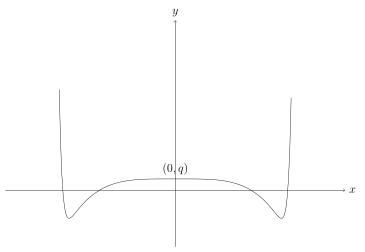
- Sketch the graph of the function \(\mathrm{f}\), where \(\mathrm{f}(x)=x^{1760}-x^{220}+q\), and \(q\) is a constant. Find the possible numbers of \textit{distinct }roots of the equation \(\mathrm{f}(x)=0\), and state the inequalities satisfied by \(q\).
Solution:
- \begin{align*} \int_{1}^{3}\frac{1}{6x^{2}+19x+15}\,\mathrm{d}x &= \int_1^3 \frac1{(2x+3)(3x+5)} \d x \\ &= \int_1^3 \l \frac{2}{2x+3} - \frac{3}{3x+5} \r \d x \\ &= \left [\ln(2x+3) - \ln(3x+5) \right ]_1^3 \\ &= \l \ln9 - \ln14 \r - \l \ln 5 - \ln 8 \r \\ &= \ln \frac{72}{70} \\ &= \ln \frac{36}{35} \end{align*}
- When \(q = 0\) the roots are \(-1, 0, 1\) There can be \(0, 2, 3, 4\) roots. There will be no roots if \(q > -\min (x^{1760} - x^{220})\) since the whole graph will be above the axis. There will be \(2\) roots if \(q = -\min (x^{1760} - x^{220})\) or \(q > 0\) There will be \(4\) roots if \(0 > q > -\min (x^{1760} - x^{220})\). There will be \(3\) roots if \(q =0\)
1990 Paper 2 Q3
Sketch the curves given by \[ y=x^{3}-2bx^{2}+c^{2}x, \] where \(b\) and \(c\) are non-negative, in the cases: \begin{questionparts} \item \(2b < c\sqrt{3}\) \item \(2b=c\sqrt{3}\neq0\) \item \(c\sqrt{3} < 2b < 2c\), \item \(b=c\neq0\) \item \(b > c > 0\), \item \(c=0,b\neq0\) \item \(c=b=0\). \end{questionpart} Sketch also the curves given by \(y^{2}=x^{3}-2bx^{2}+c^{2}x\) in the cases \((i), (v)\) and \((vii)\).
Solution:


1988 Paper 1 Q1
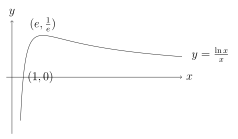
Sketch the graph of the function \(\mathrm{h}\), where \[ \mathrm{h}(x)=\frac{\ln x}{x},\qquad(x>0). \] Hence, or otherwise, find all pairs of distinct positive integers \(m\) and \(n\) which satisfy the equation \[ n^{m}=m^{n}. \]
Solution:
1988 Paper 1 Q2
The function \(\mathrm{f}\) and \(\mathrm{g}\) are related (for all real \(x\)) by \[ \mathrm{g}(x)=\mathrm{f}(x)+\frac{1}{\mathrm{f}(x)}\,. \] Express \(\mathrm{g}'(x)\) and \(\mathrm{g}''(x)\) in terms of \(\mathrm{f}(x)\) and its derivatives. If \(\mathrm{f}(x)=4+\cos2x+2\sin x\), find the stationary points of \(\mathrm{g}\) for \(0\leqslant x\leqslant2\pi,\) and determine which are maxima and which are minima.
Solution: \(g'(x) = f'(x) - \frac{f'(x)}{(f(x))^2} = f'(x) \l 1 - \frac{1}{(f(x))^2} \r\) \(g''(x) = f''(x) - \frac{f''(x)f(x)^2-f'(x)\cdot 2f(x) f'(x)}{(f(x))^4} = f''(x) + \frac{f''(x)f(x)-2(f'(x))^2}{(f(x))^3}\) \begin{align*} f(x) &=4+\cos2x+2\sin x \\ f'(x) &=-2\sin2x+2\cos x \\ f''(x) &= -4\cos2x-2\sin x \end{align*} Therefore, since the stationary points of \(g\), ie points where \(g'(x) = 0\) are where \(f'(x) = 0\) or \(f(x) = \pm 1\) we should look at \begin{align*} && 0 &= f'(x) \\ && 0 &= 2 \cos x - 2 \sin 2x \\ &&&= 2 \cos x - 4 \sin x \cos x \\ &&&= 2\cos x (1 - 2 \sin x) \\ \Rightarrow && x &= \frac{\pi}2, \frac{3\pi}{2}, \frac{\pi}{6}, \frac{5\pi}{6} \end{align*} \begin{align*} && 1 &= f(x) \\ && 1 &= 4 + \cos 2x + 2 \sin x \\ \Rightarrow && \cos 2x = -1,& \sin x = -1 \\ \Rightarrow && x &= \frac{3\pi}{2} \end{align*} which we were already checking. For each of these points we have: \begin{array}{c|c|c|c||c} x & f(x) & f'(x) & f''(x) & g''(x) \\ \hline \frac{\pi}{2} & 5 & 0 & 2 & > 0\\ \frac{3\pi}{2} & 1 & 0 & 6 &> 0\\ \frac{\pi}{6} & 5.5 & 0 & -3 & < 0 \\ \frac{5\pi}{6} & 5.5 & 0 & -3 & < 0\\ \end{array} Therefore \(\frac{\pi}{2}, \frac{3\pi}{2}\) are minimums and \(\frac{\pi}{6}\) and \(\frac{5\pi}{6}\) are maxima.
1988 Paper 3 Q1
Sketch the graph of \[ y=\frac{x^{2}\mathrm{e}^{-x}}{1+x}, \] for \(-\infty< x< \infty.\) Show that the value of \[ \int_{0}^{\infty}\frac{x^{2}\mathrm{e}^{-x}}{1+x}\,\mathrm{d}x \] lies between \(0\) and \(1\).
Solution:

1987 Paper 1 Q1
Find the stationary points of the function \(\mathrm{f}\) given by \[ \mathrm{f}(x)=\mathrm{e}^{ax}\cos bx,\mbox{ }(a>0,b>0). \] Show that the values of \(\mathrm{f}\) at the stationary points with \(x>0\) form a geometric progression with common ratio \(-\mathrm{e}^{a\pi/b}\). Give a rough sketch of the graph of \(\mathrm{f}\).
Solution: Let \(f(x) = e^{ax} \cos bx\) then, \(f'(x) = ae^{ax} \cos bx - be^{ax} \sin bx = e^{ax} \l a\cos bx - b \sin bx \r\). Therefore the stationary points are where \(f'(x) = 0 \Leftrightarrow \tan bx = \frac{b}a\), ie \(x = \tan^{-1} \frac{a}{b} + \frac{n}{b} \pi, n \in \mathbb{Z}\). \begin{align*} f(\tan^{-1} \frac{a}{b} + \frac{n}{b} \pi) &= e^{a \tan^{-1} \frac{a}{b} + \frac{an}{b} \pi} \cos \l b \tan^{-1} \frac{a}{b} +n \pi\r \\ &= e^{a \tan^{-1} \frac{a}{b}} \cos \l b \tan^{-1} \frac{a}{b}\r \cdot e^{\frac{an}{b} \pi}(-1)^n \\ &= e^{a \tan^{-1} \frac{a}{b}} \cos \l b \tan^{-1} \frac{a}{b}\r \cdot (-e^{\frac{a}{b} \pi})^n \\ \end{align*} showing the form the desired geometric progression.
