Problems
Filters
71 problems found
1994 Paper 3 Q9
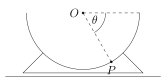
A smooth, axially symmetric bowl has its vertical cross-sections determined by \(s=2\sqrt{ky},\) where \(s\) is the arc-length measured from its lowest point \(V\), and \(y\) is the height above \(V\). A particle is released from rest at a point on the surface at a height \(h\) above \(V\). Explain why \[ \left(\frac{\mathrm{d}s}{\mathrm{d}t}\right)^{2}+2gy \] is constant. Show that the time for the particle to reach \(V\) is \[ \pi\sqrt{\frac{k}{2g}}. \] Two elastic particles of mass \(m\) and \(\alpha m,\) where \(\alpha<1,\) are released simultaneously from opposite sides of the bowl at heights \(\alpha^{2}h\) and \(h\) respectively. If the coefficient of restitution between the particles is \(\alpha,\) describe the subsequent motion.
1993 Paper 3 Q12
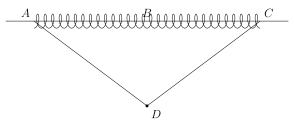
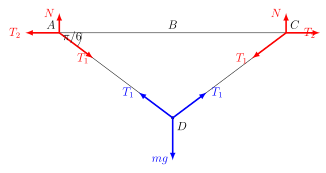
\(ABCD\) is a horizontal line with \(AB=CD=a\) and \(BC=6a\). There are fixed smooth pegs at \(B\) and \(C\). A uniform string of natural length \(2a\) and modulus of elasticity \(kmg\) is stretched from \(A\) to \(D\), passing over the pegs at \(B\) and \(C\). A particle of mass \(m\) is attached to the midpoint \(P\) of the string. When the system is in equilibrium, \(P\) is a distance \(a/4\) below \(BC\). Evaluate \(k\). The particle is pulled down to a point \(Q\), which is at a distance \(pa\) below the mid-point of \(BC\), and is released from rest. \(P\) rises to a point \(R\), which is at a distance \(3a\) above \(BC\). Show that \(2p^2-p-17=0\). Show also that the tension in the strings is less when the particle is at \(R\) than when the particle is at \(Q\).
1993 Paper 3 Q13
\(\ \)\vspace{-1cm} \noindent
1993 Paper 3 Q14
A particle rests at a point \(A\) on a horizontal table and is joined to a point \(O\) on the table by a taut inextensible string of length \(c\). The particle is projected vertically upwards at a speed \(64\surd(6gc)\). It next strikes the table at a point \(B\) and rebounds. The coefficient of restitution for any impact between the particle and the table is \({1\over 2}\). After rebounding at \(B\), the particle will rebound alternately at \(A\) and \(B\) until the string becomes slack. Show that when the string becomes slack the particle is at height \(c/2\) above the table. Determine whether the first rebound between \(A\) and \(B\) is nearer to \(A\) or to \(B\).
Solution: \begin{align*} \text{N2}(radially): && T + mg \cos \theta &= m\frac{v^2}{r} \\ \Rightarrow && v^2-gc \cos \theta &\geq 0 \\ \text{COE}: && \frac12 m u^2 &= \frac12mv^2 + mgc\cos \theta \\ \Rightarrow && u^2 &= v^2 + 2gc\cos \theta \\ && u^2 &\geq gc \cos \theta+2gc\cos \theta \\ \Rightarrow && u^2 &\geq 3gc\cos \theta \end{align*} Therefore it will complete bounces with the string taught if it leaves the table with \(u^2 \geq 3gc\). After \(6\) bounces it will leave the table with speed \(\sqrt{6gc} > \sqrt{3gc}\) and after \(7\) bounces it will leave the table with speed \(\sqrt{\frac{3}{2} gc} < \sqrt{3 gc}\). When it leaves the table with speed \(\sqrt{\tfrac32 gc}\), the string will go slack when \begin{align*} && \tfrac32 gc &= 3gc \cos \theta \\ \Rightarrow && \cos \theta &= \frac{1}{2} \end{align*} ie at a height \(c\cos \theta = \frac12c\) above the table. Once the string goes slack, the particle travels under circular motion, \begin{align*} && u^2 &= \frac12 gc \\ \Rightarrow && u_\rightarrow &= \sqrt{\tfrac12 gc} \cos \theta \\ && u_{\uparrow} &= \sqrt{\tfrac12 gc} \sin \theta \\ \Rightarrow && s &= ut - \tfrac12 gt^2 \\ \Rightarrow && -\frac{c}{2} &= \sqrt{\tfrac12 gc} \frac{\sqrt{3}}{2} t - \tfrac12 g t^2 \\ \Rightarrow && t &= \sqrt{\frac{c}{g}} \left ( \frac{\sqrt{6}+\sqrt{22}}{4} \right) \\ \Rightarrow && s_{\rightarrow} &= \tfrac12 \sqrt{\tfrac12 gc} \sqrt{\frac{c}{g}} \left ( \frac{\sqrt{6}+\sqrt{22}}{4} \right) - \frac{\sqrt{3}}{2}c \\ &&&= \left ( \frac{\sqrt{11}-3\sqrt{3}}{8} \right)c \\ \end{align*} We need to establish whether this position is positive or negative (ie if we cross the centre line. Clearly \(\sqrt{11} < 3\sqrt{3}\) so we haven't crossed the centre line and we land closer to where we took off. Since it's the 7th take off, this is closer to \(B\).
1992 Paper 1 Q13
A comet, which may be regarded as a particle of mass \(m\), moving in the sun's gravitational field, at a distance \(x\) from the sun, experiences a force \(Gm/x^{2}\) (where \(G\) is a constant) directly towards the sun. Show that if, at some time, \(x=h\) and the comet is travelling directly away from the sun with speed \(V\), then \(x\) cannot become arbitrarily large unless \(V^{2}\geqslant2G/h\). A comet is initially motionless at a great distance from the sun. If, at some later time, it is at a distance \(h\) from the sun, how long after that will it take to fall into the sun?
Solution: Consider \(E = \frac12 m \dot{x}^2 - \frac{Gm}{x}\), notice that \begin{align*} && \dot{E} &= m \dot{x} \ddot{x} + \frac{Gm}{x^2} \dot{x} \\ &&&= \dot{x} \underbrace{\left (m\ddot{x} + \frac{Gm}{x^2} \right)}_{=0 \text{ by N2}} \end{align*} Therefore \(E\) is conserved. Therefore if \(x \to \infty\) \(\frac12 m V^2 - \frac{Gm}{h} = \frac12 m u^2 - 0 \geq 0\) so \(V^2 \geqslant 2G/h\) Since \(E \approx 0\) we want to solve \begin{align*} && \dot{x} &= -\sqrt{\frac{2G}{x}} \\ \Rightarrow && -\int_h^0 \sqrt{x} \d x &= \int_0^T \sqrt{2G} \d t \\ \Rightarrow && \frac{2h^{3/2}}{3} &= \sqrt{2G}T \\ \Rightarrow && T &= \frac{\sqrt{2}h^{3/2}}{3\sqrt{G}} = \frac13 \sqrt{\frac{2h^3}{G}} \end{align*}
1992 Paper 2 Q13
Two particles \(P_{1}\) and \(P_{2}\), each of mass \(m\), are joined by a light smooth inextensible string of length \(\ell.\) \(P_{1}\) lies on a table top a distance \(d\) from the edge, and \(P_{2}\) hangs over the edge of the table and is suspended a distance \(b\) above the ground. The coefficient of friction between \(P_{1}\) and the table top is \(\mu,\) and \(\mu<1\). The system is released from rest. Show that \(P_{1}\) will fall off the edge of the table if and only if \[ \mu<\frac{b}{2d-b}. \] Suppose that \(\mu>b/(2d-b)\) , so that \(P_{1}\) comes to rest on the table, and that the coefficient of restitution between \(P_{2}\) and the floor is \(e\). Show that, if \(e>1/(2\mu),\) then \(P_{1}\) comes to rest before \(P_{2}\) bounces a second time.
1992 Paper 3 Q12
\(\,\)
1992 Paper 3 Q13
\(\,\)
1991 Paper 1 Q11
A piledriver consists of a weight of mass \(M\) connected to a lighter counterweight of mass \(m\) by a light inextensible string passing over a smooth light fixed pulley. By considerations of energy or otherwise, show that if the weights are released from rest, and move vertically, then as long as the string remains taut and no collisions occur, the weights experience a constant acceleration of magnitude \[ g\left(\frac{M-m}{M+m}\right). \] Initially the weight is held vertically above the pile, and is released from rest. During the subsequent motion both weights move vertically and the only collisions are between the weight and the pile. Treating the pile as fixed and the collisions as completely inelastic, show that, if just before a collision the counterweight is moving with speed \(v\), then just before the next collision it will be moving with speed \(mv/\left(M+m\right)\). {[}You may assume that when the string becomes taut, the momentum lost by one weight equals that gained by the other.{]} Further show that the times between successive collisions with the pile form a geometric progression. Show that the total time before the weight finally comes to rest is three times the time from the start to the first impact.
1991 Paper 2 Q13
A non-uniform rod \(AB\) of mass \(m\) is pivoted at one end \(A\) so that it can swing freely in a vertical plane. Its centre of mass is a distance \(d\) from \(A\) and its moment of inertia about any axis perpendicular to the rod through \(A\) is \(mk^{2}.\) A small ring of mass \(\alpha m\) is free to slide along the rod and the coefficient of friction between the ring and rod is \(\mu.\) The rod is initially held in a horizontal position with the ring a distance \(x\) from \(A\). If \(k^{2} > xd\), show that when the rod is released, the ring will start to slide when the rod makes an angle \(\theta\) with the downward vertical, where \[ \mu\tan\theta=\frac{3\alpha x^{2}+k^{2}+2xd}{k^{2}-xd}. \] Explain what will happen if (i) \(k^{2}=xd\) and (ii) \(k^{2} < xd\).
1991 Paper 3 Q12
A smooth tube whose axis is horizontal has an elliptic cross-section in the form of the curve with parametric equations \[ x=a\cos\theta\qquad y=b\sin\theta \] where the \(x\)-axis is horizontal and the \(y\)-axis is vertically upwards. A particle moves freely under gravity on the inside of the tube in the plane of this cross-section. By first finding \(\ddot{x}\) and \(\ddot{y},\) or otherwise, show that the acceleration along the inward normal at the point with parameter \(\theta\) is \[ \frac{ab\dot{\theta}^{2}}{\sqrt{a^{2}\sin^{2}\theta+b^{2}\cos^{2}\theta}}. \] The particle is projected along the surface in the vertical cross-section plane, with speed \(2\sqrt{bg},\) from the lowest point. Given that \(2a=3b,\) show that it will leave the surface at the point with parameter \(\theta\) where \[ 5\sin^{3}\theta+12\sin\theta-8=0. \]
1990 Paper 1 Q12
\(\,\)
Solution:
1990 Paper 2 Q11
A disc is free to rotate in a horizontal plane about a vertical axis through its centre. The moment of inertia of the disc about this axis is \(mk^{2}.\) Along one diameter is a narrow groove in which a particle of mass \(m\) slides freely. At time \(t=0,\) the disc is rotating with angular speed \(\Omega,\) and the particle is at a distance \(a\) from the axis and is moving towards the axis with speed \(V\), where \(k^{2}V^{2}=\Omega^{2}a^{2}(k^{2}+a^{2}).\) Show that, at a later time \(t,\) while the particle is still moving towards the axis, the angular speed \(\omega\) of the disc and the distance \(r\) of the particle from the axis are related by \[ \omega=\frac{\Omega(k^{2}+a^{2})}{k^{2}+r^{2}}\qquad\mbox{ and }\qquad\frac{\mathrm{d}r}{\mathrm{d}t}=-\frac{\Omega r(k^{2}+a^{2})}{k(k^{2}+r^{2})^{\frac{1}{2}}}. \] Deduce that \[ k\frac{\mathrm{d}r}{\mathrm{d}\theta}=-r(k^{2}+r^{2})^{\frac{1}{2}}, \] where \(\theta\) is the angle through which the disc has turned at time \(t\). By making the substitution \(u=1/r\), or otherwise, show that \(r\sinh(\theta+\alpha)=k,\) where \(\sinh\alpha=k/a.\) Hence, or otherwise, show that the particle never reaches the axis.
1990 Paper 3 Q11
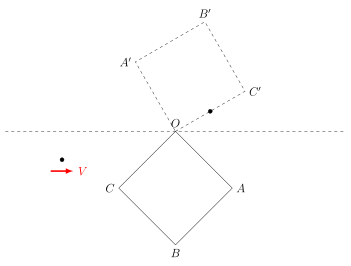
The points \(O,A,B\) and \(C\) are the vertices of a uniform square lamina of mass \(M.\) The lamina can turn freely under gravity about a horizontal axis perpendicular to the plane of the lamina through \(O\). The sides of the lamina are of length \(2a.\) When the lamina is haning at rest with the diagonal \(OB\) vertically downwards it is struck at the midpoint of \(OC\) by a particle of mass \(6M\) moving horizontally in the plane of the lamina with speed \(V\). The particle adheres to the lamina. Find, in terms of \(a,M\) and \(g\), the value which \(V^{2}\) must exceed for the lamina and particle to make complete revolutions about the axis.
Solution:
1990 Paper 3 Q12
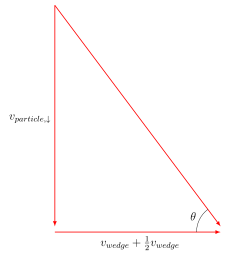
A uniform smooth wedge of mass \(m\) has congruent triangular end faces \(A_{1}B_{1}C_{1}\) and \(A_{2}B_{2}C_{2},\) and \(A_{1}A_{2},B_{1}B_{2}\) and \(C_{1}C_{2}\) are perpendicular to these faces. The points \(A,B\) and \(C\) are the midpoints of \(A_{1}A_{2},B_{1}B_{2}\) and \(C_{1}C_{2}\) respectively. The sides of the triangle \(ABC\) have lengths \(AB=AC=5a\) and \(BC=6a.\) The wedge is placed with \(BC\) on a smooth horizontal table, a particle of mass \(2m\) is placed at \(A\) on \(AC,\) and the system is released from rest. The particle slides down \(AC,\) strikes the table, bounces perfectly elastically and lands again on the table at \(D\). At this time the point \(C\) of the wedge has reached the point \(E\). Show that \(DE=\frac{192}{19}a.\)
Solution: Conservation of energy, tells us that \(2m \cdot g \cdot 4a = 8amg\) is equal to \(\frac12 m v_{wedge}^2 + \frac12(2m)v_{particle}^2\). Conservation of momentum (horizontally) tells us that \(m v_{wedge}+2mv_{particle, \rightarrow} = 0 \Rightarrow v_{particle, \rightarrow} = -\frac12 v_{wedge}\).