Problems
Filters
1531 problems found
2009 Paper 3 Q1
The points \(S\), \(T\), \(U\) and \(V\) have coordinates \((s,ms)\), \((t,mt)\), \((u,nu)\) and \((v,nv)\), respectively. The lines \(SV\) and \(UT\) meet the line \(y=0\) at the points with coordinates \((p,0)\) and \((q,0)\), respectively. Show that \[ p = \frac{(m-n)sv}{ms-nv}\,, \] and write down a similar expression for \(q\). Given that \(S\) and \(T\) lie on the circle \(x^2 + (y-c)^2 = r^2\), find a quadratic equation satisfied by \(s\) and by \(t\), and hence determine \(st\) and \(s+t\) in terms of \(m\), \(c\) and \(r\). Given that \(S\), \(T\), \(U\) and \(V\) lie on the above circle, show that \(p+q=0\).
2009 Paper 3 Q2
- Let \(\displaystyle y= \sum_{n=0}^\infty a_n x^n\,\), where the coefficients \(a_n\) are independent of \(x\) and are such that this series and all others in this question converge. Show that \[ \displaystyle y'= \sum_{n=1}^\infty na_n x^{n-1}\,, \] and write down a similar expression for \(y''\). Write out explicitly each of the three series as far as the term containing \(a_3\).
- It is given that \(y\) satisfies the differential equation \[ xy''-y'+4x^3y =0\,. \] By substituting the series of part (i) into the differential equation and comparing coefficients, show that \(a_1=0\). Show that, for \(n\ge4\), \[ a_n =- \frac{4}{n(n-2)}\, a_{n-4}\,, \] and that, if \(a_0=1\) and \(a_2=0\), then \( y=\cos (x^2)\,\). Find the corresponding result when \(a_0=0\) and \(a_2=1\).
Solution:
- Let \(\displaystyle y= \sum_{n=0}^\infty a_n x^n\,\) then \begin{align*} y' &= \frac{\d}{\d x} \l \sum_{n=0}^\infty a_n x^n \r \\ &= \sum_{n=0}^\infty \frac{\d}{\d x} \l a_n x^n \r \\ &= \sum_{n=0}^\infty n a_n x^{n-1} \\ &= \sum_{n=1}^\infty n a_n x^{n-1} \\ \\ y'' &= \frac{\d}{\d x} \l\sum_{n=1}^\infty n a_n x^{n-1} \r \\ &= \sum_{n=1}^\infty \frac{\d}{\d x} \l n a_n x^{n-1} \r \\ &= \sum_{n=1}^\infty n(n-1) a_n x^{n-2} \\ &= \sum_{n=2}^\infty n(n-1) a_n x^{n-2} \\ \\ y &= a_0 + a_1 x+ a_2x^2 + a_3x^3 + \cdots \\ y'&= a_1 + 2a_2x+3a_3x^2 + \cdots \\ y'' &= 2a_2 + 6a_3x + \cdots \end{align*}
- \begin{align*} && 0 &= xy''-y'+4x^3y \\ &&&= x\sum_{n=2}^\infty n(n-1) a_n x^{n-2} - \sum_{n=1}^\infty n a_n x^{n-1} + 4x^3 \sum_{n=0}^\infty a_n x^n \\ &&&= \sum_{n=2}^\infty n(n-1) a_n x^{n-1} - \sum_{n=1}^\infty n a_n x^{n-1} + \sum_{n=0}^\infty 4a_n x^{n+3} \\ &&&= \sum_{n=2}^\infty n(n-1) a_n x^{n-1} - \sum_{n=1}^\infty n a_n x^{n-1} + \sum_{n=4}^\infty 4a_{n-4} x^{n-1} \\ &&&= \sum_{n=4}^{\infty} \l n(n-1) a_n- n a_n +4a_{n-4} \r x^{n-1} + 2a_2x + 6a_3x^2-a_1-2a_2x-3a_3x^2 \\ &&&= \sum_{n=4}^{\infty} \l n(n-2) a_n +4a_{n-4} \r x^{n-1}+ 3a_3x^2-a_1 \\ \end{align*} Therefore since all coefficients are \(0\), \(a_1 = 0\), \(a_3 = 0\) and \(\displaystyle a_n = -\frac{4}{n(n-2)}a_{n-4}\). If \(a_0 = 1, a_2 = 0\), and since \(a_1 = 0, a_3 = 0\) the only values which will take non-zero value are \(a_{4k}\). We can compute these values as: \(a_{4k} = -\frac{4}{(4k)(4k-2)} a_{4k-4} = \frac{1}{2k(2k-1)}a_{4k-r}\) so \(a_{4k} = \frac{(-1)^k}{(2k)!}\), which are precisely the coefficients in the expansion \(\cos x^2\). If \(a_0 = 0, a_2 = 1\) then since \(a_1 = 0, a_3 = 0\) the only values which take non-zero values are \(a_{4k+2}\) we can compute these values as: \(a_{4k+2} = -\frac{4}{(4k+2)(4k)}a_{4k-2} = -\frac{1}{(2k+1)2k}a_{4k-2}\) so we can see that \(a_{4k+2}= \frac{(-1)^k}{(2k+1)!}\) precisely the coefficients of \(\sin x^2\)
2009 Paper 3 Q3
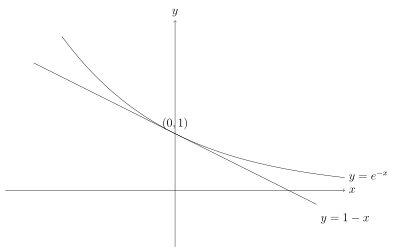
The function \(\f(t)\) is defined, for \(t\ne0\), by \[ \f(t) = \frac t {\e^t-1}\,. \] \begin{questionparts} \item By expanding \(\e^t\), show that \(\displaystyle \lim _{t\to0} \f(t) = 1\,\). Find \(\f'(t)\) and evaluate \(\displaystyle \lim _{t\to0} \f'(t)\,\). \item Show that \(\f(t) +\frac12 t\) is an even function. [{\bf Note:} A function \(\g(t)\) is said to be {\em even} if \(\g(t) \equiv \g(-t)\).] \item Show with the aid of a sketch that \( \e^t( 1-t)\le 1\,\) and deduce that \(\f'(t)\ne 0\) for \(t\ne0\). \end{questionpart} Sketch the graph of \(\f(t)\).
Solution:
- Claim \(f(t) + \frac12 t\) is an even function. Proof: Consider \(f(-t) - \frac12t\), then \begin{align*} f(-t) - \frac12t &= \frac{-t}{e^{-t}-1} - \frac12t \\ &= \frac{-te^t}{1-e^t} - \frac12 t \\ &= \frac{t(1-e^t) -t}{1-e^t} - \frac12 t \\ &= t - \frac{t}{1-e^t} - \frac12 t \\ &= \frac{t}{e^t-1} + \frac12 t \end{align*} So it is even.
- Drawing the tangent to \(y = e^{-x}\) at \((0,1)\) we find that \(e^{-t} \geq (1-t)\) for all \(t\), in particular, \(e^t(1-t) \leq 1\) \(f'(t) = \frac{(e^t(1-t) -1}{(e^t-1)^2} \leq 0\) and \(f'(t) = -\frac12\) when \(t = 0\)

2009 Paper 3 Q4
For any given (suitable) function \(\f\), the Laplace transform of \(\f\) is the function \(\F\) defined by \[ \F(s) = \int_0^\infty \e^{-st}\f(t)\d t \quad \quad \, (s>0) \,. \]
- Show that the Laplace transform of \(\e^{-bt}\f(t)\), where \(b>0\), is \(\F(s+b)\).
- Show that the Laplace transform of \(\f(at)\), where \(a>0\), is \(a^{-1}\F(\frac s a)\,\).
- Show that the Laplace transform of \(\f'(t)\) is \(s\F(s) -\f(0)\,\).
- In the case \(\f(t)=\sin t\), show that \(\F(s)= \dfrac 1 {s^2+1}\,\).
Solution:
- \begin{align*} \mathcal{L}\{e^{-bt}f(t)\}(s) &= \int_0^{\infty}e^{-st}\{ e^{-bt}f(t) \} \d t \\ &= \int_0^{\infty} e^{-(s+b)t}f(t) \d t \\ &= F(s+b) \end{align*}
- \begin{align*} \mathcal{L}\{f(at)\}(s) &= \int_0^{\infty} e^{-st}f(at) \d t \\ &= \int_{u=0}^{\infty}e^{-s \frac{u}{a}} f\left(a \tfrac{u}{a}\right)\frac{1}{a} \d u \\ &= \int_0^{\infty}e^{-su/a}f(u) a^{-1} \d u \\ &= a^{-1} \int_0^{\infty} e^{-(s/a)u}f(u) \d u \\ &= a^{-1} F\left (\frac{s}{a} \right) \end{align*}
- \begin{align*} \mathcal{L}\{f'(t)\}(s) &= \int_0^{\infty} e^{-st}f'(t) \d t \\ &= \left [e^{-st} f(t) \right]_0^{\infty} - \int_0^{\infty} -s e^{-st} f(t) \d t\\ &= -f(0)+sF(s) \\ &= sF(s) - f(0) \end{align*}
- Since \(f''(t) = -f(t)\) we must have: \begin{align*} && -\mathcal{L}(f)&= \mathcal{L}(f'') \\ &&&= s\mathcal{L}(f') -f'(0) \\ &&&= s(s\mathcal{L}(f)-f(0)) - f'(0) \\ &&&= s^2\mathcal{L}(f) - 1 \\ \Rightarrow && (1+s^2) \mathcal{L}(f) &= 1 \\ \Rightarrow && F(s) &= \frac{1}{1+s^2} \end{align*}
2009 Paper 3 Q5
The numbers \(x\), \(y\) and \(z\) satisfy \begin{align*} x+y+z&= 1\\ x^2+y^2+z^2&=2\\ x^3+y^3+z^3&=3\,. \end{align*} Show that \[ yz+zx+xy=-\frac12 \,.\] Show also that \(x^2y+x^2z+y^2z+y^2x+z^2x+z^2y=-1\,\), and hence that \[ xyz=\frac16 \,.\] Let \(S_n=x^n+y^n+z^n\,\). Use the above results to find numbers \(a\), \(b\) and \(c\) such that the relation \[ S_{n+1}=aS_{n}+bS_{n-1}+cS_{n-2}\,, \] holds for all \(n\).
Solution: \begin{align*} && (x+y+z)^2 &= x^2 + y^2 + z^2 + 2(xy+yz+zx) \\ \Rightarrow && 1^2 &= 2 + 2(xy+yz+zx) \\ \Rightarrow && xy+yz+zx &= -\frac12 \end{align*} \begin{align*} && 1 \cdot 2 &= (x+y+z)(x^2+y^2+z^2) \\ &&&= x^3 + y^3 + z^3 + x^2y+x^2z+y^2z+y^2x+z^2x+z^2y \\ &&&= 3 + x^2y+x^2z+y^2z+y^2x+z^2x+z^2y\\ \Rightarrow && -1 &= x^2y+x^2z+y^2z+y^2x+z^2x+z^2y \end{align*} \begin{align*} && (x+y+z)^3 &= x^3 + y^3 + z^3 + \\ &&&\quad \quad 3xy^2 + 3xz^2 + \cdots + 3zx^2 + 3zy^2 + \\ &&&\quad \quad \quad 6xyz \\ \Rightarrow && 1 &= 3 + 3(-1) + 6xyz \\ \Rightarrow && xyz &= \frac16 \end{align*} Since we have \(f(t) = (t-x)(t-y)(t-z) = t^3-t^2-\frac12 t - \frac16\) is zero for \(x,y,z\) we can notice that: \(t^{n+1} = t^n +\frac12 t^{n-1} + \frac16 t^{n-2}\) is also true for \(x,y,z\) (by multiplying by \(t^{n-2}\). Therefore: \(S_{n+1} = S_n + \frac12 S_{n-1} + \frac16 S_{n-2}\)
2009 Paper 3 Q6
Show that $\big\vert \e^{\i\beta} -\e^{\i\alpha}\big\vert = 2\sin\frac12 (\beta-\alpha)\,\( for \)0<\alpha<\beta<2\pi\,$. Hence show that \[ \big\vert \e^{\i\alpha} -\e^{\i\beta}\big\vert \; \big\vert \e^{\i\gamma} -\e^{\i\delta}\big\vert + \big\vert \e^{\i\beta} -\e^{\i\gamma}\big\vert \; \big\vert \e^{\i\alpha} -\e^{\i\delta}\big\vert = \big\vert \e^{\i\alpha} -\e^{\i\gamma}\big\vert \; \big\vert \e^{\i\beta} -\e^{\i\delta}\big\vert \,, \] where \(0<\alpha<\beta<\gamma<\delta<2\pi\). Interpret this result as a theorem about cyclic quadrilaterals.
2009 Paper 3 Q7
- The functions \(\f_n(x)\) are defined for \(n=0\), \(1\), \(2\), \(\ldots\)\, , by \[ \f_0(x) = \frac 1 {1+x^2}\, \qquad \text{and}\qquad \f_{n+1}(x) =\frac{\d \f_n(x)}{\d x}\,. \] Prove, for \(n\ge1\), that \[ (1+x^2)\f_{n+1}(x) + 2(n+1)x\f_n(x) + n(n+1)\f_{n-1}(x)=0\,. \]
- The functions \(\P_n(x)\) are defined for \(n=0\), \(1\), \(2\), \(\ldots\)\, , by \[ \P_n(x) = (1+x^2)^{n+1}\f_n(x)\,. \] Find expressions for \(\P_0(x)\), \(\P_1(x)\) and \(\P_2(x)\). Prove, for \(n\ge0\), that \[ \P_{n+1}(x) -(1+x^2)\frac {\d \P_n(x)}{\d x}+ 2(n+1)x \P_n(x)=0\,, \] and that \(\P_n(x)\) is a polynomial of degree \(n\).
2009 Paper 3 Q8
Let \(m\) be a positive integer and let \(n\) be a non-negative integer.
- Use the result \(\displaystyle \lim_{t\to\infty}\e^{-mt} t^n=0\) to show that \[ \lim_{x\to0} x^m (\ln x)^n =0\,. \] By writing \(x^x\) as \(\e^{x\ln x}\) show that \[ \lim _{x\to0} x^x=1\,. \]
- Let \(\displaystyle I_{n} = \int_0^1 x^m (\ln x)^n \d x\,\). Show that \[ I_{n+1} = - \frac {n+1}{m+1} I_{n} \] and hence evaluate \(I_{n}\).
- Show that \[ \int_0^1 x^x \d x = 1 -\left(\tfrac12\right)^2 +\left(\tfrac13\right)^3 -\left(\tfrac14\right)^4 + \cdots \,. \]
Solution:
- \(\,\) \begin{align*} && \lim_{x \to 0} x^m(\ln x)^n &= \lim_{t \to \infty} (e^{-t})^m (\ln e^{-t})^n \\ &&&= \lim_{t \to \infty} e^{-mt} (-t)^n \\ &&&= (-1)^n \lim_{t \to \infty} e^{-mt} t^n = 0 \\ \\ && \lim_{x \to 0} x^x &= \lim_{x \to 0} e^{x \ln x} \\ &&&= \exp \left (\lim_{x \to 0} x \ln x \right) \\ &&&= \exp \left (0 \right) = 1 \end{align*}
- \(\,\) \begin{align*} && I_{n} &= \int_0^1 x^m (\ln x)^n \d x \\ && I_{n+1} &= \int_0^1 x^m (\ln x)^{n+1} \d x \\ &&&= \left [\frac{x^{m+1}}{m+1} (\ln x)^{n+1} \right]_0^1 - \frac{1}{m+1} \int_0^1 x^{m+1} (n+1) (\ln x)^n \cdot x^{-1} \d x \\ &&&= 0 - \frac{1}{m+1} \lim_{x \to 0} \left (x^{m+1} (\ln x)^{n+1} \right) - \frac{n+1}{m+1} \int_0^1 x^m (\ln x)^n \d x \\ &&&= - \frac{n+1}{m+1} I_n \\ \\ && I_0 &= \int_0^1 x^m \d x = \frac{1}{m+1} \\ && I_1 &= -\frac{1}{(m+1)^2} \\ && I_2 &= \frac{2}{(m+1)^3} \\ && I_n &= (-1)^n \frac{n!}{(m+1)^{n+1}} \end{align*}
- \(\,\) \begin{align*} && \int_0^1 x^x \d x &= \int_0^1 e^{x \ln x} \d x \\ &&&= \int_0^1 \sum_{k=0}^{\infty} \frac{x^k(\ln x)^k}{k!} \d x \\ &&&= \sum_{k=0}^{\infty} \int_0^1 \frac{x^k(\ln x)^k}{k!} \d x\\ &&&= \sum_{k=0}^{\infty} (-1)^k \frac{k!}{k!(k+1)^{k+1}}\\ &&&= \sum_{k=0}^{\infty} \frac{(-1)^k}{(k+1)^{k+1}}\\ &&&= 1 - \frac{1}{2^2} + \frac{1}{3^3} - \frac{1}{4^4} + \cdots \end{align*}
2009 Paper 3 Q9
A particle is projected under gravity from a point \(P\) and passes through a point \(Q\). The angles of the trajectory with the positive horizontal direction at \(P\) and at \(Q\) are \(\theta\) and \(\phi\), respectively. The angle of elevation of \(Q\) from \(P\) is \(\alpha\).
- Show that \(\tan\theta +\tan\phi = 2\tan\alpha\).
- It is given that there is a second trajectory from \(P\) to \(Q\) with the same speed of projection. The angles of this trajectory with the positive horizontal direction at \(P\) and at \(Q\) are \(\theta'\) and \(\phi'\), respectively. By considering a quadratic equation satisfied by \(\tan\theta\), show that \(\tan(\theta+\theta') = -\cot\alpha\). Show also that \(\theta+\theta'=\pi+\phi+\phi'\,\).
2009 Paper 3 Q10
A light spring is fixed at its lower end and its axis is vertical. When a certain particle \(P\) rests on the top of the spring, the compression is \(d\). When, instead, \(P\) is dropped onto the top of the spring from a height \(h\) above it, the compression at time \(t\) after \(P\) hits the top of the spring is \(x\). Obtain a second-order differential equation relating \(x\) and \(t\) for \(0\le t \le T\), where \(T\) is the time at which \(P\) first loses contact with the spring. Find the solution of this equation in the form \[ x= A + B\cos (\omega t) + C\sin(\omega t)\,, \] where the constants \(A\), \(B\), \(C\) and \(\omega\) are to be given in terms of \(d\), \(g\) and \(h\) as appropriate. Show that \[ T = \sqrt{d/g\;} \left (2 \pi - 2 \arctan \sqrt{2h/d\;}\;\right)\,. \]
2009 Paper 3 Q11
A comet in deep space picks up mass as it travels through a large stationary dust cloud. It is subject to a gravitational force of magnitude \(M\!f\) acting in the direction of its motion. When it entered the cloud, the comet had mass \(M\) and speed \(V\). After a time \(t\), it has travelled a distance \(x\) through the cloud, its mass is \(M(1+bx)\), where~\(b\) is a positive constant, and its speed is \(v\).
- In the case when \(f=0\), write down an equation relating \(V\), \(x\), \(v\) and \(b\). Hence find an expression for \(x\) in terms of \(b\), \(V\) and \(t\).
- In the case when \(f\) is a non-zero constant, use Newton's second law in the form \[ \text{force} = \text{rate of change of momentum} \] to show that \[ v = \frac{ft+V}{1+bx}\,. \] Hence find an expression for \(x\) in terms of \(b\), \(V\), \(f\) and \(t\). Show that it is possible, if \(b\), \(V\) and \(f\) are suitably chosen, for the comet to move with constant speed. Show also that, if the comet does not move with constant speed, its speed tends to a constant as \(t\to\infty\).
2009 Paper 3 Q12
- Albert tosses a fair coin \(k\) times, where \(k\) is a given positive integer. The number of heads he gets is \(X_1\). He then tosses the coin \(X_1\) times, getting \(X_2\) heads. He then tosses the coin \(X_2\) times, getting \(X_3\) heads. The random variables \(X_4\), \(X_5\), \(\ldots\) are defined similarly. Write down \(\E(X_1)\). By considering \(\E(X_2 \; \big\vert \; X_1 = x_1)\), or otherwise, show that \(\E(X_2) = \frac14 k\). Find \(\displaystyle \sum_{i=1}^\infty \E(X_i)\).
- Bertha has \(k\) fair coins. She tosses the first coin until she gets a tail. The number of heads she gets before the first tail is \(Y_1\). She then tosses the second coin until she gets a tail and the number of heads she gets with this coin before the first tail is \(Y_2\). The random variables \(Y_3, Y_4, \ldots\;\), \(Y_k\) are defined similarly, and \(Y= \sum\limits_{i=1}^k Y_i\,\). Obtain the probability generating function of \(Y\), and use it to find \(\E(Y)\), \(\var(Y)\) and \(\P(Y=r)\).
Solution:
- \(X_1 \sim B(k, \tfrac12)\) so \(\E[X_1] = \frac{k}{2}\) Note that \(X_2 | X_1 = x_1 \sim B(x_1, \tfrac12)\) so \(\E[X_2 | X_1 = x_1) = \frac{x_1}{2}\) or \(\E[X_2 | X_1] = \frac12 X_1\). Therefore by the tower law, \(\E[\E[X_2|X_1]] = \E[\frac12 X_1] = \frac14k\) Notice also that \(\E[X_n] = \frac1{2^n} k\) and so \begin{align*} && \sum_{i=1}^\infty \E[X_i] &= \sum_{i=1}^{\infty} \frac1{2^i} k \\ &&&= \frac{\frac12 k}{1-\frac12} = k \end{align*}
- Note that \(Y_1 \sim Geo(\tfrac12)-1\) which has generating function \(\E[t^{Y_1}] = \E[t^{G-1}] = \frac{\frac12 t}{1-(1-\frac12)t}\frac1{t} = \frac{\frac12}{1-\frac12t}\). Notice that \begin{align*} && \E \left [ t^Y \right] &= \E \left [ t^{\sum_{i=1}^kY_i} \right] \\ &&&= \prod_{i=1}^k \E[t^{Y_i}] \\ &&&= \frac{1}{(2-t)^k} \end{align*} Therefore \(\E[Y] = G'(1) = k(2-1)^{-(k+1)} = k\) \(\E[Y^2] = (tG'(t))'|_{t=1} = k(k+1)(2-1)^{-(k+2)}+k(2-1)^{-(k+1)} = k^2+2k\) so \(\var[Y] = k^2+2k - k^2 =2 k\). Finally \(\mathbb{P}(Y=r) = \binom{k+r-1}{k} \frac{1}{2^{r+k}}\)
2009 Paper 3 Q13
- The point \(P\) lies on the circumference of a circle of unit radius and centre \(O\). The angle, \(\theta\), between \(OP\) and the positive \(x\)-axis is a random variable, uniformly distributed on the interval \(0\le\theta<2\pi\). The cartesian coordinates of \(P\) with respect to \(O\) are \((X,Y)\). Find the probability density function for \(X\), and calculate \(\var (X)\). Show that \(X\) and \(Y\) are uncorrelated and discuss briefly whether they are independent.
- The points \(P_i\) (\(i=1\), \(2\), \(\ldots\) , \(n\)) are chosen independently on the circumference of the circle, as in part (i), and have cartesian coordinates \((X_i, Y_i)\). The point \(\overline P\) has coordinates \((\overline X, \overline Y)\), where \(\overline X =\dfrac1n \sum\limits _{i=1}^n X_i\) and \(\overline Y =\dfrac1n \sum\limits _{i=1}^n Y_i\). Show that \(\overline X\) and \(\overline Y\) are uncorrelated. Show that, for large \(n\), \(\displaystyle \P\left(\vert \overline X \vert \le \sqrt{\frac2n}\right)\approx 0.95\,\).
Solution:
- \(X = \cos \theta\) \(\theta \sim U(0, 2\pi)\). Noting that \(\mathbb{P}(X \geq t ) = \frac{2}{2\pi}\cos^{-1} t\) so \(f_X(t) = \frac{1}{\pi} \frac{1}{\sqrt{1-x^2}}\) \begin{align*} && \E[X] &= 0 \tag{by symmetry} \\ && \E[X^2] &= \int_0^{2\pi} \cos^2 \theta \frac{1}{2 \pi} \d \theta \\ &&&= \frac{1}{2} \cdot 2\pi \cdot \frac{1}{2\pi} \\ &&&= \frac12 \\ \Rightarrow & &\var[X] &= \frac12 \\ \\ && \E[XY] &= \int_0^{2\pi} \cos \theta \sin \theta \frac{1}{2 \pi} \d \theta \\ &&&= \frac{1}{4\pi} \int_0^{2\pi} \sin 2\theta \d \theta \\ &&& =0 = \E[X]\E[Y] \end{align*} But note that clearly \(X\) and \(Y\) are not independent, since given \(X\) there are only two possible values of \(Y\).
- \(\,\) \begin{align*} && \E \left [ XY \right] &= \E \left [ \left ( \frac1n \sum_{i=1}^n X_i \right)\left ( \frac1n \sum_{i=1}^n Y_i\right) \right] \\ &&&= \frac{1}{n^2} \sum_{i=1}^n \sum_{j=1}^n \E [X_i Y_j] \\ &&&= 0 = \E[X] \E[Y] \end{align*} Therefore \(X\) and \(Y\) are uncorrelated. Note that \(\E[X_i] = 0, \var[X_i] = \frac12\) so we can apply the central limit theorem to see that \(X \approx N(0, \frac{1}{2n})\), in particular \begin{align*} && 0.95 &\approx \mathbb{P}(|Z| < 2) \\ &&&= \mathbb{P} \left ( \Big |\frac{X}{\sqrt{\frac{1}{2n}}} \Big | < 2 \right ) \\ &&&= \mathbb{P}\left (|X| < \sqrt{\frac{2}{n}} \right) \end{align*}
2008 Paper 1 Q1
What does it mean to say that a number \(x\) is irrational? Prove by contradiction statements A and B below, where \(p\) and \(q\) are real numbers.
- A: If \(pq\) is irrational, then at least one of \(p\) and \(q\) is irrational.
- B: If \(p+q\) is irrational, then at least one of \(p\) and \(q\) is irrational.
- C: If \(p\) and \(q\) are irrational, then \(p+q\) is irrational.
Solution:
- A: Suppose for sake of contradiction that neither \(p\) nor \(q\) is irrational, then \(pq\) is the product of two rational numbers, ie is also rational. Therefore \(pq\) is rational. Contradiction.
- B: Suppose for the sake of contradiction both \(p\) and \(q\) are rational, but then \(p+q\) is also rational, contradicting \(p+q\) is irrational.
- C: Note that \(\sqrt{2}\) and \(-\sqrt{2}\) are both irrational, but \(\sqrt{2}+(-\sqrt{2}) = 0\) which is rational.
2008 Paper 1 Q2
The variables \(t\) and \(x\) are related by \(t=x+ \sqrt{x^2+2bx+c\;} \,\), where \(b\) and \(c\) are constants and \(b^2 < c\). Show that \[ \frac{\d x}{\d t} = \frac{t-x}{t+b}\;, \] and hence integrate \(\displaystyle \frac1 {\sqrt{x^2+2bx+c}}\,\). Verify by direct integration that your result holds also in the case \(b^2=c\) if \(x+b > 0\) but that your result does not hold in the case \(b^2=c\) if \(x+b < 0\,\).
Solution: \begin{align*} && t &= x+ \sqrt{x^2+2bx+c} \\ && \frac{\d t}{\d x} &= 1 + \frac{x+b}{\sqrt{x^2+2bx+c}} \\ &&&= \frac{x + \sqrt{x^2+2bx+c} + b}{\sqrt{x^2+2bx+c}} \\ &&&= \frac{t+b}{t-x} \\ \Rightarrow && \frac{\d x}{\d t} &= \frac{t-x}{t+b} \\ \\ && \int \frac{1}{\sqrt{x^2+2bx+c}} \d x &= \int \frac{1}{t-x} \frac{t-x}{t+b} \d t \\ &&&= \int \frac{1}{t+b} \d t \\ &&&= \ln (t + b) +C \\ &&&= \ln \left (x + \sqrt{x^2+2bx+c} + b \right) + C \end{align*} If \(b^2 = c\) then we have \(x^2+2bx+b^2 = (x+b)^2\) so \(\sqrt{x^2+2bx+c^2} = x+b\) (if \(x+b>0\)), so \begin{align*} && \int \frac{1}{\sqrt{x^2+2bx+c}} \d x &= \int \frac{1}{x+b} \d x\\ &&&= \ln (x + b) + C \\ &&&= \ln(x+b) + \ln 2 + C' \\ &&&= \ln (2(x+b)) + C' \\ &&&= \ln \left(x + b + \sqrt{(x+b)^2} \right)+C'\\ &&&= \ln \left(x + b + \sqrt{x^2+2bx+c} \right)+C'\\ \end{align*} If \(x+b < 0\) then the antiderivative is \(\ln 0\). \begin{align*} && \int \frac{1}{\sqrt{x^2+2bx+c}} \d x &= -\int \frac{1}{x+b} \d x\\ &&&= -\ln |x + b| + C \\ \end{align*} which are clearly different.