Problems
Filters
35 problems found
2019 Paper 3 Q8
A pyramid has a horizontal rectangular base \(ABCD\) and its vertex \(V\) is vertically above the centre of the base. The acute angle between the face \(AVB\) and the base is \(\alpha\), the acute angle between the face \(BVC\) and the base is \(\beta\) and the obtuse angle between the faces \(AVB\) and \(BVC\) is \(\pi - \theta\).
- The edges \(AB\) and \(BC\) are parallel to the unit vectors \(\mathbf{i}\) and \(\mathbf{j}\), respectively, and the unit vector \(\mathbf{k}\) is vertical. Find a unit vector that is perpendicular to the face \(AVB\). Show that $$\cos \theta = \cos \alpha \cos \beta.$$
- The edge \(BV\) makes an angle \(\phi\) with the base. Show that $$\cot^2 \phi = \cot^2 \alpha + \cot^2 \beta.$$ Show also that $$\cos^2 \phi = \frac{\cos^2 \alpha + \cos^2 \beta - 2 \cos^2 \theta}{1 - \cos^2 \theta} \geq \frac{2 \cos \theta - 2 \cos^2 \theta}{1 - \cos^2 \theta}$$ and deduce that \(\phi < \theta\).
Solution:
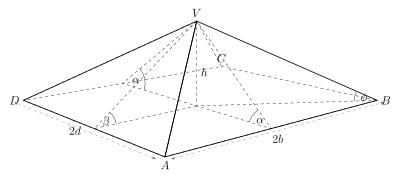
- Let \(A = (0,0,0)\) and then \(B = 22b \mathbf{i}, D = 2d\mathbf{j}, C = 2b\mathbf{i}+2d\mathbf{j}\) and \(V = b \mathbf{i} + d\mathbf{j} + h\mathbf{k}\) We also have \begin{align*} && \tan \alpha &= \frac{h}{d}\\ && \tan \beta &= \frac{d}{b} \\ && \vec{AV} \times \vec{VB} &= \begin{pmatrix} b \\ d \\ h \end{pmatrix} \times \begin{pmatrix} -b \\ d \\ h \end{pmatrix} \\ &&&= \begin{pmatrix} 0 \\ -2bh \\ 2db \end{pmatrix} \\ &&&= 2b \begin{pmatrix} 0 \\ -d \tan \alpha \\ d \end{pmatrix} \\ &&&= k \begin{pmatrix} 0 \\ - \sin \alpha \\ \cos \alpha \end{pmatrix} \end{align*} similarly for the vector perpendicular to the other face it must be \(\begin{pmatrix}-\sin \beta \\ 0 \\ \cos \beta \end{pmatrix}\) Looking at the angle between these perpendicular (to find the angles between the faces we see: \begin{align*} \begin{pmatrix} 0 \\ - \sin \alpha \\ \cos \alpha \end{pmatrix} \cdot \begin{pmatrix}-\sin \beta \\ 0 \\ \cos \beta \end{pmatrix} &= \cos \alpha \cos \beta \end{align*} But this is also \(\pi -\) the angle between the planes, ie \(\cos \theta = \cos \alpha \cos \beta\)
- \(\,\) \begin{align*} && \cot^2 \phi &= \frac{b^2+d^2}{h^2} \\ && \cot^2 \alpha &= \frac{d^2}{h^2} \\ && \cot^2 \beta &= \frac{b^2}{h^2} \\ \Rightarrow && cot^2 \phi &= \cot^2 \beta+\cot^2 \alpha \end{align*} \begin{align*} && \cos^2 \phi &= \frac{b^2+d^2}{b^2+d^2+h^2} \\ && \cos^2 \alpha &= \frac{d^2}{d^2+h^2} \\ && \cos^2 \beta &= \frac{b^2}{b^2+h^2} \\ && \frac{\cos^2 \alpha + \cos^2 \beta - 2 \cos^2 \theta}{1-\cos^2 \theta} &= \frac{\frac{d^2}{d^2+h^2}+\frac{b^2}{b^2+h^2}-2\cdot \frac{d^2}{d^2+h^2} \cdot \frac{b^2}{b^2+h^2}}{1 - \frac{d^2}{d^2+h^2} \cdot\frac{b^2}{b^2+h^2}} \\ &&&= \frac{d^2(b^2+h^2)+b^2(d^2+h^2)-2d^2b^2}{(d^2+h^2)(b^2+h^2)-d^2b^2} \\ &&&= \frac{h^2(b^2+d^2)}{h^2(b^2+d^2+h^2)} \\ &&&= \frac{b^2+d^2}{b^2+d^2+h^2} \\ &&&= \cos^2\phi \end{align*} Also notice that \begin{align*} && \cos^2 \alpha + \cos^2 \beta &\underbrace{\geq}_{AM-GM} 2 \cos \alpha \cos \beta \\ &&&= 2 \cos \theta \\ \Rightarrow && \frac{\cos^2 \alpha + \cos^2 \beta - 2 \cos^2 \theta}{1-\cos^2 \theta} &\geq \frac{2 \cos \theta - 2\cos^2 \theta}{1-\cos^2 \theta} \\ &&&= \frac{2\cos \theta}{1+\cos \theta} = \cos \theta \frac{2}{1+\cos \theta} \\ &&&> \cos^2 \theta \\ \Rightarrow && \phi &< \theta \end{align*}
2019 Paper 3 Q9
In this question, \(\mathbf{i}\) and \(\mathbf{j}\) are perpendicular unit vectors and \(\mathbf{j}\) is vertically upwards. A smooth hemisphere of mass \(M\) and radius \(a\) rests on a smooth horizontal table with its plane face in contact with the table. The point \(A\) is at the top of the hemisphere and the point \(O\) is at the centre of its plane face. Initially, a particle \(P\) of mass \(m\) rests at \(A\). It is then given a small displacement in the positive \(\mathbf{i}\) direction. At a later time \(t\), when the particle is still in contact with the hemisphere, the hemisphere has been displaced by \(-s\mathbf{i}\) and \(\angle AOP = \theta\).
- Let \(\mathbf{r}\) be the position vector of the particle at time \(t\) with respect to the initial position of \(O\). Write down an expression for \(\mathbf{r}\) in terms of \(a\), \(\theta\) and \(s\) and show that $$\dot{\mathbf{r}} = (a\dot{\theta} \cos \theta - \dot{s})\mathbf{i} - a\dot{\theta} \sin \theta \mathbf{j}.$$ Show also that $$\dot{s} = (1 - k)a\dot{\theta} \cos \theta,$$ where \(k = \frac{M}{m + M}\), and deduce that $$\dot{\mathbf{r}} = a\dot{\theta}(k \cos \theta \mathbf{i} - \sin \theta \mathbf{j}).$$
- Show that $$a\dot{\theta}^2 \left(k \cos^2 \theta + \sin^2 \theta\right) = 2g(1 - \cos \theta).$$
- At time \(T\), when \(\theta = \alpha\), the particle leaves the hemisphere. By considering the component of \(\ddot{\mathbf{r}}\) parallel to the vector \(\sin \theta \mathbf{i} + k \cos \theta \mathbf{j}\), or otherwise, show that at time \(T\) $$a\dot{\theta}^2 = g \cos \alpha.$$ Find a cubic equation for \(\cos \alpha\) and deduce that \(\cos \alpha > \frac{2}{3}\).
Solution:
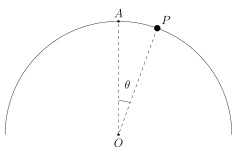
- \(\mathbf{r} = (a \sin \theta - s) \mathbf{i}+a\cos \theta\mathbf{j}\), so \begin{align*} && \dot{\mathbf{r}} &=(a \dot{\theta} \cos \theta - \dot{s}) \mathbf{i}- a\dot{\theta} \sin \theta \mathbf{j}\\ \\ \text{COM}(\rightarrow): && 0 &= M(-\dot{s}) + m(a \dot{\theta} \cos \theta - \dot{s}) \\ \Rightarrow && \dot{s} &= \frac{ma \dot{\theta} \cos \theta}{m+M} \\ &&&= \left ( 1- \frac{M}{m+M} \right) a\dot{\theta} \cos \theta \\ &&&= (1 - k) a\dot{\theta} \cos \theta \\ \\ \Rightarrow && \dot{\mathbf{r}} &=(a \dot{\theta} \cos \theta - \dot{s}) \mathbf{i}- a\dot{\theta} \sin \theta \mathbf{j} \\ &&&= (a \dot{\theta} \cos \theta - (1 - k) a\dot{\theta} \cos \theta) \mathbf{i}- a\dot{\theta} \sin \theta \mathbf{j} \\ &&&= a\dot{\theta} \left ( k \cos \theta \mathbf{i} - \sin \theta \mathbf{j} \right) \end{align*}
- \(\,\) \begin{align*} COE: &&\underbrace{0}_{\text{k.e.}}+ \underbrace{mga}_{\text{GPE}} &= \underbrace{\frac12 m \mathbf{\dot{r}}\cdot\mathbf{\dot{r}}}_{\text{k.e. }P} + \underbrace{mg a\cos \theta}_{\text{GPE}} + \underbrace{\frac12 M \dot{s}^2}_{\text{k.e. hemisphere}} \\ \Rightarrow && 2amg(1-\cos \theta) &= a^2m \dot{\theta}^2(k^2 \cos^2 \theta + \sin^2 \theta)+ M(1 - k)^2 a^2\dot{\theta}^2 \cos^2 \theta \\ \Rightarrow && 2mg(1-\cos \theta) &= a \dot{\theta}^2 \left (m\sin^2 \theta + (mk^2 + M(1-k)^2)\cos^2 \theta \right) \\ &&&= a \dot{\theta}^2 \left (m\sin^2 \theta + mk\cos^2 \theta \right) \\ \Rightarrow && 2g(1-\cos \theta) &= a \dot{\theta}^2 \left (\sin^2 \theta + k\cos^2 \theta \right) \\ \end{align*}
- The equation of motion is \(m \ddot{\mathbf{r}} = \mathbf{R} - mg\mathbf{j}\) and the particle will leave the surface when \(\mathbf{R} = 0\). If we take the component in the directions suggested: \begin{align*} && \ddot{\mathbf{r}} &= a\ddot{\theta}(k \cos \theta \mathbf{i}- \sin \theta \mathbf{j}) + a \dot{\theta}(-k\dot{\theta} \sin \theta \mathbf{i}- \dot{\theta} \cos \theta \mathbf{j}) \\ &&&= ak (\ddot{\theta} \cos \theta - \dot{\theta}^2 \sin \theta) \mathbf{i} -a(\ddot{\theta} \sin \theta + \dot{\theta}^2 \cos \theta) \mathbf{j} \\ \Rightarrow && \mathbf{\ddot{r}} \cdot (\sin \theta \mathbf{i} + k \cos \theta \mathbf{j}) &= ak (\ddot{\theta} \cos \theta - \dot{\theta}^2 \sin \theta) \sin \theta -ak(\ddot{\theta} \sin \theta + \dot{\theta}^2 \cos \theta)\cos \theta \\ &&&= - ak \dot{\theta}^2 \\ && (-g\mathbf{j}) \cdot (\sin \theta \mathbf{i} + k \cos \theta \mathbf{j}) &= -gk \cos \theta \\ \mathbf{R} = 0: && gk \cos \theta &= ak \dot{\theta}^2 \\ \Rightarrow && g \cos \theta &= a \dot{\theta}^2 \end{align*}
- \(\,\) \begin{align*} && 2g(1-\cos \theta) &= a \dot{\theta}^2(k \cos^2 \theta + \sin^2 \theta) \\ && a \dot{\theta}^2 &= g \cos \alpha \\ \Rightarrow && 2g(1-\cos \alpha) &= g \cos \alpha(k \cos^2 \alpha + (1-\cos^2 \alpha)) \\ \Rightarrow && 0 &= g(k-1)c^3+3gc-2g \\ \Rightarrow && 0 &= (k-1)c^3+3c - 2 \end{align*} When \(c =1, f(c) = k > 0\) when \(c = \frac23, f(c) = k-1 < 0\). Therefore there is a root with \(\cos \alpha > \frac23\)
2019 Paper 3 Q10
Two identical smooth spheres \(P\) and \(Q\) can move on a smooth horizontal table. Initially, \(P\) moves with speed \(u\) and \(Q\) is at rest. Then \(P\) collides with \(Q\). The direction of travel of \(P\) before the collision makes an acute angle \(\alpha\) with the line joining the centres of \(P\) and \(Q\) at the moment of the collision. The coefficient of restitution between \(P\) and \(Q\) is \(e\) where \(e < 1\). As a result of the collision, \(P\) has speed \(v\) and \(Q\) has speed \(w\), and \(P\) is deflected through an angle \(\theta\).
- Show that $$u \sin \alpha = v \sin(\alpha + \theta)$$ and find an expression for \(w\) in terms of \(v\), \(\theta\) and \(\alpha\).
- Show further that $$\sin \theta = \cos(\theta + \alpha) \sin \alpha + e \sin(\theta + \alpha) \cos \alpha$$ and find an expression for \(\tan \theta\) in terms of \(\tan \alpha\) and \(e\). Find, in terms of \(e\), the maximum value of \(\tan \theta\) as \(\alpha\) varies.
Solution:
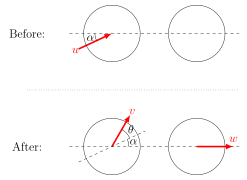
- Since the impulse is along the line of centres, the velocities are as show in the diagram. Additionally, vertical velocity is unchanged, so: \(v \sin (\theta + \alpha) = u \sin \alpha\) \begin{align*} \text{COM}(\rightarrow): && u \cos\alpha &= v \cos(\alpha + \theta) + w \\ \Rightarrow && w &= u \cos \alpha - v \cos (\alpha + \theta) \end{align*}
- Since the approach speed (horizontally) is \(u \cos \alpha\) the speed of separation is \(e u \cos \alpha\), in particular \(w - v \cos(\theta + \alpha) = e u \cos \alpha\) or \(w = v \cos (\theta + \alpha) + e u \cos \alpha\). \begin{align*} && w &= w \\ && v \cos (\theta + \alpha) + e u \cos \alpha &= u \cos \alpha - v \cos (\alpha + \theta) \\ \Rightarrow && \frac{u \sin \alpha}{\sin (\alpha + \theta)} \cos (\theta + \alpha) + e u \cos \alpha &= u \cos \alpha - \frac{u \sin \alpha}{\sin (\alpha + \theta)} \cos (\alpha + \theta) \\ \Rightarrow && \sin \alpha \cos(\theta + \alpha) + e \sin (\alpha+\theta)\cos \alpha &= \sin(\alpha+\theta) \cos \alpha - \cos(\alpha+\theta)\sin \alpha \\ &&&= \sin ((\alpha+\theta)-\alpha) \\ &&&= \sin \theta \end{align*} as required. \begin{align*} && \sin \theta &= \cos(\theta+ \alpha)\sin \alpha + e \sin (\theta + \alpha) \cos \alpha \\ &&&= \cos \theta \cos \alpha \sin \alpha - \sin \theta \sin^2 \alpha + e \sin \theta \cos ^2 \alpha + e \cos \theta \sin \alpha \cos \alpha \\ \Rightarrow && \tan \theta \sec^2 \alpha &= \tan \alpha - \tan \theta \tan^2 \alpha + e \tan \theta + e \tan \alpha \\ \Rightarrow && \tan \theta (1 + \tan^2 \alpha+\tan^2 \alpha-e) &= \tan \alpha + e \tan \alpha \\ \Rightarrow && \tan \theta &= \frac{(1+e)\tan \alpha}{1-e + 2\tan^2 \alpha} \end{align*} We seek to maximise \(y = \frac{x}{c+2x^2}\), \begin{align*} && \frac{\d y}{\d x} &= \frac{c+2x^2-4x^2}{(c+2x^2)^2} \\ &&&= \frac{c-2x^2}{(c+2x^2)^2} \end{align*} Therefore the maximum will occur at \(x = \sqrt{c/2}\), ie \(\tan \alpha = \sqrt{(1-e)/2}\) and theta will be \(\displaystyle \frac{(1+e)\sqrt{(1-e)/2}}{2(1-e)} =\frac{1}{2\sqrt{2}} \frac{1+e}{\sqrt{1-e}}\)
2019 Paper 3 Q11
The number of customers arriving at a builders' merchants each day follows a Poisson distribution with mean \(\lambda\). Each customer is offered some free sand. The probability of any given customer taking the free sand is \(p\).
- Show that the number of customers each day who take sand follows a Poisson distribution with mean \(p\lambda\).
- The merchant has a mass \(S\) of sand at the beginning of the day. Each customer who takes the free sand gets a proportion \(k\) of the remaining sand, where \(0 \leq k < 1\). Show that by the end of the day the expected mass of sand taken is $$\left(1 - e^{-kp\lambda}\right)S.$$
- At the beginning of the day, the merchant's bag of sand contains a large number of grains, exactly one of which is made from solid gold. At the end of the day, the merchant's assistant takes a proportion \(k\) of the remaining sand. Find the probability that the assistant takes the golden grain. Comment on the case \(k = 0\) and on the limit \(k \to 1\). In the case \(p\lambda > 1\) find the value of \(k\) which maximises the probability that the assistant takes the golden grain.
Solution:
- Let \(X\) be the number of people arriving on a given day, and \(Y\) be the number taking sand, then \begin{align*} && \mathbb{P}(Y = k) &= \sum_{x=k}^{\infty} \mathbb{P}(x \text{ arrive and }k\text{ of them take sand}) \\ &&&= \sum_{x=k}^{\infty} \mathbb{P}(X=x)\mathbb{P}(k \text{ out of }x\text{ of them take sand})\\ &&&= \sum_{x=k}^{\infty} e^{-\lambda} \frac{\lambda^x}{x!}\binom{x}{k}p^k(1-p)^{x-k}\\ &&&= e^{-\lambda} \left ( \frac{p}{1-p} \right)^k \sum_{x=k}^{\infty} \frac{((1-p)\lambda)^x}{k!(x-k)!} \\ &&&= e^{-\lambda} \left ( \frac{p}{1-p} \right)^k \frac{((1-p)\lambda)^k}{k!} \sum_{x=0}^{\infty} \frac{((1-p)\lambda)^x}{x!} \\ &&&= e^{-\lambda} \left ( \frac{p}{1-p} \right)^k \frac{((1-p)\lambda)^k}{k!}e^{(1-p)\lambda)} \\ &&&= e^{-p\lambda} \frac{(p\lambda)^k}{k!} \end{align*} which is precisely a Poisson with parameter \(p\lambda\). Alternatively, \(Y = B_1 + B_2 + \cdots + B_X\) where \(B_i \sim Bernoulli(p)\) so \(G_Y(t) = G_X(G_B(t)) = G_X(1-p+pt) = e^{-\lambda(1-(1-p+pt))} = e^{-p\lambda(1-t)}\) so \(Y \sim Po(\lambda)\) Alternatively, alternatively, let \(Z\) be the number of people not taking sand, so \begin{align*} && \mathbb{P}(Y = y, Z= z) &= \mathbb{P}(X=y+z) \cdot \binom{y+z}{y} p^y(1-p)^z \\ &&&= e^{-\lambda} \frac{\lambda^{y+z}}{(y+z)!} \frac{(y+z)!}{y!z!} p^y(1-p)^z \\ &&&=\left ( e^{-p\lambda} \frac{(p\lambda)^y}{y!} \right) \cdot \left ( e^{-(1-p)\lambda} \frac{((1-p)\lambda)^z}{z!}\right) \end{align*} So clearly \(Y\) and \(Z\) are both (independent!) Poisson with parameters \(p\lambda \) and \((1-p)\lambda\)
- The amount taken is \(Sk + S(1-k)k + \cdots +Sk(1-k)^{Y-1} = Sk\cdot \frac{1-(1-k)^Y}{k} = S(1-(1-k)^Y)\) so \begin{align*} \E[\text{taken sand}] &= \E \left [ S(1-(1-k)^Y)\right] \\ &= S-S\E\left [(1-k)^Y \right] \\ &= S - SG_Y(1-k)\\ &=S - Se^{-p\lambda(1-(1-k))} \tag{pgf for Poisson} \\ &= S\left (1-e^{-kp\lambda} \right) \end{align*}
- The fraction of grains the assistant takes home is: \((1-k)^Yk\), which has expected value \(ke^{-kp\lambda}\). This the the probability he takes home the golden grain. When \(k = 0\) the probability is \(0\) which makes sense (no-one takes home any sand, including the merchant's assistant). As \(k \to 1\) we get \(e^{-p\lambda}\) which is the probability that no-one gets any sand other than him. \begin{align*} && \frac{\d }{\d k} \left ( ke^{-kp\lambda} \right) &= e^{-kp\lambda} - (p\lambda)ke^{-kp\lambda} \\ &&&= e^{-kp\lambda}(1 - (p\lambda)k) \end{align*} Therefore maximised at \(k = \frac{1}{p\lambda}\). (Clearly this is a maximum just by sketching the function)
2019 Paper 3 Q12
The set \(S\) is the set of all integers from 1 to \(n\). The set \(T\) is the set of all distinct subsets of \(S\), including the empty set \(\emptyset\) and \(S\) itself. Show that \(T\) contains exactly \(2^n\) sets. The sets \(A_1, A_2, \ldots, A_m\), which are not necessarily distinct, are chosen randomly and independently from \(T\), and for each \(k\) \((1 \leq k \leq m)\), the set \(A_k\) is equally likely to be any of the sets in \(T\).
- Write down the value of \(P(1 \in A_1)\).
- By considering each integer separately, show that \(P(A_1 \cap A_2 = \emptyset) = \left(\frac{3}{4}\right)^n\). Find \(P(A_1 \cap A_2 \cap A_3 = \emptyset)\) and \(P(A_1 \cap A_2 \cap \cdots \cap A_m = \emptyset)\).
- Find \(P(A_1 \subseteq A_2)\), \(P(A_1 \subseteq A_2 \subseteq A_3)\) and \(P(A_1 \subseteq A_2 \subseteq \cdots \subseteq A_m)\).
Solution: For every element in \(S\) we can choose whether or not it appears in a subset of \(S\), therefore there are \(2^n\) choices so \(2^n\) distinct subsets.
- \(\mathbb{P}(1 \in A_1) = \frac12\) (since \(1\) is in exactly half the subsets)
- \(\,\) \begin{align*} && \mathbb{P}(A_1 \cap A_2 = \emptyset) &= \mathbb{P}(i \not \in (A_1 \cap A_2) \forall i) \\ &&&= \prod_{i=1}^n \left ( 1-\mathbb{P}(i \in A_1 \cap A_2) \right) \\ &&&= \prod_{i=1}^n \left ( 1-\mathbb{P}(i \in A_1)\mathbb{P}(i \in \cap A_2) \right) \\ &&&= \prod_{i=1}^n \left ( 1-\frac12 \cdot \frac12\right) \\ &&&= \left (\frac34 \right)^n \end{align*}
- \(\,\) \begin{align*} && \mathbb{P}(A_1 \cap A_2 \cap A_3 = \emptyset) &= \mathbb{P}(i \not \in (A_1 \cap A_2 \cap A_3) \forall i) \\ &&&= \prod_{i=1}^n \left ( 1-\mathbb{P}(i \in A_1 \cap A_2 \cap A_3) \right) \\ &&&= \prod_{i=1}^n \left ( 1-\mathbb{P}(i \in A_1)\mathbb{P}(i \in \cap A_2))\mathbb{P}(i \in \cap A_3) \right) \\ &&&= \prod_{i=1}^n \left ( 1-\frac12 \cdot \frac12 \cdot \frac12\right) \\ &&&= \left (\frac78 \right)^n \end{align*} Similarly, \(\displaystyle \mathbb{P}(A_1 \cap A_2 \cap \cdots \cap A_m = \emptyset) = \left ( \frac{2^m-1}{2^m} \right)^n\)
- \(\,\) \begin{align*} && \mathbb{P}(A_1 \subseteq A_2) &= \mathbb{P}(A_1 \cap A_2^c = \emptyset) \\ &&&= \left (\frac34 \right)^n \\ \\ && \mathbb{P}(A_1 \subseteq A_2 \subseteq A_3) &= \prod_{i=1}^n \mathbb{P}(\text{once }i\text{ appears it keeps appearing}) \\ &&&= \prod_{i=1}^n \frac{\#\{(0,0,0), (0,0,1), (0,1,1), (1,1,1) \}}{2^3} \\ &&&= \prod_{i=1}^n \frac{4}{8} \\ &&&= \frac{1}{2^n} \\ \\ && \mathbb{P}(A_1 \subseteq A_2 \subseteq \cdots \subseteq A_m) &= \prod_{i=1}^n \frac{m+1}{2^m} \\ &&&= \left ( \frac{m+1}{2^m} \right)^n \end{align*}