Problems
Filters
39 problems found
2015 Paper 3 Q5
- In the following argument to show that \(\sqrt2\) is irrational, give proofs appropriate for steps 3, 5 and 6.
- Assume that \(\sqrt2\) is rational.
- Define the set \(S\) to be the set of positive integers with the following property:
\(n\) is in \(S\) if and only if \(n \sqrt2\) is an integer.
- Show that the set \(S\) contains at least one positive integer.
- Define the integer \(k\) to be the smallest positive integer in \(S\).
- Show that \((\sqrt2-1)k\) is in \(S\).
- Show that steps 4 and 5 are contradictory and hence that \(\sqrt2\) is irrational.
- Prove that \(2^{\frac13} \) is rational if and only if \(2^{\frac23}\) is rational. Use an argument similar to that of part (i) to prove that \(2^{\frac13}\) and \(2^{\frac23}\) are irrational.
Solution:
- For step 3, since we have assumed \(\sqrt{2}\) is rational we can write it in the form \(p/q\) with \(p, q\) coprime with \(q \geq 1\). Then \(q \in S\) since \(q\sqrt{2} = p\) which is an integer. For step 5, notice that \((\sqrt{2}-1)k\) is an integer (since \(\sqrt{2}k\) is an integer and so is \(-k\). It is also positive since \(\sqrt{2} > 1\). We must check that \((\sqrt{2}-1)k \cdot \sqrt{2} = 2k - \sqrt{2}k\) is also an integer, but clearly it is as both \(2k\) and \(-\sqrt{2}k\) are integers. Therefore \((\sqrt{2}-1)k \in S\). For step 6, notice that \((\sqrt{2}-1) < 1\) and therefore \((\sqrt{2}-1)k < k\), contradicting that \(k\) is the smallest element in our set. (And all non-empty sets of positive integers have a smallest element)
- Claim: \(2^{\frac13}\) is irrational \(\Leftrightarrow 2^{\frac23}\) is irrational.
Proof: Since \(2^{\frac13} \cdot 2^{\frac23} = 2\) if one of them is rational, then the other one must also be rational. Which is the same as them both being irrational at the same time.
- Assume that \(\sqrt[3]{2}\) is rational, ie \(\sqrt[3]{2} = p/q\) for some integers.
- \(S := \{ n \in \mathbb{Z}_{>0} : n \sqrt[3]{2} \text{ and } n \sqrt[3]{4}\in \mathbb{Z}\}\)
- Suppose \(k\) is the smallest element in \(S\) (which must exist, consider \(q^2\)
- Consider \((\sqrt[3]{2}-1)k\) then clearly this is an integer, and \((\sqrt[3]{2}-1)\sqrt[3]{2}k = \sqrt[3]{4}k - \sqrt[3]{2}k \in \mathbb{Z}\) and \((\sqrt[3]{2}-1)\sqrt[3]{4}k = 2 k -\sqrt[3]{4}k \in \mathbb{Z}\).
- But this is a smaller element of \(S\), contradicting that \(k\) is the smallest element. Therefore, we have a contradiction.
2015 Paper 3 Q6
- Let \(w\) and \(z\) be complex numbers, and let \(u= w+z\) and \(v=w^2+z^2\). Prove that \(w\) and \(z\) are real if and only if \(u\) and \(v\) are real and \(u^2\le2v\).
- The complex numbers \(u\), \(w\) and \(z\) satisfy the equations \begin{align*} w+z-u&=0 \\ w^2+z^2 -u^2 &= - \tfrac 23 \\ w^3+z^3 -\lambda u &= -\lambda\, \end{align*} where \(\lambda \) is a positive real number. Show that for all values of \(\lambda\) except one (which you should find) there are three possible values of \(u\), all real. Are \(w\) and \(z\) necessarily real? Give a proof or counterexample.
Solution:
- Notice that \(u^2 = v+2wz\), so \(w,z\) are roots of the quadratic \(t^2 -ut+\frac{u^2-v}{2}\). Therefore they are both real if \(u^2 \geq 2(u^2-v) \Rightarrow 2v \geq u^2\).
- \begin{align*} && w+z &= u \\ && w^2+z^2 &= u^2 - \tfrac23 \\ && w^3+z^3 &= \lambda(u-1) \\ \\ && wz &= \frac{u^2 - (u^2-\tfrac23)}{2} = \tfrac13\\ \\ && (w+z)(w^2+z^2) &= w^3+z^3+wz(w+z) \\ &&u(u^2-\tfrac23)&= \lambda(u-1)+\frac13u \\ \Rightarrow && u^3-u&= \lambda (u-1) \\ \Rightarrow && 0 &= (u-1)(u(u+1) - \lambda) \\ \Rightarrow && 0 &= (u-1)(u^2+u - \lambda) \end{align*} Therefore there will be at most 3 values for \(u\), unless \(1\) is a root of \(u^2+u-\lambda\), ie \(\lambda = 2\). Suppose \(u = 1\), then we have: \(w+z = 1, wz = 1/3 \Rightarrow w,z = \frac{-1 \pm \sqrt{-1/3}}{2}\) which are clearly complex.
2015 Paper 3 Q7
An operator \(\rm D\) is defined, for any function \(\f\), by \[ {\rm D}\f(x) = x\frac{\d\f(x)}{\d x} .\] The notation \({\rm D}^n\) means that \(\rm D\) is applied \(n\) times; for example \[ \displaystyle {\rm D}^2\f(x) = x\frac{\d\ }{\d x}\left( x\frac{\d\f(x)}{\d x} \right) \,. \] Show that, for any constant \(a\), \({\rm D}^2 x^a = a^2 x^a\,\).
- Show that if \(\P(x)\) is a polynomial of degree \(r\) (where \(r\ge1\)) then, for any positive integer \(n\), \({\rm D}^n\P(x)\) is also a polynomial of degree \(r\).
- Show that if \(n\) and \(m\) are positive integers with \(n < m\), then \({\rm D}^n(1-x)^m\) is divisible by \((1-x)^{m-n}\).
- Deduce that, if \(m\) and \(n\) are positive integers with \(n < m\), then \[ \sum_{r=0}^m (-1)^r \binom m r r^n =0 \, . \]
- [Not on original paper] Let \(\f_n(x) = D^n(1-x)^n\,\), where \(n\) is a positive integer. Prove that \(\f_n(1)=(-1)^nn!\, \).
Solution: \begin{align*} {\mathrm D}^2 x^a &= x\frac{\d\ }{\d x}\left( x\frac{\d}{\d x} \left ( x^a \right) \right) \\ &= x\frac{\d\ }{\d x}\left( ax^a \right) \\ &= a^2 x^a \end{align*}
- Claim: \({\mathrm D^n}(x^a) =a^n x^a\) Proof: Induct on \(n\). Base cases we have already seen, so consider \(D^{k+1}(x^a) = D(a^k x^a) = a^{k+1}x^a\) as required. Claim: \({\mathrm D}\) is linear, ie \({\mathrm D}(f(x) + g(x)) = {\mathrm D}(f(x)) + {\mathrm D}(g(x))\) Proof: \begin{align*} {\mathrm D}(f(x) + g(x)) &= x\frac{\d\ }{\d x}\left(f(x) + g(x) \right) \\ &= x\frac{\d\ }{\d x}f(x) + x\frac{\d\ }{\d x}g(x) \\ &= {\mathrm D}(f(x)) + {\mathrm D}(g(x)) \end{align*} Claim: If \(p(x)\) is a polynomial degree \(r\) then \({\mathrm D}^n p(x)\) is a polynomial degree \(n\). Proof: Since \({\mathrm D}\) is linear, it suffices to prove this for a monomial of degree \(n\), but this was already proven in the first question.
- Claim: If \(f(x)\) is some polynomial, \({\mathrm D}((1-x)^m f(x))\) is divisible by \((1-x)^{m-1}\) Proof: \({\mathrm D}((1-x)^mf(x)) = -xm(1-x)^{m-1}f(x) + (1-x)^mxf'(x) = x(1-x)^{m-1}((1-x)f'(x)-xf(x))\) as required. Therefore repeated application of \({\mathrm D}\) will reduce the factor of \(1-x\) by at most \(1\) each time as required.
- \begin{align*} {\mathrm D}^n(1-x)^m &= {\mathrm D}^n \left ( \sum_{r=0}^m \binom{m}{r}(-1)^r x^r\right) \\ &= \sum_{r=0}^m {\mathrm D}^n \left ( \binom{m}{r}(-1)^r x^r \right ) \\ &= \sum_{r=0}^m\binom{m}{r}(-1)^r r^n x^r \end{align*} Since the left-hand side is divisible by \(1-x\), if we substitute \(x = 1\), the sum must be \(0\), i.e., we get the desired result.
- On each application of \({\mathrm D}\) to \((1-x)^m f(x)\) we end up with a term in the form \(x(1-x)^{m-1}(x)\) and a term of the form \((1-x)^m\). After the latter term will be annihilated once we evaluate at \(x = 1\) because there will be insufficient applications to remove the factors of \(1-x\). Therefore we only need to focus on the term which does not get annihilated. This term is will be \((-x)^n n \cdot (n-1) \cdots 1\), so \(f_n(1) = (-1)^n n!\) as required. Alternatively: \begin{align*} {\mathrm D}^n((1-x)^n) &= D^{n-1}(-nx(1-x)^{n-1}) \\ &= -n{\mathrm D}^{n-1}(x(1-x)^{n-1}) \\ &= -n{\mathrm D}^{n-1}((x-1+1)(1-x)^{n-1}) \\ &= -n{\mathrm D}^{n-1}(-(1-x)^{n}+(1-x)^{n-1}) \\ &= -n{\mathrm D}^{n-1}(-(1-x)^{n})-n{\mathrm D}^{n-1}((1-x)^{n-1}) \\ \end{align*} Therefore, when this is evaluated at \(x = 1\), recursively, we will have \(f_n(1) = -nf_{n-1}(1)\), in particular, \(f_n(1) = (-1)^n n!\)
2015 Paper 3 Q8
- Show that under the changes of variable \(x= r\cos\theta\) and \(y = r\sin\theta\), where \(r\) is a function of \(\theta\) with \(r>0\), the differential equation \[ (y+x)\frac{\d y}{\d x} = y-x \] becomes \[ \frac{\d r}{\d\theta} + r=0 \,. \] Sketch a solution in the \(x\)-\(y\) plane.
- Show that the solutions of \[ \left( y+x -x(x^2+y^2) \right) \, \frac{\d y }{\d x} = y-x - y(x^2+y^2) \] can be written in the form \\ \[ r^2 = \dfrac 1 {1+A\e^{2\theta}}\, \]\\ and sketch the different forms of solution that arise according to the value of \(A\).
Solution:
- \begin{align*}
&& (y+x)\frac{\d y}{\d x} &= y-x \\
\Rightarrow && (r \sin \theta + r \cos\theta) \frac{\frac{dy}{d\theta}}{\frac{dx}{d\theta}} &= (r \sin\theta - r \cos\theta) \\
\Rightarrow && ( \sin \theta + \cos\theta) \frac{dy}{d\theta} &= (\sin\theta - \cos\theta){\frac{dx}{d\theta}} \\
\Rightarrow && ( \sin \theta + \cos\theta) \left ( \frac{dr}{d\theta} \cos \theta - r \sin \theta\right ) &= (\sin\theta - \cos\theta)\left ( \frac{dr}{d\theta} \sin\theta + r \cos \theta\right) \\
\Rightarrow && \frac{dr}{d\theta} \left (\sin \theta \cos \theta + \cos^2 \theta - \sin^2 \theta + \sin \theta \cos \theta \right)&= r \left (\sin \theta \cos \theta - \cos^2 \theta + \sin^2 \theta + \sin\theta \cos \theta\right) \\
\Rightarrow && \frac{dr}{d\theta}&= -r \\
\end{align*}
Therefore \(r = Ae^{-\theta}\)

- \begin{align*}
&& \left( y+x -x(x^2+y^2) \right) \, \frac{\d y }{\d x} &= y-x - y(x^2+y^2) \\
\Rightarrow && \left( r \sin \theta+r\cos \theta -r^3\cos \theta \right) \, \frac{\d y }{\d \theta} &= \left ( r \sin \theta- r \cos \theta- r^3\sin \theta \right)\frac{\d x }{\d \theta} \\
\Rightarrow && \left( r \sin \theta+r\cos \theta -r^3\cos \theta \right) \, \left (\frac{\d r}{\d \theta} \sin \theta + r \cos \theta \right) &= \\
&& \left ( r \sin \theta- r \cos \theta- r^3\sin \theta \right)&\left (\frac{\d r}{\d \theta} \cos \theta - r \sin \theta \right) \\
\Rightarrow && \frac{\d r}{\d \theta} \left (\sin \theta ( \sin \theta + \cos \theta - r^2 \cos \theta) - \cos \theta (\sin \theta - \cos \theta - r^2 \sin \theta) \right) &= \\
&& r ( -\sin \theta (\sin \theta - \cos \theta - r^2 \sin \theta) - \cos \theta ( \sin \theta + \cos \theta &- r^2 \cos \theta)) \\
\Rightarrow && \frac{\d r}{\d \theta} &= r ( -1 +r^2) \\
\Rightarrow && \int \frac{1}{r(r-1)(r+1)} \d r &= \int \d \theta \\
\Rightarrow && \int \l \frac{-1}{r} + \frac{1}{2(r-1)} + \frac{1}{2(r+1)} \r \d r &= \int \d \theta \\
\Rightarrow && \l -\log r+ \frac12 \log (1+r)+ \frac12 \log (1-r)\r + C &= \theta \\
\Rightarrow && \frac12 \log \left (\frac{1-r^2}{r^2} \right) + C &= \theta \\
\Rightarrow && \log \left (\frac{1}{r^2}-1 \right) + C &= 2\theta \\
\Rightarrow && r &= \frac{1}{1 + Ae^{2\theta}} \\
\end{align*}
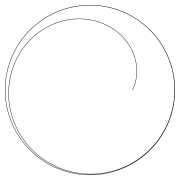


2015 Paper 3 Q9
A particle \(P\) of mass \(m\) moves on a smooth fixed straight horizontal rail and is attached to a fixed peg \(Q\) by a light elastic string of natural length \(a\) and modulus \(\lambda\). The peg \(Q\) is a distance \(a\) from the rail. Initially \(P\) is at rest with \(PQ=a\). An impulse imparts to \(P\) a speed \(v\) along the rail. Let \(x\) be the displacement at time \(t\) of \(P\) from its initial position. Obtain the equation \[ \dot x^2 = v^2 - k^2 \left( \sqrt{x^2+a^2} -a\right)^{\!2} \] where \( k^2 = \lambda/(ma)\), \(k>0\) and the dot denotes differentiation with respect to \(t\). Find, in terms of \(k\), \(a\) and \(v\), the greatest value, \(x_0\), attained by \(x\). Find also the acceleration of \(P\) at \(x=x_0\). Obtain, in the form of an integral, an expression for the period of the motion. Show that in the case \(v\ll ka\) (that is, \(v\) is much less than \(ka\)), this is approximately \[ \sqrt {\frac {32a}{kv}} \int_0^1 \frac 1 {\sqrt{1-u^4}} \, \d u \, . \]
2015 Paper 3 Q10
A light rod of length \(2a\) has a particle of mass \(m\) attached to each end and it moves in a vertical plane. The midpoint of the rod has coordinates \((x,y)\), where the \(x\)-axis is horizontal (within the plane of motion) and \(y\) is the height above a horizontal table. Initially, the rod is vertical, and at time \(t\) later it is inclined at an angle \(\theta\) to the vertical. Show that the velocity of one particle can be written in the form \[ \begin{pmatrix} \dot x + a \dot\theta \cos\theta \\ \dot y - a \dot\theta \sin\theta \end{pmatrix} \] and that \[ m\begin{pmatrix} \ddot x + a\ddot\theta \cos\theta - a \dot\theta^2 \sin\theta \\ \ddot y- a\ddot\theta \sin\theta - a \dot\theta^2 \cos\theta \end{pmatrix} =-T\begin{pmatrix} \sin\theta \\ \cos\theta \end{pmatrix} -mg \begin{pmatrix} 0 \\ 1 \end{pmatrix} \] where the dots denote differentiation with respect to time \(t\) and \(T\) is the tension in the rod. Obtain the corresponding equations for the other particle. Deduce that \(\ddot x =0\), \(\ddot y = -g\) and \(\ddot\theta =0\). Initially, the midpoint of the rod is a height \(h\) above the table, the velocity of the higher particle is \(\Big(\begin{matrix} \, u \, \\ v \end{matrix}\Big)\), and the velocity of the lower particle is \(\Big(\begin{matrix}\, 0 \, \\ v\end{matrix}\Big)\). Given that the two particles hit the table for the first time simultaneously, when the rod has rotated by \(\frac12\pi\), show that \[ 2hu^2 = \pi^2a^2 g - 2\pi uva \,. \]
2015 Paper 3 Q11
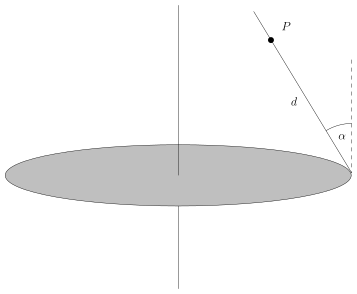
- A horizontal disc of radius \(r\) rotates about a vertical axis through its centre with angular speed \(\omega\). One end of a light rod is fixed by a smooth hinge to the edge of the disc so that it can rotate freely in a vertical plane through the centre of the disc. A particle \(P\) of mass \(m\) is attached to the rod at a distance \(d\) from the hinge. The rod makes a constant angle \(\alpha\) with the upward vertical, as shown in the diagram, and \(d\sin\alpha < r\).
By considering moments about the hinge for the (light) rod, show that the force exerted on the rod by \(P\) is parallel to the rod. Show also that \[ r\cot\alpha = a + d \cos\alpha \,, \] where \(a = \dfrac {g \;} {\omega^2}\,\). State clearly the direction of the force exerted by the hinge on the rod, and find an expression for its magnitude in terms of \(m\), \(g\) and \(\alpha\).
- The disc and rod rotate as in part (i), but two particles (instead of \(P\)) are attached to the rod. The masses of the particles are \(m_1\) and \(m_2\) and they are attached to the rod at distances \(d_1\) and \(d_2\) from the hinge, respectively. The rod makes a constant angle \(\beta\) with the upward vertical and \(d_1\sin\beta < d_2\sin\beta < r\). Show that \(\beta\) satisfies an equation of the form \[ r\cot\beta = a+ b \cos\beta \,, \] where \(b\) should be expressed in terms of \(d_1\), \(d_2\), \(m_1\) and \(m_2\).
Solution:
- Since the particle is not moving (relative to the hinge) there is no moment about the hinge and in particular the only forces must be directed towards the hinge, ie parallel to the rod.
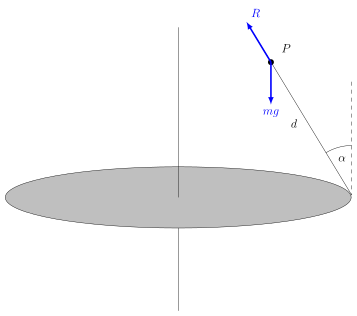
\begin{align*} \text{N2}(\uparrow): && R \cos \alpha &= mg \\ \\ \text{N2}(\leftarrow, \text{radially}): && R \sin \alpha &= m (r-d\sin \alpha) \omega^2 \\ \Rightarrow && \cot \alpha &= \frac{g}{(r-d\sin \alpha) \omega^2} \\ \Rightarrow && r\cot \alpha-d \cos \alpha &= a \\ \Rightarrow && r \cot \alpha &= a + d \cos \alpha \end{align*} The force of the hinge is acting in the same direction and magnitude as the rod on the particle (the force \(R\) in the diagram). It has magnitude \(mg \sec \alpha\)
- \(\,\)
\begin{align*} \overset{\curvearrowleft}{\text{hinge}}: && gm_1d_1 \sin \beta+gm_2d_2 \sin \beta &= m_1 (r-d_1 \sin \beta) \omega^2 d_1 \cos \beta + m_2 (r-d_2 \sin \beta) \omega^2 d_2 \cos \beta \\ \Rightarrow && a(m_1d_1+m_2d_2) \tan \beta &= r(m_1d_1+m_2d_2) - (m_1d_1^2+m_2d_2^2) \sin \beta \\ \Rightarrow && r\cot \beta &= a + \frac{m_1d_1^2+m_2d_2^2}{m_1d_1+m_2d_2} \cos \beta \end{align*}

2015 Paper 3 Q12
A 6-sided fair die has the numbers 1, 2, 3, 4, 5, 6 on its faces. The die is thrown \(n\) times, the outcome (the number on the top face) of each throw being independent of the outcome of any other throw. The random variable \(S_n\) is the sum of the outcomes.
- The random variable~\(R_n\) is the remainder when \(S_n\) is divided by 6. Write down the probability generating function, \(\G(x)\), of \(R_1\) and show that the probability generating function of \(R_2\) is also \(\G(x)\). Use a generating function to find the probability that \(S_n\) is divisible by 6.
- The random variable \(T_n\) is the remainder when \(S_n\) is divided by 5. Write down the probability generating function, \(\G_1(x)\), of \(T_1\) and show that \(\G_2(x)\), the probability generating function of \(T_2\), is given by \[ {\rm G}_2(x) = \tfrac 1 {36} (x^2 +7y) \] where \(y= 1+x+x^2+x^3+x^4\,\). Obtain the probability generating function of \(T_n\) and hence show that the probability that \(S_n\) is divisible by \(5\) is \[ \frac15\left(1- \frac1 {6^n}\right) \] if \(n\) is not divisible by 5. What is the corresponding probability if \(n\) is divisible by 5?
Solution:
- \(G(x) = \frac{1}{6} (1 + x + x^2 + x^3 + x^4 + x^5)\) The pgf for \(R_2\) is: \begin{align*} \frac1{36}x^2 + \frac{2}{36}x^3 + \frac{3}{36}x^4 + \frac{4}{36}x^5 + \frac{5}{36} +\\ \quad \quad + \frac{6}{36}x^1 + \frac{5}{36}x^2 + \frac4{36}x^3 + \frac3{36}x^4 + \frac{2}{36}x^5 + \frac{1}{36} \\ = \frac{1}{6}(1 + x + x^2 + x^3 + x^4 + x^5) = G(x) \end{align*} Since rolling the dice twice is the same as rolling the dice once, rolling the dice \(n\) times will be the same as rolling it once, ie the pgf for \(R_n\) will be \(G(x)\) and the probability \(S_n\) is divisible by \(6\) is \(\frac16\)
- \(G_1(x) = \frac{1}{6} + \frac{1}{3}x^1 + \frac{1}{6}x^2 + \frac16x^3+ \frac16x^4 = \frac16(1 + 2x+x^2+x^3+x^4)\). If \(G_n\) is the probability generating function for \(T_n\) then we can obtain \(G_n\) by multiplying \(G_{n-1}\) by \(G(x)\) and replacing any terms of order higher than \(5\) with their remainder on division by \(5\). (Or equivalently, working over \(\mathbb{R}[x]/(x^5-1)\). If \(y = 1 + x + x^2 + x^3 + x^4\) then: \begin{align*} xy &= x + x^2 + x^3 + x^4 +x^5 \\ &= x + x^2 + x^3 + x^4 + 1 \\ &= y \\ \\ y^2 &= (1 + x+x^2 + x^3+x^4)^2 \\ &= 1 + 2x + 3x^2 + 4x^3+5x^4+4x^5+3x^6 + 2x^7 + x^8 \\ &= (1+4) + (2+3)x+(3+2)x^2 + (4+1)x^3 + 5x^4 \\ &= 5y \end{align*} \begin{align*} \frac{1}{36}(y+x)(y+x) &= \frac1{36}(y^2 + 2xy + x^2) \\ &= \frac1{36}(5y + 2y + x^2 ) \\ &= \frac1{36}(7y + x^2) \end{align*} Similarly, \begin{align*} G_n(x) &= \l\frac{1}{6}(x+y) \r^n \\ &= \frac1{6^n} \l \sum_{i=0}^n \binom{n}{i} y^ix^{n-i} \r \\ &= \frac1{6^n} \l \sum_{i=1}^n \binom{n}{i} y^i + x^n \r \\ &= \frac1{6^n} \l \sum_{i=1}^n \binom{n}{i} 5^{i-1}y + x^n \r \\ &= \frac1{6^n} \l \frac{1}{5}y((5+1)^n-1) + x^n \r \\ &= \frac1{6^n} \l \frac{1}{5}y(6^n-1) + x^n \r \\ \end{align*} Therefore if \(n \not \equiv 0 \pmod{5}\), we can find the probability of \(T_n = 0\) by looking at the constant coefficient, ie plugging in \(x = 0\), which is: \[\frac1{6^n} \l \frac{1}{5}(6^n-1) \r = \frac{1}{5} \l 1- \frac{1}{6^n} \r \] When \(n \equiv 0 \pmod{5}\) we can also find the constant coefficient by plugging in \(x = 0\), which is: \[\frac1{6^n} \l \frac{1}{5}(6^n-1) + 1 \r = \frac{1}{5} \l 1+ \frac{4}{6^n} \r \]
2015 Paper 3 Q13
Each of the two independent random variables \(X\) and \(Y\) is uniformly distributed on the interval~\([0,1]\).
- By considering the lines \(x+y =\) \(\mathrm{constant}\) in the \(x\)-\(y\) plane, find the cumulative distribution function of \(X+Y\).
- Hence show that the probability density function \(f\) of \((X+Y)^{-1}\) is given by \[ \f(t) = \begin{cases} 2t^{-2} -t^{-3} & \text{for \( \tfrac12 \le t \le 1\)} \\ t^{-3} & \text{for \(1\le t <\infty\)}\\ 0 & \text{otherwise}. \end{cases} \] Evaluate \(\E\Big(\dfrac1{X+Y}\Big)\,\).
- Find the cumulative distribution function of \(Y/X\) and use this result to find the probability density function of \(\dfrac X {X+Y}\). Write down \(\E\Big( \dfrac X {X+Y}\Big)\) and verify your result by integration.
Solution:
- \(\mathbb{P}(X + Y \leq c) \) is the area between the \(x\)-axis, \(y\)-axis and the line \(x + y = c\). There are two cases for this: \[\mathbb{P}(X + Y \leq c) = \begin{cases} 0 & \text{ if } c \leq 0 \\ \frac{c^2}{2} & \text{ if } c \leq 1 \\ 1- \frac{(2-c)^2}{2} & \text{ if } 1 \leq c \leq 2 \\ 1 & \text{ otherwise} \end{cases}\]
- \begin{align*} && \mathbb{P}((X + Y)^{-1} \leq t) &= 1- \mathbb{P}(X + Y \leq \frac1{t}) \\ \Rightarrow && f_{(X+Y)^{-1}}(t) &= 0 -\begin{cases} 0 & \text{ if } \frac1{t} \leq 0 \\ \frac{\d}{\d t}\frac{1}{2t^2} & \text{ if } \frac{1}{t} \leq 1 \\ \frac{\d}{\d t} \l 1- \frac{(2-\frac1t)^2}{2} \r & \text{ if } 1 \leq \frac{1}{t} \leq 2 \\ 0 & \text{ otherwise}\end{cases} \\ && &= \begin{cases} t^{-3} & \text{ if } t \geq 1 \\ (2-\frac1t)t^{-2} & \text{ if } \frac12 \leq t \leq 1\\ 0 & \text{ otherwise}\end{cases} \\ && &= \begin{cases} t^{-3} & \text{ if } t \geq 1 \\ 2t^{-2}-t^{-3} & \text{ if } \frac12 \leq t \leq 1\\ 0 & \text{ otherwise}\end{cases} \end{align*} Therefore, \begin{align*} \E \Big(\dfrac1{X+Y}\Big) &= \int_{\frac12}^{\infty} t f_{(X+Y)^{-1}}(t) \, \d t \\ &= \int_{\frac12}^{1} t f_{(X+Y)^{-1}}(t) \, \d t + \int_{1}^{\infty} t f_{(X+Y)^{-1}}(t) \d t\\ &= \int_{\frac12}^{1} \l 2t^{-1} - t^{-2} \r \, \d t + \int_{1}^{\infty} t^{-2} \d t\\ &= \left [ 2 \ln (t) + t^{-1} \right]_{\frac12}^{1} + \left [ -t^{-1} \right ]_{1}^{\infty} \\ &= 1 + 2 \ln 2 -2 + 1 \\ &= 2 \ln 2 \end{align*}
- \begin{align*} &&\mathbb{P} \l \frac{Y}{X} \leq c \r &= \mathbb{P}( Y \leq c X) \\ &&&= \begin{cases} 0 & \text{if } c \leq 0 \\ \frac{c}{2} & \text{if } 0 \leq c \leq 1 \\ 1-\frac{1}{2c} & \text{if } 1 \leq c \end{cases} \\ \\ \Rightarrow && \mathbb{P} \l \frac{X}{X+Y} \leq t\r &= \mathbb{P} \l \frac{1}{1+\frac{Y}{X}} \leq t\r \\ &&&= \mathbb{P} \l \frac{1}{t} \leq 1+\frac{Y}{X}\r \\ &&&= \mathbb{P} \l \frac{1}{t} - 1\leq \frac{Y}{X}\r \\ &&&= 1- \mathbb{P} \l \frac{Y}{X} \leq \frac{1}{t} - 1\r \\ &&&= 1 - \begin{cases} 0 & \text{if } \frac1{t} \leq 0 \\ \frac{1}{2t} - \frac{1}{2} & \text{if } 0 \leq \frac1{t} \leq 1 \\ 1-\frac{t}{2-2t} & \text{if } 1 \leq \frac1{t} \end{cases} \\ && f_{\frac{X}{X+Y}}(t) &= \begin{cases} 0 & \text{if } \frac1{t} \leq 0 \\ \frac{1}{2t^2} & \text{if } t \geq 1 \\ \frac{1}{2(1-t)^2} & \text{if } 0 \leq t \leq 1 \end{cases} \\ \Rightarrow && \mathbb{E} \l \frac{X}{X+Y} \r &= \int_0^\infty t f(t) \d t \\ &&&= \int_0^1 \frac{1}{2(1-t)^2} \d t + \int_1^\infty \frac{1}{t^2} \d t \\ &&& = \frac{1}{4} + \frac{1}{4} = \frac{1}{2} \\ \\ && \mathbb{E} \l \frac{X}{X+Y} \r &= \int_0^1 \int_0^1 \frac{x}{x+y} \d y\d x \\ &&&= \int_0^1 \l x \ln (x+1) - x \ln x \r \d x \\ &&&= \left [\frac{x^2}2 \ln(x+1) - \frac{x^2}{2} \ln(x) \right]_0^1 -\int_0^1 \l \frac{x^2}{2(x+1)} - \frac{x}{2} \r \d x \\ &&&= \frac{\ln 2}{2} + \frac{1}{4} - \int_0^1 \frac{x^2-1+1}{2(x+1)}\d x \\ &&&= \frac{\ln 2}{2} + \frac{1}{4} - \int_0^1 \frac{x -1}{2} + \frac{1}{2(x+1)}\d x \\ &&&= \frac{\ln 2}{2} + \frac{1}{4} - \frac{1}{4} + \frac{1}{2} - \frac{\ln 2}{2} \\ &&&= \frac{1}{2} \end{align*} We can also notice that \(1 = \mathbb{E} \l \frac{X+Y}{X+Y} \r = \mathbb{E} \l \frac{X}{X+Y} \r + \mathbb{E} \l \frac{Y}{X+Y} \r = 2 \mathbb{E} \l \frac{X}{X+Y} \r\) so it's clearly true as long as we can show that the integral converges.