Problems
Filters
42 problems found
2001 Paper 3 Q3
Consider the equation \[ x^2 - b x + c = 0 \;, \] where \(b\) and \(c\) are real numbers.
- Show that the roots of the equation are real and positive if and only if \(b>0\) and \phantom{} \(b^2\ge4c>0\), and sketch the region of the \(b\,\)-\(c\) plane in which these conditions hold.
- Sketch the region of the \(b\,\)-\(c\) plane in which the roots of the equation are real and less than \(1\) in magnitude.
2001 Paper 3 Q4
In this question, the function \(\sin^{-1}\) is defined to have domain \( -1\le x \le 1\) and range \linebreak \( - \frac{1}{2}\pi \le x \le \frac{1}{2}\pi\) and the function \(\tan^{-1}\) is defined to have the real numbers as its domain and range \( - \frac{1}{2}\pi < x < \frac{1}{2}\pi\).
- Let
$$
\g(x) = \displaystyle {2x \over 1 + x^2}\;, \ \ \ \ \ \ \ \ \ \ -\infty
- Let \[ \displaystyle \f \l x \r = \sin^{-1} \l {2x \over 1 + x^2} \r \;,\ \ \ \ \ \ \ \ \ -\infty < x < \infty\;. \] Show that $ \f(x ) = 2 \tan^{-1} x\( for \) -1 \le x \le 1\,\( and \)\f(x) = \pi - 2 \tan^{-1} x \( for \)x\ge1\,$. Sketch the graph of \(\f(x)\).
2001 Paper 3 Q5
Show that the equation \(x^3 + px + q=0\) has exactly one real solution if \(p \ge 0\,\). A parabola \(C\) is given parametrically by \[ x = at^2, \: \ \ y = 2at \: \: \: \ \ \ \ \ \ \l a > 0 \r \;. \] Find an equation which must be satisfied by \(t\) at points on \(C\) at which the normal passes through the point \(\l h , \; k \r\,\). Hence show that, if \(h \le 2a \,\), exactly one normal to \(C\) will pass through \(\l h , \; k \r \, \). Find, in Cartesian form, the equation of the locus of the points from which exactly two normals can be drawn to \(C\,\). Sketch the locus.
Solution: If \(p \geq 0\) then the derivative is \(x^2+p \geq 0\) and in particular the function is increasing. Therefore it will have exactly \(1\) real root (as for very large negative \(x\) it is negative, and vice-versa fo positive \(x\)). \begin{align*} && \frac{\d y}{\d x} &= \frac{\dot{y}}{\dot{x}} \\ &&&= \frac{2a}{2at} \\ &&&= \frac{1}{t} \\ \text{eq of normal} && \frac{k-2at}{h-at^2} &= -t \\ \Rightarrow && k-2at &= at^3-th \\ && 0 &= at^3+(2a-h)t-k \end{align*} Since \(a > 0\) this is the same constraint as the first part, in particular \(2a-h \geq 0 \Leftrightarrow 2a \geq h\). If exactly two normals can be drawn to \(C\) we must have that our equation has a repeated root, ie \begin{align*} && 0 &= at^3+(2a-h)t-k\\ && 0 &= 3at^2+2a-h\\ \Rightarrow && 0 &= 3at^3+ 3(2a-h)t-3k \\ && 0 &= 3at^3+(2a-h)t \\ \Rightarrow && 0 &= 2(2a-h)t-3k \\ \Rightarrow && t &= \frac{3k}{2(2a-h)} \\ \Rightarrow && 0 &= 3a \left (\frac{3k}{2(2a-h)} \right)^2+2a-h \\ && 0 &= 27ak^2+4(2a-h)^3 \end{align*}

2001 Paper 3 Q6
The plane \[ {x \over a} + {y \over b} +{z \over c} = 1 \] meets the co-ordinate axes at the points \(A\), \(B\) and \(C\,\). The point \(M\) has coordinates \(\left( \frac12 a, \frac12 b, \frac 12 c \right)\) and \(O\) is the origin. Show that \(OM\) meets the plane at the centroid \(\left( \frac13 a, \frac13 b, \frac 13 c \right)\) of triangle \(ABC\). Show also that the perpendiculars to the plane from \(O\) and from \(M\) meet the plane at the orthocentre and at the circumcentre of triangle \(ABC\) respectively. Hence prove that the centroid of a triangle lies on the line segment joining its orthocentre and circumcentre, and that it divides this line segment in the ratio \(2 : 1\,\). [The orthocentre of a triangle is the point at which the three altitudes intersect; the circumcentre of a triangle is the point equidistant from the three vertices.]
Solution: The line \(OM\) is \(\lambda \begin{pmatrix} a \\ b \\ c \end{pmatrix}\), then we need \(1 = \lambda \begin{pmatrix} a \\ b \\ c \end{pmatrix} \cdot \begin{pmatrix} \frac1{a} \\ \frac1b \\ \frac1c \end{pmatrix} = 3 \lambda \Rightarrow \lambda = \frac13\). Therefore \(OM\) meets the plane at the centroid. The orthocentre is the point \(\mathbf{h}\) such that \((\mathbf{a}-\mathbf{b}) \cdot (\mathbf{c} - \mathbf{h}) = 0 \Leftrightarrow \begin{pmatrix} a \\ -b \\ 0 \end{pmatrix} \cdot \begin{pmatrix} -p \\ -q \\ c-r \end{pmatrix} \Leftrightarrow ap-bq = 0\) \((\mathbf{b}-\mathbf{c}) \cdot (\mathbf{a} - \mathbf{h}) = 0 \Leftrightarrow \begin{pmatrix} 0 \\ b \\ -c \end{pmatrix} \cdot \begin{pmatrix} a-p \\ -q \\ -r \end{pmatrix} \Leftrightarrow bq-cr = 0\) \((\mathbf{c}-\mathbf{a}) \cdot (\mathbf{b} - \mathbf{h}) = 0 \Leftrightarrow \begin{pmatrix} -a \\ 0 \\ c \end{pmatrix} \cdot \begin{pmatrix} -p \\ b-q \\ -r \end{pmatrix} \Leftrightarrow cr-ap = 0\) ie \(ap = bq = cr\) but this is clearly on the line \(\lambda \begin{pmatrix} \frac1{a} \\ \frac1b \\ \frac1c \end{pmatrix}\) therefore the orthocentre is on the perpendicular from \(O\) \(M-A = \begin{pmatrix} -a/2 \\ b/2 \\ c/2 \end{pmatrix}\) so \(|M-A|=|M-B|=|M-C|\) Also by pythagoras the point of intersection satisfies \(|M-P|^2 + |P-A|^2 = |M-A|^2\) so \(|P-A|^2 = |P-B|^2 = |P-C|^2\), therefore \(P\) is the circumcentre. Since all these points are in the same plane and \(OGM\) is a line, we have the points are in a line. Similar triangles gives the desired ratio
2001 Paper 3 Q7
Sketch the graph of the function \(\ln x - {1 \over 2} x^2\). Show that the differential equation \[ {\mathrm{d} y \over \mathrm{d} x} = {2xy \over x^2 - 1} \] describes a family of parabolas each of which passes through the points \((1,0)\) and \((-1,0)\) and has its vertex on the \(y\)-axis. Hence find the equation of the curve that passes through the point \((1,1)\) and intersects each of the above parabolas orthogonally. Sketch this curve. [Two curves intersect orthogonally if their tangents at the point of intersection are perpendicular.]
Solution:


2001 Paper 3 Q8
- Prove that the equations $$ \left|z - (1 + \mathrm{i}) \right|^2 = 2 \eqno(*) $$ and $$ \qquad \quad \ \left|z - (1 - \mathrm{i}) \right|^2 = 2 \left|z - 1 \right|^2 $$ describe the same locus in the complex \(z\)--plane. Sketch this locus.
- Prove that the equation $$ \arg \l {z - 2 \over z} \r = {\pi \over 4} \eqno(**) $$ describes part of this same locus, and show on your sketch which part.
- The complex number \(w\) is related to \(z\) by \[ w = {2 \over z}\;. \] Determine the locus produced in the complex \(w\)--plane if \(z\) satisfies \((*)\). Sketch this locus and indicate the part of this locus that corresponds to \((**)\).
2001 Paper 3 Q9
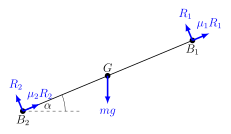
\(B_1\) and \(B_2\) are parallel, thin, horizontal fixed beams. \(B_1\) is a vertical distance \(d \sin \alpha \) above \(B_2\), and a horizontal distance \(d\cos\alpha \) from \(B_2\,\), where \(0<\alpha<\pi/2\,\). A long heavy plank is held so that it rests on the two beams, perpendicular to each, with its centre of gravity at \(B_1\,\). The coefficients of friction between the plank and \(B_1\) and \(B_2\) are \(\mu_1\) and \(\mu_2\,\), respectively, where \(\mu_1<\mu_2\) and \(\mu_1+\mu_2=2\tan\alpha\,\). The plank is released and slips over the beams experiencing a force of resistance from each beam equal to the limiting frictional force (i.e. the product of the appropriate coefficient of friction and the normal reaction). Show that it will come to rest with its centre of gravity over \(B_2\) in a time \[ \pi \left(\frac{d}{g(\mu_2-\mu_1)\cos\alpha }\right)^{\!\frac12}\;. \]
Solution:
2001 Paper 3 Q10
Three ships \(A\), \(B\) and \(C\) move with velocities \({\bf v}_1\), \({\bf v}_2\) and \(\bf u\) respectively. The velocities of \(A\) and \(B\) relative to \(C\) are equal in magnitude and perpendicular. Write down conditions that \(\bf u\), \({\bf v}_1\) and \({\bf v}_2\) must satisfy and show that \[ \left| {\bf u} -{\textstyle\frac12} \l {\bf v}_1 + {\bf v}_2 \r \right|^2 = \left|{\textstyle\frac12} \l {\bf v}_1 - {\bf v}_2 \r \right|^2 \] and \[ \l {\bf u} -{\textstyle\frac12} \l {\bf v}_1 + {\bf v}_2 \r \r \cdot \l {\bf v}_1 - {\bf v}_2 \r = 0 \;. \] Explain why these equations determine, for given \({\bf v}_1\) and \({\bf v}_2\), two possible velocities for \(C\,\), provided \({\bf v}_1 \ne {\bf v}_2 \,\). If \({\bf v}_1\) and \({\bf v}_2\) are equal in magnitude and perpendicular, show that if \({\bf u} \ne {\bf 0}\) then \({\bf u} = {\bf v}_1 + {\bf v}_2\,\).
2001 Paper 3 Q11
A uniform cylinder of radius \(a\) rotates freely about its axis, which is fixed and horizontal. The moment of inertia of the cylinder about its axis is \(I\,\). A light string is wrapped around the cylinder and supports a mass \(m\) which hangs freely. A particle of mass \(M\) is fixed to the surface of the cylinder. The system is held at rest with the particle vertically below the axis of the cylinder, and then released. Find, in terms of \(I\), \(a\), \(M\), \(m\), \(g\) and \(\theta\), the angular velocity of the cylinder when it has rotated through angle \(\theta\,\). Show that the cylinder will rotate without coming to a halt if \(m/M>\sin\alpha\,\), where \(\alpha\) satisifes \(\alpha=\tan \frac12\alpha\) and \(0<\alpha<\pi\,\).
2001 Paper 3 Q12
A bag contains \(b\) black balls and \(w\) white balls. Balls are drawn at random from the bag and when a white ball is drawn it is put aside.
- If the black balls drawn are also put aside, find an expression for the expected number of black balls that have been drawn when the last white ball is removed.
- If instead the black balls drawn are put back into the bag, prove that the expected number of times a black ball has been drawn when the first white ball is removed is \(b/w\,\). Hence write down, in the form of a sum, an expression for the expected number of times a black ball has been drawn when the last white ball is removed.
2001 Paper 3 Q13
In a game for two players, a fair coin is tossed repeatedly. Each player is assigned a sequence of heads and tails and the player whose sequence appears first wins. Four players, \(A\), \(B\), \(C\) and \(D\) take turns to play the game. Each time they play, \(A\) is assigned the sequence TTH (i.e.~Tail then Tail then Head), \(B\) is assigned THH, \(C\) is assigned HHT and \(D\) is assigned~HTT.
- \(A\) and \(B\) play the game. Let \(p_{\mathstrut\mbox{\tiny HH}}\), \(p_{\mathstrut\mbox{\tiny HT}}\), \(p_{\mathstrut\mbox{\tiny TH}}\) and \(p_{\mathstrut\mbox{\tiny TT}}\) be the probabilities of \(A\) winning the game given that the first two tosses of the coin show HH, HT, TH and TT, respectively. Explain why \(p_{\mathstrut\mbox{\tiny TT}} = 1\,\), and why $p_{\mathstrut\mbox{\tiny HT}} = {1 \over 2} \, p_{\mathstrut\mbox{\tiny TH}} + {1\over 2} \, p_{\mathstrut\mbox{\tiny TT}}\,$. Show that $p_{\mathstrut\mbox{\tiny HH}} = p_{\mathstrut\mbox{\tiny HT}} = {2 \over 3}$ and that \(p_{\mathstrut\mbox{\tiny TH}} = {1\over 3}\,\). Deduce that the probability that A wins the game is \({2\over 3}\,\).
- \(B\) and \(C\) play the game. Find the probability that \(B\) wins.
- Show that if \(C\) plays \(D\), then \(C\) is more likely to win than \(D\), but that if \(D\) plays \(A\), then \(D\) is more likely to win than \(A\).
2001 Paper 3 Q14
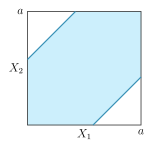
A random variable \(X\) is distributed uniformly on \([\, 0\, , \, a\,]\). Show that the variance of \(X\) is \({1 \over 12} a^2\). A sample, \(X_1\) and \(X_2\), of two independent values of the random variable is drawn, and the variance \(V\) of the sample is determined. Show that \(V = {1 \over 4} \l X_1 -X_2 \r ^2\), and hence prove that \(2 V\) is an unbiased estimator of the variance of X. Find an exact expression for the probability that the value of \(V\) is less than \({1 \over 12} a^2\) and estimate the value of this probability correct to one significant figure.
Solution: \begin{align*} && \E[X] &= \frac{a}{2}\tag{by symmetry} \\ &&\E[X^2] &= \int_0^a \frac{1}{a} x^2 \d x \\ &&&= \frac{a^3}{3a} = \frac{a^2}{3} \\ \Rightarrow && \var[X] &= \frac{a^2}{3} - \frac{a^2}{4} = \frac{a^2}{12} \\ \end{align*} \begin{align*} && V &=\frac{1}{2} \left ( \left ( X_1 - \frac{X_1+X_2}{2} \right )^2+\left ( X_2- \frac{X_1+X_2}{2} \right )^2 \right ) \\ &&&= \frac{1}{8} ((X_1 - X_2)^2 + (X_2 - X_1)^2 ) \\ &&&= \frac14 (X_1-X_2)^2 \\ \\ && \E[2V] &= \E \left [ \frac12 (X_1 - X_2)^2 \right] \\ &&&= \frac12 \E[X_1^2] - \E[X_1X_2] + \frac12 \E[X_2^2] \\ &&&= \frac{a^2}{3} - \frac{a^2}{4} = \frac{a^2}{12} \end{align*} Therefore \(2V\) is an unbiased estimator of the variance of \(X\).