2001 Paper 3 Q14
Year: 2001
Paper: 3
Question Number: 14
Course: UFM Statistics
Section: Central limit theorem
Difficulty: 1700.0
Banger: 1484.0
uniform distribution
variance
unbiased estimator
sample variance
central limit theorem
probability density function
continuous distribution
order statistics
Problem
A random variable \(X\) is distributed uniformly on \([\, 0\, , \, a\,]\).
Show that the variance of \(X\) is \({1 \over 12} a^2\).
A sample, \(X_1\) and \(X_2\), of two independent values of the random variable is drawn, and the variance \(V\) of the sample is determined. Show that \(V = {1 \over 4} \l X_1 -X_2 \r ^2\), and hence prove that \(2 V\) is an unbiased estimator of the variance of X.
Find an exact expression for the probability that the value of \(V\) is less than \({1 \over 12} a^2\) and estimate the value of this probability correct to one significant figure.
Solution
\begin{align*}
&& \E[X] &= \frac{a}{2}\tag{by symmetry} \\
&&\E[X^2] &= \int_0^a \frac{1}{a} x^2 \d x \\
&&&= \frac{a^3}{3a} = \frac{a^2}{3} \\
\Rightarrow && \var[X] &= \frac{a^2}{3} - \frac{a^2}{4} = \frac{a^2}{12} \\
\end{align*}
\begin{align*}
&& V &=\frac{1}{2} \left ( \left ( X_1 - \frac{X_1+X_2}{2} \right )^2+\left ( X_2- \frac{X_1+X_2}{2} \right )^2 \right ) \\
&&&= \frac{1}{8} ((X_1 - X_2)^2 + (X_2 - X_1)^2 ) \\
&&&= \frac14 (X_1-X_2)^2 \\
\\
&& \E[2V] &= \E \left [ \frac12 (X_1 - X_2)^2 \right] \\
&&&= \frac12 \E[X_1^2] - \E[X_1X_2] + \frac12 \E[X_2^2] \\
&&&= \frac{a^2}{3} - \frac{a^2}{4} = \frac{a^2}{12}
\end{align*}
Therefore \(2V\) is an unbiased estimator of the variance of \(X\).
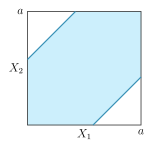 We need \(|X_1 - X_2| < \frac{a}{\sqrt{3}}\)
We are interested in the blue area, which is \(a^2 - a^2(1- \frac{1}{\sqrt{3}})^2 = a^2 \left ( \frac{2}{\sqrt{3}} - \frac13 \right)\) ie the probability is \(\frac{2\sqrt{3}-1}{3} \approx 0.8\)
We need \(|X_1 - X_2| < \frac{a}{\sqrt{3}}\)
We are interested in the blue area, which is \(a^2 - a^2(1- \frac{1}{\sqrt{3}})^2 = a^2 \left ( \frac{2}{\sqrt{3}} - \frac13 \right)\) ie the probability is \(\frac{2\sqrt{3}-1}{3} \approx 0.8\)
Rating Information
Difficulty Rating: 1700.0
Difficulty Comparisons: 0
Banger Rating: 1484.0
Banger Comparisons: 1
Show LaTeX source
Problem source
A random variable $X$ is distributed uniformly on $[\, 0\, , \, a\,]$.
Show that the variance of $X$ is ${1 \over 12} a^2$.
A sample, $X_1$ and $X_2$, of two independent values of the random variable is drawn, and the variance $V$ of the sample is determined. Show that $V = {1 \over 4} \l X_1 -X_2 \r ^2$, and hence prove that $2 V$ is an unbiased estimator of the variance of X.
Find an exact expression for the probability that the value of $V$ is less than ${1 \over 12} a^2$ and estimate the value of this probability correct to one significant figure.
Solution source
\begin{align*}
&& \E[X] &= \frac{a}{2}\tag{by symmetry} \\
&&\E[X^2] &= \int_0^a \frac{1}{a} x^2 \d x \\
&&&= \frac{a^3}{3a} = \frac{a^2}{3} \\
\Rightarrow && \var[X] &= \frac{a^2}{3} - \frac{a^2}{4} = \frac{a^2}{12} \\
\end{align*}

\begin{align*}
&& V &=\frac{1}{2} \left (  \left ( X_1 - \frac{X_1+X_2}{2} \right )^2+\left ( X_2- \frac{X_1+X_2}{2} \right )^2 \right ) \\
&&&= \frac{1}{8} ((X_1 - X_2)^2 + (X_2 - X_1)^2 ) \\
&&&= \frac14 (X_1-X_2)^2 \\
\\
&& \E[2V] &= \E \left [ \frac12 (X_1 - X_2)^2 \right] \\
&&&= \frac12 \E[X_1^2] - \E[X_1X_2] + \frac12 \E[X_2^2] \\
&&&= \frac{a^2}{3} - \frac{a^2}{4} = \frac{a^2}{12}
\end{align*}

Therefore $2V$ is an unbiased estimator of the variance of $X$.

\begin{center}
    \begin{tikzpicture}
    \def\functionf(#1){0.5 * exp(-abs(#1))};
    \def\xl{-4};
    \def\xu{4};
    \def\yl{-0.2}; \def\yu{.75};

    % Calculate scaling factors to make the plot square
    % \pgfmathsetmacro{\xrange}{\xu-\xl}
    % \pgfmathsetmacro{\yrange}{\yu-\yl}
    % \pgfmathsetmacro{\xscale}{10/\xrange}
    % \pgfmathsetmacro{\yscale}{10/\yrange}

    % Define the reusable styles to keep code clean
    \tikzset{
        % x=\xscale cm, y=\yscale cm,
        axis/.style={thick, draw=black!80},
        grid/.style={thin, dashed, gray!30},
        curveA/.style={very thick, color=cyan!70!black, smooth},
        curveB/.style={very thick, color=orange!90!black, smooth},
        dot/.style={circle, fill=black, inner sep=1.2pt},
        labelbox/.style={fill=white, inner sep=2pt, rounded corners=2pt} % Protects text from lines
    }

    \filldraw[color=cyan!20] (0,0) -- (0, {4/sqrt(3)}) -- ({4-4/sqrt(3)},4) --
                (4,4) -- (4,{4-4/sqrt(3)}) -- ({4/sqrt(3)},0)  -- cycle;
    \draw[axis] (0,0) rectangle (4,4);

    \node[below] at (2,0) {$X_1$};
    \node[below] at (4,0) {$a$};
    \node[left] at (0,4) {$a$};
    \node[left] at (0, 2) {$X_2$};

    \draw[curveA] (0, {4/sqrt(3)}) -- ({4-4/sqrt(3)},4);
    \draw[curveA] ({4/sqrt(3)},0) -- (4,{4-4/sqrt(3)});

    % \draw[curveA] (0, {4/sqrt(3)}) -- ({1-4/sqrt(3)},1);
        % Set up axes


    \end{tikzpicture}
\end{center}

We need $|X_1 - X_2| < \frac{a}{\sqrt{3}}$

We are interested in the blue area, which is $a^2 - a^2(1- \frac{1}{\sqrt{3}})^2 = a^2 \left ( \frac{2}{\sqrt{3}} - \frac13 \right)$ ie the probability is $\frac{2\sqrt{3}-1}{3} \approx 0.8$