Problems
Filters
142 problems found
2013 Paper 3 Q8
Evaluate \(\displaystyle \sum_{r=0}^{n-1} \e^{2i(\alpha + r\pi/n)}\) where \(\alpha\) is a fixed angle and \(n\ge2\). The fixed point \(O\) is a distance \(d\) from a fixed line \(D\). For any point \(P\), let \(s\) be the distance from \(P\) to \(D\) and let \(r\) be the distance from \(P\) to \(O\). Write down an expression for \(s\) in terms of \(d\), \(r\) and the angle \(\theta\), where \(\theta\) is as shown in the diagram below.

Solution: \begin{align*} \sum_{r=0}^{n-1} \e^{2i(\alpha + r\pi/n)} &= e^{2i\alpha} \sum_{r=0}^{n-1} \left (\e^{2i\pi/n} \right)^r \\ &= e^{2i\alpha} \frac{1-\left (\e^{2i\pi/n} \right)^n}{1-\e^{2i\pi/n} } \\ &= 0 \end{align*} \(d = s + r \cos \theta\) ie \(s = d - r \cos \theta\) Therefore \(d = \frac{r}{k} + r \cos \theta \Rightarrow r = \frac{kd}{1+k \cos \theta}\). The \(l_j\) will come from \(r(\alpha + \frac{j \pi}{n} )+r(\alpha + \pi + \frac{j \pi}{n} )\) \begin{align*} && l_j &= r(\alpha + \frac{(j-1) \pi}{n} )+r(\alpha + \pi + \frac{(j-1) \pi}{n} ) \\ &&&= \frac{kd}{1+k \cos \left ( \alpha + \frac{(j-1) \pi}{n}\right)}+\frac{kd}{1+k \cos \left ( \alpha+\pi+ \frac{(j-1) \pi}{n}\right)}\\ &&&= \frac{kd}{1+k \cos \left ( \alpha + \frac{(j-1) \pi}{n}\right)}+\frac{kd}{1-k \cos \left ( \alpha+ \frac{(j-1) \pi}{n}\right)}\\ &&&= \frac{2kd}{1-k^2 \cos^2 \left ( \alpha + \frac{(j-1) \pi}{n}\right)}\\ \Rightarrow && \sum_{j=1}^n \frac 1 {l_j} &= \sum_{j=0}^{n-1} \frac{1-k^2 \cos^2 \left ( \alpha + \frac{j \pi}{n}\right)}{2kd} \\ &&&= \frac{n}{2kd}-\frac{k^2}{2kd} \sum_{j=0}^{n-1} \cos^2 \left ( \alpha + \frac{j \pi}{n}\right) \\ &&&= \frac{n}{2kd}-\frac{k^2}{2kd} \sum_{j=0}^{n-1} \frac{1+ \cos \left ( 2\alpha + \frac{2j \pi}{n}\right)}{2} \\ &&&= \frac{n}{2kd}-\frac{nk^2}{2kd}-\frac{k^2}{4kd} \sum_{j=0}^{n-1}\cos \left ( 2\alpha + \frac{2j \pi}{n}\right) \\ &&&= \frac{n}{2kd}-\frac{nk^2}{2kd}-\frac{k^2}{4kd} \underbrace{\textrm{Re} \left ( \sum_{j=0}^{n-1}e^{ 2i(\alpha + \frac{j \pi}{n})} \right)}_{=0} \\ &&&= \frac{n}{2kd} - \frac{nk^2}{4kd} \\ &&&= \frac{n(2-k^2)}{4kd} \end{align*}
2012 Paper 1 Q3
- Sketch the curve \(y=\sin x\) for \(0\le x \le \tfrac12 \pi\) and add to your diagram the tangent to the curve at the origin and the chord joining the origin to the point \((b, \sin b)\), where \(0 < b < \frac12\pi\). By considering areas, show that \[ 1-\tfrac12 b^2 <\cos b < 1-\tfrac 12 b \sin b\,. \]
- By considering the curve \(y=a^x\), where \(a>1\), show that \[ \frac{2(a-1)}{a+1} < \ln a < -1 + \sqrt{2a-1\,}\,. \] [Hint: You may wish to write \(a^x\) as \(\e^{x\ln a}\).]
Solution:
- \(\,\)
The area under the blue curve is \(1-\cos b\). The area under the green line is \(\frac12 b \sin b\) The area under the red line is \(\frac12 b^2\) Therefore \(\frac12 b \sin b < 1- \cos b < \frac12 b^2 \Rightarrow 1- \frac12 b^2 < \cos b < 1 - \frac12 b \sin b\)

- \(\,\)
\begin{align*} &&\text{Area under blue curve}: &= \int_0^1 a^x \d x\\ &&&= \left [ \frac{1}{\ln a}e^{x \ln a} \right]_0^1 \\ &&&= \frac{a-1}{\ln a} \\ \\ &&\text{Area under green line}: &=\frac12 \cdot 1 \cdot (a + 1)\\ &&&= \frac{a+1}{2} \\ \\ &&\text{Area under tangent}: &=\frac12 \cdot 1 \cdot (1+\ln a + 1)\\ &&&= \frac{\ln a+2}{2} \\ \\ \Rightarrow && \frac{a+1}{2} & > \frac{a-1}{\ln a} \\ \Rightarrow && \ln a& > \frac{2(a-1)}{a+1} \\ \\ \Rightarrow && \frac{a-1}{\ln a} &> \frac{\ln a +2}{2} \\ \Rightarrow && 2(a-1) -2\ln a - (\ln a)^2 &> 0 \\ \Rightarrow && \ln a & < -1 + \sqrt{2a-1} \end{align*}

2012 Paper 1 Q5
Show that \[ \int_0^{\frac14\pi} \sin (2x) \ln(\cos x)\, \d x = \frac14(\ln 2 -1)\,, \] and that \[ \int_0^{\frac14\pi} \cos (2x) \ln(\cos x)\, \d x = \frac18(\pi -\ln 4-2)\,. \] Hence evaluate \[ \int_{\frac14\pi}^{\frac12\pi} \big ( \cos(2x) + \sin (2x)\big) \, \ln \big( \cos x + \sin x\big)\, \d x\,. \]
Solution: \begin{align*} &&\int_0^{\frac14\pi} \sin (2x) \ln(\cos x)\, \d x &= \int_0^{\frac14 \pi} 2 \sin x \cos x \ln (\cos x) \d x \\ u = \cos \theta :&&&= \int_{u=1}^{u=\frac1{\sqrt2}} -2u \ln u \d u \\ &&&= \int_{\frac1{\sqrt{2}}}^1 2u \ln u \d u \\ &&&= \left [u^2 \ln u \right]_{\frac1{\sqrt{2}}}^1-\int_{\frac1{\sqrt{2}}}^1 u \d u \\ &&&= -\frac12 \ln \frac{1}{\sqrt{2}} - \l\frac12 - \frac14 \r \\ &&&= \frac14 (\ln 2 - 1) \end{align*} \begin{align*} && \int_0^{\frac14\pi} \cos (2x) \ln(\cos x)\, \d x &= \left [ \frac12 \sin 2x \ln (\cos x) \right]_0^{\frac14\pi}- \int_0^{\frac14\pi} \frac12 \sin 2x \frac{-\sin x}{\cos x} \d x \\ &&&=\frac12 \ln \frac{1}{\sqrt{2}}+\int_0^{\frac14\pi} \sin^2 x \d x \\ &&&= -\frac14 \ln 2 + \int_0^{\frac14\pi} \frac{1-\cos 2x }{2} \d x \\ &&&= -\frac14 \ln 2 +\frac{\pi}{8} -\frac{1}{4} \\ &&&= \frac18 (\pi - 2\ln 2 - 2) \\ &&&= \frac18 (\pi - \ln 4 - 2) \\ \end{align*} Notice that \(\cos x + \sin x = \sqrt{2} \cos (x -\frac{\pi}{4})\), so: \begin{align*} &&\int_{\frac14\pi}^{\frac12\pi} \big ( \cos(2x) + \sin (2x)\big) \ln \big( \cos x + \sin x\big)\d x &= \int_{\frac14\pi}^{\frac12\pi} \big ( \cos(2x) + \sin (2x)\big) \ln (\sqrt{2} \cos ( x - \frac{\pi}{4}) ) \d x \\ &&&= \int_{u=0}^{u=\frac{\pi}{4}} \l \cos(2u+\frac{\pi}{2})+\sin(2u+\frac{\pi}{2}) \r \cdot \l \frac12 \ln 2 +\ln (\cos u) \r \d x \\ &&&= \int_{0}^{\frac{\pi}{4}} \l -\sin 2u+\cos 2u \r \cdot \l \frac12 \ln 2 +\ln (\cos u) \r \d x \\ &&&= \frac14 \ln 2\left [ \cos 2u + \sin 2u \ \right]_{0}^{\frac{\pi}{4}} - \frac14(\ln2 - 1) + \frac18\pi - \frac14(\ln 2 +1) \\ &&&= \frac{\pi}{8}-\frac12 \ln 2 \end{align*}
2012 Paper 1 Q9
A tall shot-putter projects a small shot from a point \(2.5\,\)m above the ground, which is horizontal. The speed of projection is \(10\,\text{ms}^{- 1}\) and the angle of projection is \(\theta\) above the horizontal. Taking the acceleration due to gravity to be \(10\,\text{ms}^{-2}\), show that the time, in seconds, that elapses before the shot hits the ground is \[ \frac1{\sqrt2}\left ( \sqrt{1-c}+ \sqrt{2-c}\right), \] where \(c = \cos2\theta\). Find an expression for the range in terms of \(c\) and show that it is greatest when \(c= \frac15\,\). Show that the extra distance attained by projecting the shot at this angle rather than at an angle of \(45^\circ\) is \(5(\sqrt6 -\sqrt2 -1)\,\)m.
Solution: \begin{align*} && s &= ut + \frac12 gt^2 \\ \Rightarrow && -2.5 &= 10 \sin \theta \, T - 5 T^2 \\ \Rightarrow && T &= \frac{10\sin \theta \pm \sqrt{100\sin^2 \theta - 4 \cdot 5 \cdot (-2.5)}}{10} \\ &&&= \sin \theta +\sqrt{\sin^2 \theta + \frac12} \\ &&&= \frac1{\sqrt{2}} \left ( \sqrt{2} \sin \theta +\sqrt{2 \sin^2 \theta +1} \right) \\ &&&= \frac1{\sqrt{2}} \left ( \sqrt{2 (1-\cos^2 \theta)} + \sqrt{2-\cos 2\theta} \right) \\ &&&= \frac1{\sqrt{2}} \left ( \sqrt{1-\cos2 \theta} + \sqrt{2-\cos 2\theta} \right) \\ &&&= \frac{1}{\sqrt{2}}\left ( \sqrt{1-c}+\sqrt{2-c} \right)\\ \\ && s &= 10 \cos \theta T \\ &&&= 10 \sqrt{\frac{\cos 2 \theta +1}{2}}\frac{1}{\sqrt{2}}\left ( \sqrt{1-c}+\sqrt{2-c} \right) \\ &&&= 5 \sqrt{c+1}\left ( \sqrt{1-c}+\sqrt{2-c} \right) \\ \\ && \frac15\frac{\d s}{\d c} &= \frac12(c+1)^{-1/2}((1-c)^{1/2} + (2-c)^{1/2}) - \frac12(c+1)^{1/2}\left ((1-c)^{-1/2}+(2-c)^{-1/2} \right) \\ &&&= \frac{((1-c)(2-c)^{1/2}+(2-c)(1-c)^{1/2})-((c+1)(2-c)^{1/2}+(c+1)(1-c)^{1/2})}{2\sqrt{c+1}\sqrt{1-c}\sqrt{2-c}} \\ &&&= \frac{\sqrt{2-c}\left (1-c-c-1 \right)+\sqrt{1-c}\left(2-c-c-1) \right)}{2\sqrt{c+1}\sqrt{1-c}\sqrt{2-c}} \\ &&&= \frac{\sqrt{1-c}\left(1-2c\right)-2c\sqrt{2-c}}{2\sqrt{c+1}\sqrt{1-c}\sqrt{2-c}} \\ \\ \frac{\d s}{\d c} =0: && \sqrt{1-c}\left(1-2c\right)&=2c\sqrt{2-c} \\ \Rightarrow && (1-c)(1-2c)^2&=4c^2(2-c) \\ \Rightarrow && 1-5c+8c^2-4c^3 &= 8c^2-4c^3 \\ \Rightarrow && 0 &= -5c+1 \\ \Rightarrow && c &= \frac15 \end{align*} When \(\theta = 45^{\circ}, c = 0\), so \(s_{45^{\circ}} = 5(1+\sqrt{2})\) When \(c = \frac15\), \begin{align*} s &= 5 \sqrt{\frac15+1}\left ( \sqrt{1-\frac15}+\sqrt{2-\frac15} \right) \\ &= 5 \sqrt{\frac65} \left ( \sqrt{\frac45} + \sqrt{\frac95} \right) \\ &= 2\sqrt{6}+3\sqrt{6} = 5\sqrt{6} \end{align*} Therefore the additional distance is \(5(\sqrt{6}-\sqrt{2}-1)\)
2012 Paper 2 Q9
A tennis ball is projected from a height of \(2h\) above horizontal ground with speed \(u\) and at an angle of \(\alpha\) below the horizontal. It travels in a plane perpendicular to a vertical net of height \(h\) which is a horizontal distance of \(a\) from the point of projection. Given that the ball passes over the net, show that \[ \frac 1{u^2}< \frac {2(h-a\tan\alpha)}{ga^2\sec^2\alpha}\,. \] The ball lands before it has travelled a horizontal distance of \(b\) from the point of projection. Show that \[ \sqrt{u^2\sin^2\alpha +4gh \ } < \frac{bg}{u\cos\alpha} + u \sin\alpha\,. \] Hence show that \[ \tan\alpha < \frac{h(b^2-2a^2)}{ab(b-a)}\,. \]
Solution: \begin{align*} && s &= ut \\ \Rightarrow && a &= u \cos \alpha t\\ \Rightarrow && t &= \frac{a}{u \cos \alpha}\\ && s &= ut+ \frac12at^2 \\ \Rightarrow && -h &< -u\sin \alpha \frac{a}{u \cos \alpha}-\frac12 g \left (\frac{a}{u \cos \alpha} \right)^2 \\ &&&= -a \tan \alpha-\frac12 g a^2 \frac{1}{u^2} \sec^2 \alpha \\ \Rightarrow && \frac12 g a^2 \frac{1}{u^2} \sec^2 \alpha &< h -a\tan \alpha \\ \Rightarrow &&\frac{1}{u^2} &< \frac{2(h-a\tan \alpha)}{ga^2 \sec^2 \alpha} \end{align*} \begin{align*} && s &= ut + \frac12a t^2 \\ \Rightarrow && 2h &= u\sin \alpha t + \frac12 gt^2 \\ \Rightarrow && t &= \frac{-u\sin \alpha \pm \sqrt{u^2 \sin^2 \alpha+4hg}}{g}\\ && t &= \frac{-u\sin \alpha +\sqrt{u^2 \sin^2 \alpha+4hg}}{g}\\ && s &= ut \\ \Rightarrow && b &> u \cos \alpha t \\ \Rightarrow && \frac{b}{u \cos \alpha} &> \frac{-u\sin \alpha +\sqrt{u^2 \sin^2 \alpha+4hg}}{g} \\ \Rightarrow && \sqrt{u^2 \sin^2 \alpha+4hg} &< \frac{bg}{u \cos \alpha} + u \sin \alpha \\ \end{align*} \begin{align*} \Rightarrow && u^2 \sin^2 \alpha+4hg &< \frac{b^2g^2}{u^2 \cos^2 \alpha} +u^2 \sin^2 \alpha + 2bg \tan \alpha \\ \Rightarrow && 4hg - 2bg \tan \alpha &< \frac{b^2g^2}{u^2 \cos^2 \alpha} \\ &&&< \frac{b^2g^2}{\cos^2 \alpha} \frac{2(h-a\tan \alpha)}{ga^2 \sec^2 \alpha} \\ &&&= \frac{2b^2g(h-a\tan \alpha)}{a^2} \\ \Rightarrow && \tan \alpha \left (\frac{2b^2g}{a} - 2bg \right) &< \frac{2b^2gh}{a^2} - 4hg \\ \Leftrightarrow && \tan \alpha \left (\frac{2b^2g- 2abg}{a} \right) &< \frac{2b^2gh- 4hga^2}{a^2} \\ \Leftrightarrow && \tan \alpha \left (\frac{2bg(b- a)}{a} \right) &< \frac{2hg(b^2- 2a^2)}{a^2} \\ \Rightarrow && \tan \alpha &< \frac{h(b^2-2a^2)}{ab(b-a)} \end{align*}
2012 Paper 2 Q10
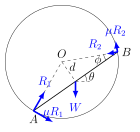
A hollow circular cylinder of internal radius \(r\) is held fixed with its axis horizontal. A uniform rod of length \(2a\) (where \(a < r\)) rests in equilibrium inside the cylinder inclined at an angle of \(\theta\) to the horizontal, where \(\theta\ne0\). The vertical plane containing the rod is perpendicular to the axis of the cylinder. The coefficient of friction between the cylinder and each end of the rod is \(\mu\), where \(\mu > 0\). Show that, if the rod is on the point of slipping, then the normal reactions \(R_1\) and \(R_2\) of the lower and higher ends of the rod, respectively, on the cylinder are related by \[ \mu(R_1+R_2) = (R_1-R_2)\tan\phi \] where \(\phi\) is the angle between the rod and the radius to an end of the rod. Show further that \[ \tan\theta = \frac {\mu r^2}{r^2 -a^2(1+\mu^2)}\,. \] Deduce that \(\lambda <\phi \), where \(\tan\lambda =\mu\).
Solution:
2011 Paper 1 Q5
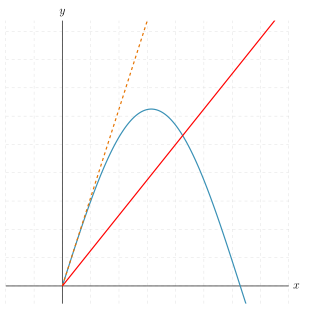
Given that \(0 < k < 1\), show with the help of a sketch that the equation \[ \sin x = k x \tag{\(*\)}\] has a unique solution in the range \(0 < x < \pi\). Let \[ I= \int_0^\pi \big\vert \sin x -kx\big\vert \, \d x\,. \] Show that \[ I= \frac{\pi^2 \sin\alpha }{2\alpha} -2\cos\alpha - \alpha \sin\alpha\,, \] where \(\alpha\) is the unique solution of \((*)\). Show that \(I\), regarded as a function of \(\alpha\), has a unique stationary value and that this stationary value is a minimum. Deduce that the smallest value of \(I\) is \[ -2 \cos \frac{\pi}{\sqrt2}\, .\]
Solution:
2011 Paper 2 Q3
In this question, you may assume without proof that any function \(\f\) for which \(\f'(x)\ge 0\) is increasing; that is, \(\f(x_2)\ge \f(x_1)\) if \(x_2\ge x_1\,\).
- Let \(\f(x) =\sin x -x\cos x\). Show that \(\f(x)\) is increasing for \(0\le x \le \frac12\pi\,\) and deduce that \(\f(x)\ge 0\,\) for \(0\le x \le \frac12\pi\,\).
- Given that \(\dfrac{\d}{\d x} (\arcsin x) \ge1\) for \(0\le x< 1\), show that \[ \arcsin x\ge x \quad (0\le x < 1). \]
- Let \(\g(x)= x\cosec x\, \text{ for }0< x < \frac12\pi\). Show that \(\g\) is increasing and deduce that \[ ({\arcsin x})\, x^{-1} \ge x\,{\cosec x} \quad (0 < x < 1). \]
- Given that $\dfrac{\d}{\d x} (\arctan x)\le 1\text{ for }x\ge 0$, show by considering the function \(x^{-1} \tan x\) that \[ (\tan x)( \arctan x) \ge x^2 \quad (0< x < \tfrac12\pi). \]
Solution:
- Given \(\frac{\d}{\d x} (\arctan x) \leq 1\) we must have \(\frac{\d}{ \d x} (x-\arctan x) \geq 0\) for \(x \geq 0\), but since \( 0 - \arctan 0 = 0\) this means that \(x - \arctan x \geq 0\), ie \( \arctan x \geq x\) for \(x \geq 0\) \(g(x) = x^{-1} \tan x \Rightarrow g'(x) = -x^{-2}\tan x +x^{-1} \sec^2 x\). If we can show \(f(x) = x \sec ^2 x - \tan x\) is positive that would be great. However \(f'(x) = x 2 \tan x \sec^2 x \geq 0\) and \(f(0) = 0\) so \(f(x)\) is positive and \(g'(x)\) is positive and hence increasing, therefore \(g(x) \geq g(\arctan x) \Rightarrow \frac{\tan x}{x} \geq \frac{x}{\arctan x}\) from which the result follows.
2011 Paper 2 Q6
For any given function \(\f\), let \[ I = \int [\f'(x)]^2 \,[\f(x)]^n \d x\,, \tag{\(*\)} \] where \(n\) is a positive integer. Show that, if \(\f(x)\) satisfies \(\f''(x) =k \f(x)\f'(x)\) for some constant \(k\), then (\(*\)) can be integrated to obtain an expression for \(I\) in terms of \(\f(x)\), \(\f'(x)\), \(k\) and \(n\).
- Verify your result in the case \(\f(x) = \tan x\,\). Hence find \[ \displaystyle \int \frac{\sin^4x}{\cos^{8}x} \, \d x\;. \]
- Find \[ \displaystyle \int \sec^2x\, (\sec x + \tan x)^6\,\d x\;. \]
Solution: If \(f''(x) = kf(x)f'(x)\) then we can see \begin{align*} && I &= \int [\f'(x)]^2 \,[\f(x)]^n \d x \\ &&&= \int f'(x) \cdot f'(x) [f(x)]^n \d x \\ &&&= \left[ f'(x) \cdot \frac{[f(x)]^{n+1}}{n+1} \right] - \int f''(x) \frac{[f(x)]^{n+1}}{n+1} \d x \\ &&&= \frac{1}{n+1} \left (f'(x) [f(x)]^{n+1} - \int kf'(x) [f(x)]^{n+2} \d x \right) \\ &&&= \frac{1}{n+1} \left (f'(x) [f(x)]^{n+1} - k \frac{[f(x)]^{n+3}}{n+3} \right) +C\\ &&&= \frac{[f(x)]^{n+1}}{n+1} \left ( f'(x) - \frac{k[f(x)]^2}{n+3} \right) + C \end{align*}
- If \(f(x) = \tan x, f'(x) = \sec^2 x, f''(x) = 2 \sec^2 x \tan x = 2 \cdot f(x) \cdot f'(x)\), so \(\tan\) satisfies the conditions for the theorem. \begin{align*} && I &= \int \sec^4 x \tan^n x \d x \\ &&&= \left [\sec^2x \cdot \frac{\tan^{n+1} x}{n+1} \right] - \int 2 \sec^2 x \tan x \cdot \frac{\tan^{n+1} x}{n+1} \d x \\ &&&= \left [\sec^2x \cdot \frac{\tan^{n+1} x}{n+1} \right] - 2 \cdot \frac{\tan^{n+3} x}{(n+1)(n+3)} \\ \end{align*} So \begin{align*} && I &= \int \frac{\sin^4 x}{\cos^8 x} \d x \\ &&&= \int \tan^4 x \sec^4 x \d x \\ &&&= \int [\sec^2 x]^2 [\tan x]^4 \d x \\ &&&= \frac{\tan^{5}x}{5} \left ( \sec^2 x - \frac{2 \tan^2 x}{7} \right) + C \end{align*}
- \begin{align*} && I &= \int \sec^2x\, (\sec x + \tan x)^6\,\d x \\ &&&= \int (\sec x (\sec x + \tan x))^2 \cdot (\sec x + \tan x )^4 \d x \\ &&&= \frac{(\sec x + \tan x)^5}{5} \left ( \sec x (\sec x + \tan x) - \frac{(\sec x + \tan x)^2}{7} \right) + C \end{align*}
2010 Paper 2 Q1
Let \(P\) be a given point on a given curve \(C\). The \textit{osculating circle} to \(C\) at \(P\) is defined to be the circle that satisfies the following two conditions at \(P\): it touches \(C\); and the rate of change of its gradient is equal to the rate of change of the gradient of \(C\). Find the centre and radius of the osculating circle to the curve \(y=1-x+\tan x\) at the point on the curve with \(x\)-coordinate \(\frac14 \pi\).
Solution: The condition is that we match the first and second derivative (as well as passing through the point in question, which is \((\frac{\pi}{4}, 2 - \frac{\pi}{4})\) The gradient is \(y' = -1 + \sec^2 x\), so the value is \(1\). The second derivative is \(y'' = 2 \sec^2 x \tan x\), which is \(4\) If we have a circle, radius \(r\), so \((x-a)^2 + (y-b)^2 = r^2\) then \(2(x-a) + 2(y-b) \frac{\d y}{\d x} = 0\) and \(2 + 2 \left ( \frac{\d y}{\d x} \right)^2 + 2(y-b) \frac{\d^2y}{\d x^2} = 0\). Therefore we must have \(1+1+(2-\frac{\pi}{4}-b)4 = 0 \Rightarrow b =\frac52-\frac{\pi}{4}\) We know that the centre lies on the line \(y = 2-x\), so we must have \(a = \frac{\pi}{4}-\frac12\) and so the centre is \(( \frac{\pi}{4} - \frac12,\frac52 - \frac{\pi}{4})\) and the radius is \(\sqrt{\frac14 + \frac14} = \frac{\sqrt{2}}{2}\)
2010 Paper 2 Q2
Prove that \[ \cos 3x = 4 \cos^3 x - 3 \cos x \,. \] Find and prove a similar result for \(\sin 3x\) in terms of \(\sin x\).
- Let \[ {\rm I}(\alpha) = \int_0^\alpha \big(7\sin x - 8 \sin^3 x\big) \d x\,. \] Show that \[ {\rm I}(\alpha) = -\tfrac 8 3 c^3 + c +\tfrac5 3\,, \] where \(c = \cos \alpha\). Write down one value of \(c\) for which \({\rm I}(\alpha) =0\).
- Useless Eustace believes that \[ \int \sin^n x \, \d x =\dfrac {\sin^{n+1}x}{n+1}\, \] for \(n=1, \ 2, \ 3, \ldots\, \). Show that Eustace would obtain the correct value of \({\rm I}(\beta)\,\), where \(\cos \beta= -\frac16\). Find all values of \(\alpha\) for which he would obtain the correct value of \({\rm I}(\alpha)\).
Solution: \begin{align*} \cos 3x &\equiv \cos (2x + x) \\ &\equiv \cos 2x \cos x - \sin 2x \sin x \\ &\equiv (2\cos^2 x - 1) \cos x - 2 \sin x \cos x \sin x \\ &\equiv 2 \cos^3 x - \cos x - 2\cos x (\sin^2 x) \\ &\equiv 2 \cos^3 x - \cos x - 2\cos x (1- \cos^2 x) \\ &\equiv 4\cos^3 x - 3\cos x \end{align*} Similarly, \begin{align*} \sin 3x &\equiv \sin (2x + x) \\ &\equiv \sin 2x \cos x + \cos 2x \sin x \\ &\equiv 2 \sin x \cos x \cos x + (1-2\sin^2 x) \sin x \\ &\equiv 2 \sin x (1-\sin^2 x) + \sin x - 2 \sin^3 x \\ &\equiv 3 \sin x -4 \sin ^3 x \end{align*}
- \begin{align*} I(\alpha) &= \int_0^{\alpha} (7 \sin x - 8 \sin^3 x) \d x \\ &= \int_0^{\alpha} (7 \sin x - (6\sin x-2 \sin 3x) ) \d x \\ &= \int_0^{\alpha} (\sin x +2 \sin 3x ) \d x \\ &= -\cos \alpha - \frac23 \cos 3\alpha +1+\frac23 \\ &= -c - \frac23 (4c^3-3c) + \frac53 \\ &= -\frac83 c^3 +c + \frac53 \end{align*} as required. When \(c = -1\) this value is \(0\). Eustace will obtain the value \(\frac{7}{2} \sin^2 \beta - 2 \sin^4 \beta = \frac72 (1-\cos^2 \beta) - 2(1-\cos^2 \beta)^2 = \frac32 + \frac12\cos^2 \beta -2\cos^4 \beta\) So if \(\cos \beta = -\frac16\) he will obtain \(\frac32 + \frac{1}{2\cdot36} - \frac{2}{6^4}\) and he should obtain \(\frac{8}{3} \frac{1}{6^3} - \frac{1}{6} + \frac{5}{3}\) which are equal. We want to find all roots of: \begin{align*} && \frac32 + \frac12 c^2 - 2c^4 &= -\frac83 c^3+ c + \frac53 \\ \Rightarrow && 0 &=2c^4-\frac83c^3-\frac12 c^2+c +\frac{1}{6} \\ &&&= 12c^4-16c^3-3c^2+6c+1\\ &&&= (6c+1)(2c^3-3c^2+1) \\ &&&= (6c+1)(2c+1)(c-1)^2 \end{align*} Therefore \(\cos \alpha = - \frac16, -\frac12, 1\) will give the correct answers.
2010 Paper 2 Q4
- Let \[ I=\int_0^a \frac {\f(x)}{\f(x)+\f(a-x)} \, \d x\,. \] Use a substitution to show that \[ I = \int_0^a \frac {\f(a-x)}{\f(x)+\f(a-x)} \, \d x\, \] and hence evaluate \(I\) in terms of \(a\). Use this result to evaluate the integrals \[ \int_0^1 \frac{\ln (x+1)}{\ln (2+x-x^2)}\, \d x \ \ \ \ \ \ \text{ and }\ \ \ \ \ \int_0^{\frac\pi 2} \frac{\sin x } {\sin(x+\frac \pi 4 )} \, \d x \,. \]
- Evaluate \[ \int_{\frac12}^2 \frac {\sin x}{x \big(\sin x + \sin \frac 1 x\big)} \, \d x\,. \]
Solution:
- \(\,\) \begin{align*} && I &= \int_0^a \frac{f(x)}{f(x)+f(a-x)} \d x \\ u =a-x, \d u = - \d x: &&& \int_{u=a}^{u=0} \frac{f(a-u)}{f(a-u)+f(u)} (-1) \d u \\ &&&= \int_0^a \frac{f(a-u)}{f(u)+f(a-u)} \d u \\ &&&= \int_0^a \frac{f(a-x)}{f(x)+f(a-x)} \d x \\ \Rightarrow && 2 I &= \int_0^a \left ( \frac{f(x)}{f(x)+f(a-x)} + \frac{f(a-x)}{f(x)+f(a-x)} \right) \d x \\ &&&= \int_0^a 1 \d x \\ &&&= a \\ \Rightarrow && I &= \frac{a}{2} \end{align*} \begin{align*} && J &= \int_0^1 \frac{\ln (x+1)}{\ln (2+x-x^2)}\, \d x \\ &&&= \int_0^1 \frac{\ln (x+1)}{\ln((x+1)(2-x))} \d x \\ &&&= \int_0^1 \frac{\ln (x+1)}{\ln(x+1) + \ln ((1-x)+1)} \d x \\ &&&= \frac{1}{2} \tag{\(f(x) = \ln (x+1)\)} \\ \\ && K &= \int_0^{\frac\pi 2} \frac{\sin x } {\sin(x+\frac \pi 4 )} \, \d x \\ &&&= \int_0^{\frac{\pi}{2}} \frac{\sin x }{\sin x \cos \frac{\pi}{4} + \cos x \sin \frac{\pi}{4}} \\ &&&= \sqrt{2} \int_0^{\frac{\pi}{2}} \frac{\sin x }{\sin x + \sin (\frac{\pi}{2}-x)} \d x\\ &&&= \frac{\pi}{2\sqrt{2}} \end{align*}
- \(\,\) \begin{align*} &&I &= \int_{\frac12}^2 \frac{\sin x }{x(\sin x + \sin \frac1x)} \d x \\ u = 1/x, \d u = -1/x^2 \d x : &&&= \int_{u = 2}^{u=\frac12} \frac{\sin \frac1u}{\frac{1}{u}(\sin \frac1u + \sin u)} (-\frac{1}{u^2} ) \d u \\ &&&= \int_{\frac12}^2 \frac{\sin \frac1u}{u (\sin u + \sin \frac1u)} \d u \\ \Rightarrow && 2I &= \int_{\frac12}^2 \left ( \frac{\sin x }{x(\sin x + \sin \frac1x)} + \frac{\sin \frac1x }{x(\sin x + \sin \frac1x)}\right) \d x \\ &&&= \int_{\frac12}^2 \frac{1}{x} \d x\\ &&&= 2\ln2 \\ \Rightarrow && I &= \ln 2 \end{align*}
2010 Paper 2 Q8
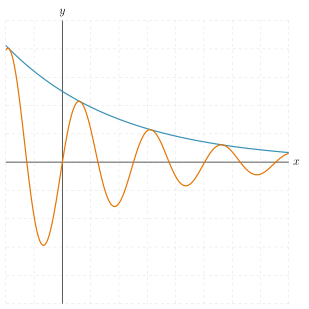
The curves \(C_1\) and \(C_2\) are defined by \[ y= \e^{-x} \quad (x>0) \quad \text{ and } \quad y= \e^{-x}\sin x \quad (x>0), \] respectively. Sketch roughly \(C_1\) and \(C_2\) on the same diagram. Let \(x_n\) denote the \(x\)-coordinate of the \(n\)th point of contact between the two curves, where \(0 < x_1 < x_2 < \cdots\), and let \(A_n\) denote the area of the region enclosed by the two curves between \(x_n\) and \(x_{n+1}\). Show that \[ A_n = \tfrac12(\e^{2\pi}-1) \e^{-(4n+1)\pi/2} \] and hence find \(\displaystyle \sum_{n=1}^\infty A_n\).
Solution:
2010 Paper 3 Q7
Given that \(y = \cos(m \arcsin x)\), for \(\vert x \vert <1\), prove that \[ (1-x^2) \frac {\d^2 y}{\d x^2} -x \frac {\d y}{\d x} +m^2y=0\,. \] Obtain a similar equation relating \(\dfrac{\d^3y}{\d x^3}\,\), \(\dfrac{\d^2y}{\d x^2}\, \) and \(\, \dfrac{\d y}{\d x}\,\), and a similar equation relating \(\dfrac{\d^4y}{\d x^4}\,\), \(\dfrac{\d^3y}{\d x^3}\,\) and \(\,\dfrac{\d^2 y}{\d x^2}\,\). Conjecture and prove a relation between \(\dfrac{\d^{n+2}y}{\d x^{n+2}}\,\), \(\dfrac{\d^{n+1}y}{\d x^{n+1}}\;\) and \(\;\dfrac{\d^n y}{\d x^n}\,\). Obtain the first three non-zero terms of the Maclaurin series for \(y\). Show that, if \(m\) is an even integer, \(\cos m\theta\) may be written as a polynomial in \(\sin\theta\) beginning \[ 1 - \frac{m^2\sin^2\theta}{2!}+ \frac{m^2(m^2-2^2)\sin^4\theta}{4!} -\cdots \,. \, \tag{\(\vert\theta\vert < \tfrac12 \pi\)} \] State the degree of the polynomial.
Solution: \begin{align*} && y &= \cos(m \arcsin x) \\ && y' &= -m \sin (m \arcsin x) \cdot (1-x^2)^{-\frac12} \\ && y'' &= -m^2 \cos(m \arcsin x) \cdot (1-x^2)^{-1} -m \sin(m \arcsin x) \cdot (1-x^2)^{-\frac32} \cdot (-x) \\ &&&= -m^2 y (1-x^2)^{-1} + x(1-x^2)^{-1} y' \\ \Rightarrow && 0 &= (1-x^2)y'' - x y' + m^2y \\ \\ && 0 &= (1-x^2)y^{(3)} -2xy'' - xy''-y' + m^2y' \\ &&&= (1-x^2)y^{(3)} - 3xy'' + (m^2-1)y' \\ \\ && 0 &= (1-x^2)y^{(4)} - 2xy^{(3)} - 3xy^{(3)} - 3y^{(2)} + (m^2-1)y^{(2)} \\ &&&= (1-x^2)y^{(4)}- 5xy^{(3)} - (m^2-4)y^{(2)} \end{align*} Claim: \(0 = (1-x^2)y^{(n+2)} - (2n+1)y^{(n+1)} + (m^2-n^2)y^{(n)}\) Proof: (By induction) Clearly the first few base cases are true. Suppose it is true for some \(n\), then \begin{align*} && 0 &= (1-x^2)y^{(n+2)} - (2n+1)xy^{(n+1)} + (m^2-n^2)y^{(n)} \\ \Rightarrow && 0 &= (1-x^2)y^{(n+3)} - 2xy^{(n+2)} - (2n+1)xy^{(n+2)} - (2n+1)y^{(n+1)} + (m^2-n^2)y^{(n+1)} \\ &&&= (1-x^2)y^{(n+3)} - (2n+3)xy^{(n+2)} + (m^2-n^2-2n-1)y^{(n+1)} \\ &&&= (1-x^2)y^{(n+1+2)} - (2(n+1)+1)xy^{(n+1+1)} +(m^2-(n+1)^2)y^{(n)} \end{align*} And so we can conclude the result by induction. Notice that \begin{align*} && y(0) &= \cos(m 0) = 1 \\ && y'(0) &= -m\sin(m 0) = 0 \\ && y''(0) &= -m^2 y(0) = -m^2\\ \end{align*} Notice that \(y^{(n+2)}(0) + (m^2-n^2)y^{(n)} = 0\) so in particular all the odd terms will be \(0\) and the even terms will be \(1, -m^2, m^2(m^2-2^2), \cdots\), therefore \begin{align*} && \cos (m \arcsin x) &= 1 -\frac{m^2}{2!} x^2 + \frac{m^2(m^2-2^2)}{4!}x^4 - \cdots \\ \Rightarrow && \cos(m \theta) &= 1 - \frac{m^2}{2!} \sin^2 \theta + \frac{m^2(m^2-2^2)}{4!} \sin^4 \theta \end{align*} Notice that if \(m\) is even, then at some point we will have \(m^2-m^2\) appearing in our expansion and all remaining terms will be zero. Therefore we will end up with a polynomial series, of degree \(m\) in \(\sin \theta\)
2010 Paper 3 Q8
Given that \({\rm P} (x) = {\rm Q} (x){\rm R}'(x) - {\rm Q}'(x){\rm R}(x)\), write down an expression for \[ \int \frac{{\rm P} ( x)}{ \big( {\rm Q} ( x)\big )^ 2}\, \d x\, . \]
- By choosing the function \({\rm R}(x)\) to be of the form \(a +bx+c x^2\), find \[ \int \frac{5x^2 - 4x - 3} {(1 + 2x + 3x^2 )^2 } \, \d x \,.\] Show that the choice of \({\rm R}(x)\) is not unique and, by comparing the two functions \({\rm R}(x)\) corresponding to two different values of \(a\), explain how the different choices are related.
- Find the general solution of \[ (1+\cos x +2 \sin x) \frac {\d y}{\d x} +(\sin x -2 \cos x)y = 5 - 3 \cos x + 4 \sin x\,. \]
Solution: \begin{align*} && \int \frac{{\rm P} ( x)}{ \big( {\rm Q} ( x)\big )^ 2}\, \d x &= \int \frac{{\rm Q} (x){\rm R}'(x) - {\rm Q}'(x){\rm R}(x)}{ \big( {\rm Q} ( x)\big )^ 2}\, \d x \\ &&&= \int \frac{\d}{\d x} \left ( \frac{R(x)}{Q(x)} \right) \d x \\ &&&= \frac{R(x)}{Q(x)} + C \end{align*}
- Suppose \(Q(x) = 1 + 2x + 3x^2, P(x) = 5x^2-4x-3\), and \(R(x) = a +bx + cx^2\), then \begin{align*} && 5x^2-4x-3 &= (1 + 2x + 3x^2)(2cx+b) - (6x+2)(a+bx+cx^2) \\ &&&= (6c-6c)x^3 + (3b+4c-6b-2c)x^2 + \\ &&&\quad+(2c+2b-6a-2b)x + (b-2a) \\ \Rightarrow && 2c-3b &= 5 \\ && 2c-6a &= -4 \\ && b - 2a &= -3 \\ \Rightarrow && b &= 2a - 3\\ && c &= 3a-2 \end{align*} So say \(a = 0, b = -3, c = -2\) we will have \begin{align*} \int \frac{5x^2 - 4x - 3} {(1 + 2x + 3x^2 )^2 } \, \d x &= \frac{-3x-2x^2}{1+2x+3x^2} + C \end{align*} Suppose we have a different value of \(a\), then we end up with: \begin{align*} \frac{a+(2a-3)x+(3a-2)x^2}{1+2x+3x^2} = a +\frac{-3x-2x^2}{1+2x+3x^2} \end{align*} So the different antiderivatives differ by a constant.
- \(\,\) \begin{align*} && \frac{\d }{\d x} \left ( \frac{1}{1+\cos x + 2 \sin x } y\right) &= \frac{5-3\cos x + 4 \sin x }{(1+\cos x + 2 \sin x)^2} \\ \end{align*} We want to find \(R(x) = A \cos x + B\sin x + C\) such that \begin{align*} &&5-3\cos x + 4 \sin x &= (1+\cos x + 2 \sin x)R'(x) - R(x)(-\sin x + 2 \cos x) \\ &&&= (1+\cos x + 2 \sin x)(-A\sin x + B \cos x) \\ &&&\quad- (A\cos x + B \sin x + C)(-\sin x + 2 \cos x) \\ &&&=(-A+C) \sin x + (B-2C)\cos x +\\ &&&\quad\quad (2B-A+A-2B)\sin x \cos x \\ &&&\quad\quad (-2A+B)\sin^2x+(B-2A)\cos^2x \\ &&&= (-A+C)\sin x + (B-2C)\cos x +(B-2A) \\ \Rightarrow && B-2A &= 5\\ && C-A &= 4 \\ && B-2C &= -3 \\ \end{align*} There are many solutions so WLOG \(C=4, A = 0, B = 5\) and so \begin{align*} && \int \frac{5-3\cos x + 4 \sin x }{(1+\cos x + 2 \sin x)^2} \d x &= \frac{5\sin x +4}{1+\cos x + 2 \sin x} + K \\ \Rightarrow && y &= 5\sin x + 4 + K(1 + \cos x + 2 \sin x) \end{align*}