Problems
Filters
54 problems found
2005 Paper 3 Q2
Find the general solution of the differential equation \(\displaystyle \frac{\mathrm{d}y}{\mathrm{d}x} = -\frac{xy}{x^2+a^2}\;\), where \(a\ne0\,\), and show that it can be written in the form \(\displaystyle y^2(x^2+a^2)= c^2\,\), where \(c\) is an arbitrary constant. Sketch this curve. Find an expression for \(\displaystyle \frac{\mathrm{d}}{\mathrm{d}x} (x^2+y^2)\) and show that \[ \frac{\mathrm{d^2}}{\mathrm{d}x^2} (x^2+y^2) = 2\left(1 -\frac {c^2}{(x^2+a^2)^2} \right) + \frac{8c^2x^2}{(x^2+a^2)^3}\;. \]
- Show that, if \(0 < c < a^2\), the points on the curve whose distance from the origin is least are \(\displaystyle \l 0\,,\;\pm \frac{c}{a}\r\).
- If \(c > a^2\), determine the points on the curve whose distance from the origin is least.
Solution: \begin{align*} && \frac{\d y}{\d x} &= - \frac{xy}{x^2+a^2} \\ \Rightarrow && \int \frac{1}{y} \d y &= \int -\frac{x}{x^2+a^2} \d x \\ && \ln |y| &= -\frac12 \ln |x^2 + a^2| + C \\ \Rightarrow && C' &= \ln y^2 + \ln (x^2+a^2) \\ \Rightarrow && c^2 &= y^2(x^2+a^2) \end{align*} (where the final constant \(c^2\) can be taken as a square since it is clearly positive).

- The shortest distance from the origin will have the first derivative as \(0\), ie \(x = 0\) or \(x^2 + a^2 = c\), but if \(c < a^2\) this can only occur for \(x = 0\), so the closest to the origin is \((0, \pm \frac{c}{a})\)
- If \(c > a^2\) then we can have \(x = 0\) or \(x = \pm \sqrt{c-a^2}\). Looking at the second derivative, when \(x = 0\) we have \(2(1- \frac{c^2}{a^4}) < 0\) which is a local maximum. When \(x = \pm\sqrt{c-a^2}\) we have \(8(c-a^2)c^2/c^3 > 0\) which is the minimum, therefore the points are \((\pm \sqrt{c-a^2}, c)\)

2004 Paper 2 Q3
The curve \(C\) has equation $$ y = x(x+1)(x-2)^4. $$ Determine the coordinates of all the stationary points of \(C\) and the nature of each. Sketch \(C\). In separate diagrams draw sketches of the curves whose equations are:
- \( y^2 = x(x+1)(x-2)^4\;\);
- \(y = x^2(x^2+1)(x^2-2)^4\,\).
Solution: \begin{align*} && y &= x(x+1)(x-2)^4 \\ \Rightarrow && y' &= (x+1)(x-2)^4+x(x-2)^4+4x(x+1)(x-2)^3 \\ &&&= (x-2)^3 \left ( (2x+1)(x-2)+4x(x+1) \right) \\ &&&= (x-2)^3 \left (2x^2-3x-2+4x^2+4x \right) \\ &&&=(x-2)^3(6x^2+x-2) \\ &&&=(x-2)^3(2x-1)(3x+2) \end{align*} Therefore there are stationary points at \((2,0), (\frac12, -\frac{625}{64}), (-\frac23, -\frac{4078}{81})\) \((0,2)\) is a minimum by considering the sign of \(y'\) either side. \( (-\frac23, \frac{2560}{729})\) is a minimum, since it's the first stationary point. \( (\frac12, \frac{243}{64})\) is a maximum since you can't have consecutive minima and the second derivative is clearly non-zero.

- \(\,\)

- \(\,\)

2003 Paper 2 Q8
It is given that \(y\) satisfies $$ {{\d y} \over { \d t}} + k\left({{t^2-3t+2} \over {t+1}}\right)y = 0\;, $$ where \(k\) is a constant, and \(y=A \) when \(t=0\,\), where \(A\) is a positive constant. Find \(y\) in terms of \(t\,\), \(k\) and \(A\,\). Show that \(y\) has two stationary values whose ratio is \((3/2)^{6k}\e^{-5{k}/2}.\) Describe the behaviour of \(y\) as \(t \to +\infty\) for the case where \(k> 0\) and for the case where \(k<0\,.\) In separate diagrams, sketch the graph of \(y\) for \(t>0\) for each of these cases.
Solution: \begin{align*} && \frac{\d y}{\d t} &= - k \left (\frac{t^2-3t+2}{t+1} \right) y \\ \Rightarrow && \int \frac1y \d y &= -k\int \left (t-4 + \frac{6}{t+1}\right) \d t \\ \Rightarrow && \ln y &= -k \left ( \frac12 t^2 -4t + 6\ln (t+1) \right) + C \\ (t,y) = (0,A): && \ln A &=C \\ \Rightarrow && \ln y &= -k \left ( \frac12 t^2 -4t + 6\ln (t+1) \right) + \ln A \\ && \ln \left ( \frac{y}{A}(t+1)^{6k} \right) &= -k \l \frac12 t^2 - 4t \r \\ \Rightarrow && y &= A\frac{\exp \l -k(\frac12 t^2-4t)\r}{(t+1)^{6k}} \end{align*} \(y\) wil have stationary values when \(\frac{\d y}{\d t} = 0\), ie \begin{align*} k \left (\frac{t^2-3t+2}{t+1} \right) y &= 0 \\ k \left ( \frac{(t-2)(t-1)}{t+1} \right) y &= 0 \end{align*} ie when \(y = 0, t = 1, t =2\). Clearly \(y = 0\) is not a solution, so \(y\) has the values: \begin{align*} t = 1: && y &= A\frac{\exp \l -k(\frac12 -4)\r}{(2)^{6k}} \\ &&&= A \frac{e^{7/2 k}}{2^{6k}} \\ t = 2: && y &= A\frac{\exp \l -k(2 -8)\r}{(3)^{6k}} \\ &&&= A \frac{e^{6 k}}{3^{6k}} \\ \text{ratio}: && \frac{e^{7/2k}}{2^{6k}} \cdot \frac{3^{6k}}{e^{6k}} &= (3/2)^{6k} e^{-5k/2} \end{align*} If \(k > 0\) as \(t \to \infty\) \(y \to 0\) since the \(e^{-kt^2/2}\) term dominates everything. If \(k < 0\) as \(t \to \infty\) \(y \to \infty\) as since the \(e^{-kt^2}\) term also dominates but now it growing to infinity faster than everything else.

2002 Paper 1 Q2
Let \(f(x) = x^m(x-1)^n\), where \(m\) and \(n\) are both integers greater than \(1\). Show that the curve \(y=f(x)\) has a stationary point with \(0 < x < 1\). By considering \(f''(x)\), show that this stationary point is a maximum if \(n\) is even and a minimum if \(n\) is odd. Sketch the graphs of \(f(x)\) in the four cases that arise according to the values of \(m\) and \(n\).
Solution: \begin{align*} && f'(x) &= mx^{m-1}(x-1)^n + nx^m(x-1)^{n-1} \\ &&&= (m(x-1)+nx)x^{m-1}(x-1)^{n-1} \\ &&&= (x(m+n) - m)x^{m-1}(x-1)^{n-1} \\ \end{align*} Therefore when \(x = \frac{m}{m+n}\) there is a stationary point with \(0 < x < 1\). \begin{align*} && f''(x) &= m(m-1)x^{m-2}(x-1)^n + 2mnx^{m-1}(x-1)^{n-1} + n(n-1)x^{m}(x-1)^{n-2} \\ &&&= (m(m-1)(x-1)^2 +2mnx(x-1)+n(n-1)x^2)x^{m-2}(1-x)^{n-2} \\ \Rightarrow && f'' \left ( \frac{m}{m+n} \right) &= \left ( m(m-1) \frac{n^2}{(m+n)^2} - 2mn\frac{mn}{(m+n)^2} + n(n-1) \frac{m^2}{(m+n)^2} \right) \frac{m^{m-2}}{(m+n)^{m-2}} \frac{(-1)^{n-2}n^{n-2}}{(m+n)^{n-2}} \\ &&&= (-1)^{n-2}\frac{m^{m-1}n^{n-1}}{(m+n)^{m+n-2}} \left ( (m-1)n-2mn+(n-1)m\right) \\ &&&= (-1)^{n-2}\frac{m^{m-1}n^{n-1}}{(m+n)^{m+n-2}} \left ( -m-n\right) \\ &&&= (-1)^{n-1} \frac{m^{m-1}n^{n-1}}{(m+n)^{m+n-3}} \end{align*} Therefore this is positive (and a minimum) when \(n\) is odd and negative (and a maximum) when \(n\) is even.


2002 Paper 1 Q3
Show that \((a+b)^2\le 2a^2+2b^2\,\). Find the stationary points on the curve $y=\big(a^2\cos^2\theta +b^2\sin^2\theta\big)^{\frac12} + \big(a^2\sin^2\theta +b^2\cos^2\theta\big)^{\frac12}\,$, where \(a\) and \(b\) are constants. State, with brief reasons, which points are maxima and which are minima. Hence prove that \[ \vert a\vert +\vert b \vert \le \big(a^2\cos^2\theta +b^2\sin^2\theta\big)^{\frac12} + \big(a^2\sin^2\theta +b^2\cos^2\theta\big)^{\frac12} \le \big(2a^2+2b^2\big)^{\frac12} \;. \]
Solution: \begin{align*} && 2a^2+2b^2 &= a^2 + b^2 + (a^2+b^2) \\ &&&\underbrace{\geq}_{AM-GM} a^2+b^2+2\sqrt{a^2b^2} \\ &&&= a^2+b^2 + 2|a||b| \\ &&&\geq a^2+b^2 + 2ab \\ &&&= (a+b)^2 \end{align*} Assume \(a^2 \neq b^2\), otherwise the curve is a constant. \begin{align*} && y & = \big(a^2\cos^2\theta +b^2\sin^2\theta\big)^{\frac12} + \big(a^2\sin^2\theta +b^2\cos^2\theta\big)^{\frac12}\\ && \frac{\d y}{\d \theta} &= \tfrac12 \left (a^2\cos^2\theta +b^2\sin^2\theta \right)^{-\frac12} \cdot (2 \sin \theta \cos \theta (b^2 - a^2)) + \tfrac12 (a^2\sin^2\theta +b^2\cos^2\theta)^{-\frac12} \cdot (2 \sin \theta \cos \theta (a^2 - b^2) \\ &&&= \tfrac12\sin2 \theta (b^2 - a^2) \left ( \left (a^2\cos^2\theta +b^2\sin^2\theta \right)^{-\frac12} - (a^2\sin^2\theta +b^2\cos^2\theta)^{-\frac12}\right) \\ \therefore \frac{\d y}{\d x} = 0 \Rightarrow && \sin 2\theta = 0 & \text{ or } a^2\cos^2\theta +b^2\sin^2\theta = a^2\sin^2\theta +b^2\cos^2\theta \\ \Rightarrow && \theta &= 0, \frac{\pi}{2}, \pi, \frac{3\pi}{2}, 2\pi \\ && (a^2-b^2) \cos ^2\theta &= (a^2-b^2) \sin^2 \theta \\ \Rightarrow && \theta &= \frac{\pi}{4}, \frac{3\pi}{4}, \frac{5\pi}{4}, \frac{7\pi}{4} \end{align*} WLOG \(b^2 - a^2 > 0\), then the two parts of the derivative look like:

2001 Paper 2 Q5
The curve \(C_1\) passes through the origin in the \(x\)--\(y\) plane and its gradient is given by $$ \frac{\d y}{\d x} =x(1-x^2)\e^{-x^2}. $$ Show that \(C_1\) has a minimum point at the origin and a maximum point at \(\left(1,{\frac12\, \e^{-1}} \right)\). Find the coordinates of the other stationary point. Give a rough sketch of \(C_1\). The curve \(C_2\) passes through the origin and its gradient is given by $$ \frac{\d y}{\d x}= x(1-x^2)\e^{-x^3}. $$ Show that \(C_2\) has a minimum point at the origin and a maximum point at \((1,k)\), where \phantom{} \(k > \frac12 \,\e^{-1}.\) (You need not find \(k\).)
2000 Paper 1 Q7
Let \[ {\f}(x)=a x-\frac{x^{3}}{1+x^{2}}, \] where \(a\) is a constant. Show that, if \(a\ge 9/8\), then \(\mathrm{f}' (x) \ge0\) for all \(x\).
Solution: \begin{align*} && f(x) &= a x-\frac{x^{3}}{1+x^{2}} \\ \Rightarrow && f'(x) &= a - \frac{3x^2(1+x^2)-x^3 \cdot 2 x}{(1+x^2)^2} \\ &&&= a - \frac{-x^4+3x^2}{(1+x^2)^2} \\ &&&= a - \frac{-t^2+3t}{(1+t)^2} \\ &&&= \frac{a+2at+at^2-t^2-3t}{(1+t)^2} \\ &&&= \frac{(a-1)t^2+(2a-3)t+a}{(1+t)^2} \\ \\ && 0 \leq \Delta &= (2a-3)^2 - 4 \cdot (a-1) \cdot a \\ &&&= 4a^2-12a+9 - 4a^2+4a \\ &&&= -8a + 9 \\ \Leftrightarrow && a &\geq 9/8 \end{align*} Therefore if \(a \geq 9/8\) the numerator is always non-negative and \(f'(x) \geq 0\)
1999 Paper 2 Q7
The curve \(C\) has equation $$ y = \frac x {\sqrt{x^2-2x+a}}\; , $$ where the square root is positive. Show that, if \(a>1\), then \(C\) has exactly one stationary point. Sketch \(C\) when (i) \(a=2\) and (ii) \(a=1\).
Solution: \begin{align*} && y &= \frac x {\sqrt{x^2-2x+a}} \\ && y' &= \frac{\sqrt{x^2-2x+a} - \frac{x(x-1)}{\sqrt{x^2-2x+a}}}{x^2-2x+a} \\ &&&= \frac{-x+a}{(x^2-2x+a)^{3/2}} \end{align*} Since the denominator is always positive, the only stationary point is when \(x = a\)


1999 Paper 3 Q2
- Let \(\f(x)=(1+x^2)\e^x\). Show that \(\f'(x)\ge 0\) and sketch the graph of \(\f(x)\). Hence, or otherwise, show that the equation \[ (1+x^2)\e^x = k, \] where \(k\) is a constant, has exactly one real root if \(k>0\) and no real roots if \(k\le 0\).
- Determine the number of real roots of the equation $$ (\e^x-1) - k \tan^{-1} x=0 $$ in the cases (a) \(0< k\le 2/\pi\) and (b) \(2/\pi < k < 1\).
Solution:
- \(\,\) \begin{align*}
&& f(x) &= (1+x^2)e^x \\
&& f'(x) &= 2xe^x + (1+x^2)e^x \\
&&&= (1+x)^2e^x \geq 0
\end{align*}
As \(x \to -\infty\), \(f(x) \to 0\) and as \(x \to \infty\), \(f(x) \to +\infty\) and since \(f\) is strictly increasing we have exactly one solution to \(f(x) = k\) on \((0,\infty)\). Since \(f(x) > 0\) there are no solutions if \(k \leq 0\).
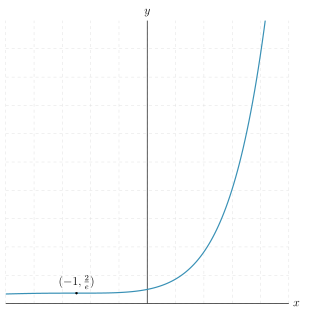
- Considering the function \(g(x) = (e^x-1)-k\tan^{-1} x \) then \(g'(x) = e^x - \frac{k}{1+x^2}\) therefore \(g'(x)\) has exactly one turning point when \(k > 0\) and \(0\) otherwise at the root of \(f(x) = k\) Notice also that \(g(0) = 0\) so we already have one solution, and \(g'(0) = 1 - k > 0\). Notice from our sketch that if \(0 < k < 1\) the root for \(f(x) = k\) has \(x \leq 0\), so our turning point is to the left of the origin and we are interested in the behaviour of \(g(x)\) as \(x \to -\infty\). (ie do we cross the axis again). \(\lim_{x \to -\infty} \left [ e^x - 1 - k \tan^{-1} x \right] = 0 - 1 +k \frac{\pi}{2} = k \frac{\pi}{2} - 1\). if this is positive, ie if \(k > \frac{2}{\pi}\) there are two solutions, otherwise there is only one real root.
1998 Paper 2 Q7
\begin{eqnarray*} {\rm f}(x)&=& \tan x-x,\\ {\rm g}(x)&=& 2-2\cos x-x\sin x,\\ {\rm h}(x)&=& 2x+x\cos 2x-\tfrac{3}{2}\sin 2x,\\ {\rm F}(x)&=& {x(\cos x)^{1/3}\over\sin x}. \end{eqnarray*} \vspace{1mm}
- By considering \(\f(0)\) and \(\f'(x)\), show that \(\f(x)>0\)
for \(0
- Show similarly that \(\g(x)>0\) for \(0
- Show that \(\h(x)>0\) for \(0
- By considering \(\displaystyle {{\rm F}'(x)\over {\rm F}(x)}\), show that \({\rm F}'(x)<0\) for \(0
- Show similarly that \(\g(x)>0\) for \(0
1998 Paper 3 Q1
Let $$ {\rm f}(x)=\sin^2x + 2 \cos x + 1 $$ for \(0 \le x \le 2\pi\). Sketch the curve \(y={\rm f}(x)\), giving the coordinates of the stationary points. Now let $$ \hspace{0.6in}{\rm g}(x)={a{\rm f}(x)+b \over c{\rm f}(x)+d} \hspace{0.8in} ad\neq bc\,,\; d\neq -3c\,,\; d\neq c\;. $$ Show that the stationary points of \(y={\rm g}(x)\) occur at the same values of \(x\) as those of \(y={\rm f}(x)\), and find the corresponding values of \({\rm g}(x)\). Explain why, if \(d/c <-3\) or \(d/c>1\), \(|{\rm g}(x)|\) cannot be arbitrarily large.
1997 Paper 1 Q8
By considering the maximum of \(\ln x-x\ln a\), or otherwise, show that the equation \(x=a^{x}\) has no real roots if \(a > e^{1/e}\). How many real roots does the equation have if \(0 < a < 1\)? Justify your answer.
Solution: \begin{align*} && y &= \ln x - x \ln a \\ \Rightarrow && y' &= \frac1x - \ln a \\ && y'' &= -\frac{1}{x^2} \end{align*} Therefore the maximum is when \(x = \frac{1}{\ln a}\) and \(y_{max} = -\ln \ln a - 1\). If \(y_{max} < 0\) then \(y \neq 0\). But that's equivalent to \(a > e^{1/e}\). \begin{align*} && 0 &> -\ln \ln a - 1 \\ \Leftrightarrow && 1 &> - \ln \ln a \\ \Leftrightarrow && \ln \ln a &>-1 \\ \Leftrightarrow && \ln a &> e^{-1} \\ \Leftrightarrow && a & > e^{1/e} \end{align*} If \(0 < a < 1\) then, when \(x\) is small, \(\ln x - x \ln a\) is large and negative. When \(x\) is large and positive \(\ln x\) is positive and \(-x \ln a\) is positive. We also notice there is no turning point. Hence exactly one solution
1997 Paper 2 Q7
Let $$y^2=x^2(a^2-x^2),$$ where \(a\) is a real constant. Find, in terms of \(a\), the maximum and minimum values of \(y\). Sketch carefully on the same axes the graphs of \(y\) in the cases \(a=1\) and \(a=2\).
Solution: \begin{align*} && y^2 &= x^2a^2-x^2 \\ &&&= \frac{a^4}{4} -\left ( x^2 -\frac{a^2}{2} \right)^2 \end{align*} Therefore the maximum and minimum values of \(y\) are \(\pm \frac{a^2}2\)

1997 Paper 3 Q2
Let \[\mathrm{f}(t)=\frac{\ln t}t\quad\text{ for }t>0.\] Sketch the graph of \(\mathrm{f}(t)\) and find its maximum value. How many positive values of \(t\) correspond to a given value of \(\mathrm f(t)\)? Find how many positive values of \(y\) satisfy \(x^y=y^x\) for a given positive value of \(x\). Sketch the set of points \((x,y)\) which satisfy \(x^y=y^x\) with \(x,y>0\).
1993 Paper 1 Q7
Sketch the curve \[ \mathrm{f}(x)=x^{3}+Ax^{2}+B \] first in the case \(A>0\) and \(B>0\), and then in the case \(A<0\) and \(B>0.\) Show that the equation \[ x^{3}+ax^{2}+b=0, \] where \(a\) and \(b\) are real, will have three distinct real roots if \[ 27b^{2}+3a^{3}b<0, \] but will have fewer than three if \[ 27b^{2}+4a^{3}b<0. \]