Problems
Filters
39 problems found
1999 Paper 1 Q3
The \(n\) positive numbers \(x_{1},x_{2},\dots,x_{n}\), where \(n\ge3\), satisfy $$ x_{1}=1+\frac{1}{x_{2}}\, ,\ \ \ x_{2}=1+\frac{1}{x_{3}}\, , \ \ \ \dots\; , \ \ \ x_{n-1}=1+\frac{1}{x_{n}}\, , $$ and also $$ \ x_{n}=1+\frac{1}{x_{1}}\, . $$ Show that
- \(x_{1},x_{2},\dots,x_{n}>1\),
- \({\displaystyle x_{1}-x_{2}=-\frac{x_{2}-x_{3}}{x_{2}x_{3}}}\),
- \(x_{1}=x_{2}=\cdots=x_{n}\).
1999 Paper 1 Q12
- Prove that if \(x>0\) then \(x+x^{-1}\ge2.\;\) I have a pair of six-faced dice, each with faces numbered from 1 to 6. The probability of throwing \(i\) with the first die is \(q_{i}\) and the probability of throwing \(j\) with the second die is \(r_{j}\) (\(1\le i,j \le 6\)). The two dice are thrown independently and the sum noted. By considering the probabilities of throwing 2, 12 and 7, show the sums \(2, 3, \dots, 12\) are not equally likely.
- The first die described above is thrown twice and the two numbers on the die noted. Is it possible to find values of \(q_{j}\) so that the probability that the numbers are the same is less than \(1/36\)?
Solution:
- Notice that if \(x > 0\) we must have \begin{align*} && \left ( \sqrt{x} - \frac{1}{\sqrt{x}} \right)^2 &\geq 0 \\ \Leftrightarrow && x - 2 + x^{-1} & \geq 0 \\ \Leftrightarrow && x + x^{-1} & \geq 2 \end{align*} Let \(S\) be the sum, and assume all probabilities are equal \begin{align*} && \mathbb{P}(S = 2) &= q_1 r_1 \\ && \mathbb{P}(S = 12) &= q_6 r_6 \\ && \mathbb{P}(S = 7) &= \sum_{i=1}^6 q_i r_{7-i} \\ \Rightarrow && q_1r_1 &= q_6r_6 \\ \Rightarrow && q_1r_6+q_6r_1 &\leq q_1r_1 \\ \Rightarrow && \frac{r_6}{r_1} + \frac{q_6}{q_1} &\leq 1 \\ \Rightarrow && q_1r_6+q_6r_1 &\leq q_6r_6 \\ \Rightarrow && \frac{q_1}{q_6} + \frac{r_1}{r_6} &\leq 1 \\ \Rightarrow && \frac{r_6}{r_1} + \frac{q_6}{q_1}+\frac{q_1}{q_6} + \frac{r_1}{r_6} &\leq 2\\ \text{but} && \frac{r_6}{r_1} + \frac{q_6}{q_1}+\frac{q_1}{q_6} + \frac{r_1}{r_6} &\geq 4 \end{align*} Since we have a contradiction they cannot all be equal.
- We would like \(\displaystyle \sum q_i^2 \leq 1/36\) (subject to \(\displaystyle \sum q_i = 1\), clearly this cannot be true since: \begin{align*} && 1 &= \left ( \sum_{i=1}^6 q_i \right)^2 \\ &&&= \sum_{i=1}^6 q_i^2 + \sum_{i \neq j} 2q_i q_j \\ &&&\leq \sum_{i=1}^6 q_i^2 + 5\sum_{i=1}^6 q_i^2 \\ &&&=6 \sum_{i=1}^6 q_i^2 \\ \Rightarrow && \sum_{i=1}^6 q_i^2 &\geq 1/6 > 1/36 \end{align*} [For a weaker solution to the last part, notice that the largest value of \(q_i\) is \(\geq 1/6\) and therefore \(q_{max}^2 \geq 1/36\), but if equality holds then the other values must also be non-zero, and therefore the inequality cannot hold]
1998 Paper 2 Q1
Show that, if \(n\) is an integer such that $$(n-3)^3+n^3=(n+3)^3,\quad \quad {(*)}$$ then \(n\) is even and \(n^2\) is a factor of \(54\). Deduce that there is no integer \(n\) which satisfies the equation \((*)\). Show that, if \(n\) is an integer such that $$(n-6)^3+n^3=(n+6)^3, \quad \quad{(**)}$$ then \(n\) is even. Deduce that there is no integer \(n\) which satisfies the equation \((**)\).
Solution: \begin{align*} && n^3 &= (n+3)^3 - (n-3)^3 \\ &&&= n^3 + 9n^2+27n + 27 - (n^3 - 9n^2+27n-27) \\ &&&= 18n^2+54 \end{align*} Therefore since \(2 \mid 2(9n^2 + 27)\), \(2 \mid n^3 \Rightarrow 2 \mid n\), so \(n\) is even. Since \(n^2 \mid n^3\), \(n^2 \mid 54 = 2 \cdot 3^3\), therefore \(n = 1\) or \(n = 3\). \((1-3)^3 + 1^3 < 0 < (1+3)^3\). So \(n = 1\) doesn't work. \((3 - 3)^3 + 3^3 < (3+3)^3\) so \(n = 3\) doesn't work. Therefore there are no solutions. \begin{align*} && n^3 &= (n+6)^3 - (n-6)^3 \\ &&&= n^3 + 18n^2 + 180n + 6^3 - (n^3 - 18n^2 + 180n - 6^3 ) \\ &&&= 36n^2+2 \cdot 6^3 \end{align*} Therefore \(n^2 \mid 2 \cdot 6^3 = 2^4 \cdot 3^3\), therefore \(n = 1, 2, 3, 4, 6, 12\). \(n = 1\), \(1^3 <36+2\cdot 6^3\) \(n = 2\), \(2^3 <36 \cdot 4 + 2 \cdot 6^3\) \(n = 3\), \(3^3 <36 \cdot 9 + 2 \cdot 6^3\) \(n = 4\), \(4^3 < 36 \cdot 16 + 2 \cdot 6^3\) \(n = 6\), \(6^3 < 36\cdot 6^2+ 2 \cdot 6^3\) \(n = 12\), \(12^3 < 36 \cdot 12^2 + 2 \cdot 6^3\) Therefore there are no solutions \(n\) to the equation. These are both special cases of Fermat's Last Theorem, when \(n = 3\)
1997 Paper 3 Q7
For each positive integer \(n\), let \begin{align*} a_n&=\frac1{n+1}+\frac1{(n+1)(n+2)}+\frac1{(n+1)(n+2)(n+3)}+\cdots;\\ b_n&=\frac1{n+1}+\frac1{(n+1)^2}+\frac1{(n+1)^3}+\cdots. \end{align*}
- Evaluate \(b_n\).
- Show that \(0
- Deduce that \(a_n=n!{\rm e}-[n!{\rm e}]\) (where \([x]\) is the integer part of \(x\)).
- Hence show that \(\mathrm{e}\) is irrational.
1993 Paper 2 Q7
The integers \(a,b\) and \(c\) satisfy \[ 2a^{2}+b^{2}=5c^{2}. \] By considering the possible values of \(a\pmod5\) and \(b\pmod5\), show that \(a\) and \(b\) must both be divisible by \(5\). By considering how many times \(a,b\) and \(c\) can be divided by \(5\), show that the only solution is \(a=b=c=0.\)
Solution: \begin{array}{c|ccccc} a & 0 & 1 & 2 & 3 & 4 \\ a^2 & 0 & 1 & 4 & 4 & 1 \end{array} Therefore \(a^2 \in \{0,1,4\}\) and so we can have \begin{array} $2a^2+b^2 & 0 & 1 & 4 \\ \hline 0 & 0 & 1 & 4 \\ 1 & 2 & 3 & 1 \\ 4 & 3 & 4 & 2 \end{array} Therefore the only solution must have \(5 \mid a,b\), but then we can write them has \(5a'\) and \(5b'\) so the equation becomes \(2\cdot25 a'^2 + 25b'^2 = 5c^2\) ie \(5 \mid c^2 \Rightarrow 5 \mid c\). But that means we can always divide \((a,b,c)\) by \(5\), which is clearly a contradiction if we consider the lowest power of \(5\) dividing \(a,b,c\) for any solution.
1993 Paper 2 Q9
\textit{In this question, the argument of a complex number is chosen to satisfy \(0\leqslant\arg z<2\pi.\)} Let \(z\) be a complex number whose imaginary part is positive. What can you say about \(\arg z\)? The complex numbers \(z_{1},z_{2}\) and \(z_{3}\) all have positive imaginary part and \(\arg z_{1}<\arg z_{2}<\arg z_{3}.\) Draw a diagram that shows why \[ \arg z_{1}<\arg(z_{1}+z_{2}+z_{3})<\arg z_{3}. \] Prove that \(\arg(z_{1}z_{2}z_{3})\) is never equal to \(\arg(z_{1}+z_{2}+z_{3}).\)
1991 Paper 1 Q9
- Suppose that the real number \(x\) satisfies the \(n\) inequalities \begin{alignat*}{2} 1<\ & x & & < 2\\ 2<\ & x^{2} & & < 3\\ 3<\ & x^{3} & & < 4\\ & \vdots\\ n<\ & x^{n} & & < n+1 \end{alignat*} Prove without the use of a calculator that \(n\leqslant4\).
- If \(n\) is an integer strictly greater than 1, by considering how many terms there are in \[ \frac{1}{n+1}+\frac{1}{n+2}+\cdots+\frac{1}{n^{2}}, \] or otherwise, show that \[ \frac{1}{n}+\frac{1}{n+1}+\cdots+\frac{1}{n^{2}}>1. \] Hence or otherwise find, with justification, an integer \(N\) such that \({\displaystyle {\displaystyle \sum_{n=1}^{N}\frac{1}{n}>10.}}\)
Solution:
- Suppose \(n > 4\) then the following inequalities are both true \begin{align*} 3 < x^3 < 4 & \Rightarrow 3^5 < x^{15} < 4^{5}\\ 5 < x^5 < 6 & \Rightarrow 5^{3} < x^{15} < 6^3 \end{align*} But \(3^5 = 243\) and \(6^3 = 216\) so \(243 < x^{15} < 216\) whichis a contradiction.
- This question is wrong. Consider \(n = 2\), then \(\frac{1}{2+1} + \frac{1}{2+2} = \frac13+\frac14 = \frac{7}{12} < 1\). The question should be about \(n \geq 4\). \begin{align*} \frac{1}{n+1}+\frac1{n+2}+\cdots + \frac{1}{2n} > \frac{n}{2n} &= \frac12 \\ \frac{1}{2n+1}+\frac1{2n+2}+\cdots + \frac{1}{3n} > \frac{n}{3n} &= \frac13 \\ \frac{1}{4n+1}+\frac1{4n+2}+\cdots + \frac{1}{4n} > \frac{n}{4n} &= \frac14 \\ \sum_{k=1}^{n^2-n} \frac{1}{n+k} > \frac{13}{12} &> 1 \end{align*} We have a stronger result, \(\frac1{n+1} + \cdots + \frac1{4n} > 1\) for \(n > 4\) so we can take \(N = 4^{10}\) since, since there will be \(9\) sequences from \(\frac{1}{4^{i}+1} \to \frac{1}{4^{i+1}}\) and we will have \(\frac1{1}\) at the start to give use the extra \(1\).
1989 Paper 1 Q4
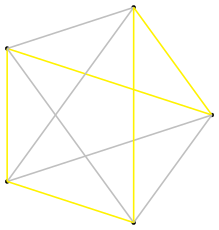
Six points \(A,B,C,D,E\) and \(F\) lie in three dimensional space and are in general positions, that is, no three are collinear and no four lie on a plane. All possible line segments joining pairs of points are drawn and coloured either gold or silver. Prove that there is a triangle whose edges are entirely of one colour. {[}\(Hint\): consider segments radiating from \(A.\){]} Give a sketch showing that the result is false for five points in general positions.
Solution: Consider the \(5\) segements radiating from \(A\). By the pigeonhole principle, at least \(3\) of them must be the same colour (say gold and say reaching \(B,C,D\)). If any of the segments joining any of \(B,C,D\) are gold then we have found a monochromatic gold triangle. But if none of them are gold, they are all silver, therefore \(BCD\) is a monochromatic silver triangle.
1988 Paper 2 Q9
Give a careful argument to show that, if \(G_{1}\) and \(G_{2}\) are subgroups of a finite group \(G\) such that every element of \(G\) is either in \(G_{1}\) or in \(G_{2},\) then either \(G_{1}=G\) or \(G_{2}=G\). Give an example of a group \(H\) which has three subgroups \(H_{1},H_{2}\) and \(H_{3}\) such that every element of \(H\) is either in \(H_{1},H_{2}\) or \(H_{3}\) and \(H_{1}\neq H,H_{2}\neq H,H_{3}\neq H\).
Solution: Suppose \(|G_1|, |G_2| < |G|\) for sake of contraction. Then by Lagrange's theorem \(|G_1| \mid |G|\) and \(|G_2| \mid |G|\), so \(|G_1|, |G_2| \leq \frac{|G|}{2}\). But \(|G_1 \cup G_2| = |G_1| + |G_2| - |G_1 \cap G_2|\). \(|G_1 \cup G_2| = |G|\) by assumption, and \(e \in G_1 \cap G_2\), so \(|G_1 \cap G_2| \geq 1\). Therefore \(|G| = |G_1| + |G_2| - |G_1 \cap G_2| \leq \frac{|G|}{2} + \frac{|G|}{2} - 1 = |G| - 1 < |G|\), contradiction! Let \(H = K_4 = \{e, a, b, c\}\) with \(a^2 = b^2 = c^2 = e\). then \(H = \{e, a\} \cup \{e, b\} \cup \{e, c\}\) with all subgroups distinct