1989 Paper 1 Q4
Year: 1989
Paper: 1
Question Number: 4
Course: LFM Pure
Section: Proof
Difficulty: 1500.0
Banger: 1484.0
proof by contradiction
combinatorics
pigeonhole principle
graph theory
Ramsey theory
three-dimensional geometry
coloring argument
Problem
Six points \(A,B,C,D,E\) and \(F\) lie in three dimensional space and are in general positions, that is, no three are collinear and no four lie on a plane. All possible line segments joining pairs of points are drawn and coloured either gold or silver. Prove that there is a triangle whose edges are entirely of one colour.
{[}\(Hint\): consider segments radiating from \(A.\){]}
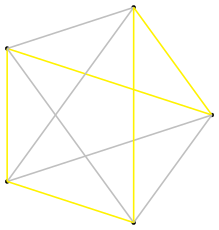
Give a sketch showing that the result is false for five points in general positions.
Solution
Consider the \(5\) segements radiating from \(A\). By the pigeonhole principle, at least \(3\) of them must be the same colour (say gold and say reaching \(B,C,D\)).
If any of the segments joining any of \(B,C,D\) are gold then we have found a monochromatic gold triangle. But if none of them are gold, they are all silver, therefore \(BCD\) is a monochromatic silver triangle.
Rating Information
Difficulty Rating: 1500.0
Difficulty Comparisons: 0
Banger Rating: 1484.0
Banger Comparisons: 1
Show LaTeX source
Problem source
Six points $A,B,C,D,E$ and $F$ lie in three dimensional space and are in general positions, that is, no three are collinear and no four lie on a plane. All possible line segments joining pairs of points are drawn and coloured either gold or silver. Prove that there is a triangle whose edges are entirely of one colour.
{[}$\textbf{Hint}$: consider segments radiating from $A.${]}
Give a sketch showing that the result is false for five points in general positions.
Solution source
Consider the $5$ segements radiating from $A$. By the pigeonhole principle, at least $3$ of them must be the same colour (say gold and say reaching $B,C,D$).

If any of the segments joining any of $B,C,D$ are gold then we have found a monochromatic gold triangle. But if none of them are gold, they are all silver, therefore $BCD$ is a monochromatic silver triangle.

\begin{center}
    \begin{tikzpicture}[scale=2]
        \def\r{2};
        \coordinate (A) at ({\r*cos(0)}, {\r*sin(0)});
        \coordinate (B) at ({\r*cos(1*72)}, {\r*sin(1*72)});
        \coordinate (C) at ({\r*cos(2*72)}, {\r*sin(2*72)});
        \coordinate (D) at ({\r*cos(3*72)}, {\r*sin(3*72)});
        \coordinate (E) at ({\r*cos(4*72)}, {\r*sin(4*72)});


        \filldraw (A) circle (1pt);
        \filldraw (B) circle (1pt);
        \filldraw (C) circle (1pt);
        \filldraw (D) circle (1pt);
        \filldraw (E) circle (1pt);

        \draw[ultra thick, yellow] (A) -- (B);
        \draw[ultra thick, yellow] (A) -- (C);
        \draw[ultra thick, lightgray] (A) -- (D);
        \draw[ultra thick, lightgray] (A) -- (E);

        \draw[ultra thick, lightgray] (B) -- (C);
        \draw[ultra thick, lightgray] (B) -- (D);
        \draw[ultra thick, yellow] (B) -- (E);

        \draw[ultra thick, yellow] (C) -- (D);
        \draw[ultra thick, lightgray] (C) -- (E);

        \draw[ultra thick, yellow] (D) -- (E);
    \end{tikzpicture}
\end{center}