Problems
Filters
298 problems found
2019 Paper 1 Q6
In both parts of this question, \(x\) is real and \(0 < \theta < \pi\).
- By completing the square, find in terms of \(\theta\) the minimum value as \(x\) varies of $$9x^2 - 12x \cos \theta + 4.$$ Find also the maximum value as \(x\) varies of \(12x^2 \sin \theta - 9x^4\). Hence determine the values of \(x\) and \(\theta\) that satisfy the equation $$9x^4 + (9 - 12 \sin \theta)x^2 - 12x \cos \theta + 4 = 0.$$
- Sketch the curve $$y = \frac{x^2}{x - \theta},$$ where \(\theta\) is a constant. Deduce that either \(\frac{x^2}{x - \theta} \leq 0\) or \(\frac{x^2}{x - \theta} \geq 4\theta\). By considering the numerator and denominator separately, or otherwise, show that $$\frac{\sin^2 \theta \cos^2 x}{1 + \cos^2 \theta \sin^2 x} \leq 1.$$ Hence determine the values of \(x\) and \(\theta\) that satisfy the equation $$\frac{x^2}{4\theta(x - \theta)} = \frac{\sin^2 \theta \cos^2 x}{1 + \cos^2 \theta \sin^2 x}.$$
Solution:
- \(\,\) \begin{align*} && y &= 9x^2 - 12x \cos \theta + 4 \\ &&&= (3x-2\cos \theta)^2+4-4\cos^2 \theta \\ &&&= (3x-2\cos \theta)^2 + 4 \sin^2 \theta \end{align*} Therefore the minimum is \(4\sin^2 \theta\) when \(x = \frac23 \cos \theta\). \begin{align*} && y &= 12x^2 \sin \theta - 9x^4 \\ &&&=4\sin^2 \theta -(3x^2-2\sin\theta)^2 \end{align*} Therefore the maximum is \(4\sin^2 \theta\) when \(x^2 = \frac23\sin \theta\) Therefore \begin{align*} && 0 &= 9x^4 + (9 - 12 \sin \theta)x^2 - 12x \cos \theta + 4 \\ && \underbrace{-9x^4+12x^2\sin \theta}_{\leq 4\sin^2 \theta } &= \underbrace{9x^2 - 12x \cos \theta + 4 }_{\geq 4 \sin^2 \theta} \end{align*} Therefore the equality cases must be achieved in both cases, ie \(x = \frac23 \cos \theta\) and \(x^2 = \frac23 \sin \theta\) \begin{align*} && x^2 &= \frac49\cos^2 \theta \\ &&&= \frac49(1-\sin^2 \theta) \\ &&&= \frac49(1-\frac94 x^2) \\ \Rightarrow && 2x^2 &= \frac49 \\ \Rightarrow && x &= \pm \frac{\sqrt{2}}3\\ \Rightarrow && \cos \theta &=\pm \frac32 \frac{\sqrt{2}}3 \\ &&&= \pm \frac{1}{\sqrt{2}} \\ \Rightarrow && \theta &= \frac{\pi}{4}, \frac{3\pi}{4} \\ \Rightarrow && (x, \theta) &= \left (\frac{\sqrt{2}}{3}, \frac{\pi}{4} \right), \left (-\frac{\sqrt{2}}{3}, \frac{3\pi}{4} \right) \end{align*}
- Sketching we obtain, noticing we can find the turning point by:
\begin{align*}
&& \frac{x^2}{x-\theta} &= \lambda \\
\Leftrightarrow && x^2 - \lambda x +\theta \lambda &= 0 \\
\Leftrightarrow && 0 &\leq \Delta = \lambda^2 -4\lambda \theta \\
\Leftrightarrow && \lambda &\geq 4 \theta, \lambda \leq 0
\end{align*}
Notice that \(\sin^2 \theta \cos^2 x \leq 1\) and \(1 + cos^2 \theta \sin^2 x \geq 1\) and therefore we must have the inequality desired. \begin{align*} && \underbrace{\frac{x^2}{4\theta(x - \theta)}}_{\geq 1 \text{ or } \leq 0} &= \underbrace{\frac{\sin^2 \theta \cos^2 x}{1 + \cos^2 \theta \sin^2 x}}_{\in [0,1]} \\ \text{both}=0: && x = 0 &, \sin \theta = 0 \\ \text{both}=1: && x = 2\theta &, \sin^2 \theta = 1,\cos^2 x = 1 \\ && 1 &= \cos^2 2 \theta \\ &&&= (1-2 \sin^2 \theta)^2 \\ &&&= 1 \\ \Rightarrow && (x, \theta) &= \left(\frac{\pi}{2}, \pi\right) \end{align*}

2019 Paper 1 Q10
In this question, the \(x\)-axis is horizontal and the positive \(y\)-axis is vertically upwards. A particle is projected from the origin with speed \(u\) at an angle \(\alpha\) to the vertical. The particle passes through the fixed point \((h \tan \beta, h)\), where \(0 < \beta < 90^{\circ}\) and \(h > 0\).
- Show that
$$c^2 - ck \cot \beta + 1 + k \cot^2 \beta = 0, \quad (*)$$
where \(c = \cot \alpha\) and \(k = \frac{2u^2}{gh}\).
You are given that there are two distinct values of \(\alpha\) that satisfy equation \((*)\). Let \(\alpha_1\) and \(\alpha_2\) be these values.
- Show that $$\cot \alpha_1 + \cot \alpha_2 = k \cot \beta.$$ Show also that $$\alpha_1 + \alpha_2 = \beta.$$
- Show that $$k > 2(1 + \sec \beta).$$
- By considering the greatest height attained by the particle, show that \(k \geq 4 \sec^2 \alpha\).
Solution:
- The horizontal position of the particle at time \(t\) is \(u \sin\alpha t\), so \(T = \frac{h \tan \beta}{u \sin \alpha}\)
The vertical position of the particle at this time \(T\) satisifes:
\begin{align*}
&& h &= u \cos\alpha \frac{h \tan \beta}{u \sin\alpha} - \frac12 g \left ( \frac{h \tan \beta}{u \sin\alpha} \right)^2 \\
&&&= h\cot \alpha \tan \beta - \frac{gh^2}{2u^2} \tan^2 \beta \cosec^2 \beta \\
\Rightarrow && 1 &= c \tan \beta - \frac{1}{k} \tan^2 \beta (1 + c^2) \\
\Rightarrow && k \cot^2 \beta &= kc\cot \beta -1-c^2 \\
\Rightarrow && 0 &= c^2 -ck \cot \beta + 1 + k \cot^2 \beta
\end{align*}
- As a quadratic in \(c\) the sum of the roots is \(k \cot \beta\), therefore \(\cot \alpha_1 + \cot \alpha_2 = k \cot \beta\). We also have that \(\cot \alpha_1 \cot \alpha_2 = 1 + k \cot^2 \beta\), so \begin{align*} && \cot (\alpha_1 + \alpha_2) &= \frac{\cot \alpha_1 \cot \alpha_2-1}{\cot \alpha_1 + \cot \alpha_2} \\ &&&= \frac{1 + k \cot^2 \beta - 1}{k \cot \beta} \\ &&&= \cot \beta \\ \Rightarrow && \beta &= \alpha_1 + \alpha_2 \pmod{\pi} \end{align*} but since \(\alpha_i \in (0, \frac{\pi}{2})\) the equation must hold exactly.
- Since it has two real roots we must have \begin{align*} && 0 &<\Delta = k^2 \cot^2 \beta - 4 (1 + k \cot^2 \beta) \\ &&&= k^2 \cot^2 \beta-4k \cot^2 \beta -4 \\ &&&= \cot^2 \beta (k^2 - 4k - 4(\sec^2 \beta - 1)) \\ &&&= \cot^2 \beta ( (k-2)^2 -4\sec^2 \beta) \\ \Rightarrow && k &> 2 + 2\sec \beta = 2(1+\sec \beta) \end{align*}
- The greatest height will satisfy \(v^2 = u^2 + 2as\) so \(0 = u^2 \cos^2 \alpha - 2gh_{max} \Rightarrow 4\sec^2 \alpha = \frac{2u^2}{gh_{max}} = k_{max}\), but this decreases with \(h\), so the smallest \(k\) can be is \(4\sec^2 \alpha\), ie \(k \geq 4 \sec^2 \alpha\)
2019 Paper 1 Q11
- Two people adopt the following procedure for deciding where to go for a cup of tea: either to a hotel or to a tea shop. Each person has a coin which has a probability \(p\) of showing heads and \(q\) of showing tails (where \(p+q = 1\)). In each round of the procedure, both people toss their coins once. If both coins show heads, then both people go to the hotel; if both coins show tails, then both people go to the tea shop; otherwise, they continue to the next round. This process is repeated until a decision is made. Show that the probability that they make a decision on the \(n\)th round is $$(q^2 + p^2)(2qp)^{n-1}.$$ Show also that the probability that they make a decision on or before the \(n\)th round is at least $$1 - \frac{1}{2^n}$$ whatever the value of \(p\).
- Three people adopt the following procedure for deciding where to go for a cup of tea: either to a hotel or to a tea shop. Each person has a coin which has a probability \(p\) of showing heads and \(q\) of showing tails (where \(p + q = 1\)). In the first round of the procedure, all three people toss their coins once. If all three coins show heads, then all three people go to the hotel; if all three coins show tails, then all three people go to the tea shop; otherwise, they continue to the next round. In the next round the two people whose coins showed the same face toss again, but the third person just turns over his or her coin. If all three coins show heads, then all three people go to the hotel; if all three coins show tails, then all three people go to the tea shop; otherwise, they go to the third round. Show that the probability that they make a decision on or before the second round is at least \(\frac{7}{16}\), whatever the value of \(p\).
Solution:
- The probability they don't make a decision in a round is \(qp + pq = 2qp\) (TH and HT). The probability they make a decision in a round is \(q^2+p^2\) (TT and HH). Therefore the probability they make a decision in the \(n\)th round is: \[ (q^2+p^2)(2qp)^{n-1} \] by having \(n-1\) failures and one success. The probability they make a decision on or before the \(n\)th round is the \(1-\) the probability they don't, ie \(1 - (2qp)^n\). Notice that \(\sqrt{qp} \leq \frac{p+1}{2} = \frac12 \Rightarrow qp \leq \frac14\) so \(1-(2pq)^n \leq 1 - \frac1{2^n}\)
- The probability it's decided in the first round is \(p^3 + q^3\) (HHH, TTT). The probability it's decided in the second round is \(3p^2q \cdot p^2 + 3qq^2 \cdot q^2 = 3pq(p^3+q^3)\) (HHT -> HHH) and (TTH -> TTT) with reorderings). Therefore the probability of making a decision in the first or second round is \((p^3+q^3)(1 + 3pq)\) which is minimised when \(p = q\) by Muirhead (or whatever your favourite inequality is). So \(\frac{2}{8} \cdot \left ( 1 + \frac{3}{4} \right) = \frac{7}{16}\)
2019 Paper 2 Q3
For any two real numbers \(x_1\) and \(x_2\), show that $$|x_1 + x_2| \leq |x_1| + |x_2|.$$ Show further that, for any real numbers \(x_1, x_2, \ldots, x_n\), $$|x_1 + x_2 + \cdots + x_n| \leq |x_1| + |x_2| + \cdots + |x_n|.$$
- The polynomial f is defined by
$$f(x) = 1 + a_1 x + a_2 x^2 + \cdots + a_{n-1} x^{n-1} + x^n$$
where the coefficients are real and satisfy \(|a_i| \leq A\) for \(i = 1, 2, \ldots, n-1\), where \(A \geq 1\).
- If \(|x| < 1\), show that $$|f(x) - 1| \leq \frac{A|x|}{1 - |x|}.$$
- Let \(\omega\) be a real root of f, so that \(f(\omega) = 0\). In the case \(|\omega| < 1\), show that $$\frac{1}{1 + A} \leq |\omega| \leq 1 + A. \quad (*)$$
- Show further that the inequalities \((*)\) also hold if \(|\omega| \geq 1\).
- Find the integer root or roots of the quintic equation $$135x^5 - 135x^4 - 100x^3 - 91x^2 - 126x + 135 = 0.$$
Solution: Claim: \(|x_1 + x_2| \leq |x_1| + |x_2|\) Proof: Case 1: \(x_1, x_2 \geq 0\). The inequality is equivalent to \(|x_1 + x_2| = x_1 + x_2 = |x_1|+|x_2|\) so it's an equality. Case 2: \(x_1, x_2 \leq 0\). The inequality is equivalent to \(|x_1+x_2| = -x_1-x_2 = |x_1|+|x_2\), so it's also an equality in this case. Case 3: (wlog) \(|x_1| \geq |x_2| > 0\) and \(x_1x_2 < 0\) then \(|x_1+x_2| = x_1-x_2 \leq x_1 \leq |x_1|+|x_2|\) We can prove this by induction, we've already proven the base case and: \(|x_1+x_2 + \cdots + x_n| \leq |x_1 + x_2 + \cdots x_{n-1}| + |x_n| \leq |x_1| + |x_2| + \cdots + |x_n|\)
- \(\,\) \begin{align*} && |f(x) - 1| &= |a_1 x + a_2x^2 + \cdots + a_{n-1}x^{n-1} + x^n| \\ &&&\leq |a_1x| + |a_2x^2| + \cdots + |a_{n-1}x^{n-1}| + |x^n| \\ &&&\leq |a_1||x| + |a_2||x|^2 + \cdots + |a_{n-1}||x|^{n-1} + |x|^n \\ &&&\leq A|x| + A|x|^2 + \cdots + A|x|^{n-1} + |x|^n \\ &&&=A|x| \frac{1-|x|^{n-1}}{1-|x|} + |x|^n \\ &&&= \frac{A|x|-A|x|^{n}+|x|^{n+1}-|x|^n}{1-|x|} \\ &&&= \frac{A|x|-|x|^n(\underbrace{A-|x|+1}_{\geq0})}{1-|x|} \\ &&&\leq \frac{A|x|}{1-|x|} \end{align*}
- If \(f(\omega) = 0\) then \begin{align*} && 1 & \leq \frac{A|\omega|}{1-|\omega|} \\ \Leftrightarrow && 1-|\omega| &\leq A |\omega| \\ \Leftrightarrow && 1 &\leq (1+A) |\omega| \\ \Leftrightarrow && \frac{1}{1+A} &\leq |\omega| \\ \end{align*} We also know \(\omega \leq 1 < 1 + A\)
- If \(\omega\) is a root of \(f(x)\) then \(1/\omega\) is a root of \(1 + a_{n-1}x + a_{n-2}x^2 + \cdots + a_1x^{n-1}+x^n\) and so \(1/\omega\) satisfies that inequality, ie \begin{align*} && \frac{1}{1+A} && \leq &&|1/\omega| && \leq &&1 + A \\ \Leftrightarrow &&1+A && \geq&& |\omega| && \geq&& \frac{1}{1 + A} \end{align*}
- First notice that it's equivalent to: \(0 = x^5 - 1x^4 - \frac{100}{135}x^3-\frac{91}{135}x^2-\frac{126}{135} + 1\) therefore all integer roots must be between \(-2,-1\) and \(1\) and \(2\). \(1\) doesn't work. \(-1\) works. Clearly \(2\) cannot work by parity argument, therefore the only integer root is \(-1\).
2019 Paper 2 Q5
The sequence \(u_0, u_1, \ldots\) is said to be a constant sequence if \(u_n = u_{n+1}\) for \(n = 0, 1, 2, \ldots\). The sequence is said to be a sequence of period 2 if \(u_n = u_{n+2}\) for \(n = 0, 1, 2, \ldots\) and the sequence is not constant.
- A sequence of real numbers is defined by \(u_0 = a\) and \(u_{n+1} = f(u_n)\) for \(n = 0, 1, 2, \ldots\), where $$f(x) = p + (x - p)x,$$ and \(p\) is a given real number. Find the values of \(a\) for which the sequence is constant. Show that the sequence has period 2 for some value of \(a\) if and only if \(p > 3\) or \(p < -1\).
- A sequence of real numbers is defined by \(u_0 = a\) and \(u_{n+1} = f(u_n)\) for \(n = 0, 1, 2, \ldots\), where $$f(x) = q + (x - p)x,$$ and \(p\) and \(q\) are given real numbers. Show that there is no value of \(a\) for which the sequence is constant if and only if \(f(x) > x\) for all \(x\). Deduce that, if there is no value of \(a\) for which the sequence is constant, then there is no value of \(a\) for which the sequence has period 2. Is it true that, if there is no value of \(a\) for which the sequence has period 2, then there is no value of \(a\) for which the sequence is constant?
Solution:
- If \(f(a) = a\) then the sequence is constant, ie \(a = p+a^2-pa \Rightarrow 0 = (a-p)(a-1)\). Therefore \(a = 1, p\) If there sequence has period \(2\) then there must be a solution to \(f(f(x)) = x\), ie \begin{align*} && x &= p+(f(x)-p)f(x) \\ &&&= p+(p+(x-p)x-p)(p+(x-p)x) \\ &&&= p + (x-p)x(p+(x-p)x) \\ &&&= p+(x^2-px)(x^2-px+p) \\ \Rightarrow && 0 &= x^4-2px^3+(p+p^2)x^2-(p^2+1)x+p \\ &&&= (x-1)(x-p)(x^2-(p-1)x+1) \end{align*} The first two roots (\(x = 1, p\)) are constant sequences, so we need the second quadratic to have a root, ie \((p-1)^2-4 \geq 0 \Rightarrow p \geq 3 , p \leq -1\). We also need this root not to be \(1\) or \(p\), ie \(1-(p-1)+1 = 3-p \neq 0\) and \(p^2-(p-1)p + 1 = 1+p \neq 0\) so \(p \neq -1, 3\). Therefore \(p > 3\) or \(p < -1\).
- There exists a constant sequence iff there is a solution to \(f(x) = x\), ie \begin{align*} && x &= f(x) \\ &&&= q + (x-p)x \\ \Leftrightarrow && 0 &= x^2-(p+1)x + q \tag{has a solution} \\ \end{align*} But if it doesn't have a solution, clearly the RHS is always larger, and if it does have a solution then there is some point where the inequality doesn't hold. Suppose \(f(x) > x\) for all \(x\) then \(f(f(x)) > f(x) > x\) therefore there is no value where \(f(f(x)) = x\) which is required for any sequence of period 2. No, consider \(p = q = 0\) so \(f(x) = x^2\) then there cannot be a period \(2\) sequence by the first part, but also clearly \(u_n = 1\) is a valid constant sequence.
2019 Paper 2 Q9
A particle \(P\) is projected from a point \(O\) on horizontal ground with speed \(u\) and angle of projection \(\alpha\), where \(0 < \alpha < \frac{1}{2}\pi\).
- Show that if \(\sin \alpha < \frac{2\sqrt{2}}{3}\), then the distance \(OP\) is increasing throughout the flight. Show also that if \(\sin \alpha > \frac{2\sqrt{2}}{3}\), then \(OP\) will be decreasing at some time before the particle lands.
- At the same time as \(P\) is projected, a particle \(Q\) is projected horizontally from \(O\) with speed \(v\) along the ground in the opposite direction from the trajectory of \(P\). The ground is smooth. Show that if $$2\sqrt{2}v > (\sin \alpha - 2\sqrt{2} \cos \alpha)u,$$ then \(QP\) is increasing throughout the flight of \(P\).
Solution:
- Notice that \(P = \begin{pmatrix} u \cos \alpha t\\ u \sin \alpha t - \frac12 g t^2 \end{pmatrix}\), so \begin{align*} && |OP|^2 &= u^2 \cos^2 \alpha t^2 + \left (u \sin \alpha t - \frac12 g t^2 \right)^2 \\ &&&= u^2 \cos^2 \alpha t^2 +u^2 \sin^2 \alpha t^2 - u \sin \alpha g t^3 +\frac14 g^2 t^4 \\ &&&= u^2 t^2 -u\sin \alpha g t^3 + \frac14g^2t^4 \\ && \frac{\d |OP|^2}{\d t} &= 2u^2 t - 3u \sin \alpha g t^2+g^2 t^3 \\ &&&= t \left (2u^2 - 3u \sin \alpha (gt)+(gt)^2\right) \\ && \Delta &= 9u^2 \sin^2 \alpha -4 \cdot 2u^2 \cdot 1 \\ &&&= u^2 (9\sin^2 \alpha -8) \\ \end{align*} Therefore if \(\sin \alpha < \frac{2\sqrt{2}}3\) the discriminant is negative, the quadratic factor is always positive and the distance \(|OP|\) is always increasing. Similarly, if \(\sin \alpha > \frac{2 \sqrt{2}}3\) then the derivative has a root. This means somewhere on its (possibly extended) trajectory \(OP\) is decreasing. This must be before it lands, since if it were after it 'landed' then both the \(x\) and \(y\) distances are increasing, therefore it cannot occur after it 'lands'.
- Note that \(Q = \begin{pmatrix} -v t \\0 \end{pmatrix}\) \begin{align*} && |QP|^2 &= (u \cos \alpha t+vt)^2 + \left (u \sin \alpha t - \frac12 g t^2 \right)^2 \\ &&&= u^2 \cos^2 \alpha t^2+2u\cos \alpha v t^2 + v^2 t^2 +u^2 \sin^2 \alpha t^2 - u \sin \alpha g t^3 +\frac14 g^2 t^4 \\ &&&= (u^2+2u v \cos \alpha+v^2) t^2 - u \sin \alpha g t^3 + \frac14 g^2 t^4 \\ \\ \Rightarrow && \frac{\d |QP|^2}{\d t} &= 2(u^2+u v \cos \alpha+v^2) t - 3u \sin \alpha g t^2 + g^2 t^3 \\ &&&= t \left ( 2(u^2+2u v \cos \alpha+v^2) - 3u \sin \alpha (g t) + (g t)^2\right) \\ && \Delta &= 9u^2 \sin^2 \alpha - 8(u^2+2u v \cos \alpha+v^2) \\ &&&= (9 \sin^2 \alpha -8)u^2 - 16v \cos \alpha u - 8v^2 \\ &&&= \left (( \sin \alpha-2\sqrt{2}\cos \alpha)u-2\sqrt{2} v \right) \left ( ( \sin \alpha+2\sqrt{2}\cos \alpha)u+2\sqrt{2} v \right) \end{align*} Since the second bracket is clearly positive, the first bracket must be negative (for \(\Delta < 0\) and our derivative to be positive), ie \(2\sqrt{2} v > ( \sin \alpha-2\sqrt{2}\cos \alpha)u\)
2019 Paper 2 Q10
A small light ring is attached to the end \(A\) of a uniform rod \(AB\) of weight \(W\) and length \(2a\). The ring can slide on a rough horizontal rail. One end of a light inextensible string of length \(2a\) is attached to the rod at \(B\) and the other end is attached to a point \(C\) on the rail so that the rod makes an angle of \(\theta\) with the rail, where \(0 < \theta < 90^{\circ}\). The rod hangs in the same vertical plane as the rail. A force of \(kW\) acts vertically downwards on the rod at \(B\) and the rod is in equilibrium.
- You are given that the string will break if the tension \(T\) is greater than \(W\). Show that (assuming that the ring does not slip) the string will break if $$2k + 1 > 4 \sin \theta.$$
- Show that (assuming that the string does not break) the ring will slip if $$2k + 1 > (2k + 3)\mu \tan \theta,$$ where \(\mu\) is the coefficient of friction between the rail and the ring.
- You are now given that \(\mu \tan \theta < 1\). Show that, when \(k\) is increased gradually from zero, the ring will slip before the string breaks if $$\mu < \frac{2 \cos \theta}{1 + 2 \sin \theta}.$$
Solution:

- \(\,\) \begin{align*} \overset{\curvearrowright}{A}:&& W \cos \theta \cdot a + kW \cos \theta \cdot 2a - T \cos \theta \sin \theta \cdot 2a - T \sin \theta \cos \theta \cdot 2a &= 0 \\ && (2k+1) \cos \theta W &= T \cos \theta \cdot 4 \sin \theta \\ \Rightarrow && T &= \frac{2k+1}{4 \sin \theta} W \\ \Rightarrow && \text{breaks if }\quad \quad 2k+1 &> 4 \sin \theta \end{align*}
- \(\,\) \begin{align*} \text{N2}(\uparrow): && R - W - kW - T \sin \theta &= 0 \\ \Rightarrow && R &= (k+1)W - T \sin \theta \\ &&&= (k+1)W - \frac{2k+1}{4} W \\ &&&= \frac{2k+3}{4}W \\ \text{N2}(\leftarrow): && F_A - T \cos \theta &= 0 \\ \Rightarrow && F_A &= \frac{2k+1}{4 }\cot \theta \\ \Rightarrow && \text{slips if }\quad \quad\quad \quad\quad \quad F_A &> \mu R \\ \Rightarrow && \text{slips if }\quad \quad \frac{2k+1}{4 }\cot \theta &> \mu \frac{2k+3}{4}W \\ \Rightarrow && 2k+1 &> (2k+3) \mu \tan \theta \end{align*}
- The condition for breaking is \(k > 2\sin \theta -\frac12\). The condition for slipping is equivalent to: \begin{align*} && 2k+1 &> (2k+3) \mu \tan \theta \\ \Leftrightarrow && 2k(1- \mu \tan \theta) &> 3 \mu \tan \theta-1 \\ \Leftrightarrow && k &> \frac{3 \mu \tan \theta-1}{2(1- \mu \tan \theta)} \end{align*} Therefore we will slip first if: \begin{align*} && \frac{3 \mu \tan \theta-1}{2(1- \mu \tan \theta)} &< 2 \sin \theta - \frac12 \\ \Leftrightarrow && 3 \mu \tan \theta-1 &< 4 \sin \theta (1- \mu \tan \theta) - (1- \mu \tan \theta) \\ &&&=4 \sin \theta - 1 + \mu \tan \theta (1-4 \sin \theta) \\ \Leftrightarrow && 3 \mu \tan \theta &< 4 \sin \theta + \mu \tan \theta (1- 4 \sin \theta) \\ \Leftrightarrow && \mu \tan \theta(3-1+4\sin \theta) &< 4 \sin \theta \\ \Leftrightarrow && \mu &< \frac{2 \cos \theta}{1+2 \sin \theta} \end{align*}
2019 Paper 2 Q12
The random variable \(X\) has the probability density function on the interval \([0, 1]\): $$f(x) = \begin{cases} nx^{n-1} & 0 \leq x \leq 1, \\ 0 & \text{elsewhere}, \end{cases}$$ where \(n\) is an integer greater than 1.
- Let \(\mu = E(X)\). Find an expression for \(\mu\) in terms of \(n\), and show that the variance, \(\sigma^2\), of \(X\) is given by $$\sigma^2 = \frac{n}{(n + 1)^2(n + 2)}.$$
- In the case \(n = 2\), show without using decimal approximations that the interquartile range is less than \(2\sigma\).
- Write down the first three terms and the \((k + 1)\)th term (where \(0 \leq k \leq n\)) of the binomial expansion of \((1 + x)^n\) in ascending powers of \(x\). By setting \(x = \frac{1}{n}\), show that \(\mu\) is less than the median and greater than the lower quartile. Note: You may assume that $$1 + \frac{1}{1!} + \frac{1}{2!} + \frac{1}{3!} + \cdots < 4.$$
Solution:
- \(\,\) \begin{align*} && \mu &= \E[X] \\ &&&= \int_0^1 x f(x) \d x \\ &&&= \int_0^1 nx^n \d x \\ &&&= \frac{n}{n+1} \\ \\ && \var[X] &= \sigma^2 \\ &&&= \E[X^2] - \mu^2 \\ &&&= \int_0^1 x^2 f(x) \d x - \mu^2 \\ &&&= \int_0^1 nx^{n+1} \d x - \mu^2 \\ &&&= \frac{n}{n+2} - \frac{n^2}{(n+1)^2} \\ &&&= \frac{n(n+1)^2 - n^2(n+2)}{(n+1)^2(n+2)} \\ &&&= \frac{n}{(n+1)^2(n+2)} \end{align*}
- \(\,\) \begin{align*} && \frac14 &= \int_0^{Q_1} 2x \d x \\ &&&= Q_1^2 \\ \Rightarrow && Q_1 &= \frac12 \\ && \frac34 &= \int_0^{Q_3} 2x \d x \\ &&&= Q_3^2 \\ \Rightarrow && Q_3 &= \frac{\sqrt{3}}2 \\ \\ \Rightarrow && IQR &= Q_3 - Q_1 = \frac{\sqrt{3}-1}{2} \\ && 2 \sigma &= 2\sqrt{\frac{2}{3^2 \cdot 4}} \\ &&&= \frac{\sqrt{2}}{3} \\ \\ && 2\sigma - IRQ &= \frac{\sqrt{2}}{3} - \frac{\sqrt{3}-1}{2} \\ &&&= \frac{2\sqrt{2}-3\sqrt{3}+3}{6} \\ && (3+2\sqrt{2})^2 &= 17+12\sqrt{2} > 29 \\ && (3\sqrt{3})^2 &= 27 \end{align*} Therefore \(2\sigma > IQR\)
- \[ (1+x)^n = 1 + nx + \frac{n(n-1)}2 x^2 + \cdots + \binom{n}{k} x^k+ \cdots \] \begin{align*} && Q_1^{-n} &= 4 \\ && Q_2^{-n} &= 2\\ && \mu &=\frac{n}{n+1} \\ \Rightarrow && \mu^{-n} &= \left (1 + \frac1n \right)^n\\ &&&\geq 1 + n \frac1n + \cdots > 2 \\ \Rightarrow && \mu &< Q_2 \\ \\ && \mu^{-n} &= \left (1 + \frac1n \right)^n\\ &&&= 1 + n \frac1n + \frac{n(n-1)}{2!} \frac{1}{n^2} + \cdots + \frac{n(n-1) \cdots (n-k+1)}{k!} \frac{1}{n^k} + \cdots \\ &&&= 1 + 1 + \left (1 - \frac1n \right ) \frac1{2!} + \cdots + \left (1 - \frac1n \right)\cdot\left (1 - \frac2n \right) \cdots \left (1 - \frac{k-1}n \right) \frac{1}{k!} + \cdots \\ &&&< 1 + 1 + \frac1{2!} + \cdots + \frac1{k!} \\ &&&< 4 \\ \Rightarrow && \mu &> Q_1 \end{align*}
2019 Paper 3 Q8
A pyramid has a horizontal rectangular base \(ABCD\) and its vertex \(V\) is vertically above the centre of the base. The acute angle between the face \(AVB\) and the base is \(\alpha\), the acute angle between the face \(BVC\) and the base is \(\beta\) and the obtuse angle between the faces \(AVB\) and \(BVC\) is \(\pi - \theta\).
- The edges \(AB\) and \(BC\) are parallel to the unit vectors \(\mathbf{i}\) and \(\mathbf{j}\), respectively, and the unit vector \(\mathbf{k}\) is vertical. Find a unit vector that is perpendicular to the face \(AVB\). Show that $$\cos \theta = \cos \alpha \cos \beta.$$
- The edge \(BV\) makes an angle \(\phi\) with the base. Show that $$\cot^2 \phi = \cot^2 \alpha + \cot^2 \beta.$$ Show also that $$\cos^2 \phi = \frac{\cos^2 \alpha + \cos^2 \beta - 2 \cos^2 \theta}{1 - \cos^2 \theta} \geq \frac{2 \cos \theta - 2 \cos^2 \theta}{1 - \cos^2 \theta}$$ and deduce that \(\phi < \theta\).
Solution:
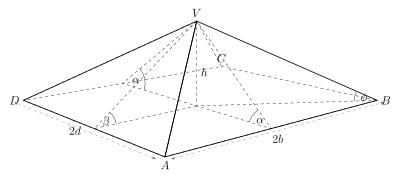
- Let \(A = (0,0,0)\) and then \(B = 22b \mathbf{i}, D = 2d\mathbf{j}, C = 2b\mathbf{i}+2d\mathbf{j}\) and \(V = b \mathbf{i} + d\mathbf{j} + h\mathbf{k}\) We also have \begin{align*} && \tan \alpha &= \frac{h}{d}\\ && \tan \beta &= \frac{d}{b} \\ && \vec{AV} \times \vec{VB} &= \begin{pmatrix} b \\ d \\ h \end{pmatrix} \times \begin{pmatrix} -b \\ d \\ h \end{pmatrix} \\ &&&= \begin{pmatrix} 0 \\ -2bh \\ 2db \end{pmatrix} \\ &&&= 2b \begin{pmatrix} 0 \\ -d \tan \alpha \\ d \end{pmatrix} \\ &&&= k \begin{pmatrix} 0 \\ - \sin \alpha \\ \cos \alpha \end{pmatrix} \end{align*} similarly for the vector perpendicular to the other face it must be \(\begin{pmatrix}-\sin \beta \\ 0 \\ \cos \beta \end{pmatrix}\) Looking at the angle between these perpendicular (to find the angles between the faces we see: \begin{align*} \begin{pmatrix} 0 \\ - \sin \alpha \\ \cos \alpha \end{pmatrix} \cdot \begin{pmatrix}-\sin \beta \\ 0 \\ \cos \beta \end{pmatrix} &= \cos \alpha \cos \beta \end{align*} But this is also \(\pi -\) the angle between the planes, ie \(\cos \theta = \cos \alpha \cos \beta\)
- \(\,\) \begin{align*} && \cot^2 \phi &= \frac{b^2+d^2}{h^2} \\ && \cot^2 \alpha &= \frac{d^2}{h^2} \\ && \cot^2 \beta &= \frac{b^2}{h^2} \\ \Rightarrow && cot^2 \phi &= \cot^2 \beta+\cot^2 \alpha \end{align*} \begin{align*} && \cos^2 \phi &= \frac{b^2+d^2}{b^2+d^2+h^2} \\ && \cos^2 \alpha &= \frac{d^2}{d^2+h^2} \\ && \cos^2 \beta &= \frac{b^2}{b^2+h^2} \\ && \frac{\cos^2 \alpha + \cos^2 \beta - 2 \cos^2 \theta}{1-\cos^2 \theta} &= \frac{\frac{d^2}{d^2+h^2}+\frac{b^2}{b^2+h^2}-2\cdot \frac{d^2}{d^2+h^2} \cdot \frac{b^2}{b^2+h^2}}{1 - \frac{d^2}{d^2+h^2} \cdot\frac{b^2}{b^2+h^2}} \\ &&&= \frac{d^2(b^2+h^2)+b^2(d^2+h^2)-2d^2b^2}{(d^2+h^2)(b^2+h^2)-d^2b^2} \\ &&&= \frac{h^2(b^2+d^2)}{h^2(b^2+d^2+h^2)} \\ &&&= \frac{b^2+d^2}{b^2+d^2+h^2} \\ &&&= \cos^2\phi \end{align*} Also notice that \begin{align*} && \cos^2 \alpha + \cos^2 \beta &\underbrace{\geq}_{AM-GM} 2 \cos \alpha \cos \beta \\ &&&= 2 \cos \theta \\ \Rightarrow && \frac{\cos^2 \alpha + \cos^2 \beta - 2 \cos^2 \theta}{1-\cos^2 \theta} &\geq \frac{2 \cos \theta - 2\cos^2 \theta}{1-\cos^2 \theta} \\ &&&= \frac{2\cos \theta}{1+\cos \theta} = \cos \theta \frac{2}{1+\cos \theta} \\ &&&> \cos^2 \theta \\ \Rightarrow && \phi &< \theta \end{align*}
2019 Paper 3 Q9
In this question, \(\mathbf{i}\) and \(\mathbf{j}\) are perpendicular unit vectors and \(\mathbf{j}\) is vertically upwards. A smooth hemisphere of mass \(M\) and radius \(a\) rests on a smooth horizontal table with its plane face in contact with the table. The point \(A\) is at the top of the hemisphere and the point \(O\) is at the centre of its plane face. Initially, a particle \(P\) of mass \(m\) rests at \(A\). It is then given a small displacement in the positive \(\mathbf{i}\) direction. At a later time \(t\), when the particle is still in contact with the hemisphere, the hemisphere has been displaced by \(-s\mathbf{i}\) and \(\angle AOP = \theta\).
- Let \(\mathbf{r}\) be the position vector of the particle at time \(t\) with respect to the initial position of \(O\). Write down an expression for \(\mathbf{r}\) in terms of \(a\), \(\theta\) and \(s\) and show that $$\dot{\mathbf{r}} = (a\dot{\theta} \cos \theta - \dot{s})\mathbf{i} - a\dot{\theta} \sin \theta \mathbf{j}.$$ Show also that $$\dot{s} = (1 - k)a\dot{\theta} \cos \theta,$$ where \(k = \frac{M}{m + M}\), and deduce that $$\dot{\mathbf{r}} = a\dot{\theta}(k \cos \theta \mathbf{i} - \sin \theta \mathbf{j}).$$
- Show that $$a\dot{\theta}^2 \left(k \cos^2 \theta + \sin^2 \theta\right) = 2g(1 - \cos \theta).$$
- At time \(T\), when \(\theta = \alpha\), the particle leaves the hemisphere. By considering the component of \(\ddot{\mathbf{r}}\) parallel to the vector \(\sin \theta \mathbf{i} + k \cos \theta \mathbf{j}\), or otherwise, show that at time \(T\) $$a\dot{\theta}^2 = g \cos \alpha.$$ Find a cubic equation for \(\cos \alpha\) and deduce that \(\cos \alpha > \frac{2}{3}\).
Solution:
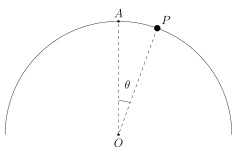
- \(\mathbf{r} = (a \sin \theta - s) \mathbf{i}+a\cos \theta\mathbf{j}\), so \begin{align*} && \dot{\mathbf{r}} &=(a \dot{\theta} \cos \theta - \dot{s}) \mathbf{i}- a\dot{\theta} \sin \theta \mathbf{j}\\ \\ \text{COM}(\rightarrow): && 0 &= M(-\dot{s}) + m(a \dot{\theta} \cos \theta - \dot{s}) \\ \Rightarrow && \dot{s} &= \frac{ma \dot{\theta} \cos \theta}{m+M} \\ &&&= \left ( 1- \frac{M}{m+M} \right) a\dot{\theta} \cos \theta \\ &&&= (1 - k) a\dot{\theta} \cos \theta \\ \\ \Rightarrow && \dot{\mathbf{r}} &=(a \dot{\theta} \cos \theta - \dot{s}) \mathbf{i}- a\dot{\theta} \sin \theta \mathbf{j} \\ &&&= (a \dot{\theta} \cos \theta - (1 - k) a\dot{\theta} \cos \theta) \mathbf{i}- a\dot{\theta} \sin \theta \mathbf{j} \\ &&&= a\dot{\theta} \left ( k \cos \theta \mathbf{i} - \sin \theta \mathbf{j} \right) \end{align*}
- \(\,\) \begin{align*} COE: &&\underbrace{0}_{\text{k.e.}}+ \underbrace{mga}_{\text{GPE}} &= \underbrace{\frac12 m \mathbf{\dot{r}}\cdot\mathbf{\dot{r}}}_{\text{k.e. }P} + \underbrace{mg a\cos \theta}_{\text{GPE}} + \underbrace{\frac12 M \dot{s}^2}_{\text{k.e. hemisphere}} \\ \Rightarrow && 2amg(1-\cos \theta) &= a^2m \dot{\theta}^2(k^2 \cos^2 \theta + \sin^2 \theta)+ M(1 - k)^2 a^2\dot{\theta}^2 \cos^2 \theta \\ \Rightarrow && 2mg(1-\cos \theta) &= a \dot{\theta}^2 \left (m\sin^2 \theta + (mk^2 + M(1-k)^2)\cos^2 \theta \right) \\ &&&= a \dot{\theta}^2 \left (m\sin^2 \theta + mk\cos^2 \theta \right) \\ \Rightarrow && 2g(1-\cos \theta) &= a \dot{\theta}^2 \left (\sin^2 \theta + k\cos^2 \theta \right) \\ \end{align*}
- The equation of motion is \(m \ddot{\mathbf{r}} = \mathbf{R} - mg\mathbf{j}\) and the particle will leave the surface when \(\mathbf{R} = 0\). If we take the component in the directions suggested: \begin{align*} && \ddot{\mathbf{r}} &= a\ddot{\theta}(k \cos \theta \mathbf{i}- \sin \theta \mathbf{j}) + a \dot{\theta}(-k\dot{\theta} \sin \theta \mathbf{i}- \dot{\theta} \cos \theta \mathbf{j}) \\ &&&= ak (\ddot{\theta} \cos \theta - \dot{\theta}^2 \sin \theta) \mathbf{i} -a(\ddot{\theta} \sin \theta + \dot{\theta}^2 \cos \theta) \mathbf{j} \\ \Rightarrow && \mathbf{\ddot{r}} \cdot (\sin \theta \mathbf{i} + k \cos \theta \mathbf{j}) &= ak (\ddot{\theta} \cos \theta - \dot{\theta}^2 \sin \theta) \sin \theta -ak(\ddot{\theta} \sin \theta + \dot{\theta}^2 \cos \theta)\cos \theta \\ &&&= - ak \dot{\theta}^2 \\ && (-g\mathbf{j}) \cdot (\sin \theta \mathbf{i} + k \cos \theta \mathbf{j}) &= -gk \cos \theta \\ \mathbf{R} = 0: && gk \cos \theta &= ak \dot{\theta}^2 \\ \Rightarrow && g \cos \theta &= a \dot{\theta}^2 \end{align*}
- \(\,\) \begin{align*} && 2g(1-\cos \theta) &= a \dot{\theta}^2(k \cos^2 \theta + \sin^2 \theta) \\ && a \dot{\theta}^2 &= g \cos \alpha \\ \Rightarrow && 2g(1-\cos \alpha) &= g \cos \alpha(k \cos^2 \alpha + (1-\cos^2 \alpha)) \\ \Rightarrow && 0 &= g(k-1)c^3+3gc-2g \\ \Rightarrow && 0 &= (k-1)c^3+3c - 2 \end{align*} When \(c =1, f(c) = k > 0\) when \(c = \frac23, f(c) = k-1 < 0\). Therefore there is a root with \(\cos \alpha > \frac23\)
2018 Paper 1 Q1
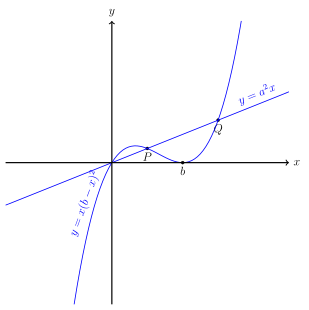
The line \(y=a^2 x\) and the curve \(y=x(b-x)^2\), where \(0 < a < b\,\), intersect at the origin \(O\) and at points \(P\) and \(Q \). The \(x\)-coordinate of \(P\) is less than the \(x\)-coordinate of \(Q\). Find the coordinates of \(P\) and \(Q\), and sketch the line and the curve on the same axes. Show that the equation of the tangent to the curve at \(P\) is \[ y = a(3a-2b)x + 2a(b-a)^2 . \] This tangent meets the \(y\)-axis at \(R\). The area of the region between the curve and the line segment \(OP\) is denoted by \(S\). Show that \[ S= \frac1{12}(b-a)^3(3a+b)\,. \] The area of triangle \(OPR\) is denoted by \(T\). Show that \(S>\frac{1}{3}T\,\).
Solution:
2018 Paper 1 Q2
If \(x=\log_bc\,\), express \(c\) in terms of \(b\) and \(x\) and prove that $ \dfrac{\log_a c}{\log_a b} = \ds \log_b c \,$.
- Given that \(\pi^2 < 10\,\), prove that \[ \frac{1}{\log_2 \pi}+\frac{1}{\log_5 \pi} > 2\,. \]
- Given that \(\ds \log_2 \frac{\pi}{\e} > \frac{1}{5}\) and that \(\e^2 < 8\), prove that \(\ln \pi > \frac{17}{15}\,\).
- Given that \(\e^3 >20\), \, \(\pi^2 < 10\,\) and \(\log_{10}2 >\frac{3}{10}\,\), prove that \(\ln \pi < \frac{15}{13}\,\).
Solution: \(x = \log_bc\) means that \(b^x = c\) Therefore, we can write \(\frac{\log_ac}{\log_ab} = \frac{\log_ab^{x}}{\log_ab} = \frac{x \log_ab}{\log_ab} = x = \log_bc\), giving us the change of base rule. Rearranging the chance of base rule, we get \(\frac{1}{\log_bc} = \frac{\log_ab}{\log_ac}\)
- Since \(\pi^2 < 10\), we have \begin{align*} \Leftrightarrow && \pi^2 &< 10 \\ \Leftrightarrow && 2\log_{10} \pi &< 1 \\ \Leftrightarrow && 2 &< \frac{1}{\log_{10} \pi} \\ \Leftrightarrow && 2 &< \frac{\log_{10} 2 + \log_{10} 5}{\log_{10} \pi} \\ \Leftrightarrow && 2 &< \frac{\log_{10} 2}{\log_{10} \pi} + \frac{\log_{10} 5}{\log_{10} \pi} \\ \Leftrightarrow && 2 &< \frac1{\log_2\pi}+ \frac1{\log_5\pi} \\ \end{align*}
- Since \(e^2 < 8 \Rightarrow 2 < 3 \ln 2 \Rightarrow \ln 2 > \frac23\) \begin{align*} && \log_2 \frac{\pi}{e} &= \frac{\ln \frac{\pi}{e}}{\ln 2} \\ &&&= \frac{\ln \frac{\pi}{e}}{\ln 2} \\ &&&< \frac{3(\ln \pi - 1)}{2} \\ \Rightarrow && \frac{1}{5} &< \frac{3 \ln \pi - 1}{2} \\ \Rightarrow && \frac{2}{15} + 1 = \frac{17}{15}&< \ln \pi \end{align*}
- From the inequalities given we can set up two linear inequalities in \(\ln 2\) and \(\ln 5\) \begin{align*} && 20 &< e^3 \\ \Rightarrow && 2\ln 2 + \ln 5 &< 3 \tag{*}\\ \\ && \frac{3}{10} &< \log_{10} 2 \\ \Rightarrow && \frac{3}{10} &< \frac{\ln 2}{\ln 10} \\ \Rightarrow && 3 \ln 2 + 3 \ln 5 &< 10 \ln 2 \\ \Rightarrow && -7 \ln 2 + 3 \ln 5 &< 0 \tag{**}\\ \\ \\ && \pi^2 & < 10 \\ \Rightarrow && 2 \ln \pi &< \ln 2 + \ln 5 \tag{***}\\ \end{align*} It would be nice to combine \((*)\) and \((**)\) to bound \(\ln 2+ \ln 5\), so we want to use a linear combination such that \begin{align*} && \begin{cases} 2x -7y &= 1 \\ x + 3y &= 1\end{cases} \\ \Rightarrow && \begin{cases} y &= \frac1{13} \\ x &= \frac{10}{13}\end{cases} \\ \\ \Rightarrow && \ln 2 + \ln 5 < \frac{30}{13} + 0 \\ \Rightarrow && \ln \pi < \frac{15}{13} \end{align*}
2018 Paper 1 Q9
A straight road leading to my house consists of two sections. The first section is inclined downwards at a constant angle \(\alpha\) to the horizontal and ends in traffic lights; the second section is inclined upwards at an angle \(\beta\) to the horizontal and ends at my house. The distance between the traffic lights and my house is \(d\). I have a go-kart which I start from rest, pointing downhill, a distance \(x\) from the traffic lights on the downward-sloping section. The go-kart is not powered in any way, all resistance forces are negligible, and there is no sudden change of speed as I pass the traffic lights. Given that I reach my house, show that \(x \sin \alpha\ge d \sin\beta\,\). Let \(T\) be the total time taken to reach my house. Show that \[ \left(\frac{g\sin\alpha}2 \right)^{\!\frac12} T = (1+k) \sqrt{x} - \sqrt{k^2 x -kd\;} \,, \] where \(k = \dfrac{\sin\alpha}{\sin\beta}\,\). Hence determine, in terms of \(d\) and \(k\), the value of \(x\) which minimises \(T\). [You need not justify the fact that the stationary value is a minimum.]
Solution: Applying conservation of energy, since there are no external forces (other than gravity) the condition to reach the house (with any speed) is the initial GPE is larger than the final GPE, ie: \begin{align*} && m g x \sin \alpha &\geq m g d \sin \beta \\ \Rightarrow && x \sin \alpha &\geq d \sin \beta \end{align*} Let \(T_1\) be the time taken on the downward section, and \(T_2\) the time taken on the upward section, then: \begin{align*} && s &= ut + \frac12 a t^2 \\ \Rightarrow && x &= \frac12 g \sin \alpha T_1^2 \\ \Rightarrow && T_1^2 &= \frac{2x}{g \sin \alpha} \\ && v &= u + at \\ \Rightarrow && v &= T_1 g \sin \alpha \\ && mg x \sin \alpha &= mg d \sin \beta + \frac12 m w^2 \\ \Rightarrow && w &= \sqrt{2(x \sin \alpha - d \sin \beta)} \\ && w &= v - g \sin \beta T_2 \\ \Rightarrow && T_2 &= \frac{v - w}{g \sin \beta} \\ \Rightarrow && T &= T_1 + T_2 \\ &&&= \sqrt{\frac{2x}{g \sin \alpha}} + \frac{\sqrt{\frac{2x}{g \sin \alpha}} g \sin \alpha- \sqrt{2(x \sin \alpha - d \sin \beta)}}{g \sin \beta} \\ &&&= \left ( \frac{2}{g \sin \alpha} \right)^{\tfrac12} \left ( \sqrt{x} + \sqrt{x}k - \sqrt{k^2x-kd}\right) \end{align*} Differentiating wrt to \(x\), we obtain: \begin{align*} && \frac{\d T}{\d x} &= C(-(1+k)x^{-1/2}+k^2(k^2 x - kd)^{-1/2}) \\ \text{set to }0: && 0 &= k^2(k^2 x - kd)^{-1/2} - (1+k)x^{-1/2} \\ \Rightarrow && \sqrt{x} k^2 &= \sqrt{k^2x - kd} (1+k) \\ \Rightarrow && x k^4 &= (k^2x-kd)(1+k)^2 \\ \Rightarrow && x(k^4-k^2(1+k)^2) &= -kd(1+k)^2 \\ \Rightarrow && x(2k^2+k) &= d \\ \Rightarrow && x &= \frac{d}{(2k^2+k)} \end{align*}
2018 Paper 1 Q10
A train is made up of two engines, each of mass \(M\), and \(n\) carriages, each of mass \(m\). One of the engines is at the front of the train, and the other is coupled between the \(k\)th and \((k+1)\)th carriages. When the train is accelerating along a straight, horizontal track, the resistance to the motion of each carriage is \(R\) and the driving force on each engine is \(D\), where \(2D >nR\,\). The tension in the coupling between the engine at the front and the first carriage is \(T\).
- Show that \[ T = \frac{n(mD+MR)}{nm+2M}\,. \]
- Show that \(T\) is greater than the tension in any other coupling provided that \(k> \frac12n\,\).
- Show also that, if \(k> \frac12n\,\), then at least one of the couplings is in compression (that is, there is a negative tension in the coupling).
Solution:
- \(\,\)
\begin{align*} \text{N2}(\leftarrow, \text{first engine}): && D-T &= Ma \\ \text{N2}(\leftarrow, \text{rest of train}): && T-nR+D &= (M+nm)a \\ \Rightarrow && \frac{D-T}{M} &= \frac{T+D-nR}{M+nm} \\ \Rightarrow && T \left ( \frac{1}{M+nm}+\frac{1}{M} \right) &= \frac{D}{M} + \frac{nR-D}{M+nm} \\ \Rightarrow && T \left ( 2M+nm\right) &= DM +Dnm + nRM - DM \\ &&&= n(mD+MR) \\ \Rightarrow && T &= \frac{n(mD+MR)}{2M+nm} \end{align*}
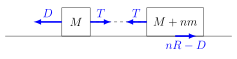
- The greatest coupling must occur behind an engine, because each carriage behind an engine acts as a drag.
Therefore we need only consider the couple between the second engine and the rest of the carriages:
\begin{align*} \text{N2}(\leftarrow, \text{up to second engine}): && 2D - T_2 - kR &= (2M+km)a \\ \text{N2}(\leftarrow, \text{everything else}): && T_2 - (n-k)R &= (n-k)ma \\ \Rightarrow && \frac{2D-T_2-kR}{2M+km} &= \frac{T_2-(n-k)R}{(n-k)m} \\ \Rightarrow && T_2 \left (\frac{1}{(n-k)m} + \frac{1}{2M+km} \right) &= \frac{2D-kR}{2M+km} + \frac{R}{m} \\ \Rightarrow && T_2 \left (2M+ nm \right) &= (2D-kR)m(n-k) + R(2M+km)(n-k) \\ \Rightarrow && T_2 &= \frac{(n-k)\left (2Dm+2RM \right)}{2M+nm} \\ &&&= \frac{2(n-k)(mD + MR)}{2M+nm} \end{align*} Therefore \(T > T_2\) provided \(2(n-k) < n \Leftrightarrow k > \frac12n\)
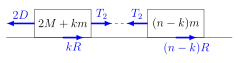
- If there is a coupling which is in negative tension, it must be between the two engines. In particular, if there is one, there must be one directly in front of the first engine.
\begin{align*} \text{N2}(\leftarrow, \text{before second engine}): && D - T_3 - kR &= (M+km)a \\ \text{N2}(\leftarrow, \text{everything else}): && T_3 +D- (n-k)R &= (M+(n-k)m)a \\ \Rightarrow && \frac{D-T_3-kR}{M+km} &= \frac{T_3+D-(n-k)R}{M+(n-k)m} \\ \Rightarrow && T_3 \left ( \frac{1}{M+(n-k)m} + \frac{1}{M+km} \right) &= \frac{D-(n-k)R}{M+(n-k)m}+\frac{kR-D}{M+km} \\ \Rightarrow && T_3 (2M+nm) &= (D-(n-k)R)(M+km)+(kR-D)(M+(n-k)m) \\ &&&= D(M+km-M-(n-k)m) + R(kM+k(n-k)m-(n-k)M-k(n-k)m) \\ &&&= D(n-2k)m+RM(2k-n)m \\ &&&= (n-2k)m(D-RM) \end{align*} Therefore \(T_3\) is negative if \(k > \frac12n\) so there are some connections in compression.
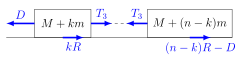
2018 Paper 1 Q11
A bag contains three coins. The probabilities of their showing heads when tossed are \(p_1\), \(p_2\) and \(p_3\).
- A coin is taken at random from the bag and tossed. What is the probability that it shows a head?
- A coin is taken at random from the bag (containing three coins) and tossed; the coin is returned to the bag and again a coin is taken at random from the bag and tossed. Let \(N_1\) be the random variable whose value is the number of heads shown on the two tosses. Find the expectation of \(N_1\) in terms of \(p\), where \(p = \frac{1}{3}(p_1+p_2+p_3)\,\), and show that \(\var(N_1) =2p(1-p)\,\).
- Two of the coins are taken at random from the bag (containing three coins) and tossed. Let \(N_2\) be the random variable whose value is the number of heads showing on the two coins. Find \(\E(N_2)\) and \(\var(N_2)\).
- Show that \(\var(N_2)\le \var(N_1)\), with equality if and only if \(p_1=p_2=p_3\,\).
Solution:
- \(\mathbb{P}(\text{head}) = \mathbb{P}(\text{head}|1)\mathbb{P}(\text{coin 1}) + \mathbb{P}(\text{head}|2)\mathbb{P}(\text{coin 2})+\mathbb{P}(\text{head}|3)\mathbb{P}(\text{coin 3}) = \frac13(p_1+p_2+p_3)\)
- \(N_1 = X_1 + X_2\) where \(X_i \sim Bernoulli(p)\), therefore \(\mathbb{E}(N_1) = 2p\) and \(\textrm{Var}(N_1) = \textrm{Var}(X_1)+ \textrm{Var}(X_2) = p(1-p)+p(1-p) = 2p(1-p)\)
- Let \(Y_i\) be the indicator for the \(i\)th coin is heads. Then \(\mathbb{E}(Y_i) = p\) and so \(\mathbb{E}(N_2) = 2p\). \begin{align*} && \textrm{Var}(N_2) &= \mathbb{E}(N_2^2) - [\mathbb{E}(N_2)]^2\\ &&&= 2^2 \cdot \left (\frac13 \left (p_1p_2+p_2p_3+p_3p_1 \right) \right) + 1 \cdot \left (\frac13 \left (p_1 (1-p_2) + (1-p_1)p_2 + p_2(1-p_3) +(1-p_2)p_3 + p_3(1-p_1) + (1-p_3)p_1 \right) \right) - [\mathbb{E}(N_2)]^2 \\ &&&= \frac43\left (p_1p_2+p_2p_3+p_3p_1 \right) + \frac13 \left ( 2(p_1+p_2+p_3) - 2(p_1p_2+p_2p_3+p_3p_1)\right)-[\mathbb{E}(N_2)]^2 \\ &&&= \frac23\left (p_1p_2+p_2p_3+p_3p_1 \right) + \frac23 \left ( p_1+p_2+p_3 \right)-[\mathbb{E}(N_2)]^2\\ &&&= \frac23\left (p_1p_2+p_2p_3+p_3p_1 \right) + \frac23 \left ( p_1+p_2+p_3 \right)-\left[\frac23(p_1+p_2+p_3)\right]^2\\ &&&= \frac23\left (p_1p_2+p_2p_3+p_3p_1 \right) +2p(1-2p)\\ \end{align*}
- \(\,\) \begin{align*} && \textrm{Var}(N_1) - \textrm{Var}(N_2) &= 2p(1-p) - \left (\frac23\left (p_1p_2+p_2p_3+p_3p_1 \right) +2p(1-2p) \right) \\ &&&= 2p^2-\frac23\left (p_1p_2+p_2p_3+p_3p_1 \right) \\ &&&= \frac23 \left ( \frac13(p_1+p_2+p_3)^2 -\left (p_1p_2+p_2p_3+p_3p_1 \right)\right)\\ &&&= \frac29 \left (p_1^2+p_2^2+p_3^2 -(p_1p_2+p_2p_3+p_3p_1) \right)\\ &&&= \frac19 \left ((p_1-p_2)^2+(p_2-p_3)^2+(p_3-p_1)^2 \right) &\geq 0 \end{align*} with equality iff \(p_1 = p_2 = p_3\)