Problems
Filters
42 problems found
1999 Paper 3 Q2
- Let \(\f(x)=(1+x^2)\e^x\). Show that \(\f'(x)\ge 0\) and sketch the graph of \(\f(x)\). Hence, or otherwise, show that the equation \[ (1+x^2)\e^x = k, \] where \(k\) is a constant, has exactly one real root if \(k>0\) and no real roots if \(k\le 0\).
- Determine the number of real roots of the equation $$ (\e^x-1) - k \tan^{-1} x=0 $$ in the cases (a) \(0< k\le 2/\pi\) and (b) \(2/\pi < k < 1\).
Solution:
- \(\,\) \begin{align*}
&& f(x) &= (1+x^2)e^x \\
&& f'(x) &= 2xe^x + (1+x^2)e^x \\
&&&= (1+x)^2e^x \geq 0
\end{align*}
As \(x \to -\infty\), \(f(x) \to 0\) and as \(x \to \infty\), \(f(x) \to +\infty\) and since \(f\) is strictly increasing we have exactly one solution to \(f(x) = k\) on \((0,\infty)\). Since \(f(x) > 0\) there are no solutions if \(k \leq 0\).
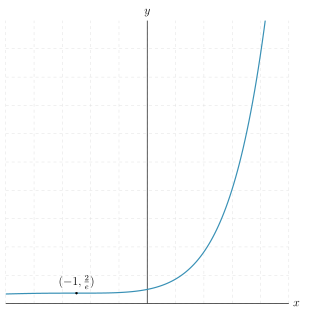
- Considering the function \(g(x) = (e^x-1)-k\tan^{-1} x \) then \(g'(x) = e^x - \frac{k}{1+x^2}\) therefore \(g'(x)\) has exactly one turning point when \(k > 0\) and \(0\) otherwise at the root of \(f(x) = k\) Notice also that \(g(0) = 0\) so we already have one solution, and \(g'(0) = 1 - k > 0\). Notice from our sketch that if \(0 < k < 1\) the root for \(f(x) = k\) has \(x \leq 0\), so our turning point is to the left of the origin and we are interested in the behaviour of \(g(x)\) as \(x \to -\infty\). (ie do we cross the axis again). \(\lim_{x \to -\infty} \left [ e^x - 1 - k \tan^{-1} x \right] = 0 - 1 +k \frac{\pi}{2} = k \frac{\pi}{2} - 1\). if this is positive, ie if \(k > \frac{2}{\pi}\) there are two solutions, otherwise there is only one real root.
1998 Paper 3 Q7
Sketch the graph of \({\rm f}(s)={ \e}^s(s-3)+3\) for \(0\le s < \infty\). Taking \({\e\approx 2.7}\), find the smallest positive integer, \(m\), such that \({\rm f}(m) > 0\). Now let $$ {\rm b}(x) = {x^3 \over \e^{x/T} -1} \, $$ where \(T\) is a positive constant. Show that \({\rm b}(x)\) has a single turning point in \(0 < x < \infty\). By considering the behaviour for small \(x\) and for large \(x\), sketch \({\rm b}(x)\) for \(0\le x < \infty\). Let $$ \int_0^\infty {\rm b}(x)\,\d x =B, $$ which may be assumed to be finite. Show that \(B = K T^n\) where \(K\) is a constant, and \(n\) is an integer which you should determine. Given that \(\displaystyle{B \approx 2 \int_0^{Tm} {\rm b}(x) {\,\rm d }x}\), use your graph of \({\rm b}(x)\) to find a rough estimate for \(K\).
1997 Paper 3 Q1
- By considering the series expansion of \((x^2+5x+4){\rm \; e}^x\) show that \[10{\rm\, e}=4+\frac{3^2}{1!}+\frac{4^2}{2!}+\frac{5^2}{3!}+\cdots\;.\]
- Show that \[5{\rm\, e}=1+\frac{2^2}{1!}+\frac{3^2}{2!}+\frac{4^2}{3!}+\cdots\;.\]
- Evaluate \[1+\frac{2^3}{1!}+\frac{3^3}{2!}+\frac{4^3}{3!}+\cdots\;.\]
Solution:
- \begin{align*} (x^2+5x+4)e^x &= \sum_{k=0}^\infty \frac{1}{k!} x^{k+2}+\sum_{k=0}^\infty \frac{5}{k!} x^{k+1}+\sum_{k=0}^\infty \frac{4}{k!} x^{k} \\ &= \sum_{k=0}^{\infty} \l \frac{1}{k!}+\frac{5}{(k+1)!}+\frac{4}{(k+2)!} \r x^{k+2} + 5x+4+4x \\ &= 4 + 9x + \sum_{k=0}^{\infty} \l \frac{(k+2)(k+1)}{(k+2)!}+\frac{5(k+2)}{(k+2)!}+\frac{4}{(k+2)!} \r x^{k+2}\\ &= 4 + 9x + \sum_{k=0}^{\infty} \l \frac{k^2+3k+2+5k+10+4}{(k+2)!} \r x^{k+2}\\ &= 4 + 9x + \sum_{k=0}^{\infty} \frac{(k+4)^2}{(k+2)!} x^{k+2}\\ &= 4 + 9x + \sum_{k=2}^{\infty} \frac{(k+2)^2}{k!} x^{k}\\ \end{align*} So when \(x = 1\) we have \[10e = 4 + \frac{3^2}{1!} + \frac{4^2}{2!} + \frac{5^2}{3!} + \cdots \]
- \begin{align*} (x^2+3x+1)e^x &= \sum_{k=0}^\infty \frac{1}{k!}x^{k+2}+\sum_{k=0}^\infty 3\frac{1}{k!}x^{k+1} + \sum_{k=0}^{\infty} \frac{1}{k!} x^k \\ &= 1+3x+\sum_{k=1}^{\infty} \l \frac1{(k-1)!}+\frac{3}{k!} + \frac{1}{(k+1)!} \r x^{k+1} \\ &= 1+3x+\sum_{k=1}^{\infty} \frac{(k+1)k + 3(k+1)+1}{(k+1)!}x^{k+1} \\ &= 1+3x+\sum_{k=1}^{\infty} \frac{k^2+4k+4}{(k+1)!}x^{k+1} \\ &= 1+3x+\sum_{k=0}^{\infty} \frac{(k+2)^2}{(k+1)!}x^{k+1} \\ &=1+3x+ \sum_{k=1}^{\infty} \frac{(k+1)^2}{k!}x^k \end{align*} Plugging in \(x=1\) we get the desired result.
- \begin{align*} && xe^x &= \sum_{k=0}^{\infty} \frac{x^{k+1}}{k!} \\ x\frac{\d}{\d x} : && x(1+x)e^x &= \sum_{k=0}^{\infty} \frac{(k+1)x^{k+1}}{k!} \\ x\frac{\d}{\d x} : && x(x(1+x)+1+2x)e^x &= \sum_{k=0}^{\infty} \frac{(k+1)^2x^{k+1}}{k!} \\ &&(x^3+3x^2+x)e^x &= \sum_{k=0}^{\infty} \frac{(k+1)^2x^{k+1}}{k!} \\ \frac{\d}{\d x} : && e^x(x^3+3x^2+x+3x^2+6x+1) &=\sum_{k=0}^{\infty} \frac{(k+1)^3x^{k}}{k!} \\ \Rightarrow && 15e &= 1 + \frac{2^3}{1!} + \frac{3^3}{2!} + \cdots \end{align*}
1997 Paper 3 Q7
For each positive integer \(n\), let \begin{align*} a_n&=\frac1{n+1}+\frac1{(n+1)(n+2)}+\frac1{(n+1)(n+2)(n+3)}+\cdots;\\ b_n&=\frac1{n+1}+\frac1{(n+1)^2}+\frac1{(n+1)^3}+\cdots. \end{align*}
- Evaluate \(b_n\).
- Show that \(0
- Deduce that \(a_n=n!{\rm e}-[n!{\rm e}]\) (where \([x]\) is the integer part of \(x\)).
- Hence show that \(\mathrm{e}\) is irrational.
1996 Paper 1 Q13
I have a Penny Black stamp which I want to sell to my friend Jim, but we cannot agree a price. So I put the stamp under one of two cups, jumble them up, and let Jim guess which one it is under. If he guesses correctly, I add a third cup, jumble them up, and let Jim guess correctly, adding another cup each time. The price he pays for the stamp is \(\pounds N,\) where \(N\) is the number of cups present when Jim fails to guess correctly. Find \(\mathrm{P}(N=k)\). Show that \(\mathrm{E}(N)=\mathrm{e}\) and calculate \(\mathrm{Var}(N).\)
Solution: \begin{align*} && \mathbb{P}(N = k) &= \mathbb{P}(\text{guesses }k-1\text{ correctly then 1 wrong})\\ &&&= \frac12 \cdot \frac{1}{3} \cdots \frac{1}{k-1} \frac{k-1}{k} \\ &&&= \frac{k-1}{k!} \\ &&\mathbb{E}(N) &= \sum_{k=2}^\infty k \cdot \mathbb{P}(N=k) \\ &&&= \sum_{k=2}^{\infty} \frac{k(k-1)}{k!} \\ &&&= \sum_{k=0}^{\infty} \frac{1}{k!} = e \\ && \textrm{Var}(N) &= \mathbb{E}(N^2) - \mathbb{E}(N)^2 \\ && \mathbb{E}(N^2) &= \sum_{k=2}^{\infty} k^2 \mathbb{P}(N=k) \\ &&&= \sum_{k=2}^{\infty} \frac{k^2(k-1)}{k!} \\ &&&= \sum_{k=0}^{\infty} \frac{k+2}{k!} \\ &&&= \sum_{k=0}^{\infty} \frac{1}{k!} + 2 \sum_{k=0}^{\infty} \frac{1}{k!} = 3e \\ \Rightarrow && \textrm{Var}(N) &= 3e-e^2 \end{align*}
1995 Paper 1 Q6
- In the differential equation \[ \frac{1}{y^{2}}\frac{\mathrm{d}y}{\mathrm{d}x}+\frac{1}{y}=\mathrm{e}^{2x} \] make the substitution \(u=1/y,\) and hence show that the general solution of the original equation is \[ y=\frac{1}{A\mathrm{e}^{x}-\mathrm{e}^{2x}}\,. \]
- Use a similar method to solve the equation \[ \frac{1}{y^{3}}\frac{\mathrm{d}y}{\mathrm{d}x}+\frac{1}{y^{2}}=\mathrm{e}^{2x}. \]
Solution:
- \(,\) \begin{align*} u = 1/y, \frac{\d u}{\d x} = -1/y^2 y': && -\frac{\d u}{\d x} + u &= e^{2x} \\ \Rightarrow && \frac{\d}{\d x} \left (e^{-x}u \right) = -e^{x} \\ \Rightarrow && e^{-x}u &= -e^x+C \\ \Rightarrow && u &= Ce^x-e^{2x} \\ \Rightarrow && y &= \frac{1}{Ce^x-e^{2x}} \end{align*}
- \(\,\) \begin{align*} u = 1/y^2, u' = -2/y^3 y': && -2u'+u &= e^{2x} \\ \Rightarrow && \frac{\d}{\d x} \left (e^{-1/2x}u\right) &= -\frac12e^{\frac32x} \\ \Rightarrow && e^{-\frac12x}u &= -\frac13e^{\frac32x}+C \\ \Rightarrow && u &= -\frac13e^{2x}+Ce^{\frac12x} \\ \Rightarrow && y &= \left ( \frac{1}{Ce^{\frac12x}-\frac13e^{2x}}\right)^{\frac12} \end{align*}
1993 Paper 2 Q5
\noindent
1992 Paper 1 Q8
Explain diagrammatically, or otherwise, why \[ \frac{\mathrm{d}}{\mathrm{d}x}\int_{a}^{x}\mathrm{f}(t)\,\mathrm{d}t=\mathrm{f}(x). \] Show that, if \[ \mathrm{f}(x)=\int_{0}^{x}\mathrm{f}(t)\,\mathrm{d}t+1, \] then \(\mathrm{f}(x)=\mathrm{e}^{x}.\) What is the solution of \[ \mathrm{f}(x)=\int_{0}^{x}\mathrm{f}(t)\,\mathrm{d}t? \] Given that \[ \int_{0}^{x}\mathrm{f}(t)\,\mathrm{d}t=\int_{x}^{1}t^{2}\mathrm{f}(t)\,\mathrm{d}t+x-\frac{x^{5}}{5}+C, \] find \(\mathrm{f}(x)\) and show that \(C=-2/15.\)
1989 Paper 1 Q6
The normal to the curve \(y=\mathrm{f}(x)\) at the point \(P\) with coordinates \((x,\mathrm{f}(x))\) cuts the \(y\)-axis at the point \(Q\). Derive an expression in terms of \(x\), \(\mathrm{f}(x)\) and \(\mathrm{f}'(x)\) for the \(y\)-coordinate of \(Q\). If, for all \(x\), \(PQ=\sqrt{\mathrm{e}^{x^{2}}+x^{2}}\), find a differential equation satisfied by \(\mathrm{f}(x)\). If the curve also has a minimum point \((0,-2)\), find its equation.
Solution: The normal to the curve \(y = f(x)\) has gradient \(-\frac{1}{f'(x)}\) and so has equation: \begin{align*} && \frac{Y - f(x)}{X - x} &= -\frac{1}{f'(x)} \\ \Rightarrow && Y &= -\frac{1}{f'(x)}X + \frac{x}{f'(x)}+f(x) \end{align*} Hence the \(Q\) is \(\displaystyle \left (0, f(x) + \frac{x}{f'(x)} \right)\). \begin{align*} && |PQ|^2 &= x^2 + \frac{x^2}{(f'(x))^2} \\ \Rightarrow && x^2 + e^{x^2} &= x^2 + \frac{x^2}{(f'(x))^2} \\ \Rightarrow && (f'(x))^2 &=x^2 e^{-x^2} \end{align*} Therefore \(f'(x) = \pm x e^{-x^2/2}\). If \(f(x)\) has a minimum at \((0,-2)\) then \(f''(0) > 0\), and \(f''(x) = \pm (e^{-x^2/2} - x^2e^{-x^2/2}) = \pm e^{-x^2/2}(1-x^2)\) so we should take the positive branch of the solution, ie \(f'(x) = xe^{-x^2/2}\). Therefore \(f(x) = - e^{-x^2/2}+C\). Since \(f(0) = -2\) we must have \(-2 = -1 + C\), ie \(C = -1\). Therefore \(f(x) = -1 - e^{-x^2/2}\)
1988 Paper 3 Q1
Sketch the graph of \[ y=\frac{x^{2}\mathrm{e}^{-x}}{1+x}, \] for \(-\infty< x< \infty.\) Show that the value of \[ \int_{0}^{\infty}\frac{x^{2}\mathrm{e}^{-x}}{1+x}\,\mathrm{d}x \] lies between \(0\) and \(1\).
Solution:

1988 Paper 3 Q10
Four greyhounds \(A,B,C\) and \(D\) are held at positions such that \(ABCD\) is a large square. At a given instant, the dogs are released and \(A\) runs directly towards \(B\) at constant speed \(v\), \(B\) runs directly towards \(C\) at constant speed \(v\), and so on. Show that \(A\)'s path is given in polar coordinates (referred to an origin at the centre of the field and a suitable initial line) by \(r=\lambda\mathrm{e}^{-\theta},\) where \(\lambda\) is a constant. Generalise this result to the case of \(n\) dogs held at the vertices of a regular \(n\)-gon (\(n\geqslant3\)).
Solution:


1987 Paper 1 Q1
Find the stationary points of the function \(\mathrm{f}\) given by \[ \mathrm{f}(x)=\mathrm{e}^{ax}\cos bx,\mbox{ }(a>0,b>0). \] Show that the values of \(\mathrm{f}\) at the stationary points with \(x>0\) form a geometric progression with common ratio \(-\mathrm{e}^{a\pi/b}\). Give a rough sketch of the graph of \(\mathrm{f}\).
Solution: Let \(f(x) = e^{ax} \cos bx\) then, \(f'(x) = ae^{ax} \cos bx - be^{ax} \sin bx = e^{ax} \l a\cos bx - b \sin bx \r\). Therefore the stationary points are where \(f'(x) = 0 \Leftrightarrow \tan bx = \frac{b}a\), ie \(x = \tan^{-1} \frac{a}{b} + \frac{n}{b} \pi, n \in \mathbb{Z}\). \begin{align*} f(\tan^{-1} \frac{a}{b} + \frac{n}{b} \pi) &= e^{a \tan^{-1} \frac{a}{b} + \frac{an}{b} \pi} \cos \l b \tan^{-1} \frac{a}{b} +n \pi\r \\ &= e^{a \tan^{-1} \frac{a}{b}} \cos \l b \tan^{-1} \frac{a}{b}\r \cdot e^{\frac{an}{b} \pi}(-1)^n \\ &= e^{a \tan^{-1} \frac{a}{b}} \cos \l b \tan^{-1} \frac{a}{b}\r \cdot (-e^{\frac{a}{b} \pi})^n \\ \end{align*} showing the form the desired geometric progression.
