Problems
Filters
48 problems found
1992 Paper 1 Q16
The four towns \(A,B,C\) and \(D\) are linked by roads \(AB,AC,CB,BD\) and \(CD.\) The probability that any one road will be blocked by snow on the 1st of January is \(p\), independent of what happens to any other \([0 < p < 1]\). Show that the probability that any open route from \(A\) to \(D\) is \(ABCD\) is \[ p^{2}(1-p)^{3}. \] In order to increase the probability that it is possible to get from \(A\) to \(D\) by a sequence of unblocked roads the government proposes either to snow-proof the road \(AB\) (so that it can never be blocked) or to snow-proof the road \(CB.\) Because of the high cost it cannot do both. Which road should it choose (or are both choices equally advantageous)? In fact, \(p=\frac{1}{10}\) and the government decides that it is only worth going ahead if the present probability of \(A\) being cut off from \(D\) is greater than \(\frac{1}{100}.\) Will it go ahead?
1992 Paper 2 Q1
Find the limit, as \(n\rightarrow\infty,\) of each of the following. You should explain your reasoning briefly. \begin{alignat*}{4} \mathbf{(i)\ \ } & \dfrac{n}{n+1}, & \qquad & \mathbf{(ii)\ \ } & \dfrac{5n+1}{n^{2}-3n+4}, & \qquad & \mathbf{(iii)\ \ } & \dfrac{\sin n}{n},\\ \\ \mathbf{(iv)\ \ } & \dfrac{\sin(1/n)}{(1/n)}, & & \mathbf{(v)}\ \ & (\arctan n)^{-1}, & & \mathbf{(vi)\ \ } & \dfrac{\sqrt{n+1}-\sqrt{n}}{\sqrt{n+2}-\sqrt{n}}. \end{alignat*}
Solution:
- \begin{align*} \lim_{n \to \infty} \frac{n}{n+1} &= \lim_{n \to \infty} \left (1 - \frac{1}{n+1} \right ) \\ &\underbrace{=}_{\text{sum of limits}} \lim_{n \to \infty} 1 - \lim_{n \to \infty} \frac{1}{n+1}\\ &= 1 \end{align*}
- \begin{align*} \lim_{n \to \infty} \frac{5n+1}{n^2-3n+4} &= \lim_{n \to \infty} \frac{5/n + 1/n^2}{1-3/n+ 4/n^2} \\ &\underbrace{=}_{\text{ratio of limits}} \frac{\displaystyle \lim_{n \to \infty}(5/n + 1/n^2)}{\displaystyle \lim_{n \to \infty}(1-3/n+ 4/n^2)} \\ &= \frac{0}{1} = 0 \end{align*}
- \begin{align*} && \lvert \frac{\sin n}{n} \rvert &\leq \frac{1}{n} \quad \quad (n \geq 1) \\ \Rightarrow && \lim_{n \to \infty} \lvert \frac{\sin n}{n} \rvert &\leq \lim_{n \to \infty}\frac{1}{n} \\ &&&= 0\\ \Rightarrow && \lim_{n \to \infty} \frac{\sin n}{n} &= 0 \end{align*}
- First note that \(\displaystyle \lim_{x \to 0} \frac{\sin x}{x} \to 1\), then \(\frac1n\) is a sequence converging to zero, therefore \(\frac{\sin 1/n}{1/n}\) also must tend to \(1\).
- Note that \(\lim_{x \to \infty} \tan^{-1} x = \frac{\pi}{2}\) and since \(n\) is a sequence tending to infinity we must have \(\lim_{n \to \infty} \tan^{-1} n = \frac{\pi}{2}\)
- \begin{align*} \lim_{n \to \infty} \dfrac{\sqrt{n+1}-\sqrt{n}}{\sqrt{n+2}-\sqrt{n}} &= \lim_{n \to \infty} \dfrac{\frac{1}{\sqrt{n+1}+\sqrt{n}}}{\frac{2}{\sqrt{n+2}+\sqrt{n}}} \\ &= \frac12 \lim_{n \to \infty} \dfrac{\sqrt{n+2}+\sqrt{n}}{\sqrt{n+1}+\sqrt{n}}\\ &= \frac12 \lim_{n \to \infty} \dfrac{\sqrt{1+2/n}+\sqrt{1}}{\sqrt{1+1/n}+\sqrt{1}}\\ &= \frac12 \end{align*}
1992 Paper 2 Q2
Suppose that \(y\) satisfies the differential equation \[ y=x\frac{\mathrm{d}y}{\mathrm{d}x}-\cosh\left(\frac{\mathrm{d}y}{\mathrm{d}x}\right).\tag{*} \] By differentiating both sides of \((*)\) with respect to \(x\), show that either \[ \frac{\mathrm{d}^{2}y}{\mathrm{d}x^{2}}=0\qquad\mbox{ or }\qquad x-\sinh\left(\frac{\mathrm{d}y}{\mathrm{d}x}\right)=0. \] Find the general solutions of each of these two equations. Determine the solutions of \((*)\).
Solution: \begin{align*} && y & =x\frac{\mathrm{d}y}{\mathrm{d}x}-\cosh\left(\frac{\mathrm{d}y}{\mathrm{d}x}\right) \\ \Rightarrow && \frac{\d y}{\d x} &= \frac{\d y}{\d x} + x\frac{\d ^2 y}{\d x^2} - \sinh \left ( \frac{\d y}{\d x} \right) \frac{\d^2 y}{\d x^2} \\ \Rightarrow && 0 &= \frac{\d^2 y}{\d x^2} \left ( x - \sinh \left ( \frac{\d y}{\d x}\right)\right) \end{align*} Therefore \(\frac{\d^2y}{\d x^2} = 0\) or \( x - \sinh \left ( \frac{\d y}{\d x}\right) = 0\) as required. \begin{align*} && \frac{\d ^2 y}{\d x^2} &= 0 \\ \Rightarrow && y &= ax + b \\ \\ && 0 &= x - \sinh \left ( \frac{\d y}{\d x}\right) \\ \Rightarrow && \frac{\d y}{\d x} &= \sinh^{-1} (x) \\ \Rightarrow && y &= x \sinh^{-1} x - \sqrt{x^2+1} + C \end{align*} Since it is necessary the solution satisfies one of those equations, we just need to check if either of these types of solutions work for our differential equation, ie \begin{align*} && ax + b &\stackrel{?}{=} ax - \cosh(a) \\ \Rightarrow && b &= -\cosh(a) \\ \Rightarrow && y &= ax -\cosh(a) \\ \\ && x \sinh^{-1} x - \sqrt{x^2+1} + C &\stackrel{?}{=} x\sinh^{-1} x - \cosh ( \sinh^{-1} x) \\ &&&= \sinh^{-1} x -\sqrt{x^2+1} \\ \Rightarrow && C &= 0 \end{align*} Therefore the general solutions are, \(y = ax - \cosh(a)\) and \(y = x \sinh^{-1} x - \sqrt{x^2+1}\)
1992 Paper 2 Q3
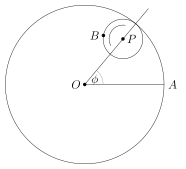
In the figure, the large circle with centre \(O\) has radius \(4\) and the small circle with centre \(P\) has radius \(1\). The small circle rolls around the inside of the larger one. When \(P\) was on the line \(OA\) (before the small circle began to roll), the point \(B\) was in contact with the point \(A\) on the large circle.
1992 Paper 2 Q4
\(\lozenge\) is an operation which take polynomials in \(x\) to polynomials in \(x\); that is, given a polynomial \(\mathrm{h}(x)\) there is another polynomial called \(\lozenge\mathrm{h}(x)\). It is given that, if \(\mathrm{f}(x)\) and \(\mathrm{g}(x)\) are any two polynomials in \(x\), the following are always true:
- \(\lozenge(\mathrm{f}(x)\mathrm{g}(x))=\mathrm{g}(x)\lozenge\mathrm{f}(x)+\mathrm{f}(x)\lozenge\mathrm{g}(x),\)
- \(\lozenge(\mathrm{f}(x)+\mathrm{g}(x))=\lozenge\mathrm{f}(x)+\lozenge\mathrm{g}(x),\)
- \(\lozenge x=1\)
- if \(\lambda\) is a constant then \(\lozenge(\lambda\mathrm{f}(x))=\lambda\lozenge\mathrm{f}(x).\)
Solution: Claim: If \(f(x) = c\) then \(\lozenge f(x) = 0\) Proof: Consider \(g(x) = x\) then \begin{align*} (1) && \lozenge(f(x)g(x)) &= g(x) \lozenge f(x) + f(x) \lozenge g(x) \\ \Rightarrow && \lozenge(c x) &= x \lozenge f(x) + c \lozenge x \\ (4) && \lozenge(c x) &= c \lozenge x \\ \Rightarrow && 0 &= x \lozenge f(x) \\ \Rightarrow && \lozenge f(x) &= 0 \end{align*} \begin{align*} (1) && \lozenge(x^2) &= x \lozenge x + x \lozenge x \\ (3) &&&= 2 x \cdot 1 \\ &&&= 2x \\ \\ (1) && \lozenge (x^3) &= x^2 \lozenge x + x \lozenge (x^2) \\ &&&= x^2 \cdot \underbrace{1}_{(3)} + x \cdot\underbrace{ 2x}_{\text{previous part}} \\ &&&= 3x^2 \end{align*} Claim: \(\lozenge h(x) = \frac{\d }{\d x} ( h(x))\) for any polynomial \(h\). Proof: (By (strong) induction on the degree of \(h\)). Base case: True, we proved this in the first part of the question. Inductive step: Assume true for all polynomials of degree less than or equal to \(k\). Then consider \(n = k+1\). We can write \(h(x) = ax^{k+1} + h_k(x)\) where \(h_k(x)\) is a polynomial of degree less than or equal to \(k\). Then notice: \begin{align*} && \lozenge (h(x)) &= \lozenge (ax^{k+1} + h_k(x)) \\ (2) &&&= \lozenge (ax^{k+1})+ \lozenge (h_k(x)) \\ &&&=\underbrace{a\lozenge (x^{k+1})}_{(4)}+ \underbrace{\frac{\d}{\d x} (h_k(x))}_{\text{inductive hypothesis}}\\ &&&= a \underbrace{\left (x \lozenge x^k + x^k \lozenge x \right)}_{(1)} + \frac{\d}{\d x} (h_k(x)) \\ &&&= a \left ( x \cdot \underbrace{k x^{k-1}}_{\text{inductive hyp.}} + x^k \cdot \underbrace{1}_{(3)} \right) + \frac{\d}{\d x} (h_k(x)) \\ &&&= (k+1)a x^k + \frac{\d}{\d x} (h_k(x)) \\ &&&= \frac{\d }{\d x} \left ( ax^{k+1} + h_k(x) \right) \\ &&&= \frac{\d }{\d x} (h(x)) \end{align*} Therefore since our statement is true for \(n=0\) and if it is true for \(n=k\) it is true for \(n=k+1\) by the principle of mathematical induction it is true for all \(n \geq 0\)
1992 Paper 2 Q5
Explain what is meant by the order of an element \(g\) of a group \(G\). The set \(S\) consists of all \(2\times2\) matrices whose determinant is \(1\). Find the inverse of the element \(\mathbf{A}\) of \(S\), where \[ \mathbf{A}=\begin{pmatrix}w & x\\ y & z \end{pmatrix}. \] Show that \(S\) is a group under matrix multiplication (you may assume that matrix multiplication is associative). For which elements \(\mathbf{A}\) is \(\mathbf{A}^{-1}=\mathbf{A}\)? Which element or elements have order 2? Show that the element \(\mathbf{A}\) of \(S\) has order 3 if, and only if, \(w+z+1=0.\) Write down one such element.
Solution: The order of an element \(g\) is the smallest positive number \(k\) such that \(g^k = e\). $\mathbf{A}^{-1} = \begin{pmatrix}z & -x\\ -y & w \end{pmatrix}$. Claim, \(S\) is a group. \begin{enumerate} \item (Closure) The product of two \(2\times2\) matrices is always a \(2\times 2\) matrix so we only need to check the determinant. Suppose \(\det(\mathbf{A}) = \det (\mathbf{B}) = 1\), then \(\det(AB) = \det(A)\det(B) = 1\), so our operation is closed \item (Associativity) Inherited from matrix multiplication \item (Identity) $\mathbf{I} =\begin{pmatrix}1 & 0\\ 1 & 1 \end{pmatrix}\( has determinant \)1$. \item (Inverses) The inverse is always fine since the matrix of cofactors always contains integers and the determinant is one, so we never end up with anything which isn't an integer. \end{itemize} If \(\mathbf{A}^-1 = \mathbf{A}\) then assuming $\mathbf{A} = \begin{pmatrix}a & b\\ c & d \end{pmatrix}\( then \)\mathbf{A}^{-1} = \begin{pmatrix}d & - b\\ -c & a \end{pmatrix}\( so we must have \)a=d, -b=b, -c=c\(, so \)b = c = 0\( and \)a = d\(. For the determinant to be \)1\( we must have \)ad = a^2 = 1\(, ie \)a = \pm 1\(. Therefore we must have \)\mathbf{A} = \begin{pmatrix}1 & 0\\ 0 & 1 \end{pmatrix}\( or \)\mathbf{A} = \begin{pmatrix}-1 & 0\\ 0 & -1 \end{pmatrix}$. For an element to have order \(2\) then \(\mathbf{A}^2 = \mathbf{I}\) ie, \(\mathbf{A} = \mathbf{A}^{-1}\) and \(\mathbf{A} \neq \mathbf{I}\) therefore the only element of order \(2\) is $\begin{pmatrix}-1 & 0\\ 0 & -1 \end{pmatrix}$. For an element to have order \(3\) we must have \(\mathbf{A}^2 = \mathbf{A}^{-1}\), ie $\begin{pmatrix}w^2 + xy & x(w+z)\\ y(w+z) & z^2 + xy \end{pmatrix} = \begin{pmatrix}z & -x\\ -y & w \end{pmatrix}$. Therefore \(w^2 + xy = z, x(w+z) = -x, y(w+z) = -y, z^2+xy = w\). The second and third equations are satisfied iff \(w+z+1 = 0\) or \(x = 0\) and \(y = 0\), but if \(x = 0\) and \(y = 0\) then we aren't order \(3\), so we just need to check this is sufficient for the first and last equations. Since \(\det(\mathbf{A}) = 1\) we have \(wz =xy +1\), so the first and last equations are equivalent to \(w^2 + wz - 1 = z\) and \(x^2 + wz-1 = w\) which are equivalent to \(w(w+z) = z+1\) or \(w + z+ 1 = 0\) as required
1992 Paper 2 Q6
Sketch the graphs of \(y=\sec x\) and \(y=\ln(2\sec x)\) for \(0\leqslant x\leqslant\frac{1}{2}\pi\). Show graphically that the equation \[ kx=\ln(2\sec x) \] has no solution with \(0\leqslant x<\frac{1}{2}\pi\) if \(k\) is a small positive number but two solutions if \(k\) is large. Explain why there is a number \(k_{0}\) such that \[ k_{0}x=\ln(2\sec x) \] has exactly one solution with \(0\leqslant x<\frac{1}{2}\pi\). Let \(x_{0}\) be this solution, so that \(0\leqslant x_{0}<\frac{1}{2}\pi\) and \(k_{0}x_{0}=\ln(2\sec x_0)\). Show that \[ x_{0}=\cot x_{0}\ln(2\sec x_{0}). \] Use any appropriate method to find \(x_{0}\) correct to two decimal places. Hence find an approximate value for \(k_{0}\).
Solution:

1992 Paper 2 Q7
The cubic equation \[ x^{3}-px^{2}+qx-r=0 \] has roots \(a,b\) and \(c\). Express \(p,q\) and \(r\) in terms of \(a,b\) and \(c\).
- If \(p=0\) and two of the roots are equal to each other, show that \[ 4q^{3}+27r^{2}=0. \]
- Show that, if two of the roots of the original equation are equal to each other, then \[ 4\left(q-\frac{p^{2}}{3}\right)^{3}+27\left(\frac{2p^{3}}{27}-\frac{pq}{3}+r\right)^{2}=0. \]
Solution: \(p = a+b+c, q = ab+bc+ca, r = abc\)
- Suppose two roots are equal to each other, this means that one of the roots is also a root of the derivative. ie \begin{align*} && 0 &= x^3+qx - r \\ && 0 &= 3x^2+q \end{align*} have a common root, but this root must satisfy \(x^2 = -\frac{q}{3}\). Then \begin{align*} &&0 &= x^3 + qx - r \\ &&&= x^3 -3x^3 - r \\ &&&= -2x^3 -r \\ \Rightarrow && r^2 &= 4x^6 \\ &&&= 4 \left ( -\frac{q}{3}\right)^3 \\ \Rightarrow && 0 &= 27r^2+4q^3 \end{align*}
- Consider \(x = z + \frac{p}{3}\), then the equation is: \begin{align*} x^{3}-px^{2}+qx-r &= (z + \frac{p}{3})^3 - p(z + \frac{p}{3})^2 + q(z + \frac{p}{3}) - r \\ &= z^3 + pz^2 + \frac{p^2}{3}z + \frac{p^3}{27} - \\ &\quad -pz^2-\frac{2p^2}{3}z-\frac{p^3}{9} + \\ &\quad\quad qz + \frac{pq}{3} - r \\ &= z^3+\left (\frac{p^2}{3}-\frac{2p^2}{3}+q \right)z + \left (\frac{p^3}{27}-\frac{p^3}{9}+\frac{pq}{3}-r \right) \\ &= z^3+\left (-\frac{p^2}{3}+q \right)z + \left (-\frac{2p^3}{27}+\frac{pq}{3}-r \right) \\ \end{align*} Since this equation must also have repeated roots we must have: \begin{align*} 4\left (-\frac{p^2}{3}+q \right)^3 + 27 \left (-\frac{2p^3}{27}+\frac{pq}{3}-r \right)^2 = 0 \end{align*} which is exactly our desired result
1992 Paper 2 Q8
Calculate the following integrals
- \({\displaystyle \int\frac{x}{(x-1)(x^{2}-1)}\,\mathrm{d}x}\);
- \({\displaystyle \int\frac{1}{3\cos x+4\sin x}\,\mathrm{d}x}\);
- \({\displaystyle \int\frac{1}{\sinh x}\,\mathrm{d}x}.\)
Solution:
- \begin{align*} \int\frac{x}{(x-1)(x^{2}-1)}\,\mathrm{d}x &= \int \frac{x}{(x-1)^2 (x+1)} \d x \\ &= \int \frac{1}{2(x-1)^2} + \frac{1}{4(x-1)} - \frac{1}{4(x+1)} \d x \\ &= -\frac12 (x-1)^{-1} + \frac14 \ln(x-1) - \frac14 \ln (x+1) + C \end{align*}
- \begin{align*} \int \frac{1}{3 \cos x + 4 \sin x } \d x &= \int \frac{1}{5 \cos (x - \cos^{-1}(3/5))} \d x \\ &= \frac15 \int \sec (x - \cos^{-1}(3/5)) \d x\\ &= \frac15 \left (\ln | \sec (x - \cos^{-1}(3/5)) + \tan (x - \cos^{-1}(3/5)) | \right) + C \end{align*}
- \begin{align*} \int \frac{1}{\sinh x} \d x &= \int \frac{2}{e^x - e^{-x}} \\ &= \int \frac{2e^x}{e^{2x}-1} \d x \\ &=\int \frac{e^x}{e^x-1} - \frac{e^x}{e^x+1} \d x \\ &= \ln (e^x - 1) + \ln (e^x+1) + C \end{align*}
1992 Paper 2 Q9
Let \(\mathbf{a},\mathbf{b}\) and \(\mathbf{c}\) be the position vectors of points \(A,B\) and \(C\) in three-dimensional space. Suppose that \(A,B,C\) and the origin \(O\) are not all in the same plane. Describe the locus of the point whose position vector \(\mathbf{r}\) is given by \[ \mathbf{r}=(1-\lambda-\mu)\mathbf{a}+\lambda\mathbf{b}+\mu\mathbf{c}, \] where \(\lambda\) and \(\mu\) are scalar parameters. By writing this equation in the form \(\mathbf{r}\cdot\mathbf{n}=p\) for a suitable vector \(\mathbf{n}\) and scalar \(p\), show that \[ -(\lambda+\mu)\mathbf{a}\cdot(\mathbf{b}\times\mathbf{c})+\lambda\mathbf{b}\cdot(\mathbf{c}\times\mathbf{a})+\mu\mathbf{c}\cdot(\mathbf{a}\times\mathbf{b})=0 \] for all scalars \(\lambda,\mu.\) Deduce that \[ \mathbf{a}\cdot(\mathbf{b}\times\mathbf{c})=\mathbf{b}\cdot(\mathbf{c}\times\mathbf{a})=\mathbf{c}\cdot(\mathbf{a}\times\mathbf{b}). \] Say briefly what happens if \(A,B,C\) and \(O\) are all in the same plane.
Solution: \(\mathbf{r}=(1-\lambda-\mu)\mathbf{a}+\lambda\mathbf{b}+\mu\mathbf{c} = \mathbf{a} + \lambda(\mathbf{b}-\mathbf{a})+\mu(\mathbf{c}-\mathbf{a})\) Therefore it is the plane through \(\mathbf{a}\) with direction vectors \(\mathbf{b}-\mathbf{a}\) and \(\mathbf{c}-\mathbf{a}\), ie it is the plane through \(\mathbf{a},\mathbf{b},\mathbf{c}\). The normal to this plane will be \((\mathbf{b}-\mathbf{a} ) \times (\mathbf{c}-\mathbf{a}) = \mathbf{b}\times \mathbf{c}-\mathbf{a} \times \mathbf{c}-\mathbf{b}\times \mathbf{a}\), so we must have: \begin{align*} && \mathbf{r} \cdot \left (\mathbf{b}\times \mathbf{c}-\mathbf{a} \times \mathbf{c}-\mathbf{b}\times \mathbf{a} \right) &= \mathbf{a} \cdot \left (\mathbf{b}\times \mathbf{c}-\mathbf{a} \times \mathbf{c}-\mathbf{b}\times \mathbf{a} \right) \\ &&&= \mathbf{a} \cdot (\mathbf{b}\times \mathbf{c}) \end{align*} Therefore, \begin{align*} && \mathbf{a} \cdot (\mathbf{b}\times \mathbf{c}) &= \mathbf{r} \cdot \left (\mathbf{b}\times \mathbf{c}-\mathbf{a} \times \mathbf{c}-\mathbf{b}\times \mathbf{a} \right) \\ &&&= \left ( (1-\lambda-\mu)\mathbf{a}+\lambda\mathbf{b}+\mu\mathbf{c} \right)\cdot \left (\mathbf{b}\times \mathbf{c}-\mathbf{a} \times \mathbf{c}-\mathbf{b}\times \mathbf{a} \right) \\ &&&= (1-\lambda- \mu) \mathbf{a}\cdot (\mathbf{b} \times \mathbf{c})-\lambda \mathbf{b}\cdot(\mathbf{a} \times \mathbf{c})-\mu \mathbf{c}\cdot(\mathbf{b} \times \mathbf{a}) \\ \Rightarrow && 0 &= (-\lambda- \mu) \mathbf{a}\cdot (\mathbf{b} \times \mathbf{c})-\lambda \mathbf{b}\cdot(\mathbf{a} \times \mathbf{c})-\mu \mathbf{c}\cdot(\mathbf{b} \times \mathbf{a}) \\ &&&= -(\lambda+ \mu) \mathbf{a}\cdot (\mathbf{b} \times \mathbf{c})+\lambda \mathbf{b}\cdot(\mathbf{c} \times \mathbf{a})+\mu \mathbf{c}\cdot(\mathbf{a} \times \mathbf{b}) \\ \end{align*} The result follows from setting \(\mu = 0, \lambda = 1\) and \(\mu = 1, \lambda = 0\). If they all lie in the same plane then the plane described is through the origin, and those values are all the same, but equal to \(0\).
1992 Paper 2 Q10
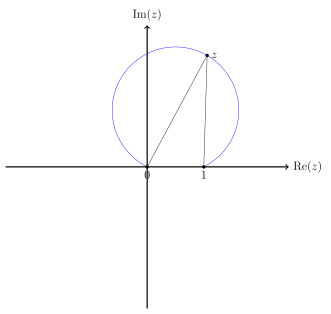
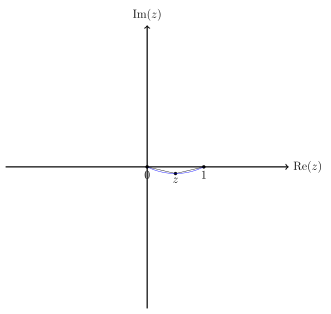
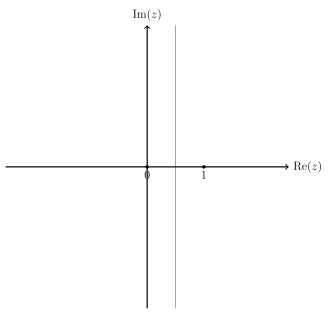
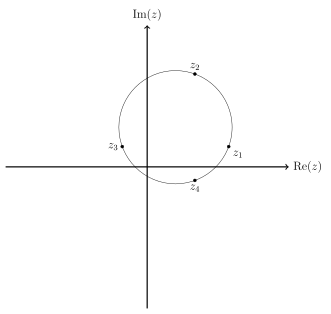
Let \(\alpha\) be a fixed angle, \(0 < \alpha \leqslant\frac{1}{2}\pi.\) In each of the following cases, sketch the locus of \(z\) in the Argand diagram (the complex plane):
- \({\displaystyle \arg\left(\frac{z-1}{z}\right)=\alpha,}\)
- \({\displaystyle \arg\left(\frac{z-1}{z}\right)=\alpha-\pi,}\)
- \(|\dfrac{z-1}{z}|=1.\)
Solution:
1992 Paper 2 Q11
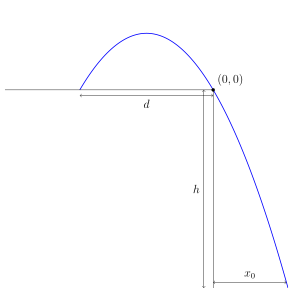
I am standing next to an ice-cream van at a distance \(d\) from the top of a vertical cliff of height \(h\). It is not safe for me to go any nearer to the top of the cliff. My niece Padma is on the broad level beach at the foot of the cliff. I have just discovered that I have left my wallet with her, so I cannot buy her an ice-cream unless she can throw the wallet up to me. She can throw it at speed \(V\), at any angle she chooses and from anywhere on the beach. Air resistance is negligible; so is Padma's height compared to that of the cliff. Show that she can throw the wallet to me if and only if \[ V^{2}\geqslant g(2h+d). \]
Solution:
1992 Paper 2 Q12
In the figure, \(W_{1}\) and \(W_{2}\) are wheels, both of radius \(r\). Their centres \(C_{1}\) and \(C_{2}\) are fixed at the same height, a distance \(d\) apart, and each wheel is free to rotate, without friction, about its centre. Both wheels are in the same vertical plane. Particles of mass \(m\) are suspended from \(W_{1}\) and \(W_{2}\) as shown, by light inextensible strings would round the wheels. A light elastic string of natural length \(d\) and modulus elasticity \(\lambda\) is fixed to the rims of the wheels at the points \(P_{1}\) and \(P_{2}.\) The lines joining \(C_{1}\) to \(P_{1}\) and \(C_{2}\) to \(P_{2}\) both make an angle \(\theta\) with the vertical. The system is in equilibrium. \noindent
- sep}{3mm}
- \(\bf (i)\) no equilibrium positions,
- \(\bf (ii)\) just one equilibrium position,
- \(\bf (iii)\) exactly two equilibrium positions,
- \(\bf (iv)\) more than two equilibrium positions?
1992 Paper 2 Q13
Two particles \(P_{1}\) and \(P_{2}\), each of mass \(m\), are joined by a light smooth inextensible string of length \(\ell.\) \(P_{1}\) lies on a table top a distance \(d\) from the edge, and \(P_{2}\) hangs over the edge of the table and is suspended a distance \(b\) above the ground. The coefficient of friction between \(P_{1}\) and the table top is \(\mu,\) and \(\mu<1\). The system is released from rest. Show that \(P_{1}\) will fall off the edge of the table if and only if \[ \mu<\frac{b}{2d-b}. \] Suppose that \(\mu>b/(2d-b)\) , so that \(P_{1}\) comes to rest on the table, and that the coefficient of restitution between \(P_{2}\) and the floor is \(e\). Show that, if \(e>1/(2\mu),\) then \(P_{1}\) comes to rest before \(P_{2}\) bounces a second time.
1992 Paper 2 Q14
\noindent