Problems
Filters
23 problems found
1993 Paper 3 Q12
\(ABCD\) is a horizontal line with \(AB=CD=a\) and \(BC=6a\). There are fixed smooth pegs at \(B\) and \(C\). A uniform string of natural length \(2a\) and modulus of elasticity \(kmg\) is stretched from \(A\) to \(D\), passing over the pegs at \(B\) and \(C\). A particle of mass \(m\) is attached to the midpoint \(P\) of the string. When the system is in equilibrium, \(P\) is a distance \(a/4\) below \(BC\). Evaluate \(k\). The particle is pulled down to a point \(Q\), which is at a distance \(pa\) below the mid-point of \(BC\), and is released from rest. \(P\) rises to a point \(R\), which is at a distance \(3a\) above \(BC\). Show that \(2p^2-p-17=0\). Show also that the tension in the strings is less when the particle is at \(R\) than when the particle is at \(Q\).
1993 Paper 3 Q13
\(\ \)\vspace{-1cm} \noindent
1992 Paper 1 Q12
The diagram shows a crude step-ladder constructed by smoothly hinging-together two light ladders \(AB\) and \(AC,\) each of length \(l,\) at \(A\). A uniform rod of wood, of mass \(m\), is pin-jointed to \(X\) on \(AB\) and to \(Y\) on \(AC\), where \(AX=\frac{3}{4}l=AY.\) The angle \(\angle XAY\) is \(2\theta.\) \noindent
1992 Paper 2 Q14
\noindent
1991 Paper 1 Q10
\(\ \)\vspace{-1cm} \noindent
1989 Paper 1 Q12
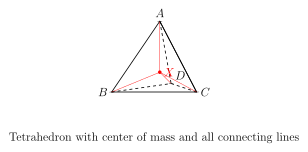
A regular tetrahedron \(ABCD\) of mass \(M\) is made of 6 identical uniform rigid rods, each of length \(2a.\) Four light elastic strings \(XA,XB,XC\) and \(XD\), each of natural length \(a\) and modulus of elasticity \(\lambda,\) are fastened together at \(X\), the other end of each string being attached to the corresponding vertex. Given that \(X\) lies at the centre of mass of the tetrahedron, find the tension in each string. The tetrahedron is at rest on a smooth horizontal table, with \(B,C\) and \(D\) touching the table, and the ends of the strings at \(X\) attached to a point \(O\) fixed in space. Initially the centre of mass of the tetrahedron coincides with \(O.\) Suddenly the string \(XA\) breaks, and the tetrahedron as a result rises vertically off the table. If the maximum height subsequently attained is such that \(BCD\) is level with the fixed point \(O,\) show that (to 2 significant figures) \[ \frac{Mg}{\lambda}=0.098. \]
Solution:
1989 Paper 3 Q13
The points \(A,B,C,D\) and \(E\) lie on a thin smooth horizontal table and are equally spaced on a circle with centre \(O\) and radius \(a\). At each of these points there is a small smooth hole in the table. Five elastic strings are threaded through the holes, one end of each beging attached at \(O\) under the table and the other end of each being attached to a particle \(P\) of mass \(m\) on top of the table. Each of the string has natural length \(a\) and modulus of elasticity \(\lambda.\) If \(P\) is displaced from \(O\) to any point \(F\) on the table and released from rest, show that \(P\) moves with simple harmonic motion of period \(T\), where \[ T=2\pi\sqrt{\frac{am}{5\lambda}}. \] The string \(PAO\) is replaced by one of natural length \(a\) and modulus \(k\lambda.\) \(P\) is displaced along \(OA\) from its equilibrium position and released. Show that \(P\) still moves in a straight line with simple harmonic motion, and, given that the period is \(T/2,\) find \(k\).
Solution:

1987 Paper 2 Q14
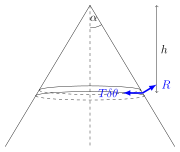
A thin uniform elastic band of mass \(m,\) length \(l\) and modulus of elasticity \(\lambda\) is pushed on to a smooth circular cone of vertex angle \(2\alpha,\) in such a way that all elements of the band are the same distance from the vertex. It is then released from rest. Let \(x(t)\) be the length of the band at time \(t\) after release, and let \(t_{0}\) be the time at which the band becomes slack. Assuming that a small element of the band which subtends an angle \(\delta\theta\) at the axis of the cone experiences a force, due to the tension \(T\) in the band, of magnitude \(T\delta\theta\) directed towards the axis, and ignoring the effects of gravity, show that \[ \frac{\mathrm{d}^{2}x}{\mathrm{d}t^{2}}+\frac{4\pi^{2}\lambda}{ml}(x-l)\sin^{2}\alpha=0,\qquad(0< t< t_{0}). \] Find the value of \(t_{0}.\)
Solution: