Problems
Filters
47 problems found
2015 Paper 2 Q6
- Show that \[ \mathrm{sec}^2\left(\tfrac14\pi-\tfrac12 x\right)=\frac{2}{1+\sin x} \,. \] Hence integrate \(\dfrac{1}{1+\sin x}\) with respect to \(x\).
- By means of the substitution \(y=\pi -x\), show that \[ \int_0^\pi x \f (\sin x)\, \d x = \frac \pi 2 \int_0^\pi \f(\sin x) \, \d x ,\] where \(\mathrm{f}\) is any function for which these integrals exist. Hence evaluate \[ \int_0^\pi \frac x {1+\sin x} \, \d x \,. \]
- Evaluate \[ \int_0^\pi\frac{ 2x^3 -3\pi x^2}{(1+\sin x)^2}\, \d x .\]
Solution:
- \(\,\) \begin{align*} && \sec^2\left(\tfrac14\pi-\tfrac12 x\right) &= \frac{1}{\cos^2 \left(\tfrac14\pi-\tfrac12 x\right)} \\ &&&= \frac{1}{\frac{1+\cos 2\left(\tfrac14\pi-\tfrac12 x\right)}{2}} \\ &&&= \frac{2}{1 + \cos \left(\tfrac12\pi- x\right)} \\ &&&= \frac{2}{1+\sin x} \\ \\ && \int \frac{1}{1+\sin x} \d x &= \int \tfrac12\sec^2\left(\tfrac14\pi-\tfrac12 x\right) \d x\\ &&&= - \tan\left(\tfrac14\pi-\tfrac12 x\right) + C \end{align*}
- \(\,\) \begin{align*} && I &= \int_0^{\pi} x f(\sin x) \d x \\ y = \pi - x, \d y = - \d x: &&&= \int_{y=\pi}^{y = 0} (\pi - y) f(\sin(\pi - y))(-1) \d y \\ &&&= \int_0^\pi (\pi - y) f(\sin y) \d y \\ &&&= \pi \int_0^\pi f(\sin y) \d y - I \\ \Rightarrow && I &= \frac{\pi}{2} \int_0^\pi f(\sin x) \d x \\ \\ \Rightarrow && \int_0^{\pi} \frac{x}{1 + \sin x} \d x &= \frac{\pi}{2} \int_0^{\pi} \frac{1}{1 + \sin x} \d x\\ &&&=\frac{\pi}{2} \left [- \tan\left(\tfrac14\pi-\tfrac12 x\right) \right]_0^{\pi} \\ &&&= \frac{\pi}{2} \left (-\tan (-\tfrac{\pi}{4}) + \tan \tfrac{\pi}{4} \right) \\ &&&= \pi \end{align*}
- \(\,\) \begin{align*} && J &= \int_0^{\pi} \frac{2x^3-3\pi x^2}{(1+\sin x)^2} \d x \\ y = \pi - x: &&&= \int_0^{\pi} \frac{2(\pi-y)^3-3\pi (\pi - y)^2}{(1+\sin x)^2 } \d y \\ &&&= \int_0^{\pi} \frac{-2 y^3 + 3 \pi y^2 - \pi^3}{(1+ \sin x)^2}\\ &&&= -\pi^3 \int_0^{\pi} \frac{1}{(1 + \sin x)^2} \d x -J \\ \Rightarrow && J &= -\frac{\pi^3}{2} \int_0^{\pi} \frac{1}{(1 + \sin x)^2} \d x\\ &&&= -\frac{\pi^3}{2} \int_0^\pi \tfrac14 \sec^4\left(\tfrac14\pi-\tfrac12 x\right) \d x \\ &&&= -\frac{\pi^3}{8} \int_0^\pi \sec^2\left(\tfrac14\pi-\tfrac12 x\right)\left (1 + \tan^2\left(\tfrac14\pi-\tfrac12 x\right) \right) \d x \\ &&&= -\frac{\pi^3}{8} \left [-\frac23 \tan^3\left(\tfrac14\pi-\tfrac12 x\right) - 2 \tan\left(\tfrac14\pi-\tfrac12 x\right) \right]_0^{\pi} \\ &&&= -\frac{\pi^3}{8} \left (\frac43+4 \right) \\ &&&= -\frac{2\pi^3}{3} \end{align*}
2013 Paper 2 Q5
- A function \(\f(x)\) satisfies \(\f(x) = \f(1-x)\) for all \(x\). Show, by differentiating with respect to \(x\), that \(\f'(\frac12) =0\,\). If, in addition, \(\f(x) = \f(\frac1x)\) for all (non-zero) \(x\), show that \(\f'(-1)=0\) and that \(\f'(2)=0\).
- The function \(\f\) is defined, for \(x\ne0\) and \(x\ne1\), by \[ \f(x) = \frac {(x^2-x+1)^3}{(x^2-x)^2} \,. \] Show that \(\f(x)= \f(\frac 1 x)\) and \(\f(x) = \f(1-x)\). Given that it has exactly three stationary points, sketch the curve \(y=\f(x)\).
- Hence, or otherwise, find all the roots of the equation \(\f(x) = \dfrac {27} 4\,\) and state the ranges of values of \(x\) for which \(\f(x) > \dfrac{27} 4\,\). Find also all the roots of the equation \(\f(x) = \dfrac{343}{36}\,\) and state the ranges of values of \(x\) for which \(\f(x) > \dfrac{343}{36}\).
Solution:
- \(\,\) \begin{align*} && f(x) &= f(1-x) \\ \Rightarrow && f'(x) &= -f'(1-x) \\ \Rightarrow && f'(\tfrac12) &= -f'(\tfrac12) \\ \Rightarrow && f'(\tfrac12) &= 0 \\ \\ && f(x) &= f(\tfrac1x) \\ \Rightarrow && f'(x) &= f'(\tfrac1x) \cdot \frac{-1}{x^2} \\ \Rightarrow && f'(-1) &= -f'(-1) \\ \Rightarrow && f'(-1) &= 0 \\ \\ && f'(2) &= -\frac{1}{4}f'(\tfrac12) \\ &&&= 0 \end{align*}
- Suppose \begin{align*}
&& f(x) &= \frac{(x^2-x+1)^3}{(x^2-x)^2} \\
&& f(1/x) &= \frac{(x^{-2}-x^{-1}+1)^3}{(x^{-2}-x^{-1})^2} \\
&&&= \frac{(1-x+x^2)^3/x^6}{((x-x^2)^2/x^6} \\
&&&= f(x) \\
\\
&& f(1-x) &= \frac{((1-x)^2-(1-x)+1)^3}{((1-x)^2-(1-x))^2} \\
&&&= \frac{(1-x+x^2)^3}{(x^2-x)^2} = f(x)
\end{align*}
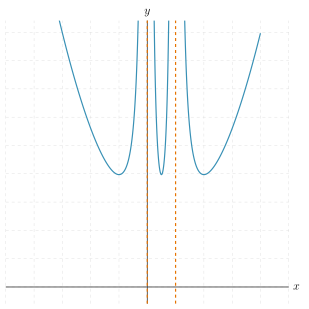
- Clearly \(x = -1\) is a root of \(f(x) = \frac{27}{4}\), so we must also have \(x=2\) and \(x = \frac12\), therefore \(f(x) > \frac{27}{4}\) if \(x \in \mathbb{R} \setminus \{-1, 2, \tfrac12, 0, 1 \}\). Clearly \(x = 3\) and \(x = -2\) are solutions so we also have: \(\frac13, -\frac12, \frac32, \frac23\) and these must be all solutions so we must have: \(f(x) > \frac{343}{36} \Leftrightarrow x \in (-\infty, -2) \cup (-\frac12, 0) \cup (0, \frac13) \cup (\frac23, 1) \cup (1, \frac32) \cup (3, \infty)\)
2013 Paper 3 Q3
The four vertices \(P_i\) (\(i= 1, 2, 3, 4\)) of a regular tetrahedron lie on the surface of a sphere with centre at \(O\) and of radius 1. The position vector of \(P_i\) with respect to \(O\) is \({\bf p}_i\) (\(i= 1, 2, 3, 4\)). Use the fact that \({\bf p}_1+ {\bf p}_2+{\bf p}_3+{\bf p}_4={\bf 0}\,\) to show that \({\bf p}_i \,.\, {\bf p}_j =-\frac13\,\) for \(i\ne j\). Let \(X\) be any point on the surface of the sphere, and let \(XP_i\) denote the length of the line joining \(X\) and \(P_i\) (\(i= 1, 2, 3, 4\)).
- By writing \((XP_i) ^2\) as \(({\bf p}_i- {\bf x)}\,.\,({\bf p}_i- {\bf x})\), where \({\bf x}\) is the position vector of \(X\) with respect to \(O\), show that \[ \sum_{i=1}^4(XP_i) ^2 =8\,. \]
- Given that \(P_1\) has coordinates \((0,0,1)\) and that the coordinates of \(P_2\) are of the form \((a,0,b)\), where \(a > 0\), show that \(a=2\sqrt2/3\) and \(b=-1/3\), and find the coordinates of \(P_3\) and \(P_4\).
- Show that \[ \sum_{i=1}^4 (XP_i)^4 = 4 \sum_{i=1}^4 (1- {\bf x}\,.\,{\bf p}_i)^2\,. \] By letting the coordinates of \(X\) be \( (x,y,z)\), show further that \(\sum\limits_{i=1}^4 (XP_i)^4\) is independent of the position of \(X\).
Solution: Note that \({\bf p}_i \cdot {\bf p}_i = 1\) and \({\bf p}_i \cdot {\bf p}_j\) are all equal when \(i \neq j\) by symmetry and commutativity. \begin{align*} && 0 &= {\bf p}_i \cdot \left ( {\bf p}_1+ {\bf p}_2+{\bf p}_3+{\bf p}_4 \right) \\ &&&= 1 + \sum_{j \neq i} {\bf p}_i \cdot {\bf p}_j \\ &&&= 1 + 3 {\bf p}_i \cdot {\bf p}_j \\ \Rightarrow && {\bf p}_i \cdot {\bf p}_j &= -\frac13 \end{align*}
- \(\,\) \begin{align*} && (XP_i)^2 &= ({\bf p}_i- {\bf x)}\,.\,({\bf p}_i- {\bf x}) \\ &&&= {\bf p}_i \cdot {\bf p}_i - 2 {\bf p}_i \cdot {\bf x} + {\bf x} \cdot {\bf x} \\ &&&= 2 - 2 {\bf p}_i \cdot {\bf x} \\ \Rightarrow && \sum_i (XP_i)^2 &= \sum_i \left (2 - 2 {\bf p}_i \cdot {\bf x} \right) \\ &&&= 8 - 2 \sum_i {\bf p}_i \cdot {\bf x} \\ &&&= 8 - 2 \left ( {\bf p}_1+ {\bf p}_2+{\bf p}_3+{\bf p}_4 \right) \cdot {\bf x} \\ &&&= 8 \end{align*}
- Notice we have \(1 = \left \|\begin{pmatrix} a \\0 \\b \end{pmatrix} \right \|= a^2 + b^2\) and \(-\frac13 = \begin{pmatrix} a \\0 \\b \end{pmatrix} \cdot \begin{pmatrix} 0 \\0 \\ 1 \end{pmatrix} = b\). So \(b = -1/3\) and \(a = \sqrt{1-b^2} = 2\sqrt{2}/3\). Suppose another of the vertices has coordinates \((u,v,w)\) we must have \begin{align*} && 1 &= u^2+v^2+w^2 \\ && -\frac13&=w \\ && -\frac13 &= \frac{2\sqrt{2}}3 u +\frac19 \\ \Rightarrow && u &= -\frac{\sqrt2}3 \\ \Rightarrow && 1 &= \frac19 + \frac29 + v^2 \\ \Rightarrow && v &= \pm \sqrt{\frac{2}{3}} \end{align*} So \(P_3, P_4 = (-\frac{\sqrt2}3, \pm \frac{\sqrt{6}}3, -\frac13)\)
- \(\,\) \begin{align*} && \sum_{i=1}^4 (XP_i)^4 &= \sum_i \left (2 - 2 {\bf p}_i \cdot {\bf x} \right)^2 \\ &&&= 4 \sum_i \left (1 - {\bf p}_i \cdot {\bf x} \right)^2 \\ &&&= 4 \sum_i (1 - 2{\bf p}_i \cdot {\bf x} + ({\bf p}_i \cdot {\bf x})^2) \\ &&&= 16 + 4\sum_i ({\bf p}_i \cdot {\bf x})^2 \\ &&&=16+ 4\left ( z^2+\left (\frac{2\sqrt{2}}3x-\frac13z \right)^2 +\left (-\frac{\sqrt{2}}3x-\frac{\sqrt{6}}3y-\frac13z \right)^2 +\left (-\frac{\sqrt{2}}3x+\frac{\sqrt{6}}3y-\frac13z \right)^2 \right) \\ &&&= 16+4 \left ( \frac43z^2 + \left (\frac89 + \frac29+\frac29 \right)x^2+\left (\frac69 + \frac69 \right)y^2 + 0xz + 0yz + 0zx \right) \\ &&&= 16+ 4\cdot\frac43(x^2+y^2+z^2) \\ &&&=16+\frac{16}{3}=\frac{64}{3} \end{align*}
2012 Paper 2 Q5
- Sketch the curve \(y=\f(x)\), where \[ \f(x) = \frac 1 {(x-a)^2 -1} \hspace{2cm}(x\ne a\pm1), \] and \(a\) is a constant.
- The function \(\g(x)\) is defined by \[ \g(x) = \frac 1 {\big( (x-a)^2-1 \big) \big( (x-b)^2 -1\big)} \hspace{1cm}(x\ne a\pm1, \ x\ne b\pm1), \] where \(a\) and \(b\) are constants, and \(b>a\). Sketch the curves \(y=\g(x)\) in the two cases \(b>a+2\) and \(b=a+2\), finding the values of \(x\) at the stationary points.
Solution:
- \(\,\)

- \(\,\) \begin{align*}
&& \frac{\d}{\d x} \left ( \frac{1}{g(x)} \right) &= \frac{\d }{\d x} \left ( \big( (x-a)^2-1 \big) \big( (x-b)^2 -1\big)\right) \\
&&&= ((x-a)^2-1)(2(x-b))+((x-b)^2-1)(2(x-a)) \\
&&&= 2(2x-a-b)(x^2-(a+b)x+ab-1) \\
\Rightarrow && x &= \frac{a+b}{2}, \frac{a+b \pm \sqrt{(a+b)^2-4ab+4}}{2} \\
&&&= \frac{a+b}{2}, \frac{a+b \pm \sqrt{(a-b)^2+4}}{2}
\end{align*}
If \(b > a+2\):
If \(b = a+2\):


2010 Paper 2 Q4
- Let \[ I=\int_0^a \frac {\f(x)}{\f(x)+\f(a-x)} \, \d x\,. \] Use a substitution to show that \[ I = \int_0^a \frac {\f(a-x)}{\f(x)+\f(a-x)} \, \d x\, \] and hence evaluate \(I\) in terms of \(a\). Use this result to evaluate the integrals \[ \int_0^1 \frac{\ln (x+1)}{\ln (2+x-x^2)}\, \d x \ \ \ \ \ \ \text{ and }\ \ \ \ \ \int_0^{\frac\pi 2} \frac{\sin x } {\sin(x+\frac \pi 4 )} \, \d x \,. \]
- Evaluate \[ \int_{\frac12}^2 \frac {\sin x}{x \big(\sin x + \sin \frac 1 x\big)} \, \d x\,. \]
Solution:
- \(\,\) \begin{align*} && I &= \int_0^a \frac{f(x)}{f(x)+f(a-x)} \d x \\ u =a-x, \d u = - \d x: &&& \int_{u=a}^{u=0} \frac{f(a-u)}{f(a-u)+f(u)} (-1) \d u \\ &&&= \int_0^a \frac{f(a-u)}{f(u)+f(a-u)} \d u \\ &&&= \int_0^a \frac{f(a-x)}{f(x)+f(a-x)} \d x \\ \Rightarrow && 2 I &= \int_0^a \left ( \frac{f(x)}{f(x)+f(a-x)} + \frac{f(a-x)}{f(x)+f(a-x)} \right) \d x \\ &&&= \int_0^a 1 \d x \\ &&&= a \\ \Rightarrow && I &= \frac{a}{2} \end{align*} \begin{align*} && J &= \int_0^1 \frac{\ln (x+1)}{\ln (2+x-x^2)}\, \d x \\ &&&= \int_0^1 \frac{\ln (x+1)}{\ln((x+1)(2-x))} \d x \\ &&&= \int_0^1 \frac{\ln (x+1)}{\ln(x+1) + \ln ((1-x)+1)} \d x \\ &&&= \frac{1}{2} \tag{\(f(x) = \ln (x+1)\)} \\ \\ && K &= \int_0^{\frac\pi 2} \frac{\sin x } {\sin(x+\frac \pi 4 )} \, \d x \\ &&&= \int_0^{\frac{\pi}{2}} \frac{\sin x }{\sin x \cos \frac{\pi}{4} + \cos x \sin \frac{\pi}{4}} \\ &&&= \sqrt{2} \int_0^{\frac{\pi}{2}} \frac{\sin x }{\sin x + \sin (\frac{\pi}{2}-x)} \d x\\ &&&= \frac{\pi}{2\sqrt{2}} \end{align*}
- \(\,\) \begin{align*} &&I &= \int_{\frac12}^2 \frac{\sin x }{x(\sin x + \sin \frac1x)} \d x \\ u = 1/x, \d u = -1/x^2 \d x : &&&= \int_{u = 2}^{u=\frac12} \frac{\sin \frac1u}{\frac{1}{u}(\sin \frac1u + \sin u)} (-\frac{1}{u^2} ) \d u \\ &&&= \int_{\frac12}^2 \frac{\sin \frac1u}{u (\sin u + \sin \frac1u)} \d u \\ \Rightarrow && 2I &= \int_{\frac12}^2 \left ( \frac{\sin x }{x(\sin x + \sin \frac1x)} + \frac{\sin \frac1x }{x(\sin x + \sin \frac1x)}\right) \d x \\ &&&= \int_{\frac12}^2 \frac{1}{x} \d x\\ &&&= 2\ln2 \\ \Rightarrow && I &= \ln 2 \end{align*}
2009 Paper 1 Q6
- Show that, for \(m>0\,\), \[ \int_{1/m}^m \frac{x^2}{x+1} \, \d x = \frac{(m-1)^3(m+1)}{2m^2}+ \ln m\,. \]
- Show by means of a substitution that \[ \int_{1/m}^m \frac1 {x^n(x+1)}\,\d x = \int_{1/m}^m \frac {u^{n-1}}{u+1}\,\d u \,. \]
- Evaluate:
- \(\bf (a)\) \(\displaystyle \int_{1/2}^2 \frac {x^5+3}{x^3(x+1)}\,\d x \;;\)
- \(\bf (b)\) \(\displaystyle \int_1^2 \frac{x^5+x^3 +1}{x^3(x+1)}\, \d x\;. \)
Solution:
- \(\,\) \begin{align*} && \int_{1/m}^m \frac{x^2}{x+1} \d x &= \int_{1/m}^m \left ( x- 1 + \frac{1}{x+1} \right) \d x \\ &&&= \left [ \frac{x^2}{2} - x + \ln (x+1) \right]_{1/m}^m \\ &&&= \left ( m^2/2 - m + \ln(m+1) \right)- \left ( \frac{1}{2m^2} - \frac{1}{m} + \ln\left(\frac1m+1\right) \right) \\ &&&= \frac{m^4-2m^3-1+2m}{2m^2} + \ln (m+1) - \ln(m+1) + \ln m \\ &&&= \frac{(m-1)^3(m+1)}{2m^2} + \ln m \end{align*}
- \(\,\) \begin{align*} u = \frac{1}x, \d x = -\frac{1}{u^2} \d u:&& \int_{1/m}^m \frac1 {x^n(x+1)}\,\d x &= \int_{u=m}^{u=1/m} \frac{1}{u^{-n}(u^{-1}+1)} \frac{-1}{u^2} \d u \\ &&&= \int_{1/m}^m \frac{u^{n-1}}{u+1} \d u \end{align*}
- \(\bf (a)\) \(\,\) \begin{align*} && I &= \int_{1/2}^2 \frac {x^5+3}{x^3(x+1)}\,\d x \\ &&&= \int_{1/2}^2 \left ( \frac{x^2}{x+1} + \frac{3}{x^3(x+1)} \right) \d x \\ &&&= \int_{1/2}^2 \frac{x^2}{x+1} \d x + 3 \int_{1/2}^2 \frac{x^2}{x+1} \d x \\ &&&= 4 \left ( \frac{(2-1)^3(2+1)}{2 \cdot 2^2} + \ln 2 \right) \\ &&&= \frac32+4 \ln 2 \end{align*}
- \(\bf (b)\) \(\,\) \begin{align*} && J &= \int_1^2 \frac{x^5+x^3 +1}{x^3(x+1)}\, \d x \\ && K &= \int_1^2 \frac{x^5 +1}{x^3(x+1)}\, \d x\\ u = 1/x, \d x = -1/u^2 \d u: &&&= \int_{u=1}^{u=1/2} \frac{u^{-5}+1}{u^{-3}(u^{-1}+1)} \frac{-1}{u^2} \d u \\ &&&= \int_{1/2}^1 \frac{1 + u^5}{u^3(u+1)} \d u \\ \Rightarrow && K &= \frac12 \int_{1/2}^2 \frac{x^5+1}{x^3(x+1)} \d x \\ &&&= \frac{(2-1)^3(2+1)}{2 \cdot 2^2} + \ln 2 \\ &&&= \frac38 + \ln 2 \\ && L &= \int_1^2 \frac{x^3}{x^3(x+1)} \d x \\ &&&= \ln (3) - \ln 2 \\ \Rightarrow && J &= \frac38 + \ln 3 \end{align*}
2009 Paper 2 Q1
Two curves have equations \(\; x^4+y^4=u\;\) and \(\; xy = v\;\), where \(u\) and \(v\) are positive constants. State the equations of the lines of symmetry of each curve. The curves intersect at the distinct points \(A\), \(B\), \(C\) and \(D\) (taken anticlockwise from \(A\)). The coordinates of \(A\) are \((\alpha,\beta)\), where \(\alpha > \beta > 0\). Write down, in terms of \(\alpha\) and \(\beta\), the coordinates of \(B\), \(C\) and \(D\). Show that the quadrilateral \(ABCD\) is a rectangle and find its area in terms of \(u\) and \(v\) only. Verify that, for the case \(u=81\) and \(v=4\), the area is \(14\).
Solution: The curve \(x^4 + y^4 = u\) has lines of symmetry:
- \(y = 0\)
- \(x = 0\)
- \(y = x\)
- \(y = -x\)
- \(y = x\)
- \(y = -x\)

2007 Paper 1 Q12
- A bag contains \(N\) sweets (where \(N \ge 2\)), of which \(a\) are red. Two sweets are drawn from the bag without replacement. Show that the probability that the first sweet is red is equal to the probability that the second sweet is red.
- There are two bags, each containing \(N\) sweets (where \(N \ge 2\)). The first bag contains \(a\) red sweets, and the second bag contains \(b\) red sweets. There is also a biased coin, showing Heads with probability \(p\) and Tails with probability \(q\), where \(p+q = 1\). The coin is tossed. If it shows Heads then a sweet is chosen from the first bag and transferred to the second bag; if it shows Tails then a sweet is chosen from the second bag and transferred to the first bag. The coin is then tossed a second time: if it shows Heads then a sweet is chosen from the first bag, and if it shows Tails then a sweet is chosen from the second bag. Show that the probability that the first sweet is red is equal to the probability that the second sweet is red.
2007 Paper 2 Q2
A curve has equation \(y=2x^3-bx^2+cx\). It has a maximum point at \((p,m)\) and a minimum point at \((q,n)\) where \(p>0\) and \(n>0\). Let \(R\) be the region enclosed by the curve, the line \(x=p\) and the line \(y=n\).
- Express \(b\) and \(c\) in terms of \(p\) and \(q\).
- Sketch the curve. Mark on your sketch the point of inflection and shade the region \(R\). Describe the symmetry of the curve.
- Show that \(m-n=(q-p)^3\).
- Show that the area of \(R\) is \(\frac12 (q-p)^4\).
Solution:
- \(\,\) \begin{align*} && y &= 2x^3-bx^2+cx \\ \Rightarrow && y' &= 6x^2-2bx+c \end{align*} We must have \(p, q\) are the roots of this equation, ie \(\frac13b = p+q, \frac16c = pq\)
- The point of inflection will be at \(\frac{b}6\)
The graph will have rotational symmetry of \(180^{\circ}\) about the point of inflection.

- \begin{align*} && m-n &= 2(p^3-q^3)-b(p^2-q^2)+c(p-q) \\ &&&= (p-q)(2(p^2+qp+q^2)-b(p+q)+c) \\ &&&= (p-q)(2(p^2+qp+q^2)-3(p+q)^2+6pq) \\ &&&= (p-q)(-p^2-q^2+2pq) \\ &&&= (q-p)^3 \end{align*}
- The area of \(R\) is \begin{align*} A &= \frac12 bh \\ &= \frac12 (q-p)(m-n) = \frac12(q-p)^4 \end{align*} as required.
2006 Paper 2 Q4
By making the substitution \(x=\pi-t\,\), show that \[ \! \int_0^\pi x\f(\sin x) \d x = \tfrac12 \pi \! \int_0^\pi \f(\sin x) \d x\,, \] where \(\f(\sin x)\) is a given function of \(\sin x\). Evaluate the following integrals:
- \(\displaystyle \int_0^\pi \frac {x \sin x}{3+\sin^2 x}\,\d x\,\);
- $\displaystyle \int_0^{2\pi} \frac {x \sin x}{3+\sin^2 x}\,\d x\,\(;
- \)\displaystyle \int_{0}^{\pi} \frac {x \big\vert\sin 2x\big\vert}{3+\sin^2 x}\,\d x\,$.
2006 Paper 3 Q2
Let \[ I = \int_{-\frac12 \pi}^{\frac12\pi} \frac {\cos^2\theta}{1-\sin\theta\sin2\alpha} \, \d\theta \text{ and } J = \int_{-\frac12 \pi}^{\frac12\pi} \frac {\sec^2\theta}{1+\tan^2\theta\cos^22\alpha} \, \d\theta \] where \(0 < \alpha < \frac14\pi\,\).
- Show that \[ I = \int_{-\frac12 \pi}^{\frac12\pi} \frac {\cos^2\theta}{1+\sin\theta\sin2\alpha} \d\theta \] and hence that \[ \displaystyle 2I = \int_{-\frac12 \pi}^{\frac12\pi} \frac {2}{1+\tan^2\theta\cos^22\alpha} \, \d\theta \]
- Find \(J\).
- By considering \(I\sin^2 2\alpha +J\cos^2 2\alpha \), or otherwise, show that \(I =\frac12 \pi \sec^2\alpha\).
- Evaluate \(I\) in the case \(\frac14\pi < \alpha < \frac12\pi\).
Solution:
- \(\,\) \begin{align*} && I &= \int_{-\frac12 \pi}^{\frac12\pi} \frac {\cos^2\theta}{1-\sin\theta\sin2\alpha} \, \d\theta \\ \phi = -\theta, \d \phi = - \d \theta: &&&= \int_{\phi=\frac12\pi}^{\phi=-\frac12\pi} \frac{\cos^2(-\phi)}{1-\sin(-\phi)\sin 2 \alpha} (-1) \d \phi \\ &&&= \int_{-\frac12 \pi}^{\frac12\pi} \frac {\cos^2\phi}{1+\sin\phi\sin2\alpha} \d\phi \\ \\ && 2I &= \int_{-\frac12 \pi}^{\frac12\pi} \frac {\cos^2\theta}{1-\sin\theta\sin2\alpha} \, \d\theta +\int_{-\frac12 \pi}^{\frac12\pi} \frac {\cos^2\theta}{1+\sin\theta\sin2\alpha} \, \d\theta \\ &&&= \int_{-\frac12 \pi}^{\frac12\pi} \left ( \frac {\cos^2\theta}{1-\sin\theta\sin2\alpha} +\frac {\cos^2\theta}{1+\sin\theta\sin2\alpha} \right) \, \d\theta \\ &&&= \int_{-\frac12 \pi}^{\frac12\pi} \left ( \frac {2\cos^2\theta}{1-\sin^2\theta\sin^22\alpha} \right) \, \d\theta \\ &&&= \int_{-\frac12 \pi}^{\frac12\pi} \left ( \frac {2\cos^2\theta}{1-(1-\cos^2\theta)(1-\cos^22\alpha)} \right) \, \d\theta \\ &&&= \int_{-\frac12 \pi}^{\frac12\pi} \left ( \frac {2\cos^2\theta}{\cos^2\theta+\cos^22\alpha-\cos^2 \theta \cos^2 2 \alpha)} \right) \, \d\theta \\ &&&= \int_{-\frac12 \pi}^{\frac12\pi} \left ( \frac {2}{1+\cos^22\alpha(\sec^2 \theta - 1))} \right) \, \d\theta \\ &&&= \int_{-\frac12 \pi}^{\frac12\pi} \left ( \frac {2}{1+\tan^2 \theta \cos^22\alpha} \right) \, \d\theta \\ \end{align*}
- \(\,\) \begin{align*} && J &= \int_{-\frac12 \pi}^{\frac12\pi} \frac {\sec^2\theta}{1+\tan^2\theta\cos^22\alpha} \, \d\theta \\ &&&= \left [\sec 2 \alpha \tan^{-1} \left ( \cos 2 \alpha \tan \theta \right) \right]_{-\frac12 \pi}^{\frac12\pi} \\ &&&= \sec(2\alpha)\pi = \frac{\pi}{\cos 2 \alpha} \end{align*}
- \(\,\) \begin{align*} && I\sin^2 2\alpha +J\cos^2 2\alpha &= \int_{-\frac12\pi}^{\frac12 \pi} \frac{\sin^2 2 \alpha+\cos^2 2 \alpha \sec^2 \theta}{1+\tan^2 \theta \cos^2 2\alpha} \d \theta \\ &&&= \int_{-\frac12\pi}^{\frac12 \pi} \frac{\sin^2 2 \alpha+\cos^2 2 \alpha (1 + \tan^2 \theta)}{1+\tan^2 \theta \cos^2 2\alpha} \d \theta \\ &&&= \pi \\ \\ \Rightarrow && I &= \frac{\pi - \pi \cos 2 \alpha}{\sin^2 2 \alpha} \\ &&&= \pi \frac{2\sin^2 \alpha}{4 \sin^2 \alpha \cos^2 \alpha} \\ &&&= \frac12 \pi \sec^2 \alpha \end{align*}
- If \(\frac14 \pi < \alpha < \frac12 \pi\) then our calculation for \(J\) is not correct. \begin{align*} && J &= \int_{-\frac12 \pi}^{\frac12\pi} \frac {\sec^2\theta}{1+\tan^2\theta\cos^22\alpha} \, \d\theta \\ &&&= \left [\sec 2 \alpha \tan^{-1} \left ( \cos 2 \alpha \tan \theta \right) \right]_{-\frac12 \pi}^{\frac12\pi} \\ &&&= \sec(2\alpha) \left ( \lim_{\theta \to \frac{\pi}{2}} \tan^{-1} \left ( \cos 2 \alpha \tan \theta \right) - \lim_{\theta \to -\frac{\pi}{2}} \tan^{-1} \left ( \cos 2 \alpha \tan \theta \right) \right) \\ &&&= \sec(2\alpha) \left ( \tan^{-1} \left ( \lim_{x\to -\infty} x \right) - \tan^{-1} \left ( \lim_{x\to \infty} x \right) \right) \\ &&&= -\pi \sec 2 \alpha \end{align*} Still using the same logic, we can say \begin{align*} && I &= \frac{\pi+\pi\cos 2 \alpha}{\sin^2 2 \alpha} \\ &&&= \pi \frac{2 \cos^2 \alpha}{4 \sin^2 \alpha \cos^2 \alpha}\\ &&&= \frac12 \pi \cosec^2 \alpha \end{align*}
2004 Paper 2 Q3
The curve \(C\) has equation $$ y = x(x+1)(x-2)^4. $$ Determine the coordinates of all the stationary points of \(C\) and the nature of each. Sketch \(C\). In separate diagrams draw sketches of the curves whose equations are:
- \( y^2 = x(x+1)(x-2)^4\;\);
- \(y = x^2(x^2+1)(x^2-2)^4\,\).
Solution: \begin{align*} && y &= x(x+1)(x-2)^4 \\ \Rightarrow && y' &= (x+1)(x-2)^4+x(x-2)^4+4x(x+1)(x-2)^3 \\ &&&= (x-2)^3 \left ( (2x+1)(x-2)+4x(x+1) \right) \\ &&&= (x-2)^3 \left (2x^2-3x-2+4x^2+4x \right) \\ &&&=(x-2)^3(6x^2+x-2) \\ &&&=(x-2)^3(2x-1)(3x+2) \end{align*} Therefore there are stationary points at \((2,0), (\frac12, -\frac{625}{64}), (-\frac23, -\frac{4078}{81})\) \((0,2)\) is a minimum by considering the sign of \(y'\) either side. \( (-\frac23, \frac{2560}{729})\) is a minimum, since it's the first stationary point. \( (\frac12, \frac{243}{64})\) is a maximum since you can't have consecutive minima and the second derivative is clearly non-zero.

- \(\,\)

- \(\,\)

2003 Paper 3 Q13
In a rabbit warren, underground chambers \(A, B, C\) and \(D\) are at the vertices of a square, and burrows join \(A\) to \(B\), \ \(B\) to \(C\), \ \(C\) to \(D\) and \(D\) to \(A\). Each of the chambers also has a tunnel to the surface. A rabbit finding itself in any chamber runs along one of the two burrows to a neighbouring chamber, or leaves the burrow through the tunnel to the surface. Each of these three possibilities is equally likely. Let \(p_A\,\), \(p_B\,\), \(p_C\) and \(p_D\) be the probabilities of a rabbit leaving the burrow through the tunnel from chamber \(A\), given that it is currently in chamber \(A, B, C\) or \(D\), respectively.
- Explain why \(p_A = \frac13 + \frac13p_B + \frac13 p_D\).
- Determine \(p_A\,\).
- Find the probability that a rabbit which starts in chamber \(A\) does not visit chamber~\(C\), given that it eventually leaves the burrow through the tunnel in chamber \(A\).
2002 Paper 1 Q7
Let \[ I= \int_0^a \frac {\cos x}{\sin x + \cos x} \; \d x \, \quad \mbox{ and } \quad J= \int_0^a \frac {\sin x}{\sin x + \cos x} \; \d x \;, \] where \(0\le a < \frac{3}{4}\pi\,\). By considering \(I+J\) and \(I-J\), show that $ 2I= a + \ln (\sin a +\cos a)\;. $ Find also:
- \(\displaystyle \int_0^{\frac{1}{2}\pi} \frac {\cos x}{p\sin x + q\cos x} \; \d x \,\), where \(p\) and \(q\) are positive numbers; %
- [(ii)] %\(\displaystyle \int_0^{\frac{1}{2}\pi/2} \frac {\cos x}{\sin (x+k)} \; \d x \,\), where \(0 < k < \pi/2\,\);
- \(\displaystyle \int_0^{\frac{1}{2}\pi} \frac {\cos x+4}{3\sin x + 4\cos x+ 25} \; \d x \,\).
Solution: \begin{align*} && I + J &= \int_0^a \frac{\sin x + \cos x}{\sin x + \cos x } \d x = a \\ && I - J &= \int_0^a \frac{\cos x - \sin x}{\sin x + \cos x} \d x \\ &&&= \left [\ln ( \sin x + \cos x) \right]_0^a = \ln (\sin a + \cos a) - \ln 1 = \ln(\sin a + \cos a) \\ \\ \Rightarrow && 2I &= a + \ln(\sin a + \cos a) \end{align*}
- Let \(\displaystyle I = \int_0^{\frac12 \pi} \frac{\cos x}{p \sin x + q \cos x} \d x, J = \int_0^{\frac12 \pi} \frac{\sin x}{p \sin x + q \cos x} \d x\) so \begin{align*} && qI + pJ &= \frac{\pi}{2} \\ && pI - qJ &= \int_0^{\frac12 \pi} \frac{p \cos x - q \sin x}{p \sin x + q \cos x } \d x \\ &&&= \left [\ln (p \sin x + q \cos x) \right]_0^{\pi/2} \\ &&&= \ln(p) - \ln(q) = \ln \frac{p}{q} \end{align*}
- \(\,\) \begin{align*} && \int_0^{\frac{\pi}{2}} \frac{\cos x}{\sin(x + k)} \d x &= \int_0^{\frac{\pi}{2}} \frac{\cos x}{\sin(x) \cos(k) + \cos(x) \sin (k)} \d x \\ &&&= \ln \tan k \end{align*}
- Let \(\displaystyle I = \int_0^{\pi/2} \frac{\cos x + 4}{3 \sin x + 4 \cos x + 25} \d x, J = \int_0^{\pi/2} \frac{\sin x + 3}{3 \sin x + 4 \cos x + 25} \d x\), so \begin{align*} && 4I + 3J &= \int_0^{\pi/2} \frac{3 \sin x + 4 \cos x + 25}{3 \sin x + 4 \cos x + 25} \d x \\ &&&= \frac{\pi}{2} \\ && 3I - 4J &= \int_0^{\pi/2} \frac{3\cos x - 4 \sin x}{3 \sin x + 4 \cos x + 25} \d x \\ &&&= \left [\ln(3 \sin x + 4 \cos x + 25) \right]_0^{\pi/2} \\ &&&= \ln (28) - \ln (29) = \ln \frac{28}{29} \\ \Rightarrow && 25I &= 2\pi + 3 \ln \frac{28}{29} \\ \Rightarrow && I &= \frac{2}{25} \pi + \frac{3}{25} \ln \frac{28}{29} \end{align*}
2001 Paper 1 Q12
Four students, Arthur, Bertha, Chandra and Delilah, exchange gossip. When Arthur hears a rumour, he tells it to one of the other three without saying who told it to him. He decides whom to tell by choosing at random amongst the other three, omitting the ones that he knows have already heard the rumour. When Bertha, Chandra or Delilah hear a rumour, they behave in exactly the same way (even if they have already heard it themselves). The rumour stops being passed round when it is heard by a student who knows that the other three have already heard it. Arthur starts a rumour and tells it to Chandra. By means of a tree diagram, or otherwise, show that the probability that Arthur rehears it is \(3/4\). Find also the probability that Bertha hears it twice and the probability that Chandra hears it twice.
Solution: Without loss of generality, \(C\) will tell \(B\) about the rumour. If \(B\) tells \(D\) then \(D\) can either tell \(A\) or \(C\) at which point either \(A\) is told or the rumour stops spreading.

