Problems
Filters
29 problems found
2001 Paper 3 Q6
The plane \[ {x \over a} + {y \over b} +{z \over c} = 1 \] meets the co-ordinate axes at the points \(A\), \(B\) and \(C\,\). The point \(M\) has coordinates \(\left( \frac12 a, \frac12 b, \frac 12 c \right)\) and \(O\) is the origin. Show that \(OM\) meets the plane at the centroid \(\left( \frac13 a, \frac13 b, \frac 13 c \right)\) of triangle \(ABC\). Show also that the perpendiculars to the plane from \(O\) and from \(M\) meet the plane at the orthocentre and at the circumcentre of triangle \(ABC\) respectively. Hence prove that the centroid of a triangle lies on the line segment joining its orthocentre and circumcentre, and that it divides this line segment in the ratio \(2 : 1\,\). [The orthocentre of a triangle is the point at which the three altitudes intersect; the circumcentre of a triangle is the point equidistant from the three vertices.]
Solution: The line \(OM\) is \(\lambda \begin{pmatrix} a \\ b \\ c \end{pmatrix}\), then we need \(1 = \lambda \begin{pmatrix} a \\ b \\ c \end{pmatrix} \cdot \begin{pmatrix} \frac1{a} \\ \frac1b \\ \frac1c \end{pmatrix} = 3 \lambda \Rightarrow \lambda = \frac13\). Therefore \(OM\) meets the plane at the centroid. The orthocentre is the point \(\mathbf{h}\) such that \((\mathbf{a}-\mathbf{b}) \cdot (\mathbf{c} - \mathbf{h}) = 0 \Leftrightarrow \begin{pmatrix} a \\ -b \\ 0 \end{pmatrix} \cdot \begin{pmatrix} -p \\ -q \\ c-r \end{pmatrix} \Leftrightarrow ap-bq = 0\) \((\mathbf{b}-\mathbf{c}) \cdot (\mathbf{a} - \mathbf{h}) = 0 \Leftrightarrow \begin{pmatrix} 0 \\ b \\ -c \end{pmatrix} \cdot \begin{pmatrix} a-p \\ -q \\ -r \end{pmatrix} \Leftrightarrow bq-cr = 0\) \((\mathbf{c}-\mathbf{a}) \cdot (\mathbf{b} - \mathbf{h}) = 0 \Leftrightarrow \begin{pmatrix} -a \\ 0 \\ c \end{pmatrix} \cdot \begin{pmatrix} -p \\ b-q \\ -r \end{pmatrix} \Leftrightarrow cr-ap = 0\) ie \(ap = bq = cr\) but this is clearly on the line \(\lambda \begin{pmatrix} \frac1{a} \\ \frac1b \\ \frac1c \end{pmatrix}\) therefore the orthocentre is on the perpendicular from \(O\) \(M-A = \begin{pmatrix} -a/2 \\ b/2 \\ c/2 \end{pmatrix}\) so \(|M-A|=|M-B|=|M-C|\) Also by pythagoras the point of intersection satisfies \(|M-P|^2 + |P-A|^2 = |M-A|^2\) so \(|P-A|^2 = |P-B|^2 = |P-C|^2\), therefore \(P\) is the circumcentre. Since all these points are in the same plane and \(OGM\) is a line, we have the points are in a line. Similar triangles gives the desired ratio
2001 Paper 3 Q10
Three ships \(A\), \(B\) and \(C\) move with velocities \({\bf v}_1\), \({\bf v}_2\) and \(\bf u\) respectively. The velocities of \(A\) and \(B\) relative to \(C\) are equal in magnitude and perpendicular. Write down conditions that \(\bf u\), \({\bf v}_1\) and \({\bf v}_2\) must satisfy and show that \[ \left| {\bf u} -{\textstyle\frac12} \l {\bf v}_1 + {\bf v}_2 \r \right|^2 = \left|{\textstyle\frac12} \l {\bf v}_1 - {\bf v}_2 \r \right|^2 \] and \[ \l {\bf u} -{\textstyle\frac12} \l {\bf v}_1 + {\bf v}_2 \r \r \cdot \l {\bf v}_1 - {\bf v}_2 \r = 0 \;. \] Explain why these equations determine, for given \({\bf v}_1\) and \({\bf v}_2\), two possible velocities for \(C\,\), provided \({\bf v}_1 \ne {\bf v}_2 \,\). If \({\bf v}_1\) and \({\bf v}_2\) are equal in magnitude and perpendicular, show that if \({\bf u} \ne {\bf 0}\) then \({\bf u} = {\bf v}_1 + {\bf v}_2\,\).
2000 Paper 1 Q5
Arthur and Bertha stand at a point \(O\) on an inclined plane. The steepest line in the plane through \(O\) makes an angle \(\theta\) with the horizontal. Arthur walks uphill at a steady pace in a straight line which makes an angle \(\alpha\) with the steepest line. Bertha walks uphill at the same speed in a straight line which makes an angle \(\beta\) with the steepest line (and is on the same side of the steepest line as Arthur). Show that, when Arthur has walked a distance \(d\), the distance between Arthur and Bertha is \(2d \vert\sin\frac12(\alpha-\beta)\vert\). Show also that, if \(\alpha\ne\beta\), the line joining Arthur and Bertha makes an angle \(\phi\) with the vertical, where \[ \cos\phi = \sin\theta \sin \frac12(\alpha+\beta). \]
2000 Paper 2 Q7
The line \(l\) has vector equation \({\bf r} = \lambda {\bf s}\), where \[ {\bf s} = (\cos\theta+\sqrt3\,) \; {\bf i} +(\surd2\;\sin\theta)\;{\bf j} +(\cos\theta-\sqrt3\,)\;{\bf k} \] and \(\lambda\) is a scalar parameter. Find an expression for the angle between \(l\) and the line \mbox{\({\bf r} = \mu(a\, {\bf i} + b\,{\bf j} +c\, {\bf k})\)}. Show that there is a line \(m\) through the origin such that, whatever the value of \(\theta\), the acute angle between \(l\) and \(m\) is \(\pi/6\). A plane has equation \(x-z=4\sqrt3\). The line \(l\) meets this plane at \(P\). Show that, as \(\theta\) varies, \(P\) describes a circle, with its centre on \(m\). Find the radius of this circle.
1998 Paper 3 Q8
- Consider the sphere of radius \(a\) and centre the origin. %Show that the line through the point with position vector %\({\bf b}\) and parallel to a unit %vector \({\bf m}\) intersects the sphere at two points if %$$ %a^2 > {\bf b}.{\bf b} -({\bf b}.{\bf m})^2 \,. %$$ %What is the corresponding condition for there to be precisely one %point of intersection? %If this point has position vector \({\bf p}\), show that the line %is perpendicular to \({\bf p}\).
- Show that the line \({\bf r} ={\bf b} + \lambda {\bf m}\), where \(\bf m\) is a unit vector, intersects the sphere \({\bf r}\cdot {\bf r} = a^2\) at two points if $$ a^2 > {\bf b}\cdot{\bf b} -({\bf b}\cdot{\bf m})^2 \,. $$ Write down the corresponding condition for there to be precisely one point of intersection. If this point has position vector \({\bf p}\), show that \({\bf m}\cdot{\bf p}=0\).
- Now consider a second sphere of radius \(a\) and a plane perpendicular to a unit vector~\({\bf n}\). The centre of the sphere has position vector \({\bf d}\) and the minimum distance from the origin to the plane is \(l\). What is the condition for the plane to be tangential to this second sphere?
- Show that the first and second spheres intersect at right angles ({\em i.e.\ }the two radii to each point of intersection are perpendicular) if $$ {\bf d}\cdot{\bf d} = 2 a^2 \,. $$
1997 Paper 1 Q5
Four rigid rods \(AB\), \(BC\), \(CD\) and \(DA\) are freely jointed together to form a quadrilateral in the plane. Show that if \(P\), \(Q\), \(R\), \(S\) are the mid-points of the sides \(AB\), \(BC\), \(CD\), \(DA\), respectively, then \[|AB|^{2}+|CD|^{2}+2|PR|^{2}=|AD|^{2}+|BC|^{2}+2|QS|^{2}.\] Deduce that \(|PR|^{2}-|QS|^{2}\) remains constant however the vertices move. (Here \(|PR|\) denotes the length of \(PR\).)
1995 Paper 1 Q7
Let \(A,B,C\) be three non-collinear points in the plane. Explain briefly why it is possible to choose an origin equidistant from the three points. Let \(O\) be such an origin, let \(G\) be the centroid of the triangle \(ABC,\) let \(Q\) be a point such that \(\overrightarrow{GQ}=2\overrightarrow{OG},\) and let \(N\) be the midpoint of \(OQ.\)
- Show that \(\overrightarrow{AQ}\) is perpendicular to \(\overrightarrow{BC}\) and deduce that the three altitudes of \(\triangle ABC\) are concurrent.
- Show that the midpoints of \(AQ,BQ\) and \(CQ\), and the midpoints of the sides of \(\triangle ABC\) are all equidistant from \(N\).
1995 Paper 3 Q8
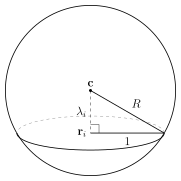
A plane \(\pi\) in 3-dimensional space is given by the vector equation \(\mathbf{r}\cdot\mathbf{n}=p,\) where \(\mathbf{n}\) is a unit vector and \(p\) is a non-negative real number. If \(\mathbf{x}\) is the position vector of a general point \(X\), find the equation of the normal to \(\pi\) through \(X\) and the perpendicular distance of \(X\) from \(\pi\). The unit circles \(C_{i},\) \(i=1,2,\) with centres \(\mathbf{r}_{i},\) lie in the planes \(\pi_{i}\) given by \(\mathbf{r}\cdot\mathbf{n}_{i}=p_{i},\) where the \(\mathbf{n}_{i}\) are unit vectors, and \(p_{i}\) are non-negative real numbers. Prove that there is a sphere whose surface contains both circles only if there is a real number \(\lambda\) such that \[ \mathbf{r}_{1}+\lambda\mathbf{n}_{1}=\mathbf{r}_{2}\pm\lambda\mathbf{n}_{2}. \] Hence, or otherwise, deduce the necessary conditions that \[ (\mathbf{r}_{1}-\mathbf{r}_{2})\cdot(\mathbf{n}_{1}\times\mathbf{n}_{2})=0 \] and that \[ (p_{1}-\mathbf{n}_{1}\cdot\mathbf{r}_{2})^{2}=(p_{2}-\mathbf{n}_{2}\cdot\mathbf{r}_{1})^{2}. \] Interpret each of these two conditions geometrically.
Solution: The equation of the normal to \(\pi\) through \(X\) is \(\mathbf{x} + \lambda \mathbf{n}\). The distance is \(|\mathbf{x}\cdot \mathbf{n}-p|\) We know that the centre of the sphere must lie above the centre of the circle following the normal, ie \(\mathbf{c} = \mathbf{r}_1+\lambda_1 \mathbf{n}_1 = \mathbf{r}_2+\lambda_2 \mathbf{n}_2\)
1991 Paper 1 Q5
A set of \(n\) distinct vectors \(\mathbf{a}_{1},\mathbf{a}_{2},\ldots,\mathbf{a}_{n},\) where \(n\geqslant2\), is called regular if it satisfies the following two conditions:
- there are constants \(\alpha\) and \(\beta\), with \(\alpha>0\), such that for any \(i\) and \(j\), \[ \mathbf{a}_{i}\cdot\mathbf{a}_{j}=\begin{cases} \alpha^{2} & \mbox{ when }i=j\\ \beta & \mbox{ when }i\neq j, \end{cases} \]
- the centroid of \(\mathbf{a}_{1},\mathbf{a}_{2},\ldots,\mathbf{a}_{n}\) is the origin \(\mathbf{0}.\) {[}The centroid of vectors \(\mathbf{b}_{1},\mathbf{b}_{2},\ldots,\mathbf{b}_{m}\) is the vector \(\frac{1}{m}(\mathbf{b}_{1}+\mathbf{b}_{2}+\cdots+\mathbf{b}_{m}).\){]}
Solution: \begin{align*} && \mathbf{0} &= \sum_i \mathbf{a}_i \tag{ii} \\ \Rightarrow && 0 &= \mathbf{a}_i \cdot \mathbf{0} \\ &&&= \sum_j \mathbf{a}_i \cdot \mathbf{a}_j \\ &&&= (n-1)\beta + \alpha^2 \tag{i} \\ \Rightarrow && (n-1)\beta &= -\alpha^2 \end{align*} Suppose we have \(\mathbf{a}_j = \binom{x}{y}\), \(j \neq 1\) then \(x = \beta\). We also must have \(\beta^2 + y^2 = 1\), so there are at most two values for \(y\), ie two extra vectors. ie \(n = 2, 3\). If \(n = 2 \Rightarrow \mathbf{a}_2 = - \mathbf{a}_1\). If \(n = 3\) \begin{align*} && \mathbf{0} &= \binom{1}{0} + \binom{\beta}{y} + \binom{\beta}{-y} \\ \Rightarrow && \beta = -1/2 \\ \Rightarrow && y &= \pm \frac{\sqrt{3}}{2} \end{align*} Suppose $\mathbf{a}_{1}=\begin{pmatrix}1\\ 0\\ 0 \end{pmatrix}\(, \)\mathbf{a}_{2}=\begin{pmatrix}\cos \theta \\ \sin \theta \\ 0 \end{pmatrix}$ (since we need \(\mathbf{a}_2 \cdot \mathbf{a}_2 = 1\)). \(\beta = \cos \theta\)). We can have \(\cos \theta = - 1\). Suppose we have \(\mathbf{a}_j =\begin{pmatrix}x\\ y \\ z \end{pmatrix}\), so \(x = \cos \theta\), and \(y^2 + z^2 = \sin^2 \theta\), so we can write it as: \(\mathbf{a}_j =\begin{pmatrix} \cos \theta \\ \sin \theta \cos \phi \\ \sin \theta \sin \phi \end{pmatrix}\). We must also have \(\beta = \begin{pmatrix} \cos \theta \\ \sin \theta \cos \phi \\ \sin \theta \sin \phi \end{pmatrix} \cdot \begin{pmatrix} \cos \theta \\ \sin \theta\\ 0 \end{pmatrix} = \cos^2 \theta + \sin^2 \theta \cos \phi = \cos \theta\), so \(\cos \phi = \frac{\cos \theta - \cos^2\theta}{1-\cos^2 \theta} = \frac{\cos \theta}{1+\cos \theta}\). Therefore there is one value for \(\cos \phi\), so at most two values for \(\sin \phi\), Therefore we can have either \(2, 3,4\) or \(5\) different values in the set. \(n = 2\), we've already handled. If \(n = 3\), then \(\beta = -\frac12\), \(\cos \phi = -1\), so we can only have two different values for \(\sin \theta\), ie: \(\displaystyle \left \{\begin{pmatrix} 1\\ 0 \\ 0 \end{pmatrix}, \begin{pmatrix} -1/2\\ \frac{\sqrt{3}}{2} \\ 0 \end{pmatrix}, \begin{pmatrix} -1/2\\ -\frac{\sqrt{3}}{2} \\ 0 \end{pmatrix} \right \}\) Finally, if \(n = 4\), we have \(\beta = -\frac13\), \(\cos \phi = \frac{-1/3}{2/3} = -\frac12\). \(\sin \theta = \pm \frac{\sqrt{3}}{2}\) \(\displaystyle \left \{\begin{pmatrix} 1\\ 0 \\ 0 \end{pmatrix}, \begin{pmatrix} -\frac13\\ \frac{2\sqrt{2}}{3} \\ 0 \end{pmatrix}, \begin{pmatrix} -\frac13\\ -\frac{\sqrt{2}}{3} \\ \frac{\sqrt{6}}{3} \end{pmatrix},\begin{pmatrix} -\frac13\\ -\frac{\sqrt{2}}{3} \\ -\frac{\sqrt{6}}{3} \end{pmatrix} \right \}\) \(\displaystyle \left \{\begin{pmatrix} 1\\ 0 \\ 0 \end{pmatrix}, \begin{pmatrix} -\frac13\\ -\frac{2\sqrt{2}}{3} \\ 0 \end{pmatrix}, \begin{pmatrix} -\frac13\\ \frac{\sqrt{2}}{3} \\ \frac{\sqrt{6}}{3} \end{pmatrix},\begin{pmatrix} -\frac13\\ \frac{\sqrt{2}}{3} \\ -\frac{\sqrt{6}}{3} \end{pmatrix} \right \}\) If \(n = 5\), then \(\beta = -\frac14\), \(\cos \phi = \frac{-1/4}{3/4} = -\frac13\). \(\sin \theta = \frac{\sqrt{15}}{4}\), \(\sin \phi = \frac{2\sqrt{2}}{3}\) \(\displaystyle \left \{\begin{pmatrix} 1\\ 0 \\ 0 \end{pmatrix}, \begin{pmatrix} -\frac14\\ \frac{\sqrt{15}}{4} \\ 0 \end{pmatrix}, \begin{pmatrix} -\frac14\\ -\frac{\sqrt{15}}{4} \\ 0 \end{pmatrix}, \begin{pmatrix} -\frac14\\ \frac{\sqrt{15}}{12} \\ \frac{\sqrt{30}}{6} \end{pmatrix}, \begin{pmatrix} -\frac14\\ -\frac{\sqrt{15}}{12} \\ -\frac{\sqrt{30}}{6} \end{pmatrix}, \right \}\)
1990 Paper 3 Q2
The distinct points \(O\,(0,0,0),\) \(A\,(a^{3},a^{2},a),\) \(B\,(b^{3},b^{2},b)\) and \(C\,(c^{3},c^{2},c)\) lie in 3-dimensional space.
- Prove that the lines \(OA\) and \(BC\) do not intersect.
- Given that \(a\) and \(b\) can vary with \(ab=1,\) show that \(\angle AOB\) can take any value in the interval \(0<\angle AOB<\frac{1}{2}\pi\), but no others.
Solution:
- The line \(OA\) is \(\lambda \begin{pmatrix} a^3 \\ a^2 \\ a \end{pmatrix}\). The line \(BC\) is \(\begin{pmatrix} b^3 \\ b^2 \\ b \end{pmatrix} + \mu \begin{pmatrix} c^3-b^3 \\ c^2-b^2 \\ c-b \end{pmatrix}\). If these lies are concurrent then there would be \(\mu\) and \(\lambda\) such that they are equal, and in particular, \begin{align*} && \frac{b^2 + \mu(c^2-b^2)}{b + \mu (c-b)} &= \frac{b^3 + \mu(c^3-b^3)}{b^2 + \mu (c^2-b^2)} \\ \Leftrightarrow && (b^2 + \mu(c^2-b^2))^2 &= (b+\mu(c-b))(b^3+\mu(c^3-b^3)) \\ && b^4 +2\mu b^2 (c^2-b^2) + \mu^2 (c^2-b^2) &= b^4 + \mu(c-b)b^3 + \mu b(c^3-b^3) + \mu^2 (c-b)(c^3-b^3) \\ \Leftrightarrow && 2\mu b^2 (c+b) + \mu^2(c-b)(c+b)^2 &= \mu (b^3 + b(c^2+bc+b^2)) + \mu^2 (c^3-b^3) \\ && \mu = 0 & \Rightarrow a = b \\ \Leftrightarrow && b^2c - bc^2 &= \mu (c^3-b^3-(c-b)(c+b)^2) \\ \Leftrightarrow && bc(b-c) &= \mu (c-b)(c^2+bc+b^2-c^2-2bc-b^2) \\ \Leftrightarrow && bc &= \mu (bc) \\ \Leftrightarrow && \mu &= 1 \\ && \mu = -1 & \Rightarrow a = c \end{align*} Therefore there are no solutions.
- \begin{align*} \cos \angle AOB &= \frac{ab+a^2b^2+a^3b^3}{\sqrt{a^2+a^4+a^6}\sqrt{b^2+b^4+b^6}} \\ &= \frac{3}{\sqrt{1 + a^2 + a^4} \sqrt{1 + b^2 + b^4}} \\ &> 0 \end{align*} Therefore the angle satisfies \(\angle AOB < \tfrac12 \pi\). We cannot achieve \(0\), since that would require \(a = b = 1\), therefore it falls in the range \(0 < \angle AOB < \tfrac12 \pi\)
1989 Paper 1 Q3
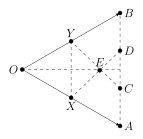
In the triangle \(OAB,\) \(\overrightarrow{OA}=\mathbf{a},\) \(\overrightarrow{OB}=\mathbf{b}\) and \(OA=OB=1\). Points \(C\) and \(D\) trisect \(AB\) (i.e. \(AC=CD=DB=\frac{1}{3}AB\)). \(X\) and \(Y\) lie on the line-segments \(OA\) and \(OB\) respectively, in such a way that \(CY\) and \(DX\) are perpendicular, and \(OX+OY=1\). Denoting \(OX\) by \(x\), obtain a condition relating \(x\) and \(\mathbf{a\cdot b}\), and prove that \[ \frac{8}{17}\leqslant\mathbf{a\cdot b}\leqslant1. \] If the angle \(AOB\) is as large as possible, determine the distance \(OE,\) where \(E\) is the point of intersection of \(CY\) and \(DX\).
Solution:
1988 Paper 1 Q8
\(ABCD\) is a skew (non-planar) quadrilateral, and its pairs of opposite sides are equal, i.e. \(AB=CD\) and \(BC=AD\). Prove that the line joining the midpoints of the diagonals \(AC\) and \(BD\) is perpendicular to each diagonal.
Solution: Let \(\mathbf{a}\) denote the vector position of \(A\) and similarly for \(B, C, D\). Then we know that \((\mathbf{b}-\mathbf{a})\cdot(\mathbf{b}-\mathbf{a})=(\mathbf{c}-\mathbf{d})\cdot(\mathbf{c}-\mathbf{d})\) and \((\mathbf{b}-\mathbf{c})\cdot(\mathbf{b}-\mathbf{c})=(\mathbf{a}-\mathbf{d})\cdot(\mathbf{a}-\mathbf{d})\). Subtracting these two equations we see that \(|\mathbf{a}|^2 -2\mathbf{a}\cdot\mathbf{b}+2\mathbf{c}\cdot\mathbf{b} - |\mathbf{c}|^2 = |\mathbf{c}|^2-2\mathbf{c}\cdot\mathbf{d}+2\mathbf{a}\cdot\mathbf{d}-|\mathbf{a}|^2\) or \(2|\mathbf{a}|^2 -2\mathbf{a}\cdot\mathbf{b}+2\mathbf{c}\cdot\mathbf{b} - 2|\mathbf{c}|^2 +2\mathbf{c}\cdot\mathbf{d}-2\mathbf{a}\cdot\mathbf{d}=0\) The midpoints of the diagonals \(AC\) and \(BD\) are \(\frac{\mathbf{a}+\mathbf{c}}{2}\) and \(\frac{\mathbf{b}+\mathbf{d}}{2}\), so the line is parallel to: \(\mathbf{a}-\mathbf{b}+\mathbf{c}-\mathbf{d}\). The diagonals are parallel to \(\mathbf{a}-\mathbf{c}\) and \(\mathbf{b}-\mathbf{d}\). So it suffices to prove that \((\mathbf{a}-\mathbf{b}+\mathbf{c}-\mathbf{d}) \cdot (\mathbf{a}-\mathbf{c}) = 0\) (since the other will follow by symmetry, \begin{align*} (\mathbf{a}-\mathbf{b}+\mathbf{c}-\mathbf{d}) \cdot (\mathbf{a}-\mathbf{c}) &= |\mathbf{a}|^2-\mathbf{a}\cdot\mathbf{b}-\mathbf{a}\cdot \mathbf{d}+\mathbf{b}\cdot \mathbf{c}-|\mathbf{c}|^2+\mathbf{c}\cdot \mathbf{d} \\ \end{align*} But this is exactly half the equation we determined earlier, so we are done.
1988 Paper 2 Q10
The surface \(S\) in 3-dimensional space is described by the equation \[ \mathbf{a}\cdot\mathbf{r}+ar=a^{2}, \] where \(\mathbf{r}\) is the position vector with respect to the origin \(O\), \(\mathbf{a}(\neq\mathbf{0})\) is the position vector of a fixed point, \(r=\left|\mathbf{r}\right|\) and \(a=\left|\mathbf{a}\right|.\) Show, with the aid of a diagram, that \(S\) is the locus of points which are equidistant from the origin \(O\) and the plane \(\mathbf{r}\cdot\mathbf{a}=a^{2}.\) The point \(P\), with position vector \(\mathbf{p},\) lies in \(S\), and the line joining \(P\) to \(O\) meets \(S\) again at \(Q\). Find the position vector of \(Q\). The line through \(O\) orthogonal to \(\mathbf{p}\) and \(\mathbf{a}\) meets \(S\) at \(T\) and \(T'\). Show that the position vectors of \(T\) and \(T'\) are \[ \pm\frac{1}{\sqrt{2ap-a^{2}}}\mathbf{a}\times\mathbf{p}, \] where \(p=\left|\mathbf{p}\right|.\) Show that the area of the triangle \(PQT\) is \[ \frac{ap^{2}}{2p-a}. \]
Solution: The plane is the same as the plane \((\mathbf{r} - \mathbf{a}) \cdot \mathbf{a} = 0\), ie the plane through \(\mathbf{a}\) whose normal is parallel to \(\mathbf{a}\) The distance from \(\mathbf{r}\) to the plane therefore is \(\lambda\) where \(\mathbf{r}+\lambda \frac{1}{a}\mathbf{a}\) must be on the plane, ie \((\mathbf{r}+\frac{\lambda}{a} \mathbf{a} - \mathbf{a})\cdot \mathbf{a} = 0 \Rightarrow \lambda = \frac{a^2-\mathbf{a} \cdot \mathbf{r}}{a}\) But if \(\mathbf{a} \cdot \mathbf{r} = a^2 - ar\) then \(\lambda = r\), ie the distance to the plane is the same as the distance to the origin. \(\mathbf{q} = k \mathbf{p}\) and so \(\mathbf{a} \cdot k \mathbf{p} + a |k|p = a^2\) if \(k > 0\) we will find \(k = 1\) the position vector we already know about, therefore suppose \(k < 0\) so: \begin{align*} && \mathbf{a} \cdot k \mathbf{p} - ka p &= a^2 \\ \Rightarrow && k(a^2-ap)-kap &= a^2 \\ \Rightarrow && k(a^2-2ap) &= a^2 \\ \Rightarrow && k &= \frac{a^2}{a^2-2ap} \end{align*} Therefore \(\mathbf{q} = \frac{a^2}{a^2-2ap} \mathbf{p}\) The line through \(O\) orthogonal to \(\mathbf{p}\) and \(\mathbf{a}\) will be parallel to \(\mathbf{a} \times \mathbf{p}\). Therefore we should consider points of the from \(s \mathbf{a} \times \mathbf{p}\) on the surface \(S\). \begin{align*} && s\mathbf{a} \cdot ( \mathbf{a} \times \mathbf{p}) + sa^2p |\sin \theta| &= a^2 \end{align*} The angle between \(\cos \theta = \frac{\mathbf{a} \cdot \mathbf{p}}{ap} = \frac{a^2-ap}{ap} \Rightarrow |\sin \theta| = \sqrt{1-\frac{(a-p)^2}{p^2}} = \frac{1}{p} \sqrt{2ap-a^2}\) Therefore \(sa^2 \sqrt{2ap-a^2} = a^2 \Rightarrow s = \frac{1}{\sqrt{2ap-a^2}}\) and so the points are as required. Noting that \(|\mathbf{p} \times \mathbf{t}| = |\frac{1}{p \sin \theta}\mathbf{p} \times (\mathbf{p} \times \mathbf{a}) | = |\frac{1}{p \sin \theta}p^2a \sin \theta | = pa\) The area of triangle \(PQT\) is : \begin{align*} \frac12 | (\mathbf{p} - \mathbf{t}) \times (\mathbf{q} - \mathbf{t}) | &= \frac12 |\mathbf{p} \times \mathbf{q} - \mathbf{t} \times \mathbf{q} - \mathbf{p} \times \mathbf{t} - \mathbf{t} \times \mathbf{t}| \\ &= \frac12 |\mathbf{t} \times (\mathbf{p} - \mathbf{q})| \\ &= \frac12 \cdot (1 - \frac{a^2}{a^2-2ap})| \mathbf{t} \times \mathbf{p}| \\ &= \frac12 \frac{2ap}{a^2-2ap} \cdot ap \\ &= \frac{ap^2}{a^2-ap} \end{align*}
1987 Paper 2 Q8
Let \(\mathbf{r}\) be the position vector of a point in three-dimensional space. Describe fully the locus of the point whose position vector is \(\mathbf{r}\) in each of the following four cases:
- \(\left(\mathbf{a-b}\right) \cdot \mathbf{r}=\frac{1}{2}(\left|\mathbf{a}\right|^{2}-\left|\mathbf{b}\right|^{2});\)
- \(\left(\mathbf{a-r}\right)\cdot\left(\mathbf{b-r}\right)=0;\)
- \(\left|\mathbf{r-a}\right|^{2}=\frac{1}{2}\left|\mathbf{a-b}\right|^{2};\)
- \(\left|\mathbf{r-b}\right|^{2}=\frac{1}{2}\left|\mathbf{a-b}\right|^{2}.\)
Solution:
- \(\mathbf{n} \cdot \mathbf{r} = 0\) is the equation of a plane with normal \(\mathbf{n}\). \(\mathbf{n} \cdot (\mathbf{r}-\mathbf{a}) = 0\) is the equation of a plane through \(\mathbf{a}\) with normal \(\mathbf{n}\). Our expression is: \begin{align*} && \left(\mathbf{a-b}\right) \cdot \mathbf{r}&=\frac{1}{2}(\left|\mathbf{a}\right|^{2}-\left|\mathbf{b}\right|^{2}) \\ &&&=\frac{1}{2}(\mathbf{a}-\mathbf{b})\cdot(\mathbf{a}+\mathbf{b}) \\ \Leftrightarrow && \left(\mathbf{a-b}\right) \cdot \left ( \mathbf{r} - \frac12 (\mathbf{a}+\mathbf{b}) \right) &= 0 \end{align*} So this is a plane through \(\frac12 (\mathbf{a}+\mathbf{b})\) perpendicular to \(\mathbf{a}-\mathbf{b}\). ie the plane halfway between \(\mathbf{a}\) and \(\mathbf{b}\) perpendicular to the line between them.
- \begin{align*} && 0 &= \left(\mathbf{a-r}\right)\cdot\left(\mathbf{b-r}\right) \\ &&&= \mathbf{a} \cdot \mathbf{b} - \mathbf{r} \cdot (\mathbf{a}+\mathbf{b}) + \mathbf{r}\cdot\mathbf{r} \\ &&&= \left ( \mathbf{r}- \frac12(\mathbf{a}+\mathbf{b}) \right) \cdot \left ( \mathbf{r}- \frac12(\mathbf{a}+\mathbf{b}) \right) - \frac14 \left (\mathbf{a}\cdot\mathbf{a}+2\mathbf{a}\cdot\mathbf{b} + \mathbf{b}\cdot\mathbf{b} \right) +\mathbf{a}\cdot\mathbf{b} \\ &&&= \left | \mathbf{r} - \frac12 \left (\mathbf{a}+\mathbf{b} \right) \right|^2 - \left |\frac12 \left ( \mathbf{a} - \mathbf{b}\right) \right|^2 \end{align*} Therefore this is a sphere, centre \(\frac12 \left (\mathbf{a}+\mathbf{b} \right)\) radius \(\left |\frac12 \left ( \mathbf{a} - \mathbf{b}\right) \right|\)
- This is a sphere centre \(\mathbf{a}\) radius \(\frac1{\sqrt{2}} \left|\mathbf{a-b}\right|\)
- This is a sphere centre \(\mathbf{b}\) radius \(\frac1{\sqrt{2}} \left|\mathbf{a-b}\right|\)