Problems
Filters
32 problems found
2006 Paper 3 Q6
Show that in polar coordinates the gradient of any curve at the point \((r,\theta)\) is \[ \frac{ \ \ \dfrac{\d r }{\d\theta} \tan\theta + r \ \ } { \dfrac{\d r }{\d\theta} -r\tan\theta}\,. \] \noindent
2005 Paper 1 Q2
The point \(P\) has coordinates \(\l p^2 , 2p \r\) and the point \(Q\) has coordinates \(\l q^2 , 2q \r\), where \(p\) and~\(q\) are non-zero and \(p \neq q\). The curve \(C\) is given by \(y^2 = 4x\,\). The point \(R\) is the intersection of the tangent to \(C\) at \(P\) and the tangent to \(C\) at \(Q\). Show that \(R\) has coordinates \(\l pq , p+q \r\). The point \(S\) is the intersection of the normal to \(C\) at \(P\) and the normal to \(C\) at \(Q\). If \(p\) and \(q\) are such that \(\l 1 , 0 \r\) lies on the line \(PQ\), show that \(S\) has coordinates \(\l p^2 + q^2 + 1 , \, p+q \r\), and that the quadrilateral \(PSQR\) is a rectangle.
2005 Paper 3 Q5
Let \(P\) be the point on the curve \(y=ax^2+bx+c\) (where \(a\) is non-zero) at which the gradient is \(m\). Show that the equation of the tangent at \(P\) is \[ y-mx=c-\frac{(m-b)^2}{4a}\;. \] Show that the curves \(y=a_1 x^2+b_1 x+c_1\) and \(y=a_2 x^2+b_2 x+c_2\) (where \(a_1\) and \(a_2\) are non-zero) have a common tangent with gradient \(m\) if and only if \[ (a_2 -a_1 )m^2 + 2(a_1 b_2-a_2 b_1)m + 4a_1 a_2(c_2-c_1)+ a_2 b_1^2-a_1 b_2 ^2=0\;. \] Show that, in the case \(a_1 \ne a_2 \,\), the two curves have exactly one common tangent if and only if they touch each other. In the case \(a_1 =a_2\,\), find a necessary and sufficient condition for the two curves to have exactly one common tangent.
Solution: \begin{align*} && y' &= 2ax+b \\ \Rightarrow && m &= 2ax_t+b \\ \Rightarrow && x_t &= \frac{m-b}{2a} \end{align*} Therefore we must have \begin{align*} mx_t &= 2ax_t^2+bx_t \\ y - mx &= ax_t^2+bx_t+c - mx_t \\ &= ax_t^2+bx_t+c - (2ax_t^2+bx_t) \\ &= c - ax_t^2 \\ &= c-a\left (\frac{m-b}{2a} \right)^2 \\ &= c - \frac{(m-b)^2}{4a} \end{align*} They will have a common tangent if and only if the constant terms are equal, ie \begin{align*} && c_1 - \frac{(m-b_1)^2}{4a_1} &= c_2 - \frac{(m-b_2)^2}{4a_2} \\ \Leftrightarrow && (c_1-c_2) &= \frac{(m-b_1)^2}{4a_1} -\frac{(m-b_2)^2}{4a_2} \\ \Leftrightarrow && 4a_1a_2(c_1-c_2) &= a_2(m-b_1)^2-a_1(m-b_2)^2 \\ &&&= (a_2-a_1)m^2+2(a_1b_2-a_2b_1)m+a_2b_1^2-a_1b_2^2 \end{align*} as required. Treating this as a polynomial in \(m\), we can see that the two curves will have exactly one common tangent iff \(\Delta = 0\), ie: \begin{align*} && 0 &= \Delta \\ &&&= (2(a_1b_2-a_2b_1))^2 - 4 (a_2-a_1)(4a_1 a_2(c_2-c_1)+ a_2 b_1^2-a_1 b_2 ^2) \\ &&&= 4a_1^2b_2^2-8a_1a_2b_1b_2+4a_2b_1^2 - 4a_2^2b_1^2-4a_1^2b_2^2 + 4a_1a_2(b_1^2+b_2^2)-16(a_2-a_1)a_1a_2(c_2-c_1) \\ &&&=-8a_1a_2b_1b_2+4a_1a_2(b_1^2+b_2^2)-16(a_2-a_1)a_1a_2(c_2-c_1) \\ &&&=a_1a_2(4(b_1-b_2)^2-16(a_2-a_1)(c_2-c_1)) \\ &&&= 4a_1a_2((b_2-b_1)^2 - 4(a_2-a_1)(c_2-c_1) \end{align*} But this is just the discriminant of the difference, ie equivalent to the two parabolas just touching. (Assuming \(a_1-a_2 \neq 0\) and we do end up with a quadratic). If \(a_1 = a_2 = a\) then we need exactly one solution to \(2a(b_1-b_2)m +4a^2(c_2-c_1)+a(b_1^2-b_2^2) = 0\), ie \(b_1 \neq b_2\).
2001 Paper 3 Q5
Show that the equation \(x^3 + px + q=0\) has exactly one real solution if \(p \ge 0\,\). A parabola \(C\) is given parametrically by \[ x = at^2, \: \ \ y = 2at \: \: \: \ \ \ \ \ \ \l a > 0 \r \;. \] Find an equation which must be satisfied by \(t\) at points on \(C\) at which the normal passes through the point \(\l h , \; k \r\,\). Hence show that, if \(h \le 2a \,\), exactly one normal to \(C\) will pass through \(\l h , \; k \r \, \). Find, in Cartesian form, the equation of the locus of the points from which exactly two normals can be drawn to \(C\,\). Sketch the locus.
Solution: If \(p \geq 0\) then the derivative is \(x^2+p \geq 0\) and in particular the function is increasing. Therefore it will have exactly \(1\) real root (as for very large negative \(x\) it is negative, and vice-versa fo positive \(x\)). \begin{align*} && \frac{\d y}{\d x} &= \frac{\dot{y}}{\dot{x}} \\ &&&= \frac{2a}{2at} \\ &&&= \frac{1}{t} \\ \text{eq of normal} && \frac{k-2at}{h-at^2} &= -t \\ \Rightarrow && k-2at &= at^3-th \\ && 0 &= at^3+(2a-h)t-k \end{align*} Since \(a > 0\) this is the same constraint as the first part, in particular \(2a-h \geq 0 \Leftrightarrow 2a \geq h\). If exactly two normals can be drawn to \(C\) we must have that our equation has a repeated root, ie \begin{align*} && 0 &= at^3+(2a-h)t-k\\ && 0 &= 3at^2+2a-h\\ \Rightarrow && 0 &= 3at^3+ 3(2a-h)t-3k \\ && 0 &= 3at^3+(2a-h)t \\ \Rightarrow && 0 &= 2(2a-h)t-3k \\ \Rightarrow && t &= \frac{3k}{2(2a-h)} \\ \Rightarrow && 0 &= 3a \left (\frac{3k}{2(2a-h)} \right)^2+2a-h \\ && 0 &= 27ak^2+4(2a-h)^3 \end{align*}

2001 Paper 3 Q7
Sketch the graph of the function \(\ln x - {1 \over 2} x^2\). Show that the differential equation \[ {\mathrm{d} y \over \mathrm{d} x} = {2xy \over x^2 - 1} \] describes a family of parabolas each of which passes through the points \((1,0)\) and \((-1,0)\) and has its vertex on the \(y\)-axis. Hence find the equation of the curve that passes through the point \((1,1)\) and intersects each of the above parabolas orthogonally. Sketch this curve. [Two curves intersect orthogonally if their tangents at the point of intersection are perpendicular.]
Solution:


1995 Paper 1 Q9
A particle is projected from a point \(O\) with speed \(\sqrt{2gh},\) where \(g\) is the acceleration due to gravity. Show that it is impossible, whatever the angle of projection, for the particle to reach a point above the parabola \[ x^{2}=4h(h-y), \] where \(x\) is the horizontal distance from \(O\) and \(y\) is the vertical distance above \(O\). State briefly the simplifying assumptions which this solution requires.
Solution: The position of the particle is projected at angle \(\theta\) is \((x,y) = (v \cos \theta t, v \sin \theta t - \frac12 g t^2)\), ie \(t = \frac{x}{v \cos \theta}\), \begin{align*} && y &= x\tan \theta -\frac12 g \frac{x^2}{v^2} \sec^2 \theta \\ && y &= x \tan \theta -\frac{1}{4h} (1+\tan^2 \theta) x^2 \\ && 0 &= \frac{1}{4h} x^2\tan^2 \theta - x \tan \theta + \frac{x^2}{4h} +y \\ \Delta \geq 0: && 0 &\leq \Delta = x^2-4\frac{x^2}{4h}\left (\frac{x^2}{4h}+y \right) \\ &&&=1-\frac{1}{4h^2}(x^2+4hy) \\ \Rightarrow && x^2+4hy &\leq 4h^2 \\ \Rightarrow && x^2 &\leq 4h(h-y) \end{align*} We are assuming that there are no forces acting other than gravity (eg air resistance)
1994 Paper 1 Q5
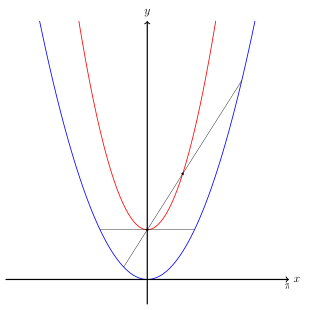
A parabola has the equation \(y=x^{2}.\) The points \(P\) and \(Q\) with coordinates \((p,p^{2})\) and \((q,q^{2})\) respectively move on the parabola in such a way that \(\angle POQ\) is always a right angle.
- Find and sketch the locus of the midpoint \(R\) of the chord \(PQ.\)
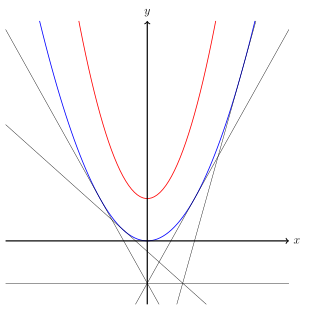
- Find and sketch the locus of the point \(T\) where the tangents to the parabola at \(P\) and \(Q\) intersect.
Solution:
- The line \(PO\) has gradient \(\frac{p^2}{p} = p\) and teh line \(QO\) has gradient \(q\), therefore we must have that \(pq = -1\). Therefore, \(R\) is the point
\begin{align*}
&& R &= \left ( \frac{p-\frac{1}{p}}{2}, \frac{p^2+\frac{1}{p^2}}{2} \right) \\
&&&= \left ( \frac12\left ( p - \frac{1}{p} \right),2\left (\frac12 \left(p-\frac{1}{p}\right) \right)^2+1 \right) \\
&&&= \left ( t, 2t^2+1\right)
\end{align*}
So we are looking at another parabola.
- The tangents are \(y = 2px+c\), ie \(p^2 = 2p^2+c\), ie \(y = 2px -p^2\) so we have
\begin{align*}
&& y - 2px &= -p^2 \\
&& y - 2qx &= -q^2 \\
\Rightarrow && (2p-2q)x &= p^2-q^2 \\
\Rightarrow && x &= \frac12 (p+q)\\
&& y &= p(p+q)-p^2 \\
&& y &= pq = -1
\end{align*}
Therefore \(x = \frac12(p - \frac1p), y= -1\), so we have the line \(y = -1\) (the directrix)
1994 Paper 3 Q4
Find the two solutions of the differential equation \[ \left(\frac{\mathrm{d}y}{\mathrm{d}x}\right)^{2}=4y \] which pass through the point \((a,b^{2}),\) where \(b\neq0.\) Find two distinct points \((a_{1},1)\) and \((a_{2},1)\) such that one of the solutions through each of them also passes through the origin. Show that the graphs of these two solutions coincide and sketch their common graph, together with the other solutions through \((a_{1},1)\) and \((a_{2},1)\). Now sketch sufficient members of the family of solutions (for varying \(a\) and \(b\)) to indicate the general behaviour. Use your sketch to identify a common tangent, and comment briefly on its relevance to the differential equation.
1993 Paper 3 Q1
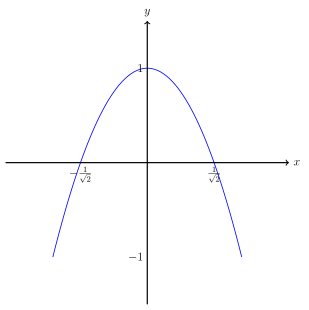
The curve \(P\) has the parametric equations $$ x= \sin\theta, \quad y=\cos2\theta \qquad\hbox{ for }-\pi/2 \le \theta \le \pi/2. $$ Show that \(P\) is part of the parabola \(y=1-2x^2\) and sketch \(P\). Show that the length of \(P\) is \(\surd (17) + {1\over 4} \sinh^{-1}4\). Obtain the volume of the solid enclosed when \(P\) is rotated through \(2\pi\) radians about the line \(y=-1\).
Solution: First notice that \(y = \cos 2 \theta = 1 - 2\sin^2 \theta = 1- 2x^2\), therefore \(P\) is lies on that parabola.
1991 Paper 1 Q10
\(\ \)\vspace{-1cm} \noindent
1990 Paper 2 Q9
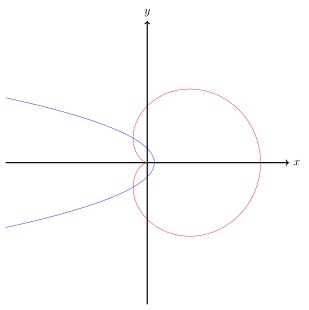
Show by means of a sketch that the parabola \(r(1+\cos\theta)=1\) cuts the interior of the cardioid \(r=4(1+\cos\theta)\) into two parts. Show that the total length of the boundary of the part that includes the point \(r=1,\theta=0\) is \(18\sqrt{3}+\ln(2+\sqrt{3}).\)
Solution:
1989 Paper 1 Q1

Solution: \(AG = r\), therefore the area is: \begin{align*} A &= [AHG] - 2*[ABC] + [CDE] \\ &= \frac12 \pi r^2 - \pi h^2 + \frac12 \pi (r-2h)^2 \\ &= \frac12 \pi \l r^2 - 2h^2 + r^2 -4rh+4h^2 \r \\ &= \frac12 \pi \l 2r^2 -4rh + 2h^2\r \\ &= \pi (r-h)^2 \end{align*} This is the same area as a circle radius \(r-h\) But \(HD = r + (r-2d) = 2(r-d)\), ie the circle with diameter \(HD\) has radius \(r-h\) as required. Suppose \(A = (-h, 0), C = (h, 0), B = (0, h)\) then our parabola is \(y = \frac1{h}(h^2-x^2)\)

1989 Paper 2 Q5
- Show that in polar coordinates, the gradient of any curve at the point
\((r,\theta)\) is
\[
\left.\left(\frac{\mathrm{d}r}{\mathrm{d}\theta}\tan\theta+r\right)\right/\left(\frac{\mathrm{d}r}{\mathrm{d}\theta}-r\tan\theta\right).
\]

- A mirror is designed so that any ray of light which hits one side of the mirror and which is parallel to a certain fixed line \(L\) is reflected through a fixed point \(O\) on \(L\). For any ray hitting the mirror, the normal to the mirror at the point of reflection bisects the angle between the incident ray and the reflected ray, as shown in the figure. Prove that the mirror intersects any plane containing \(L\) in a parabola.
Solution:
- Suppose our curve is \(r(\theta)\), then \(y = r \sin \theta, x = r \cos \theta\) and \begin{align*} && \frac{\d y}{\d \theta} &= \frac{\d r}{\d \theta} \sin \theta + r \cos \theta \\ && \frac{\d x}{\d \theta} &= \frac{\d r}{\d \theta} \cos \theta - r \sin \theta \\ \Rightarrow && \frac{\d y}{\d x} &= \frac{\d y}{\d \theta} \Bigg / \frac{\d x}{\d \theta} \\ &&&= \frac{\frac{\d r}{\d \theta} \sin \theta + r \cos \theta}{\frac{\d r}{\d \theta} \cos \theta - r \sin \theta} \\ &&&= \frac{\frac{\d r}{\d \theta} \tan\theta + r }{\frac{\d r}{\d \theta} - r \tan\theta} \end{align*} as required.
- Set up a system of polar coordinates such that the origin is at \(O\) and all points in the plane containing \(L\) are represented by \((r, \theta)\). The constraint we have is that the angle of the normal, is \(\frac12 \theta\). Let \(\tan \tfrac12 \theta = t\), then \(\tan \theta = \frac{2t}{1-t^2}\) \begin{align*} && \tan \frac12 \theta &= -\frac{\frac{\d r}{\d \theta} - r \tan\theta}{\frac{\d r}{\d \theta} \tan\theta + r } \\ \Rightarrow && t &= -\frac{r'-r\frac{2t}{1-t^2}}{r' \frac{2t}{1-t^2}+r} \\ &&&= \frac{2tr-(1-t^2)r'}{2tr'+(1-t^2)r} \\ \Rightarrow && (2t^2+1-t^2)r' &= (2t-t+t^3)r \\ && (1+t^2)r' &= t(t^2+1) r \\ \Rightarrow && r' &= t r \\ \Rightarrow && \frac{\d r}{\d \theta} &= \tan \tfrac12 \theta r \\ \Rightarrow && \int \frac1r \d r &= \int \tan \frac12 \theta \d \theta \\ && \ln r &= -2\ln \cos \tfrac12 \theta+C \\ \Rightarrow && r\cos^2 \frac12 \theta &= C \\ \Rightarrow && r + r\cos \theta &= D \\ \Rightarrow && r &= D-x \\ \Rightarrow && x^2 + y^2 &= D^2 - 2Dx + x^2 \\ \Rightarrow && y^2 &= D^2-2Dx \end{align*} Therefore it is a parabola
1988 Paper 2 Q4
The complex number \(w\) is such that \(w^{2}-2w\) is real.
- Sketch the locus of \(w\) in the Argand diagram.
- If \(w^{2}=x+\mathrm{i}y,\) describe fully and sketch the locus of points \((x,y)\) in the \(x\)-\(y\) plane.
Solution:
- Suppose \(w = u+ vi\) then \(w^2 - 2w = u^2-v^2-2u+(2uv-2v)i\) so to be purely real we must have \(2uv-2v = 2v(u-1) = 0\) ie either \(v = 0\) or \(u = 1\). Therefore the locus is the real axis and the line \(1 + ti\):

- If \(w^2 = x+yi\) then we must have \(x = u^2-v^2\) and \(y = 2uv\), so either \(v = 0, y = 0, x = u^2-2u \geq -1\) or \(u = 1, x = 1-v^2, y = 2v\) which is a parabola:


1988 Paper 3 Q4
A kingdom consists of a vast plane with a central parabolic hill. In a vertical cross-section through the centre of the hill, with the \(x\)-axis horizontal and the \(z\)-axis vertical, the surface of the plane and hill is given by \[ z=\begin{cases} \dfrac{1}{2a}(a^{2}-x^{2}) & \mbox{ for }\left|x\right|\leqslant a,\\ 0 & \mbox{ for }\left|x\right|>a. \end{cases} \] The whole surface is formed by rotating this cross-section about the \(z\)-axis. In the \((x,z)\) plane through the centre of the hill, the king has a summer residence at \((-R,0)\) and a winter residence at \((R,0)\), where \(R>a.\) He wishes to connect them by a road, consisting of the following segments: \begin{itemize} \item a path in the \((x,z)\) plane joining \((-R,0)\) to \((-b,(a^{2}-b^{2})/2a),\) where \(0\leqslant b\leqslant a.\) \item a horizontal semicircular path joining the two points \((\pm b,(a^{2}-b^{2})/2a),\) if \(b\neq0;\) \item a path in the \((x,z)\) plane joining \((b,(a^{2}-b^{2})/2a)\) to \((R,0).\) \end{itemiz} The king wants the road to be as short as possible. Advise him on his choice of \(b.\)
Solution: The path can be broken down into \(5\) sections. 1. The section from \((-R,0)\) to \((-a,0)\) which will have distance \(R-a\) and is unchangeable. 2. The distance from \((-a,0)\) to \((-b, \frac{a^2-b^2}{2a})\) whose distance we will calculate shortly. 3. The distance from \((-b, \frac{a^2-b^2}{2a})\) to \((b, \frac{a^2-b^2}{2a})\) which will have distance \(\pi b\). 4. The distance from \((b, \frac{a^2-b^2}{2a})\) to \((a,0)\) which will have the same distance as 2. 5. The distance from \((a,0)\) to \((R,0)\) which will have distance \(R-a\) and we have no control over. \begin{align*} \text{distance 2.} &= \int_b^a \sqrt{1 + \left ( \frac{x}{a}\right)^2 } \d x \end{align*} We want to minimize the total, by varying \(b\), so it makes sense to differentiate and set to zero. \begin{align*} &&0&= -2\sqrt{1+\frac{b^2}{a^2}} + \pi \\ \Rightarrow && \frac{\pi^2}{4} &= 1 + \frac{b^2}{a^2} \\ \Rightarrow && b &= a \sqrt{\frac{\pi^2}{4}-1} \end{align*} Since \(\pi \approx 3\) this point is outside our range \(0 \leq b \leq a\), and our derivative is always positive. Therefore the distance is always increasing and the king would be better off going around the hill as soon as he arrives at it.