Problems
Filters
27 problems found
2008 Paper 1 Q11
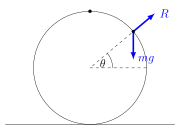
A straight uniform rod has mass \(m\). Its ends \(P_1\) and \(P_2\) are attached to small light rings that are constrained to move on a rough rigid circular wire with centre \(O\) fixed in a vertical plane, and the angle \(P_1OP_2\) is a right angle. The rod rests with \(P_1\) lower than \(P_2\), and with both ends lower than \(O\). The coefficient of friction between each of the rings and the wire is \(\mu\). Given that the rod is in limiting equilibrium (i.e. \ on the point of slipping at both ends), show that \[ \tan \alpha = \frac{1-2\mu -\mu^2}{1+2\mu -\mu^2}\,, \] where \(\alpha\) is the angle between \(P_1O\) and the vertical (\(0<\alpha<45^\circ\)). Let \(\theta\) be the acute angle between the rod and the horizontal. Show that \(\theta =2\lambda\), where \(\lambda \) is defined by \(\tan \lambda= \mu\) and \(0<\lambda<22.5^\circ\).
2008 Paper 2 Q11
A wedge of mass \(km\) has the shape (in cross-section) of a right-angled triangle. It stands on a smooth horizontal surface with one face vertical. The inclined face makes an angle \(\theta\) with the horizontal surface. A particle \(P\), of mass \(m\), is placed on the inclined face and released from rest. The horizontal face of the wedge is smooth, but the inclined face is rough and the coefficient of friction between \(P\) and this face is \(\mu\).
- When \(P\) is released, it slides down the inclined plane at an acceleration \(a\) relative to the wedge. Show that the acceleration of the wedge is \[ \frac {a \cos\theta}{k+1}\,. \] To a stationary observer, \(P\) appears to descend along a straight line inclined at an angle~\(45^\circ\) to the horizontal. Show that \[ \tan\theta = \frac k {k+1}\,. \] In the case \(k=3\), find an expression for \(a\) in terms of \(g\) and \(\mu\).
- What happens when \(P\) is released if \(\tan\theta \le \mu\)?
2007 Paper 3 Q11
- A wheel consists of a thin
light circular rim attached by light spokes of length \(a\)
to a small hub of mass
\(m\). The wheel rolls without slipping
on a rough horizontal table
directly towards a straight edge of the table.
The plane of the wheel is vertical throughout the motion.
The speed of the wheel is \(u\), where
\(u^2
- Two particles, each of mass \(m/2\), are attached to a light circular hoop of radius \(a\), at the ends of a diameter. The hoop rolls without slipping on a rough horizontal table directly towards a straight edge of the table. The plane of the hoop is vertical throughout the motion. When the centre of the hoop is vertically above the edge of the table it has speed \(u\), where \(u^2
- Two particles, each of mass \(m/2\), are attached to a light circular hoop of radius \(a\), at the ends of a diameter. The hoop rolls without slipping on a rough horizontal table directly towards a straight edge of the table. The plane of the hoop is vertical throughout the motion. When the centre of the hoop is vertically above the edge of the table it has speed \(u\), where \(u^2
2003 Paper 2 Q10
A bead \(B\) of mass \(m\) can slide along a rough horizontal wire. A light inextensible string of length \(2\ell\) has one end attached to a fixed point \(A\) of the wire and the other to \(B\,\). A particle \(P\) of mass \(3m\) is attached to the mid-point of the string and \(B\) is held at a distance \(\ell\) from~\(A\,\). The bead is released from rest. Let \(a_1\) and \(a_2\) be the magnitudes of the horizontal and vertical components of the initial acceleration of \(P\,\). Show by considering the motion of \(P\) relative to \(A\,\), or otherwise, that \(a_1= \sqrt 3 a_2\,\). Show also that the magnitude of the initial acceleration of \(B\) is \(2a_1\,\). Given that the frictional force opposing the motion of \(B\) is equal to \(({\sqrt{3}}/6)R\), where \(R\) is the normal reaction between \(B\) and the wire, show that the magnitude of the initial acceleration of \(P\) is~\(g/18\,\).
2002 Paper 3 Q10
A light hollow cylinder of radius \(a\) can rotate freely about its axis of symmetry, which is fixed and horizontal. A particle of mass \(m\) is fixed to the cylinder, and a second particle, also of mass \(m\), moves on the rough inside surface of the cylinder. Initially, the cylinder is at rest, with the fixed particle on the same horizontal level as its axis and the second particle at rest vertically below this axis. The system is then released. Show that, if \(\theta\) is the angle through which the cylinder has rotated, then \[ \ddot{\theta} = {g \over 2a} \l \cos \theta - \sin \theta \r \,, \] provided that the second particle does not slip. Given that the coefficient of friction is \( (3 + \sqrt{3})/6\), show that the second particle starts to slip when the cylinder has rotated through \(60^\circ\).
2001 Paper 3 Q9
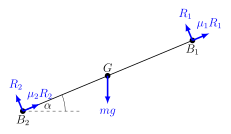
\(B_1\) and \(B_2\) are parallel, thin, horizontal fixed beams. \(B_1\) is a vertical distance \(d \sin \alpha \) above \(B_2\), and a horizontal distance \(d\cos\alpha \) from \(B_2\,\), where \(0<\alpha<\pi/2\,\). A long heavy plank is held so that it rests on the two beams, perpendicular to each, with its centre of gravity at \(B_1\,\). The coefficients of friction between the plank and \(B_1\) and \(B_2\) are \(\mu_1\) and \(\mu_2\,\), respectively, where \(\mu_1<\mu_2\) and \(\mu_1+\mu_2=2\tan\alpha\,\). The plank is released and slips over the beams experiencing a force of resistance from each beam equal to the limiting frictional force (i.e. the product of the appropriate coefficient of friction and the normal reaction). Show that it will come to rest with its centre of gravity over \(B_2\) in a time \[ \pi \left(\frac{d}{g(\mu_2-\mu_1)\cos\alpha }\right)^{\!\frac12}\;. \]
Solution:
2000 Paper 3 Q11
A thin beam is fixed at a height \(2a\) above a horizontal plane. A uniform straight rod \(ACB\) of length \(9a\) and mass \(m\) is supported by the beam at \(C\). Initially, the rod is held so that it is horizontal and perpendicular to the beam. The distance \(AC\) is \(3a\), and the coefficient of friction between the beam and the rod is \(\mu\). The rod is now released. Find the minimum value of \(\mu\) for which \(B\) strikes the horizontal plane before slipping takes place at \(C\).
1996 Paper 3 Q9
A particle of mass \(m\) is at rest on top of a smooth fixed sphere of radius \(a\). Show that, if the particle is given a small displacement, it reaches the horizontal plane through the centre of the sphere at a distance % at least $$a(5\sqrt5+4\sqrt23)/27$$ from the centre of the sphere. [Air resistance should be neglected.]
1992 Paper 3 Q12
\(\,\)
1990 Paper 3 Q13
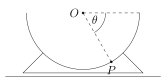
A particle \(P\) is projected, from the lowest point, along the smooth inside surface of a fixed sphere with centre \(O\). It leaves the surface when \(OP\) makes an angle \(\theta\) with the upward vertical. Find the smallest angle that must be exceeded by \(\theta\) to ensure that \(P\) will strike the surface below the level of \(O\). You may find it helpful to find the time at which the particle strikes the sphere.
Solution:

1988 Paper 3 Q14
A small heavy bead can slide smoothly in a vertical plane on a fixed wire with equation \[ y=x-\frac{x^{2}}{4a}, \] where the \(y\)-axis points vertically upwards and \(a\) is a positive constant. The bead is projected from the origin with initial speed \(V\) along the wire.
- Show that for a suitable value of \(V\), to be determined, a motion is possible throughout which the bead exerts no pressure on the wire.
- Show that \(\theta,\) the angle between the particle's velocity at time \(t\) and the \(x\)-axis, satisfies \[ \frac{4a^{2}\dot{\theta}^{2}}{\cos^{6}\theta}+2ga(1-\tan^{2}\theta)=V^{2}. \]
Solution:
- The condition that the bead exerts no pressure on the wire is equivalent to the condition that the wire exerts no force on the bead. (Newton's Third Law). This is equivalent to the bead being projected under gravity. Notice that the initial projection is at \(45^{\circ}\) since \(\frac{dy}{dx}|_{x=0} = 1\). The position of the particle (under gravity) at time \(t\) is \(x = \frac{1}{\sqrt{2}}Vt\) and \(y = \frac{1}{\sqrt{2}}Vt - \frac12 gt^2 = x - \frac{1}{2}g \frac{2x^2}{V^2} = x - \frac{g}{V^2}x^2\). Therefore they follow the same trajectory if \(\frac{g}{V^2} = \frac{1}{4a} \Leftrightarrow V = 2\sqrt{ag}\)
- First note that the wire does no work as it is perpendicular to the velocity, so it is fine to use conservation of momentum. If we take our \(0\) GPE level to be be \(x = 0\), then we notice the initial energy is \(\frac12mV^2\). Secondly, notice that \(\tan \theta = \frac{\d y}{\d x} = 1- \frac{x}{2a} \Rightarrow x = 2a - 2a \tan \theta\) \begin{align*} y &= 2a(1-\tan \theta) - \frac{4a^2(1-\tan \theta)^2}{4a}\\ &= (1-\tan \theta)(2a-a(1-\tan \theta)) \\ &= a(1-\tan \theta)(1+\tan \theta) \\ &= a(1-\tan^2 \theta) \end{align*} GPE \(mga(1-\tan^2 \theta)\). To calculate the kinetic energy, notice that \(\dot{x} = v \cos \theta \dot{\theta}\) and \(\dot{x} = -2a\sec^2 \theta\dot{\theta} \Rightarrow v = -\frac{2a\dot{\theta} }{\cos^{3} \theta}\). Therefore, energy at time \(t\) is: \begin{align*} && \frac12 m V^2 &= \frac12 m \l - \frac{2a\dot{\theta}}{\cos^3 \theta} \r^2 + mga(1-\tan^2 \theta) \\ \Rightarrow && V^2 &= \frac{4a^2\dot{\theta}^2}{\cos^6 \theta} + 2ag(1-\tan^2 \theta) \end{align*}
1987 Paper 1 Q11
A smooth sphere of radius \(r\) stands fixed on a horizontal floor. A particle of mass \(m\) is displaced gently from equilibrium on top of the sphere. Find the angle its velocity makes with the horizontal when it loses contact with the sphere during the subsequent motion. By energy considerations, or otherwise, find the vertical component of the momentum of the particle as it strikes the floor.
Solution: