Problems
Filters
24 problems found
1992 Paper 1 Q11
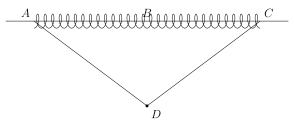
Three light elastic strings \(AB,BC\) and \(CD\), each of natural length \(a\) and modulus of elasticity \(\lambda,\) are joined together as shown in the diagram. \noindent
1992 Paper 2 Q12
In the figure, \(W_{1}\) and \(W_{2}\) are wheels, both of radius \(r\). Their centres \(C_{1}\) and \(C_{2}\) are fixed at the same height, a distance \(d\) apart, and each wheel is free to rotate, without friction, about its centre. Both wheels are in the same vertical plane. Particles of mass \(m\) are suspended from \(W_{1}\) and \(W_{2}\) as shown, by light inextensible strings would round the wheels. A light elastic string of natural length \(d\) and modulus elasticity \(\lambda\) is fixed to the rims of the wheels at the points \(P_{1}\) and \(P_{2}.\) The lines joining \(C_{1}\) to \(P_{1}\) and \(C_{2}\) to \(P_{2}\) both make an angle \(\theta\) with the vertical. The system is in equilibrium. \noindent
- sep}{3mm}
- \(\bf (i)\) no equilibrium positions,
- \(\bf (ii)\) just one equilibrium position,
- \(\bf (iii)\) exactly two equilibrium positions,
- \(\bf (iv)\) more than two equilibrium positions?
1992 Paper 3 Q13
\(\,\)
1991 Paper 3 Q14
1990 Paper 1 Q12
\(\,\)
Solution:
1989 Paper 1 Q12
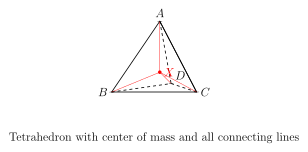
A regular tetrahedron \(ABCD\) of mass \(M\) is made of 6 identical uniform rigid rods, each of length \(2a.\) Four light elastic strings \(XA,XB,XC\) and \(XD\), each of natural length \(a\) and modulus of elasticity \(\lambda,\) are fastened together at \(X\), the other end of each string being attached to the corresponding vertex. Given that \(X\) lies at the centre of mass of the tetrahedron, find the tension in each string. The tetrahedron is at rest on a smooth horizontal table, with \(B,C\) and \(D\) touching the table, and the ends of the strings at \(X\) attached to a point \(O\) fixed in space. Initially the centre of mass of the tetrahedron coincides with \(O.\) Suddenly the string \(XA\) breaks, and the tetrahedron as a result rises vertically off the table. If the maximum height subsequently attained is such that \(BCD\) is level with the fixed point \(O,\) show that (to 2 significant figures) \[ \frac{Mg}{\lambda}=0.098. \]
Solution:
1988 Paper 1 Q13
A piece of circus apparatus consists of a rigid uniform plank of mass 1000\(\,\)kg, suspended in a horizontal position by two equal light vertical ropes attached to the ends. The ropes each have natural length 10\(\,\)m and modulus of elasticity 490\(\,\)000 N. Initially the plank is hanging in equilibrium. Nellie, an elephant of mass 4000\(\,\)kg, lands in the middle of the plank while travelling vertically downwards at speed 5\(\,\)ms\(^{-1}.\) While carrying Nellie, the plank comes instantaneously to rest at a negligible height above the floor, and at this instant Nellie steps nimbly and gently off the plank onto the floor. Assuming that the plank remains horizontal, and the rope remain vertical, throughout the motion, find to three significant figures its initial height above the floor. During the motion after Nellie alights, do the ropes ever become slack? {[}Take \(g\) to be \(9.8\mbox{\,\ ms}^{-1}.\){]}
Solution: In the initial position, since the system is in equilibrium the tension in the two ropes must be \(500g\). Therefore since \(T = \frac{\lambda x}{l} \Rightarrow x = \frac{10 \cdot 500 g}{490\, 000} = \frac1{10}\) so the initial extension is \(\frac1{10}\) By conservation of momentum, if the initial speed of the plank + Nellie is \(V\), we must have \(4000 \cdot 5 = 5000 V \Rightarrow V = 4\) \begin{array}{ccc} & \text{GPE} & \text{EPE} & \text{KE} \\ \hline \text{Initially} & 5000gh & 2 \cdot \frac12 \frac{\lambda}{l} \frac{1}{100} & \frac12 \cdot 5000 \cdot 4^2 \\ & 49\,000h & 490 & 40\,000 \\ \text{Finally} & 0 & 2 \cdot \frac12 \frac{\lambda}{l} (h + \frac1{10})^2 & 0 \\ & 0 & 49\,000 (h+\frac1{10})^2 & 0 \end{array} By conservation of energy, we can set up a quadratic: \begin{align*} && 49\,000 (h+\frac1{10})^2 &= 49\,000h + 40\,490 \\ \Rightarrow && 49\,000(h + \frac1{10})^2 &= 49\,000(h + \frac1{10})+35\, 590 \\ \Rightarrow&& h + \frac1{10} &= 1.488092\cdots \\ \Rightarrow && h &= 1.49 \,\, (3\text{ s.f.}) \end{align*} When she gets off the plank, it will move according to: \begin{align*} \text{N2}(\uparrow): && \frac{\lambda x}{l} -1000g &= -1000 \ddot{x} \\ && 49 x-g &= -\ddot{x} \\ \Rightarrow && x &= A \sin 7t + B \cos 7t + 0.2 \\ && x(0) = 1.49, &x'(0) = 0 \\ \Rightarrow && B = -1.69, & A=0 \end{align*} If we continued under this motion the string would definitely reach a point \(0.1\) above \(0\), and therefore the ropes would go slack.
1987 Paper 1 Q10
A rubber band band of length \(2\pi\) and modulus of elasticity \(\lambda\) encircles a smooth cylinder of unit radius, whose axis is horizontal. A particle of mass \(m\) is attached to the lowest point of the band, and hangs in equilibrium at a distance \(x\) below the axis of the cylinder. Obtain an expression in terms of \(x\) for the stretched length of the band in equilibrium. What is the value of \(\lambda\) if \(x=2\)?
Solution:

1987 Paper 2 Q14
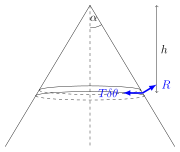
A thin uniform elastic band of mass \(m,\) length \(l\) and modulus of elasticity \(\lambda\) is pushed on to a smooth circular cone of vertex angle \(2\alpha,\) in such a way that all elements of the band are the same distance from the vertex. It is then released from rest. Let \(x(t)\) be the length of the band at time \(t\) after release, and let \(t_{0}\) be the time at which the band becomes slack. Assuming that a small element of the band which subtends an angle \(\delta\theta\) at the axis of the cone experiences a force, due to the tension \(T\) in the band, of magnitude \(T\delta\theta\) directed towards the axis, and ignoring the effects of gravity, show that \[ \frac{\mathrm{d}^{2}x}{\mathrm{d}t^{2}}+\frac{4\pi^{2}\lambda}{ml}(x-l)\sin^{2}\alpha=0,\qquad(0< t< t_{0}). \] Find the value of \(t_{0}.\)
Solution: