Problems
Filters
27 problems found
2005 Paper 1 Q5
- Evaluate the integral \[ \int_0^1 \l x + 1 \r ^{k-1} \; \mathrm{d}x \] in the cases \(k\ne0\) and \(k = 0\,\). Deduce that \(\displaystyle \frac{2^k - 1}{k} \approx \ln 2\) when \(k \approx 0\,\).
- Evaluate the integral \[ \int_0^1 x \l x + 1 \r ^m \; \mathrm{d}x \; \] in the different cases that arise according to the value of \(m\).
Solution:
- Case \(k \neq 0\): \begin{align*} && \int_0^1 (x+1)^{k-1} \d x &= \left [\frac{1}{k}(x+1)^k \right]_0^1 \\ &&&= \frac{2^k-1}{k} \\ \end{align*} Case \(k = 0\): \begin{align*} && \int_0^1 (x+1)^{k-1} \d x &= \int_0^1 (x+1)^{-1} \d x \\ &&&= \left [\ln(x+1) \right]_0^1 \\ &&&= \ln 2 \end{align*} Therefore for \(k \approx 0\), we must have both integrals being close to each other, since the function is nice on this interval, ie \(\frac{2^k-1}{k} \approx \ln 2\)
- Case \(m = 0\). \(I = \frac12\) Case \(m \neq 0, -1, -2\) \begin{align*} u = x+1, \d u = \d x && \int_0^1 x(x+1)^m \d x &= \int_{u=1}^{u=2} (u-1)u^m \d u \\ &&&=\left[ \frac{u^{m+2}}{m+2} - \frac{u^{m+1}}{m+1} \right]_1^2 \\ &&&= 2^{m+1}\left ( \frac{2}{m+2} - \frac1{m+1} \right) - \frac{1}{m+2} + \frac{1}{m+1} \\ &&&= 2^{m+1} \frac{m}{(m+1)(m+2)} + \frac{1}{(m+1)(m+2)} \\ &&&= \frac{m2^{m+1}+1}{(m+1)(m+2)} \\ \end{align*} Case \(m = -1\). \begin{align*} && \int_0^1 \frac{x}{x+1} \d x &= \int_0^1 1 - \frac{1}{x+1} \d x \\ &&&= 1 - \ln2 \\ \end{align*} Case \(m = -2\): \begin{align*} && \int_0^1 \frac{x}{(x+1)^2} \d x &= \int_0^1\frac{x+1-1}{(x+1)^2} \d x \\ &&&= \left [ \ln (x+1) +(1+x)^{-1} \right]_0^1 \\ &&&= \ln 2 + \frac12 - 1 \\ &&&= \ln 2 - \frac12 \end{align*}
2004 Paper 3 Q7
For \(n=1\), \(2\), \(3\), \(\ldots\,\), let \[ I_n = \int_0^1 {t^{n-1} \over \l t+1 \r^n} \, \mathrm{d} t \, . \] By considering the greatest value taken by \(\displaystyle {t \over t+1}\) for \(0 \le t \le 1\) show that \(I_{n+1} < {1 \over 2} I_{n}\,\). Show also that \(\; \displaystyle I_{n+1}= - \frac 1{\; n\, 2^n} + I_{n}\,\). Deduce that \(\; \displaystyle I_n < \frac1 {\; n \, 2^{n-1}}\,\). Prove that \[ \ln 2 = \sum_{r=1}^n {1 \over \; r\, 2^r} + I_{n+1} \] and hence show that \({2 \over 3} < \ln 2 < {17 \over 24}\,\).
Solution: \begin{align*} && \frac{t}{t+1} &= 1 - \frac{1}{t+1} \geq \frac12 \\ \Rightarrow && I_{n+1} &= \int_0^1 \frac{t^{n}}{(t+1)^{n+1}} \d t \\ &&&= \int_0^1\frac{t}{t+1} \frac{t^{n-1}}{(t+1)^{n}} \d t \\ &&&< \int_0^1\frac12\frac{t^{n-1}}{(t+1)^{n}} \d t \\ &&&= \frac12 I_n \\ \\ && I_{n+1} &= \int_0^1 \frac{t^{n}}{(t+1)^{n+1}} \d t \\ &&&= \left [ t^n \frac{(1+t)^{-n}}{-n} \right]_0^1 +\frac1n \int_0^1 n t^{n-1}(1+t)^{-n} \d t \\ &&&= -\frac{1}{n2^n} + I_n \\ \Rightarrow && \frac12 I_n &> -\frac1{n2^n} + I_n \\ \Rightarrow && \frac{1}{n2^{n-1}} &> I_n \end{align*} \begin{align*} && \ln 2 &= \int_0^1 \frac{1}{1+t} \d t \\ &&&= I_1 \\ &&&= \frac1{2} + I_2 \\ &&&= \frac1{2} + \frac{1}{2 \cdot 2^2} + I_3 \\ &&&= \sum_{r=1}^n \frac{1}{r2^r} + I_{n+1} \\ \\ && \ln 2 &= \frac12 + \frac18 + \frac1{24} + I_4 \\ \Rightarrow && \ln 2 &> \frac12 + \frac18 + \frac1{24} = \frac{12+3+1}{24} = \frac{16}{24} = \frac23 \\ \Rightarrow && \ln 2 &= \frac12 + \frac18 + I_3 \\ &&&< \frac12 + \frac18 +\frac{1}{3 \cdot 4} \\ &&&< \frac{12}{24} + \frac{3}{24} + \frac{2}{24} = \frac{17}{24} \end{align*}
2002 Paper 2 Q4
Give a sketch to show that, if \(\f(x) > 0\) for \(p < x < q\,\), then \(\displaystyle \int_p^{q} \f(x) \d x > 0\,\).
- By considering \(\f(x) = ax^2-bx+c\,\) show that, if \(a > 0\) and \(b^2 < 4ac\), then \(3b < 2a+6c\,\).
- By considering \(\f(x)= a\sin^2x - b\sin x + c\,\) show that, if \(a > 0\) and \(b^2< 4ac\), then \(4b < (a+2c)\pi\)
- Show that, if \(a > 0\), \(b^2 < 4ac\) and \(q > p > 0\,\), then $$ b\ln(q/p) < a\left(\frac1p -\frac1q\right) +c(q-p)\;. $$
Solution:
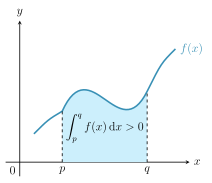
- If \(a > 0\) and \(b^2 < 4ac \Rightarrow \Delta < 0\) then \(f(x) = ax^2-bx+c > 0\) for all \(x\). Therefore \begin{align*} && 0 & < \int_0^1 (ax^2-bx+c) \d x\\ &&&= \frac13 a-\frac12b+c \\ \Rightarrow && 3b &< 2a+6c \end{align*}
- Similar logic tells us this must also be always positive, therefore \begin{align*} && 0 &< \int_0^{\pi} (a \sin^2 x - b \sin x +c ) \d x\\ &&&= \frac{\pi}{2}a - 2b+\pi c \\ \Rightarrow && 4b &< (a+2c)\pi \end{align*}
- Similar logic shows that \(f(x) = \frac{a}{x^2}-\frac{b}{x} +c>0\), therefore \begin{align*} && 0 &< \int_p^q \left (\frac{a}{x^2} - \frac{b}{x} + c\right) \d x \\ &&&=a\left (\frac{1}{p} - \frac{1}{q} \right) - b(\ln q - \ln p)+c(q-p) \\ \Rightarrow && b \ln (q/p) &,< a\left (\frac{1}{p} - \frac{1}{q} \right) +c(q-p) \end{align*}
2000 Paper 1 Q3
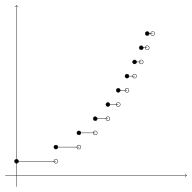
For any number \(x\), the largest integer less than or equal to \(x\) is denoted by \([x]\). For example, \([3.7]=3\) and \([4]=4\). Sketch the graph of \(y=[x]\) for \(0\le x<5\) and evaluate \[ \int_0^5 [x]\;\d x. \] Sketch the graph of \(y=[\e^{x}]\) for \(0\le x< \ln n\), where \(n\) is an integer, and show that \[ \int_{0}^{\ln n}[\e^{x}]\, \d x =n\ln n - \ln (n!). \]
Solution:

1999 Paper 1 Q8
The function \(\f\) satisfies \(0\leqslant\f(t)\leqslant K\) when \(0\leqslant t\leqslant x\). Explain by means of a sketch, or otherwise, why \[0\leqslant\int_{0}^{x} \f (t)\,{\mathrm d}t \leqslant Kx.\] By considering \(\displaystyle \int_{0}^{1}\frac{t}{n(n-t)}\,{\mathrm d}t\), or otherwise, show that, if \(n>1\), \[ 0\le \ln \left( \frac n{n-1}\right) -\frac 1n \le \frac 1 {n-1} - \frac 1n \] and deduce that \[ 0\le \ln N -\sum_{n=2}^N \frac1n \le 1. \] Deduce that as \(N\to \infty\) \[ \sum_{n=1}^N \frac1n \to\infty. \] Noting that \(2^{10}=1024\), show also that if \(N<10^{30}\) then \[ \sum_{n=1}^N \frac1n <101. \]
1999 Paper 2 Q6
Find \(\displaystyle \ \frac{\d y}{\d x} \ \) if $$ y = \frac{ax+b}{cx+d}. \tag{*} $$ By using changes of variable of the form \((*)\), or otherwise, show that \[ \int_0^1 \frac{1}{(x+3)^2} \; \ln \left(\frac{x+1}{x+3}\right)\d x = {\frac16} \ln3 - {\frac14}\ln 2 - \frac 1{12}, \] and evaluate the integrals \[ \int_0^1 \frac{1}{(x+3)^2} \; \ln \left(\frac{x^2+3x+2}{(x+3)^2}\right)\d x \mbox{ and } \int_0^1 \frac{1}{(x+3)^2} \; \ln\left(\frac{x+1}{x+2}\right)\d x . \] [Not on original paper:] By changing to the variable \(y\) defined by $$ y=\frac{2x-3}{x+1},$$ evaluate the integral $$ \int_2^4 \frac{2x-3}{(x+1)^3}\; \ln\!\left(\frac{2x-3}{x+1}\right)\d x.$$ Evaluate the integral $$ \int_9^{25} {\big({2z^{-3/2} -5z^{-2}}\big)}\ln{\big(2-5z^{-1/2}\big)}\; \d z.$$
Solution: \begin{align*} && y &= \frac{ax+b}{cx+d} \\ &&&= \frac{\frac{a}{c}(cx+d) - \frac{da}{c} + b}{cx+d} \\ \Rightarrow && y' &= \left (b - \frac{da}{c} \right)(-1)(cx+d)^{-2} \cdot c \\ &&&= (ad-bc)(cx+d)^{-2} \end{align*} \begin{align*} && y &= \frac{x+1}{x+3} \\ && \frac{\d y}{\d x} &= \frac{2}{(x+3)^2} \\ \Rightarrow && I &= \int_0^1 \frac{1}{(x+3)^2} \; \ln \left(\frac{x+1}{x+3}\right)\d x \\ &&&= \int_{y=1/3}^{y=1/2} \frac12 \ln y \, \d y \\ &&&= \frac12 \left [ y \ln y - y \right]_{1/3}^{1/2} \\ &&&= \frac12 \left ( \frac12\ln \frac12 - \frac12 - \frac13 \ln\frac13 + \frac13 \right) \\ &&&= \frac16 \ln 3 -\frac14 \ln 2 -\frac1{12} \end{align*} \begin{align*} && J &= \int_0^1 \frac1{(x+3)^2} \ln \left ( \frac{x^2+3x+2}{(x+3)^2} \right) \d x \\ &&&= \int_0^1 \frac1{(x+3)^2} \left ( \ln \frac{x+1}{x+3} + \ln \frac{x+2}{x+3} \right) \d x \\ &&&= I + \int_0^1 \frac1{(x+3)^2} \ln \left ( \frac{x+2}{x+3} \right) \d x \\ &&&= I + \int_{y=2/3}^{y=3/4} \ln y\, \d y \\ &&&= I + \left [ y \ln y- y\right]_{2/3}^{3/4} \\ &&&= I + \left ( \frac34 \ln \frac34 - \frac34 - \frac23 \ln \frac23 + \frac23 \right) \\ &&&= I + \left ( \frac34 \ln 3 - \frac32 \ln 2- \frac1{12} - \frac23 \ln 2 + \frac23 \ln 3\right) \\ &&&= I + \left ( \frac{17}{12} \ln 3 - \frac{13}6 \ln 2- \frac1{12} \right) \\ &&&= \frac16 \ln 3 -\frac14 \ln 2 -\frac1{12} + \left ( \frac{17}{12} \ln 3 - \frac{13}6 \ln 2- \frac1{12} \right) \\ &&&= \frac{19}{12} \ln 3 -\frac{29}{12}\ln 2 - \frac16 \end{align*} \begin{align*} && K &= \int_0^1 \frac{1}{(x+3)^2} \; \ln\left(\frac{x+1}{x+2}\right)\d x \\ &&&= \int_0^1 \frac{1}{(x+3)^2} \; \left ( \ln\left(\frac{x+1}{x+3}\right) - \ln \left ( \frac{x+3}{x+2} \right) \right)\d x \\ &&&= \frac16 \ln 3 -\frac14 \ln 2 -\frac1{12} - \left ( \frac{17}{12} \ln 3 - \frac{13}6 \ln 2- \frac1{12} \right) \\ &&&= -\frac54 \ln 3 +\frac{23}{12} \ln 2 \end{align*}
1999 Paper 3 Q3
Justify, by means of a sketch, the formula $$ \lim_{n\rightarrow\infty}\left\{{1\over n}\sum_{m=1}^n \f(1+m/n)\right\} = \int_1^2 \f(x)\,\d x \,. $$ Show that $$ \lim_{n\rightarrow\infty}\left\{{1\over n+1} + {1\over n+2} + \cdots + {1\over n+n}\right\} = \ln 2 \,. $$ Evaluate $$ \lim_{n\rightarrow\infty}\left\{{n\over n^2+1} + {n\over n^2+4} + \cdots + {n\over n^2+n^2}\right\}\,. $$
Solution:

1992 Paper 3 Q1
- Given that \[ \mathrm{f}(x)=\ln(1+\mathrm{e}^{x}), \] prove that \(\ln[\mathrm{f}'(x)]=x-\mathrm{f}(x)\) and that \(\mathrm{f}''(x)=\mathrm{f}'(x)-[\mathrm{f}'(x)]^{2}.\) Hence, or otherwise, expand \(\mathrm{f}(x)\) as a series in powers of \(x\) up to the term in \(x^{4}.\)
- Given that \[ \mathrm{g}(x)=\frac{1}{\sinh x\cosh2x}, \] explain why \(\mathrm{g}(x)\) can not be expanded as a series of non-negative powers of \(x\) but that \(x\mathrm{g}(x)\) can be so expanded. Explain also why this latter expansion will consist of even powers of \(x\) only. Expand \(x\mathrm{g}(x)\) as a series as far as the term in \(x^{4}.\)
Solution:
- \begin{align*} && f(x) &= \ln (1+e^x) \\ && f'(x) &= \frac{1}{1+e^x} \cdot e^x \\ &&&= \frac{e^x}{1+e^x} \\ \Rightarrow && \ln [f'(x)] &= x - \ln (1+e^x) \\ &&&= x - f(x) \\ \\ \Rightarrow && \frac{f''(x)}{f'(x)} &= 1 - f'(x) \\ \Rightarrow && f''(x) &= f'(x) - [f'(x)]^2 \\ && f'''(x) &= f''(x) - 2f'(x) f''(x) \\ && f^{(4)}(x) &= f'''(x) - 2[f''(x)]^2-2f'(x)f'''(x) \end{align*} \begin{align*} f(0) &= \ln 2 \\ f'(0) &= \tfrac12 \\ f''(0) &= \tfrac12 -\tfrac14 \\ &= \tfrac 14 \\ f'''(0) &= \tfrac14 - 2 \tfrac12 \tfrac 14 \\ &= 0 \\ f^{(4)}(0) &= -2 \cdot \tfrac1{16} \\ &= -\frac18 \end{align*} Therefore \(f(x) = \ln 2 + \tfrac12 x + \tfrac18 x^2 - \frac1{8 \cdot 4!} x^4 + O(x^5)\)
- As \(x \to 0\), \(g(x) \to \infty\) therefore there can be no power series about \(0\). But as \(x \to 0, x g(x) \not \to \infty\) as \(\frac{x}{\sinh x}\) is well behaved. We can also notice that \(x g(x)\) is an even function, since \(\cosh x\) is even and \(\frac{x}{\sinh x}\) is even, therefore the power series will consist of even powers of \(x\) \begin{align*} \lim_{x \to 0} \frac{x}{\sinh x \cosh 2 x} &= \lim_{x \to 0} \frac{x}{\sinh x} \cdot \lim_{x \to 0} \frac{1}{\cosh2 x} \\ &= 1 \end{align*} Notice that \begin{align*} \frac{x}{\sinh x \cosh 2 x} &= \frac{4x}{(e^x - e^{-x})(e^{2x}+e^{-2x})} \\ &= \frac{4x}{(2x + \frac{x^3}{3} + \cdots)(2 + 4x^2 + \frac43 x^4 + \cdots )} \\ &= \frac{1}{1+\frac{x^2}{6}+\frac{x^4}{5!} + \cdots } \frac{1}{1 + 2x^2 + \frac23 x^4 + \cdots } \\ &= \left (1-(\frac{x^2}{6} + \frac{x^4}{5!})+ (\frac{x^2}{6} )^2 + O(x^6)\right) \left (1-(2x^2+\frac23 x^4)+ (2x^2)^2 + O(x^6)\right) \\ &= \left (1 - \frac16 x^2 + \frac{7}{360} x^4 + O(x^6) \right) \left (1 - 2x^2+ \frac{10}3x^4 + O(x^6) \right) \\ &= 1 - \frac{13}{6} x^2 + \frac{1327}{360}x^4 + O(x^6) \end{align*}
1991 Paper 2 Q7
The function \(\mathrm{g}\) satisfies, for all positive \(x\) and \(y\), \[ \mathrm{g}(x)+\mathrm{g}(y)=\mathrm{g}(z),\tag{*} \] where \(z=xy/(x+y+1).\) By treating \(y\) as a constant, show that \[ \mathrm{g}'(x)=\frac{y^{2}+y}{(x+y+1)^{2}}\mathrm{g}'(z)=\frac{z(z+1)}{x(x+1)}\mathrm{g}'(z), \] and deduce that \(2\mathrm{g}'(1)=(u^{2}+u)\mathrm{g}'(u)\) for all \(u\) satisfying \(0 < u < 1.\) Now by treating \(u\) as a variable, show that \[ \mathrm{g}(u)=A\ln\left(\frac{u}{u+1}\right)+B, \] where \(A\) and \(B\) are constants. Verify that \(\mathrm{g}\) satisfies \((*)\) for a suitable value of \(B\). Can \(A\) be determined from \((*)\)? The function \(\mathrm{f}\) satisfies, for all positive \(x\) and \(y\), \[ \mathrm{f}(x)+\mathrm{f}(y)=\mathrm{f}(z) \] where \(z=xy.\) Show that \(\mathrm{f}(x)=C\ln x\) where \(C\) is a constant.
Solution: Note that \(z = xy/(x+y+1) \Rightarrow y(x-z) = z(x+1)\) \begin{align*} && g(x) + g(y) &= g(z) \\ \Rightarrow && g'(x) &= g'(z) \cdot \frac{y(x+y+1) - xy \cdot 1} {(x+y+1)^2} \\ &&&= g'(z) \frac{y^2+y}{(x+y+1)^2} \\ &&&= g'(z) \frac{z^2(y^2+y)}{x^2y^2} \\ &&&= g'(z) \frac{z^2(y+1)}{x^2y} \\ &&&= g'(z) \frac{z^2}{x^2} \left (1 + \frac{x-z}{z(x+1)} \right) \\ &&&= g'(z) \frac{z}{x^2} \frac{zx+x}{x+1} \\ &&&= g'(z) \frac{z(z+1)}{x(x+1)} \end{align*} If \(x = 1\) then as \(y\) ranges from \(0\) to \(\infty\), \(z\) ranges from \(0\) to \(1\), so \(g'(1) = \frac{z(z+1)}{1(1+1)}g'(z)\), ie \(2g'(1) = (u^2+u)g'(u)\). \begin{align*} && g'(u) &= \frac{A}{u(u+1)} \\ \Rightarrow && g(u) &= A\int \left ( \frac{1}{u} - \frac{1}{u+1} \right) \d u \\ &&&= A \left ( \ln u - \ln(u+1) \right) + B \\ &&&= A \ln \left ( \frac{u}{u+1} \right) + B \\ \\ && A \ln \left ( \frac{x}{x+1} \right) + B+A \ln \left ( \frac{y}{y+1} \right) + B &=A \ln \left ( \frac{z}{z+1} \right) + B \\ \Rightarrow && B &= A \ln \left ( \frac{z}{z+1} \frac{y+1}{y} \frac{x+1}{x} \right) \\ &&&= A \ln \left ( \frac{1}{1+\frac{x+y+1}{xy}} \frac{(y+1)(x+1)}{xy} \right) \\ &&&= A \ln 1 \\ &&& = 0 \end{align*} Therefore \(B = 0\). \(A\) cannot be determined from \((*)\). Suppose \(f(x) + f(y) = f(z)\), then \(f'(x) = yf'(z)\). Letting \(x = 1\) we find \(f'(1) = uf'(u) \Rightarrow f(u) = C \ln u + D\), but \(D = 0\) so \(f(x) = C \ln x\)
1990 Paper 1 Q9
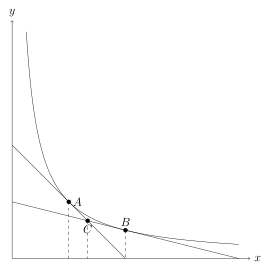
Let \(A\) and \(B\) be the points \((1,1)\) and \((b,1/b)\) respectively, where \(b>1\). The tangents at \(A\) and \(B\) to the curve \(y=1/x\) intersect at \(C\). Find the coordinates of \(C\). Let \(A',B'\) and \(C'\) denote the projections of \(A,B\) and \(C\), respectively, to the \(x\)-axis. Obtain an expression for the sum of the areas of the quadrilaterals \(ACC'A'\) and \(CBB'C'\). Hence or otherwise prove that, for \(z>0\), \[ \frac{2z}{2+z}\leqslant\ln\left(1+z\right)\leqslant z. \]
Solution:
1989 Paper 1 Q2
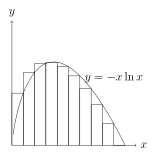
For \(x>0\) find \(\int x\ln x\,\mathrm{d}x\). By approximating the area corresponding to \(\int_{0}^{1}x\ln(1/x)\, \d x\) by \(n\) rectangles of equal width and with their top right-hand vertices on the curve \(y=x\ln(1/x)\), show that, as \(n\rightarrow\infty\), \[ \frac{1}{2}\left(1+\frac{1}{n}\right)\ln n-\frac{1}{n^{2}}\left[\ln\left(\frac{n!}{0!}\right)+\ln\left(\frac{n!}{1!}\right)+\ln\left(\frac{n!}{2!}\right)+\cdots+\ln\left(\frac{n!}{(n-1)!}\right)\right]\rightarrow\frac{1}{4}. \] {[}You may assume that \(x\ln x\rightarrow0\) as \(x\rightarrow0\).{]}
Solution: Integrating by parts we obtain: \begin{align*} \int x \ln x \, \d x &= [\frac12 x^2 \ln x] - \int \frac12x^2 \cdot \frac1x \d x \\ &= \frac12 x^2 \ln x - \frac14 x^2 + C \end{align*}
1987 Paper 2 Q7
A definite integral can be evaluated approximately by means of the Trapezium rule: \[ \int_{x_{0}}^{x_{N}}\mathrm{f}(x)\,\mathrm{d}x\approx\tfrac{1}{2}h\left\{ \mathrm{f}\left(x_{0}\right)+2\mathrm{f}\left(x_{1}\right)+\ldots+2\mathrm{f}\left(x_{N-1}\right)+\mathrm{f}\left(x_{N}\right)\right\} , \] where the interval length \(h\) is given by \(Nh=x_{N}-x_{0}\), and \(x_{r}=x_{0}+rh\). Justify briefly this approximation. Use the Trapezium rule with intervals of unit length to evaluate approximately the integral \[ \int_{1}^{n}\ln x\,\mathrm{d}x, \] where \(n(>2)\) is an integer. Deduce that \(n!\approx\mathrm{g}(n)\), where \[ \mathrm{g}(n)=n^{n+\frac{1}{2}}\mathrm{e}^{1-n}, \] and show by means of a sketch, or otherwise, that \[ n!<\mathrm{g}(n). \] By using the Trapezium rule on the above integral with intervals of width \(k^{-1}\), where \(k\) is a positive integer, show that \[ \left(kn\right)!\approx k!n^{kn+\frac{1}{2}}\left(\frac{\mathrm{e}}{k}\right)^{k\left(1-n\right)}. \] Determine whether this approximation or \(\mathrm{g}(kn)\) is closer to \(\left(kn\right)!\).
Solution:

