Problems
Filters
47 problems found
2012 Paper 3 Q6
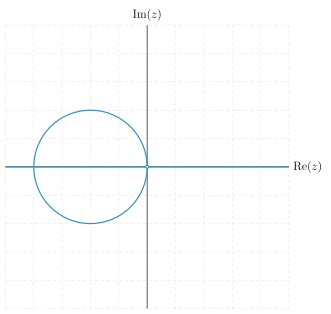
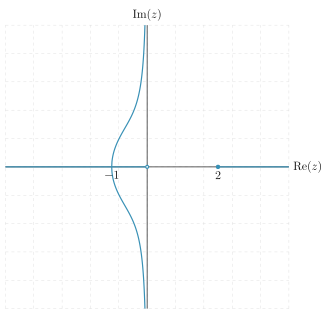
Let \(x+{\rm i} y\) be a root of the quadratic equation \(z^2 + pz +1=0\), where \(p\) is a real number. Show that \(x^2-y^2 +px+1=0\) and \((2x+p)y=0\). Show further that either \(p=-2x\) or \(p=-(x^2+1)/x\) with \(x\ne0\). Hence show that the set of points in the Argand diagram that can (as \(p\) varies) represent roots of the quadratic equation consists of the real axis with one point missing and a circle. This set of points is called the root locus of the quadratic equation. Obtain and sketch in the Argand diagram the root locus of the equation \[ pz^2 +z+1=0\, \] and the root locus of the equation \[ pz^2 + p^2z +2=0\,.\]
Solution: \begin{align*} && 0 &= z^2 + pz + 1\\ &&&= (x+iy)^2 + (x+iy)p + 1 \\ &&& = (x^2-y^2+px+1) + (2xy+py)i \\ \Rightarrow && 0 &= x^2 - y^2 + px + 1 \\ && 0 &= (2x+p)y \\ \Rightarrow && p &= -2x \\ \text{ or } && y &= 0 \\ \Rightarrow && p &= -(x^2+1)/x \end{align*} Therefore as \(p\) varies with either have \(y = 0\) and \(x\) taking any real value except \(0\) ie the real axis minus the origin. Or \(p = -2x\) and \(-y^2-x^2+1 = 0 \Rightarrow x^2 + y^2 = 1\) which is a circle. Suppose \(pz^2 + z + 1 = 0\) \begin{align*} && 0 &= pz^2 + z +1\\ &&&= p(x+iy)^2 + (x+iy) + 1\\ &&&= (px^2-py^2+x+1) + (2xyp + y) i \\ \Rightarrow && 0 &= (2xp+1)y \\ \Rightarrow && y & = 0, p = \frac{-(x+1)}{x^2}, x \neq 0 \\ \text{ or } && p &= -\frac{1}{2x}\\ \Rightarrow && 0 &= -\frac{1}{2}x + \frac{y^2}{2x} + x + 1 \\ &&&= \frac{y^2 - x^2 +2x^2 + 2x}{2x} \\ &&&= \frac{(x+1)^2+y^2-1}{2x} \end{align*} So we either have the real axis (except \(0\)) or a circle radius \(1\) centre \((-1, 0)\) (excluding \(x = 0\)).
2011 Paper 3 Q8
The complex numbers \(z\) and \(w\) are related by \[ w= \frac{1+\mathrm{i}z}{\mathrm{i}+z}\,. \] Let \(z=x+\mathrm{i}y\) and \(w=u+\mathrm{i}v\), where \(x\), \(y\), \(u\) and \(v\) are real. Express \(u\) and \(v\) in terms of \(x\) and \(y\).
- By setting \(x=\tan(\theta/2)\), or otherwise, show that if the locus of \(z\) is the real axis \(y=0\), \(-\infty < x < \infty\), then the locus of \(w\) is the circle \(u^2+v^2=1\) with one point omitted.
- Find the locus of \(w\) when the locus of \(z\) is the line segment \(y=0\), \(-1 < x < 1\,\).
- Find the locus of \(w\) when the locus of \(z\) is the line segment \(x=0\), \(-1 < y < 1\,\).
- Find the locus of \(w\) when the locus of \(z\) is the line \(y=1\), \(-\infty < x < \infty\,\).
Solution: \begin{align*} w &= \frac{1+iz}{i+z} \\ &= \frac{1-y+ix}{x+i(1+y)} \\ &= \frac{((1-y)+ix)(x-i(1+y))}{x^2+(1+y)^2} \\ &= \frac{x(1-y)+x(1+y)}{x^2+(1+y)^2}+\frac{x^2+y^2-1}{x^2+(1+y)^2}i \\ &= \frac{2x}{x^2+(y+1)^2}+\frac{x^2+y^2-1}{x^2+(1+y)^2}i \end{align*} Therefore \(u = \frac{2x}{x^2+(y+1)^2}, v = \frac{x^2+y^2-1}{x^2+(1+y)^2}\)
- Suppose \(z = \tan(\theta/2) = t\) then \(u = \frac{2t}{t^2+1} = \sin \theta, v = \frac{t^2-1}{t^2+1} = \cos \theta\), ie \(u+iv\) is the unit circle, where \(-\frac{\pi}{2} < \theta/2 < \frac{\pi}{2}\) or \(-\pi < \theta < \pi\), ie excluding the point \((\sin \pi, \cos \pi) = (0,1)\).
- When \(-1 < x < 1\) we have \(-\frac{\pi}{4} < \frac{\theta}{2} < \frac{\pi}{4}\) ie \(-\frac{\pi}{2} < \theta < \frac{\pi}{2}\), ie the lower half of the unit circle.
- When \(x = 0, -1 < y < 1\) we have \(u = 0, v = \frac{y^2-1}{(1+y)^2}\) which is the negative imaginary axis.
- We have \(u = \frac{2t}{t^2+4}, v = \frac{t^2}{t^2+4}\), ie \(u^2 + v^2 = v\), ie \(u^2+(v-\frac12)^2 = \frac12^2\), so a circle centre \(\frac12i\) radius \(\frac12\), missing out \((0,1)\)
2010 Paper 2 Q5
The points \(A\) and \(B\) have position vectors \(\bf i +j+k\) and \(5{\bf i} - {\bf j} -{\bf k}\), respectively, relative to the origin \(O\). Find \(\cos2\alpha\), where \(2\alpha\) is the angle \(\angle AOB\).
- The line \(L _1\) has equation \({\bf r} =\lambda(m{\bf i}+n {\bf j} + p{\bf k})\). Given that \(L _1\) is inclined equally to \(OA\) and to \(OB\), determine a relationship between \(m\), \(n\) and~\(p\). Find also values of \(m\), \(n\) and~\(p\) for which \(L _1\) is the angle bisector of \(\angle AOB\).
- The line \(L _2\) has equation \({\bf r} =\mu(u{\bf i}+v {\bf j} + w{\bf k})\). Given that \( L _2\) is inclined at an angle \(\alpha\) to \(OA\), where \(2\alpha = \angle AOB\), determine a relationship between \(u\), \(v\) and \(w\). Hence describe the surface with Cartesian equation \(x^2+y^2+z^2 =2(yz+zx+xy)\).
2010 Paper 3 Q5
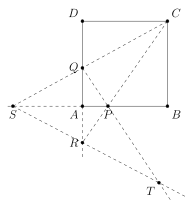
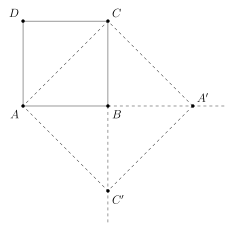
The vertices \(A\), \(B\), \(C\) and \(D\) of a square have coordinates \((0,0)\), \((a,0)\), \((a,a)\) and \((0,a)\), respectively. The points \(P\) and \(Q\) have coordinates \((an,0)\) and \((0,am)\) respectively, where \(0 < m < n < 1\). The line \(CP\) produced meets \(DA\) produced at \(R\) and the line \(CQ\) produced meets \(BA\) produced at \(S\). The line \(PQ\) produced meets the line \(RS\) produced at \(T\). Show that \(TA\) is perpendicular to \(AC\). Explain how, given a square of area \(a^2\), a square of area \(2a^2\) may be constructed using only a straight-edge. [Note: a straight-edge is a ruler with no markings on it; no measurements (and no use of compasses) are allowed in the construction.]
Solution:
2007 Paper 2 Q8
The points \(B\) and \(C\) have position vectors \(\mathbf{b}\) and \(\mathbf{c}\), respectively, relative to the origin \(A\), and \(A\), \(B\) and \(C\) are not collinear.
- The point \(X\) has position vector \(s \mathbf{b}+t\mathbf{c}\). Describe the locus of \(X\) when \(s+t=1\).
- The point \(P\) has position vector \(\beta \mathbf{b}+\gamma\mathbf{c}\), where \(\beta\) and \(\gamma\) are non-zero, and \(\beta+\gamma\ne1\). The line \(AP\) cuts the line \(BC\) at \(D\). Show that \(BD:DC=\gamma:\beta\).
- The line \(BP\) cuts the line \(CA\) at \(E\), and the line \(CP\) cuts the line \(AB\) at \(F\). Show that \[ \frac{AF}{FB} \times \frac{BD}{DC} \times \frac{CE}{EA}=1\,. \]
Solution:
- \(X\) lies on the line including \(B\) and \(C\).
- points on the line \(AP\) have the form \(\lambda(\beta \mathbf{b}+\gamma\mathbf{c})\), and the point \(D\) will be the point where \(\lambda\beta + \lambda \gamma = 1\). \begin{align*} && \frac{|BD|}{|DC|} &= \frac{|\mathbf{b} -\lambda(\beta \mathbf{b}+\gamma\mathbf{c})| }{|\lambda(\beta \mathbf{b}+\gamma\mathbf{c})- \mathbf{c}|} \\ &&&= \frac{|(1-\lambda \beta)\mathbf{b} - \lambda \gamma \mathbf{c}|}{|\lambda \beta \mathbf{b}+(\lambda \gamma -1)\mathbf{c}|}\\ &&&= \frac{|\lambda \gamma\mathbf{b} - \lambda \gamma \mathbf{c}|}{|\lambda \beta \mathbf{b}-(\lambda \beta)\mathbf{c}|} \\ &&&= \frac{\gamma}{\beta} \end{align*}
- The line \(BP\) is \(\mathbf{b} + \mu(\beta \mathbf{b}+\gamma\mathbf{c})\) and will meet \(CA\) when \(1+\mu\beta = 0\), ie \(\mu = -\frac{1}{\beta}\), therefore \(E\) is \(-\frac{\gamma}{\beta}\mathbf{c}\), and so \(\frac{|CE|}{|EA|} = \frac{1+\gamma/\beta}{\gamma/\beta} = \frac{\beta+\gamma}{\gamma}\). Similarly, \(F\) is \(-\frac{\beta}{\gamma}\mathbf{b}\) and \(\frac{|AF|}{|FB|} = \frac{\beta/\gamma}{1+\frac{\beta}{\gamma}} = \frac{\beta}{\gamma+\beta}\), and so \[\frac{AF}{FB} \times \frac{BD}{DC} \times \frac{CE}{EA} = \frac{\beta}{\gamma+\beta} \frac{\gamma}{\beta} \frac{\beta+\gamma}{\gamma} = 1 \]
2005 Paper 1 Q2
The point \(P\) has coordinates \(\l p^2 , 2p \r\) and the point \(Q\) has coordinates \(\l q^2 , 2q \r\), where \(p\) and~\(q\) are non-zero and \(p \neq q\). The curve \(C\) is given by \(y^2 = 4x\,\). The point \(R\) is the intersection of the tangent to \(C\) at \(P\) and the tangent to \(C\) at \(Q\). Show that \(R\) has coordinates \(\l pq , p+q \r\). The point \(S\) is the intersection of the normal to \(C\) at \(P\) and the normal to \(C\) at \(Q\). If \(p\) and \(q\) are such that \(\l 1 , 0 \r\) lies on the line \(PQ\), show that \(S\) has coordinates \(\l p^2 + q^2 + 1 , \, p+q \r\), and that the quadrilateral \(PSQR\) is a rectangle.
2005 Paper 1 Q6
- The point \(A\) has coordinates \(\l 5 \, , 16 \r\) and the point \(B\) has coordinates \(\l -4 \, , 4 \r\). The variable point \(P\) has coordinates \(\l x \, , y \r\,\) and moves on a path such that \(AP=2BP\). Show that the Cartesian equation of the path of \(P\) is \[ \displaystyle \l x+7 \r^2 + y^2 =100 \;. \]
- The point \(C\) has coordinates \(\l a \, , 0 \r\) and the point \(D\) has coordinates \(\l b \, , 0 \r\), where \(a\ne b\). The variable point \(Q\) moves on a path such that \[ QC = k \times QD\;, \] where \(k>1\,\). Given that the path of \(Q\) is the same as the path of \(P\), show that \[ \frac{a+7}{b+7}=\frac{a^2+51}{b^2+51}\;. \] Show further that \((a+7)(b+7)=100\,\).
Solution:
- Since \(AP = 2BP\) we also have \(|AP|^2 = 4|BP|^2\) ie \begin{align*} && (x-5)^2 + (y-16)^2 &= 4(x+4)^2 + 4(y-4)^2 \\ \Rightarrow && x^2 - 10x+25 + y^2 -32y + 256 &= 4x^2+32x+64+4y^2-32y+64 \\ \Rightarrow && 281 &= 3x^2+42x+3y^2+128\\ && 281 &= 3(x+7)^2-147+3y^2+128 \\ \Rightarrow && 300 &= 3(x+7)^2 + 3y^2 \\ && 100 &= (x+7)^2 + y^2 \end{align*}
- Since \(|QC|^2 = k^2 |QD|^2\), \begin{align*} && (x-a)^2 + y^2 &= k^2 (x-b)^2 + k^2y^2 \\ \Rightarrow && x^2-2ax+a^2 &= k^2x^2-2k^2bx+k^2b^2 + (k^2-1)y^2 \\ && a^2-k^2b^2 &= (k^2-1)x^2-2(k^2b-a)x + (k^2-1)y^2 \\ && a^2-k^2b^2&= (k^2-1)\left(x-\frac{k^2b-a}{k^2-1}\right)^2-(k^2-1)\left(\frac{k^2b-a}{k^2-1}\right)^2+(k^2-1)y^2 \\ && \frac{a^2-k^2b^2}{k^2-1}+\left(\frac{k^2b-a}{k^2-1}\right)^2&= \left(x-\frac{k^2b-a}{k^2-1}\right)^2+y^2 \\ \Rightarrow && -7 &= \frac{k^2b-a}{k^2-1} \tag{*} \\ && 100 &= \frac{a^2-k^2b^2}{k^2-1}+\left(\frac{k^2b-a}{k^2-1}\right)^2 \\ &&&= \frac{a^2-k^2b^2}{k^2-1}+7^2 \\ \Rightarrow && 51 &= \frac{a^2-k^2b^2}{k^2-1} \tag{**} \\ (*) \Rightarrow && k^2(b+7)&= a+7 \\ (**) \Rightarrow && k^2(51+b^2)&= a^2+51 \\ \Rightarrow && \frac{a^2+51}{b^2+51} &= \frac{a+7}{b+7} \\ \\ \Rightarrow && a^2b+51b+7a^2 &= ab^2+51a+7b^2 \\ && 0 &= ab(b-a)-51(b-a)+7(b-a)(b+a) \\ &&&= (b-a)(ab+7(b+a)-51) \\ &&&= (b-a)((a+7)(b+7)-100) \\ \Rightarrow && 100 &= (a+7)(b+7) \end{align*} Since \(a \neq b\)
2003 Paper 3 Q7
In the \(x\)--\(y\) plane, the point \(A\) has coordinates \((a\,,0)\) and the point \(B\) has coordinates \((0\,,b)\,\), where \(a\) and \(b\) are positive. The point \(P\,\), which is distinct from \(A\) and \(B\), has coordinates~\((s,t)\,\). \(X\) and \(Y\) are the feet of the perpendiculars from \(P\) to the \(x\)--axis and \(y\)--axis respectively, and \(N\) is the foot of the perpendicular from \(P\) to the line \(AB\,\). Show that the coordinates \((x\,,y)\) of \(N\) are given by \[ x= \frac {ab^2 -a(bt-as)}{a^2+b^2} \;, \ \ \ y = \frac{a^2b +b(bt-as)}{a^2+b^2} \;. \] Show that, if $\ds \ \left( \frac{t-b} s\right)\left( \frac t {s-a}\right) = -1\;\(, then \)N$ lies on the line \(XY\,\). Give a geometrical interpretation of this result.
2001 Paper 3 Q5
Show that the equation \(x^3 + px + q=0\) has exactly one real solution if \(p \ge 0\,\). A parabola \(C\) is given parametrically by \[ x = at^2, \: \ \ y = 2at \: \: \: \ \ \ \ \ \ \l a > 0 \r \;. \] Find an equation which must be satisfied by \(t\) at points on \(C\) at which the normal passes through the point \(\l h , \; k \r\,\). Hence show that, if \(h \le 2a \,\), exactly one normal to \(C\) will pass through \(\l h , \; k \r \, \). Find, in Cartesian form, the equation of the locus of the points from which exactly two normals can be drawn to \(C\,\). Sketch the locus.
Solution: If \(p \geq 0\) then the derivative is \(x^2+p \geq 0\) and in particular the function is increasing. Therefore it will have exactly \(1\) real root (as for very large negative \(x\) it is negative, and vice-versa fo positive \(x\)). \begin{align*} && \frac{\d y}{\d x} &= \frac{\dot{y}}{\dot{x}} \\ &&&= \frac{2a}{2at} \\ &&&= \frac{1}{t} \\ \text{eq of normal} && \frac{k-2at}{h-at^2} &= -t \\ \Rightarrow && k-2at &= at^3-th \\ && 0 &= at^3+(2a-h)t-k \end{align*} Since \(a > 0\) this is the same constraint as the first part, in particular \(2a-h \geq 0 \Leftrightarrow 2a \geq h\). If exactly two normals can be drawn to \(C\) we must have that our equation has a repeated root, ie \begin{align*} && 0 &= at^3+(2a-h)t-k\\ && 0 &= 3at^2+2a-h\\ \Rightarrow && 0 &= 3at^3+ 3(2a-h)t-3k \\ && 0 &= 3at^3+(2a-h)t \\ \Rightarrow && 0 &= 2(2a-h)t-3k \\ \Rightarrow && t &= \frac{3k}{2(2a-h)} \\ \Rightarrow && 0 &= 3a \left (\frac{3k}{2(2a-h)} \right)^2+2a-h \\ && 0 &= 27ak^2+4(2a-h)^3 \end{align*}

2001 Paper 3 Q8
- Prove that the equations $$ \left|z - (1 + \mathrm{i}) \right|^2 = 2 \eqno(*) $$ and $$ \qquad \quad \ \left|z - (1 - \mathrm{i}) \right|^2 = 2 \left|z - 1 \right|^2 $$ describe the same locus in the complex \(z\)--plane. Sketch this locus.
- Prove that the equation $$ \arg \l {z - 2 \over z} \r = {\pi \over 4} \eqno(**) $$ describes part of this same locus, and show on your sketch which part.
- The complex number \(w\) is related to \(z\) by \[ w = {2 \over z}\;. \] Determine the locus produced in the complex \(w\)--plane if \(z\) satisfies \((*)\). Sketch this locus and indicate the part of this locus that corresponds to \((**)\).
2001 Paper 3 Q10
Three ships \(A\), \(B\) and \(C\) move with velocities \({\bf v}_1\), \({\bf v}_2\) and \(\bf u\) respectively. The velocities of \(A\) and \(B\) relative to \(C\) are equal in magnitude and perpendicular. Write down conditions that \(\bf u\), \({\bf v}_1\) and \({\bf v}_2\) must satisfy and show that \[ \left| {\bf u} -{\textstyle\frac12} \l {\bf v}_1 + {\bf v}_2 \r \right|^2 = \left|{\textstyle\frac12} \l {\bf v}_1 - {\bf v}_2 \r \right|^2 \] and \[ \l {\bf u} -{\textstyle\frac12} \l {\bf v}_1 + {\bf v}_2 \r \r \cdot \l {\bf v}_1 - {\bf v}_2 \r = 0 \;. \] Explain why these equations determine, for given \({\bf v}_1\) and \({\bf v}_2\), two possible velocities for \(C\,\), provided \({\bf v}_1 \ne {\bf v}_2 \,\). If \({\bf v}_1\) and \({\bf v}_2\) are equal in magnitude and perpendicular, show that if \({\bf u} \ne {\bf 0}\) then \({\bf u} = {\bf v}_1 + {\bf v}_2\,\).
2000 Paper 2 Q7
The line \(l\) has vector equation \({\bf r} = \lambda {\bf s}\), where \[ {\bf s} = (\cos\theta+\sqrt3\,) \; {\bf i} +(\surd2\;\sin\theta)\;{\bf j} +(\cos\theta-\sqrt3\,)\;{\bf k} \] and \(\lambda\) is a scalar parameter. Find an expression for the angle between \(l\) and the line \mbox{\({\bf r} = \mu(a\, {\bf i} + b\,{\bf j} +c\, {\bf k})\)}. Show that there is a line \(m\) through the origin such that, whatever the value of \(\theta\), the acute angle between \(l\) and \(m\) is \(\pi/6\). A plane has equation \(x-z=4\sqrt3\). The line \(l\) meets this plane at \(P\). Show that, as \(\theta\) varies, \(P\) describes a circle, with its centre on \(m\). Find the radius of this circle.
2000 Paper 3 Q1
Sketch on the same axes the two curves \(C_1\) and \(C_2\), given by
Solution:

1999 Paper 1 Q2
A point moves in the \(x\)-\(y\) plane so that the sum of the squares of its distances from the three fixed points \((x_{1},y_{1})\), \((x_{2},y_{2})\), and \((x_{3},y_{3})\) is always \(a^{2}\). Find the equation of the locus of the point and interpret it geometrically. Explain why \(a^2\) cannot be less than the sum of the squares of the distances of the three points from their centroid. [The centroid has coordinates \((\bar x, \bar y)\) where \(3\bar x = x_1+x_2+x_3,\) $3\bar y =y_1+y_2+y_3. $]
Solution: \begin{align*} && a^2 &= d_1^2 + d_2^2 + d_3^2 \\ &&&= (x-x_1)^2+(y-y_1)^2 + (x-x_2)^2+(y-y_2)^2 + (x-x_3)^2+(y-y_3)^2 \\ &&&= \sum (x-\bar{x}+\bar{x}-x_i)^2 + \sum (y-\bar{y}+\bar{y}-y_i)^2 \\ &&&= \sum \left ( (x-\bar{x})^2+(\bar{x}-x_i)^2 + 2(x-\bar{x})(\bar{x}-x_i) \right)+ \sum \left ( (y-\bar{y})^2+(\bar{y}-y_i)^2 + 2(y-\bar{y})(\bar{y}-y_i) \right)\\ &&&= 3(x-\bar{x})^2 + \sum (\bar{x}-x_i)^2 + 6x\bar{x} -6\bar{x}^2-2x\sum x_i+2\bar{x}\sum x_i + \\ &&&\quad\quad\quad 3(y-\bar{y})^2 + \sum (\bar{y}-y_i)^2 + 6y\bar{y} -6\bar{y}^2-2y\sum y_i+2\bar{y}\sum y_i \\ &&&= 3(x-\bar{x})^2 + \sum (\bar{x}-x_i)^2+3(y-\bar{y})^2 + \sum (\bar{y}-y_i)^2 \\ \\ \Rightarrow && (x-\bar{x})^2+(y-\bar{y})^2 &= \frac13\left ( a^2- \sum \left((\bar{x}-x_i)^2+(\bar{y}-y_i)^2 \right) \right) \end{align*} Therefore the locus is a circle, centre \((\bar{x}, \bar{y})\). radius \(\sqrt{\frac13(a^2 - \text{sum of squares distances of centroid to vertices}})\). \(a^2\) cannot be less than this distance, because clearly the right hand side is always bigger than it!
1997 Paper 2 Q5
The complex numbers \(w=u+\mathrm{i}v\) and \(z=x+\mathrm{i}y\) are related by the equation $$z= (\cos v+\mathrm{i}\sin v)\mathrm{e}^u.$$ Find all \(w\) which correspond to \(z=\mathrm{i\,e}\). Find the loci in the \(x\)--\(y\) plane corresponding to the lines \(u=\) constant in the \(u\)--\(v\) plane. Find also the loci corresponding to the lines \(v=\) constant. Illustrate your answers with clearly labelled sketches. Identify two subsets \(W_1\) and \(W_2\) of the \(u\)--\(v\) plane each of which is in one-to-one correspondence with the first quadrant \(\{(x,\,y):\,x>0,\,y>0\}\) of the \(x\)--\(y\) plane. Identify also two subsets \(W_3\) and \(W_4\) each of which is in one-to-one correspondence with the set \(\{z\,:0<\,\vert z\vert\,<1\}\). \noindent[{\bf NB} `one-to-one' means here that to each value of \(w\) there is only one corresponding value of \(z\), and vice-versa.]