Problems
Filters
29 problems found
2006 Paper 1 Q9
A block of mass \(4\,\)kg is at rest on a smooth, horizontal table. A smooth pulley \(P\) is fixed to one edge of the table and a smooth pulley \(Q\) is fixed to the opposite edge. The two pulleys and the block lie in a straight line. Two horizontal strings are attached to the block. One string runs over pulley \(P\); a particle of mass \(x\,\)kg hangs at the end of this string. The other string runs over pulley \(Q\); a particle of mass \(y\,\)kg hangs at the end of this string, where \(x > y\) and \(x + y = 6\,\). The system is released from rest with the strings taut. When the \(4\,\)kg block has moved a distance \(d\), the string connecting it to the particle of mass \(x\,\)kg is cut. Show that the time taken by the block from the start of the motion until it first returns to rest (assuming that it does not reach the edge of the table) is \(\sqrt{d/(5g)\,} \,\f(y)\), where \[ \f(y)= \frac{10}{ \sqrt{6-2y}}+ \left(1 + \frac{4}{ y} \right) \sqrt {6 -2y}. \] Calculate the value of \(y\) for which \(\f'(y)=0\).
2006 Paper 2 Q11
A projectile of unit mass is fired in a northerly direction from a point on a horizontal plain at speed \(u\) and an angle \(\theta\) above the horizontal. It lands at a point \(A\) on the plain. In flight, the projectile experiences two forces: gravity, of magnitude \(g\); and a horizontal force of constant magnitude \(f\) due to a wind blowing from North to South. Derive an expression, in terms of \(u\), \(g\), \(f\) and \(\theta\) for the distance \(OA\).
- Determine the angle \(\alpha\) such that, for all \(\theta>\alpha\), the wind starts to blow the projectile back towards \(O\) before it lands at \(A\).
- An identical projectile, which experiences the same forces, is fired from \(O\) in a northerly direction at speed \(u\) and angle \(45^\circ\) above the horizontal and lands at a point \(B\) on the plain. Given that \(\theta\) is chosen to maximise \(OA\), show that \[ \frac{OB}{OA} = \frac{ g-f}{\; \sqrt{g^2+f^2\;}- f \;\;}\;. \] Describe carefully the motion of the second projectile when \(f=g\).
2005 Paper 2 Q11
A plane is inclined at an angle \(\arctan \frac34\) to the horizontal and a small, smooth, light pulley~\(P\) is fixed to the top of the plane. A string, \(APB\), passes over the pulley. A particle of mass~\(m_1\) is attached to the string at \(A\) and rests on the inclined plane with \(AP\) parallel to a line of greatest slope in the plane. A particle of mass \(m_2\), where \(m_2>m_1\), is attached to the string at \(B\) and hangs freely with \(BP\) vertical. The coefficient of friction between the particle at \(A\) and the plane is \( \frac{1}{2}\). The system is released from rest with the string taut. Show that the acceleration of the particles is \(\ds \frac{m_2-m_1}{m_2+m_1}g\). At a time \(T\) after release, the string breaks. Given that the particle at \(A\) does not reach the pulley at any point in its motion, find an expression in terms of \(T\) for the time after release at which the particle at \(A\) reaches its maximum height. It is found that, regardless of when the string broke, this time is equal to the time taken by the particle at \(A\) to descend from its point of maximum height to the point at which it was released. Find the ratio \(m_1 : m_2\). \noindent [Note that \(\arctan \frac34\) is another notation for \(\tan^{-1} \frac34\,\).]
2004 Paper 1 Q10
A particle is travelling in a straight line. It accelerates from its initial velocity \(u\) to velocity \(v\), where \(v > \vert u \vert > 0\,\), travelling a distance \(d_1\) with uniform acceleration of magnitude \(3a\,\). It then comes to rest after travelling a further distance \(d_2\,\) with uniform deceleration of magnitude \(a\,\). Show that
- if \(u>0\) then \(3d_1 < d_2\,\);
- if \(u<0\) then \(d_2 < 3d_1 < 2d_2\,\).
2004 Paper 2 Q10
In this question take \(g = 10 ms^{-2}.\) The point \(A\) lies on a fixed rough plane inclined at \(30^{\circ}\) to the horizontal and \(\ell\) is the line of greatest slope through \(A\). A particle \(P\) is projected up \(\ell\) from \(A\) with initial speed \(6\)ms\(^{-1}\). A time \(T\) seconds later, a particle \(Q\) is projected from \(A\) up \(\ell\), also with speed \(6\)ms\(^{-1}\). The coefficient of friction between each particle and the plane is \(1/(5\sqrt{3})\,\) and the mass of each particle is \(4\)kg.
- Given that \(T<1+\sqrt{3/2}\), show that the particles collide at a time \((3-\sqrt6)T+1\) seconds after \(P\) is projected.
- In the case \(T=1+\sqrt{2/3}\,\), determine the energy lost due to friction from the instant at which \(P\) is projected to the time of the collision.
Solution: Since the particles are identical and are projected with the same speed, the only way they can reach the same point \(x\) at the same time, is if \(A\) has reached it's apex and started descending. Considering \(P\), we must have (setting the level of \(A\) to be the \(0\) G.P.E. level), suppose it travels a distance \(x\) before becoming stationary: \begin{align*} \text{N2}(\nwarrow): && R - 4g \cos(30^\circ) &= 0 \\ \Rightarrow && R &= 20\sqrt{3} \\ \Rightarrow && \mu R &= \frac1{5 \sqrt{3}} (20 \sqrt{3}) \\ &&&= 4 \\ \end{align*} Therefore in the two phases of the journey the particle is being accelerated down the slope by either \(6\) or \(4\). \(v^2 = u^2 + 2as \Rightarrow 0 = 36 - 12s \Rightarrow s = 3\). \(v = u + at \Rightarrow t = 1\). Therefore after \(1\) second \(P\) reaches its highest point having travelled \(3\) metres. It will pass back to the start in \(s = ut + \frac12 a t^2 \Rightarrow 3 = \frac12 4 t^2 \Rightarrow t = \sqrt{3/2}\) seconds, ie the constraint is that the particle hasn't already past \(Q\) before the collision. The collision will occur when \(s = 6t - \frac12 6 t^2\) and \(s =3 - \frac12 4 (t+T-1)^2\) coincide, ie: \begin{align*} && 6t - 3t^2 &= 3 - 2(t+T-1)^2 \\ && 0 &= 3 -2(T-1)^2 -(4(T-1)+6)t + t^2 \\ && 0 &= 3 -2(T-1)^2 -(4T+2)t + t^2 \\ \Rightarrow && t &= \frac{4T+2 \pm \sqrt{(4T+2)^2 - 4(3-2(T-1)^2)}}{2} \\ &&&= \frac{4T+2 \pm \sqrt{24T^2}}{2} \\ &&&= 2T + 1 \pm \sqrt{6} T \\ &&&= (2 \pm \sqrt{6})T + 1 \end{align*} we must take the smaller root, ie \((2-\sqrt{6})T + 1\). In the case the collision occurs exactly at the start, the particle \(P\) has traveled \(6\) meters, against a force of \(4\) newtons of friction, ie work done is \(24\) Joules.
2001 Paper 1 Q9
A ship sails at \(20\) kilometres/hour in a straight line which is, at its closest, 1 kilometre from a port. A tug-boat with maximum speed 12 kilometres/hour leaves the port and intercepts the ship, leaving the port at the latest possible time for which the interception is still possible. How far does the tug-boat travel?
Solution: The position of the ship is \(\mathbf{s} = \binom{20t}{1}\). Suppose the interception is at \(T\), then the ship leaves at \(T-\frac1{12}\underbrace{\sqrt{400T^2+1}}_{\text{distance to intercept}}\). We wish to maximise this, ie \begin{align*} && \frac{\d}{\d T} \left ( T - \frac1{12}\sqrt{400T^2+1}\right) &= 1 - \frac{1}{12} \cdot \frac12 \cdot 400 \cdot 2T \cdot \left (400T^2+1 \right)^{-1/2} \\ &&&= 1 - \frac{100}3 T(400T^2+1)^{-1/2} \\ \Rightarrow && \frac{T}{\sqrt{400T^2+1}} &= \frac{3}{100} \\ \Rightarrow && \frac{T^2}{400T^2+1} &= \frac{9}{10000} \\ \Rightarrow && 10000T^2 &= 3600T^2+9 \\ \Rightarrow && 6400T^2 &= 9 \\ \Rightarrow && T &= \pm \frac{3}{80} \quad \text{(T > 0)} \end{align*} Therefore the distance is \(\sqrt{400 \frac{9}{6400} + 1} = \sqrt{\frac{9}{16}+1} = \frac{5}{4} = 1.25 \text{ km}\)
2000 Paper 2 Q10
A long light inextensible string passes over a fixed smooth light pulley. A particle of mass 4~kg is attached to one end \(A\) of this string and the other end is attached to a second smooth light pulley. A long light inextensible string \(BC\) passes over the second pulley and has a particle of mass 2 kg attached at \(B\) and a particle of mass of 1 kg attached at \(C\). The system is held in equilibrium in a vertical plane. The string \(BC\) is then released from rest. Find the accelerations of the two moving particles. After \(T\) seconds, the end \(A\) is released so that all three particles are now moving in a vertical plane. Find the accelerations of \(A\), \(B\) and \(C\) in this second phase of the motion. Find also, in terms of \(g\) and \(T\), the speed of \(A\) when \(B\) has moved through a total distance of \(0.6gT^{2}\)~metres.
1999 Paper 1 Q9
A tortoise and a hare have a race to the vegetable patch, a distance \(X\) kilometres from the starting post, and back. The tortoise sets off immediately, at a steady \(v\) kilometers per hour. The hare goes to sleep for half an hour and then sets off at a steady speed \(V\) kilometres per hour. The hare overtakes the tortoise half a kilometre from the starting post, and continues on to the vegetable patch, where she has another half an hour's sleep before setting off for the return journey at her previous pace. One and quarter kilometres from the vegetable patch, she passes the tortoise, still plodding gallantly and steadily towards the vegetable patch. Show that \[ V= \frac{10}{4X-9} \] and find \(v\) in terms of \(X\). Find \(X\) if the hare arrives back at the starting post one and a half hours after the start of the race.
Solution: If \(T_1\) is the time they meet after \(\frac12\)km from the starting points and \(T_2\) is the time they meet a second time, then \begin{align*} && \frac12 &= vT_1 \\ &&&= V(T_1-\tfrac12) \\ && X - \frac54 &= vT_2 \\ && X + \frac54 &= V(T_2 - 1) \\ && \frac{T_2}{T_1} &= \frac{4X-5}{2} \\ && X + \frac54 + V &= VT_2 \\ && \frac12 + \frac12 V &= VT_1 \\ \Rightarrow && \frac{T_2}{T_1} &= \frac{4X + 5 + 4V}{2(1+V)} \\ \Rightarrow && \frac{4X-5}{2}&=\frac{4X + 5 + 4V}{2(1+V)} \\ \Rightarrow && V(4X-9) &= 10 \\ \Rightarrow && V &= \frac{10}{4X-9} \\ \\ && T_1 &= \frac{1}{2V} + \frac12 \\ &&&= \frac{4X+1}{20} \\ && v &= \frac{1}{2T_1} \\ &&&= \frac{10}{4X+1} \end{align*} \begin{align*} && 2X &= \frac12 V \\ \Rightarrow && 2X(4X-9) &= 5 \\ \Rightarrow && 0 &= 8X^2-18X-5 \\ &&&= (4X+1)(2X-5) \\ \Rightarrow && X &= -\frac14, \frac52 \end{align*} Since \(X\) is positive, we must have \(X = \frac52\)km
1995 Paper 3 Q10
A cannon is situated at the bottom of a plane inclined at angle \(\beta\) to the horizontal. A (small) cannon ball is fired from the cannon at an initial speed \(u.\) Ignoring air resistance, find the angle of firing which will maximise the distance up the plane travelled by the cannon ball and show that in this case the ball will land at a distance \[ \frac{u^{2}}{g(1+\sin\beta)} \] from the cannon.
1994 Paper 1 Q11
\(\,\)
- Find the condition which \(m,M\) and \(\theta\) must satisfy to ensure that the ball will fall to the ground. Assuming that this condition is satisfied, show that the velocity \(v\) of the ball when it hits the ground satisfies \[ v^{2}=\frac{2g(M-m\sin\theta)d\sin\theta}{M+m}. \]
- Find the condition which \(m,M\) and \(\theta\) must satisfy if the wagon is not to collide with the pulley at the top of the incline.
1993 Paper 1 Q13
A train starts from a station. The tractive force exerted by the engine is at first constant and equal to \(F\). However, after the speed attains the value \(u\), the engine works at constant rate \(P,\) where \(P=Fu.\) The mass of the engine and the train together is \(M.\) Forces opposing motion may be neglected. Show that the engine will attain a speed \(v\), with \(v\geqslant u,\) after a time \[ t=\frac{M}{2P}\left(u^{2}+v^{2}\right). \] Show also that it will have travelled a distance \[ \frac{M}{6P}(2v^{3}+u^{3}) \] in this time.
Solution: While the force is constant, the train is accelerating at \(\frac{F}{M}\), and since \(u = \frac{F}{M} t_1 \Rightarrow t_1 = \frac{Mu^2}{Fu} = \frac{Mu^2}{P}\). Once the train is being driven at a constant rate, we can observe that change in energy will be power times time, ie \(Pt_2 = \frac{1}{2}M(v^2 - u^2) \Rightarrow t_2 = \frac{M}{2P} ( v^2 - u^2)\). Therefore the total time will be \(t_1 + t_2 = \frac{M}{2P} ( u^2 + v^2)\). During the first period, the distance will be: \(s_1 = \frac12 \frac{F}{M} t_1^2 = \frac12 \frac{F}{M} \frac{M^2u^2}{F^2} = \frac{Mu^3}{2P}\) In the second period, \(P = Fu\) and so \(\text{Force} = \frac{P}{v} \Rightarrow M v \frac{\d v}{\d x} = \frac{P}{v} \Rightarrow M \l \frac{v^3}{3} - \frac{u^3}{3}\r = Ps_2\) and therefore total distance will be: \(\frac{M}{6P}(2v^{3}+u^{3})\)
1992 Paper 3 Q11
\(\,\)
1990 Paper 2 Q12
A straight staircase consists of \(N\) smooth horizontal stairs each of height \(h\). A particle slides over the top stair at speed \(U\), with velocity perpendicular to the edge of the stair, and then falls down the staircase, bouncing once on every stair. The coefficient of restitution between the particle and each stair is \(e\), where \(e<1\). Show that the horizontal distance \(d_{n}\) travelled between the \(n\)th and \((n+1)\)th bounces is given by \[ d_{n}=U\left(\frac{2h}{g}\right)^{\frac{1}{2}}\left(e\alpha_{n}+\alpha_{n+1}\right), \] where \({\displaystyle \alpha_{n}=\left(\frac{1-e^{2n}}{1-e^{2}}\right)^{\frac{1}{2}}}\). If \(N\) is very large, show that \(U\) must satisfy \[ U=\left(\frac{L^{2}g}{2h}\right)^{\frac{1}{2}}\left(\frac{1-e}{1+e}\right)^{\frac{1}{2}}, \] where \(L\) is the horizontal distance between the edges of successive stairs.
1987 Paper 1 Q12
\(\,\) \vspace{-1cm}
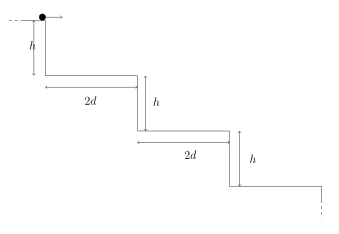
Solution: Considering the horizontal component, this will be constant as there are no forces acting in that direction. The first step will take the particle \(t = \sqrt{\frac{2h}g}\) to reach. At which point it will be travelling with speed \(v = \sqrt{2gh} \) (by energy considerations, \(mgh = \frac12 mv^2\)). To reach the second step must take twice as long (since the ball has to travel \(2d\) horizontally, rather than \(d\)). Since \(t = 2\sqrt{\frac{2h}g}\) we must have that: \begin{align*} && s &= ut + \frac12 gt^2 \\ \Rightarrow && h &= u 2\sqrt{\frac{2h}g} + \frac12 g \frac{8h}g \\ \Rightarrow && u &= -\frac{3}{2} h\sqrt{\frac{g}{2h}} \\ &&&= -\frac{3}{2\sqrt{2}} \sqrt{gh} \end{align*} Therefore, using Newton's experimental law, we must have that \(e = \frac{\frac{3}{2 \sqrt{2}} \sqrt{gh}}{\sqrt{2} \sqrt{gh}} = \frac{3}{4}\). Again by conservation of energy \(mgh + \frac12 \frac{9}{8} mgh = \frac12 mv^2 \Rightarrow v = \frac{5}{2\sqrt{2}} \sqrt{gh}\) when it lands on the next step. Therefore we would need the coefficient of restitution for the second (and subsequent steps) to be: \(\displaystyle \frac{\frac{3}{2\sqrt{2}} \sqrt{gh}}{\frac{5}{2\sqrt{2}} \sqrt{gh}} = \frac35\)