Problems
Filters
49 problems found
2014 Paper 3 Q4
- Let \[ I = \int_0^1 \bigl((y')^2 -y^2\bigr)\d x \qquad\text{and}\qquad I_1=\int_0^1 (y'+y\tan x)^2 \d x \,, \] where \(y\) is a given function of \(x\) satisfying \(y=0\) at \(x=1\). Show that \(I-I_1=0\) and deduce that \(I\ge0\). Show further that \(I=0\) only if \(y=0\) for all \(x\) (\(0\le x \le 1\)).
- Let \[ J = \int_0^1 \bigl((y')^2 -a^2y^2\bigr)\d x \,, \] where \(a\) is a given positive constant and \(y\) is a given function of \(x\), not identically zero, satisfying \(y=0\) at \(x=1\). By considering an integral of the form \[ \int_0^1 (y'+ay\tan bx)^2 \d x \,, \] where \(b\) is suitably chosen, show that \(J\ge0\). You should state the range of values of \(a\), in the form \(a < k\), for which your proof is valid. In the case \(a=k\), find a function \(y\) (not everywhere zero) such that \(J=0\).
Solution:
- \begin{align*} && I - I_1 &= \int_0^1 \left ( \left ( y' \right)^2 - y^2 \right) \d x - \int_0^1 \left ( y' + y \tan x \right)^2 \d x\\ &&&= \int_0^1 \left ( \left ( y' \right)^2 - y^2 \right) - \left ( y' + y \tan x \right)^2 \d x\\ &&&= \int_0^1 \left (-y^2-2yy' \tan x - y^2 \tan^2 x \right) \d x\\ &&&= \int_0^1 \left (-2yy' \tan x - y^2(1+ \tan^2 x )\right) \d x\\ &&&= \int_0^1 \left (-2yy' \tan x - y^2 \sec^2 x\right) \d x\\ &&&= \int_0^1 -\frac{\d}{\d x} \left (y^2 \tan x \right) \d x\\ &&&= \left [-y^2 \tan x \right]_0^1 \\ &&&= 0 \\ \\ \Rightarrow && I &= I_1 = \int_0^1 \left ( y' + y \tan x \right)^2 d x \geq 0 \end{align*} The only way \(I_0 = 0\) is is \(y' + y \tan x =0\), so \begin{align*} && \frac{\d y}{\d x} &= - y \tan x \\ \Rightarrow && \int \frac{1}{y} &= \int -\tan x \d x \\ \Rightarrow && \ln |y| &= \ln |\cos x| + C \\ \Rightarrow && y &= A \cos x \\ \Rightarrow && A &= 0 \Rightarrow y = 0 \end{align*}
- Let \(J_1 = \int_0^1 (y'+ay\tan ax)^2 \d x\), then \begin{align*} && J-J_1 &= \int_0^1 \left ( \left ( y' \right)^2 - a^2y^2 \right) - \left ( y' + ya \tan ax \right)^2 \d x\\ &&&= \int_0^1 \left (-a^2y^2-2yy' a \tan a x-y^2a^2 \tan^2 ax \right) \d x \\ &&&= \int_0^1 \left (-2yy' a \tan ax - a^2y^2(1+\tan^2 ax) \right) \d x \\ &&&= \int_0^1 \left (-2yy' a \tan ax - a^2y^2\sec^2 ax \right) \d x \\ &&&= \left [ - a y^2 \tan a x \right]_0^1 = 0 \end{align*} This is true if \(a < \frac{\pi}{2}\), since otherwise we might care about the order of the zero for \(y\) at \(x = 1\). Consider \(y = \cos \frac{\pi}{2} x\), then \(y' = -\frac{\pi}{2} \sin^2\frac{\pi}{2} x\) and \begin{align*} && \int_0^1 \frac{\pi^2}{4} \left (\sin^2 \frac{\pi}{2}x - \cos^2 \frac{\pi}{2} x \right) \d x &= -\frac{\pi^2}{4} \int_0^1 \cos(\pi x) \d x \\ &&&= 0 \end{align*}
2013 Paper 1 Q4
- Show that, for \(n> 0\), \[ \int_0^{\frac14\pi} \tan^n x \,\sec^2 x \, \d x = \frac 1 {n+1} \; \text{ and } \int_0^{\frac14\pi} \!\! \sec ^n\! x \, \tan x \, \d x = \frac{(\sqrt 2)^n - 1}n \,. \]
- Evaluate the following integrals: \[ \displaystyle \int_0^{\frac14\pi} \!\! x\, \sec ^4 \! x\, \tan x \, \d x \, \text{ and } \int_0^{\frac14\pi} \!\! x^2 \sec ^2 \! x\, \tan x \, \d x \,. \]
Solution:
- \begin{align*} u = \tan x, \d u = \sec^2 x \d x: &&\int_0^{\pi/4} \tan^n x \sec^2 x \d x &= \int_0^1 u^n \d u \\ &&&= \frac{1}{n+1} \end{align*} \begin{align*} u = \sec x, \d u = \sec x \tan x \d x: &&\int_0^{\pi/4} \sec^n x \tan x \d x &= \int_{u=1}^{u=\sqrt{2}} u^{n-1} \d u \\ &&&= \left [ \frac{u^n}{n}\right] \\ &&&= \frac{(\sqrt{2})^n - 1}n \end{align*}
- \begin{align*} &&\int_0^{\frac14\pi} x \sec ^4 x \tan x \d x &= \left [x \frac{1}{4} \sec^4 x \right]_0^{\frac14\pi} - \frac14 \int_0^{\frac14\pi} \sec^4 x \d x \\ &&&= \frac{\pi}{4} - \frac14 \int_0^{\frac14\pi} \sec^2 x(1+ \tan^2 x) \d x \\ &&&= \frac{\pi}{4} - \frac14 \left [ \tan x+ \frac13 \tan^3 x \right] _0^{\frac14\pi} \\ &&&= \frac{\pi}{4} - \frac{1}{3} \end{align*} \begin{align*} \int_0^{\frac14\pi} \!\! x^2 \sec ^2 \! x\, \tan x \, \d x &= \left [x^2 \frac12 \tan^2 x \right]_0^{\frac14\pi} - \int_0^{\frac14\pi} x \tan^2 x \d x\\ &= \frac{\pi^2}{32} - \int_0^{\frac14\pi} x (\sec^2 x - 1) \d x\\ &= \frac{\pi^2}{32} - \left [x (-x + \tan x) \right]_0^{\frac14\pi} + \int_0^{\frac14\pi}-x + \tan x \d x \\ &= \frac{\pi^2}{32} - \frac{\pi}{4} (-\frac{\pi}{4} + 1) -\frac{\pi^2}{32} + \left [ -\ln \cos x \right]_0^{\pi/4} \\ &= \frac{\pi^2}{16}- \frac{\pi}{4} + \frac12 \ln 2 \end{align*}
2013 Paper 3 Q13
- The continuous random variable \(X\) satisfies
\(0\le X\le 1\), and has probability density function
\(\f(x)\) and cumulative distribution
function \(\F(x)\). The
greatest value of \(\f(x)\) is \(M\), so that \(0\le \f(x) \le M\).
- Show that \(0\le \F(x) \le Mx\) for \(0\le x\le1\).
- For any function \(\g(x)\), show that \[ \int_0^1 2 \g(x) \F(x) \f(x) \d x = \g(1) - \int_0^1 \g'(x) \big( \F(x)\big)^2 \d x \,. \]
- The
continuous random variable \(Y\)
satisfies
\(0\le Y\le 1\), and has probability density function
\(k \F(y) \f(y)\), where \(\f\) and \(\F\) are as above.
- Determine the value of the constant \(k\).
- Show that \[ 1+ \frac{nM}{n+1}\mu_{n+1} - \frac{nM}{n+1} \le \E(Y^n) \le 2M\mu_{n+1}\,, \] where \(\mu_{n+1} = \E(X^{n+1})\) and \(n\ge0\).
- Hence show that, for \(n\ge 1\), \[ \mu _n \ge \frac{n}{(n+1)M} -\frac{n-1}{n+1} \,.\]
Solution:
- \(\,\) \begin{align*} && 0 &\leq f(t) &\leq M \\ \Rightarrow && \int_0^x 0 \d t &\leq \int_0^x f(t) \d t & \leq \int_0^x M \d x \\ \Rightarrow && 0 &\leq F(x) &\leq Mx \end{align*}
- \(\,\) \begin{align*} && \int_0^1 2g(x)F(x)f(x) \d x &= \left [ g(x) F(x)^2 \right] - \int_0^1 g'(x) \left ( F(x)\right)^2 \d x \\ &&&= g(1) - \int_0^1 g'(x) \left ( F(x)\right)^2 \d x \end{align*}
- \(\,\) \begin{align*} && 1 &= \int_0^1 kF(y)f(y) \d y \\ &&&= k\left [ \frac12 F(y)^2\right]_0^1 \\ &&&= \frac{k}{2} \\ \Rightarrow && k &= 2 \end{align*}
- \(\,\) \begin{align*} \E[Y^n] &= \int_0^1 y^n 2F(y)f(y) \d y \\ &\geq \int_0^1 y^n 2My f(y) \d y \\ &= 2M\int_0^1 y^{n+1} f(y) \d y \\ &= 2M \E[X^{n+1}] = 2M\mu_{n+1} \\ \\ \E[Y^n] &= \int_0^1 y^n 2F(y)f(y) \d y \\ &= 1 - \int_0^1 ny^{n-1} F(y)^2 \d y \\ &\geq 1 - \int_0^1 ny^{n-1}My F(y) \d y \\ &= 1 - M\int_0^1 ny^n F(y) \d y \\ &= 1 - M[\frac{n}{n+1}y^{n+1} F(y)]_0^1 + M\int_0^1\frac{n}{n+1} y^{n+1} f(y) \d y \\ &= 1 - \frac{nM}{n+1} + \frac{nM}{n+1} \mu_{n+1} \end{align*}
- Since \(\E[Y^{n-1}] \geq 0\) we must have \begin{align*} && 2M\mu_n \geq 1 + \frac{(n-1)M}{n}\mu_n - \frac{(n-1)M}{n} \\ \Rightarrow && \mu_n \left (2M + \frac{(n-1)M}{n} \right) \geq 1 - \frac{(n-1)M}{n} \\ \Rightarrow && \mu_n \frac{3Mn-M}{n} & \geq \frac{n-(n-1)M}{n} \\ \Rightarrow && \mu_n & \geq \frac{n-(n-1)M}{3Mn-M} \end{align*}
2012 Paper 1 Q5
Show that \[ \int_0^{\frac14\pi} \sin (2x) \ln(\cos x)\, \d x = \frac14(\ln 2 -1)\,, \] and that \[ \int_0^{\frac14\pi} \cos (2x) \ln(\cos x)\, \d x = \frac18(\pi -\ln 4-2)\,. \] Hence evaluate \[ \int_{\frac14\pi}^{\frac12\pi} \big ( \cos(2x) + \sin (2x)\big) \, \ln \big( \cos x + \sin x\big)\, \d x\,. \]
Solution: \begin{align*} &&\int_0^{\frac14\pi} \sin (2x) \ln(\cos x)\, \d x &= \int_0^{\frac14 \pi} 2 \sin x \cos x \ln (\cos x) \d x \\ u = \cos \theta :&&&= \int_{u=1}^{u=\frac1{\sqrt2}} -2u \ln u \d u \\ &&&= \int_{\frac1{\sqrt{2}}}^1 2u \ln u \d u \\ &&&= \left [u^2 \ln u \right]_{\frac1{\sqrt{2}}}^1-\int_{\frac1{\sqrt{2}}}^1 u \d u \\ &&&= -\frac12 \ln \frac{1}{\sqrt{2}} - \l\frac12 - \frac14 \r \\ &&&= \frac14 (\ln 2 - 1) \end{align*} \begin{align*} && \int_0^{\frac14\pi} \cos (2x) \ln(\cos x)\, \d x &= \left [ \frac12 \sin 2x \ln (\cos x) \right]_0^{\frac14\pi}- \int_0^{\frac14\pi} \frac12 \sin 2x \frac{-\sin x}{\cos x} \d x \\ &&&=\frac12 \ln \frac{1}{\sqrt{2}}+\int_0^{\frac14\pi} \sin^2 x \d x \\ &&&= -\frac14 \ln 2 + \int_0^{\frac14\pi} \frac{1-\cos 2x }{2} \d x \\ &&&= -\frac14 \ln 2 +\frac{\pi}{8} -\frac{1}{4} \\ &&&= \frac18 (\pi - 2\ln 2 - 2) \\ &&&= \frac18 (\pi - \ln 4 - 2) \\ \end{align*} Notice that \(\cos x + \sin x = \sqrt{2} \cos (x -\frac{\pi}{4})\), so: \begin{align*} &&\int_{\frac14\pi}^{\frac12\pi} \big ( \cos(2x) + \sin (2x)\big) \ln \big( \cos x + \sin x\big)\d x &= \int_{\frac14\pi}^{\frac12\pi} \big ( \cos(2x) + \sin (2x)\big) \ln (\sqrt{2} \cos ( x - \frac{\pi}{4}) ) \d x \\ &&&= \int_{u=0}^{u=\frac{\pi}{4}} \l \cos(2u+\frac{\pi}{2})+\sin(2u+\frac{\pi}{2}) \r \cdot \l \frac12 \ln 2 +\ln (\cos u) \r \d x \\ &&&= \int_{0}^{\frac{\pi}{4}} \l -\sin 2u+\cos 2u \r \cdot \l \frac12 \ln 2 +\ln (\cos u) \r \d x \\ &&&= \frac14 \ln 2\left [ \cos 2u + \sin 2u \ \right]_{0}^{\frac{\pi}{4}} - \frac14(\ln2 - 1) + \frac18\pi - \frac14(\ln 2 +1) \\ &&&= \frac{\pi}{8}-\frac12 \ln 2 \end{align*}
2011 Paper 1 Q2
The number \(E\) is defined by $\displaystyle E= \int_0^1 \frac{\e^x}{1+x} \, \d x\,.$ Show that \[ \int_0^1 \frac{x \e^x}{1+x} \, \d x = \e -1 -E\, ,\] and evaluate \(\ds \int_0^1 \frac{x^2\e^x}{1+x} \, \d x\) in terms of \(\e\) and \(E\). Evaluate also, in terms of \(E\) and \(\rm e\) as appropriate:
- \[ \int_0^1 \frac{\e^{\frac{1-x}{1+x}}}{1+x}\, \d x\,\]
- \[ \int_1^{\sqrt2} \frac {\e^{x^2}}x \, \d x \, \]
Solution: \begin{align*} \int_0^1 \frac{x \e^x}{1+x} \, \d x &= \int_0^1 \frac{(x+1-1) \e^x}{1+x} \, \d x \\ &= \int_0^1 \left ( e^x -\frac{\e^x}{1+x} \right )\, \d x \\ &= \e-1-E \end{align*} \begin{align*} \int_0^1 \frac{x^2 \e^x}{1+x} \, \d x &= \int_0^1 \frac{(x^2+x-x) \e^x}{1+x} \, \d x \\ &= \int_0^1 \left ( xe^x -\frac{x\e^x}{1+x} \right )\, \d x \\ &= \left [xe^{x} \right]_0^1 - \int_0^1 e^x \, \d x -(\e-1-E) \\ &= \e-(\e-1)-(\e -1 -E) \\ &= 2-\e + E \end{align*}
- Since \(\displaystyle u = \frac{1-x}{1+x},\frac{\d u}{\d x} = \frac{-(1+x)-(1-x)}{(1+x)^2}\), \begin{align*} && \int_0^1 \frac{\e^{\frac{1-x}{1+x}}}{1+x}\, \d x &= \int_{u=1}^{u=0} \frac{e^u}{1+x} \cdot \frac{(1+x)^2}{-2} \d u \\ &&&= \int_0^1 \frac{(1+x) e^u}{2} \d u \\ &&&= \int_0^1 \frac{\left ( 1 + \frac{1-u}{1+u} \right) e^u}{2}\, \d u \\ &&&= \frac12 \int_0^1 \left (e^u + \frac{e^{u}}{1+u} - \frac{ue^u}{1+u} \right) \, \d u \\ &&&= \frac12 \left( \e-1 + E - (\e - 1 - E) \right) \\ &&&= E \end{align*}
- Since \(\displaystyle u = x^2-1, \d u = 2x \d x\)\begin{align*} \int_1^{\sqrt2} \frac {\e^{x^2}}x \, \d x &= \int_{u=0}^{u=1} \frac{e^{u+1}}{x} \frac{1}{2x} \d u \\ &= \int_0^1 \frac{e^{u+1}}{2(u+1)} \d u \\ &= \frac{\e}{2} E \\ &= \frac{E\e}{2} \end{align*}
2011 Paper 2 Q6
For any given function \(\f\), let \[ I = \int [\f'(x)]^2 \,[\f(x)]^n \d x\,, \tag{\(*\)} \] where \(n\) is a positive integer. Show that, if \(\f(x)\) satisfies \(\f''(x) =k \f(x)\f'(x)\) for some constant \(k\), then (\(*\)) can be integrated to obtain an expression for \(I\) in terms of \(\f(x)\), \(\f'(x)\), \(k\) and \(n\).
- Verify your result in the case \(\f(x) = \tan x\,\). Hence find \[ \displaystyle \int \frac{\sin^4x}{\cos^{8}x} \, \d x\;. \]
- Find \[ \displaystyle \int \sec^2x\, (\sec x + \tan x)^6\,\d x\;. \]
Solution: If \(f''(x) = kf(x)f'(x)\) then we can see \begin{align*} && I &= \int [\f'(x)]^2 \,[\f(x)]^n \d x \\ &&&= \int f'(x) \cdot f'(x) [f(x)]^n \d x \\ &&&= \left[ f'(x) \cdot \frac{[f(x)]^{n+1}}{n+1} \right] - \int f''(x) \frac{[f(x)]^{n+1}}{n+1} \d x \\ &&&= \frac{1}{n+1} \left (f'(x) [f(x)]^{n+1} - \int kf'(x) [f(x)]^{n+2} \d x \right) \\ &&&= \frac{1}{n+1} \left (f'(x) [f(x)]^{n+1} - k \frac{[f(x)]^{n+3}}{n+3} \right) +C\\ &&&= \frac{[f(x)]^{n+1}}{n+1} \left ( f'(x) - \frac{k[f(x)]^2}{n+3} \right) + C \end{align*}
- If \(f(x) = \tan x, f'(x) = \sec^2 x, f''(x) = 2 \sec^2 x \tan x = 2 \cdot f(x) \cdot f'(x)\), so \(\tan\) satisfies the conditions for the theorem. \begin{align*} && I &= \int \sec^4 x \tan^n x \d x \\ &&&= \left [\sec^2x \cdot \frac{\tan^{n+1} x}{n+1} \right] - \int 2 \sec^2 x \tan x \cdot \frac{\tan^{n+1} x}{n+1} \d x \\ &&&= \left [\sec^2x \cdot \frac{\tan^{n+1} x}{n+1} \right] - 2 \cdot \frac{\tan^{n+3} x}{(n+1)(n+3)} \\ \end{align*} So \begin{align*} && I &= \int \frac{\sin^4 x}{\cos^8 x} \d x \\ &&&= \int \tan^4 x \sec^4 x \d x \\ &&&= \int [\sec^2 x]^2 [\tan x]^4 \d x \\ &&&= \frac{\tan^{5}x}{5} \left ( \sec^2 x - \frac{2 \tan^2 x}{7} \right) + C \end{align*}
- \begin{align*} && I &= \int \sec^2x\, (\sec x + \tan x)^6\,\d x \\ &&&= \int (\sec x (\sec x + \tan x))^2 \cdot (\sec x + \tan x )^4 \d x \\ &&&= \frac{(\sec x + \tan x)^5}{5} \left ( \sec x (\sec x + \tan x) - \frac{(\sec x + \tan x)^2}{7} \right) + C \end{align*}
2011 Paper 2 Q8
The end \(A\) of an inextensible string \(AB\) of length \(\pi\) is attached to a point on the circumference of a fixed circle of unit radius and centre \(O\). Initially the string is straight and tangent to the circle. The string is then wrapped round the circle until the end \(B\) comes into contact with the circle. The string remains taut during the motion, so that a section of the string is in contact with the circumference and the remaining section is straight. Taking \(O\) to be the origin of cartesian coordinates with \(A\) at \((-1,0)\) and \(B\) initially at \((-1, \pi)\), show that the curve described by \(B\) is given parametrically by \[ x= \cos t + t\sin t\,, \ \ \ \ \ \ y= \sin t - t\cos t\,, \] where \(t\) is the angle shown in the diagram.
2010 Paper 2 Q8
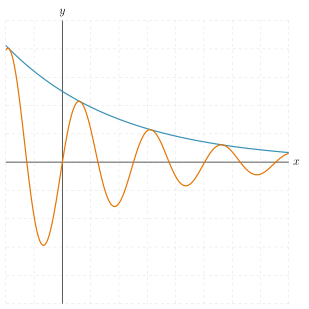
The curves \(C_1\) and \(C_2\) are defined by \[ y= \e^{-x} \quad (x>0) \quad \text{ and } \quad y= \e^{-x}\sin x \quad (x>0), \] respectively. Sketch roughly \(C_1\) and \(C_2\) on the same diagram. Let \(x_n\) denote the \(x\)-coordinate of the \(n\)th point of contact between the two curves, where \(0 < x_1 < x_2 < \cdots\), and let \(A_n\) denote the area of the region enclosed by the two curves between \(x_n\) and \(x_{n+1}\). Show that \[ A_n = \tfrac12(\e^{2\pi}-1) \e^{-(4n+1)\pi/2} \] and hence find \(\displaystyle \sum_{n=1}^\infty A_n\).
Solution:
2009 Paper 1 Q7
Show that, for any integer \(m\), \[ \int_0^{2\pi} \e^x \cos mx \, \d x = \frac {1}{m^2+1}\big(\e^{2\pi}-1\big)\,. \]
- Expand \(\cos(A+B) +\cos(A-B)\). Hence show that \[\displaystyle \int_0^{2\pi} \e^x \cos x \cos 6x \, \d x\, = \tfrac{19}{650}\big( \e^{2\pi}-1\big)\,. \]
- Evaluate $\displaystyle \int_0^{2\pi} \e^x \sin 2x \sin 4x \cos x \, \d x\,$.
Solution: \begin{align*} && I &= \int_0^{2 \pi} e^{x} \cos m x \d x \\ &&&= \left [e^x \cos m x \right]_0^{2 \pi}-\int_0^{2 \pi} e^x m (-\sin mx) \d x\\ &&&= e^{2\pi}-1 + m\int_0^{2\pi}e^x \sin m x \d x \\ &&&= e^{2\pi}-1 + m\left [e^x \sin m x \right]_0^{2\pi} - m \int_0^{2\pi} e^x m \cos x \d x \\ &&&= e^{2\pi}-1+0 - m^2 I\\ \Rightarrow && (m^2+1)I &= e^{2\pi}-1 \\ \Rightarrow && I &= \frac{1}{m^2+1} (e^{2\pi}-1) \end{align*}
- \(\,\) \begin{align*} && \cos(A+B) + \cos(A-B) &= \cos A\cos B - \sin A \sin B + \cos A \cos B + \sin A \sin B \\ &&&= 2 \cos A \cos B \end{align*} Therefore \begin{align*} && I &= \int_0^{2\pi} e^x \cos x \cos 6x \d x \\ &&&= \int_0^{2\pi} e^x \frac12\left (\cos 7x + \cos 5x \right) \d x\\ &&&= \left ( \frac{1}{2(1+7^2)} + \frac1{2(1+5^2)}\right)(e^{2\pi}-1) \\ &&&= \left (\frac{1}{100}+\frac{1}{52} \right) (e^{2\pi}-1) \\ &&&= \frac{19}{650}(e^{2\pi}-1) \end{align*}
- \(\,\) \begin{align*} && I &= \int_0^{2\pi} e^x \sin 2x \sin 4x \cos x \d x\\ &&&= \int_0^{2\pi} e^x \tfrac12(\cos2x-\cos 6x) \cos x \d x\\ &&&= \frac12 \int_0^{2\pi} e^x \left (\cos 2x \cos x -\cos 6x \cos x \right) \d x \\ &&&= \frac14 \int_0^{2\pi} e^x \left (\cos 3x + \cos x-\cos 7x-\cos 5x \right) \d x \\ &&&= \frac14 \left (\frac{1}{1+3^2}+\frac{1}{1+1^2}-\frac{1}{1+7^2} - \frac{1}{1+5^2} \right)(e^{2\pi}-1) \\ &&&= \frac14 \left (\frac{1}{10}+\frac{1}{2}-\frac{1}{50} - \frac{1}{26} \right)(e^{2\pi}-1) \\ &&&= \frac{44}{325}(e^{2\pi}-1) \end{align*}
2009 Paper 3 Q4
For any given (suitable) function \(\f\), the Laplace transform of \(\f\) is the function \(\F\) defined by \[ \F(s) = \int_0^\infty \e^{-st}\f(t)\d t \quad \quad \, (s>0) \,. \]
- Show that the Laplace transform of \(\e^{-bt}\f(t)\), where \(b>0\), is \(\F(s+b)\).
- Show that the Laplace transform of \(\f(at)\), where \(a>0\), is \(a^{-1}\F(\frac s a)\,\).
- Show that the Laplace transform of \(\f'(t)\) is \(s\F(s) -\f(0)\,\).
- In the case \(\f(t)=\sin t\), show that \(\F(s)= \dfrac 1 {s^2+1}\,\).
Solution:
- \begin{align*} \mathcal{L}\{e^{-bt}f(t)\}(s) &= \int_0^{\infty}e^{-st}\{ e^{-bt}f(t) \} \d t \\ &= \int_0^{\infty} e^{-(s+b)t}f(t) \d t \\ &= F(s+b) \end{align*}
- \begin{align*} \mathcal{L}\{f(at)\}(s) &= \int_0^{\infty} e^{-st}f(at) \d t \\ &= \int_{u=0}^{\infty}e^{-s \frac{u}{a}} f\left(a \tfrac{u}{a}\right)\frac{1}{a} \d u \\ &= \int_0^{\infty}e^{-su/a}f(u) a^{-1} \d u \\ &= a^{-1} \int_0^{\infty} e^{-(s/a)u}f(u) \d u \\ &= a^{-1} F\left (\frac{s}{a} \right) \end{align*}
- \begin{align*} \mathcal{L}\{f'(t)\}(s) &= \int_0^{\infty} e^{-st}f'(t) \d t \\ &= \left [e^{-st} f(t) \right]_0^{\infty} - \int_0^{\infty} -s e^{-st} f(t) \d t\\ &= -f(0)+sF(s) \\ &= sF(s) - f(0) \end{align*}
- Since \(f''(t) = -f(t)\) we must have: \begin{align*} && -\mathcal{L}(f)&= \mathcal{L}(f'') \\ &&&= s\mathcal{L}(f') -f'(0) \\ &&&= s(s\mathcal{L}(f)-f(0)) - f'(0) \\ &&&= s^2\mathcal{L}(f) - 1 \\ \Rightarrow && (1+s^2) \mathcal{L}(f) &= 1 \\ \Rightarrow && F(s) &= \frac{1}{1+s^2} \end{align*}
2009 Paper 3 Q8
Let \(m\) be a positive integer and let \(n\) be a non-negative integer.
- Use the result \(\displaystyle \lim_{t\to\infty}\e^{-mt} t^n=0\) to show that \[ \lim_{x\to0} x^m (\ln x)^n =0\,. \] By writing \(x^x\) as \(\e^{x\ln x}\) show that \[ \lim _{x\to0} x^x=1\,. \]
- Let \(\displaystyle I_{n} = \int_0^1 x^m (\ln x)^n \d x\,\). Show that \[ I_{n+1} = - \frac {n+1}{m+1} I_{n} \] and hence evaluate \(I_{n}\).
- Show that \[ \int_0^1 x^x \d x = 1 -\left(\tfrac12\right)^2 +\left(\tfrac13\right)^3 -\left(\tfrac14\right)^4 + \cdots \,. \]
Solution:
- \(\,\) \begin{align*} && \lim_{x \to 0} x^m(\ln x)^n &= \lim_{t \to \infty} (e^{-t})^m (\ln e^{-t})^n \\ &&&= \lim_{t \to \infty} e^{-mt} (-t)^n \\ &&&= (-1)^n \lim_{t \to \infty} e^{-mt} t^n = 0 \\ \\ && \lim_{x \to 0} x^x &= \lim_{x \to 0} e^{x \ln x} \\ &&&= \exp \left (\lim_{x \to 0} x \ln x \right) \\ &&&= \exp \left (0 \right) = 1 \end{align*}
- \(\,\) \begin{align*} && I_{n} &= \int_0^1 x^m (\ln x)^n \d x \\ && I_{n+1} &= \int_0^1 x^m (\ln x)^{n+1} \d x \\ &&&= \left [\frac{x^{m+1}}{m+1} (\ln x)^{n+1} \right]_0^1 - \frac{1}{m+1} \int_0^1 x^{m+1} (n+1) (\ln x)^n \cdot x^{-1} \d x \\ &&&= 0 - \frac{1}{m+1} \lim_{x \to 0} \left (x^{m+1} (\ln x)^{n+1} \right) - \frac{n+1}{m+1} \int_0^1 x^m (\ln x)^n \d x \\ &&&= - \frac{n+1}{m+1} I_n \\ \\ && I_0 &= \int_0^1 x^m \d x = \frac{1}{m+1} \\ && I_1 &= -\frac{1}{(m+1)^2} \\ && I_2 &= \frac{2}{(m+1)^3} \\ && I_n &= (-1)^n \frac{n!}{(m+1)^{n+1}} \end{align*}
- \(\,\) \begin{align*} && \int_0^1 x^x \d x &= \int_0^1 e^{x \ln x} \d x \\ &&&= \int_0^1 \sum_{k=0}^{\infty} \frac{x^k(\ln x)^k}{k!} \d x \\ &&&= \sum_{k=0}^{\infty} \int_0^1 \frac{x^k(\ln x)^k}{k!} \d x\\ &&&= \sum_{k=0}^{\infty} (-1)^k \frac{k!}{k!(k+1)^{k+1}}\\ &&&= \sum_{k=0}^{\infty} \frac{(-1)^k}{(k+1)^{k+1}}\\ &&&= 1 - \frac{1}{2^2} + \frac{1}{3^3} - \frac{1}{4^4} + \cdots \end{align*}
2005 Paper 1 Q5
- Evaluate the integral \[ \int_0^1 \l x + 1 \r ^{k-1} \; \mathrm{d}x \] in the cases \(k\ne0\) and \(k = 0\,\). Deduce that \(\displaystyle \frac{2^k - 1}{k} \approx \ln 2\) when \(k \approx 0\,\).
- Evaluate the integral \[ \int_0^1 x \l x + 1 \r ^m \; \mathrm{d}x \; \] in the different cases that arise according to the value of \(m\).
Solution:
- Case \(k \neq 0\): \begin{align*} && \int_0^1 (x+1)^{k-1} \d x &= \left [\frac{1}{k}(x+1)^k \right]_0^1 \\ &&&= \frac{2^k-1}{k} \\ \end{align*} Case \(k = 0\): \begin{align*} && \int_0^1 (x+1)^{k-1} \d x &= \int_0^1 (x+1)^{-1} \d x \\ &&&= \left [\ln(x+1) \right]_0^1 \\ &&&= \ln 2 \end{align*} Therefore for \(k \approx 0\), we must have both integrals being close to each other, since the function is nice on this interval, ie \(\frac{2^k-1}{k} \approx \ln 2\)
- Case \(m = 0\). \(I = \frac12\) Case \(m \neq 0, -1, -2\) \begin{align*} u = x+1, \d u = \d x && \int_0^1 x(x+1)^m \d x &= \int_{u=1}^{u=2} (u-1)u^m \d u \\ &&&=\left[ \frac{u^{m+2}}{m+2} - \frac{u^{m+1}}{m+1} \right]_1^2 \\ &&&= 2^{m+1}\left ( \frac{2}{m+2} - \frac1{m+1} \right) - \frac{1}{m+2} + \frac{1}{m+1} \\ &&&= 2^{m+1} \frac{m}{(m+1)(m+2)} + \frac{1}{(m+1)(m+2)} \\ &&&= \frac{m2^{m+1}+1}{(m+1)(m+2)} \\ \end{align*} Case \(m = -1\). \begin{align*} && \int_0^1 \frac{x}{x+1} \d x &= \int_0^1 1 - \frac{1}{x+1} \d x \\ &&&= 1 - \ln2 \\ \end{align*} Case \(m = -2\): \begin{align*} && \int_0^1 \frac{x}{(x+1)^2} \d x &= \int_0^1\frac{x+1-1}{(x+1)^2} \d x \\ &&&= \left [ \ln (x+1) +(1+x)^{-1} \right]_0^1 \\ &&&= \ln 2 + \frac12 - 1 \\ &&&= \ln 2 - \frac12 \end{align*}
2005 Paper 2 Q3
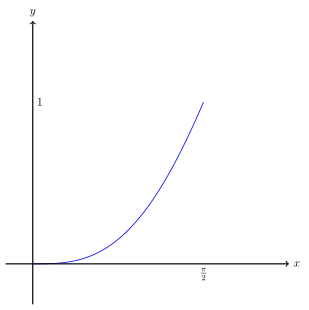
Give a sketch, for \(0 \le x \le \frac{1}{2}\pi\), of the curve $$ y = (\sin x - x\cos x)\;, $$ and show that \(0\le y \le 1\,\). Show that:
- \(\displaystyle \int_0^{\frac{1}{2}\pi}\,y\;\d x = 2 -\frac \pi 2 \)
- \(\displaystyle \int_0^{\frac{1}{2}\pi}\,y^2\,\d x = \frac{\pi^3}{48}-\frac \pi 8 \)
Solution:
- \(\,\) \begin{align*} \int_0^{\frac{1}{2}\pi}\,y\;\d x &= \int_0^{\frac{1}{2}\pi} (\sin x - x \cos x) \d x \\ &= \left [-\cos x \right]_0^{\frac{1}{2}\pi} +\left [ -x \sin x \right]_0^{\frac{1}{2}\pi} + \int_0^{\frac{1}{2}\pi} \sin x \d x \\ &= 1-\frac{\pi}{2} + 1 = 2 - \frac{\pi}{2} \end{align*}
- \(\,\) \begin{align*} \int_0^{\frac{1}{2}\pi}y^2\d x &= \int_0^{\frac{1}{2}\pi} (\sin x - x \cos x)^2 \d x \\ &= \int_0^{\frac{1}{2}\pi} (\sin^2x - 2x\sin x \cos x+x^2\cos^2 x) \d x\\ &= \int_0^{\frac{1}{2}\pi} (\sin^2x -x \sin 2x+\tfrac12x^2(\cos 2 x + 1)) \d x\\ &= \frac{\pi}{4} + \frac{\pi^3}{48} + \int_0^{\frac{1}{2}\pi} (-x \sin 2x+\tfrac12x^2\cos 2 x) \d x \\ &= \frac{\pi}{4} + \frac{\pi^3}{48} + \left [\frac12 x \cos 2x +\frac14 x^2 \sin2x\right]_0^{\frac{1}{2}\pi}-\int_0^{\frac{1}{2}\pi}(\tfrac12 \cos 2x +\tfrac12 x \sin 2x) \d x\\ &= \frac{\pi}{4} + \frac{\pi^3}{48} - \frac{\pi}{4} - \left [ \frac14 \sin 2x \right]_0^{\frac{1}{2}\pi} - \int_0^{\frac{1}{2}\pi} \tfrac12 x \sin 2x \d x\\ &= \frac{\pi^3}{48} - \left( \left[ -\frac14 x \cos 2x \right]_0^{\frac{1}{2}\pi} - \int_0^{\frac{1}{2}\pi} -\frac14 \cos 2x \d x \right)\\ &= \frac{\pi^3}{48} - \left( \frac{\pi}{8} + \left[ \frac18 \sin 2x \right]_0^{\frac{1}{2}\pi} \right)\\ &= \frac{\pi^3}{48} - \frac{\pi}{8} \end{align*}
2004 Paper 2 Q5
Evaluate \(\int_0^{{\pi}} x \sin x\,\d x\) and \(\int_0^{{\pi}} x \cos x\,\d x\;\). The function \(\f\) satisfies the equation \begin{equation} \f(t)=t + \int_0^{{\pi}} \f(x)\sin(x+t)\,\d x\;. \tag{\(*\)} \end{equation} Show that \[ \f(t)=t + A\sin t + B\cos t\;, \] where \(A= \int_0^{{\pi}}\,\f(x)\cos x\,\d x\;\) and \(B= \int_0^{{\pi}}\,\f(x)\sin x\,\d x\;\). Find \(A\) and \(B\) by substituting for \(\f(t)\) and \(\f(x)\) in \((*)\) and equating coefficients of \(\sin t\) and \(\cos t\,\).
Solution: \begin{align*} && I &= \int_0^\pi x \sin x \d x \\ &&&= \left [ -x \cos x \right]_0^\pi + \int_0^{\pi} \cos x \d x \\ &&&= \pi \\ \\ && J &= \int_0^\pi x \cos x \d x \\ &&&= \left [ x \sin x \right]_0^\pi - \int_0^\pi \sin x \d x \\ &&&= -2 \end{align*} \begin{align*} && f(t) &= t + \int_0^\pi f(x) \sin (x+t) \d x \\ &&&= t + \int_0^\pi f(x) \left ( \sin t \cos x + \cos t \sin x \right) \d x \\ &&&= t + \sin t \int_0^{\pi} f(x) \cos x \d x + \cos t \int_0^{\pi} f(x) \sin x \d x \\ \\ && A &= \int_0^\pi (x + A \sin x + B \cos x) \cos x \d x \\ &&&= -2+ \frac{\pi}{2} B \\ && B &= \int_0^{\pi} (x + A \sin x + B \cos x ) \sin x \d x \\ &&&= \pi + \frac{\pi}{2} A \\ \Rightarrow && (A,B) &= (-2,0) \end{align*}
2003 Paper 2 Q7
Show that, if \(n>0\,\), then $$ \int_{e^{1/n}}^\infty\,{{\ln x} \over {x^{n+1}}}\,\d x = {2 \over {n^2\e}}\;. $$ You may assume that \(\ds \frac{\ln x} x \to 0\;\) as \(x\to\infty\,\). Explain why, if \(1 < a < b\,\), then $$ \int_b^\infty\,{{\ln x} \over {x^{n+1}}}\,\d x < \int_a^\infty\,{{\ln x} \over {x^{n+1}}}\,\d x\;. $$ Deduce that $$ \sum_{n=1}^{N}{1 \over n^2} < {\e \over 2}\int_{\e^{1/N}}^{\infty} \left({1-x^{-N}} \over {x^2-x}\right) \ln x\,\d x\;, $$ where \(N\,\) is any integer greater than \(1\).