Problems
Filters
233 problems found
2020 Paper 3 Q5
Show that for positive integer \(n\), \(x^n - y^n = (x-y)\displaystyle\sum_{r=1}^{n} x^{n-r} y^{r-1}\).
- Let \(\mathrm{F}\) be defined by
\[ \mathrm{F}(x) = \frac{1}{x^n(x-k)} \quad \text{for } x \neq 0,\, k \]
where \(n\) is a positive integer and \(k \neq 0\).
- Given that \[ \mathrm{F}(x) = \frac{A}{x-k} + \frac{\mathrm{f}(x)}{x^n}, \] where \(A\) is a constant and \(\mathrm{f}(x)\) is a polynomial, show that \[ \mathrm{f}(x) = \frac{1}{x-k}\left(1 - \left(\frac{x}{k}\right)^n\right). \] Deduce that \[ \mathrm{F}(x) = \frac{1}{k^n(x-k)} - \frac{1}{k}\sum_{r=1}^{n} \frac{1}{k^{n-r}x^r}. \]
- By differentiating \(x^n \mathrm{F}(x)\), prove that \[ \frac{1}{x^n(x-k)^2} = \frac{1}{k^n(x-k)^2} - \frac{n}{xk^n(x-k)} + \sum_{r=1}^{n} \frac{n-r}{k^{n+1-r}x^{r+1}}. \]
- Hence evaluate the limit of \[ \int_2^N \frac{1}{x^3(x-1)^2} \; \mathrm{d}x \] as \(N \to \infty\), justifying your answer.
2020 Paper 3 Q6
- Sketch the curve \(y = \cos x + \sqrt{\cos 2x}\) for \(-\frac{1}{4}\pi \leqslant x \leqslant \frac{1}{4}\pi\).
- The equation of curve \(C_1\) in polar co-ordinates is \[ r = \cos\theta + \sqrt{\cos 2\theta} \qquad -\tfrac{1}{4}\pi \leqslant \theta \leqslant \tfrac{1}{4}\pi. \] Sketch the curve \(C_1\).
- The equation of curve \(C_2\) in polar co-ordinates is \[ r^2 - 2r\cos\theta + \sin^2\theta = 0 \qquad -\tfrac{1}{4}\pi \leqslant \theta \leqslant \tfrac{1}{4}\pi. \] Find the value of \(r\) when \(\theta = \pm\frac{1}{4}\pi\). Show that, when \(r\) is small, \(r \approx \frac{1}{2}\theta^2\). Sketch the curve \(C_2\), indicating clearly the behaviour of the curve near \(r=0\) and near \(\theta = \pm\frac{1}{4}\pi\). Show that the area enclosed by curve \(C_2\) and above the line \(\theta = 0\) is \(\dfrac{\pi}{2\sqrt{2}}\).
2020 Paper 3 Q11
The continuous random variable \(X\) is uniformly distributed on \([a,b]\) where \(0 < a < b\).
- Let \(\mathrm{f}\) be a function defined for all \(x \in [a,b]\)
- with \(\mathrm{f}(a) = b\) and \(\mathrm{f}(b) = a\),
- which is strictly decreasing on \([a,b]\),
- for which \(\mathrm{f}(x) = \mathrm{f}^{-1}(x)\) for all \(x \in [a,b]\).
- The random variable \(Z\) is defined by \(\dfrac{1}{Z} + \dfrac{1}{X} = \dfrac{1}{c}\) where \(\dfrac{1}{c} = \dfrac{1}{a} + \dfrac{1}{b}\). By finding the variance of \(Z\), show that \[ \ln\left(\frac{b-c}{a-c}\right) < \frac{b-a}{c}. \]
2019 Paper 1 Q3
By first multiplying the numerator and the denominator of the integrand by \((1 - \sin x)\), evaluate $$\int_0^{\frac{1}{4}\pi} \frac{1}{1 + \sin x} dx.$$ Evaluate also: $$\int_{\frac{1}{4}\pi}^{\frac{1}{3}\pi} \frac{1}{1 + \sec x} dx \quad \text{and} \quad \int_0^{\frac{1}{3}\pi} \frac{1}{(1 + \sin x)^2} dx.$$
Solution: \begin{align*} \int_0^{\frac{1}{4}\pi} \frac{1}{1 + \sin x} dx &= \int_0^{\frac{1}{4}\pi} \frac{1-\sin x}{1 - \sin^2 x} dx \\ &= \int_0^{\frac{1}{4}\pi} \frac{1-\sin x}{\cos^2 x} dx \\ &= \int_0^{\frac{1}{4}\pi} \sec^2 x - \sec x \tan x dx \\ &= \left [\tan x-\sec x \right]_0^{\frac{1}{4}\pi} \\ &= 2 - \frac{1}{\sqrt{2}} \end{align*} \begin{align*} \int_{\frac{1}{4}\pi}^{\frac{1}{3}\pi} \frac{1}{1 + \sec x} \d x &= \int_{\frac{1}{4}\pi}^{\frac{1}{3}\pi} \frac{1-\sec x}{1 - \sec^2 x} \d x \\ &= \int_{\frac{1}{4}\pi}^{\frac{1}{3}\pi} \frac{\sec x-1}{\tan^2 x} \d x \\ &= \int_{\frac{1}{4}\pi}^{\frac{1}{3}\pi} \cot x \cosec x-\cot^2 x\d x \\ &= \left [ -\cosec x +x+\cot x\right]_{\frac{1}{4}\pi}^{\frac{1}{3}\pi} \\ &= \l -\frac{2}{\sqrt3}+\frac{\pi}{3}+\frac{1}{\sqrt{3}}\r - \l-\sqrt{2}+\frac{\pi}{4}+1 \r \\ &= \frac{\pi}{12}-\frac{1}{\sqrt{3}}+\sqrt{2}-1 \end{align*} \begin{align*} \int_0^{\frac{1}{3}\pi} \frac{1}{(1 + \sin x)^2} \d x &= \int_0^{\frac{1}{3}\pi} \frac{1-2\sin x+\sin^2x}{(1-\sin^2 x)^2} \d x \\ &= \int_0^{\frac{1}{3}\pi} \frac{1-2\sin x+\sin^2x}{\cos^4 x} \d x \\ \end{align*} Splitting this up into: \begin{align*} \int_0^{\frac{1}{3}\pi} \frac{-2\sin x}{\cos^4 x} \d x &= -\frac23 \left [ \frac{1}{\cos^3 x}\right]_0^{\frac{1}{3}\pi} \\ &= -\frac{16}3+\frac23 \\ &= -\frac{14}3 \end{align*} and \begin{align*} && \int_0^{\frac{1}{3}\pi} \frac{1+\sin^2x}{\cos^4 x} \d x &= \int_0^{\frac{1}{3}\pi} (\sec^2 x + \tan^2 x) \sec^2 x \d x \\ &&&= \int_0^{\frac{1}{3}\pi} (1+ 2\tan^2 x) \sec^2 x \d x \\ u = \tan x, \d u = \sec^2 x \d x&&&= \int_0^{\sqrt{3}}(1+2u^2) \d u \\ &&&= \left [u + \frac23 u^3 \right]_0^{\sqrt{3}} \\ &&&= \sqrt{3} + 2\sqrt{3} \\ &&&= 3\sqrt{3} \end{align*} And so our complete integral is: \[ \int_0^{\frac{1}{3}\pi} \frac{1}{(1 + \sin x)^2} \d x = 3\sqrt{3} - \frac{14}3\]
2019 Paper 1 Q8
The function \(f\) is defined, for \(x > 1\), by $$f(x) = \int_1^x \sqrt{\frac{t-1}{t+1}} dt.$$ Do not attempt to evaluate this integral.
- Show that, for \(x > 2\), $$\int_2^x \sqrt{\frac{u-2}{u+2}} du = 2f\left(\frac{1}{2}x\right).$$
- Evaluate in terms of \(f\), for \(x > 0\), $$\int_0^x \sqrt{\frac{u}{u+4}} du.$$
- Evaluate in terms of \(f\), for \(x > 5\), $$\int_5^x \sqrt{\frac{u-5}{u+1}} du.$$
- Evaluate in terms of \(f\) $$\int_1^2 \frac{u^2}{\sqrt{u^2+4}} du.$$
Solution:
- Let \(2t = u\), \begin{align*} \int_2^x \sqrt{\frac{u-2}{u+2}} du &= \int_{t=1}^{t=x/2} \sqrt{\frac{2t-2}{2t+2}}2 \d t \\ &= 2\int_{t=1}^{x/2} \sqrt{\frac{t-1}{t+1}} \d t \\ &= 2f\l\frac{x}{2}\r \end{align*}
- Let \(v = u-2\), \begin{align*} \int_0^x \sqrt{\frac{u}{u+4}} du &= \int_{v = 2}^{x+2} \sqrt{\frac{v-2}{v+2}} \d v \\ &= 2 f \l \frac{x+2}{2} \r \end{align*}
- Let \(v = u-2, \d v = \d u\) \begin{align*} \int_5^x \frac{u-5}{u+1} du &= \int_3^{x-2} \frac{v-3}{v+3} \d v \\ &= \int_1^{\frac{x-2}{3}} \frac{3t - 3}{3t+3} 3 \d t \\ &= 3 f \l \frac{x-2}{3} \r \end{align*}
- Let \(v = u^2, \d v = 2u \d u\)\begin{align*}\int_1^2 \frac{u^2}{\sqrt{u^2+4}} du &= \int_1^2 \sqrt{\frac{u^2}{u^2+4}} u \d u \\ &= \int_1^4 \sqrt{\frac{v}{v+4}} \frac12 \d v \\ &= f \l \frac{4+2}{2} \r - f \l \frac{3}{2} \r \\ &= f(3) - f(\frac32) \end{align*}
2019 Paper 2 Q2
The function f satisfies \(f(0) = 0\) and \(f'(t) > 0\) for \(t > 0\). Show by means of a sketch that, for \(x > 0\), $$\int_0^x f(t) \, dt + \int_0^{f(x)} f^{-1}(y) \, dy = xf(x).$$
- The (real) function g is defined, for all \(t\), by $$(g(t))^3 + g(t) = t.$$ Prove that \(g(0) = 0\), and that \(g'(t) > 0\) for all \(t\). Evaluate \(\int_0^2 g(t) \, dt\).
- The (real) function h is defined, for all \(t\), by $$(h(t))^3 + h(t) = t + 2.$$ Evaluate \(\int_0^8 h(t) \, dt\).
Solution:

- Suppose \((g(t))^3 + g(t) = t\). Notice that \((g(0))^3 + g(0) =0 \Rightarrow g(0)((g(0))^2 + 1) = 0 \Rightarrow g(0) = 0\).
\begin{align*}
&& t &= (g(t))^3 + g(t) \\
\Rightarrow && 1 &= 3(g(t))^2 g'(t) + g'(t) \\
\Rightarrow && g'(t) &= \frac{1}{1 + 3(g(t))^2} > 0
\end{align*}
From our sketch, we can see we are interested in: \begin{align*} && \int_0^2 g(t) \d t &= 2 - \int_0^1 (x^3 + x) \d x \\ &&&= 2 - \frac14 - \frac12 = \frac54 \end{align*}

- \(\,\)
From our second sketch, we can see that: \begin{align*} && \int_0^8 h(t) \d t &= 16 - \int_1^2 (x^3+x-2) \d x \\ &&&= 16 - \left ( \frac{8}{4} + \frac{2^2}{2} - 2 \cdot 2 \right)+ \left ( \frac{1}{4} + \frac{1}{2} - 2 \right) \\ &&&= \frac{59}{4} \end{align*}

2019 Paper 3 Q5
- Let $$f(x) = \frac{x}{\sqrt{x^2 + p}},$$ where \(p\) is a non-zero constant. Sketch the curve \(y = f(x)\) for \(x \geq 0\) in the case \(p > 0\).
- Let $$I = \int \frac{1}{(b^2 - y^2)\sqrt{c^2 - y^2}} \, dy,$$ where \(b\) and \(c\) are positive constants. Use the substitution \(y = \frac{cx}{\sqrt{x^2 + p}}\), where \(p\) is a suitably chosen constant, to show that $$I = \int \frac{1}{b^2 + (b^2 - c^2)x^2} \, dx.$$ Evaluate $$\int_1^{\sqrt{2}} \frac{1}{(3 - y^2)\sqrt{2 - y^2}} \, dy.$$ [ Note: \(\int \frac{1}{a^2 + x^2} \, dx = \frac{1}{a} \tan^{-1} \frac{x}{a} + \text{constant.}\) ] Hence evaluate $$\int_{\frac{1}{\sqrt{2}}}^1 \frac{y}{(3y^2 - 1)\sqrt{2y^2 - 1}} \, dy.$$
- By means of a suitable substitution, evaluate $$\int_{\frac{1}{\sqrt{2}}}^1 \frac{1}{(3y^2 - 1)\sqrt{2y^2 - 1}} \, dy.$$
Solution:
- \(\,\)
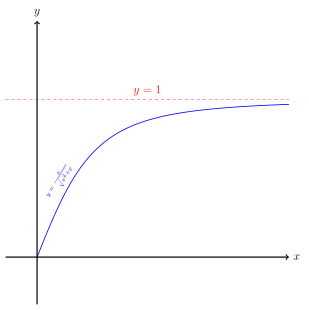
- \(\,\) \begin{align*} && y &= \frac{cx}{\sqrt{x^2+p}} \\ && \d y &= \frac{c(x^2+p)-cx^2}{(x^2+p)^{3/2}} \d x \\ &&&= \frac{cp^2}{(x^2+p)^{3/2}} \d x\\ && I &= \int \frac1{(b^2-y^2)\sqrt{c^2-y^2}} \d y \\ &&&= \int \frac{1}{\left ( b^2 - \frac{c^2x^2}{x^2+p} \right) \sqrt{c^2 - \frac{c^2x^2}{x^2+p} }} \d y \\ &&&= \int \frac{(x^2+p)^{3/2}}{((b^2-c^2)x^2+pb^2)\sqrt{c^2p}}\frac{cp}{(x^2+p)^{3/2}} \d x \\ &&&= \int \frac{\sqrt{p}}{((b^2-c^2)x^2+pb^2)} \d x \\ p=1: &&&= \int \frac{1}{(b^2-c^2)x^2+b^2} \d x \end{align*} When \(b = \sqrt{3}, c = \sqrt{2}\) \begin{align*} && I_1 &= \int_1^{\sqrt{2}} \frac{1}{(3 - y^2)\sqrt{2 - y^2}} \d y\\ &&&= \int_{x =1 }^{x=\infty} \frac{1}{3+x^2} \d x \\ &&&= \left [ \frac{1}{\sqrt{3}} \tan^{-1} \frac{x}{\sqrt{3}} \right]_1^\infty \\ &&&= \frac{\pi}{2\sqrt{3}} - \frac{1}{\sqrt{3}} \frac{\pi}{6} \\ &&&= \frac{\pi}{3\sqrt{3}} \end{align*} \begin{align*} && I_2 &= \int_{\frac{1}{\sqrt{2}}}^1 \frac{y}{(3y^2 - 1)\sqrt{2y^2 - 1}} \d y \\ x = \frac1y, \d x = -\frac1{y^2} \d y &&&= \int_{x=\sqrt{2}}^{x=1} \frac{x^2}{(3-x^2)\sqrt{2-x^2}}\cdot \left ( -\frac{1}{x^2} \right ) \d x \\ &&&= \int_1^{\sqrt{2}} \frac{1}{(3-x^2)\sqrt{2-x^2}} \d x \\ &&&= I_1 = \frac{\pi}{3\sqrt{3}} \end{align*}
- \(\,\) \begin{align*} && I_3 &= \int_{\frac{1}{\sqrt{2}}}^1 \frac{1}{(3y^2 - 1)\sqrt{2y^2 - 1}} \d y \\ x = 1/y, \d x = -1/y^2 \d y &&&= \int_{x=1}^{x=\sqrt{2}} \frac{x}{(3-x^2)\sqrt{2-x^2}} \d x \\ u = x^2, \d u = 2x \d x &&&= \int_{u=1}^{u=2} \frac{\frac12}{(3-u)\sqrt{2-u}} \d u \\ v=2-u, \d v = -\d u &&&= \frac12\int_{v=0}^{v=1} \frac{1}{(1+v)\sqrt{v}} \d v \\ &&&=\left [\tan^{-1}\sqrt{v}\right]_0^1 \\ &&&= \frac{\pi}{4} \end{align*}
2018 Paper 1 Q1
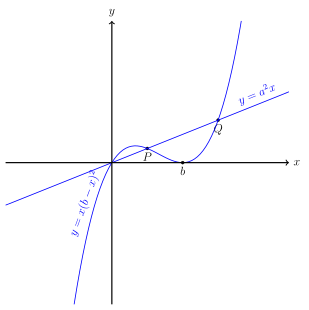
The line \(y=a^2 x\) and the curve \(y=x(b-x)^2\), where \(0 < a < b\,\), intersect at the origin \(O\) and at points \(P\) and \(Q \). The \(x\)-coordinate of \(P\) is less than the \(x\)-coordinate of \(Q\). Find the coordinates of \(P\) and \(Q\), and sketch the line and the curve on the same axes. Show that the equation of the tangent to the curve at \(P\) is \[ y = a(3a-2b)x + 2a(b-a)^2 . \] This tangent meets the \(y\)-axis at \(R\). The area of the region between the curve and the line segment \(OP\) is denoted by \(S\). Show that \[ S= \frac1{12}(b-a)^3(3a+b)\,. \] The area of triangle \(OPR\) is denoted by \(T\). Show that \(S>\frac{1}{3}T\,\).
Solution:
2018 Paper 1 Q4
The function \(\f\) is defined by \[ \phantom{\ \ \ \ \ \ \ \ \ \ \ \ (x>0, \ \ x\ne1)} \f(x) = \frac{1}{x\ln x} \left(1 - (\ln x)^2 \right)^2 \ \ \ \ \ \ \ \ \ \ \ \ (x>0, \ \ x\ne1) \,.\] Show that, when \(( \ln x )^2 = 1\,\), both \(\f(x)=0\) and \(\f'(x)=0\,\). The function \(F\) is defined by \begin{align*} F(x) = \begin{cases} \displaystyle \int_{ 1/\text{e}}^x \f(t) \; \mathrm{d}t & \text{ for } 0 < x < 1\,, \\[7mm] \displaystyle \int_{\text{e}}^x \f(t) \; \mathrm{d}t & \text{ for } x > 1\,. \\ \end{cases} \end{align*}
- Find \(F(x)\) explicitly and hence show that \(F(x^{-1})=F(x)\,\).
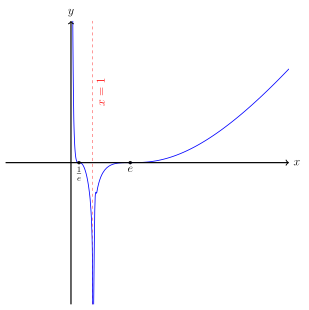
- Sketch the curve with equation \(y=F(x)\,\). [You may assume that \(\dfrac{ (\ln x)^k} x\to 0\) as \(x\to\infty\) for any constant \(k\).]
Solution: When \((\ln x)^2 = 1\) we have \(f(x) = \frac{1}{x\ln x}(1 - 1^2)^2 = 0\) \(f'(x) = \frac{2(1 - (\ln x)^2) \cdot (-2 \ln x ) \cdot \frac1x \cdot (x \ln x) - (\ln x +1)(1-(\ln x)^2)^2}{(x\ln x)^2} = \frac{2\cdot 0 \cdot (-2 \ln x ) \cdot \frac1x \cdot (x \ln x) - (\ln x +1) \cdot 0}{(x\ln x)^2} = 0\)
- First consider \(0 < x < 1\), so \begin{align*} && F(x) &= \int_{1/e}^x f(t) \d t \\ &&&= \int_{1/e}^x \frac{1}{t\ln t} \left(1 - (\ln t)^2 \right)^2 \d t \\ u = \ln t, \d u = \frac1t \d t: &&&= \int_{u=-1}^{u=\ln x} \frac{1}{u}(1-u^2)^2 \d u \\ &&&= \int_{-1}^{\ln x} \left ( u^3 - 2u+\frac1u \right) \d u \\ &&&= \left [ \frac{u^4}{4} - u^2+ \ln |u| \right]_{-1}^{\ln x} \\ &&&= \frac{(\ln x)^4}{4} -(\ln x)^2 + \ln |\ln x| - \frac14+1 \end{align*} Now consider \(x > 1\) \begin{align*} && F(x) &= \int_{e}^x f(t) \d t \\ &&&= \int_{e}^x \frac{1}{t\ln t} \left(1 - (\ln t)^2 \right)^2 \d t \\ u = \ln t, \d u = \frac1t \d t: &&&= \int_{u=1}^{u=\ln x} \frac{1}{u}(1-u^2)^2 \d u \\ &&&= \int_{1}^{\ln x} \left ( u^3 - 2u+\frac1u \right) \d u \\ &&&= \left [ \frac{u^4}{4} - u^2+ \ln |u| \right]_{1}^{\ln x} \\ &&&= \frac{(\ln x)^4}{4} -(\ln x)^2 + \ln| \ln x| - \frac14+1 \end{align*} Notice that \begin{align*} F(x^{-1}) &= \frac{(\ln x^{-1})^4}{4} -(\ln x^{-1})^2 + \ln| \ln x^{-1}| - \frac14+1 \\ &= \frac{(-\ln x)^4}{4} -(-\ln x)^2 + \ln| -\ln x| - \frac14+1 \\ &= \frac{(\ln x)^4}{4} -(\ln x)^2 + \ln| \ln x| - \frac14+1 \\ &= F(x) \end{align*}
- \(\,\)
2018 Paper 1 Q8
The functions \(\s\) and \(\c\) satisfy \(\s(0)= 0\,\), \(\c(0)=1\,\) and \[ \s'(x) = \c(x)^2 ,\] \[ \c'(x)=-\s(x)^2. \] You may assume that \(\s\) and \(\c\) are uniquely defined by these conditions.
- Show that \(\s(x)^3+\c(x)^3\) is constant, and deduce that \(\s(x)^3+\c(x)^3=1\,\).
- Show that \[ \frac{\d }{\d x} \, \Big( \s(x) \c(x) \Big) = 2\c(x)^3-1 \] and find (and simplify) an expression in terms of \(\c(x)\) for $\dfrac{\d }{\d x} \left( \dfrac{\s(x)}{\c(x)} \right) $.
- Find the integrals \[ \int \s(x)^2 \, \d x \ \ \ \ \ \ \text{and} \ \ \ \ \ \ \int \s(x)^5 \, \d x \,. \]
- Given that \(\s\) has an inverse function, \(\s^{-1}\), use the substitution \(u = \s(x)\) to show that \[ \int \frac{1}{(1-u^3)^{\frac{2}{3}}} \, \d u = \s^{-1}(u) \, + \text{constant}. \]
- Find, in terms of \(u\), the integrals \[ \int \frac{1}{{(1-u^3)}^{\frac{4}{3}}} \, \d u \ \ \ \ \ \ \text{and} \ \ \ \ \ \ \int {(1-u^3)}^{\frac{1}{3}} \, \d u \,. \]
Solution: \begin{questionparts} \item \begin{align*} && \dfrac{\d }{\d x} \left( \s(x)^3 + \c(x)^3 \right) &= 3\s(x)^2\s'(x) + 3\c(x)^2 \c'(x) \\ &&&= 3\s(x)^2\c(x)^2 - 3\c(x)^2\s(x)^2 \\ &&&= 0 \\ \\ \Rightarrow && \s(x)^3 + \c(x)^3 &= \text{constant} \\ &&&= \s(0)^3 + \c(0)^3 \\ &&&= 1 \end{align*} \item \begin{align*} \frac{\d }{\d x} \, \Big( \s(x) \c(x) \Big) &= \s'(x) \c(x) + \s(x)\c'(x) \\ &= \c(x)^3 - \s(x)^3 \\ &= \c(x)^3 - (1-\c(x)^3) \\ &= 2\c(x)^3 - 1 \\ \\ \dfrac{\d }{\d x} \left( \dfrac{\s(x)}{\c(x)} \right) &= \frac{\s'(x)\c(x) - \s(x)\c'(x)}{\c(x)^2} \\ &= \frac{\c(x)^3 + \s(x)^3}{\c(x)^2} \\ &= \frac{1}{\c(x)^2} \\ \end{align*} \item \begin{align*} \int \s(x)^2 \d x &= -\int -\s(x)^2 \d x \\ &= -\int \c'(x) \d x \\ &= - \s(x) +C \\ \\ \int \s(x)^5 \, \d x &= \int \s(x)^2 \s(x)^3 \d x \\ &= \int \s(x)^2 (1 - \c(x)^3) \d x \\ &= -\int \c'(x) (1 - \c(x)^3) \d x \\ &= - c(x) + \frac{\c(x)^4}{4} + C \end{align*} \item If \(u = \s(x), \frac{\d u}{\d x} = \c(x)^2\) \begin{align*} \int \frac{1}{(1-u^3)^{\frac{2}{3}}} \, \d u &= \int \frac{1}{(1-\s(x)^3)^{\frac{2}{3}}} \c(x)^2 \d x \\ &= \int 1 \d x \\ &= x + C \\ &= \s^{-1}(u) + C \\ \\ \int \frac{1}{{(1-u^3)^{\frac{4}{3}}}} \d u &= \int \frac1{(1-\s(x)^3)^{\frac43} }\c(x)^2 \d x \\ &= \int \frac1{(\c(x)^3)^{\frac43}} \c(x)^2 \d x \\ &= \int \frac1{\c(x)^2} \d x \\ &= \frac{\s(x)}{\c(x)} + C \\ &= \frac{u}{(1-u^3)^{\frac13}} + C \\ \end{align*} \begin{align*} && \int {(1-u^3)}^{\frac{1}{3}} \, \d u &= \int (1-s(x)^3)^{\frac13} c(x)^2 \d x \\ &&&= \int \c(x)^3 \d x = I\\ &&&= \int \c(x) s'(x) \d x \\ &&&= \left [\c(x) \s(x) \right] + \int \s(x)^2 s(x) \d x \\ &&&= \c(x) \s(x) + \int (1 - \c(x)^3) \d x + C \\ &&&= \c(x) \s(x) + x - I + C \\ \Rightarrow && I &= \frac{x + \c(x) \s(x)}{2} + k \\ \Rightarrow && &= \frac12 \l \s^{-1}(u) + u \sqrt[3](1-u^3)\r + k \end{align*}
2018 Paper 2 Q3
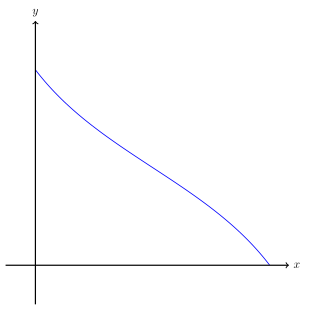
- Let \[ \f(x) = \frac 1 {1+\tan x} \] for \(0\le x < \frac12\pi\,\). Show that \(\f'(x)= -\dfrac{1}{1+\sin 2x}\) and hence find the range of \(\f'(x)\). Sketch the curve \(y=\f(x)\).
- The function \(\g(x)\) is continuous for \(-1\le x \le 1\,\). Show that the curve \(y=\g(x)\) has rotational symmetry of order 2 about the point \((a,b)\) on the curve if and only if \[ \g(x) + \g(2a-x) = 2b\,. \] Given that the curve \(y=\g(x)\) passes through the origin and has rotational symmetry of order 2 about the origin, write down the value of \[\displaystyle \int_{-1}^1 \g(x)\,\d x\,. \]
- Show that the curve \(y=\dfrac{1}{1+\tan^kx}\,\), where \(k\) is a positive constant and \(0 < x < \frac12\pi\,\), has rotational symmetry of order 2 about a certain point (which you should specify) and evaluate \[ \int_{\frac16\pi}^{\frac13\pi} \frac 1 {1+\tan^kx} \, \d x \,. \]
Solution:
- \(\,\) \begin{align*}
&& f(x) &= \frac1{1+\tan x} \\
&& f'(x) &=-(1+\tan x)^{-2} \cdot \sec^2 x \\
&&&= - (\cos x+ \sin x)^{-2} \\
&&&= - (1 + 2 \sin x \cos x)^{-1} \\
&&&= - \frac{1}{1+\sin 2x}
\end{align*}
\(\sin 2x \in [0, 1]\) so \(1+\sin 2x \in [1,2]\) and \(f'(x) \in [-1, -\tfrac12]\)
- \(\displaystyle \int_{-1}^1 g(x) \d x = 2g(0) \)
- Let \(g(x) = \frac{1}{1 + \tan^k x}\) then \(g(x)\) has rotational symmetry of order \(2\) about the point \((\frac{\pi}{4}, \frac12)\) which we can see since \begin{align*} g(x) + g(\tfrac12\pi - x) &= \frac{1}{1 + \tan^k x} + \frac{1}{1 + \tan^k(\tfrac12\pi - x)} \\ &= \frac{1}{1+\tan^k x} + \frac{1}{1+\cot^k x} \\ &= \frac{1}{1+\tan^k x} + \frac{\tan^k x}{\tan^k x + 1} \\ &= 1 = 2 \cdot \tfrac12 \end{align*} Therefore \[ \int_{\frac16\pi}^{\frac13\pi} \frac 1 {1+\tan^kx} \, \d x = \frac{\pi}{6} \cdot \frac12 = \frac{\pi}{12}\]
2018 Paper 2 Q5
In this question, you should ignore issues of convergence.
- Write down the binomial expansion, for \(\vert x \vert<1\,\), of \(\;\dfrac{1}{1+x}\,\) and deduce that %. By considering %$ %\displaystyle \int \frac 1 {1+x} \, \d x %\,, %$ %show that \[ \displaystyle \ln (1+x) = -\sum_{n=1}^\infty \frac {(-x)^n}n \, \] for \(\vert x \vert <1 \,\).
- Write down the series expansion in powers of \(x\) of \(\displaystyle \e^{-ax}\,\). Use this expansion to show that \[ \int_0^\infty \frac {\left(1- \e^{-ax}\right)\e^{-x}}x \,\d x = \ln(1+a) \ \ \ \ \ \ \ (\vert a \vert <1)\,. \]
- Deduce the value of \[ \int_0^1 \frac{x^p - x^q}{\ln x} \, \d x \ \ \ \ \ \ (\vert p\vert <1, \ \vert q\vert <1) \,. \]
Solution:
- \begin{align*} && \frac1{1+x} &= 1 - x+ x^2 - x^3+ \cdots \\ \Rightarrow && \int_0^x \frac{1}{1+t} \d t &= \int_0^x \sum_{n=0}^{\infty} (-t)^n \d t \\ &&&= \left [\sum_{n=0}^{\infty} -\frac{(-t)^{n+1}}{n+1} \right]_0^x \\ \Rightarrow &&\ln(1+x)&=- \sum_{n=1}^\infty \frac{(-x)^n}{n} \end{align*}
- \begin{align*} && e^{-ax} &= \sum_{n=0}^\infty \frac{(-a)^n}{n!} x^n \\ \Rightarrow && \int_0^{\infty} \frac{1}{x} \left (1-e^{-ax} \right)e^{-x} \d x &= \int_0^{\infty} \frac{1}{x} \left (-\sum_{n=1}^\infty \frac{(-a)^n}{n!}x^n \right)e^{-x} \d x \\ &&&= -\int_0^{\infty} \sum_{n=1}^\infty \frac{(-a)^n}{n!} x^{n-1} e^{-x} \d x \\ &&&= -\sum_{n=1}^\infty \frac{(-a)^n}{n!} \int_0^{\infty} x^{n-1} e^{-x} \d x \\ &&&= -\sum_{n=1}^\infty \frac{(-a)^n}{n!} (n-1)! \\ &&&= -\sum_{n=1}^\infty \frac{(-a)^n}{n} \\ &&&= \ln (1+a) \end{align*}
- \begin{align*} && \int_0^1 \frac{x^p - x^q}{\ln x} \, \d x &= \int_0^1 \frac{x^p(1 - x^{q-p})}{\ln x} \, \d x \\ e^{-u} = x, \d x = -e^{-u} \d u: &&&=\int_{u=\infty}^{0} \frac{e^{-pu}-e^{-qu}}{-u} (-e^{-u})\d u \\ &&&= \int_0^\infty \frac{e^{-u}(e^{-qu}-e^{-pu})}{u} \d u \\ &&&= \int_0^\infty \frac{e^{-(1+q)u}(1-e^{-(p-q)u})}{u} \d u \\ v = (1+q)u, \d v = (1+q) \d u: &&&=\int_0^{\infty} \frac{e^{-v}(1-e^{-\left(\frac{p-q}{1+q}\right)v}}{v}\d v \\ &&&= \ln \left(1 + \frac{p-q}{1+q} \right) \\ &&&= \ln \left ( \frac{1+p}{1+q} \right) \end{align*}
2018 Paper 3 Q8
In this question, you should ignore issues of convergence.
- Let \[ I = \int_0^1 \frac{\f(x^{-1}) } {1+x} \, \d x \,, \] where \(\f(x)\) is a function for which the integral exists. Show that \[ I = \sum_{n=1}^\infty \int_n^{n+1} \frac{\f(y) } {y(1+y)}\, \d y \] and deduce that, if \(\f(x) = \f(x+1)\) for all \(x\), then \[ I= \int_0^1 \frac{\f(x)} {1+x} \, \d x \,. \]
- The {\em fractional part}, \(\{x\}\), of a real number \(x\) is defined to be \(x-\lfloor x\rfloor\) where \(\lfloor x \rfloor\) is the largest integer less than or equal to \(x\). For example \(\{3.2\} = 0.2\) and \(\{3\}=0\,\). Use the result of part (i) to evaluate \[ \displaystyle \int _0^1 \frac { \{x^{-1}\}}{1+x}\, \d x \text{ and } \displaystyle \int _0^1 \frac { \{2x^{-1}\}}{1+x}\, \d x \,. \]
- (Bonus) Use the same method to evaluate \[ \int_0^1 \frac {x\{x^{-1}\}}{1-x^2} \, \d x \,. \]
- (Bonus - harder) Use the same method to evaluate \[ \int_0^1 \frac {x^2\{x^{-1}\}}{1-x^2} \, \d x \,. \]
Solution:
- \begin{align*} && I &= \int_0^1 \frac{f(x^{-1})}{1+x} \d x \\ u = x^{-1}, \d u = -x^{-2} \d x: &&&= \int_{\infty}^1 \frac{f(u)}{1+\frac{1}{u}} \frac{-1}{u^2} \d u \\ &&&= \int_1^{\infty} \frac{f(u)}{u(1+u)} \d u \\ &&&= \sum_{n=1}^{\infty} \int_n^{n+1} \frac{f(u)}{u(u+1)} \d u \\ \\ \text{if} f(x) = f(x+1)\, \forall x && &=\sum_{n=1}^{\infty} \int_{0}^1 \frac{f(x+n)}{(x+n)(x+n+1)} \d x \\ &&&= \sum_{n=1}^\infty \int_0^1 \frac{f(x)}{(x+n)(x+n+1)} \d x \\ &&&= \int_0^1 f(x) \l \sum_{n=1}^{\infty} \frac{1}{(x+n)(x+n+1)}\r \d x \\ &&&= \int_0^1 f(x) \l \sum_{n=1}^{\infty} \l \frac{1}{x+n} - \frac{1}{x+n+1} \r\r \d x \\ &&&= \int_0^1 f(x) \l \frac{1}{x+1} \r \d x \\ &&&= \int_0^1\frac{f(x)}{x+1} \d x \\ \end{align*}
- Since the fractional part is periodic with period \(1\), we can say \begin{align*} && \int_0^1 \frac{\{ x^{-1} \} }{1+x} \d x &= \int_0^1 \frac{\{ x\}}{x+1} \d x \\ &&&= \int_0^1 \frac{x}{x+1} \d x \\ &&&= \int_0^1 1-\frac{1}{x+1} \d x \\ &&&= [x - \ln (1+x) ]_0^1 \\ &&&= 1 - \ln 2 \end{align*} \begin{align*} && \int_0^1 \frac{\{ 2x^{-1}\}}{1+x} \d x &= \int_0^1 \frac{\{2x\}}{x+1} \d x \\ &&&= \int_0^{1/2} \frac{2x}{x+1} \d x +\int_{1/2}^{1} \frac{2x-1}{x+1} \d x \\ &&&= 2\int_0^1 \frac{x}{x+1} \d x + \int_{1/2}^1 \frac{-1}{x+1} \d x \\ &&&= 2 - 2\ln 2 - \l \ln 2 - \ln \tfrac32 \r \\ &&&= 2 - 4 \ln 2 + \ln 3 \\ &&&= 2 + \ln \tfrac {3}{16} \end{align*}
- \begin{align*} && \int_0^1 \frac{x \{ x^{-1} \} }{1-x^2} \d x &= \frac12 \l \int_0^1 \frac{ \{ x^{-1} \}}{1-x} - \frac{\{x^{-1} \}}{1+x} \d x\r \end{align*} Consider for \(f\) periodic with period \(1\) \begin{align*} \int_0^1 \frac{f(x^{-1})}{1-x} \d x &= \int_1^{\infty} \frac{f(u)}{u(u-1)} \d u \\ &= \sum_{n=1}^{\infty}\int_{n}^{n+1} \frac{f(u)}{u(u-1)} \d u \\ &= \sum_{n=1}^{\infty}\int_{0}^{1} \frac{f(u)}{(u+n)(u+n-1)} \d u \\ &= \int_{0}^{1} \sum_{n=1}^{\infty}\frac{f(u)}{(u+n)(u+n-1)} \d u \\ &= \int_{0}^{1} f(u) \sum_{n=1}^{\infty}\l\frac{1}{u+n-1} - \frac{1}{u+n} \r\d u \\ &= \int_0^1 \frac{f(u)}{u} \d u \end{align*} So we have \begin{align*} && \int_0^1 \frac{x \{ x^{-1} \} }{1-x^2} \d x &= \frac12 \l \int_0^1 \frac{ \{ x^{-1} \}}{1-x} - \frac{\{x^{-1} \}}{1+x} \d x \r \\ &&&= \frac12 \int_0^1 \frac{\{ x \}}{x} \d x - \frac12 (1 - \ln 2) \\ &&&= \frac12 - \frac12 + \frac12 \ln 2 \\ &&&= \frac12 \ln 2 \end{align*}
2018 Paper 3 Q12
A random process generates, independently, \(n\) numbers each of which is drawn from a uniform (rectangular) distribution on the interval 0 to 1. The random variable \(Y_k\) is defined to be the \(k\)th smallest number (so there are \(k-1\) smaller numbers).
- Show that, for \(0\le y\le1\,\), \[ {\rm P}\big(Y_k\le y) =\sum^{n}_{m=k}\binom{n}{m}y^{m}\left(1-y\right)^{n-m} . \tag{\(*\)} \]
- Show that \[ m\binom n m = n \binom {n-1}{m-1} \] and obtain a similar expression for \(\displaystyle (n-m) \, \binom n m\,\). Starting from \((*)\), show that the probability density function of \(Y_k\) is \[ n\binom{ n-1}{k-1} y^{k-1}\left(1-y\right)^{ n-k} \,.\] Deduce an expression for \(\displaystyle \int_0^1 y^{k-1}(1-y)^{n-k} \, \d y \,\).
- Find \(\E(Y_k) \) in terms of \(n\) and \(k\).
Solution:
- \begin{align*} && \mathbb{P}(Y_k \leq y) &= \sum_{j=k}^n\mathbb{P}(\text{exactly }j \text{ values less than }y) \\ &&&= \sum_{j=k}^m \binom{m}{j} y^j(1-y)^{n-j} \end{align*}
- This is the number of ways to choose a committee of \(m\) people with the chair from those \(m\) people. This can be done in two ways. First: choose the committee in \(\binom{n}{m}\) ways and choose the chair in \(m\) ways so \(m \binom{n}{m}\). Alternatively, choose the chain in \(n\) ways and choose the remaining \(m-1\) committee members in \(\binom{n-1}{m-1}\) ways. Therefore \(m \binom{n}{m} = n \binom{n-1}{m-1}\) \begin{align*} (n-m) \binom{n}{m} &= (n-m) \binom{n}{n-m} \\ &= n \binom{n-1}{n-m-1} \\ &= n \binom{n-1}{m} \end{align*} \begin{align*} f_{Y_k}(y) &= \frac{\d }{\d y} \l \sum^{n}_{m=k}\binom{n}{m}y^{m}\left(1-y\right)^{n-m} \r \\ &= \sum^{n}_{m=k} \l \binom{n}{m}my^{m-1}\left(1-y\right)^{n-m} -\binom{n}{m}(n-m)y^{m}\left(1-y\right)^{n-m-1} \r \\ &= \sum^{n}_{m=k} \l n \binom{n-1}{m-1}y^{m-1}\left(1-y\right)^{n-m} -n \binom{n-1}{m} y^{m}\left(1-y\right)^{n-m-1} \r \\ &= n\sum^{n}_{m=k} \binom{n-1}{m-1}y^{m-1}\left(1-y\right)^{n-m} -n\sum^{n+1}_{m=k+1} \binom{n-1}{m-1} y^{m-1}\left(1-y\right)^{n-m} \\ &= n \binom{n-1}{k-1} y^{k-1}(1-y)^{n-k} \end{align*} \begin{align*} &&1 &= \int_0^1 f_{Y_k}(y) \d y \\ &&&= \int_0^1 n \binom{n-1}{k-1} y^{k-1}(1-y)^{n-k} \d y \\ &&&= n \binom{n-1}{k-1} \int_0^1 y^{k-1}(1-y)^{n-k} \d y \\ \Rightarrow && \frac{1}{n \binom{n-1}{k-1}} &= \int_0^1 y^{k-1}(1-y)^{n-k} \d y \\ \end{align*}
- \begin{align*} && \mathbb{E}(Y_k) &= \int_0^1 y f_{Y_k}(y) \d y \\ &&&= \int_0^1 n \binom{n-1}{k-1} y^{k}(1-y)^{n-k} \\ &&&= n \binom{n-1}{k-1}\int_0^1 y^{k}(1-y)^{n-k} \d y \\ &&&= n \binom{n-1}{k-1}\int_0^1 y^{k+1-1}(1-y)^{n+1-(k+1)} \d y \\ &&&= n \binom{n-1}{k-1} \frac{1}{(n+1) \binom{n}{k}}\\ &&&= \frac{n}{n+1} \cdot \frac{k}{n} \\ &&&= \frac{k}{n+1} \end{align*}
2017 Paper 1 Q1
- Use the substitution \(u= x\sin x +\cos x\) to find \[ \int \frac{x }{x\tan x +1 } \, \d x \,. \] Find by means of a similar substitution, or otherwise, \[ \int \frac{x }{x\cot x -1 } \, \d x \,. \]
- Use a substitution to find \[ \int \frac{x\sec^2 x \, \tan x}{x\sec^2 x -\tan x} \,\d x \, \] and \[ \int \frac{x\sin x \cos x}{(x-\sin x \cos x)^2} \, \d x \,. \]
Solution:
- \(\,\) \begin{align*} && I &= \int \frac{x}{x \tan x + 1} \d x \\ &&&= \int \frac{x \cos x}{x \sin x + \cos x} \d x \\ u = x \sin x + \cos x , \d u = x \cos x \d x: &&&= \int \frac{\d u}{u} \\ &&&= \ln u + C \\ &&&= \ln (x \sin x + \cos x) + C \\ \\ && J &= \int \frac{x}{x \cot x - 1} \d x \\ &&&= \int \frac{x \sin x }{x \cos x - \sin x} \d x \\ u = x \cos x - \sin x, \d u = x \sin x \d x: &&&= \int \frac{1}{u} \d u \\ &&&= \ln u + K \\ &&&= \ln (x \cos x -\sin x) + K \end{align*}
- \(\,\) \begin{align*} && I &= \int \frac{x \sec^2 x \tan x}{x \sec^2 x - \tan x} \d x \\ u = x\sec^2 x-\tan x, \d u = 2x \sec^2 x \tan x&&&= \frac12 \int \frac{1}{u} \d u \\ &&&= \frac12 \ln (x \sec^2 x - \tan x) + C \\ \\ && J &= \int \frac{x \sin x \cos x}{(x - \sin x \cos x)^2} \d x \\ u = x \sec^2 x -\tan x, \d u=2x \frac{\sin x}{\cos^3 x} &&&= \int \frac{x \sin x \cos x}{\cos^4x(x\sec^2 x -\tan x)^2} \d x \\ &&&= \frac12 \int \frac{1}{u^2} \d u \\ &&&= -\frac12u^{-1} + K \\ &&&= \frac{1}{2(\tan x - x \sec^2 x)} + K \end{align*}