Problems
Filters
29 problems found
2008 Paper 2 Q4
A curve is given by \[x^2+y^2 +2axy = 1,\] where \(a\) is a constant satisfying \(0 < a < 1\). Show that the gradient of the curve at the point \(P\) with coordinates \((x,y)\) is \[\displaystyle - \frac {x+ay}{ax+y}\,,\] provided \(ax+y \ne0\). Show that \(\theta\), the acute angle between \(OP\) and the normal to the curve at \(P\), satisfies \[ \tan\theta = a\vert y^2-x^2\vert\;. \] Show further that, if \(\ \displaystyle \frac{\d \theta}{\d x}=0\) at \(P\), then:
- \(a(x^2+y^2)+2xy=0\,\);
- \((1+a)(x^2+y^2+2xy)=1\,\);
- \(\displaystyle \tan\theta = \frac a{\sqrt{1-a^2}}\,\).
Solution: \begin{align*} && 1 &= x^2 + y^2 + 2axy \\ \frac{\d}{\d x}: && 0 &= 2x + 2y \frac{\d y}{\d x} + 2ay + 2ax \frac{\d y}{\d x} \\ &&&= (2x+2ay) + \frac{\d y}{\d x} \left (2ax + 2y \right) \\ \Rightarrow && \frac{\d y}{\d x} &= -\frac{x+ay}{ax+y} \end{align*}
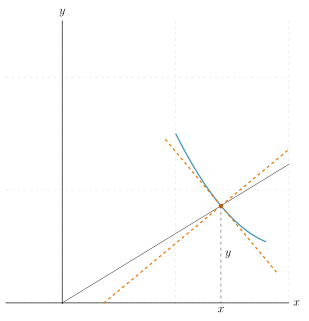
- \(\,\) \begin{align*} && \sec^2 \theta \frac{\d \theta}{\d x} &= \pm a \left (2y \frac{\d y}{\d x} - 2 x\right) \\ \Rightarrow && 0 &= a \left (y \cdot \frac{x+ay}{ax+y} + x \right) \\ &&&=a \left ( \frac{xy+ay^2+ax^2+xy}{ax+y} \right) \\ \Rightarrow && 0 &= a(x^2+y^2)+2xy \end{align*}
- \(\,\) \begin{align*} && 0 &=a(x^2+y^2)+2xy \\ && 1 &= x^2+y^2 + 2axy \\ \Rightarrow && 1 &= (a+1)(x^2+y^2) + (a+1)(2xy) \\ &&&= (a+1)(x^2+y^2+2xy) \end{align*}
- \(\,\) \begin{align*} && 1 &= (a+1)(x+y)^2 \\ \Rightarrow && x +y &= \pm \frac{1}{\sqrt{1+a}} \\ && 0 &=a(x^2+y^2)+2xy \\ && 1 &= x^2+y^2 + 2axy \\ \Rightarrow && 1 &= (1-a)(x^2+y^2) + (a-1)(2xy) \\ &&&= (1-a)(x^2+y^2-2xy)\\ \Rightarrow && x-y &= \pm \frac{1}{\sqrt{1-a}} \\ \Rightarrow && \frac{\d \theta}{\d x} &= a|y^2-x^2| \\ &&&= a|(y-x)(x+y)| \\ &&&= \frac{a}{\sqrt{1-a^2}} \end{align*}
2008 Paper 3 Q6
In this question, \(p\) denotes \(\dfrac{\d y}{\d x}\,\).
- Given that \[ y=p^2 +2 xp\,, \] show by differentiating with respect to \(x\) that \[ \frac{\d x}{\d p} = -2 - \frac {2x} p . \] Hence show that \(x = -\frac23p +Ap^{-2}\,,\) where \(A\) is an arbitrary constant. Find \(y\) in terms of \(x\) if \(p=-3\) when \(x=2\).
- Given instead that \[ y=2xp +p \ln p\,,\] and that \(p=1\) when \(x=-\frac14\), show that \(x=-\frac12 \ln p - \frac14\,\) and find \(y\) in terms of \(x\).
2007 Paper 1 Q11
A smooth, straight, narrow tube of length \(L\) is fixed at an angle of \(30^\circ\) to the horizontal. A~particle is fired up the tube, from the lower end, with initial velocity \(u\). When the particle reaches the upper end of the tube, it continues its motion until it returns to the same level as the lower end of the tube, having travelled a horizontal distance \(D\) after leaving the tube. Show that \(D\) satisfies the equation \[ 4gD^2 - 2 \sqrt{3} \left( u^2 - Lg \right)D - 3L \left( u^2 - gL \right) = 0 \] and hence that \[ \frac{{\rm d}D}{ {\rm d}L} = - \frac{ 2\sqrt{3}gD - 3(u^2-2gL)} { 8gD - 2 \sqrt{3} \left(u^2 - gL \right)}. \] The final horizontal displacement of the particle from the lower end of the tube is \(R\). Show that \(\dfrac{\d R}{\d L} = 0\) when \(2D = L \sqrt 3\), and determine, in terms of \(u\) and \(g\), the corresponding value of \(R\).
2005 Paper 1 Q8
Show that, if \(y^2 = x^k \f(x)\), then $\displaystyle 2xy \frac{\mathrm{d}y }{ \mathrm{d}x} = ky^2 + x^{k+1} \frac{\mathrm{d}\f }{ \mathrm{d}x}$\,.
- By setting \(k=1\) in this result, find the solution of the differential equation \[ \displaystyle 2xy \frac{\mathrm{d}y }{ \mathrm{d}x} = y^2 + x^2 - 1 \] for which \(y=2\) when \(x=1\). Describe geometrically this solution.
- Find the solution of the differential equation \[ 2x^2y\displaystyle \frac{\mathrm{d}y}{\mathrm{d}x} = 2 \ln(x) - xy^2 \] for which \(y=1\) when \(x=1\,\).
2005 Paper 3 Q2
Find the general solution of the differential equation \(\displaystyle \frac{\mathrm{d}y}{\mathrm{d}x} = -\frac{xy}{x^2+a^2}\;\), where \(a\ne0\,\), and show that it can be written in the form \(\displaystyle y^2(x^2+a^2)= c^2\,\), where \(c\) is an arbitrary constant. Sketch this curve. Find an expression for \(\displaystyle \frac{\mathrm{d}}{\mathrm{d}x} (x^2+y^2)\) and show that \[ \frac{\mathrm{d^2}}{\mathrm{d}x^2} (x^2+y^2) = 2\left(1 -\frac {c^2}{(x^2+a^2)^2} \right) + \frac{8c^2x^2}{(x^2+a^2)^3}\;. \]
- Show that, if \(0 < c < a^2\), the points on the curve whose distance from the origin is least are \(\displaystyle \l 0\,,\;\pm \frac{c}{a}\r\).
- If \(c > a^2\), determine the points on the curve whose distance from the origin is least.
Solution: \begin{align*} && \frac{\d y}{\d x} &= - \frac{xy}{x^2+a^2} \\ \Rightarrow && \int \frac{1}{y} \d y &= \int -\frac{x}{x^2+a^2} \d x \\ && \ln |y| &= -\frac12 \ln |x^2 + a^2| + C \\ \Rightarrow && C' &= \ln y^2 + \ln (x^2+a^2) \\ \Rightarrow && c^2 &= y^2(x^2+a^2) \end{align*} (where the final constant \(c^2\) can be taken as a square since it is clearly positive).

- The shortest distance from the origin will have the first derivative as \(0\), ie \(x = 0\) or \(x^2 + a^2 = c\), but if \(c < a^2\) this can only occur for \(x = 0\), so the closest to the origin is \((0, \pm \frac{c}{a})\)
- If \(c > a^2\) then we can have \(x = 0\) or \(x = \pm \sqrt{c-a^2}\). Looking at the second derivative, when \(x = 0\) we have \(2(1- \frac{c^2}{a^4}) < 0\) which is a local maximum. When \(x = \pm\sqrt{c-a^2}\) we have \(8(c-a^2)c^2/c^3 > 0\) which is the minimum, therefore the points are \((\pm \sqrt{c-a^2}, c)\)

2003 Paper 3 Q8
- Show that the gradient at a point \(\l x\,, \, y \r\) on the curve \[ \l y + 2x \r^3 \l y - 4x \r = c\;, \] where \(c\) is a constant, is given by \[ \frac{\d y}{\d x} = \frac{16 x -y}{2y-5x} \;. \]
- By considering the derivative with respect to \(x\) of \(\l y + ax \r^n \l y + bx \r\,\), or otherwise, find the general solution of the differential equation \[ \frac{\mathrm{d}y}{ \mathrm{d}x} = \frac{10x - 4y}{ 3x - y}\;. \]
Solution:
- \begin{align*} && c &= \left (y+2x \right)^3\left (y-4x \right) \\ \Rightarrow && 0 &= 3\left (y+2x \right)^2\left (y-4x \right)\left ( \frac{\d y}{\d x} + 2 \right) + \left (y+2x \right)^3 \left ( \frac{\d y}{\d x} - 4 \right) \\ \Rightarrow && 0 &= 3(y-4x)\left ( \frac{\d y}{\d x} + 2 \right) + \left (y+2x \right) \left ( \frac{\d y}{\d x} - 4 \right) \\ \Rightarrow &&&= \frac{\d y}{\d x} \left (3(y-4x) + (y+2x) \right) + 6(y-4x)-4(y+2x) \\ &&&= \frac{\d y}{\d x} \left ( 4y-10x\right) + 2y-32x \\ \Rightarrow && \frac{\d y}{\d x} &= \frac{16x-y}{2y-5x} \end{align*}
- \begin{align*} && c &= \left ( y + ax \right)^n \left ( y + bx \right) \\ \Rightarrow && 0 &= n\left ( y + ax \right)^{n-1} \left ( y + bx \right)\left ( \frac{\d y}{ \d x}+a \right) + \left ( y + ax \right)^{n} \left ( \frac{\d y}{ \d x}+b \right) \\ \Rightarrow && 0 &= n \left ( y + bx \right)\left ( \frac{\d y}{ \d x}+a \right) + \left ( y + ax \right) \left ( \frac{\d y}{ \d x}+b \right) \\ &&&= \frac{\d y}{\d x} \left ( (n+1)y + (nb+a)x \right) + an(y+bx) + by+bax \\ &&&= \frac{\d y}{\d x} \left ( (n+1)y + (nb+a)x \right) + (an+b)y+ab(n+1)x \\ \Rightarrow && \frac{\d y}{\d x} &= -\frac{(an+b)y+ab(n+1)x}{(n+1)y+(nb+a)x} \end{align*} We must have \(ab = 10, a+b = -7\) so say \(a=-5,b=-2,n=2\) and we have \((y-5x)^2(y-2) = c\) is our general solution to the differential equation
2001 Paper 3 Q1
Given that \(y = \ln ( x + \sqrt{x^2 + 1})\), show that \( \displaystyle \frac{\d y}{\d x} = \frac1 {\sqrt{x^2 + 1} }\;\). Prove by induction that, for \(n \ge 0\,\), \[ \l x^2 + 1 \r y^{\l n + 2 \r} + \l 2n + 1 \r x y^{\l n + 1 \r} + n^2 y^{\l n \r} = 0\;, \] where \(\displaystyle y^{(n)} = \frac{\d^n y}{\d x^n}\) and \(y^{(0)} =y\,\). Using this result in the case \(x = 0\,\), or otherwise, show that the Maclaurin series for \(y\) begins \[ x - {x^3 \over 6} +{3 x^5 \over 40} \] and find the next non-zero term.
Solution: \begin{align*} && y & = \ln ( x + \sqrt{x^2+1}) \\ \Rightarrow && \frac{\d y}{\d x} &= \frac{1}{x+\sqrt{x^2+1}} \cdot \frac{\d }{\d x} \left ( x + \sqrt{x^2+1} \right) \\ &&&= \frac{1}{x+\sqrt{x^2+1}} \left (1 + \frac12 \frac{2x}{\sqrt{x^2+1}} \right) \\ &&&= \frac{1}{x+\sqrt{x^2+1}} \left ( \frac{\sqrt{x^2+1} + x}{\sqrt{x^2+1}}\right) \\ &&&= \frac{1}{\sqrt{x^2+1}} \end{align*} Note that \(\displaystyle y^{(2)} = - \frac12 \frac{2x}{(x^2+1)^{3/2}} = - \frac{x}{(x^2+1)^{3/2}}\), and in particular \((x^2+1)y^{(2)} + xy^{(1)} = 0\). Now applying Leibnitz formula: \begin{align*} 0 &= \left ( (x^2+1)y^{(2)} + xy^{(1)} \right )^{(n)} \\ &= \left ( (x^2+1)y^{(2)}\right )^{(n)} + \left (xy^{(1)} \right )^{(n)} \\ &= (x^2+1)y^{(n+2)} +n2xy^{(n+1)} + \binom{n}{2}2y^{(n)} + xy^{(n+1)} + n y^{(n)} \\ &= (x^2+1)y^{(n+2)} + (2n+1)xy^{(n+1)} + (n^2-n+n)y^{(n)} \\ &= (x^2+1)y^{(n+2)} + (2n+1)xy^{(n+1)} + n^2y^{(n)} \end{align*} as required. When \(x = 0\): \begin{align*} && y(0) &= \ln(0 + \sqrt{0^2+1}) \\ &&&= \ln 1 = 0 \\ && y'(0) &= \frac{1}{\sqrt{0^2+1}} = 1 \\ && y^{(n+2)} &= -n^2 y^{(n)} \\ && y^{(2k)} &= 0 \\ && y^{(3)} &= -1 \\ && y^{(5)} &= 3^2 \\ && y^{(7)} &= - 5^2 \cdot 3^2 \\ \end{align*} Therefore the Maclaurin series about \(x = 0\) is \begin{align*} y &= x - \frac{1}{3!} x^3 + \frac{3^2}{5!} x^5 - \frac{3^2 \cdot 5^2}{7!} x^7 + \cdots \\ &= x - \frac{1}{6} x^3 + \frac{3}{1 \cdot 2 \cdot 4 \cdot 5} x^5 - \frac{5}{1 \cdot 2 \cdot 4 \cdot 2 \cdot 7} x^7 + \cdots \\ &= x - \frac{1}{6}x^3 + \frac{3}{40} x^5 - \frac{5}{56} x^7 + \cdots \end{align*}
1997 Paper 1 Q2
- If \[{\mathrm f}(x)=\tan^{-1}x+\tan^{-1}\left(\frac{1-x}{1+x}\right),\] find \({\mathrm f}'(x)\). Hence, or otherwise, find a simple expression for \({\mathrm f}(x)\).
- Suppose that \(y\) is a function of \(x\) with \(0 < y < (\pi/2)^{1/2}\) and \[x=y\sin y^{2}\] for \(0 < x < (\pi/2)^{1/2}\). Show that (for this range of \(x\)) \[\frac{{\mathrm d}y}{{\mathrm d}x}= \frac{y}{x+2y^2\sqrt{y^{2}-x^{2}}}.\]
Solution:
- \begin{align*} && f(x)&=\tan^{-1}x+\tan^{-1}\left(\frac{1-x}{1+x}\right) \\ \Rightarrow && f'(x) &= \frac{1}{1+x^2} + \frac{1}{1+\l \frac{1-x}{1+x} \r^2} \cdot \l \frac{-2}{(1+x)^2}\r \\ &&&= \frac1{1+x^2}- \frac{2}{(1+x)^2+(1-x)^2} \\ &&&= \frac1{1+x^2} - \frac{2}{2+2x^2} \\ &&&= 0 \end{align*} Therefore $f(x) = \begin{cases} c_1 & \text{if } x < -1 \\ c_2 & \text{if } x > -1 \end{cases}$ \(f(0) = \tan^{-1} 0 + \tan^{-1} 1 = \frac{\pi}{4}\) \(\lim_{x \to \infty} f(x) = -\frac{\pi}{2} + \tan^{-1} -1 = -\frac{3\pi}{4}\) therefore $f(x) = \begin{cases} -\frac{3\pi}{4}& \text{if } x < -1 \\ \frac{\pi}{4} & \text{if } x > -1 \end{cases}$
- \begin{align*} && x &= y \sin y^2 \\ \Rightarrow && \frac{\d x}{\d y} &= \sin y^2 + 2y^2 \cos y^2 \\ \Rightarrow && \frac{\d y}{\d x} &= \frac{1}{\sin y^2+2y^2 \cos y^2} \\ &&&=\frac{1}{\frac{x}{y}+2y^2 \sqrt{1-\sin^2y^2}} \\ &&&= \frac{y}{x + 2y^3 \sqrt{1-\frac{x^2}{y^2}}} \\ &&&= \frac{y}{x+2y^2 \sqrt{y^2-x^2}} \end{align*}
1997 Paper 2 Q7
Let $$y^2=x^2(a^2-x^2),$$ where \(a\) is a real constant. Find, in terms of \(a\), the maximum and minimum values of \(y\). Sketch carefully on the same axes the graphs of \(y\) in the cases \(a=1\) and \(a=2\).
Solution: \begin{align*} && y^2 &= x^2a^2-x^2 \\ &&&= \frac{a^4}{4} -\left ( x^2 -\frac{a^2}{2} \right)^2 \end{align*} Therefore the maximum and minimum values of \(y\) are \(\pm \frac{a^2}2\)

1993 Paper 3 Q2
The curve \(C\) has the equation \(x^3+y^3 = 3xy\).
- Show that there is no point of inflection on \(C\). You may assume that the origin is not a point of inflection.
- The part of \(C\) which lies in the first quadrant is a closed loop touching the axes at the origin. By converting to polar coordinates, or otherwise, evaluate the area of this loop.
1991 Paper 2 Q2
The equation of a hyperbola (with respect to axes which are displaced and rotated with respect to the standard axes) is \[ 3y^{2}-10xy+3x^{2}+16y-16x+15=0.\tag{\(\dagger\)} \] By differentiating \((\dagger)\), or otherwise, show that the equation of the tangent through the point \((s,t)\) on the curve is \[ y=\left(\frac{5t-3s+8}{3t-5s+8}\right)x-\left(\frac{8t-8s+15}{3t-5s+8}\right). \] Show that the equations of the asymptote (the limiting tangents as \(s\rightarrow\infty\)) are \[ y=3x-4\qquad\mbox{ and }\qquad3y=x-4. \] {[}Hint: You will need to find a relationship between \(s\) and \(t\) which is valid in the limit as \(s\rightarrow\infty.\){]} Show that the angle between one asymptote and the \(x\)-axis is the same as the angle between the other asymptote and the \(y\)-axis. Deduce the slopes of the lines that bisect the angles between the asymptotes and find the equations of the axes of the hyperbola.
Solution: \begin{align*} && 0 &= 3y^{2}-10xy+3x^{2}+16y-16x+15 \\ \Rightarrow && 0 &= 6y \frac{\d y}{\d x} - 10x \frac{\d y}{\d x} - 10y + 6x+ 16 \frac{\d y}{\d x } - 16 \\ &&&= \frac{\d y}{\d x} \left (6y - 10x +16 \right) - (10y-6x+16) \\ \Rightarrow && \frac{\d y}{\d x} &= \frac{5y-3x+8}{3y-5x+8} \\ \Rightarrow && \frac{y-t}{x-s} &= \frac{5t-3s+8}{3t-5s+8} \\ && y &= \left(\frac{5t-3s+8}{3t-5s+8}\right)x -\left(\frac{5t-3s+8}{3t-5s+8}\right)s + t \\ &&&= \left(\frac{5t-3s+8}{3t-5s+8}\right)x - \frac{(5ts-3s^2+8s)-(3t^2-5st+8t)}{3t-5s+8} \\ &&&= \left(\frac{5t-3s+8}{3t-5s+8}\right)x - \frac{(5ts-3s^2+8s)-(3t^2-5st+8t)}{3t-5s+8} \\ &&&= \left(\frac{5t-3s+8}{3t-5s+8}\right)x - \frac{8s-8t-(3s^2+3t^2-10st)}{3t-5s+8} \\ &&&= \left(\frac{5t-3s+8}{3t-5s+8}\right)x - \frac{8s-8t-(16s-16t-15)}{3t-5s+8} \\ &&&= \left(\frac{5t-3s+8}{3t-5s+8}\right)x - \frac{8t-8s+15}{3t-5s+8} \\ \end{align*} While \(x \to \infty\) we still have \(3 \frac{y^2}{x^2} - 10 \frac{y}{x} + 3 + 16 \frac{y}{x^2} - 16\frac{1}{x} + 15 \frac{1}{x^2} = 0\), ie if \(\frac{y}{x} = k\), then \(3k^2 - 10k + 3 \to 0 \Rightarrow k \to 3, \frac13\). Therefore, as \(s \to \infty\) we can write \begin{align*} && y &= \left(\frac{5\frac{t}{s}-3+8\frac{1}{s}}{3\frac{t}{s}-5+8\frac1{s}}\right)x - \frac{8\frac{t}s-8+15\frac{1}{s}}{3\frac{t}{s}-5+8\frac{1}{s}} \\ k \to 3: &&& \to \left(\frac{15-3}{9-5}\right)x - \frac{24-8}{9-5} \\ &&&= 3x - 4 \\ k \to \frac13: && &\to \left(\frac{\frac53-3}{1-5}\right)x - \frac{\frac83-8}{1-5} \\ &&&= \frac13 x - \frac43 \end{align*} Therefore the equations are \(y = 3x-4\) and \(3y=x-4\) The lines are parallel to \(y = 3x\) and \(y = \frac13x\), so by considering the triangles formed with the origin and a point \(1\) along the \(x\) or \(y\) axis we can see the angles are identical. This means the line \(y = x\) is parallel to one axis and \(y = -x\) is parallel to the other. They must meet where our two lines meet which is \((1,-1)\), so our lines are \(y = x-2\) and \(y = -x\)
1991 Paper 2 Q7
The function \(\mathrm{g}\) satisfies, for all positive \(x\) and \(y\), \[ \mathrm{g}(x)+\mathrm{g}(y)=\mathrm{g}(z),\tag{*} \] where \(z=xy/(x+y+1).\) By treating \(y\) as a constant, show that \[ \mathrm{g}'(x)=\frac{y^{2}+y}{(x+y+1)^{2}}\mathrm{g}'(z)=\frac{z(z+1)}{x(x+1)}\mathrm{g}'(z), \] and deduce that \(2\mathrm{g}'(1)=(u^{2}+u)\mathrm{g}'(u)\) for all \(u\) satisfying \(0 < u < 1.\) Now by treating \(u\) as a variable, show that \[ \mathrm{g}(u)=A\ln\left(\frac{u}{u+1}\right)+B, \] where \(A\) and \(B\) are constants. Verify that \(\mathrm{g}\) satisfies \((*)\) for a suitable value of \(B\). Can \(A\) be determined from \((*)\)? The function \(\mathrm{f}\) satisfies, for all positive \(x\) and \(y\), \[ \mathrm{f}(x)+\mathrm{f}(y)=\mathrm{f}(z) \] where \(z=xy.\) Show that \(\mathrm{f}(x)=C\ln x\) where \(C\) is a constant.
Solution: Note that \(z = xy/(x+y+1) \Rightarrow y(x-z) = z(x+1)\) \begin{align*} && g(x) + g(y) &= g(z) \\ \Rightarrow && g'(x) &= g'(z) \cdot \frac{y(x+y+1) - xy \cdot 1} {(x+y+1)^2} \\ &&&= g'(z) \frac{y^2+y}{(x+y+1)^2} \\ &&&= g'(z) \frac{z^2(y^2+y)}{x^2y^2} \\ &&&= g'(z) \frac{z^2(y+1)}{x^2y} \\ &&&= g'(z) \frac{z^2}{x^2} \left (1 + \frac{x-z}{z(x+1)} \right) \\ &&&= g'(z) \frac{z}{x^2} \frac{zx+x}{x+1} \\ &&&= g'(z) \frac{z(z+1)}{x(x+1)} \end{align*} If \(x = 1\) then as \(y\) ranges from \(0\) to \(\infty\), \(z\) ranges from \(0\) to \(1\), so \(g'(1) = \frac{z(z+1)}{1(1+1)}g'(z)\), ie \(2g'(1) = (u^2+u)g'(u)\). \begin{align*} && g'(u) &= \frac{A}{u(u+1)} \\ \Rightarrow && g(u) &= A\int \left ( \frac{1}{u} - \frac{1}{u+1} \right) \d u \\ &&&= A \left ( \ln u - \ln(u+1) \right) + B \\ &&&= A \ln \left ( \frac{u}{u+1} \right) + B \\ \\ && A \ln \left ( \frac{x}{x+1} \right) + B+A \ln \left ( \frac{y}{y+1} \right) + B &=A \ln \left ( \frac{z}{z+1} \right) + B \\ \Rightarrow && B &= A \ln \left ( \frac{z}{z+1} \frac{y+1}{y} \frac{x+1}{x} \right) \\ &&&= A \ln \left ( \frac{1}{1+\frac{x+y+1}{xy}} \frac{(y+1)(x+1)}{xy} \right) \\ &&&= A \ln 1 \\ &&& = 0 \end{align*} Therefore \(B = 0\). \(A\) cannot be determined from \((*)\). Suppose \(f(x) + f(y) = f(z)\), then \(f'(x) = yf'(z)\). Letting \(x = 1\) we find \(f'(1) = uf'(u) \Rightarrow f(u) = C \ln u + D\), but \(D = 0\) so \(f(x) = C \ln x\)
1990 Paper 3 Q7
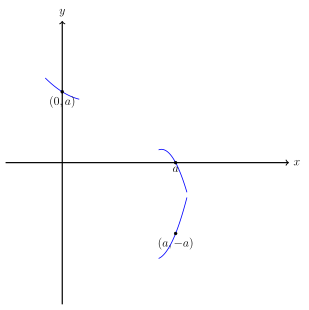
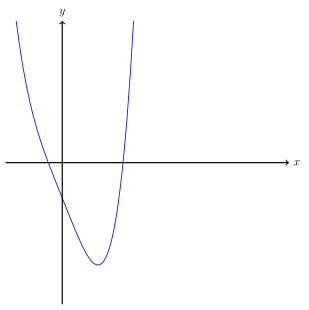
The points \(P\,(0,a),\) \(Q\,(a,0)\) and \(R\,(a,-a)\) lie on the curve \(C\) with cartesian equation \[ xy^{2}+x^{3}+a^{2}y-a^{3}=0,\qquad\mbox{ where }a>0. \] At each of \(P,Q\) and \(R\), express \(y\) as a Taylor series in \(h\), where \(h\) is a small increment in \(x\), as far as the term in \(h^{2}.\) Hence, or otherwise, sketch the shape of \(C\) near each of these points. Show that, if \((x,y)\) lies on \(C\), then \[ 4x^{4}-4a^{3}x-a^{4}\leqslant0. \] Sketch the graph of \(y=4x^{4}-4a^{3}x-a^{4}.\) Given that the \(y\)-axis is an asymptote to \(C\), sketch the curve \(C\).
Solution: \begin{align*} && 0 &= xy^{2}+x^{3}+a^{2}y-a^{3} \\ \frac{\d }{\d x} : && 0 &= y^2+2xyy' + 3x^2+a^2y' \\ \Rightarrow && y' &= -\frac{y^2+3x^2}{a^2+2xy} \\ \\ \frac{\d^2 }{\d x^2}: && 0 &= 2yy'+2yy'+2x(y')^2+2xyy''+6x+a^2y'' \\ \Rightarrow && y'' &= -\frac{4yy'+2x(y')^2+6x}{a^2+2xy} \\ \\ P: && y &= a \\ && y' &= -\frac{a^2}{a^2} = -1 \\ && y'' &= -\frac{-4a}{a^2} = \frac{4}{a} \\ \Rightarrow && y &\approx a - h+\frac{2}{a}h^2 \\ \\ Q: && y &= 0 \\ && y' &= -\frac{3a^2}{a^2} = -3 \\ && y'' &= -\frac{18a+6a}{a^2} = -\frac{24}{a} \\ \Rightarrow && y &\approx 0-3h-\frac{12}{a}h \\ \\ R: && y &= -a \\ && y' &= -\frac{a^2+3a^2}{a^2-2a^2} = 4 \\ && y'' &= -\frac{-16a+32a+6a}{a^2-2a^2} = \frac{22}{a} \\ \Rightarrow && y &\approx -a+4h + \frac{11}{a}h^2 \end{align*} Alternatively: \begin{align*} && 0 &= xy^{2}+x^{3}+a^{2}y-a^{3} \\ P(0,a): && y &\approx a + c_1h + c_2h^2 \\ && 0 &= h(a+c_1h)^2 + a^2(a + c_1h + c_2h^2)-a^3 \\ &&&= a^3-a^3 + (a^2+a^2c_1)h+(2ac_1+a^2c_2)h^2 \\ \Rightarrow && c_1 &=-1, c_2 =\frac{2}{a} \\ \Rightarrow && y &\approx a - h + \frac{2}{a}h^2 \\ \\ Q(a,0): && y &\approx c_1h + c_2h^2 \\ && 0 &= (a+h)(c_1h)^2+(a+h)^3+a^2(c_1h + c_2h^2 )-a^3 \\ &&&= a^3-a^3+(3a^2+a^2c_1)h + (ac_1^2+3a+a^2c_2)h^2 + \cdots \\ \Rightarrow && c_1 &=-3, c_2 = -\frac{12}{a} \\ \Rightarrow && y &\approx -3h -\frac{12}{a}h \\ \\ R(a,-a): && y &\approx -a + c_1h + c_2h^2 \\ && 0 &= (a+h)(-a + c_1h+c_2h^2)^2+(a+h)^3+a^2(-a + c_1h + c_2h^2)-a^3 \\ &&&= (a^2-2a^2c_1+3a^2+a^2c_1)h+(-2ac_1+c_1^2+\cdots)h^2 \\ \Rightarrow && c_1 &=4, c_2 = \frac{11}{a} \\ \Rightarrow && y &\approx -a + 4h + \frac{11}{a} \end{align*}

1990 Paper 3 Q9
The real variables \(\theta\) and \(u\) are related by the equation \(\tan\theta=\sinh u\) and \(0\leqslant\theta<\frac{1}{2}\pi.\) Let \(v=\mathrm{sech}u.\) Prove that
- \(v=\cos\theta;\)
- \(\dfrac{\mathrm{d}\theta}{\mathrm{d}u}=v;\)
- \(\sin2\theta=-2\dfrac{\mathrm{d}v}{\mathrm{d}u}\quad\) and \(\quad\cos2\theta=-\cosh u\dfrac{\mathrm{d}^{2}v}{\mathrm{d}u^{2}};\)
- \({\displaystyle \frac{\mathrm{d}u}{\mathrm{d}\theta}\frac{\mathrm{d}^{2}v}{\mathrm{d}\theta^{2}}+\frac{\mathrm{d}v}{\mathrm{d}\theta}\frac{\mathrm{d}^{2}u}{\mathrm{d}\theta^{2}}+\left(\frac{\mathrm{d}u}{\mathrm{d}\theta}\right)^{2}=0.}\)
Solution:
- \begin{align*} v &= \mathrm{sech} u \\ &= \frac{1}{\mathrm{cosh } u} \\ &= \frac{1}{\sqrt{1+\mathrm{sinh}^2 u}} \tag{\(u > 0\)} \\ &= \frac{1}{\sqrt{1+\tan^2 \theta}} \\ &= \frac{1}{\sqrt{\mathrm{sec}^2 \theta}} \\ &= \cos \theta \tag{\(0 < \theta < \tfrac{\pi}{2}\)} \end{align*}
- \begin{align*} && \tan \theta &= \textrm{sinh} u \\ \underbrace{\Rightarrow}_{\frac{\d}{\d u}} && \sec^2 \theta \cdot \frac{\d \theta}{\d u} &= \cosh u \\ \Rightarrow && \frac{\d \theta}{\d u} &=\cosh u \cdot \cos^2 \theta \\ &&&= \frac{1}{v} \cdot v^2 \\ &&&=v \end{align*}
- \begin{align*} \sin 2 \theta &= 2 \sin \theta \cos \theta \\ &= 2 \sin \theta \cdot \frac{\d \theta}{\d u} \\ &= -2 \frac{\d v}{\d \theta} \cdot \frac{\d \theta}{\d u} \tag{\(\cos \theta = v\)} \\ &= -2 \frac{\d v}{\d u} \end{align*} \begin{align*} && \sin 2 \theta &= -2 \frac{\d v}{\d u} \\ \underbrace{\Rightarrow}_{\frac{\d}{\d u}} && 2 \cos 2 \theta \cdot \frac{\d \theta}{\d u} &= -2 \frac{\d^2 v}{\d u^2} \\ \Rightarrow && \cos 2 \theta &= - \frac{\d^2 v}{\d u^2} \frac{1}{v} \\ &&&= -\frac{\d ^2v}{\d u^2} \cosh u \end{align*}
- \begin{align*} && \frac{\d u}{\d \theta} &= \frac{1}{v} \\ \Rightarrow && \frac{\d^2 u}{\d \theta^2} &= -\frac{1}{v^2} \frac{\d v}{\d \theta} \\ &&&= \frac{1}{v^2} \sin \theta \\ && \frac{\d v}{\d \theta} &= -\sin \theta \\ \Rightarrow && \frac{\d^2 v}{\d \theta^2} &= -\cos \theta \\ &&&= - v \\ \end{align*} Therefore \begin{align*} \frac{\mathrm{d}u}{\mathrm{d}\theta}\frac{\mathrm{d}^{2}v}{\mathrm{d}\theta^{2}}+\frac{\mathrm{d}v}{\mathrm{d}\theta}\frac{\mathrm{d}^{2}u}{\mathrm{d}\theta^{2}}+\left(\frac{\mathrm{d}u}{\mathrm{d}\theta}\right)^{2} &= \frac{1}{v} \cdot \left (-v\right) + \left ( - \sin \theta \right ) \cdot \left (\frac{1}{v^2} \sin \theta \right) + \frac{1}{v^2} \\ &= -1 + \frac{1-\sin^2 \theta}{v^2} \\ &= -1 + \frac{\cos^2 \theta}{v^2} \\ &= -1 + 1 \\ &= 0 \end{align*}