Problems
Filters
72 problems found
2012 Paper 3 Q2
In this question, \(\vert x \vert <1\) and you may ignore issues of convergence.
- Simplify \[ (1-x)(1+x)(1+x^2)(1+x^4) \cdots (1+x^{2^n})\,, \] where \(n\) is a positive integer, and deduce that \[ \frac1{1-x} = (1+x)(1+x^2)(1+x^4) \cdots (1+x^{2^n}) + \frac {x^{2^{n+1}}}{1-x}\,. \] Deduce further that \[ \ln(1-x) = - \sum_{r=0}^\infty \ln \left (1+ x ^{2^r}\right) \,, \] and hence that \[ \frac1 {1-x} = \frac 1 {1+x} + \frac {2x}{1+x^2} + \frac {4x^3}{1+x^4} +\cdots\,. \]
- Show that \[ \frac{1+2x}{1+x+x^2} = \frac{1-2x}{1-x+x^2} + \frac{2x-4x^3}{1-x^2+x^4} + \frac {4x^3-8x^7}{1-x^4+x^8} + \cdots\,. \]
Solution:
- \begin{align*} (1-x)&(1+x)(1+x^2)(1+x^4) \cdots (1+x^{2^n}) \\ &= (1-x^2)(1+x^2)(1+x^4) \cdots (1+x^{2^n}) \\ &= (1-x^4)(1+x^4) \cdots (1+x^{2^n}) \\ &= 1-x^{2^{n+1}} \\ \end{align*} Therefore, \begin{align*} && \frac{1}{1-x} - \frac{x^{2^{n+1}}}{1-x} &= (1+x)(1+x^2)\cdots(1+x^{2^n}) \\ \Rightarrow && \frac{1}{1-x} &=(1+x)(1+x^2)\cdots(1+x^{2^n})+ \frac{x^{2^{n+1}}}{1-x} \\ \Rightarrow && -\ln (1-x) &= \sum_{r=0}^{\infty} \ln (1+x^{2^r}) \\ \Rightarrow && \ln(1-x) &= - \sum_{r=0}^{\infty} \ln (1+x^{2^r}) \\ \underbrace{\Rightarrow}_{\frac{\d}{\d x}} && \frac{1}{1-x} &= \sum_{r=0}^{\infty} \frac{2^r x^{2^r-1}}{1+x^{2^r}} \\ &&&= \frac{1}{1+x} + \frac{2x}{1+x^2} + \frac{4x^3}{1+x^4} + \cdots \end{align*}
- Consider \begin{align*}(1+x+x^2)&(1-x+x^2)(1-x^2+x^4)\cdots(1-x^{2^n}+x^{2^{n+1}}) \\ &= (1+x^2 + x^4)(1-x^2+x^4) \cdots (1-x^{2^n}+x^{2^{n+1}}) \\ &= (1-x^{2^{n+1}}+x^{2^{n+2}}) \\ \end{align*} Therefore, \begin{align*} && \frac{1}{1+x+x^2} &= (1-x+x^2)(1-x^2+x^4)\cdots(1-x^{2^n}+x^{2^{n+1}}) + \frac{x^{2^{n+1}}}{1+x+x^2} -\frac{x^{2^{n+2}}}{1+x+x^2} \\ \Rightarrow && -\ln(1+x+x^2) &= \sum_{r=0}^\infty \ln (1 - x^{2^r}+x^{2^{r+1}}) \\ \underbrace{\Rightarrow}_{\frac{\d}{\d x}} && -\frac{1+2x}{1+x+x^2} &= \sum_{r=0}^{\infty} \frac{ -2^r x^{2^r-1}+2^{r+1}x^{2^{r+1}-1}}{1 - x^{2^r}+x^{2^{r+1}}} \\ &&&= \frac{-1+2x}{1-x+x^2}+\frac{-2x+4x^3}{1-x^2+x^4} + \frac{-4x^3+8x^7}{1-x^4+x^8} + \cdots \end{align*} Which is the desired result when we multiply both sides by \(-1\)
2012 Paper 3 Q7
A pain-killing drug is injected into the bloodstream. It then diffuses into the brain, where it is absorbed. The quantities at time \(t\) of the drug in the blood and the brain respectively are \(y(t)\) and \(z(t)\). These satisfy \[ \dot y = - 2(y-z)\,, \ \ \ \ \ \ \ \dot z = - \dot y -3z\, , \] where the dot denotes differentiation with respect to \(t\). Obtain a second order differential equation for \(y\) and hence derive the solution \[ y= A\e^{-t} + B\e ^{-6t}\,, \ \ \ \ \ \ \ z= \tfrac12 A \e^{-t} - 2 B \e^{-6t}\,, \] where \(A\) and \(B\) are arbitrary constants. \begin{questionparts} \item Obtain the solution that satisfies \(z(0)=0\) and \(y(0)= 5\). The quantity of the drug in the brain for this solution is denoted by \(z_1(t)\). \item Obtain the solution that satisfies $ z(0)=z(1)= c$, where \(c\) is a given constant. %\[ %C=2(1-\e^{-1})^{-1} - 2(1-\e^{-6})^{-1}\,. %\] The quantity of the drug in the brain for this solution is denoted by \(z_2(t)\). \item Show that for \(0\le t \le 1\), \[ z_2(t) = \sum _{n=-\infty}^{0} z_1(t-n)\,, \] provided \(c\) takes a particular value that you should find. \end {questionparts}
2011 Paper 2 Q12
Xavier and Younis are playing a match. The match consists of a series of games and each game consists of three points. Xavier has probability \(p\) and Younis has probability \(1-p\) of winning the first point of any game. In the second and third points of each game, the player who won the previous point has probability \(p\) and the player who lost the previous point has probability \(1-p\) of winning the point. If a player wins two consecutive points in a single game, the match ends and that player has won; otherwise the match continues with another game.
- Let \(w\) be the probability that Younis wins the match. Show that, for \(p\ne0\), \[ w = \frac{1-p^2}{2-p}. \] Show that \(w>\frac12\) if \(p<\frac12\), and \(w<\frac12\) if \(p>\frac12\). Does \(w\) increase whenever \(p\) decreases?
- If Xavier wins the match, Younis gives him \(\pounds1\); if Younis wins the match, Xavier gives him \(\pounds k\). Find the value of \(k\) for which the game is `fair' in the case when \(p =\frac23\).
- What happens when \(p = 0\)?
Solution:
- We can be in several states.
- No points played
- Y just won the last point
- X just won the last point
- Y won the game
- X won the game
- If \(p = \frac23\) then \(w = \frac{1-\frac49}{2-\frac23} = \frac{5}{12}\). The game is fair if \(\mathbb{E}(result) = 0\), ie \(\frac{5}{12} \cdot k - \frac{7}{12} 1 \Rightarrow k = \frac{7}{5} = 1.4\)
- If \(p = 0\) then they will keep playing forever, since no-one can win two points in a row.
2010 Paper 1 Q11
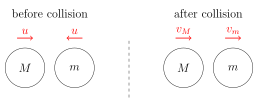
Two particles of masses \(m\) and \(M\), with \(M>m\), lie in a smooth circular groove on a horizontal plane. The coefficient of restitution between the particles is \(e\). The particles are initially projected round the groove with the same speed \(u\) but in opposite directions. Find the speeds of the particles after they collide for the first time and show that they will both change direction if \(2em> M-m\). After a further \(2n\) collisions, the speed of the particle of mass \(m\) is \(v\) and the speed of the particle of mass \(M\) is \(V\). Given that at each collision both particles change their directions of motion, explain why \[ mv-MV = u(M-m), \] and find \(v\) and \(V\) in terms of \(m\), \(M\), \(e\), \(u\) and \(n\).
Solution: All the forces in the circular groove will be perpendicular to the direction of motion. Therefore the particles will continue moving with constant speed at all times (aside from collisions). We can consider the collisions to occur as if along a tangent, (since they will be travelling perfectly perpendicular at the collisions).
2010 Paper 2 Q3
The first four terms of a sequence are given by \(F_0=0\), \(F_1=1\), \(F_2=1\) and \(F_3=2\). The general term is given by \[ F_n= a\lambda^n+b\mu^n\,, \tag{\(*\)} \] where \(a\), \(b\), \(\lambda\) and \(\mu\) are independent of \(n\), and \(a\) is positive.
- Show that \(\lambda^2 +\lambda\mu+ \mu^2 = 2\), and find the values of \(\lambda\), \(\mu\), \(a\) and \(b\).
- Use \((*)\) to evaluate \(F_6\).
- Evaluate \(\displaystyle \sum_{n=0}^\infty \frac{F_n}{2^{n+1}}\,.\)
Solution:
- \(\,\) \begin{align*} && 0 &= a+b \tag{1}\\ && 1 &= a\lambda -a\mu \tag{2} \\ && 1 &= a\lambda^2 -a\mu^2 \tag{3} \\ && 2 &= a\lambda^3 - a\mu^3 \tag{4} \\ (4) \div (2): && 2 & = \lambda^2+\lambda \mu + \mu^2 \\ (3) \div (2): && 1 &= \lambda + \mu \\ \Rightarrow && 2 &= \lambda^2 + \lambda(1-\lambda) + (1-\lambda)^2 \\ &&&= \lambda^2-\lambda+1\\ \Rightarrow && \lambda, \mu &= \frac{1 \pm \sqrt{5}}{2} \\ \Rightarrow && a &= \frac{1}{\lambda - \mu} = \frac{1}{\sqrt{5}} \\ \Rightarrow && b &= -\frac{1}{\sqrt{5}} \end{align*} (NB: This is Binet's formula)
- \(\,\) \begin{align*} F_6 &= \frac{1}{\sqrt{5}} \left ( \left ( \frac{1 +\sqrt{5}}{2} \right)^6- \left ( \frac{1 -\sqrt{5}}{2} \right)^6 \right) \\ &= \frac{1}{2^6 \sqrt{5}} \left ( (1+\sqrt{5})^6-(1-\sqrt{5})^6 \right) \\ &= \frac{1}{2^5 \cdot \sqrt{5}} \left (6 \sqrt{5} +\binom{6}{3} (\sqrt{5})^3+\binom{6}{5}(\sqrt{5})^5 \right)\\ &= \frac{1}{2^5} \left (6 +20\cdot 5+6\cdot 5^2 \right)\\ &= \frac{1}{2^5} 256 = 2^3 = 8 \end{align*} (way more painful than just computing it by adding terms!)
- \(\,\) \begin{align*} && \sum_{n=0}^{\infty} \frac{F_n}{2^{n+1}} &= \sum_{n=0}^{\infty} \frac{a\lambda^n + b\mu^n}{2^{n+1}} \\ &&&= \frac12 \left ( \frac{a}{1-\frac{\lambda}2} + \frac{b}{1-\frac{\mu}2} \right) \\ &&&= \frac12 \left ( \frac{2a}{2-\lambda} + \frac{2b}{2-\mu}\right) \\ &&&= \frac{2a}{4-2\lambda} + \frac{2b}{4-2\mu}\\ &&&= \frac{2a}{4-(1+\sqrt{5})} - \frac{2a}{4-(1-\sqrt{5})} \\ &&&= \frac{2}{3\sqrt{5}-5} - \frac{2}{3\sqrt{5}+5} \\ &&&= \frac{6\sqrt{5}+10-6\sqrt{5}+10}{45-25} \\ &&&= 1 \end{align*}
2010 Paper 2 Q8
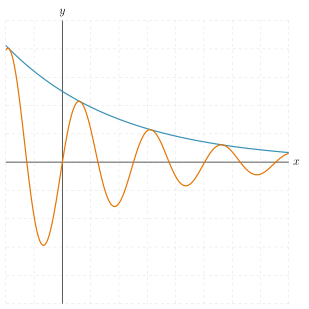
The curves \(C_1\) and \(C_2\) are defined by \[ y= \e^{-x} \quad (x>0) \quad \text{ and } \quad y= \e^{-x}\sin x \quad (x>0), \] respectively. Sketch roughly \(C_1\) and \(C_2\) on the same diagram. Let \(x_n\) denote the \(x\)-coordinate of the \(n\)th point of contact between the two curves, where \(0 < x_1 < x_2 < \cdots\), and let \(A_n\) denote the area of the region enclosed by the two curves between \(x_n\) and \(x_{n+1}\). Show that \[ A_n = \tfrac12(\e^{2\pi}-1) \e^{-(4n+1)\pi/2} \] and hence find \(\displaystyle \sum_{n=1}^\infty A_n\).
Solution:
2009 Paper 2 Q6
The Fibonacci sequence \(F_1\), \(F_2\), \(F_3\), \(\ldots\) is defined by \(F_1=1\), \(F_2= 1\) and \[ F_{n+1} = F_n+F_{n-1} \qquad\qquad (n\ge 2). \] Write down the values of \(F_3\), \(F_4\), \(\ldots\), \(F_{10}\). Let \(\displaystyle S=\sum_{i=1}^\infty \dfrac1 {F_i}\,\).
- Show that \(\displaystyle \frac 1{F_i} > \frac1{2F_{i-1}}\,\) for \(i\ge4\) and deduce that \(S > 3\,\). Show also that \(S < 3\frac23\,\).
- Show further that \(3.2 < S < 3.5\,\).
Solution: \begin{array}{c|r} n & F_n \\ \hline 1 & 1 \\ 2 & 1 \\ 3 & 2 \\ 4 & 3 \\ 5 & 5 \\ 6 & 8 \\ 7 & 13 \\ 8 & 21 \\ 9 & 34 \\ 10 & 55 \end{array} \begin{questionparts} \item Claim: \(\frac1{F_i} > \frac1{2F_{i-1}}\) for \(i \geq 4\). Proof: Since \(F_i = F_{i-1}+F_{i-2}\) and \(F_i > 1\) for \(i \geq 1\) we have \(F_i > F_{i-1}\) for \(i \geq 3\). In particular we have \(F_i = F_{i-1}+F_{i-2} < 2F_{i-1}\) for \(i -1 \geq 3\) or \(i \geq 4\). Therefore \(\frac{1}{F_i} > \frac1{2F_{i-1}}\)
2009 Paper 3 Q12
- Albert tosses a fair coin \(k\) times, where \(k\) is a given positive integer. The number of heads he gets is \(X_1\). He then tosses the coin \(X_1\) times, getting \(X_2\) heads. He then tosses the coin \(X_2\) times, getting \(X_3\) heads. The random variables \(X_4\), \(X_5\), \(\ldots\) are defined similarly. Write down \(\E(X_1)\). By considering \(\E(X_2 \; \big\vert \; X_1 = x_1)\), or otherwise, show that \(\E(X_2) = \frac14 k\). Find \(\displaystyle \sum_{i=1}^\infty \E(X_i)\).
- Bertha has \(k\) fair coins. She tosses the first coin until she gets a tail. The number of heads she gets before the first tail is \(Y_1\). She then tosses the second coin until she gets a tail and the number of heads she gets with this coin before the first tail is \(Y_2\). The random variables \(Y_3, Y_4, \ldots\;\), \(Y_k\) are defined similarly, and \(Y= \sum\limits_{i=1}^k Y_i\,\). Obtain the probability generating function of \(Y\), and use it to find \(\E(Y)\), \(\var(Y)\) and \(\P(Y=r)\).
Solution:
- \(X_1 \sim B(k, \tfrac12)\) so \(\E[X_1] = \frac{k}{2}\) Note that \(X_2 | X_1 = x_1 \sim B(x_1, \tfrac12)\) so \(\E[X_2 | X_1 = x_1) = \frac{x_1}{2}\) or \(\E[X_2 | X_1] = \frac12 X_1\). Therefore by the tower law, \(\E[\E[X_2|X_1]] = \E[\frac12 X_1] = \frac14k\) Notice also that \(\E[X_n] = \frac1{2^n} k\) and so \begin{align*} && \sum_{i=1}^\infty \E[X_i] &= \sum_{i=1}^{\infty} \frac1{2^i} k \\ &&&= \frac{\frac12 k}{1-\frac12} = k \end{align*}
- Note that \(Y_1 \sim Geo(\tfrac12)-1\) which has generating function \(\E[t^{Y_1}] = \E[t^{G-1}] = \frac{\frac12 t}{1-(1-\frac12)t}\frac1{t} = \frac{\frac12}{1-\frac12t}\). Notice that \begin{align*} && \E \left [ t^Y \right] &= \E \left [ t^{\sum_{i=1}^kY_i} \right] \\ &&&= \prod_{i=1}^k \E[t^{Y_i}] \\ &&&= \frac{1}{(2-t)^k} \end{align*} Therefore \(\E[Y] = G'(1) = k(2-1)^{-(k+1)} = k\) \(\E[Y^2] = (tG'(t))'|_{t=1} = k(k+1)(2-1)^{-(k+2)}+k(2-1)^{-(k+1)} = k^2+2k\) so \(\var[Y] = k^2+2k - k^2 =2 k\). Finally \(\mathbb{P}(Y=r) = \binom{k+r-1}{k} \frac{1}{2^{r+k}}\)
2008 Paper 2 Q2
Let \(a_n\) be the coefficient of \(x^n\) in the series expansion, in ascending powers of \(x\), of \[\displaystyle \frac{1+x}{(1-x)^2(1+x^2)} \,, \] where \(\vert x \vert <1\,\). Show, using partial fractions, that either \(a_n =n+1\) or \(a_n = n+2\) according to the value of \(n\). Hence find a decimal approximation, to nine significant figures, for the fraction \( \displaystyle \frac{11\,000}{8181}\). \newline [You are not required to justify the accuracy of your approximation.]
Solution: \begin{align*} && \frac{1+x}{(1-x)^2(1+x^2)} &= \frac{A}{1-x} + \frac{B}{(1-x)^2} + \frac{Cx+D}{1+x^2} \\ \Rightarrow && 1 + x &= A(1-x)(1+x^2) + B(1+x^2) + Cx(1-x)^2 + D(1-x)^2 \\ \Rightarrow && 2 &= 2B \tag{\(x = 1\)} \\ \Rightarrow && 1 &= B \\ \Rightarrow && 1 &= A+B+D \tag{\(x = 0\)}\\ \Rightarrow && A &= -D \\ \Rightarrow && 0 &= 4A+2B-4C+4D \tag{\(x = -1\)}\\ \Rightarrow && C &= \frac12\\ \Rightarrow && 3 &= -5A+5B+2C+D \tag{\(x=2\)} \\ \Rightarrow && 3 &= -6A+6 \\ \Rightarrow && A,D &=-\frac12,\frac12 \\ \Rightarrow && \frac{1+x}{(1-x)^2(1+x^2)} &= \frac{1}{(1-x)^2} +\frac{1}{2(1-x)}+ \frac{x-1}{2(1+x^2)} \\ &&&=\sum_{k=0}^{\infty}(k+1)x^k + \sum_{k=0}^{\infty}\frac12 x^k + \sum_{k=0}^{\infty}\frac12 (-1)^kx^{2k+1} - \sum_{k=0}^{\infty}\frac12 (-1)^kx^{2k} \end{align*} Therefore the coefficient of \(x^n\) is \(n+1\) or \(n+2\) depending on whether the coefficients from the final series add constructively \(n \equiv 1, 2 \pmod{4}\) or destructively. \begin{align*} \frac{11\, 000}{8181} &= \frac{(10+1) \cdot 1000}{(10-1)^2 \cdot (100+1)} \\ &= \frac{(1+\frac{1}{10})}{(1-\frac{1}{10})^2 \cdot (1+\frac1{10})} \\ &= 1 + \frac3{10} + \frac4{10^2} + \frac{4}{10^3}+\frac{5}{10^4} + \frac{7}{10^5} + \frac{8}{10^6} + \cdots \\ & \quad \quad \cdots + \frac{8}{10^7} + \frac{9}{10^8} + \frac{11}{10^9} + \frac{12}{10^{10}} + \cdots \\ &= 1.34457890 + \frac{12}{10^{10}} + \cdots \end{align*} \begin{align*} && \sum_{k=m}^{\infty} (k+2)x^k &= x^m \sum_{k=0}^{\infty} (k+m+2)x^{k} \\ && &= \frac{x^k}{(1-x)^2} + \frac{(m+2)x^k}{1-x} \\ \Rightarrow && |\sum_{k=m}^{\infty} a_k \left ( \frac1{10} \right )^k | &\leq \frac{1}{10^m}\left ( \frac{1}{(1-\frac1{10})^2} + \frac{m+2}{1-\frac1{10}} \right) \\ &&&= \frac{1}{10^{m-1}} \left ( \frac{9m+28}{81}\right ) \end{align*} Therefore for this will be less than \(10^{-9}\), when \(m = 11\), so our approximation is valid to 9sf
2008 Paper 3 Q8
- The coefficients in the series \[ S= \tfrac13 x + \tfrac 16 x^2 + \tfrac1{12} x^3 + \cdots + a_rx^r + \cdots \] satisfy a recurrence relation of the form \(a_{r+1} + p a_r =0\). Write down the value of \(p\). By considering \((1+px)S\), find an expression for the sum to infinity of \(S\) (assuming that it exists). Find also an expression for the sum of the first \(n+1\) terms of \(S\).
- The coefficients in the series \[ T=2 + 8x +18x^2+37 x^3 +\cdots + a_rx^r + \cdots \] satisfy a recurrence relation of the form \(a_{r+2}+pa_{r+1} +qa_r=0\). Find an expression for the sum to infinity of \(T\) (assuming that it exists). By expressing \(T\) in partial fractions, or otherwise, find an expression for the sum of the first \(n+1\) terms of \(T\).
2006 Paper 1 Q13
A very generous shop-owner is hiding small diamonds in chocolate bars. Each diamond is hidden independently of any other diamond, and on average there is one diamond per kilogram of chocolate.
- I go to the shop and roll a fair six-sided die once. I decide that if I roll a score of \(N\), I will buy \(100N\) grams of chocolate. Show that the probability that I will have no diamonds is \[ \frac{\e^{-0.1}}{ 6} \l \frac{1 - \e^{-0.6} }{ 1 - \e^{-0.1}} \r \] Show also that the expected number of diamonds I find is 0.35.
- Instead, I decide to roll a fair six-sided die repeatedly until I score a 6. If I roll my first 6 on my \(T\)th throw, I will buy \(100T\) grams of chocolate. Show that the probability that I will have no diamonds is \[ \frac{\e^{-0.1}}{ 6 - 5\e^{-0.1}} \] Calculate also the expected number of diamonds that I find. (You may find it useful to consider the the binomial expansion of \(\l 1 - x \r^{-2}\).)
Solution: Not that the number of diamonds per kilogram is \(1\) so we are assuming it is \(Po(M)\) where \(M\) is the mass in kg. In particular \(\E[X] = M\) and \(\mathbb{P}(X = 0) = e^{-M}\)
- \(\,\) \begin{align*} && \mathbb{P}(\text{no diamonds}) &= \sum_{n=1}^6\mathbb{P}(\text{no diamonds and roll }n) \\ &&&= \sum_{n=1}^6 \tfrac16 e^{-\frac{n}{10}} \\ &&&= \frac{e^{-0.1}}6 \left ( \frac{1-e^{-0.6}}{1-e^{-0.1}}\right) \\ && \E[\text{diamonds}] &= \sum_{n=1}^6 \E(\text{diamonds}|N = n)\mathbb{P}(N = n) \\ &&&= \sum_{n=1}^6 0.1n \cdot \frac16 \\ &&&= 0.1 \cdot \frac{7}{2} = 0.35 \end{align*}
- \(\mathbb{P}(T = k) = \left ( \frac56 \right)^{t-1} \frac16\), so \begin{align*} && \mathbb{P}(\text{no diamonds}) &= \sum_{n=1}^\infty\mathbb{P}(\text{no diamonds and }T=n) \\ &&&= \sum_{n=1}^\infty e^{-0.1n} \left ( \frac56 \right)^{n-1} \frac16 \\ &&&= \frac{e^{-0.1}}{6} \frac1{1- \frac56 e^{-0.1}} \\ &&&= \frac{e^{-0.1}}{6 - 5e^{-0.1}} \\ \\ && \E[\text{diamonds}] &= \sum_{n=1}^\infty \E(\text{diamonds}|T = n)\mathbb{P}(T = n) \\ &&&= \sum_{n=1}^\infty 0.1n \cdot \left ( \frac56 \right)^{n-1} \frac16 \\ &&&= \frac{0.1}{6} \sum_{n=1}^\infty n \cdot \left ( \frac56 \right)^{n-1} \\ &&&= \frac{1}{60} \frac{1}{(1- \tfrac56)^2} \\ &&&= \frac{6}{10} = \frac35 \end{align*}
2005 Paper 3 Q9
Two particles, A and B, move without friction along a horizontal line which is perpendicular to a vertical wall. The coefficient of restitution between the two particles is \(e\) and the coefficient of restitution between particle B and the wall is also \(e\), where \( 0< e < 1\). The mass of particle~A is \(4em\) (with \(m > 0\)), and the mass of particle B is \((1-e)^2m\)\,. Initially, A is moving towards the wall with speed \((1-e)v\) (where \(v > 0\)) and B is moving away from the wall and towards A with speed \(2ev\). The two particles collide at a distance \(d\) from the wall. Find the speeds of A and B after the collision. When B strikes the wall, it rebounds along the same line. Show that a second collision will take place, at a distance \(de\) from the wall. Deduce that further collisions will take place. Find the distance from the wall at which the \(n\)th collision takes place, and show that the times between successive collisions are equal.
2004 Paper 1 Q2
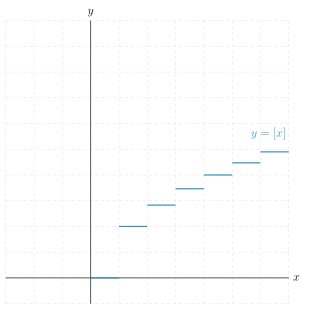
The square bracket notation \(\boldsymbol{[} x\boldsymbol{]}\) means the greatest integer less than or equal to \(x\,\). For example, \(\boldsymbol{[}\pi\boldsymbol{]} = 3\,\), \(\boldsymbol{[}\sqrt{24}\,\boldsymbol{]} = 4\,\) and \(\boldsymbol{[}5\boldsymbol{]}=5\,\).
- Sketch the graph of \(y = \sqrt{\boldsymbol{[}x\boldsymbol{]}}\) and show that \[ \displaystyle \int^a_0 \sqrt{\boldsymbol{[}x\boldsymbol{]}} \; \mathrm{d}x = \sum^{a-1}_{r=0} \sqrt{r} \] when \(a\) is a positive integer.
- Show that $\displaystyle \int^{a}_0 2_{\vphantom{A}}^{\pmb{\boldsymbol {[} } x \pmb{ \boldsymbol{]}} }\; \mathrm{d}x = 2^{a}-1\( when \)a\( is a positive integer.
- Determine an expression for \)\displaystyle \int^{a}_0 2_{\vphantom{\dot A}}^{\pmb{\boldsymbol{[} }x \pmb{ \boldsymbol{]}} } \; \mathrm{d}x\( when \)a$ is positive but not an integer.
Solution:
- \(\,\) \begin{align*} && \int_0^a \sqrt{\boldsymbol{[}x\boldsymbol{]}} \d x &= \sum_{r=0}^{a-1} \int_{x=r}^{x=r+1} \sqrt{\boldsymbol{[}x\boldsymbol{]}} \d x \\ &&&= \sum_{r=0}^{a-1} \int_r^{r+1} \sqrt{r} \d x \\ &&&= \sum_{r=0}^{a-1} \sqrt{r} \\ \end{align*}
- \(\,\) \begin{align*} && \int^{a}_0 2^{\boldsymbol {[} x \boldsymbol{]}} \d x &= \sum_{r=0}^{a-1} \int_{x=r}^{x=r+1} 2^{\boldsymbol {[} x \boldsymbol{]}} \d x \\ &&&= \sum_{r=0}^{a-1} \int_{x=r}^{x=r+1} 2^{r} \d x \\ &&&= \sum_{r=0}^{a-1} 2^{r}\\ &&&= 2^{a}-1 \end{align*}
- \(\,\) \begin{align*} && \int^{a}_0 2^{\boldsymbol {[} x \boldsymbol{]}} \d x &= \int_0^{\boldsymbol {[} a \boldsymbol{]}} 2^{\boldsymbol {[} x \boldsymbol{]}} \d x + \int_{\boldsymbol {[} a \boldsymbol{]}}^a 2^{\boldsymbol {[} x \boldsymbol{]}} \d x \\ &&&= 2^{ \boldsymbol {[} a \boldsymbol{]}}-1 + (a-\boldsymbol {[} a \boldsymbol{]})2^{\boldsymbol {[} a \boldsymbol{]}} \\ &&&= (a-\boldsymbol {[} a \boldsymbol{]}+1)2^{\boldsymbol {[} a \boldsymbol{]}} -1 \end{align*}
2004 Paper 1 Q7
- The function \(\f(x)\) is defined for \(\vert x \vert < \frac15\) by \[ \f(x) = \sum_{n=0}^\infty a_n x^n\;, \] where \(a_0=2\), \(a_1=7\) and \(a_n =7a_{n-1} - 10a_{n-2}\) for \(n\ge{2}\,\). Simplify \(\f(x) - 7x\f(x) + 10x^2\f(x)\,\), and hence show that \(\displaystyle\f(x) = {1\over 1-2x} + {1 \over 1-5x} \;\). Hence show that \(a_n=2^n + 5^n\,\).
- The function \(\g(x)\) is defined for \(\vert x \vert < \frac13\) by \[ \g(x) = \sum_{n=0}^\infty b_n x^n \;, \] where \(b_0=5\,\), \(b_1 =10 \,\), \(b_2=40\,\), \(b_3=100\) and \(b_n = pb_{n-1} + qb_{n-2}\) for \(n\ge{2}\,\). Obtain an expression for \(\g(x)\) as the sum of two algebraic fractions and determine \(b_n\) in terms of \(n\).
Solution:
- \begin{align*} && f(x) -7xf(x)+10x^2f(x) &= \sum_{n=0}^\infty a_n x^n - 7x \sum_{n=0}^{\infty} a_n x^n + 10x^2 \sum_{n=0}^{\infty} a_nx^n \\ &&&= \sum_{n=2}^\infty (a_n-7a_{n-1}+10a_{n-2})x^n + a_0+a_1x-7a_0x \\ &&&= 0 + 2-7x \\ \\ \Rightarrow && f(x) &= \frac{2-7x}{1-7x+10x^2} \\ &&&= \frac{2-7x}{(1-5x)(1-2x)} \\ &&&= \frac{1}{1-2x} + \frac{1}{1-5x} \\ &&&= \sum_{n=0}^{\infty} (2^n + 5^n)x^n \end{align*} Therefore \(a_n = 2^n +5^n\)
- \(\,\) \begin{align*} && 40 &= 10p + 5 q \\ && 100 &= 40p+10q \\ && 10 &= 4p + q \\ \Rightarrow && (p,q) &= (1,6) \\ \\ && g(x) -xg(x)-6x^2g(x) &= 5+5x \\ \Rightarrow && g(x) &= \frac{5+5x}{1-x-6x^2} \\ &&&= \frac{5+5x}{(1-3x)(1+2x)} \\ &&&= \frac{4}{1-3x} + \frac{1}{1+2x} \\ &&&= \sum_{n=0}^{\infty} (4 \cdot 3^n + (-2)^n)x^n \\ \Rightarrow && b_n &= 4 \cdot 3^n + (-2)^n \end{align*}
2004 Paper 3 Q4
The triangle \(OAB\) is isosceles, with \(OA = OB\) and angle \(AOB = 2 \alpha\) where \(0< \alpha < {\pi \over 2}\,\). The semi-circle \(\mathrm{C}_0\) has its centre at the midpoint of the base \(AB\) of the triangle, and the sides \(OA\) and \(OB\) of the triangle are both tangent to the semi-circle. \(\mathrm{C}_1, \mathrm{C}_2, \mathrm{C}_3, \ldots\) are circles such that \(\mathrm{C}_n\) is tangent to \(\mathrm{C}_{n-1}\) and to sides \(OA\) and \(OB\) of the triangle. Let \(r_n\) be the radius of \(\mathrm{C}_n\,\). Show that \[ \frac{r_{n+1}}{r_n} = \frac{1-\sin\alpha}{1+\sin\alpha}\;. \] Let \(S\) be the total area of the semi-circle \(\mathrm{C}_0\) and the circles \(\mathrm{C}_1\), \(\mathrm{C}_2\), \(\mathrm{C}_3\), \(\ldots\;\). Show that \[ S = {1 + \sin^2 \alpha \over 4 \sin \alpha} \, \pi r_0^2 \;. \] Show that there are values of \(\alpha\) for which \(S\) is more than four fifths of the area of triangle~\(OAB\).