Problems
Filters
218 problems found
2023 Paper 3 Q3
- Show that, if \(a\) and \(b\) are complex numbers, with \(b \neq 0\), and \(s\) is a positive real number, then the points in the Argand diagram representing the complex numbers \(a + sbi\), \(a - sbi\) and \(a + b\) form an isosceles triangle. Given three points which form an isosceles triangle in the Argand diagram, explain with the aid of a diagram how to determine the values of \(a\), \(b\) and \(s\) so that the vertices of the triangle represent complex numbers \(a + sbi\), \(a - sbi\) and \(a + b\).
- Show that, if the roots of the equation \(z^3 + pz + q = 0\), where \(p\) and \(q\) are complex numbers, are represented in the Argand diagram by the vertices of an isosceles triangle, then there is a non-zero real number \(s\) such that \[\frac{p^3}{q^2} = \frac{27(3s^2 - 1)^3}{4(9s^2 + 1)^2}\,.\]
- Sketch the graph \(y = \dfrac{(3x-1)^3}{(9x+1)^2}\), identifying any stationary points.
- Show that if the roots of the equation \(z^3 + pz + q = 0\) are represented in the Argand diagram by the vertices of an isosceles triangle then \(\dfrac{p^3}{q^2}\) is a real number and \(\dfrac{p^3}{q^2} > -\dfrac{27}{4}\).
2023 Paper 3 Q6
- By considering the Maclaurin series for \(\mathrm{e}^x\), show that for all real \(x\), \[\cosh^2 x \geqslant 1 + x^2.\] Hence show that the function \(\mathrm{f}\), defined for all real \(x\) by \(\mathrm{f}(x) = \tan^{-1} x - \tanh x\), is an increasing function. Sketch the graph \(y = \mathrm{f}(x)\).
- Function \(\mathrm{g}\) is defined for all real \(x\) by \(\mathrm{g}(x) = \tan^{-1} x - \frac{1}{2}\pi \tanh x\).
- Show that \(\mathrm{g}\) has at least two stationary points.
- Show, by considering its derivative, that \((1+x^2)\sinh x - x\cosh x\) is non-negative for \(x \geqslant 0\).
- Show that \(\dfrac{\cosh^2 x}{1+x^2}\) is an increasing function for \(x \geqslant 0\).
- Hence or otherwise show that \(\mathrm{g}\) has exactly two stationary points.
- Sketch the graph \(y = \mathrm{g}(x)\).
2022 Paper 2 Q1
- By integrating one of the two terms in the integrand by parts, or otherwise, find \[\int \left(2\sqrt{1+x^3} + \frac{3x^3}{\sqrt{1+x^3}}\right)\,\mathrm{d}x\,.\]
- Find \[\int (x^2+2)\frac{\sin x}{x^3}\,\mathrm{d}x\,.\]
- Sketch the graph with equation \(y = \dfrac{\mathrm{e}^x}{x}\), giving the coordinates of any stationary points.
- Find \(a\) if \[\int_a^{2a} \frac{\mathrm{e}^x}{x}\,\mathrm{d}x = \int_a^{2a} \frac{\mathrm{e}^x}{x^2}\,\mathrm{d}x\,.\]
- Show that it is not possible to find distinct integers \(m\) and \(n\) such that \[\int_m^n \frac{\mathrm{e}^x}{x}\,\mathrm{d}x = \int_m^n \frac{\mathrm{e}^x}{x^2}\,\mathrm{d}x\,.\]
2022 Paper 2 Q4
- Show that the function \(\mathrm{f}\), given by the single formula \(\mathrm{f}(x) = |x| - |x-5| + 1\), can be written without using modulus signs as \[\mathrm{f}(x) = \begin{cases} -4 & x \leqslant 0\,,\\ 2x - 4 & 0 \leqslant x \leqslant 5\,,\\ 6 & 5 \leqslant x\,.\end{cases}\] Sketch the graph with equation \(y = \mathrm{f}(x)\).
- The function \(\mathrm{g}\) is given by: \[\mathrm{g}(x) = \begin{cases} -x & x \leqslant 0\,,\\ 3x & 0 \leqslant x \leqslant 5\,,\\ x + 10 & 5 \leqslant x\,.\end{cases}\] Use modulus signs to write \(\mathrm{g}(x)\) as a single formula.
- Sketch the graph with equation \(y = \mathrm{h}(x)\), where \(\mathrm{h}(x) = x^2 - x - 4|x| + |x(x-5)|\).
- The function \(\mathrm{k}\) is given by: \[\mathrm{k}(x) = \begin{cases} 10x & x \leqslant 0\,,\\ 2x^2 & 0 \leqslant x \leqslant 5\,,\\ 50 & 5 \leqslant x\,.\end{cases}\] Use modulus signs to write \(\mathrm{k}(x)\) as a single formula, explicitly verifying that your formula is correct.
2022 Paper 3 Q3
- The curve \(C_1\) has equation \[ ax^2 + bxy + cy^2 = 1 \] where \(abc \neq 0\) and \(a > 0\). Show that, if the curve has two stationary points, then \(b^2 < 4ac\).
- The curve \(C_2\) has equation \[ ay^3 + bx^2y + cx = 1 \] where \(abc \neq 0\) and \(b > 0\). Show that the \(x\)-coordinates of stationary points on this curve satisfy \[ 4cb^3 x^4 - 8b^3 x^3 - ac^3 = 0\,. \] Show that, if the curve has two stationary points, then \(4ac^6 + 27b^3 > 0\).
- Consider the simultaneous equations \begin{align*} ay^3 + bx^2 y + cx &= 1 \\ 2bxy + c &= 0 \\ 3ay^2 + bx^2 &= 0 \end{align*} where \(abc \neq 0\) and \(b > 0\). Show that, if these simultaneous equations have a solution, then \(4ac^6 + 27b^3 = 0\).
2022 Paper 3 Q6
- Show that when \(\alpha\) is small, \(\cos(\theta + \alpha) - \cos\theta \approx -\alpha\sin\theta - \frac{1}{2}\alpha^2\cos\theta\). Find the limit as \(\alpha \to 0\) of \[ \frac{\sin(\theta+\alpha) - \sin\theta}{\cos(\theta+\alpha) - \cos\theta} \qquad (*) \] in the case \(\sin\theta \neq 0\). In the case \(\sin\theta = 0\), what happens to the value of expression \((*)\) when \(\alpha \to 0\)?
- A circle \(C_1\) of radius \(a\) rolls without slipping in an anti-clockwise direction on a fixed circle \(C_2\) with centre at the origin \(O\) and radius \((n-1)a\), where \(n\) is an integer greater than \(2\). The point \(P\) is fixed on \(C_1\). Initially the centre of \(C_1\) is at \((na, 0)\) and \(P\) is at \(\big((n+1)a, 0\big)\).
- Let \(Q\) be the point of contact of \(C_1\) and \(C_2\) at any time in the rolling motion. Show that when \(OQ\) makes an angle \(\theta\), measured anticlockwise, with the positive \(x\)-axis, the \(x\)-coordinate of \(P\) is \(x(\theta) = a(n\cos\theta + \cos n\theta)\), and find the corresponding expression for the \(y\)-coordinate, \(y(\theta)\), of \(P\).
- Find the values of \(\theta\) for which the distance \(OP\) is \((n-1)a\).
- Let \(\theta_0 = \dfrac{1}{n-1}\pi\). Find the limit as \(\alpha \to 0\) of \[ \frac{y(\theta_0 + \alpha) - y(\theta_0)}{x(\theta_0 + \alpha) - x(\theta_0)}\,. \] Hence show that, at the point \(\big(x(\theta_0),\, y(\theta_0)\big)\), the tangent to the curve traced out by \(P\) is parallel to \(OP\).
2021 Paper 2 Q4
- Sketch the curve \(y = xe^x\), giving the coordinates of any stationary points.
- The function \(f\) is defined by \(f(x) = xe^x\) for \(x \geqslant a\), where \(a\) is the minimum possible value such that \(f\) has an inverse function. What is the value of~\(a\)? Let \(g\) be the inverse of \(f\). Sketch the curve \(y = g(x)\).
- For each of the following equations, find a real root in terms of a value of the function~\(g\), or demonstrate that the equation has no real root. If the equation has two real roots, determine whether the root you have found is greater than or less than the other root.
- \(e^{-x} = 5x\)
- \(2x \ln x + 1 = 0\)
- \(3x \ln x + 1 = 0\)
- \(x = 3\ln x\)
- Given that the equation \(x^x = 10\) has a unique positive root, find this root in terms of a value of the function~\(g\).
2021 Paper 2 Q5
- Use the substitution \(y = (x - a)u\), where \(u\) is a function of \(x\), to solve the differential equation \[ (x - a)\frac{dy}{dx} = y - x, \] where \(a\) is a constant.
- The curve \(C\) with equation \(y = f(x)\) has the property that, for all values of \(t\) except \(t = 1\), the tangent at the point \(\bigl(t,\, f(t)\bigr)\) passes through the point \((1, t)\).
- Given that \(f(0) = 0\), find \(f(x)\) for \(x < 1\). Sketch \(C\) for \(x < 1\). You should find the coordinates of any stationary points and consider the gradient of \(C\) as \(x \to 1\). You may assume that \(z\ln|z| \to 0\) as \(z \to 0\).
- Given that \(f(2) = 2\), sketch \(C\) for \(x > 1\), giving the coordinates of any stationary points.
2021 Paper 3 Q1
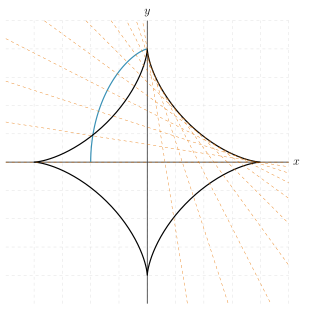
- A curve has parametric equations \[ x = -4\cos^3 t, \qquad y = 12\sin t - 4\sin^3 t. \] Find the equation of the normal to this curve at the point \[ \bigl(-4\cos^3\phi,\; 12\sin\phi - 4\sin^3\phi\bigr), \] where \(0 < \phi < \tfrac{1}{2}\pi\). Verify that this normal is a tangent to the curve \[ x^{2/3} + y^{2/3} = 4 \] at the point \((8\cos^3\phi,\; 8\sin^3\phi)\).
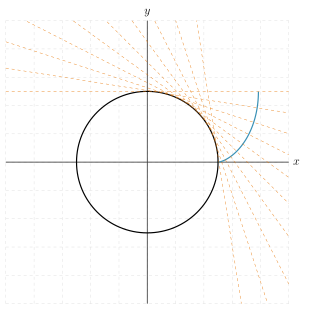
- A curve has parametric equations \[ x = \cos t + t\sin t, \qquad y = \sin t - t\cos t. \] Find the equation of the normal to this curve at the point \[ \bigl(\cos\phi + \phi\sin\phi,\; \sin\phi - \phi\cos\phi\bigr), \] where \(0 < \phi < \tfrac{1}{2}\pi\). Determine the perpendicular distance from the origin to this normal, and hence find the equation of a curve, independent of \(\phi\), to which this normal is a tangent.
Solution:
- \(\,\) \begin{align*}
&& \dot{x} &=12 \cos^2 t \sin t \\
&& \dot{y} &= 12 \cos t - 12 \sin^2 t \cos t \\
&& \frac{\d y}{\d x} &= \frac{12 \cos t - 12 \sin^2 t \cos t}{12 \cos^2 t \sin t} \\
&&&= \frac{1 - \sin^2 t}{\cos t \sin t} \\
&&&= \cot t \\
\\
&& \frac{y - (12\sin\phi - 4\sin^3\phi)}{x - (-4 \cos^3 \phi)} &= - \tan \phi \\
&& y &= -\tan \phi x -4 \cos^3 \phi \tan \phi + 12 \sin \phi -4\sin^3 \phi \\
&&&= -\tan \phi x -4 \cos^2 \phi \sin \phi + 12 \sin \phi -4\sin^3 \phi \\
&&&= -\tan \phi x - 4\sin \phi+12 \sin \phi \\
&&y&= -\tan \phi x + 8 \sin \phi
\end{align*}
Note that when \(x = 8\cos^3 \phi\) we have \(y =-8 \cos^2 \phi \sin \phi + 8 \sin \phi = 8 \sin^3 \phi\). So the point lies on the curve. Notice also that \((8\cos^3 \phi, 8 \sin^ 3\phi)\) is a parametrisation of \(x^{2/3} + y^{2/3} = 4\) and so we can use parametric differentiation to see the gradient is \(\frac{24\sin^2 \phi \cos \phi}{-24\cos^2 \phi\sin\phi} = - \tan \phi\) so it also has the same gradient as required.
- \(\,\) \begin{align*}
&& \dot{x} &= -\sin t + \sin t + t \cos t \\
&&&= t \cos t \\
&& \dot{y} &= \cos t - \cos t + t \sin t \\
&&&= t \sin t \\
&& \frac{\d y}{\d x} &= \frac{t \sin t}{t \cos t} = \tan t \\
\\
&& \frac{y - (\sin \phi - \phi \cos \phi)}{x - (\cos \phi + \phi \sin \phi)} &= -\cot \phi \\
\Rightarrow && y &= -\cot \phi x + (\cos \phi + \phi \sin \phi) \cot \phi + \sin \phi - \phi \cos \phi \\
&&&= -\cot \phi x + \cos \phi \cot \phi + \phi \cos \phi + \sin \phi - \phi \cos \phi \\
&&&= -\cot \phi x + \frac{\cos^2 \phi + \sin^2 \phi}{\sin \phi} \\
&&&= -\cot \phi x + \cosec \phi
\end{align*}
The distance to the origin is \(\displaystyle \frac{|\cosec \phi|}{\sqrt{1 + \cot^2 \phi}} = 1\) so this normal is a tangent to \(x^2 + y^2 = 1\)
2021 Paper 3 Q5
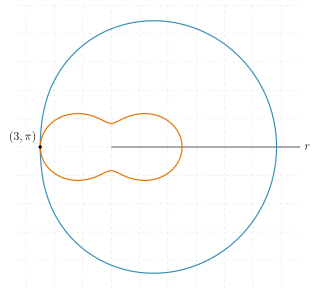
Two curves have polar equations \(r = a + 2\cos\theta\) and \(r = 2 + \cos 2\theta\), where \(r \geqslant 0\) and \(a\) is a constant.
- Show that these curves meet when \[ 2\cos^2\theta - 2\cos\theta + 1 - a = 0. \] Hence show that these curves touch if \(a = \tfrac{1}{2}\) and find the other two values of \(a\) for which the curves touch.
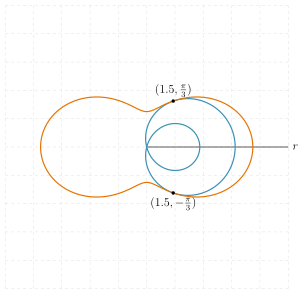
- Sketch the curves \(r = a + 2\cos\theta\) and \(r = 2 + \cos 2\theta\) on the same diagram in the case \(a = \tfrac{1}{2}\). Give the values of \(r\) and \(\theta\) at the points at which the curves touch and justify the other features you show on your sketch.
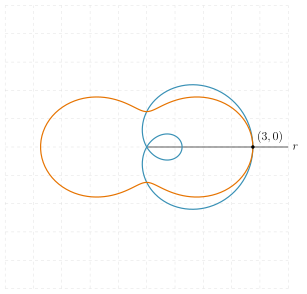
- On two further diagrams, one for each of the other two values of \(a\), sketch both the curves \(r = a + 2\cos\theta\) and \(r = 2 + \cos 2\theta\). Give the values of \(r\) and \(\theta\) at the points at which the curves touch and justify the other features you show on your sketch.
Solution:
- The curves meet when they have the same radius for a given \(\theta\) ie \begin{align*} && a + 2 \cos \theta &= 2 + \cos 2 \theta \\ &&&= 2 + 2\cos^2 \theta - 1 \\ \Rightarrow && 0 &= 2 \cos ^2 \theta - 2 \cos \theta + 1 - a \end{align*} The curves touch if this has a repeated root, ie \(0 = \Delta = 4 - 8(1-a) \Rightarrow a = \frac12\). The second way the curves can touch is if there is a single root, but it's at an extreme value of \(\cos \theta = \pm 1\) ie \(0 = 2 - 2\cdot(\pm1) + 1 - a \Rightarrow a = 3 \pm 2 = 1, 5\)
- Suppose \(a = \frac12\) then the curves touch when \(0 = 2\cos^2 \theta - 2 \cos \theta + \frac12 = (2 \cos \theta-1 )(\cos \theta -\frac12) \Rightarrow \theta = \pm \frac{\pi}{3}\)
- \(a = 1\)
\(a = 5\)
2021 Paper 3 Q6
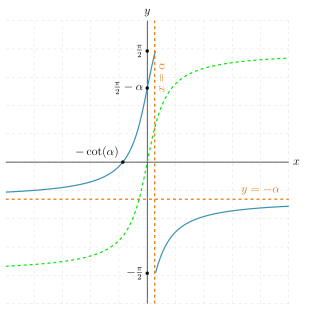
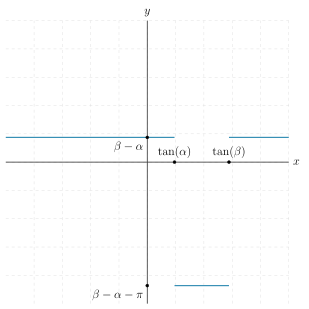
- For \(x \neq \tan\alpha\), the function \(f_\alpha\) is defined by \[ f_\alpha(x) = \tan^{-1}\!\left(\frac{x\tan\alpha + 1}{\tan\alpha - x}\right) \] where \(0 < \alpha < \tfrac{1}{2}\pi\). Show that \(f_\alpha'(x) = \dfrac{1}{1 + x^2}\). Hence sketch \(y = f_\alpha(x)\). On a separate diagram, sketch \(y = f_\alpha(x) - f_\beta(x)\) where \(0 < \alpha < \beta < \tfrac{1}{2}\pi\).
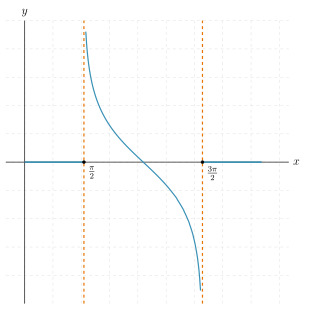
- For \(0 \leqslant x \leqslant 2\pi\) and \(x \neq \tfrac{1}{2}\pi,\, \tfrac{3}{2}\pi\), the function \(g(x)\) is defined by \[ g(x) = \tanh^{-1}(\sin x) - \sinh^{-1}(\tan x). \] For \(\tfrac{1}{2}\pi < x < \tfrac{3}{2}\pi\), show that \(g'(x) = 2\sec x\). Use this result to sketch \(y = g(x)\) for \(0 \leqslant x \leqslant 2\pi\).
Solution:
- \(\,\) \begin{align*}
&& f_\alpha(x) &= \tan^{-1}\!\left(\frac{x\tan\alpha + 1}{\tan\alpha - x}\right) \\
&& f'_\alpha(x) &= \frac{1}{1 + \left(\frac{x\tan\alpha + 1}{\tan\alpha - x}\right) ^2} \cdot \frac{\tan \alpha \cdot (\tan \alpha - x) - (x \tan \alpha + 1) \cdot (-1)}{(\tan \alpha - x)^2} \\
&&&= \frac{\tan^2 \alpha -1}{(\tan \alpha - x)^2 + (x \tan \alpha +1)^2} \\
&&&= \frac{\tan^2 \alpha +1}{\tan^2 \alpha - 2x \tan \alpha + x^2 + x^2 \tan^2 \alpha + 2 x \tan \alpha + 1} \\
&&&= \frac{1+\tan^2 \alpha}{(1+\tan^2 \alpha(x^2 + 1)} = \frac{1}{1+x^2}
\end{align*}
- Let \(g(x) = \tanh^{-1}(\sin x) - \sinh^{-1}(\tan x)\) then
\begin{align*}
&& g'(x) &= \frac{1}{1-\sin^2 x} \cdot \cos x - \frac{1}{\sqrt{\tan^2 +1}} \cdot \sec^2 x \\
&&&= \sec x - \frac{\sec^2 x}{|\sec x|} \\
&&& = \begin{cases} 0 &\text{if } \sec x \geq 0 \\
2 \sec x &\text{ otherwise}
\end{cases}
\end{align*}
Therefore \(g'(x) = 2\sec x\) if \(\tfrac12 \pi < x < \tfrac32\pi\)
Therefore $\displaystyle g(x) = \begin{cases} 0 & \text{if } x \in [0, \frac{\pi}{2}] \cup [\frac{3\pi}{2}, 2\pi] \\
\ln( (\tan x + \sec x)^2) + C &\text{otherwise} \end{cases}$
2020 Paper 2 Q2
The curves \(C_1\) and \(C_2\) both satisfy the differential equation \[\frac{\mathrm{d}y}{\mathrm{d}x} = \frac{kxy - y}{x - kxy},\] where \(k = \ln 2\). All points on \(C_1\) have positive \(x\) and \(y\) co-ordinates and \(C_1\) passes through \((1,\,1)\). All points on \(C_2\) have negative \(x\) and \(y\) co-ordinates and \(C_2\) passes through \((-1,\,-1)\).
- Show that the equation of \(C_1\) can be written as \((x-y)^2 = (x+y)^2 - 2^{x+y}\). Determine a similar result for curve \(C_2\). Hence show that \(y = x\) is a line of symmetry of each curve.
- Sketch on the same axes the curves \(y = x^2\) and \(y = 2^x\), for \(x \geqslant 0\). Hence show that \(C_1\) lies between the lines \(x + y = 2\) and \(x + y = 4\). Sketch curve \(C_1\).
- Sketch curve \(C_2\).
2020 Paper 2 Q8
In this question, \(\mathrm{f}(x)\) is a quartic polynomial where the coefficient of \(x^4\) is equal to \(1\), and which has four real roots, \(0\), \(a\), \(b\) and \(c\), where \(0 < a < b < c\). \(\mathrm{F}(x)\) is defined by \(\mathrm{F}(x) = \displaystyle\int_0^x \mathrm{f}(t)\,\mathrm{d}t\). The area enclosed by the curve \(y = \mathrm{f}(x)\) and the \(x\)-axis between \(0\) and \(a\) is equal to that between \(b\) and \(c\), and half that between \(a\) and \(b\).
- Sketch the curve \(y = \mathrm{F}(x)\), showing the \(x\) co-ordinates of its turning points. Explain why \(\mathrm{F}(x)\) must have the form \(\mathrm{F}(x) = \frac{1}{5}x^2(x-c)^2(x-h)\), where \(0 < h < c\). Find, in factorised form, an expression for \(\mathrm{F}(x) + \mathrm{F}(c-x)\) in terms of \(c\), \(h\) and \(x\).
- If \(0 \leqslant x \leqslant c\), explain why \(\mathrm{F}(b) + \mathrm{F}(x) \geqslant 0\) and why \(\mathrm{F}(b) + \mathrm{F}(x) > 0\) if \(x \neq a\). Hence show that \(c - b = a\) or \(c > 2h\). By considering also \(\mathrm{F}(a) + \mathrm{F}(x)\), show that \(c = a + b\) and that \(c = 2h\).
- Find an expression for \(\mathrm{f}(x)\) in terms of \(c\) and \(x\) only. Show that the points of inflection on \(y = \mathrm{f}(x)\) lie on the \(x\)-axis.
2020 Paper 3 Q2
The curve \(C\) has equation \(\sinh x + \sinh y = 2k\), where \(k\) is a positive constant.
- Show that the curve \(C\) has no stationary points and that \(\dfrac{\mathrm{d}^2 y}{\mathrm{d}x^2} = 0\) at the point \((x,y)\) on the curve if and only if \[ 1 + \sinh x \sinh y = 0. \] Find the co-ordinates of the points of inflection on the curve \(C\), leaving your answers in terms of inverse hyperbolic functions.
- Show that if \((x,y)\) lies on the curve \(C\) and on the line \(x + y = a\), then \[ \mathrm{e}^{2x}(1 - \mathrm{e}^{-a}) - 4k\mathrm{e}^x + (\mathrm{e}^a - 1) = 0 \] and deduce that \(1 < \cosh a \leqslant 2k^2 + 1\).
- Sketch the curve \(C\).
2020 Paper 3 Q6
- Sketch the curve \(y = \cos x + \sqrt{\cos 2x}\) for \(-\frac{1}{4}\pi \leqslant x \leqslant \frac{1}{4}\pi\).
- The equation of curve \(C_1\) in polar co-ordinates is \[ r = \cos\theta + \sqrt{\cos 2\theta} \qquad -\tfrac{1}{4}\pi \leqslant \theta \leqslant \tfrac{1}{4}\pi. \] Sketch the curve \(C_1\).
- The equation of curve \(C_2\) in polar co-ordinates is \[ r^2 - 2r\cos\theta + \sin^2\theta = 0 \qquad -\tfrac{1}{4}\pi \leqslant \theta \leqslant \tfrac{1}{4}\pi. \] Find the value of \(r\) when \(\theta = \pm\frac{1}{4}\pi\). Show that, when \(r\) is small, \(r \approx \frac{1}{2}\theta^2\). Sketch the curve \(C_2\), indicating clearly the behaviour of the curve near \(r=0\) and near \(\theta = \pm\frac{1}{4}\pi\). Show that the area enclosed by curve \(C_2\) and above the line \(\theta = 0\) is \(\dfrac{\pi}{2\sqrt{2}}\).