Problems
Filters
23 problems found
2002 Paper 3 Q9
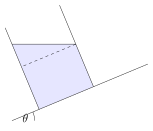
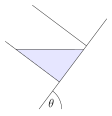
A tall container made of light material of negligible thickness has the form of a prism, with a square base of area \(a^2\). It contains a volume \(ka^3\) of fluid of uniform density. The container is held so that it stands on a rough plane, which is inclined at angle \(\theta\) to the horizontal, with two of the edges of the base of the container horizontal. In the case \(k > \frac12 \tan\theta\), show that the centre of mass of the fluid is at a distance \(x\) from the lower side of the container and at a distance \(y\) from the base of the container, where \[ \frac x a = \frac12 - \frac {\tan\theta}{12k}\;, \ \ \ \ \ \ \frac y a = \frac k 2 + \frac{\tan^2\theta}{24k}\;. \] Determine the corresponding coordinates in the case \(k < \frac12 \tan\theta\). The container is now released. Given that \(k < \frac12\), show that the container will topple if \(\theta >45^\circ\).
Solution:
1999 Paper 1 Q11
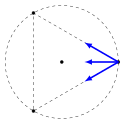
The force of attraction between two stars of masses \(m_{1}\) and \(m_{2}\) a distance \(r\) apart is \(\gamma m_{1}m_{2}/r^{2}\). The Starmakers of Kryton place three stars of equal mass \(m\) at the corners of an equilateral triangle of side \(a\). Show that it is possible for each star to revolve round the centre of mass of the system with angular velocity \((3\gamma m/a^{3})^{1/2}\). Find a corresponding result if the Starmakers place a fourth star, of mass \(\lambda m\), at the centre of mass of the system.
Solution: The net force on the planets will always be towards the centre of mass (by symmetry or similar arguments). Therefore it suffices to check whether we can find a speed where the planets follow uniform circular motion, ie \(F = mr \omega^2\). (But clearly this is possible, we just need to find the speed)

1996 Paper 2 Q9
A child's toy consists of a solid cone of height \(\lambda a\) and a solid hemisphere of radius \(a\), made out of the same uniform material and fastened together so that their plane faces coincide. (Thus the diameter of the hemisphere is equal to that of the base of the cone.) Show that if \(\lambda < \sqrt{3}\) the toy will always move to an upright position if placed with the surface of the hemisphere on a horizontal table, but that if \(\lambda > \sqrt{3}\) the toy may overbalance. Show, however, that if the toy is placed with the surface of the cone touching the table it will remain there whatever the value of \(\lambda\). [The centre of gravity of a uniform solid cone of height \(h\) is a height \(h/4\) above its base. The centre of gravity of a uniform solid hemisphere of radius \(a\) is at distance \(3a/8\) from the centre of its base.]
Solution:


1993 Paper 1 Q11
A piece of uniform wire is bent into three sides of a square \(ABCD\) so that the side \(AD\) is missing. Show that if it is first hung up by the point \(A\) and then by the point \(B\) then the angle between the two directions of \(BC\) is \(\tan^{-1}18.\)
Solution:

1990 Paper 2 Q13
A thin non-uniform rod \(PQ\) of length \(2a\) has its centre of gravity a distance \(a+d\) from \(P\). It hangs (not vertically) in equilibrium suspended from a small smooth peg \(O\) by means of a light inextensible string of length \(2b\) which passes over the peg and is attached at its ends to \(P\) and \(Q\). Express \(OP\) and \(OQ\) in terms of \(a,b\) and \(d\). By considering the angle \(POQ\), or otherwise, show that \(d < a^{2}/b\).
Solution:

1989 Paper 1 Q12
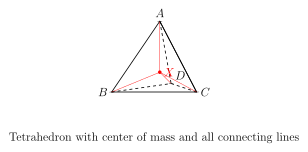
A regular tetrahedron \(ABCD\) of mass \(M\) is made of 6 identical uniform rigid rods, each of length \(2a.\) Four light elastic strings \(XA,XB,XC\) and \(XD\), each of natural length \(a\) and modulus of elasticity \(\lambda,\) are fastened together at \(X\), the other end of each string being attached to the corresponding vertex. Given that \(X\) lies at the centre of mass of the tetrahedron, find the tension in each string. The tetrahedron is at rest on a smooth horizontal table, with \(B,C\) and \(D\) touching the table, and the ends of the strings at \(X\) attached to a point \(O\) fixed in space. Initially the centre of mass of the tetrahedron coincides with \(O.\) Suddenly the string \(XA\) breaks, and the tetrahedron as a result rises vertically off the table. If the maximum height subsequently attained is such that \(BCD\) is level with the fixed point \(O,\) show that (to 2 significant figures) \[ \frac{Mg}{\lambda}=0.098. \]
Solution:
1989 Paper 2 Q12
A uniform rectangular lamina of sides \(2a\) and \(2b\) rests in a vertical plane. It is supported in equilibrium by two smooth pegs fixed in the same horizontal plane, a distance \(d\) apart, so that one corner of the lamina is below the level of the pegs. Show that if the distance between this (lowest) corner and the peg upon which the side of length \(2a\) rests is less than \(a\), then the distance between this corner and the other peg is less than \(b\). Show also that \[ b\cos\theta-a\sin\theta=d\cos2\theta, \] where \(\theta\) is the acute angle which the sides of length \(2b\) make with the horizontal.
Solution:
1988 Paper 1 Q11
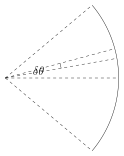
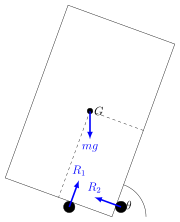
Derive a formula for the position of the centre of mass of a uniform circular arc of radius \(r\) which subtends an angle \(2\theta\) at the centre.

Solution: