Problems
Filters
27 problems found
1993 Paper 1 Q5
If \(z=x+\mathrm{i}y\) where \(x\) and \(y\) are real, define \(\left|z\right|\) in terms of \(x\) and \(y\). Show, using your definition, that if \(z_{1},z_{2}\in\mathbb{C}\) then \(\left|z_{1}z_{2}\right|=\left|z_{1}\right|\left|z_{2}\right|.\) Explain, by means of a diagram, or otherwise, why \(\left|z_{1}+z_{2}\right|\leqslant\left|z_{1}\right|+\left|z_{2}\right|.\) Suppose that \(a_{j}\in\mathbb{C}\) and \(\left|a_{j}\right|\leqslant1\) for \(j=1,2,\ldots,n.\) Show that, if \(\left|z\right|\leqslant\frac{1}{2},\) then \[ \left|a_{n}z^{n}+a_{n-1}z^{n-1}+\cdots+a_{1}z\right|<1, \] and deduce that any root \(w\) of the equation \[ a_{n}z^{n}+a_{n-1}z^{n-1}+\cdots+a_{1}z+1=0 \] must satisfy \(\left|x\right|>\frac{1}{2}.\)
1993 Paper 2 Q9
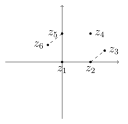
\textit{In this question, the argument of a complex number is chosen to satisfy \(0\leqslant\arg z<2\pi.\)} Let \(z\) be a complex number whose imaginary part is positive. What can you say about \(\arg z\)? The complex numbers \(z_{1},z_{2}\) and \(z_{3}\) all have positive imaginary part and \(\arg z_{1}<\arg z_{2}<\arg z_{3}.\) Draw a diagram that shows why \[ \arg z_{1}<\arg(z_{1}+z_{2}+z_{3})<\arg z_{3}. \] Prove that \(\arg(z_{1}z_{2}z_{3})\) is never equal to \(\arg(z_{1}+z_{2}+z_{3}).\)
1993 Paper 3 Q6
The point in the Argand diagram representing the complex number \(z\) lies on the circle with centre \(K\) and radius \(r\), where \(K\) represents the complex number \(k\). Show that $$ zz^* -kz^* -k^*z +kk^* -r^2 =0. $$ The points \(P\), \(Q_1\) and \(Q_2\) represent the complex numbers \(z\), \(w_1\) and \(w_2\) respectively. The point \(P\) lies on the circle with \(OA\) as diameter, where \(O\) and \(A\) represent \(0\) and \(2i\) respectively. Given that \(w_1=z/(z-1)\), find the equation of the locus \(L\) of \(Q_1\) in terms of \(w_1\) and describe the geometrical form of \(L\). Given that \(w_2=z^*\), show that the locus of \(Q_2\) is also \(L\). Determine the positions of \(P\) for which \(Q_1\) coincides with \(Q_2\).
1992 Paper 1 Q4
Sketch the following subsets of the complex plane using Argand diagrams. Give reasons for your answers.
- \(\{z:\mathrm{Re}((1+\mathrm{i})z)\geqslant0\}.\)
- \(\{z: |z^{2}| \leqslant2,\mathrm{Re}(z^{2})\geqslant0\}.\)
- \(\{z=z_{1}+z_{2}:\left|z_{1}\right|=2,\left|z_{2}\right|=1\}.\)
Solution:
- Multiplication by \(1+i\) rotates by \(45^{\circ}\) anticlockwise

- \(|z| \leq \sqrt{2}\), \(\textrm{Re}(z^2) \geq 0\) means \(\textrm{Re}{z} \geq \textrm{Im}{z}\)

- These are all points within \(1\) unit from a circle radius \(2\) units.

1992 Paper 2 Q10
Let \(\alpha\) be a fixed angle, \(0 < \alpha \leqslant\frac{1}{2}\pi.\) In each of the following cases, sketch the locus of \(z\) in the Argand diagram (the complex plane):
- \({\displaystyle \arg\left(\frac{z-1}{z}\right)=\alpha,}\)
- \({\displaystyle \arg\left(\frac{z-1}{z}\right)=\alpha-\pi,}\)
- \(|\dfrac{z-1}{z}|=1.\)
Solution:
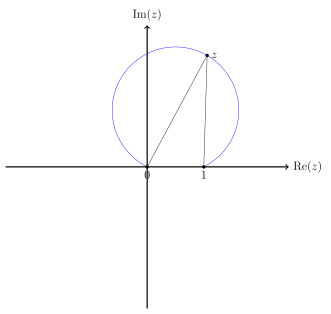
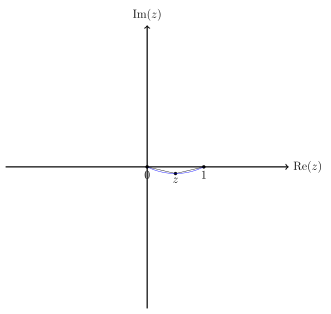
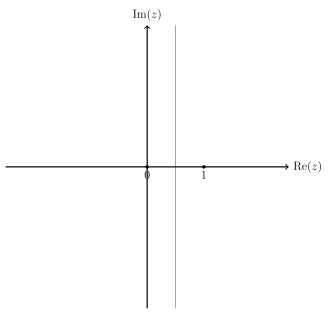
1991 Paper 1 Q3
A path is made up in the Argand diagram of a series of straight line segments \(P_{1}P_{2},\) \(P_{2}P_{3},\) \(P_{3}P_{4},\ldots\) such that each segment is \(d\) times as long as the previous one, \((d\neq1)\), and the angle between one segment and the next is always \(\theta\) (where the segments are directed from \(P_{j}\) towards \(P_{j+1}\), and all angles are measured in the anticlockwise direction). If \(P_{j}\) represents the complex number \(z_{j},\) express \[ \frac{z_{n+1}-z_{n}}{z_{n}-z_{n-1}} \] as a complex number (for each \(n\geqslant2\)), briefly justifying your answer. If \(z_{1}=0\) and \(z_{2}=1\), obtain an expression for \(z_{n+1}\) when \(n\geqslant2\). By considering its imaginary part, or otherwise, show that if \(\theta=\frac{1}{3}\pi\) and \(d=2\), then the path crosses the real axis infinitely often.
Solution: \begin{align*} && | \frac{z_{n+1}-z_{n}}{z_{n}-z_{n-1}} | &= d \\ && \arg \left ( \frac{z_{n+1}-z_{n}}{z_{n}-z_{n-1}} \right) &= \arg (z_{n+1}-z_{n}) - \arg(z_{n}-z_{n-1}) \\ &&&= \theta \\ \Rightarrow && \frac{z_{n+1}-z_{n}}{z_{n}-z_{n-1}} &= d e^{i \theta} \end{align*} \begin{align*} && z_1 &= 0 \\ && z_2 &= 1 \\ && \frac{z_3-z_2}{z_2-z_1} &= de^{i \theta} \\ \Rightarrow && z_3 &= de^{i \theta} + 1 \\ && \frac{z_4-z_3}{z_3-z_2} &= de^{i \theta} \\ \Rightarrow && z_4 &= (d e^{i \theta})^2 + d e^{i \theta} + 1\\ \Rightarrow && z_{n+1} &= \frac{(de^{i \theta})^{n}-1}{de^{i \theta}-1} \end{align*} If \(d = 2, \theta = \tfrac13 \pi\), then, \(2e^{i \tfrac13 \pi} = 1 + \sqrt{3}i\) \begin{align*} \textrm{Im}(z_{n+1})) &= \textrm{Im} \left ( \frac{(2e^{i \tfrac13 \pi})^{n}-1}{2e^{i \tfrac13 \pi}-1}\right) \\ &= \textrm{Im} \left ( \frac{(2e^{i \tfrac13 \pi})^{n}-1}{\sqrt{3}i}\right) \\ &= -\frac{1}{\sqrt{3}}\textrm{Re} \left (2^n e^{i \frac{n}{3} \pi} \right) + \frac{1}{\sqrt{3}} \end{align*} Which clearly changes sign infinitely many times, ie crosses the origin infinitely many times.
1991 Paper 3 Q2
The distinct points \(P_{1},P_{2},P_{3},Q_{1},Q_{2}\) and \(Q_{3}\) in the Argand diagram are represented by the complex numbers \(z_{1},z_{2},z_{3},w_{1},w_{2}\) and \(w_{3}\) respectively. Show that the triangles \(P_{1}P_{2}P_{3}\) and \(Q_{1}Q_{2}Q_{3}\) are similar, with \(P_{i}\) corresponding to \(Q_{i}\) (\(i=1,2,3\)) and the rotation from \(1\) to \(2\) to \(3\) being in the same sense for both triangles, if and only if \[ \frac{z_{1}-z_{2}}{z_{2}-z_{3}}=\frac{w_{1}-w_{2}}{w_{1}-w_{3}}. \] Verify that this condition may be written \[ \det\begin{pmatrix}z_{1} & z_{2} & z_{3}\\ w_{1} & w_{2} & w_{3}\\ 1 & 1 & 1 \end{pmatrix}=0. \]
- Show that if \(w_{i}=z_{i}^{2}\) (\(i=1,2,3\)) then triangle \(P_{1}P_{2}P_{3}\) is not similar to triangle \(Q_{1}Q_{2}Q_{3}.\)
- Show that if \(w_{i}=z_{i}^{3}\) (\(i=1,2,3\)) then triangle \(P_{1}P_{2}P_{3}\) is similar to triangle \(Q_{1}Q_{2}Q_{3}\) if and only if the centroid of triangle \(P_{1}P_{2}P_{3}\) is the origin. {[}The centroid of triangle \(P_{1}P_{2}P_{3}\) is represented by the complex number \(\frac{1}{3}(z_{1}+z_{2}+z_{3})\).{]}
- Show that the triangle \(P_{1}P_{2}P_{3}\) is equilateral if and only if \[ z_{2}z_{3}+z_{3}z_{1}+z_{1}z_{2}=z_{1}^{2}+z_{2}^{2}+z_{3}^{2}. \]
1990 Paper 2 Q5
The distinct points \(L,M,P\) and \(Q\) of the Argand diagram lie on a circle \(S\) centred on the origin and the corresponding complex numbers are \(l,m,p\) and \(q\). By considering the perpendicular bisectors of the chords, or otherwise, prove that the chord \(LM\) is perpendicular to the chord \(PQ\) if and only if \(lm+pq=0.\) Let \(A_{1},A_{2}\) and \(A_{3}\) be three distinct points on \(S\). For any given point \(A_{1}'\) on \(S\), the points \(A_{2}',A_{3}'\) and \(A_{1}''\) are chosen on \(S\) such that \(A_{1}'A_{2}',A_{2}'A_{3}'\) and \(A_{3}'A_{1}''\) are perpendicular to \(A_{1}A_{2},A_{2}A_{3}\) and \(A_{3}A_{1},\) respectively. Show that for exactly two positions of \(A_{1}',\) the points \(A_{1}'\) and \(A_{1}''\) coincide. If, instead, \(A_{1},A_{2},A_{3}\) and \(A_{4}\) are four given distinct points on \(S\) and, for any given point \(A_{1}',\) the points \(A_{2}',A_{3}',A_{4}'\) and \(A_{1}''\) are chosen on \(S\) such that \(A_{1}'A_{2}',A_{2}'A_{3}',A_{3}'A_{4}'\) and \(A_{4}'A_{1}''\) are respectively perpendicular to \(A_{1}A_{2},A_{2}A_{3},A_{3}A_{4}\) and \(A_{4}A_{1},\) show that \(A_{1}'\) coincides with \(A_{1}''.\) Give the corresponding result for \(n\) distinct points on \(S\).
Solution: The perpendicular bisector of the chords runs through the origin, therefore \(LM\) is perpendicular to \(PQ\) if and only if \(\frac{l+m}{2}\) is perpendicular to \(\frac{p+q}{2}\), ie \begin{align*} && (l+m) &= it (p+q) \\ \Leftrightarrow && \frac{l+m}{p+q} & \in i \mathbb{R} \\ \Leftrightarrow && 0 &= \frac{l+m}{p+q} + \frac{l^*+m^*}{p^*+q^*} \\ &&&= \frac{l+m}{p+q} + \frac{\frac{r^2}{l}+\frac{r^2}{m}}{\frac{r^2}{p}+\frac{r^2}{q}} \\ &&&=\frac{l+m}{p+q} + \frac{l+m}{p+q} \frac{pq}{lm} \\ &&&= \frac{l+m}{p+q} \left ( \frac{lm+pq}{lm} \right) \end{align*} Therefore as long as \(l+m, p+q \neq 0\) \(lm+pq = 0\) is equivalent to the chords being perpendicular. In the case where (say) \(l,m\) is a diameter, then the condition for the chords to be perpendicular is that \(p,q\) is also a diameter and at right angles, but clearly this is also equivalent to our condition. Suppose \(A_1, A_2, A_3\) are distinct points on \(S\), and \(A_1'\) is given and suppose \(a_i, a_i'\) are the corresponding complex numbers, then the conditions are: \begin{align*} A_1'A_2' \perp A_1A_2: && 0 &= a_1'a_2' + a_1a_2 \\ A_2'A_3' \perp A_2A_3: && 0 &= a_2'a_3' + a_2a_3 \\ A_3'A_1'' \perp A_3A_1: && 0 &= a_3'a_1'' + a_3a_1 \\ \\ \Rightarrow && a_2' &= -\frac{a_1a_2}{a_1'} \\ && a_3' &= -\frac{a_2a_3}{a_2'} \\ &&&= \frac{a_1'a_2a_3}{a_1a_2} \\ &&&= \frac{a_1'a_3}{a_1} \\ && a_1'' &= - \frac{a_3a_1}{a_3'} \\ &&&= \frac{a_3a_1a_1}{a_1'a_3} \\ &&&= \frac{a_1^2}{a_1'} \\ \Rightarrow && a_1'a_1'' &= a_1^2 \end{align*} Therefore \(a_1' = a_1''\) if \(a_1' = \pm a_1\) Suppose we have \(4\) points, then \begin{align*} A_1'A_2' \perp A_1A_2: && 0 &= a_1'a_2' + a_1a_2 \\ A_2'A_3' \perp A_2A_3: && 0 &= a_2'a_3' + a_2a_3 \\ A_3'A_4' \perp A_3A_4: && 0 &= a_3'a_4' + a_3a_4 \\ A_4'A_1'' \perp A_4A_1: && 0 &= a_4'a_1'' + a_4a_1 \\ \\ \Rightarrow && a_4' &= -\frac{a_3a_4}{a_3'} \\ &&&= -\frac{a_1a_3a_4}{a_1'a_3} \\ &&&= -\frac{a_1a_4}{a_1'} \\ \Rightarrow && a_1'' &= -\frac{a_4a_1}{a_4'} \\ &&&= \frac{a_4a_1a_1'}{a_1a_4} \\ &&&= a_1' \end{align*} So they coincide. For \(n\) points if there are an even number of points they coincide, an odd number and there are two points when they coincide.
1988 Paper 1 Q6
The complex numbers \(z_{1},z_{2},\ldots,z_{6}\) are represented by six distinct points \(P_{1},P_{2},\ldots,P_{6}\) in the Argand diagram. Express the following statements in terms of complex numbers:
- \(\overrightarrow{P_{1}P_{2}}=\overrightarrow{P_{5}P_{4}}\) and \(\overrightarrow{P_{2}P_{3}}=\overrightarrow{P_{6}P_{5}}\,\);
- \(\overrightarrow{P_{2}P_{4}}\) is perpendicular to \(\overrightarrow{P_{3}P_{6}}\,\).
Solution:
- \(\overrightarrow{P_{1}P_{2}}=\overrightarrow{P_{5}P_{4}}\) is equivalent to \(z_2 - z_1 = z_4 - z_5\). \(\overrightarrow{P_{2}P_{3}}=\overrightarrow{P_{6}P_{5}}\) is equivalent to \(z_3-z_2 = z_5 - z_6\).
- \(\overrightarrow{P_{2}P_{4}}\) is perpendicular to \(\overrightarrow{P_{3}P_{6}}\,\) is equivalent to \(\frac{z_4 - z_2}{z_6-z_3} \in i\mathbb{R}\)
1988 Paper 2 Q4
The complex number \(w\) is such that \(w^{2}-2w\) is real.
- Sketch the locus of \(w\) in the Argand diagram.
- If \(w^{2}=x+\mathrm{i}y,\) describe fully and sketch the locus of points \((x,y)\) in the \(x\)-\(y\) plane.
Solution:
- Suppose \(w = u+ vi\) then \(w^2 - 2w = u^2-v^2-2u+(2uv-2v)i\) so to be purely real we must have \(2uv-2v = 2v(u-1) = 0\) ie either \(v = 0\) or \(u = 1\). Therefore the locus is the real axis and the line \(1 + ti\):

- If \(w^2 = x+yi\) then we must have \(x = u^2-v^2\) and \(y = 2uv\), so either \(v = 0, y = 0, x = u^2-2u \geq -1\) or \(u = 1, x = 1-v^2, y = 2v\) which is a parabola:


1988 Paper 3 Q3
Give a parametric form for the curve in the Argand diagram determined by \(\left|z-\mathrm{i}\right|=2.\) Let \(w=(z+\mathrm{i})/(z-\mathrm{i}).\) Find and sketch the locus, in the Argand diagram, of the point which represents the complex number \(w\) when \begin{questionparts} \item \(\left|z-\mathrm{i}\right|=2;\) \item \(z\) is real; \item \(z\) is imaginary. \end{questionpart}
Solution: There are many possible parametric forms, for example \(z = i + 2e^{it}, z = 2\ cos \theta + (1 + 2\sin \theta)i\) etc. It is a circle radius \(2\) about the point \(i\).
- \begin{align*}
w &= \frac{z+i}{z-i} \\
&= \frac{2i + 2e^{it}}{2e^{it}} \\
&= 2 + ie^{-it}
\end{align*}
This is obvious a circle radius \(1\) about the point \(2\).

- If \(z\) is real, then \begin{align*} w &= \frac{z+i}{z-i} \\ &= \frac{(z+i)^2}{z^2+1} \\ &= \frac{z^2-1 + 2zi}{z^2+1} \end{align*} We can quickly notice this describes a circle radius \(1\) about \(0\). Alternatively, \(|z+i| = |z-i| \Rightarrow |\frac{z+i}{z-i}| = 1\) so we must be talking about points on the unit circle. Since this is a Mobius transform we know it maps lines and circles to lines and circles, therefore it must map to the unit circle;
- If \(z\) is purely imaginary, say \(it\) then:
\begin{align*}
w &= \frac{z+i}{z-i} \\
&= \frac{(it+i)(i-it)}{(-1+t)^2} \\
&= \frac{t^2-1}{(t-1)^2}
\end{align*}
Which is purely real, and can take all real values.

1987 Paper 2 Q4
Explain the geometrical relationship between the points in the Argand diagram represented by the complex numbers \(z\) and \(z\mathrm{e}^{\mathrm{i}\theta}.\) Write down necessary and sufficient conditions that the distinct complex numbers \(\alpha,\beta\) and \(\gamma\) represent the vertices of an equilateral triangle taken in anticlockwise order. Show that \(\alpha,\beta\) and \(\gamma\) represent the vertices of an equilateral triangle (taken in any order) if and only if \[ \alpha^{2}+\beta^{2}+\gamma^{2}-\beta\gamma-\gamma\alpha-\alpha\beta=0. \] Find necessary and sufficient conditions on the complex coefficients \(a,b\) and \(c\) for the roots of the equation \[ z^{3}+az^{2}+bz+c=0 \] to lie at the vertices of an equilateral triangle in the Argand digram.
Solution: The point \(ze^{i\theta}\) is obtained by rotating the point \(z\) about \(0\) by an angle \(\theta\) anticlockwise. The complex numbers \(\alpha, \beta\) and \(\gamma\) will form an equilateral triangle iff the angles between each side are \(\frac{\pi}{3}\), ie \begin{align*} \begin{cases}{\gamma - \beta} &= e^{i \frac{\pi}{3}}({\beta - \alpha}) \\ {\alpha- \gamma} &= e^{i \frac{\pi}{3}}({\gamma- \beta}) \\ {\beta- \alpha} &= e^{i \frac{\pi}{3}}({\alpha- \gamma})\end{cases} \end{align*} We don't need all these equations, since the first two are equivalent to the third. Combining the first two equations, we have \begin{align*} && \frac{\gamma - \beta}{\beta-\alpha} &= \frac{\alpha-\gamma}{\gamma - \beta} \\ \Leftrightarrow && (\gamma - \beta)^2 &= (\alpha-\gamma)(\beta-\alpha) \\ \Leftrightarrow && \gamma^2 +\beta^2 - 2\gamma \beta &= \alpha\beta-\alpha^2-\gamma\beta+\gamma\alpha \\ \Leftrightarrow && \alpha^{2}+\beta^{2}+\gamma^{2}-\beta\gamma-\gamma\alpha-\alpha\beta&=0 \end{align*} as required. If the roots of \(z^{3}+az^{2}+bz+c=0\) are \(\alpha, \beta, \gamma\) then \(\alpha+\beta+\gamma = -a\) and \(\beta\gamma+\gamma\alpha+\alpha\beta = b\). We also have that \(a^2 - 2b = \alpha^2+\beta^2+\gamma^2\). Therefore there roots will lie at the vertices of an equilateral triangle iff \(a^2-3b = 0\)