Problems
Filters
298 problems found
1997 Paper 1 Q9
A single stream of cars, each of width \(a\) and exactly in line, is passing along a straight road of breadth \(b\) with speed \(V\). The distance between the successive cars is \(c\).
1997 Paper 2 Q8
If \({\rm f}(t)\ge {\rm g}(t)\) for \(a\le t\le b\), explain very briefly why \(\displaystyle \int_a^b {\rm f}(t) \d t \ge \int_a^b {\rm g}(t) \d t\). Prove that if \(p>q>0\) and \(x\ge1\) then $$\frac{x^p-1}{ p}\ge\frac{x^q-1}{ q}.$$ Show that this inequality also holds when \(p>q>0\) and \(0\le x\le1\). Prove that, if \(p>q>0\) and \(x\ge0\), then $$\frac{1}{ p}\left(\frac{x^p}{ p+1}-1\right)\ge \frac{1}{q}\left(\frac{x^q}{ q+1}-1\right).$$
Solution: This is just the result that all of the area beneath \(g(t)\) is also below \(f(t)\) If \(p > q > 0, x \geq 1 \Rightarrow x^p \geq x^q\), therefore applying the result we have \begin{align*} && \int_1^x x^p\, \d t & \geq \int_1^x x^q\, \d t \\ \Rightarrow && \frac{x^p-1}{p} & \geq \frac{x^q-1}{q} \end{align*} When \(p > q > 0, 0 \leq x \leq 1\) we have \(x^p \leq x^q\), ie \begin{align*} && \int_x^1 x^q\, \d t & \geq \int_{x}^1 x^p\, \d t \\ \Rightarrow && \frac{1-x^q}{q} & \geq \frac{1-x^p}{p} \\ \Rightarrow && \frac{x^p-1}{p} &\geq \frac{x^q-1}{q} \end{align*} Now looking at the functions \(f(x) = \frac{x^p-1}{p}, g(x) = \frac{x^q-1}{q}\) and \(x \geq 1\) we have \begin{align*} && \int_0^x \frac{t^p-1}{p} \d t & \geq \int_0^x \frac{t^q-1}{q} \d t\\ \Rightarrow &&\frac1p \left[\frac{t^{p+1}}{p+1} - t \right]_0^x &\geq\frac1q \left[\frac{t^{q+1}}{q+1} - t \right]_0^x \\ \Rightarrow &&\frac1p \left(\frac{x^{p+1}}{p+1} -x\right) &\geq\frac1q \left(\frac{x^{q+1}}{q+1} - x \right)\\ \Rightarrow &&\frac1p \left(\frac{x^{p}}{p+1} -1\right) &\geq\frac1q \left(\frac{x^{q}}{q+1} - 1 \right)\\ \end{align*}
1997 Paper 2 Q11
A tennis player serves from height \(H\) above horizontal ground, hitting the ball downwards with speed \(v\) at an angle \(\alpha\) below the horizontal. The ball just clears the net of height \(h\) at horizontal distance \(a\) from the server and hits the ground a further horizontal distance \(b\) beyond the net. Show that $$v^2 = \frac{ g(a+b)^2(1+\tan^2\alpha)}{ 2[H-(a+b)\tan\alpha]}$$ and $$\tan\alpha = \frac{2a+b }{ a(a+b)}H - \frac{a+b }{ ab}h \,.$$ By considering the signs of \(v^2\) and \(\tan\alpha\), find upper and lower bounds on \(H\) for such a serve to be possible.
Solution: We have \begin{align*} \rightarrow: && a &= v\cos \alpha t_{net} \\ \Rightarrow && t_{net} &= \frac{a}{v \cos \alpha} \\ \downarrow: && H-h &= v\sin \alpha t_{net} + \frac12 g t_{net}^2 \\ &&&= a \tan \alpha + \frac12 g \frac{a^2}{v^2} \sec^2 \alpha \\ &&&= a \tan \alpha + \frac{a^2g}{2v^2}(1 + \tan^2 \alpha) \tag{*}\\ \\ \rightarrow: && a+b &= v \cos \alpha t_{ground} \\ && t_{ground} &= \frac{a+b}{v \cos \alpha}\\ \downarrow: && H &= v\sin \alpha t_{ground} + \frac12 g t_{ground}^2 \\ &&&= (a+b)\tan \alpha + \frac{(a+b)^2g}{2v^2}(1+\tan^2\alpha) \tag{**} \\ \\ (**): && v^2 &= \frac{g(a+b)^2(1+\tan^2\alpha)}{2[H-(a+b)\tan \alpha]} \\ (a+b)^2(*) - a^2(**): && (a+b)^2(H-h) -a^2H &= [(a+b)^2a - a^2(a+b)]\tan \alpha \\ \Rightarrow && (2ab+b^2)H - (a+b)^2h &= ab(a+b) \tan \alpha \\ \Rightarrow && \tan \alpha &= \frac{2a+b}{a(a+b)}H - \frac{a+b}{ab} h \end{align*} Noting that \(v^2 \geq 0\) and the numerator is positive, we must have \begin{align*} && H &> (a+b)\tan \alpha \\ &&&= \frac{2a+b}{a}H - \frac{(a+b)^2}{ab} h \\ \Rightarrow && \frac{a+b}{a}H &< \frac{(a+b)^2}{ab} h \\ \Rightarrow && H &< \frac{a+b}{b} h \end{align*} Noting that \(\tan \alpha > 0\) we must have \begin{align*} && \frac{2a+b}{a(a+b)} H & > \frac{a+b}{ab} h \\ \Rightarrow && H &> \frac{(a+b)^2}{b(2a+b)}h \end{align*}
1997 Paper 3 Q4
In this question, you may assume that if \(k_1,\dots,k_n\) are distinct positive real numbers, then \[\frac1n\sum_{r=1}^nk_r>\left({\prod\limits_{r=1}^n} k_r\right )^{\!\! \frac1n},\] i.e. their arithmetic mean is greater than their geometric mean. Suppose that \(a\), \(b\), \(c\) and \(d\) are positive real numbers such that the polynomial \[{\rm f}(x)=x^4-4ax^3+6b^2x^2-4c^3x+d^4\] has four distinct positive roots.
- Show that \(pqr,qrs,rsp\) and \(spq\) are distinct, where \(p,q,r\) and \(s\) are the roots of the polynomial \(\mathrm{f}\).
- By considering the relationship between the coefficients of \(\mathrm{f}\) and its roots, show that \(c > d\).
- Explain why the polynomial \(\mathrm{f}'(x)\) must have three distinct roots.
- By differentiating \(\mathrm{f}\), show that \(b > c\).
- Show that \(a > b\).
Solution:
- Suppose \(pqr = qrs\), since the roots are positive, we can divide by \(qr\) to obtain \(p=s\) (a contradiction. Therefore all those terms are distinct.
- \(4c^3 = pqr+qrs+rsp+spq\), \(d^4 = pqrs\). Applying AM-GM, we obtain: \begin{align*} && c^3 = \frac{ pqr+qrs+rsp+spq}{4} & > \sqrt[4]{p^3q^3r^3s^3} = d^{3} \\ \Rightarrow && c &> d \end{align*}
- There must be a turning point between each root (since there are no repeated roots).
- \(f'(x) = 4x^3-12ax^2+12b^2-4c^3 = 4(x^3-3ax^2+3b^2-c^3)\). Letting the roots of this polynomial be \(\alpha, \beta, \gamma\) and again applying AM-GM, we must have: \begin{align*} && b^2 = \frac{\alpha\beta + \beta \gamma+\gamma \alpha}{3} &> \sqrt[3]{\alpha^2\beta^2\gamma^2} = c^2 \\ \Rightarrow && b &> c \end{align*}
- Again, since there are turning points between the roots of \(f'(x)\) we must have distinct roots for \(f''(x)\), ie: \(f''(x) = 3x^2-6ax+6b^2 = 3(x^2-2ax+b^2)\) has distinct real roots. But for this to occur we must have that \((2a)^2-4b^2 = 4(a^2-b^2) > 0\), ie \(a>b\)
1997 Paper 3 Q7
For each positive integer \(n\), let \begin{align*} a_n&=\frac1{n+1}+\frac1{(n+1)(n+2)}+\frac1{(n+1)(n+2)(n+3)}+\cdots;\\ b_n&=\frac1{n+1}+\frac1{(n+1)^2}+\frac1{(n+1)^3}+\cdots. \end{align*}
- Evaluate \(b_n\).
- Show that \(0
- Deduce that \(a_n=n!{\rm e}-[n!{\rm e}]\) (where \([x]\) is the integer part of \(x\)).
- Hence show that \(\mathrm{e}\) is irrational.
1996 Paper 1 Q10
A spaceship of mass \(M\) is at rest. It separates into two parts in an explosion in which the total kinetic energy released is \(E\). Immediately after the explosion the two parts have masses \(m_{1}\) and \(m_{2}\) and speeds \(v_{1}\) and \(v_{2}\) respectively. Show that the minimum possible relative speed \(v_{1}+v_{2}\) of the two parts of the spaceship after the explosion is \((8E/M)^{1/2}.\)
1996 Paper 2 Q14
The random variable \(X\) is uniformly distributed on \([0,1]\). A new random variable \(Y\) is defined by the rule \[ Y=\begin{cases} 1/4 & \mbox{ if }X\leqslant1/4,\\ X & \mbox{ if }1/4\leqslant X\leqslant3/4\\ 3/4 & \mbox{ if }X\geqslant3/4. \end{cases} \] Find \({\mathrm E}(Y^{n})\) for all integers \(n\geqslant 1\). Show that \({\mathrm E}(Y)={\mathrm E}(X)\) and that \[{\mathrm E}(X^{2})-{\mathrm E}(Y^{2})=\frac{1}{24}.\] By using the fact that \(4^{n}=(3+1)^{n}\), or otherwise, show that \({\mathrm E}(X^{n}) > {\mathrm E}(Y^{n})\) for \(n\geqslant 2\). Suppose that \(Y_{1}\), \(Y_{2}\), \dots are independent random variables each having the same distribution as \(Y\). Find, to a good approximation, \(K\) such that \[{\rm P}(Y_{1}+Y_{2}+\cdots+Y_{240000} < K)=3/4.\]
Solution: \begin{align*} && \E[Y^n] &= \frac14 \cdot \frac1{4^n} + \frac14 \cdot \frac{3^n}{4^n} + \frac12 \int_{1/4}^{3/4}2 y^n \d y \\ &&&= \frac{3^n+1}{4^{n+1}} + \left [ \frac{y^{n+1}}{n+1} \right]_{1/4}^{3/4} \\ &&&= \frac{3^n+1}{4^{n+1}} + \frac{3^{n+1}-1}{(n+1)4^{n+1}} \end{align*} \begin{align*} && \E[Y] &= \frac{3+1}{16} + \frac{9-1}{2 \cdot 16} \\ &&&= \frac{1}{4} + \frac{1}{4} = \frac12 = \E[X] \end{align*} \begin{align*} && \E[X^2] &= \int_0^1 x^2 \d x = \frac13 \\ && \E[Y^2] &= \frac{9+1}{64} + \frac{27-1}{3 \cdot 64} = \frac{56}{3 \cdot 64} = \frac{7}{24} \\ \Rightarrow && \E[X^2] - \E[Y^2] &= \frac13 - \frac{7}{24} = \frac{1}{24} \end{align*} \begin{align*} && \E[X^n] &= \frac{1}{n+1} \\ && \E[Y^n] &= \frac{1}{n+1} \frac{1}{4^{n+1}}\left ( (n+1)(3^n+1)+3^{n+1}-1 \right) \\ &&&= \frac{1}{n+1} \frac{1}{4^{n+1}}\left ( 3^{n+1} + (n+1)3^n +n \right) \\ \\ && (3+1)^{n+1} &= 3^{n+1} + (n+1)3^n + \cdots + (n+1) \cdot 3 + 1 \\ &&&> 3^{n+1} + (n+1)3^n + n + 1 \end{align*} if \(n \geq 2\) Notice that by the central limit theorem: \begin{align*} &&\frac{1}{240\,000} \sum_{i=1}^{240\,000} Y_i &\sim N \left ( \frac12, \frac{1}{24 \cdot 240\,000}\right) \\ \Rightarrow && \mathbb{P}\left (\frac{\frac{1}{240\,000} \sum_{i=1}^{240\,000} Y_i - \frac12}{\frac1{24} \frac{1}{100}} \leq \frac23 \right) &\approx 0.75 \\ \Rightarrow && \mathbb{P} \left ( \sum_i Y_i \leq 240\,000 \cdot \left ( \frac2{3} \frac1{2400}+\frac12 \right) \right ) & \approx 0.75 \\ \Rightarrow && K &= 120\,000 + 66 \\ &&&\approx 120\,066 \end{align*}
1996 Paper 3 Q4
Find the integers \(k\) satisfying the inequality \(k\leqslant2(k-2).\) Given that \(N\) is a strictly positive integer consider the problem of finding strictly positive integers whose sum is \(N\) and whose product is as large as possible. Call this largest possible product \(P(N).\) Show that \(P(5)=2\times3, P(6)=3^{2}, P(7)=2^{2}\times3, P(8)=2\times3^{2}\) and \(P(9)=3^{3}.\) Find \(P(1000)\) explaining your reasoning carefully.
Solution: \begin{align*} && k &\leq 2(k-2) \\ \Rightarrow && 4 &\leq k \end{align*} Lemma: Suppose we construct \(N \neq \) (optimally) as a sum out of \(a_1 + \cdots +a_k\), then \(a_i \in \{2, 3\}\). Proof: Suppose not, suppose some \(a_i > 3\). Then from our earlier inequality, the sum \(a_1 + \cdots +a_{i-1} + 2 + (a_i - 2) + \cdots \) has the same sum, but a larger product. Therefore \(a_i \leq 3\). Suppose also some \(a_i = 1\), then we could replace \(a_1\) with \(a_1+1\) and remove \(a_i\), leaving us again with the same sum but larger product. (Assuming \(N \neq 1\)) \(5 = 2+3\) is the only way to write \(5\) as a sum of \(2\)s and \(3\)s, therefore \(P(5) = 2\times 3\) \(6 = 2 + 2 + 2 = 3 + 3\) and we can immediately see that \(2^3 = 8 < 3^2 = 9\), so \(P(6) = 3^2\) and whenever we have three \(2\)s we should replace them with two \(3\)s. So \(7 = 2 + 2 + 3 \Rightarrow P(7) = 2^2 \times 3\) \(8 = 3 + 3 + 2 \Rightarrow P(8) = 2\times 3^2\) \(9 = 3 + 3 + 3 \Rightarrow P(9) = 3^3\) Suppose \(1000 = 2n + 3m\), considered \(\pmod{3}\) we can see that \(n \equiv 2 \pmod{3}\) therefore we should have \(1000 = 2 + 2 + \underbrace{3 + \cdots + 3}_{332\text{ }3\text{s}}\) and so \(P(1000) = 2^2 \times 3^{332}\)
1996 Paper 3 Q10
Two rough solid circular cylinders, of equal radius and length and of uniform density, lie side by side on a rough plane inclined at an angle \(\alpha\) to the horizontal, where \(0<\alpha<\pi/2\). Their axes are horizontal and they touch along their entire length. The weight of the upper cylinder is \(W_1\) and the coefficient of friction between it and the plane is \(\mu_1\). The corresponding quantities for the lower cylinder are \(W_2\) and \(\mu_2\) respectively and the coefficient of friction between the two cylinders is \(\mu\). Show that for equilibrium to be possible:
- \(W_1\ge W_2\);
- \(\mu\geqslant\dfrac{W_1+W_2}{W_1-W_2}\);
- \(\mu_{1}\geqslant\left(\dfrac{2W_{1}\cot\alpha}{W_{1}+W_{2}}-1\right)^{-1}\,.\)
Solution:
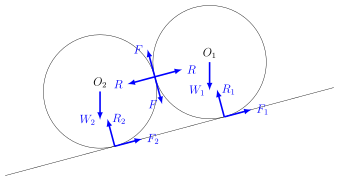
- \begin{align*} \overset{\curvearrowright}{O_2}: && 0 &= F_2 - F \\ \Rightarrow && F_2 &= F \\ \overset{\curvearrowright}{O_1}: && 0 &= F_1- F \\ \Rightarrow && F_1 &= F \\ \text{N2}(\swarrow, 2): && 0 &= R+W_2\sin\alpha -F \tag{1}\\ \text{N2}(\swarrow, 1): && 0 &= W_1\sin\alpha -F-R\tag{2}\\ \Rightarrow && W_1 \sin \alpha-R &= W_2 \sin \alpha+R \\ \Rightarrow && W_1 &\geq W_2 \end{align*}
- \begin{align*} (1)+(2)\Rightarrow && F &= \frac12 \sin \alpha (W_1 + W_2) \\ (1)-(2) \Rightarrow && R &= \frac12 \sin \alpha (W_1-W_2) \\ \Rightarrow && \frac{F}{R} &= \frac{W_1+W_2}{W_1-W_2} \\ \underbrace{\Rightarrow}_{F \leq \mu R} && \mu &\geq \frac{W_1+W_2}{W_1-W_2}\\ \end{align*}
- \begin{align*} \text{N2}(\nwarrow, 1): && 0 &= F+R_1-W_1\cos \alpha \\ \Rightarrow && R_1 &= W_1\cos \alpha - F \\ &&&= W_1 \cos \alpha - \frac12 \sin \alpha (W_1 + W_2) \\ \Rightarrow && \frac{R_1}{F_1} &= \frac{R_1}{F} \\ &&&= \frac{W_1 \cos \alpha - \frac12 \sin \alpha (W_1 + W_2)}{\frac12 \sin \alpha (W_1 + W_2) } \\ &&&= \frac{2W_1 \cot \alpha}{W_1+W_2} - 1 \\ \Rightarrow && \mu_1 & \geq \left ( \frac{2W_1 \cot \alpha}{W_1+W_2} - 1 \right)^{-1} \end{align*}
1996 Paper 3 Q13
Let \(X\) be a random variable which takes only the finite number of different possible real values \(x_{1},x_{2},\ldots,x_{n}.\) Define the expectation \(\mathbb{E}(X)\) and the variance \(\var(X)\) of \(X\). Show that , if \(a\) and \(b\) are real numbers, then \(\E(aX+b)=a\E(X)+b\) and express \(\var(aX+b)\) similarly in terms of \(\var(X)\). Let \(\lambda\) be a positive real number. By considering the contribution to \(\var(X)\) of those \(x_{i}\) for which \(\left|x_{i}-\E(X)\right|\geqslant\lambda,\) or otherwise, show that \[ \mathrm{P}\left(\left|X-\E(X)\right|\geqslant\lambda\right)\leqslant\frac{\var(X)}{\lambda^{2}}\,. \] Let \(k\) be a real number satisfying \(k\geqslant\lambda.\) If \(\left|x_{i}-\E(X)\right|\leqslant k\) for all \(i\), show that \[ \mathrm{P}\left(\left|X-\E(X)\right|\geqslant\lambda\right)\geqslant\frac{\var(X)-\lambda^{2}}{k^{2}-\lambda^{2}}\,. \]
Solution: Definition: \(\displaystyle \mathbb{E}(X) = \sum_{i=1}^n x_i \mathbb{P}(X = x_i)\) Definition: \(\displaystyle \mathrm{Var}(X) = \sum_{i=1}^n (x_i-\mathbb{E}(X))^2 \mathbb{P}(X = x_i)\) Claim: \(\mathbb{E}(aX+b) = a\mathbb{E}(X)+b\) Proof: \begin{align*} \mathbb{E}(aX+b) &= \sum_{i=1}^n (ax_i+b) \mathbb{P}(X = x_i) \\ &= a\sum_{i=1}^n x_i \mathbb{P}(X = x_i) + b\sum_{i=1}^n \mathbb{P}(X = x_i)\\ &= a \mathbb{E}(X) + b \end{align*} Claim: \(\mathrm{Var}(aX+b) = a^2 \mathrm{Var}(X)\) Claim: \(\mathrm{P}\left(\left|X-\mathrm{E}(X)\right|\geqslant\lambda\right)\leqslant\frac{\mathrm{var}(X)}{\lambda^{2}}\) Proof: \begin{align*} \mathrm{Var}(X) &= \sum_{i=1}^n (x_i-\mathbb{E}(X))^2 \mathbb{P}(X = x_i) \\ &\geq \sum_{|x_i - \mathbb{E}(X)| \geq \lambda} (x_i-\mathbb{E}(X))^2 \mathbb{P}(X = x_i) \\ &\geq \sum_{|x_i - \mathbb{E}(X)| \geq \lambda} \lambda^2 \mathbb{P}(X = x_i) \\ &= \lambda^2 \sum_{|x_i - \mathbb{E}(X)| \geq \lambda} \mathbb{P}(X = x_i) \\ &= \lambda^2 \mathrm{P}\left(\left|X-\mathrm{E}(X)\right|\geqslant\lambda\right) \end{align*} Claim: \[ \mathrm{P}\left(\left|X-\mathrm{E}(X)\right|\geqslant\lambda\right)\geqslant\frac{\mathrm{var}(X)-\lambda^{2}}{k^{2}-\lambda^{2}}\,. \] Proof: \begin{align*} && \mathrm{Var}(X) &= \sum_{i=1}^n (x_i-\mathbb{E}(X))^2 \mathbb{P}(X = x_i) \\ &&&= \sum_{|x_i - \mathbb{E}(X)| \geq \lambda} (x_i-\mathbb{E}(X))^2 \mathbb{P}(X = x_i) + \sum_{|x_i - \mathbb{E}(X)| < \lambda} (x_i-\mathbb{E}(X))^2 \mathbb{P}(X = x_i) \\ &&& \leq \sum_{|x_i - \mathbb{E}(X)| \geq \lambda} k^2 \mathbb{P}(X = x_i) + \sum_{|x_i - \mathbb{E}(X)| < \lambda} \lambda^2 \mathbb{P}(X = x_i) \\ &&&= k^2 \mathbb{P}\left(\left|X-\mathrm{E}(X)\right|\geqslant\lambda\right) + \lambda^2 \mathbb{P}\left(\left|X-\mathrm{E}(X)\right| < \lambda\right) \\ &&&= k^2 \mathbb{P}\left(\left|X-\mathrm{E}(X)\right|\geqslant\lambda\right) + \lambda^2(1- \mathbb{P}\left(\left|X-\mathrm{E}(X)\right| \leq \lambda\right) \\ &&&= (k^2 - \lambda^2) \mathbb{P}\left(\left|X-\mathrm{E}(X)\right|\geqslant\lambda\right) + \lambda^2 \\ \Rightarrow&& \frac{\mathrm{Var}(X)-\lambda^2}{k^2 - \lambda^2} &\leq \mathbb{P}\left(\left|X-\mathrm{E}(X)\right|\geqslant\lambda\right) \end{align*} [Note: This result is known as Chebyshev's inequality, and is an important starting point to understanding the behaviour of tails of random variables]
1995 Paper 1 Q9
A particle is projected from a point \(O\) with speed \(\sqrt{2gh},\) where \(g\) is the acceleration due to gravity. Show that it is impossible, whatever the angle of projection, for the particle to reach a point above the parabola \[ x^{2}=4h(h-y), \] where \(x\) is the horizontal distance from \(O\) and \(y\) is the vertical distance above \(O\). State briefly the simplifying assumptions which this solution requires.
Solution: The position of the particle is projected at angle \(\theta\) is \((x,y) = (v \cos \theta t, v \sin \theta t - \frac12 g t^2)\), ie \(t = \frac{x}{v \cos \theta}\), \begin{align*} && y &= x\tan \theta -\frac12 g \frac{x^2}{v^2} \sec^2 \theta \\ && y &= x \tan \theta -\frac{1}{4h} (1+\tan^2 \theta) x^2 \\ && 0 &= \frac{1}{4h} x^2\tan^2 \theta - x \tan \theta + \frac{x^2}{4h} +y \\ \Delta \geq 0: && 0 &\leq \Delta = x^2-4\frac{x^2}{4h}\left (\frac{x^2}{4h}+y \right) \\ &&&=1-\frac{1}{4h^2}(x^2+4hy) \\ \Rightarrow && x^2+4hy &\leq 4h^2 \\ \Rightarrow && x^2 &\leq 4h(h-y) \end{align*} We are assuming that there are no forces acting other than gravity (eg air resistance)
1995 Paper 1 Q14
- Find the maximum value of \(\sqrt{p(1-p)}\) as \(p\) varies between \(0\) and \(1\).
- Suppose that a proportion \(p\) of the population is female. In order to estimate \(p\) we pick a sample of \(n\) people at random and find the proportion of them who are female. Find the value of \(n\) which ensures that the chance of our estimate of \(p\) being more than \(0.01\) in error is less than 1\%.
- Discuss how the required value of \(n\) would be affected if (a) \(p\) were the proportion of people in the population who are left-handed; (b) \(p\) were the proportion of people in the population who are millionaires.
Solution:
- \(\,\) \begin{align*} && \sqrt{p(1-p)} &= \sqrt{p-p^2} \\ &&&= \sqrt{\tfrac14-(\tfrac12-p)^2} \\ &&&\leq \sqrt{\tfrac14} = \tfrac12 \end{align*} Therefore the maximum is \(\tfrac12\) when \(p=\frac12\)
- Notice that our estimate \(\hat{p}\) will (for large \(n\)) be follow a normal distribution \(N(p, pq/n)\) by either the normal approximation to the binomial or central limit theorem. We would like \(0.01 > \mathbb{P}\left ( |\hat{p}-p| < 0.01 \right)\) or in other words \begin{align*} && 0.01 &> \mathbb{P}\left ( |\hat{p}-p| > 0.01 \right) \\ &&&=\mathbb{P}\left ( |\sqrt{\frac{pq}{n}}Z+p-p| > 0.01 \right) \\ &&&= \mathbb{P} \left (|Z|>\frac{0.01\sqrt{n}}{\sqrt{pq}}\right) \end{align*} therefore we need \(\frac{0.01\sqrt{n}}{\sqrt{pq}}> 2.58 \Rightarrow n > 258^2 pq \approx 2^{14} \approx 16\,000\), where we are using \(pq = \frac14\) as the worst case possibility and \(258 \approx 256 = 2^8\)
- If we were looking at when we are looking at left handed people (maybe ~\(10\%\), we would be looking at \(pq = \frac{9}{100}\) so we need a smaller sample). If we are looking at millionaires (an even smaller again percentage), we would need an even smaller sample. This is surprising since you would expect you would need a larger sample to accurately gauge smaller proportions. However, this surprise can be resolved by considering that this is an absolute error. For smaller values the relative error is larger, but the absolute error is smaller.
1995 Paper 2 Q4
Let \[ u_{n}=\int_{0}^{\frac{1}{2}\pi}\sin^{n}t\,\mathrm{d}t \] for each integer \(n\geqslant0\). By integrating \[ \int_{0}^{\frac{1}{2}\pi}\sin t\sin^{n-1}t\,\mathrm{d}t \] by parts, or otherwise, obtain a formula connecting \(u_{n}\) and \(u_{n-2}\) when \(n\geqslant2\) and deduce that \[ nu_{n}u_{n-1}=\left(n-1\right)u_{n-1}u_{n-2} \] for all \(n\geqslant2\). Deduce that \[ nu_{n}u_{n-1}=\tfrac{1}{2}\pi. \] Sketch graphs of \(\sin^{n}t\) and \(\sin^{n-1}t\), for \(0\leqslant t\leqslant\frac{1}{2}\pi,\) on the same diagram and explain why \(0 < u_{n} < u_{n-1}.\) By using the result of the previous paragraph show that \[ nu_{n}^{2} < \tfrac{1}{2}\pi < nu_{n-1}^{2} \] for all \(n\geqslant1\). Hence show that \[ \left(\frac{n}{n+1}\right)\tfrac{1}{2}\pi < nu_{n}^{2} < \tfrac{1}{2}\pi \] and deduce that \(nu_{n}^{2}\rightarrow\tfrac{1}{2}\pi\) as \(n\rightarrow\infty\).
Solution: \begin{align*} && u_n &= \int_0^{\tfrac12 \pi} \sin^{n} t \, \d t \\ && &= \int_0^{\tfrac12 \pi} \sin t \sin^{n-1} t \, \d t \\ && &= \left [ -\cos t \sin^{n-1} t \right]_0^{\tfrac12 \pi} + \int_0^{\tfrac12 \pi} \cos t (n-1) \sin^{n-2} t \cos t \d t \\ && &= 0 + (n-1)\int_0^{\tfrac12 \pi} \cos^2 t \sin^{n-2} t \d t \\ && &= (n-1) \int_0^{\tfrac12 \pi}(1-\sin^2 t) \sin^{n-2} t \d t \\ && &= (n-1)u_{n-2} - (n-1)u_n \\ \Rightarrow && n u_n &= (n-1)u_{n-2} \\ \end{align*} Mutplying both sides by \(u_{n-1}\) we obtain \(nu_{n}u_{n-1}=\left(n-1\right)u_{n-1}u_{n-2}\). Therefore \(nu_nu_{n-1}\) is constant, ie is equal to \(\displaystyle u_1u_0 = \int_0^{\tfrac12 \pi} \sin^{1} t \, \d t \int_0^{\tfrac12 \pi} \sin^{0} t \, \d t = 1 \cdot \frac{\pi}{2} = \frac{\pi}{2}\)

1995 Paper 2 Q9
\noindent
1995 Paper 2 Q10
Three small spheres of masses \(m_{1},m_{2}\) and \(m_{3},\) move in a straight line on a smooth horizontal table. (Their order on the straight line is the order given.) The coefficient of restitution between any two spheres is \(e\). The first moves with velocity \(u\) towards the second whilst the second and third are at rest. After the first collision the second sphere hits the third after which the velocity of the second sphere is \(u.\) Find \(m_{1}\) in terms of \(m_{2},m_{3}\) and \(e\). deduce that \[ m_{2}e>m_{3}(1+e+e^{2}). \] Suppose that the relation between \(m_{1},m_{2}\) and \(m_{3}\) is that in the formula you found above, but that now the first sphere initially moves with velocity \(u\) and the other two spheres with velocity \(v\), all in the same direction along the line. If \(u>v>0\) use the first part to find the velocity of the second sphere after two collisions have taken place. (You should not need to make any substantial computations but you should state your argument clearly.)