Problems
Filters
233 problems found
1994 Paper 2 Q4
By considering the area of the region defined in terms of Cartesian coordinates \((x,y)\) by \[ \{(x,y):\ x^{2}+y^{2}=1,\ 0\leqslant y,\ 0\leqslant x\leqslant c\}, \] show that \[ \int_{0}^{c}(1-x^{2})^{\frac{1}{2}}\,\mathrm{d}x=\tfrac{1}{2}[c(1-c^{2})^{\frac{1}{2}}+\sin^{-1}c], \] if \(0 < c\leqslant1.\) Show that the area of the region defined by \[ \left\{ (x,y):\ \frac{x^{2}}{a^{2}}+\frac{y^{2}}{b^{2}}=1,\ 0\leqslant y,\ 0\leqslant x\leqslant c\right\} , \] is \[ \frac{ab}{2}\left[\frac{c}{a}\left(1-\frac{c^{2}}{a^{2}}\right)^{\frac{1}{2}}+\sin^{-1}\left(\frac{c}{a}\right)\right], \] if \(0 < c\leqslant a\) and \(0 < b.\) Suppose that \(0 < b\leqslant a.\) Show that the area of intersection \(E\cap F\) of the two regions defined by \[ E=\left\{ (x,y):\ \frac{x^{2}}{a^{2}}+\frac{y^{2}}{b^{2}}\leqslant1\right\} \qquad\mbox{ and }\qquad F=\left\{ (x,y):\ \frac{x^{2}}{b^{2}}+\frac{y^{2}}{a^{2}}\leqslant1\right\} \] is \[ 4ab\sin^{-1}\left(\frac{b}{\sqrt{a^{2}+b^{2}}}\right). \]
1994 Paper 2 Q13
The makers of Cruncho (`The Cereal Which Cares') are giving away a series of cards depicting \(n\) great mathematicians. Each packet of Cruncho contains one picture chosen at random. Show that when I have collected \(r\) different cards the expected number of packets I must open to find a new card is \(n/(n-r)\) where \(0\leqslant r\leqslant n-1.\) Show by means of a diagram, or otherwise, that \[ \frac{1}{r+1}\leqslant\int_{r}^{r+1}\frac{1}{x}\,\mathrm{d}x\leqslant\frac{1}{r} \] and deduce that \[ \sum_{r=2}^{n}\frac{1}{r}\leqslant\ln n\leqslant\sum_{r=1}^{n-1}\frac{1}{r} \] for all \(n\geqslant2.\) My children will give me no peace until we have the complete set of cards, but I am the only person in our household prepared to eat Cruncho and my spouse will only buy the stuff if I eat it. If \(n\) is large, roughly how many packets must I expect to consume before we have the set?
1994 Paper 3 Q1
Calculate \[ \int_{0}^{x}\mathrm{sech}\, t\,\mathrm{d}t. \] Find the reduction formula involving \(I_{n}\) and \(I_{n-2}\), where \[ I_{n}=\int_{0}^{x}\mathrm{sech}^{n}t\,\mathrm{d}t \] and, hence or otherwise, find \(I_{5}\) and \(I_{6}.\)
Solution: \begin{align*} && \int_0^x \mathrm{sech}\, t \d t &= \int_0^x \frac{2}{e^t+e^{-t}} \d t \\ &&&= \int_0^x \frac{2e^t}{e^{2t}+1} \d t \\ &&&= \left [2 \arctan e^t \right ]_0^x \\ &&&= 2\tan^{-1}e^x- \frac{\pi}{2} \end{align*} \begin{align*} && I_n &= \int_0^x \mathrm{sech}^n\, t \d t \\ &&&= \int_0^x \mathrm{sech}^{n-2}\, t \mathrm{sech}^2\, t \d t \\ &&&= \left [ \mathrm{sech}^{n-2}\, t \cdot \tanh t\right ]_0^x - \int_0^x (n-2) \mathrm{sech}^{n-3} \, t \cdot (- \tanh t \mathrm{sech}\, t) \tanh t \d t \\ &&&= \mathrm{sech}^{n-2}\, x \cdot \tanh x+(n-2)\int_0^x \mathrm{sech}^{n-2} t \tanh^2 t \d t \\ &&&= \mathrm{sech}^{n-2}\, x \cdot \tanh x+(n-2)\int_0^x \mathrm{sech}^{n-2} t (1-\mathrm{sech}^2 \, t) \d t \\ &&&= \mathrm{sech}^{n-2}\, x \cdot \tanh x+(n-2)I_{n-2}-(n-2)I_n \\ \Rightarrow && (n-1)I_n &= \mathrm{sech}^{n-2}\, x \cdot \tanh x+(n-2)I_{n-2} \\ \Rightarrow && I_n &= \frac{1}{n-1} \left ( \mathrm{sech}^{n-2}\, x \cdot \tanh x+(n-2)I_{n-2} \right) \\ \end{align*} \begin{align*} I_1 &= 2\tan^{-1}e^x- \frac{\pi}{2} \\ I_3 &= \frac12 \left ( \mathrm{sech}\, x \cdot \tanh x+ 2\tan^{-1}e^x- \frac{\pi}{2}\right) \\ &= \frac12 \mathrm{sech}\, x \cdot \tanh x+ \tan^{-1}e^x- \frac{\pi}{4} \\ I_5 &= \frac14 \left (\mathrm{sech}^3\, x \cdot \tanh x + 3 \left ( \frac12 \mathrm{sech}\, x \cdot \tanh x+ \tan^{-1}e^x- \frac{\pi}{4} \right) \right) \\ &= \frac14 \mathrm{sech}^3\, x \cdot \tanh x +\frac38 \mathrm{sech}\, x \cdot \tanh x+\frac34 \tan^{-1}e^x- \frac{3\pi}{16} \\ \\ I_2 &= \tanh x \\ I_4 &= \frac13 \left ( \mathrm{sech}^2 x\tanh x +2\tanh x\right) \\ &= \frac13 \mathrm{sech}^2 x\tanh x +\frac23 \tanh x \\ I_6 &= \frac15 \left ( \mathrm{sech}^4 x \tanh x+4\left ( \frac13 \mathrm{sech}^2 x\tanh x +\frac23 \tanh x \right) \right) \\ &= \frac15 \mathrm{sech}^4 x \tanh x + \frac4{15}\mathrm{sech}^2 x\tanh x + \frac{8}{15} \tanh x \end{align*}
1993 Paper 1 Q4
By making the change of variable \(t=\pi-x\) in the integral \[ \int_{0}^{\pi}x\mathrm{f}(\sin x)\,\mathrm{d}x, \] or otherwise, show that, for any function \(\mathrm{f},\) \[ \int_{0}^{\pi}x\mathrm{f}(\sin x)\,\mathrm{d}x=\frac{\pi}{2}\int_{0}^{\pi}\mathrm{f}(\sin x)\,\mathrm{d}x\,. \] Evaluate \[ \int_{0}^{\pi}\frac{x\sin x}{1+\cos^{2}x}\,\mathrm{d}x\quad\mbox{ and }\quad\int_{0}^{2\pi}\frac{x\sin x}{1+\cos^{2}x}\,\mathrm{d}x\,. \]
Solution: \begin{align*} && I &= \int_0^{\pi} x f(\sin x) \d x \\ t = \pi - x, \d t = -\d t : &&&= \int_{t = \pi}^{t = 0} (\pi - t) f(\sin (\pi - t)) -\d t \\ &&&= \int_0^{\pi} (\pi - t) f(\sin t) \d t \\ \Rightarrow && 2 I &= \pi \int_0^\pi f(\sin t) \d t \\ \Rightarrow && I &= \frac{\pi}{2} \int_0^{\pi} f(\sin x) \d x \end{align*} \begin{align*} && I &= \int_{0}^{\pi}\frac{x\sin x}{1+\cos^{2}x}\,\mathrm{d}x \\ &&&= \frac{\pi}{2}\int_0^\pi \frac{\sin x}{1 + \cos^2 x} \d x \\ &&&= \frac{\pi}{2}\left [ -\tan^{-1} \cos x\right]_0^{\pi} \\ &&&= \tan 1 - \tan (-1) = \frac{\pi^2}{4} \\ \\ && I &= \int_{0}^{2\pi}\frac{x\sin x}{1+\cos^{2}x}\,\mathrm{d}x \\ &&&= \int_{0}^{\pi}\frac{x\sin x}{1+\cos^{2}x}\,\mathrm{d}x + \int_{\pi}^{2\pi} \frac{x\sin x}{1+\cos^{2}x}\,\mathrm{d}x \\ u = x - \pi, \d u = \d x: &&&= \frac{\pi^2}{4} + \int_{0}^{\pi} \frac{(u+\pi)(-\sin u)}{1 + \cos^2 u}\d u \\ &&&= \frac{\pi^2}{4} -\frac{3\pi}{2} \int_0^{\pi} \frac{\sin u}{1+\cos^2 u} \d u \\ &&&= - \frac{\pi^2}2 \end{align*}
1993 Paper 1 Q13
A train starts from a station. The tractive force exerted by the engine is at first constant and equal to \(F\). However, after the speed attains the value \(u\), the engine works at constant rate \(P,\) where \(P=Fu.\) The mass of the engine and the train together is \(M.\) Forces opposing motion may be neglected. Show that the engine will attain a speed \(v\), with \(v\geqslant u,\) after a time \[ t=\frac{M}{2P}\left(u^{2}+v^{2}\right). \] Show also that it will have travelled a distance \[ \frac{M}{6P}(2v^{3}+u^{3}) \] in this time.
Solution: While the force is constant, the train is accelerating at \(\frac{F}{M}\), and since \(u = \frac{F}{M} t_1 \Rightarrow t_1 = \frac{Mu^2}{Fu} = \frac{Mu^2}{P}\). Once the train is being driven at a constant rate, we can observe that change in energy will be power times time, ie \(Pt_2 = \frac{1}{2}M(v^2 - u^2) \Rightarrow t_2 = \frac{M}{2P} ( v^2 - u^2)\). Therefore the total time will be \(t_1 + t_2 = \frac{M}{2P} ( u^2 + v^2)\). During the first period, the distance will be: \(s_1 = \frac12 \frac{F}{M} t_1^2 = \frac12 \frac{F}{M} \frac{M^2u^2}{F^2} = \frac{Mu^3}{2P}\) In the second period, \(P = Fu\) and so \(\text{Force} = \frac{P}{v} \Rightarrow M v \frac{\d v}{\d x} = \frac{P}{v} \Rightarrow M \l \frac{v^3}{3} - \frac{u^3}{3}\r = Ps_2\) and therefore total distance will be: \(\frac{M}{6P}(2v^{3}+u^{3})\)
1993 Paper 1 Q16
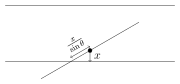
By making the substitution \(y=\cos^{-1}t,\) or otherwise, show that \[ \int_{0}^{1}\cos^{-1}t\,\mathrm{d}t=1. \] A pin of length \(2a\) is thrown onto a floor ruled with parallel lines equally spaced at a distance \(2b\) apart. The distance \(X\) of its centre from the nearest line is a uniformly distributed random variable taking values between \(0\) and \(b\) and the acute angle \(Y\) the pin makes with a direction perpendicular to the line is a uniformly distributed random variable taking values between \(0\) and \(\pi/2\). \(X\) and \(Y\) are independent. If \(X=x\) what is the probability that the pin crosses the line? If \(a < b\) show that the probability that the pin crosses a line for a general throw is \(\dfrac{2a}{\pi b}.\)
Solution: \begin{align*} && I &= \int_0^1 \cos^{-1} t \d t \\ \cos y = t: -\sin y \d y = \d t: &&&= \int_{\frac{\pi}{2}}^0 -y \sin y \d y \\ &&&= \int_0^{\pi/2} y \sin y \d y \\ &&&= \left [-y \cos y \right]_0^{\pi/2} + \int_0^{\pi/2} \cos y \d y \\ &&&= \left [ \sin y \right]_0^{\pi/2} = 1 \end{align*}
1993 Paper 2 Q2
- Evaluate \[ \int_{0}^{2\pi}\cos(mx)\cos(nx)\,\mathrm{d}x, \] where \(m,n\) are integers, taking into account any special cases that arise.
- Find \({\displaystyle \int\sqrt{1+\frac{1}{x}}\,\mathrm{d}x}.\)
1993 Paper 2 Q11
In this question, take the value of \(g\) to be \(10\ \mathrm{ms^{-2}.\)} A body of mass \(m\) kg is dropped vertically into a deep pool of liquid. Once in the liquid, it is subject to gravity, an upward buoyancy force of \(\frac{6}{5}\) times its weight, and a resistive force of \(2mv^{2}\mathrm{N}\) opposite to its direction of travel when it is travelling at speed \(v\) \(\mathrm{ms}^{-1}.\) Show that the body stops sinking less than \(\frac{1}{4}\pi\) seconds after it enters the pool. Suppose now that the body enters the liquid with speed \(1\ \mathrm{ms}^{-1}.\) Show that the body descends to a depth of \(\frac{1}{4}\ln2\) metres and that it returns to the surface with speed \(\frac{1}{\sqrt{2}}\ \mathrm{ms}^{-1},\) at a time \[ \frac{\pi}{8}+\frac{1}{4}\ln\left(\frac{\sqrt{2}+1}{\sqrt{2}-1}\right) \] seconds after entering the pool.
Solution: While descending, the body experiences the force \(-\frac15mg - 2mv^2\). \begin{align*} \text{N2:} && m \dot{v} &= -\frac15 mg - 2mv^2 \\ \Rightarrow && \frac{\dot{v}}{\frac15g + 2v^2} &= -1 \\ \Rightarrow && \frac{1}{2}\tan^{-1} v_1 - \frac{1}{2}\tan^{-1} {v_0} &= -T \end{align*} We care about when \(v_1 = 0\), ie \(\displaystyle T = \frac{1}{2}\tan^{-1} {v_0} < \frac12 \frac{\pi}2 = \frac{\pi}4\) seconds. If the body enters at speed \(1\ \mathrm{ms}^{-1}.\) then for the first part of it's journey it will experience forces \(-\frac15mg - 2mv^2\) and so: \begin{align*} \text{N2:} && m v \frac{\d v}{\d x} &= -\frac15 mg - 2mv^2 \\ \Rightarrow && \int \frac{v}{2(1 + v^2)} \d v &= \int -1 \d x \\ \Rightarrow && \frac14 \ln (1 + v^2) &= -x \end{align*} Therefore the depth is \(\frac14 \ln 2\) metres. When the body is rising, it experiences forces of: \(\frac15mg - 2mv^2\) and so: \begin{align*} \text{N2:} && m v \frac{\d v}{\d x} &= \frac15mg - 2mv^2 \\ \Rightarrow && \int \frac{v}{2(1 - v^2)} \d v &= \int -1 \d x \\ \Rightarrow && -\frac14 \ln (1 - v^2) &= \frac14 \ln 2 \\ \Rightarrow && 1-v^2 &= \frac12 \\ \Rightarrow && v &= \frac{1}{\sqrt{2}} \ \mathrm{ms}^{-1} \end{align*} This will take \begin{align*} \text{N2:} && m \dot{v} &= \frac15mg - 2mv^2 \\ \Rightarrow && \frac{\dot{v}}{2(1-v^2)} &= -1 \\ \Rightarrow && \dot{v} \frac{1}{4}\l \frac{1}{1 - v} + \frac{1}{1+v} \r &= -1 \\ \Rightarrow && \frac{1}{4} \l -\ln(1 - v) + \ln(1 + v)\r &= -T \end{align*} Since \(v = \frac{1}{\sqrt{2}}\) \begin{align*} T &= \frac{1}{4} \ln \l \frac{1+ \frac1{\sqrt{2}}}{1 - \frac1{\sqrt{2}}}\r \\ &= \frac14 \ln \l \frac{\sqrt{2} + 1}{\sqrt{2}-1} \r \end{align*} and therefore the total time will be: \begin{align*} & \frac12 \tan^{-1} 1 + \frac14 \ln \l \frac{\sqrt{2} + 1}{\sqrt{2}-1} \r \\ =& \frac{\pi}{8} + \frac14 \ln \l \frac{\sqrt{2} + 1}{\sqrt{2}-1} \r \end{align*}
1993 Paper 3 Q1
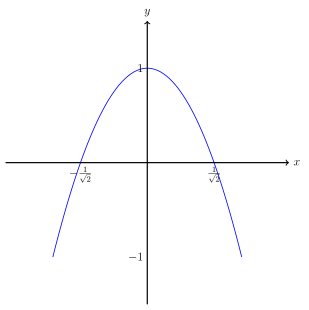
The curve \(P\) has the parametric equations $$ x= \sin\theta, \quad y=\cos2\theta \qquad\hbox{ for }-\pi/2 \le \theta \le \pi/2. $$ Show that \(P\) is part of the parabola \(y=1-2x^2\) and sketch \(P\). Show that the length of \(P\) is \(\surd (17) + {1\over 4} \sinh^{-1}4\). Obtain the volume of the solid enclosed when \(P\) is rotated through \(2\pi\) radians about the line \(y=-1\).
Solution: First notice that \(y = \cos 2 \theta = 1 - 2\sin^2 \theta = 1- 2x^2\), therefore \(P\) is lies on that parabola.
1993 Paper 3 Q2
The curve \(C\) has the equation \(x^3+y^3 = 3xy\).
- Show that there is no point of inflection on \(C\). You may assume that the origin is not a point of inflection.
- The part of \(C\) which lies in the first quadrant is a closed loop touching the axes at the origin. By converting to polar coordinates, or otherwise, evaluate the area of this loop.
1992 Paper 1 Q3
Evaluate
- \({\displaystyle \int_{-\pi}^{\pi}\left|\sin x\right|\,\mathrm{d}x,}\)
- \({\displaystyle \int_{-\pi}^{\pi}\sin\left|x\right|\,\mathrm{d}x},\)
- \({\displaystyle \int_{-\pi}^{\pi}x\sin x\,\mathrm{d}x},\)
- \({\displaystyle \int_{-\pi}^{\pi}x^{10}\sin x\,\mathrm{d}x.}\)
Solution:
- \begin{align*} \int_{-\pi}^\pi |\sin x | \d x &= \int_{-\pi}^{0} - \sin x \d x + \int_0^\pi \sin x \d x \\ &= \left [\cos x \right]_{-\pi}^{0} +[-\cos x]_0^{\pi} \\ &= 1-(-1)+(1)-(-1) \\ &= 4 \end{align*}
- \begin{align*} \int_{-\pi}^\pi \sin | x | \d x &= \int_{-\pi}^0 - \sin x \d x + \int_0^\pi \sin x \d x \\ &= 4 \end{align*}
- \begin{align*} \int_{-\pi}^\pi x \sin x \d x &= \left [ -x \cos x \right]_{-\pi}^\pi + \int_{-\pi}^{\pi} \cos x \d x \\ &= \pi -(-\pi) + \left [\sin x \right]_{-\pi}^\pi \\ &= 2\pi \end{align*}
- \begin{align*} \int_{-\pi}^{\pi} x^{10} \sin x \d x &\underbrace{=}_{x^{10}\sin x \text{ is odd}} 0 \end{align*}
1992 Paper 1 Q8
Explain diagrammatically, or otherwise, why \[ \frac{\mathrm{d}}{\mathrm{d}x}\int_{a}^{x}\mathrm{f}(t)\,\mathrm{d}t=\mathrm{f}(x). \] Show that, if \[ \mathrm{f}(x)=\int_{0}^{x}\mathrm{f}(t)\,\mathrm{d}t+1, \] then \(\mathrm{f}(x)=\mathrm{e}^{x}.\) What is the solution of \[ \mathrm{f}(x)=\int_{0}^{x}\mathrm{f}(t)\,\mathrm{d}t? \] Given that \[ \int_{0}^{x}\mathrm{f}(t)\,\mathrm{d}t=\int_{x}^{1}t^{2}\mathrm{f}(t)\,\mathrm{d}t+x-\frac{x^{5}}{5}+C, \] find \(\mathrm{f}(x)\) and show that \(C=-2/15.\)
1992 Paper 1 Q13
A comet, which may be regarded as a particle of mass \(m\), moving in the sun's gravitational field, at a distance \(x\) from the sun, experiences a force \(Gm/x^{2}\) (where \(G\) is a constant) directly towards the sun. Show that if, at some time, \(x=h\) and the comet is travelling directly away from the sun with speed \(V\), then \(x\) cannot become arbitrarily large unless \(V^{2}\geqslant2G/h\). A comet is initially motionless at a great distance from the sun. If, at some later time, it is at a distance \(h\) from the sun, how long after that will it take to fall into the sun?
Solution: Consider \(E = \frac12 m \dot{x}^2 - \frac{Gm}{x}\), notice that \begin{align*} && \dot{E} &= m \dot{x} \ddot{x} + \frac{Gm}{x^2} \dot{x} \\ &&&= \dot{x} \underbrace{\left (m\ddot{x} + \frac{Gm}{x^2} \right)}_{=0 \text{ by N2}} \end{align*} Therefore \(E\) is conserved. Therefore if \(x \to \infty\) \(\frac12 m V^2 - \frac{Gm}{h} = \frac12 m u^2 - 0 \geq 0\) so \(V^2 \geqslant 2G/h\) Since \(E \approx 0\) we want to solve \begin{align*} && \dot{x} &= -\sqrt{\frac{2G}{x}} \\ \Rightarrow && -\int_h^0 \sqrt{x} \d x &= \int_0^T \sqrt{2G} \d t \\ \Rightarrow && \frac{2h^{3/2}}{3} &= \sqrt{2G}T \\ \Rightarrow && T &= \frac{\sqrt{2}h^{3/2}}{3\sqrt{G}} = \frac13 \sqrt{\frac{2h^3}{G}} \end{align*}
1992 Paper 2 Q3
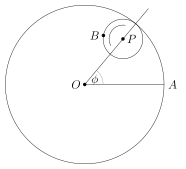
In the figure, the large circle with centre \(O\) has radius \(4\) and the small circle with centre \(P\) has radius \(1\). The small circle rolls around the inside of the larger one. When \(P\) was on the line \(OA\) (before the small circle began to roll), the point \(B\) was in contact with the point \(A\) on the large circle.
1992 Paper 2 Q8
Calculate the following integrals
- \({\displaystyle \int\frac{x}{(x-1)(x^{2}-1)}\,\mathrm{d}x}\);
- \({\displaystyle \int\frac{1}{3\cos x+4\sin x}\,\mathrm{d}x}\);
- \({\displaystyle \int\frac{1}{\sinh x}\,\mathrm{d}x}.\)
Solution:
- \begin{align*} \int\frac{x}{(x-1)(x^{2}-1)}\,\mathrm{d}x &= \int \frac{x}{(x-1)^2 (x+1)} \d x \\ &= \int \frac{1}{2(x-1)^2} + \frac{1}{4(x-1)} - \frac{1}{4(x+1)} \d x \\ &= -\frac12 (x-1)^{-1} + \frac14 \ln(x-1) - \frac14 \ln (x+1) + C \end{align*}
- \begin{align*} \int \frac{1}{3 \cos x + 4 \sin x } \d x &= \int \frac{1}{5 \cos (x - \cos^{-1}(3/5))} \d x \\ &= \frac15 \int \sec (x - \cos^{-1}(3/5)) \d x\\ &= \frac15 \left (\ln | \sec (x - \cos^{-1}(3/5)) + \tan (x - \cos^{-1}(3/5)) | \right) + C \end{align*}
- \begin{align*} \int \frac{1}{\sinh x} \d x &= \int \frac{2}{e^x - e^{-x}} \\ &= \int \frac{2e^x}{e^{2x}-1} \d x \\ &=\int \frac{e^x}{e^x-1} - \frac{e^x}{e^x+1} \d x \\ &= \ln (e^x - 1) + \ln (e^x+1) + C \end{align*}