1993 Paper 1 Q16
Year: 1993
Paper: 1
Question Number: 16
Course: LFM Stats And Pure
Section: Geometric Probability
Difficulty: 1516.0
Banger: 1531.3
geometric probability
integration
substitution
Buffon's needle
inverse trigonometric functions
conditional probability
uniform distribution
Problem
By making the substitution \(y=\cos^{-1}t,\) or otherwise, show that
\[
\int_{0}^{1}\cos^{-1}t\,\mathrm{d}t=1.
\]
A pin of length \(2a\) is thrown onto a floor ruled with parallel lines equally spaced at a distance \(2b\) apart. The distance \(X\) of its centre from the nearest line is a uniformly distributed random variable taking values between \(0\) and \(b\) and the acute angle \(Y\) the pin makes with a direction perpendicular to the line is a uniformly distributed random variable taking values between \(0\) and \(\pi/2\). \(X\) and \(Y\) are independent. If \(X=x\) what is the probability that the pin crosses the line?
If \(a < b\) show that the probability that the pin crosses a line for a general throw is \(\dfrac{2a}{\pi b}.\)
Solution
\begin{align*}
&& I &= \int_0^1 \cos^{-1} t \d t \\
\cos y = t: -\sin y \d y = \d t: &&&= \int_{\frac{\pi}{2}}^0 -y \sin y \d y \\
&&&= \int_0^{\pi/2} y \sin y \d y \\
&&&= \left [-y \cos y \right]_0^{\pi/2} + \int_0^{\pi/2} \cos y \d y \\
&&&= \left [ \sin y \right]_0^{\pi/2} = 1
\end{align*}
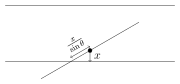 If \(X = x\) then the rod will cross the line if \(\frac{x}{\sin \theta} < a\) or \(\frac{2b-x}{\sin \theta} < a\), ie \(a\sin \theta > \max (x, 2b-x)\).
Therefore the probability is \(\frac{2\sin^{-1} \left (\max(\frac{x}{a}, \frac{2b-x}{a}) \right)}{\pi}\).
Therefore the probability the pin crosses a line is:
\begin{align*}
\mathbb{P} &= \frac{1}{2b}\int_{x=0}^{x=2b} \frac{2\sin^{-1} \left (\max(\frac{x}{a}, \frac{2b-x}{a}) \right)}{\pi} \d x \\
&= \frac{2a}{b\pi}
\end{align*}
If \(X = x\) then the rod will cross the line if \(\frac{x}{\sin \theta} < a\) or \(\frac{2b-x}{\sin \theta} < a\), ie \(a\sin \theta > \max (x, 2b-x)\).
Therefore the probability is \(\frac{2\sin^{-1} \left (\max(\frac{x}{a}, \frac{2b-x}{a}) \right)}{\pi}\).
Therefore the probability the pin crosses a line is:
\begin{align*}
\mathbb{P} &= \frac{1}{2b}\int_{x=0}^{x=2b} \frac{2\sin^{-1} \left (\max(\frac{x}{a}, \frac{2b-x}{a}) \right)}{\pi} \d x \\
&= \frac{2a}{b\pi}
\end{align*}
Rating Information
Difficulty Rating: 1516.0
Difficulty Comparisons: 1
Banger Rating: 1531.3
Banger Comparisons: 2
Show LaTeX source
Problem source
By making the substitution $y=\cos^{-1}t,$ or otherwise, show that
\[
\int_{0}^{1}\cos^{-1}t\,\mathrm{d}t=1.
\]
A pin of length $2a$ is thrown onto a floor ruled with parallel lines equally spaced at a distance $2b$ apart. The distance $X$ of its centre from the nearest line is a uniformly distributed random variable taking values between $0$ and $b$ and the acute angle $Y$ the pin makes with a direction perpendicular to the line is a uniformly distributed random variable taking values between $0$ and $\pi/2$. $X$ and $Y$ are independent. If $X=x$ what is the probability that the pin crosses the line?
If $a < b$ show that the probability that the pin crosses a line for a general throw is $\dfrac{2a}{\pi b}.$
Solution source
\begin{align*}
&& I &= \int_0^1 \cos^{-1} t \d t \\
\cos y = t: -\sin y \d y = \d t: &&&= \int_{\frac{\pi}{2}}^0 -y \sin y \d y \\
&&&= \int_0^{\pi/2} y \sin y \d y \\
&&&= \left [-y \cos y  \right]_0^{\pi/2} + \int_0^{\pi/2} \cos y \d y \\
&&&= \left [ \sin y \right]_0^{\pi/2} = 1
\end{align*}


\begin{center}
    \begin{tikzpicture}[scale=2]
        \draw (-1.5,1) -- (1.5,1);
        \draw (-1.5,2) -- (1.5,2);

        \filldraw (0, 1.2) circle (1pt);
        \def\t{30};
        \draw ({-cos(\t)}, {1.2 -sin(\t)}) --  ({cos(\t)}, {1.2 +sin(\t)});

        \draw[<->] (0,1) -- (0,1.2) node[pos=0.5,right] {$x$};
        \draw[<->] (0,{1.2+0.075}) -- ({-0.2/tan(\t)},{1+0.075}) node[pos=0.5, above, sloped] {$\frac{x}{\sin \theta}$};
    \end{tikzpicture}
\end{center}

If $X = x$ then the rod will cross the line if $\frac{x}{\sin \theta} < a$ or $\frac{2b-x}{\sin \theta} < a$, ie $a\sin \theta > \max (x, 2b-x)$.

Therefore the probability is $\frac{2\sin^{-1} \left (\max(\frac{x}{a}, \frac{2b-x}{a}) \right)}{\pi}$.

Therefore the probability the pin crosses a line is:

\begin{align*}
\mathbb{P} &= \frac{1}{2b}\int_{x=0}^{x=2b} \frac{2\sin^{-1} \left (\max(\frac{x}{a}, \frac{2b-x}{a}) \right)}{\pi} \d x \\
&= \frac{2a}{b\pi}
\end{align*}